Australia’s 2021 Census counted 19,686 people who reported Albanian ancestry. More than half were born in Australia. Their stories connect the early farming communities of Shepparton and north Queensland with Melbourne and cities across the country. The later population estimates below are editorial scenarios based on stated assumptions, not new official counts.
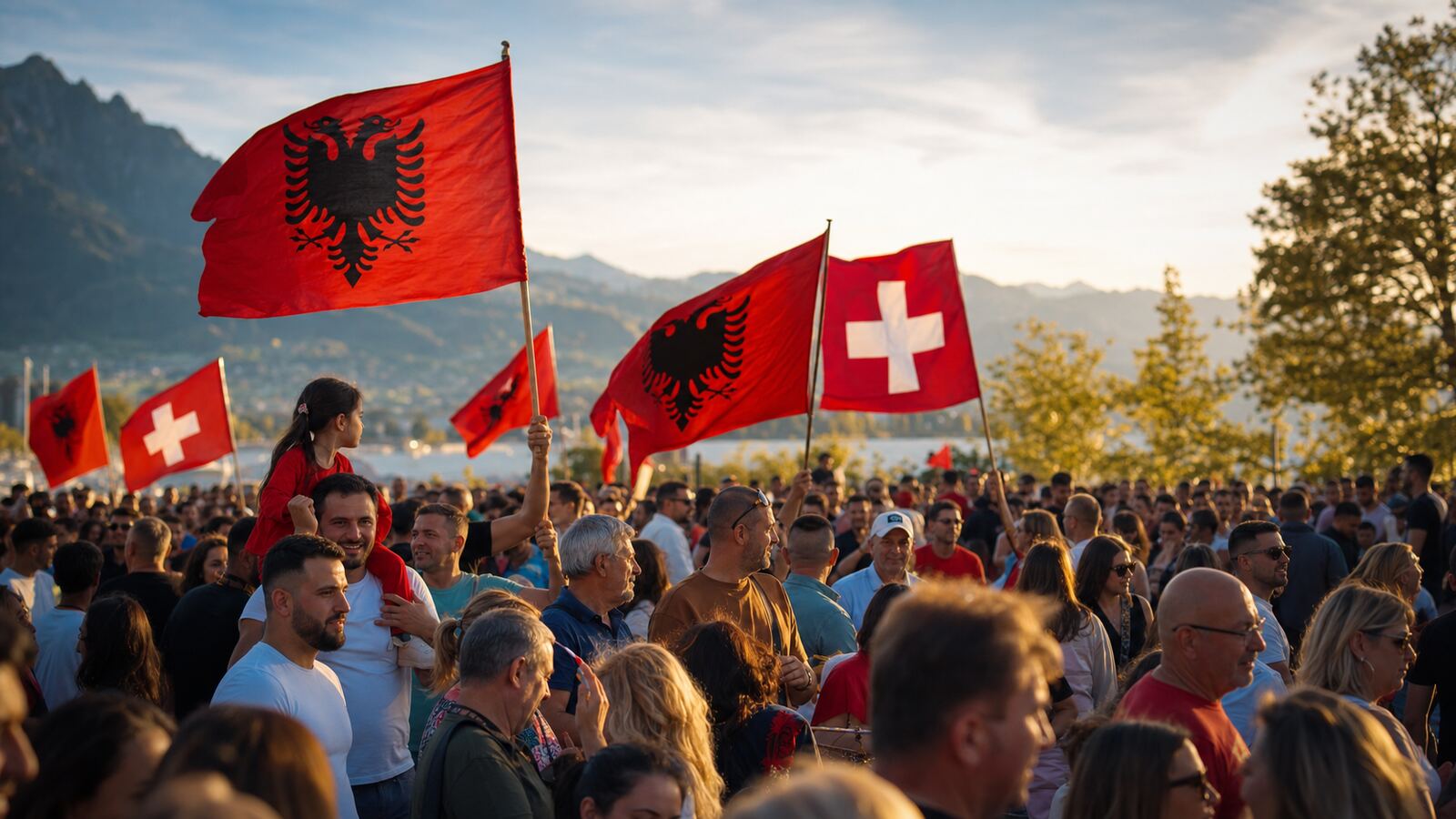
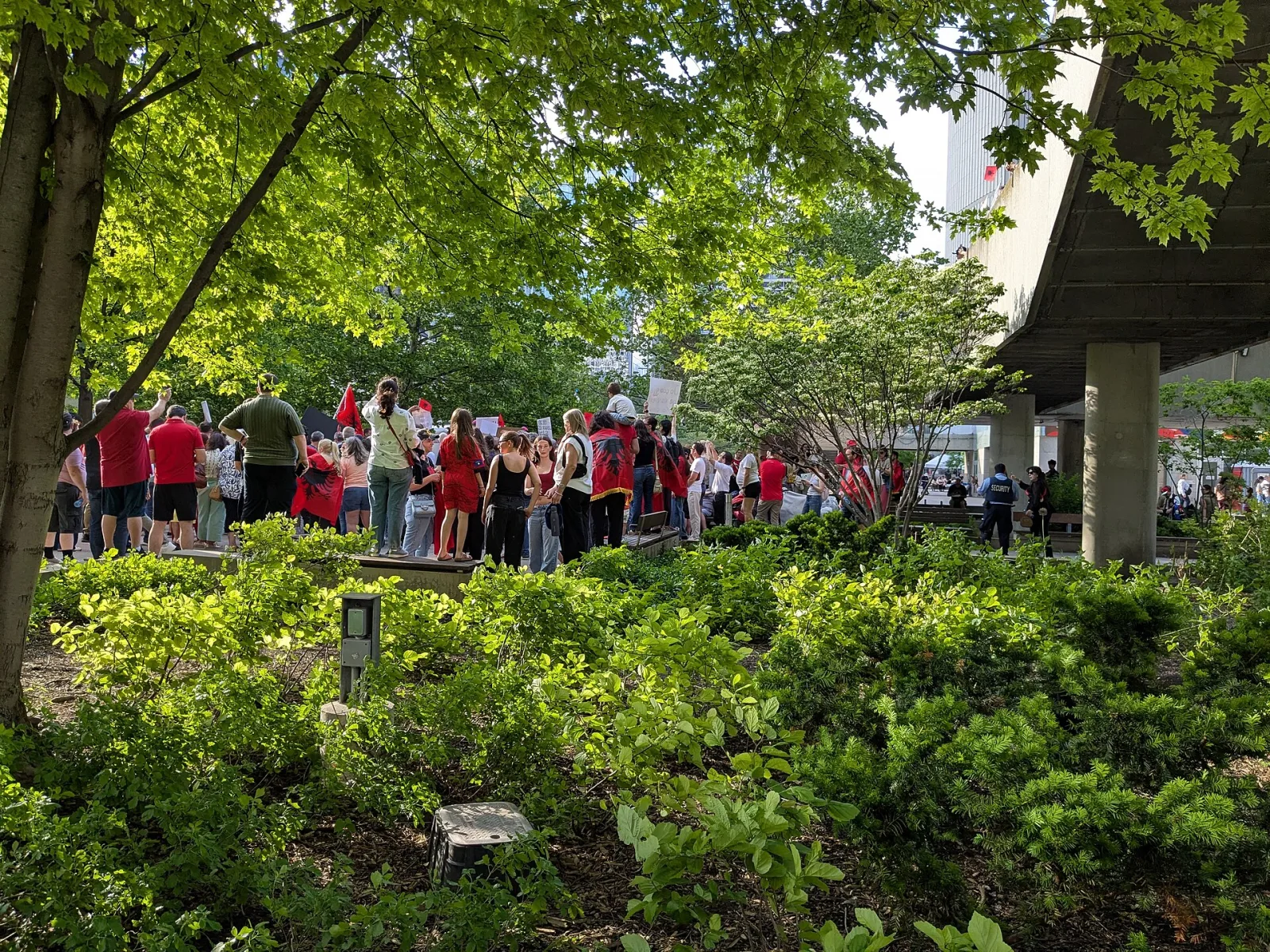
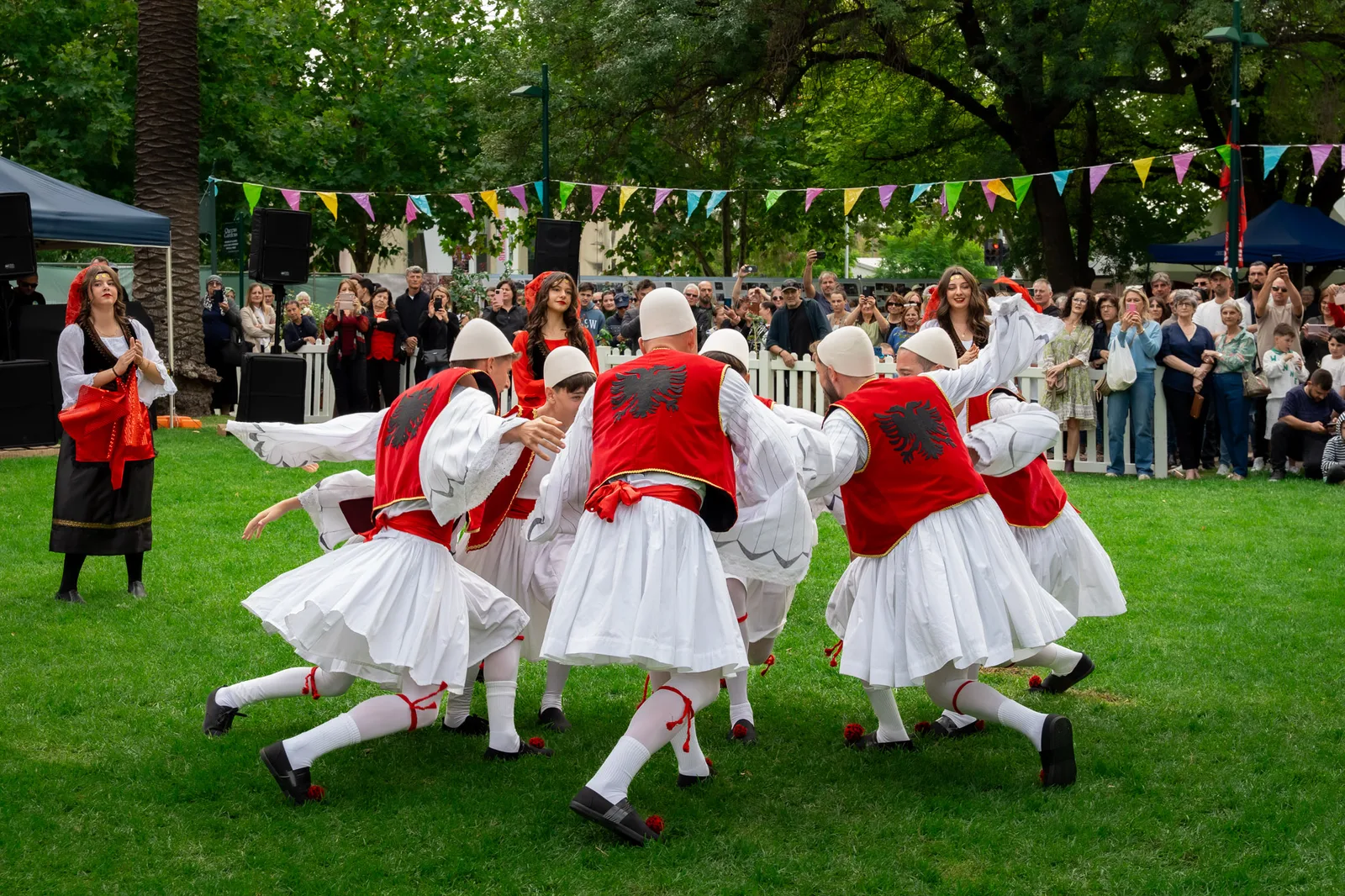
In April 2025, dancers performed a valle at Shepparton’s Albanian Harvest Festival. It is one glimpse of a community built across generations: families who settled a century ago, people who arrived more recently, and children for whom Australia has always been home. Victoria is its largest centre, but the story reaches much further.
How many Albanians live in Australia?
At the 2021 Census, 19,686 people in Australia reported Albanian ancestry. That is the best single number, and it is the one to use. The ABS counts ancestry as up to two responses per person, but because nobody can nominate the same ancestry twice, for a single category like Albanian the response count and the person count are the same thing. Two caveats travel with it: the ABS applies small random adjustments to every cell to protect confidentiality, and it codes only the first two ancestries a person writes down.
For more on this topic, read Albanians in Switzerland and Albanians in Turkey.
It is also, by some distance, the largest of the three measures the census offers. Only 10,851 people said they use Albanian at home, and only 5,109 were born in Albania (3,633) or Kosovo (1,476). Ancestry is 5.4 times the Albania-born count and 1.8 times the number of Albanian speakers. A reader who reaches for the birthplace column — the one most news stories use — will understate this community by roughly three quarters.
The community grew fast between censuses: Albanian ancestry rose from 15,907 in 2016 to 19,686 in 2021, an increase of 3,779 people or 23.8 per cent in five years.

Three questions, three different answers
The three measures answer three different questions. Ancestry asks what you consider yourself to be, and it captures the Australian-born grandchildren of the 1920s cane cutters as well as Albanians who arrived last year from anywhere in the world. Language asks what you actually speak at home, so it drops the third generation and anyone who has switched to English. Country of birth asks only where you were born, so it misses every Australian-born Albanian and every Albanian born in North Macedonia, Montenegro, Kosovo before 2008, or Greece.
The size of the ancestry-versus-birthplace gap is the clearest evidence that this is now a settled community rather than a migrant one: 11,409 of the 19,686 — 58 per cent — were born in Australia, and 8,132 overseas.
From the census floor to a realistic figure
| Measure | Value |
|---|---|
| Reported Albanian ancestry, 2021 Census | 19,686 |
| Used Albanian at home, 2021 Census | 10,851 |
| Born in Albania or Kosovo, 2021 Census | 5,109 |
| Adjusted for the 6.2% who stated no ancestry | ≈ 21,000 |
| = Realistic community today | 22,000–24,000 |
| Ceiling reachable from measured ABS inputs | ≈ 26,000 |
The floor is a count; everything above it is arithmetic we are showing rather than asserting. The non-response step assumes the 1,584,164 people who gave no ancestry in 2021 included Albanians at the same rate as everyone else. The central range carries that forward five years, on the low path at the rate the Albania- and Kosovo-born population actually grew between 2021 and 2025 (4.35 per cent), and on the high path at the 23.8 per cent the ancestry count grew between 2016 and 2021. The ceiling compounds both assumptions and should never be quoted as an estimate. The /albanians/ hub previously carried "20–30k" for Australia; nothing we could source reaches 30,000, and we have changed it to 20–26k.
Where in Australia do Albanians live?
Albanian Australia is overwhelmingly Victorian, and within Victoria it is concentrated in Melbourne's west and south-east and in one country town. The map below shades every Statistical Area Level 4 by the share of residents reporting Albanian ancestry.
One caveat matters before any of these figures are read. The ABS has not published Albanian ancestry below state level for 2021 outside its login-only TableBuilder. The 2021 DataPack ancestry table carries 30 named ancestries — Croatian, Macedonian and Serbian are among them, Albanian is not. So the fine-grained geography here is 2016, the last census cycle for which the ABS published the full classification down to suburb, supplemented by 2021 QuickStats, which prints an area's top responses and therefore shows Albanian only where the community is dense enough to enter that list.

State by state
Victoria holds 12,853 of the 19,686 — 65.3 per cent of all Albanian Australians. New South Wales is a distant second on 2,323, then Queensland on 1,702, South Australia on 1,348 and Western Australia on 1,166. Tasmania has 101, the ACT 153 and the Northern Territory 33.
That concentration is not an accident of recent migration. It was set in the 1930s, when men who had come for the north Queensland cane and tobacco moved south to the Goulburn Valley orchards, and it has held for ninety years.

| State or territory | Albanian ancestry | Share | Speaks Albanian at home |
|---|---|---|---|
| Victoria | 12,853 | 65.3% | 7,894 |
| New South Wales | 2,323 | 11.8% | 988 |
| Queensland | 1,702 | 8.6% | 601 |
| South Australia | 1,348 | 6.8% | 767 |
| Western Australia | 1,166 | 5.9% | 486 |
| ACT | 153 | 0.8% | 85 |
| Tasmania | 101 | 0.5% | 11 |
| Northern Territory | 33 | 0.2% | 16 |
| Australia | 19,686 | 100.0% | 10,851 |
Source: ABS, Census of Population and Housing: Cultural diversity data summary, 2021.
Melbourne holds six in ten
Greater Melbourne alone accounts for 11,530 people of Albanian ancestry. At the 2016 Census — the last with published suburb-level data — the two most Albanian local government areas in Australia were Greater Dandenong, with 1,769 people, and Greater Shepparton, with 769. Brimbank (1,155), Whittlesea (933), Casey (843), Wyndham (749) and Melton (725) follow, tracing Melbourne's western and south-eastern growth corridors.

| Area | Albanian ancestry | Share | Albania | Kosovo |
|---|---|---|---|---|
| Greater Dandenong | 1,769 | 1.16% | 125 | 90 |
| Brimbank | 1,155 | 0.59% | 168 | 109 |
| Whittlesea | 933 | 0.47% | 278 | 29 |
| Casey | 843 | 0.28% | 85 | 48 |
| Greater Shepparton | 769 | 1.21% | 264 | 0 |
| Wyndham | 749 | 0.34% | 117 | 78 |
| Melton | 725 | 0.54% | 121 | 79 |
| Brisbane | 505 | 0.04% | 130 | 31 |
| Darebin | 386 | 0.26% | 66 | 7 |
| Hobsons Bay | 367 | 0.41% | 24 | 28 |
| Manningham | 330 | 0.28% | 44 | 13 |
| Hume | 240 | 0.12% | 48 | 14 |
Source: ABS, Census 2016 (ABS_C16_T05_LGA, ABS_C16_T06_LGA).
The suburbs where Albanian is everywhere
Count by share rather than by headcount and the ranking flips: Greater Shepparton, at 1.21 per cent of its population, edges Greater Dandenong's 1.16 per cent, and both are more than twenty times the national rate.
Go finer still and the concentration becomes remarkable. In the Dandenong – South statistical area at the 2021 Census, 1,579 people reported Albanian ancestry — 16.9 per cent of residents, making Albanian the single largest ancestry in the area, ahead of English on 11.0 per cent. In the suburb of Dandenong itself, 1,510 people speak Albanian at home, five per cent of the population.

| Area | Population | Albanian ancestry | Share | Speaks Albanian at home |
|---|---|---|---|---|
| Dandenong - South | 9,350 | 1,579 | 16.9% | 1,400 |
| Dandenong | 30,127 | – | – | 1,510 |
| Shepparton - North | 19,928 | – | – | 268 |
| Cringila | 2,156 | – | – | 40 |
| Shepparton North | 2,048 | – | – | 33 |
| Grahamvale | 685 | – | – | 22 |
| Shepparton East | 1,192 | – | – | 21 |
| Deanside | 654 | – | – | 17 |
| Port Macquarie Surrounds | 5,301 | – | – | 12 |
| Pearcedale | 3,867 | – | – | 10 |
| Arriga | 1,323 | 10 | 0.8% | – |
| Croydon (SA) | 1,220 | – | – | 10 |
Source: ABS, 2021 Census QuickStats.
Shepparton, Mareeba and the country towns
Outside Melbourne the pattern is small, old and rural. In the Shepparton – North statistical area, Albania was the fifth most common country of birth in 2021 and Albanian the third most-spoken language other than English. Around Shepparton the Albanian-speaking villages show up one by one in the census — Grahamvale, Lemnos, Shepparton East, Kialla West — the fruit blocks Albanian families bought from the 1940s.
In Queensland the Albanian place is not Cairns but Mareeba, on the Atherton Tablelands: 0.64 per cent of the shire in 2016 against 0.05 per cent in Cairns. We crawled all 18,747 statistical areas, council areas and suburbs in Australia for the 2021 Census, and exactly one place in Queensland still has Albanian among its five most-reported ancestries — Arriga, a farming locality of 1,323 people west of Mareeba, where ten people gave it. That is what is left of the tobacco country.
And the top local government area in New South Wales is one almost no account of this community mentions: Wollongong, where the steelworks suburb of Cringila has 40 Albanian speakers, 1.9 per cent of residents and the highest Albanian-language share of any suburb outside Victoria.
When your community is an hour — or a flight — away
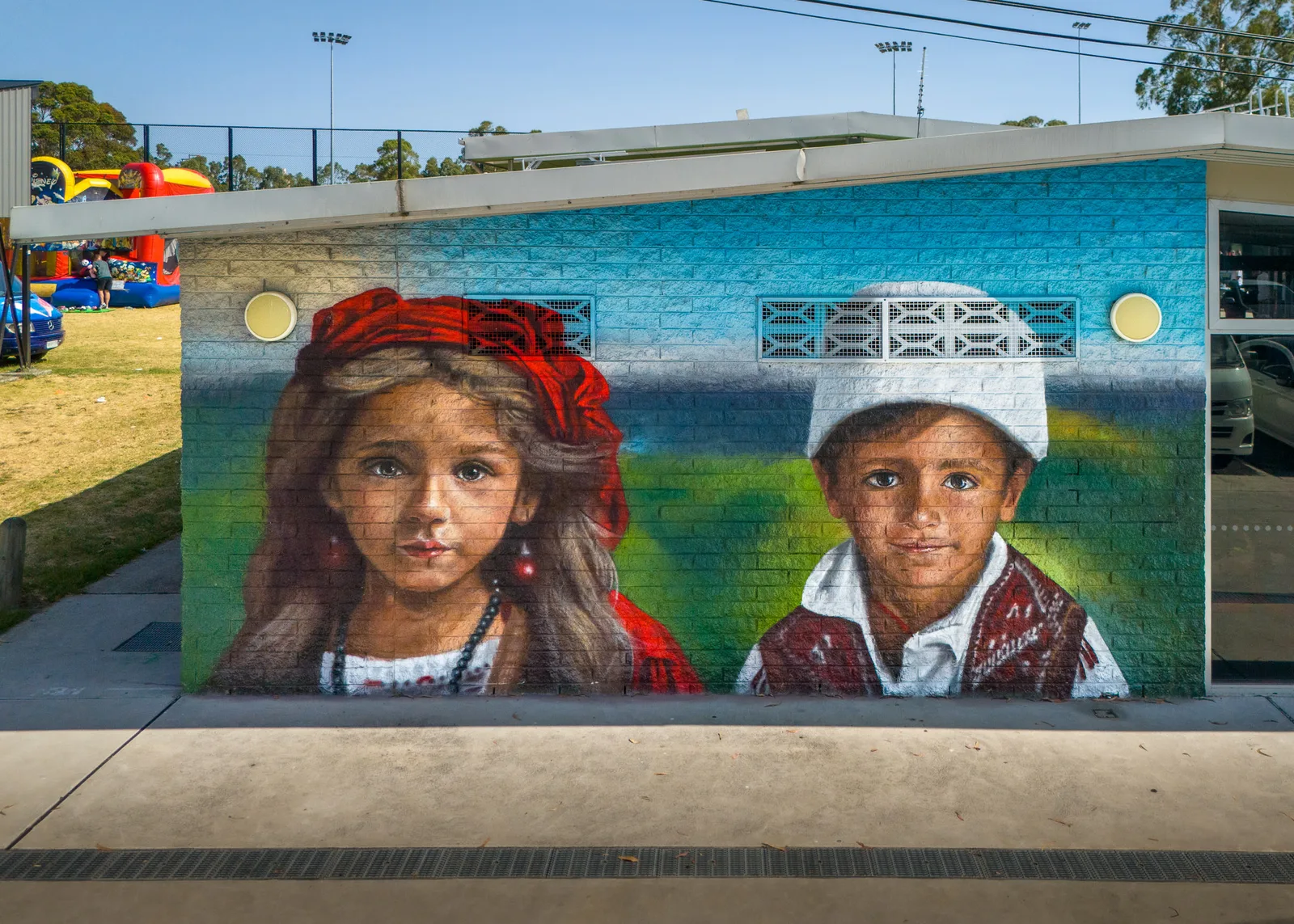
A school, a football club or a family celebration can bring people together. In Australia, distance also shapes who gets to meet. Living near Melbourne’s Albanian institutions is a different experience from having relatives in another state or a long drive between community events.
dua.com offers another way to start a conversation alongside those everyday meeting places. You can explore nearby or use Fly to choose another city. It is a way to reach beyond your usual circle, whether your next conversation stays in Australia or connects with the wider diaspora.
The cane cutters and market gardeners: Albania's first Australians
Australia's Albanian settlement begins in the 1920s, and for its first decade it was almost entirely male, almost entirely Muslim, and almost entirely from one district of southern Albania: Korçë. They were not the first Albanians here — Naum Konxha had settled in Brisbane with his English wife in 1885 — but they are the beginning of the community that exists today. The Shepparton society's Kurbet exhibition, made with the Immigration Museum, names five men from the Korçë region who came ashore at Fremantle in 1924: Bektash Muharem, Bejxhet Emini, Rexhep Mustafa, Musa Ibrahimi and Riza Ali.
The 1933 Census was the first to name Albania as a birthplace at all. It counted 770 Albania-born people in Australia — 766 men and four women. Of those 766 men, 626 — 81.7 per cent — lived in rural divisions, against 95 in the capital cities and 45 in provincial towns. And 734 of them, 95.8 per cent, had been in the country less than ten years: 209 for under five years and 525 for five to nine. This was a population that had arrived, essentially in its entirety, in the second half of the 1920s.
The state split contradicts the standard account, which names Queensland and Victoria and stops. In 1933 it was Queensland 267, Victoria 251 and Western Australia 194, with 35 in New South Wales and 23 in South Australia. Western Australia was the third centre of Albanian Australia and has been written out of most versions of the story.

Why Korçë, and why kurbet
The reason it was Korçë, and the reason it was men, is a single Albanian word: kurbet — going abroad to work, sending money home, and intending to return. Kurbet was a household economy, not an emigration. A man left, a wife and often a newborn stayed, and the money came back. Some of those men were separated from their families for twenty years; some never returned at all.
You can watch kurbet end in the census. Women were 0.5 per cent of the Albania-born in 1933 and 39.1 per cent by 1996. The intention to go home dissolved somewhere in between — for many of them, in the war.

Cane, tobacco and the north Queensland years
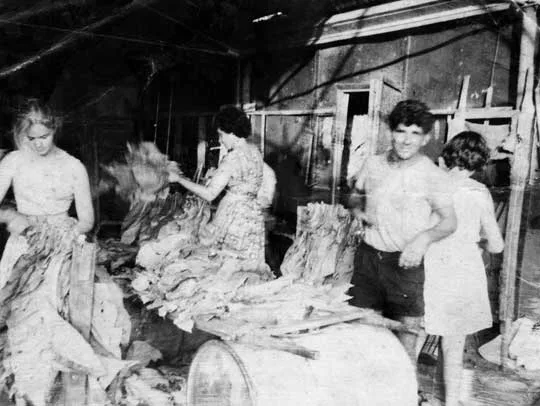
The work was seasonal and it was in the tropics. Albanians cut sugar cane in the north Queensland districts and grew tobacco on the Atherton Tablelands, around Mareeba, Dimbulah and Emerald Creek. Naturalisation notices placed in Queensland and Victorian newspapers between 1936 and 1944 give the roster and the villages: Xhemal Isuf, born at Plovesht, resident ten years, near Mareeba; Veis Ismail, born at Damjaneki, resident eleven years, at Mareeba.
The north Queensland community did not last. The historian J. C. Carne, writing in 1984, put it plainly:
By 1941 only 224 Albanians, Moslem and Christian alike, lived north of Ingham: in 1976 only 98 adults of Moslem Albanian origin were living in the district of Mareeba, the main centre of concentration.
J. C. Carne, “Moslem Albanians in North Queensland”, University of North Queensland, 1984
The move south to the orchards
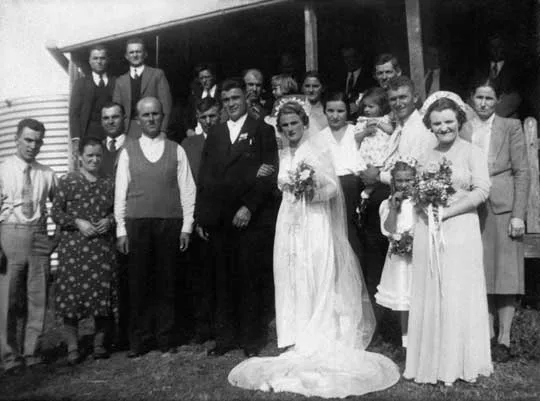
What replaced it was Victoria. Through the 1930s and 1940s Albanian men moved south into the fruit country of the Goulburn Valley around Shepparton, and into market gardening around Melbourne, and this time they bought land and brought out wives. The Depression pushed some of them: the Kurbet exhibition records Sabri Sali, who came from Albania in 1928 leaving a wife and a six-week-old son behind, worked two years as a farm labourer in Western Australia, and moved on when the Depression made work impossible.
The war then cut both ways. Some Albanian men, particularly in northern Queensland, were interned as "enemy aliens" in the early 1940s and put to work on road construction and farms. Others enlisted — and war service opened a path to naturalisation that the 1930s had closed.
How Albanians got in under the White Australia Policy
All of this happened under the Immigration Restriction Act 1901 — the White Australia Policy. Albanians were classed as European "white aliens", which meant they were not excluded outright the way non-Europeans were. It also meant the state had a set of levers for keeping their numbers down, and used all of them.
The dictation test
The sharpest was the dictation test: an officer could require any arriving passenger to write fifty words in any European language of the officer's choosing, and failure made you a prohibited immigrant. It was never a literacy test; it was a discretionary power to refuse anyone. On 24 February 1925 twenty-five Albanians — "the last of a stranded group" — were put back on a French mail steamer at Fremantle and sent home at the shipping company's expense, the company being liable precisely because the men had been declared prohibited immigrants after failing the test.
Landing money and the visa limits
The second lever was money. In March 1925 the Commonwealth instructed the states that alien immigrants were to be refused admission unless each adult held landing money — a minimum of £10, to be raised to £40 — or a written guarantee from someone already here. In the mid-1920s £40 was months of a labourer's wages.
The third was the visa itself, and it worked at one remove. Australia had no quota machinery of its own; as Prime Minister Stanley Bruce told the press in August 1927, "Australia had not the machinery to carry out the quota system". Instead British consular authorities, at the Commonwealth's request, limited visas for Australia to 100 a month for each of Greeks, Yugoslavs and Albanians. In July 1928 the Home and Territories Department recorded an agreement with the British authorities cutting that to 50 a month.
A fourth lever was industrial rather than governmental. In June 1930 the Australian Workers' Union and the sugar employers made an unregistered "Gentlemen's Agreement" covering cane cutters — not field workers, not mill hands — under which districts where more than 75 per cent of the labour employed was foreign were to reduce it towards 25 per cent. For men whose entire Australian livelihood was cutting cane, that was the door closing.
The mosques Albanians built in Australia
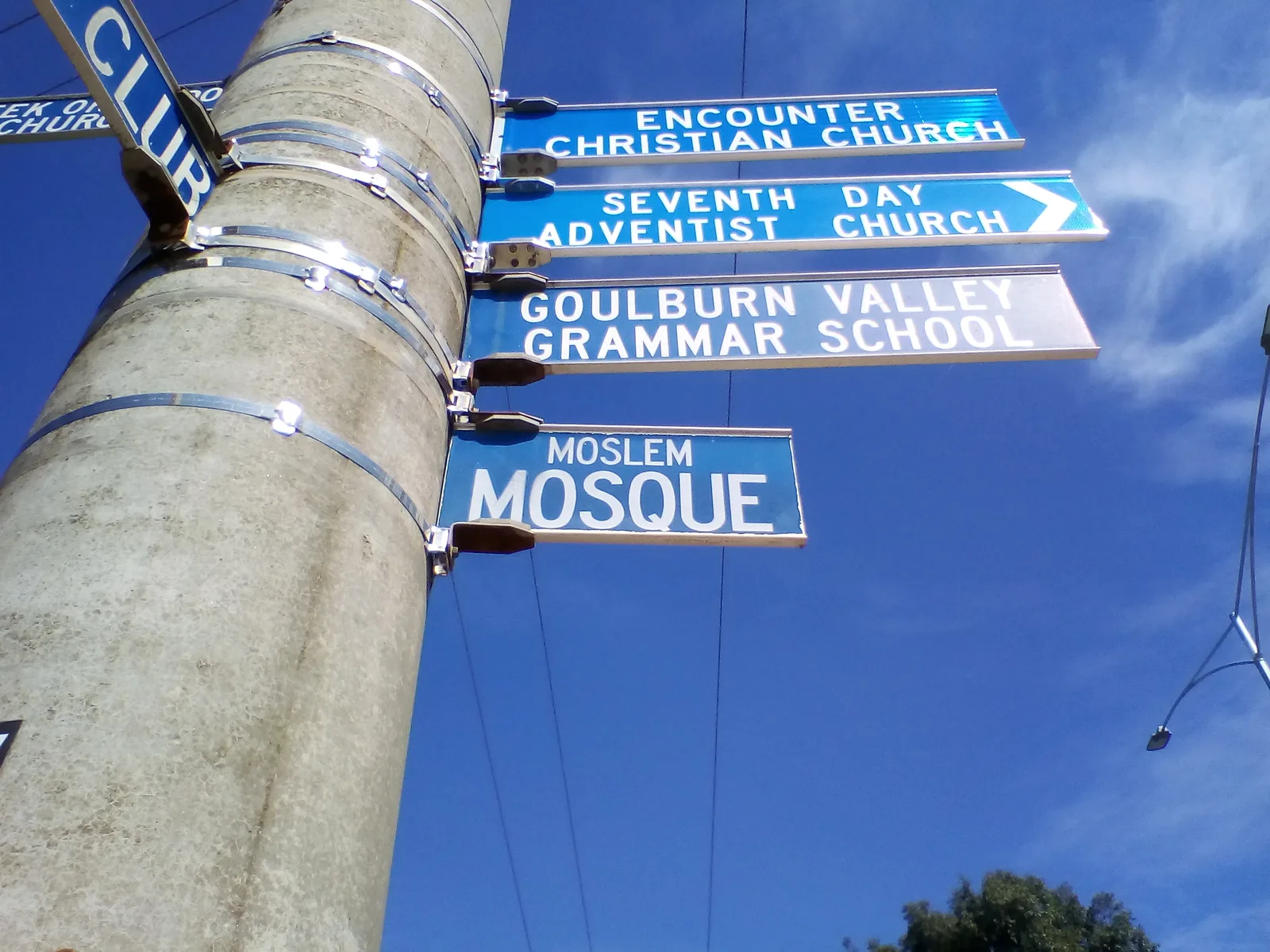
The most durable thing the 1920s generation built is architectural. Albanian Muslims from Korçë put up three mosques in Victoria and one in far north Queensland, and two of them are heritage-protected.
One myth needs clearing away first. They were not the earliest mosques built in this country. Afghan cameleers had been building them for seventy years: at Marree in South Australia in the 1860s or 1880s, in Adelaide's Little Gilbert Street — plans approved in 1887, erected in 1888–89 and financed, as the City of Adelaide's heritage sheet records, by the life savings of Afghan camel traders — in Perth from 1905–06, and at Holland Park in Brisbane, where the land was bought in 1909. What the Albanians built was the first mosque anywhere in Australia raised by an Albanian community, and, at Shepparton, the earliest purpose-built mosque still standing in Victoria.
Shepparton, 1956–1960
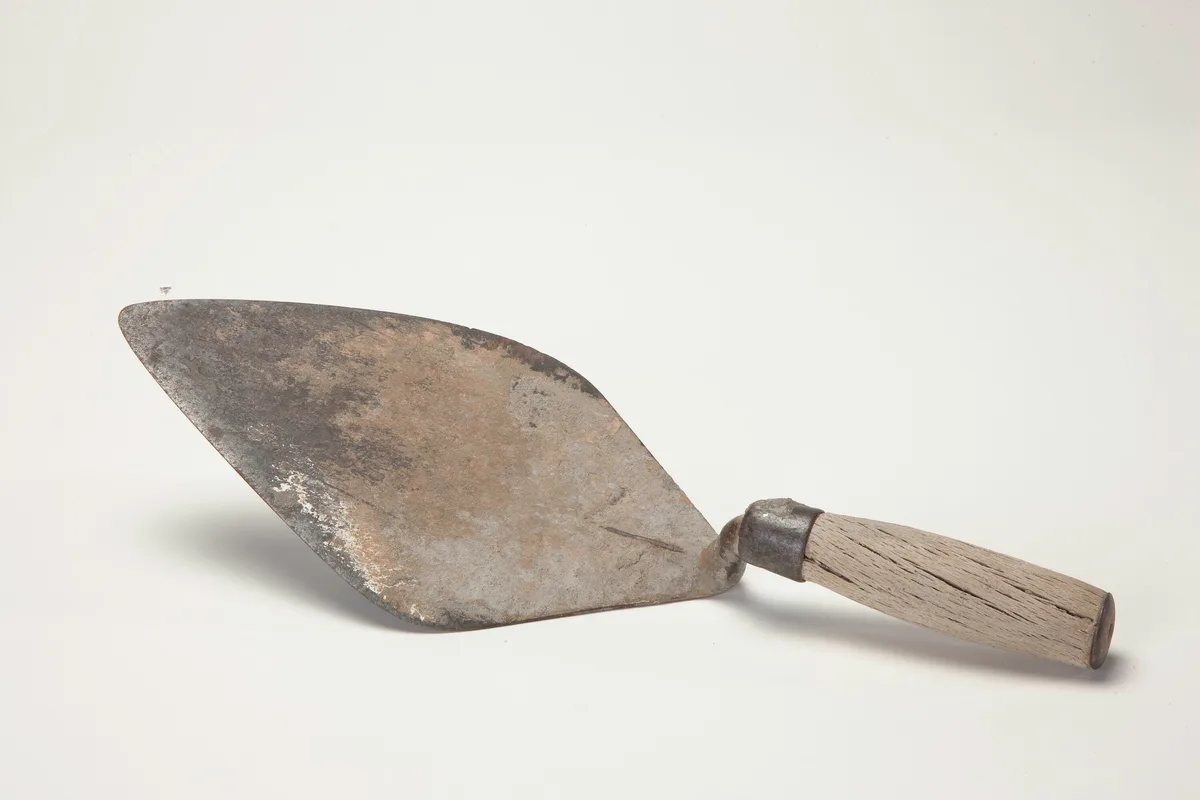
The Goulburn Valley community formed the Shepparton Albanian Moslem Society in the mid-1950s and decided to build. Heritage Victoria's citation and the society's own website both say 1955; academic fieldwork in the community — Sharon Ahmeti's 2017 doctoral thesis and a 2015 La Trobe study of Shepparton — says 1953. What is not in dispute is that the society existed before the foundation stone went down. That stone was laid in 1956 by Myrteza Adem and R. Sherif Islam, and the trowel they used is in the Museums Victoria collection. The building was finished in 1960, and Heritage Victoria records that the consecration "was attended by several dignitaries, including the Ambassador of Indonesia".
Heritage Victoria added the mosque at 8 Acacia Street to the Victorian Heritage Register as H2425 on 13 October 2022. Its citation is careful about the claim, and so are we: this is "the earliest surviving purpose-built mosque in Victoria", a state-level superlative, not a national one.
The building is still managed by the Albanian society that built it, and was extended northwards in 2002 for a growing congregation. But the people praying in it have changed: Heritage Victoria's citation estimates that around 70 per cent of those now at Friday prayers come from more recent migrant communities rather than the Albanian one. At the 2021 Census, 4,350 people in Greater Shepparton reported Islam — 6.4 per cent of the district.
The Albanian Mosque, Shepparton, is architecturally significant as the earliest surviving purpose-built mosque in Victoria.
Heritage Victoria, Victorian Heritage Register citation H2425, registered 13 October 2022
Carlton North, 1970
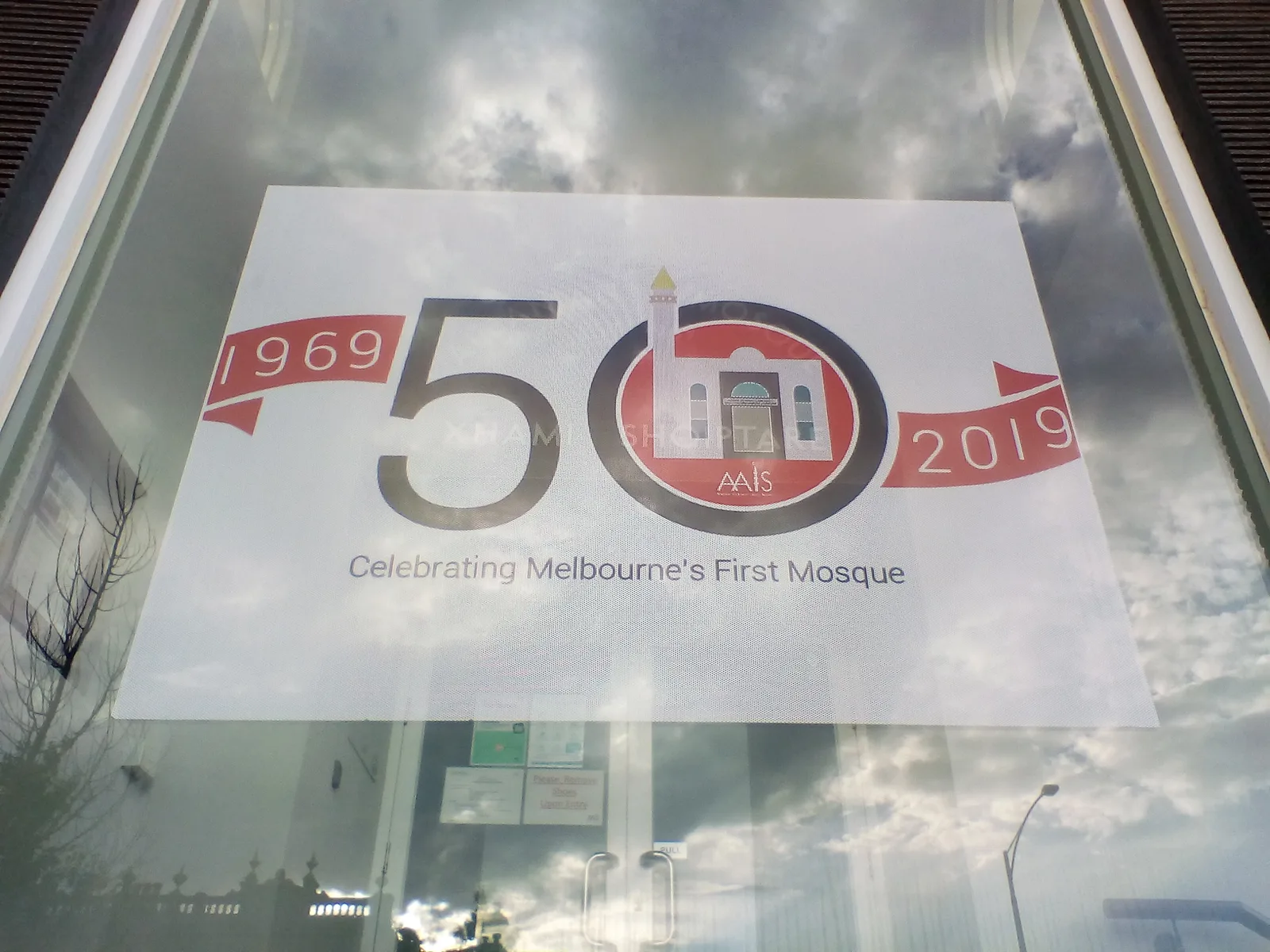
Melbourne's Albanian mosque came later. The Albanian Australian Islamic Society was formed in 1963 by Albanian Muslims from Albania, Kosovo, North Macedonia and Montenegro, and has been a company limited by guarantee since 1 November that year. Its mosque in Carlton North was planned from 1967 and completed in 1970.
It is worth correcting a widely repeated error here: the Carlton North mosque is not on the Victorian Heritage Register. The building at 765–769 Drummond Street is held by the Victorian Heritage Database under the City of Yarra as an individually significant place within heritage overlay HO326. The only Albanian mosque with a VHR number is Shepparton's. A third Albanian mosque followed at Dandenong in 1985, and a fourth at Reservoir.
Mareeba, Anzac Day 1970
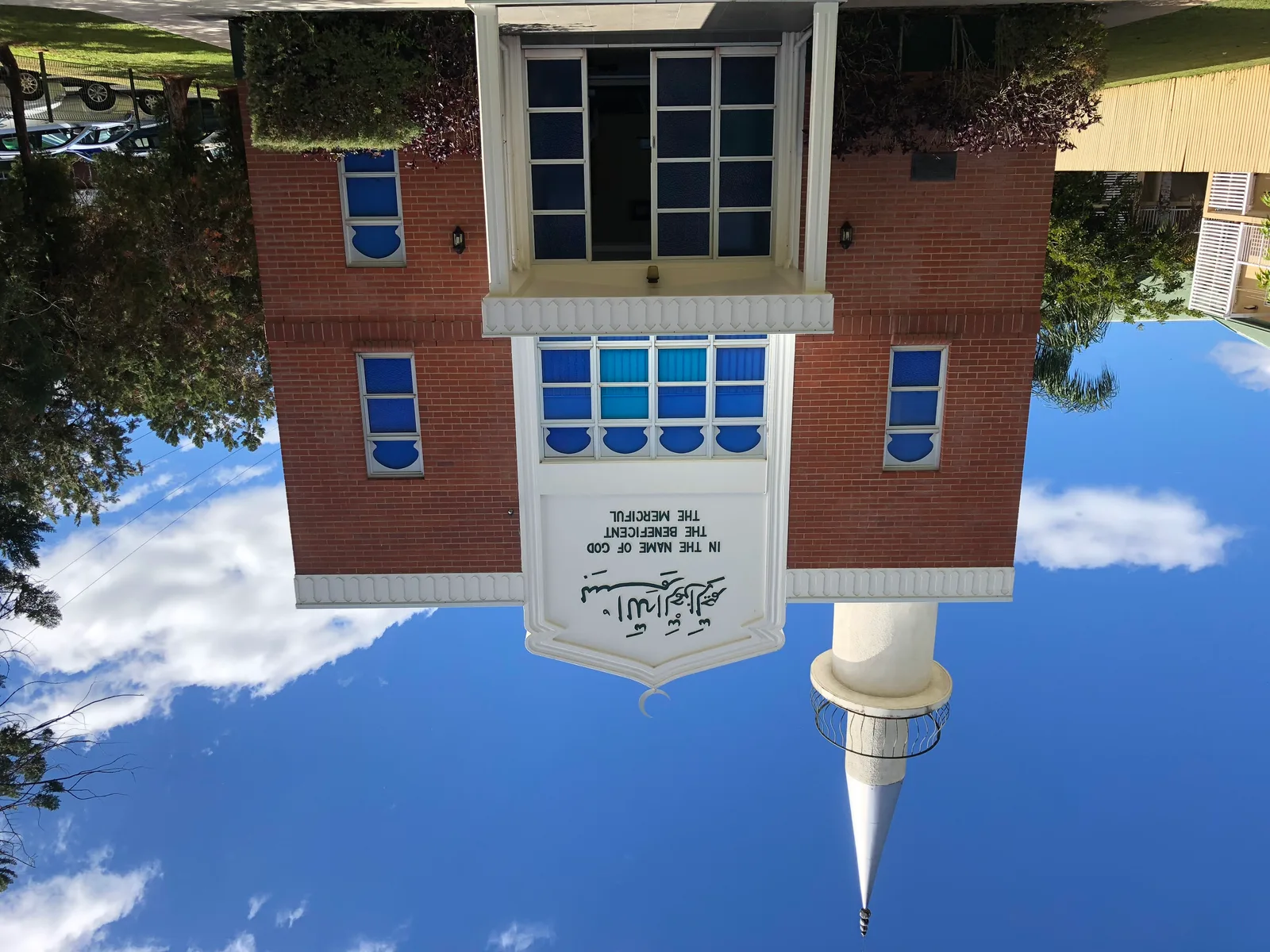
In far north Queensland, the Albanian tobacco farmers of the Tablelands built the Mareeba and District Memorial Mosque on Walsh Street. It was dedicated on Anzac Day 1970 and, in J. C. Carne's account, "was opened by the Shire Chairman on Anzac Day and dedicated to Australia's fallen servicemen"; the plaque by the door records that it was erected by the Albanian Australian Moslem Society. Mareeba Shire Council's own heritage citation calls it "the first and only mosque in the town and one of only a small number of mosques in Queensland".
It is a local heritage place under the Mareeba Shire planning scheme, not a state one. No mosque appears anywhere on the Queensland Heritage Register: we parsed the Queensland Government's full register export of 1,797 state heritage places and there is not one. The mosque is still in Albanian Muslim hands — in November 2021 the Mareeba Islamic Society lodged a development application with the council to extend it.
How Albanians came to Australia, wave by wave
Albanians did not arrive in Australia in one movement. They arrived in two, ninety years apart, with a long, thin thread between them — and the second wave has almost nothing to do with the first.
After the war
The 1920s cohort stopped growing and then shrank. The Albania-born count rose to 1,402 in 1947 and then fell for the first time, to 1,378 in 1954. It reached its mid-century peak of 1,487 in 1976 and then declined for fifteen years to a low of 978 in 1991 as the pioneer generation died. Communist Albania let almost nobody leave between 1946 and 1990, so there was no replacement.
What did change in those decades was the shape of the community rather than its size. Women were 8.9 per cent of the Albania-born in 1947, 19.3 per cent in 1961 and 39.1 per cent in 1996: families, at last, rather than remittance workers.
The Yugoslav decades
The thread that ran through those years came not from Albania but from Yugoslavia. Albanians from Kosovo and western Macedonia migrated to Australia under Yugoslav passports from the 1960s, and they are close to invisible in Australian statistics — there was no Kosovo category, and a Macedonian passport did not record that its holder spoke Albanian. The Albanian Australian Islamic Society, founded in 1963 by Albanians from four countries, is the clearest evidence that this movement was real and reasonably large.
Then Albania opened in 1991 and Kosovo went to war in 1998. The Albania-born population has risen in every census since: 1,114 in 1996, 2,397 in 2011, 2,870 in 2016 and 3,633 in 2021. On the ABS's population estimates, which adjust for census undercount, the Albania-born rose from 1,200 in 1996 to 4,210 in June 2025.
- 1885 · Naum Konxha reaches Brisbane — the earliest documented Albanian arrival in Australia.
- 1924 · The present settlement begins: young men from the Korçë district land in Western Australia and Queensland.
- 1925 · From 1 April every alien needs £40 landing money; in February, 25 Albanians fail the dictation test at Fremantle.
- 1928 · The visa limit on Greeks, Yugoslavs and Albanians is cut from 100 a month to 50.
- 1930 · The AWU's Gentlemen's Agreement pushes foreign labour out of the cane fields.
- 1933 · The first census to name Albania counts 770 Albania-born people — 766 men, four women.
- 1940s · Some Albanian men are interned as enemy aliens; others enlist. Families buy fruit blocks around Shepparton.
- 1955–60 · The Shepparton Albanian Moslem Society builds the mosque on Acacia Street.
- 1963 · The Albanian Australian Islamic Society is formed in Melbourne by Albanians from four countries.
- 1970 · Mosques open at Carlton North and, on Anzac Day, at Mareeba in far north Queensland.
- 1976 · The Albania-born population reaches its mid-century peak of 1,487, then declines for fifteen years.
- 1991 · Albania opens; the Albania-born count bottoms out at 978, its lowest ever.
- 1999 · Operation Safe Haven flies more than 3,900 Kosovar evacuees to Australia on temporary visas.
- 2008 · Kosovo gains its own ABS country code, 3216, three months after independence.
- 2021 · 19,686 people report Albanian ancestry; Albanian is the largest ancestry in Dandenong – South.
- 2022 · The Shepparton mosque enters the Victorian Heritage Register as H2425.
1999: Operation Safe Haven and the Kosovar evacuees
On 6 April 1999, three weeks into the NATO bombing campaign, Australia announced it would take up to 4,000 Kosovar Albanians out of the Macedonian camps. Between 7 May and 23 June 1999, in eleven groups of between 50 and 450 people, more than 3,900 arrived. Every group spent its first four days at the East Hills reception centre in Sydney for health screening, then moved to one of eight "safe haven" centres on Defence bases in five states: East Hills and Singleton in New South Wales, Puckapunyal, Bandiana and Portsea in Victoria, Hampstead in South Australia, Leeuwin in Western Australia and Brighton in Tasmania.
The legal machinery was built in five weeks and it was built to be temporary. Regulations made on 15 April 1999 created the subclass 448 Kosovar Safe Haven (Temporary) visa; the Migration Legislation Amendment (Temporary Safe Haven Visas) Act 1999 followed, assented on 20 May. Its central feature was that a safe haven visa holder could not apply for any other visa — including a protection visa — while they held it.

This is why the figure must never be read as settlement. By the end of October 1999 close to 3,500 had returned to Kosovo. On 1 February 2000 there were 498 Kosovars left in Australia, alongside 502 East Timorese evacuees, and only two safe havens were still open — East Hills and Bandiana. On 3 April 2000 the Minister announced his decisions on those still here; as Chief Justice Gleeson recorded in the High Court in Ex parte Fejzullahu, 259 were refused. Removals followed that month. By 2 May 2000, 338 remained — 170 on safe haven visas, 123 on bridging visas and 45 unlawfully.
In the end "some 300" Kosovars were granted temporary visas allowing them to stay, in some cases for up to three years, under a subclass 786 visa created in July 2000 for exactly this group. Thirty-one babies were born to the evacuees in Australia by early November 1999. The journalist Peter Mares later estimated the operation cost Australia at least $100 million.
The lasting Kosovar presence in Australia came not from Operation Safe Haven but from the ordinary humanitarian and family migration either side of it — and, as the next section explains, almost none of it is visible in the statistics.
What Albanian life in Australia looks like today
For the Australian-born majority recorded in the 2021 ancestry count, Australia is home. Connections with Albanian language and family history vary: some speak Albanian every day, others understand it better than they speak it, and some return to learning it later.
Language classes, folk dance, community associations and gatherings give those connections somewhere to grow. A wedding, a football match or a call to relatives in the Balkans can also carry them forward. There is room for different generations and different ways of belonging.
Why the numbers disagree: Kosovo, Macedonia and the census
Three official numbers describe this community and none of them agrees with the others. That is not sloppiness; it is what happens when a nation's borders move faster than a statistical classification.
Kosovo did not exist in Australian statistics until 2008
The ABS had no code for Kosovo until 19 May 2008, three months after independence, when the Standard Australian Classification of Countries added 3216 Kosovo — and the ABS's own change list records what it had been before: "was part of 3215 Serbia".
The consequence is visible in the data as a flat line at zero. The ABS estimated resident population series records exactly zero Kosovo-born residents of Australia for every year from 1996 to 2008, then 350 in 2009 and 1,120 in 2010. Kosovars did not arrive in Australia in 2009; a category did. Every Australian statistic before 2009 counts them as Serbian or Yugoslav.
Since the category appeared, the Kosovo-born population has barely moved: the ABS put it at 1,470 in 2016, 1,800 in 2021 and 1,790 at 30 June 2025. The Albania-born population over the same period rose from 3,530 to 4,210.
There is a second, subtler gap that runs the other way. There is no "Kosovar" ancestry category at all — the classification's only Albanian-specific code is 3201 Albanian. So a Kosovar in Australia is invisible in the birthplace column before 2009 and folded into "Albanian" in the ancestry column always. That is precisely why ancestry is the right measure for this community and birthplace is the wrong one.
The Albanians counted as Macedonians
The larger gap is North Macedonia. At the 2021 Census 41,786 Australian residents were born there — eleven times the Albania-born count — and Albanians are a substantial minority of them. The ABS measures it: 2,061 of the North Macedonia-born reported Albanian ancestry, 4.9 per cent.
In Victoria the language data says the same thing. Of the 19,025 Victorians born in North Macedonia in 2021, 1,687 — 8.9 per cent — speak Albanian at home. (It ranks third there, behind Macedonian on 14,345 and English on 1,990; in the 2016 profile Albanian ranked second, and the two are easy to confuse.)
None of these people is missing from the ancestry count. They are missing from the birthplace count. The "hidden Albanians" problem is a defect of one measure, not of the census.
The grandchildren who stop answering
The last gap is generational and it cannot be closed. The census asks about ancestry with instructional text that suggests considering the ethnic origins of your parents and grandparents. Someone whose great-grandfather cut cane at Mareeba in 1927 is, by the design of the question, unlikely to appear.
There is one measurable adjustment. In 2021, 1,584,164 people — 6.2 per cent of the 25,422,788 counted — stated no ancestry at all. Assume Albanian-origin Australians skipped the question at the same rate as everyone else, and the floor rises from 19,686 to 20,994, call it 21,000. Carry that forward at the rate the Albania- and Kosovo-born population actually grew between 2021 and 2025 and you get about 21,900; carry the 2016–2021 ancestry growth forward instead and you get 24,363. That bracket is as far as measured inputs go; the rest is judgement, and we have shown ours in the table above.
Language and faith among Albanian Australians
10,851 people used Albanian at home in 2021, up from 9,181 in 2016. Against 19,686 of Albanian ancestry, that is a language retention rate of about 55 per cent — high for a community more than half of whom were born in Australia.
Who still speaks Albanian
Where Albanian survives is where the community is dense. In the suburb of Dandenong 1,510 people speak it at home, five per cent of residents. Around Shepparton it holds on in the fruit villages — Shepparton North, Shepparton East, Grahamvale, Lemnos — and in Wollongong it survives in Cringila, where 40 people speak Albanian at home, the highest share of any suburb outside Victoria.
The institutional support has gone in the other direction. After its 2023 Language Services Review, SBS announced it intended to decommission six language services, Albanian among them; the SBS Albanian page now states that the service "has been decommissioned and is no longer broadcasting". Australia's national multicultural broadcaster no longer broadcasts in Albanian at all. Melbourne's community station 3ZZZ still runs an Albanian program, twice a week.
Muslim, Catholic, Orthodox and none
Albanian Australia is religiously mixed and always has been: the north Queensland community was, in Carne's phrase, "Moslem and Christian alike". The ABS does not publish religion crossed with detailed ancestry, so the only sourced figures are for the Albania-born. Among them in 2021 the largest affiliations were no religion (1,202), Islam (984) and Catholic (707) — a distribution that says as much about Albania's forty-six years of state atheism as about anything in Australia.
One classification note is worth recording because it mirrors the Kosovo problem. "Albanian Orthodox" existed as its own religious code at the 2021 Census and was retired in 2024 into Eastern Orthodox not elsewhere classified. Islam, meanwhile, was a single undifferentiated code in 2021: the census could not and cannot distinguish Sunni from Bektashi, and the Bektashi tradition is central to the history of Albanian Islam.
Where Albanian is taught
Albanian is taught inside the Victorian government system. The Victorian School of Languages teaches it at four centres — Altona North, Caroline Springs, Epping and Shepparton — though it is not accredited at VCE level, which means a student cannot carry it into their final-year score.
Outside that, teaching is run by the mosques: the Albanian Australian Islamic Society holds classes in Carlton North on Friday nights, and the Shepparton society runs a Sunday school. Albanian appears on neither the Victorian accredited community language schools list nor the New South Wales community languages directory, which between them list more than sixty languages including Bosnian, Bulgarian, Croatian, Macedonian and Serbian.
Notable Albanian Australians
The most interesting Albanian Australians are not the contemporary sportspeople but the men of the first generation, who arrived as labourers under a policy designed to keep them out.
- Kurtali Raman — Born in Albania, he came to Australia on kurbet and enlisted when war broke out; Private Kurtali Raman, QX15630, of the 2/31st Battalion was killed in action in Papua on 1 December 1942 and is commemorated on panel 59 of the Roll of Honour at the Australian War Memorial. The Conversation
- Laver Xhemali — He left a poor village in southern Albania at fifteen to earn money for his family, reached Australia in 1938, lied about his age to enlist when war broke out, served in North Africa and then fought the Japanese at the Battle of Wareo in New Guinea. The Conversation
- Zihni Jusuf Buzo OAM — A civil engineer from Berat and a Harvard graduate, he escaped Mussolini-occupied Albania in 1939, designed and built the Oaky River hydro-electric dam near Armidale in the 1950s, taught at the University of New England, and was awarded the Medal of the Order of Australia in 1991. Buzo family archive
- Alex Buzo — Sydney-born playwright (1944–2006) and son of Zihni Buzo, one of the defining figures of the new Australian theatre of the late 1960s. alexbuzo.com.au
- Remzi Mulla — His family migrated from Albania in 1939 and settled at Mareeba; as chairman of the North Queensland Tobacco Cooperative he watched the last 1,000 bales of Australian tobacco go on sale on 20 February 2004. ABC News
- Adem Yze — From Shepparton, taken by Melbourne with pick 16 in the 1994 national draft, he played 271 games and kicked 234 goals between 1995 and 2008, won the 2001 Bluey Truscott Medal and was named All-Australian in 2002; his home council calls him one of the earliest players of Albanian origin to play AFL football. Greater Shepparton City Council
- Rauf Soulio AM — A judge of the District Court of South Australia since 2006 and an auxiliary justice of its Supreme Court since 2022, he chaired the Australian Multicultural Council from 2011 to 2014. Courts Administration Authority of South Australia
- Avni Sali AM — Professor of surgery and founding director of Australia's National Institute of Integrative Medicine, born to an Albanian family in Australia. SBS Albanian
- Ibrahim Balla — Born in Werribee in 1990, he won his first Australian junior boxing title at eleven and boxed for Australia at the 2010 Commonwealth Games and the 2012 London Olympics. Commonwealth Games Australia
- Susie Ramadan — Born in Melbourne's west in 1979 to an Albanian father and a Turkish mother, she won a world bantamweight title in February 2011. The Footy Almanac
The Albanian community in Australia today
Albanian Australia today is two communities that share a language and not much else: the descendants of Korçë, four and five generations deep in Shepparton and Melbourne's north, and the Kosovar and Macedonian Albanian families who arrived from the 1960s onwards and are concentrated in Dandenong and the western growth corridor.
The institutions reflect that split. There are more than twenty Albanian-named organisations with active registrations across Victoria, New South Wales, Western Australia and South Australia, including two new bodies registered in Adelaide in 2026 — but not one Kosovo- or Kosovar-named organisation on either the business or the charity register. And in Queensland, the state where the story started, we could not verify a single working association: the Albanian government's own diaspora directory lists an Albanian Association of Queensland at Tarragindi, but it appears nowhere on the Australian Business Register or the charities register.
Diplomatically the balance has tipped the same way. Australia recognised Kosovo on 19 February 2008, two days after its declaration of independence, and Kosovo has had a resident ambassador in Canberra since 1 April 2022. Albania has been represented only by a chargé d'affaires since 13 December 2021, with an honorary consulate-general in Brisbane.
For a community this dispersed — 65 per cent in one state, but spread across Melbourne's outer suburbs, a fruit district in northern Victoria, a steel town in New South Wales and a tobacco town in far north Queensland — meeting other Albanians has always meant travelling. That is the practical problem dua.com was built to solve: an app for Albanians who want to meet Albanians, wherever they happen to live.
It matters more in Australia than almost anywhere else in the diaspora, because the distances are absurd. Shepparton to Dandenong is a three-hour round trip. Mareeba to Melbourne is 2,700 kilometres.
Albanian organisations in Australia: a directory
| Place | Organisation | Note |
|---|---|---|
| Shepparton, Vic | Albanian Moslem Society Shepparton | Founded 1955; built and still manages the Acacia Street mosque (VHR H2425). |
| Carlton North, Vic | Albanian Australian Islamic Society | Formed 1963; mosque completed 1970; Albanian classes on Friday nights. |
| Mareeba, Qld | Mareeba and District Memorial Mosque | Dedicated Anzac Day 1970; a local heritage place in the shire planning scheme. |
| Melbourne, Vic | 3ZZZ 92.3FM Albanian program | "Albanian Shqip", Tuesdays at 4pm and Fridays at 6pm — the only regular Albanian broadcast left in Australia. |
| Victoria | Victorian School of Languages | Teaches Albanian at Altona North, Caroline Springs, Epping and Shepparton; not VCE-accredited. |
| Canberra, ACT | Embassy of the Republic of Kosovo | Resident ambassador since 1 April 2022. |
| Canberra, ACT | Embassy of the Republic of Albania | Headed by a chargé d'affaires since 13 December 2021; honorary consulate-general in Brisbane. |
| Australia-wide | Albanian National Diaspora Agency directory | Lists Albanian organisations abroad — but still shows SBS Albanian, decommissioned in 2023. |
See every Albanian community guide
Albanians in Australia: frequently asked questions
How many Albanians are there in Australia?
19,686 people reported Albanian ancestry at the 2021 Census. Allowing for the 6.2 per cent of Australians who stated no ancestry, and for growth since 2021, the realistic figure today is between 22,000 and 24,000, with a ceiling of about 26,000. Only 3,633 were born in Albania and 1,476 in Kosovo — birthplace understates this community by about three quarters.
Where do most Albanians in Australia live?
Victoria, which holds 12,853 of the 19,686 — 65.3 per cent. Greater Melbourne alone has 11,530. The densest concentrations are Greater Dandenong and Greater Shepparton; in the Dandenong – South statistical area, Albanian is the largest single ancestry at 16.9 per cent of residents.
When did Albanians first come to Australia?
The earliest documented arrival is Naum Konxha, who reached Brisbane in 1885, but the present settlement begins in the mid-1920s with young Muslim men from the Korçë district of southern Albania. The 1933 Census — the first to name Albania as a birthplace — counted 770 of them, of whom 766 were men.
Why did Albanians settle in Shepparton and Mareeba?
Work. They cut sugar cane and grew tobacco in north Queensland around Mareeba and the Atherton Tablelands, then moved south from the 1930s into the fruit orchards of the Goulburn Valley around Shepparton, where they could buy land and bring out their families.
Did Albanians build the first mosque in Australia?
No. Afghan cameleers built mosques at Marree, Adelaide, Perth and Brisbane from the 1860s onwards. What Albanians built at Shepparton between 1956 and 1960 is, in Heritage Victoria's words, the earliest surviving purpose-built mosque in Victoria, and it is on the Victorian Heritage Register as H2425.
How many Kosovars came to Australia in 1999?
More than 3,900 arrived between 7 May and 23 June 1999 under Operation Safe Haven, against an announced ceiling of 4,000. It was an evacuation, not a settlement programme: close to 3,500 had returned by the end of October 1999, 498 remained in February 2000, and in the end about 300 were granted temporary visas to stay.
Why is there no Kosovo figure in older Australian statistics?
Because there was no Kosovo category. The ABS added country code 3216 Kosovo on 19 May 2008, and its own change list notes it "was part of 3215 Serbia". The estimated resident population series shows exactly zero Kosovo-born residents every year from 1996 to 2008 — a classification artefact, not a migration fact.
Is Albanian still spoken in Australia?
Yes — 10,851 people used it at home in 2021, up from 9,181 in 2016. It is taught at four Victorian School of Languages centres and in mosque classes, though not at VCE level, and SBS decommissioned its Albanian radio service in February 2023.