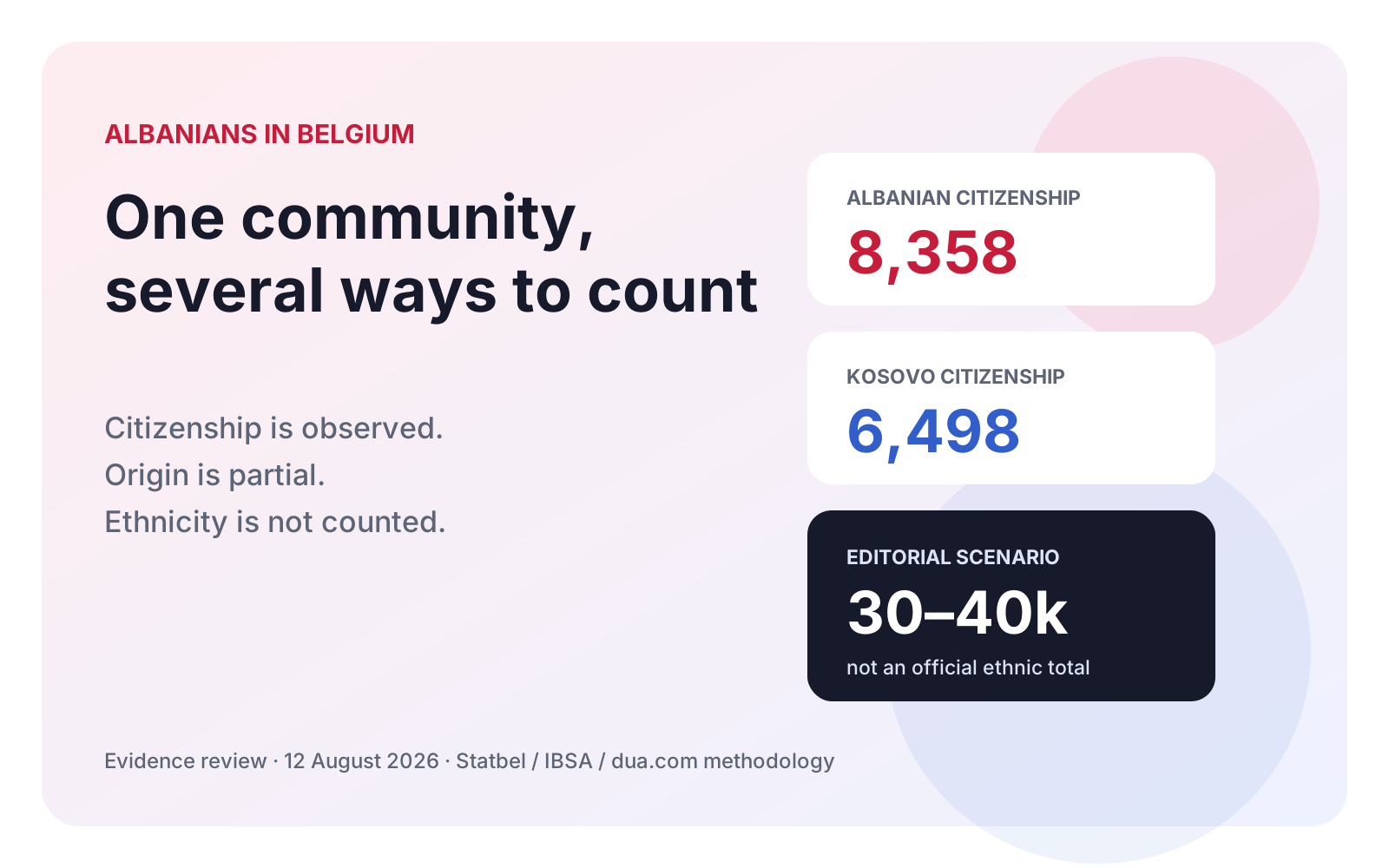
On 1 January 2026, Belgium's legal-population register counted 8,358 Albanian citizens and 6,498 Kosovo citizens. Those are two precise citizenship rows, not an ethnic count. Belgium does not publish a current total for Albanian ethnicity, identity, language or all descendants. After re-auditing the historical and administrative record, dua.com uses roughly 50,000–70,000 as a planning range for the wider Albanian-origin community, centred near 60,000; the range is editorial, not official.
That distinction shapes this entire guide. A naturalised Belgian with Albanian roots disappears from the Albanian-citizenship row without leaving Belgium. A child first registered as Belgian may never enter it. A Kosovo passport is not an ethnicity label, while an Albanian speaker from North Macedonia, Serbia or Montenegro appears under another state. The responsible answer is therefore a ledger, not one magic number.
This page follows the migration story from Faik Konitza's Brussels journal in 1897 and the organised post-war wave commemorated from 1956, through labour and family movement, the Kosovo displacement of 1999 and today's Belgian-born generations. It maps Brussels, Antwerp, Ghent and Walloon hubs; explains Belgium's multilingual setting; introduces institutions and people; and separates dua.com's first-party product data from demographic evidence.
For more on this topic, read Albanians in Switzerland and Albanians in Brussels.
Last evidence review: 12 August 2026. Official statistics, editorial modelling, historical records, community information and first-party dua.com data are labelled separately throughout.
How many Albanians live in Belgium?
The strongest current official answer is 8,358 residents with Albanian citizenship. A second official row counts 6,498 residents with Kosovo citizenship. Displaying them together produces a 14,856 two-citizenship marker, but not an Albanian population total.
Swipe horizontally to explore the full chart.
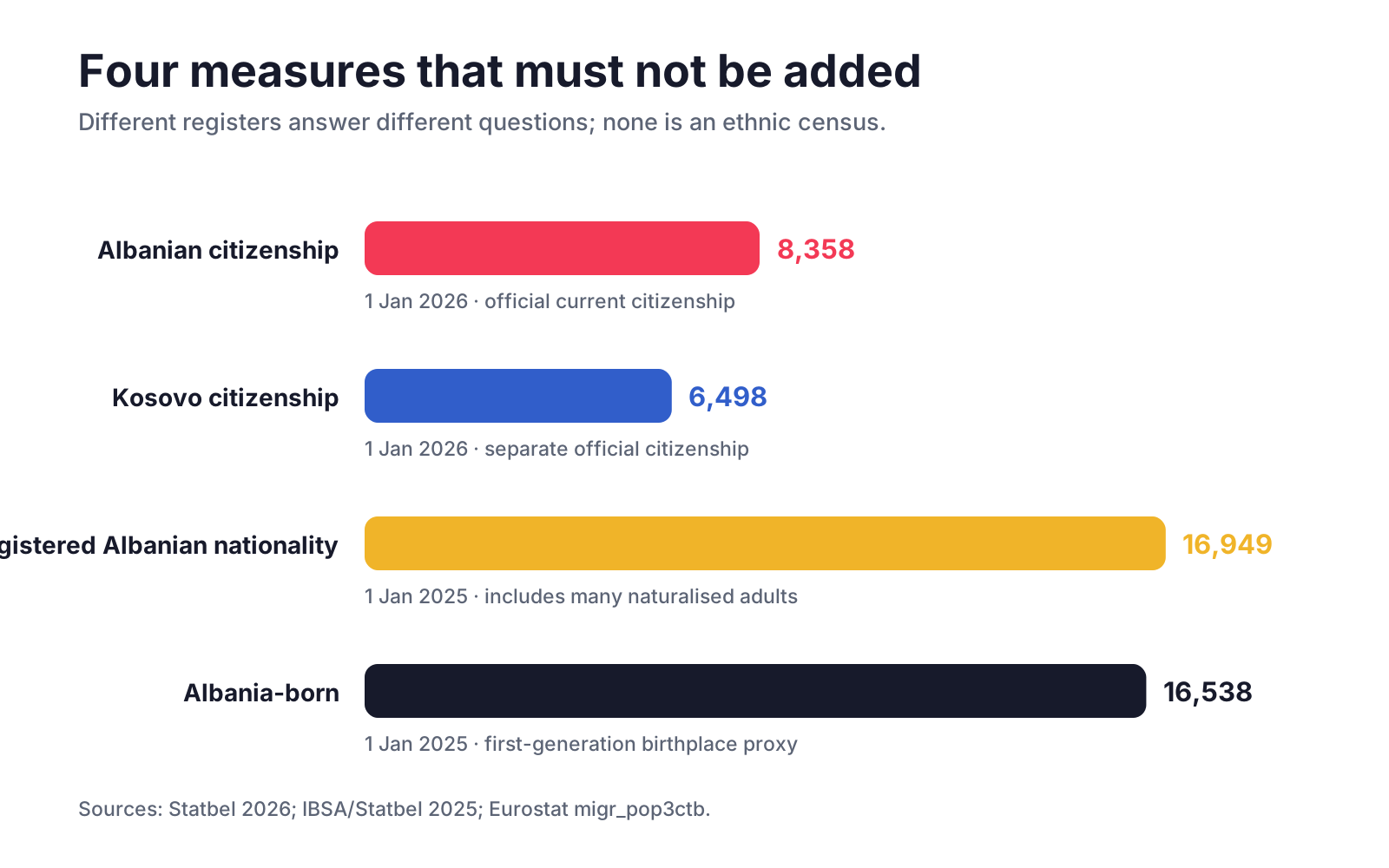
| Measure | Value | Date | What it does—and does not—count |
|---|---|---|---|
| Albanian citizenship | 8,358 | 1 Jan 2026 | Current legal citizenship; excludes naturalised Belgians and most descendants. |
| Kosovo citizenship | 6,498 | 1 Jan 2026 | A separate citizenship; includes people of different identities and is not an ethnicity row. |
| First registered Albanian nationality | 16,949 | 1 Jan 2025 | Includes many naturalised first-generation adults; excludes descendants first registered Belgian. |
| Albania-born residents | 16,538 | 1 Jan 2025 | Birthplace, not ethnicity; includes everyone born in Albania and excludes Belgium-born descendants. |
| First registered Serbia / former Yugoslavia nationality | 57,258 | 1 Jan 2025 | A mixed administrative row containing Albanian and non-Albanian histories; its Albanian share is not published. |
| Editorial planning range | 50,000–70,000 | 2026 review | A triangulated band for the wider Albanian-origin community; not an official statistic, confidence interval or maximum. |
Why the 16,949 figure matters
Current nationality is a legal status at one moment. IBSA's workbook, built from Statbel's National Register data, also publishes first registered nationality. It counted 16,949 residents whose first recorded nationality was Albanian on 1 January 2025: 8,213 in Flanders, 5,342 in Brussels and 3,394 in Wallonia. This is more useful for following first-generation settlement because becoming Belgian does not erase the earlier register entry.
It still does not count a child whose first nationality was Belgian, and the public table has no separate Kosovo row. The same workbook counts 57,258 residents under the combined first-nationality label “Serbia and former Yugoslavia”, compared with 6,838 under that combined current-nationality label. That row contains people with many identities and migration histories, including but not limited to Kosovo Albanians. It also may contain people who now hold Kosovo citizenship. The scale of the row proves that legacy coding matters; it does not reveal an Albanian share.
Naturalisation changes the visible count
Statbel recorded 680 acquisitions of Belgian nationality by former Albanian nationals in 2025. The flow total was 5,396 from 2015 through 2025 and 9,607 from 2000 through 2025. This helps explain why current citizenship understates settled origin, but the flows cannot simply be added back: people may later emigrate, die or move, and the series misses earlier naturalisations and some child acquisitions.
Statbel's national origin framework makes the broader mechanism clear. In 2026, 22.8% of Belgium's population were Belgian citizens with a foreign background and another 13.8% were non-Belgian. Among Belgian citizens with foreign background, 50.9% had themselves started with a foreign nationality; the remainder were first registered Belgian and classified through parents. The framework is valuable, but its published country detail does not isolate Albania or Kosovo.
Why the planning range is 50,000–70,000
The range is an editorial triangulation, not a census result, probability interval or claim that every person inside it identifies the same way. It describes a broad community network: people with Albanian roots from Albania, Kosovo, North Macedonia, Serbia, Montenegro and elsewhere, together with Belgian-born descendants who retain an Albanian family or cultural connection.
1. The administrative evidence has a large legacy-coding gap
The strongest Albania-linked stock is 16,949 residents with Albanian as their first registered nationality. The matched public table does not isolate Kosovo as a first nationality, but it does contain 57,258 people in the combined “Serbia and former Yugoslavia” row. Adding those two rows gives 74,207, but 74,207 is not an Albanian count: the larger row includes Serbs, Bosnians, Croats, Montenegrins, Macedonians and others, may overlap today's Kosovo-citizenship row, and says nothing about ethnicity.
2. Historical community estimates were already much larger than citizenship
Kole Gjeloshaj's chapter in the Albanian government's 2005 migration workshop proceedings, published by IOM, records two useful—but non-official—benchmarks. It says Kosovo's LDK estimated 40,000 Kosovars in Belgium in 1994, and that a commonly quoted estimate for Albanophones in Belgium was 30,000–50,000 people. The author explicitly described an accurate total as almost impossible because Albanians appeared under Albanian, Yugoslav, Turkish and refugee categories. These are historical community estimates, not National Register results, but they show why a present-day model based only on current passports was too low.
3. A current 60,000 claim is a useful signal, not official proof
A February 2026 Brussels Times community feature reports roughly 60,000 Albanians in Belgium. It attributes the figure to INSTAT, but INSTAT's published 2025 diaspora table for Belgium reports Albania-born residents and Albanian citizens—not a 60,000 ethnic or origin total. This page therefore treats 60,000 as a contemporary press/community estimate that sits between the older historical anchors and today's partial administrative evidence, not as an INSTAT statistic.
Taken together, the evidence supports a present-day 50,000–70,000 planning range, with about 60,000 as the working midpoint. The lower end recognises that the community was already commonly estimated at up to 50,000 in 2005 and that two more decades of settlement, naturalisation and Belgian-born generations are now missing from citizenship rows. The upper end allows for a meaningful—though unmeasured—Albanian share inside former-Yugoslav coding without assigning the whole category to one identity.
Could the widest possible definition reach 100,000?
It can be made to cross 100,000 on paper by assigning all 57,258 people in the Serbia/former-Yugoslavia first-nationality row to the Albanian community, adding the 16,949 Albania row and then adding Belgian-born descendants. That is an outer stress test, not an evidence-based estimate. It treats a multi-ethnic category as Albanian, risks overlap with the Kosovo row and applies an unobserved descendant layer. The page therefore does not use 100,000 as its headline or upper bound. A future country-specific Belgian origin or language table could move the planning range in either direction.
Where do Albanians live in Belgium?
Flanders contains the largest combined citizenship marker, Brussels has the strongest concentration of Albanian citizens, and Wallonia has almost equal Albanian- and Kosovo-citizenship totals. The map is multi-centred: Brussels is crucial, but it is not the whole community.
Swipe horizontally to explore the full chart.
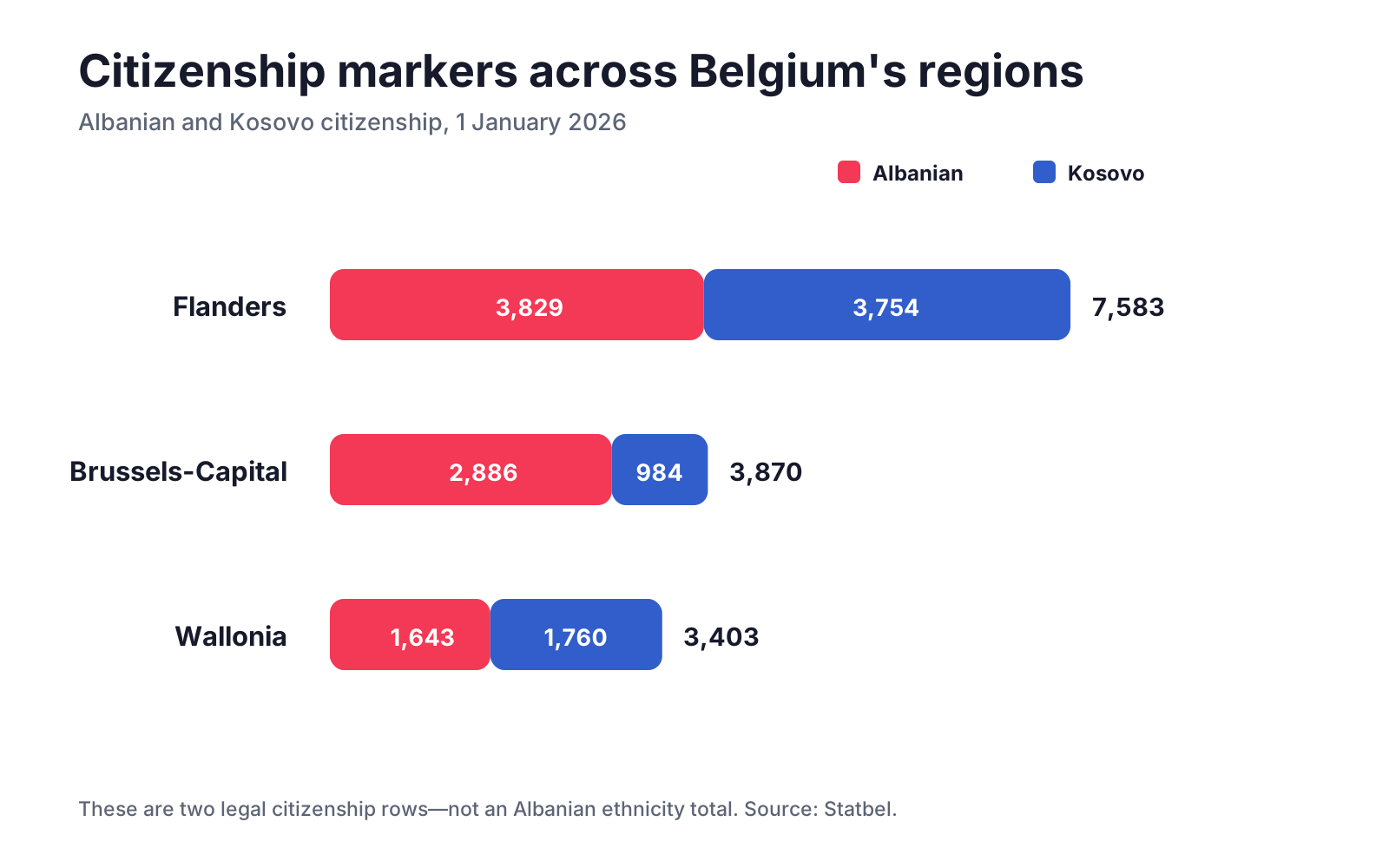
| Region | Albanian | Kosovo | Two-row marker |
|---|---|---|---|
| Flanders | 3,829 | 3,754 | 7,583 |
| Brussels-Capital | 2,886 | 984 | 3,870 |
| Wallonia | 1,643 | 1,760 | 3,403 |
Brussels: institutions, history and many local centres
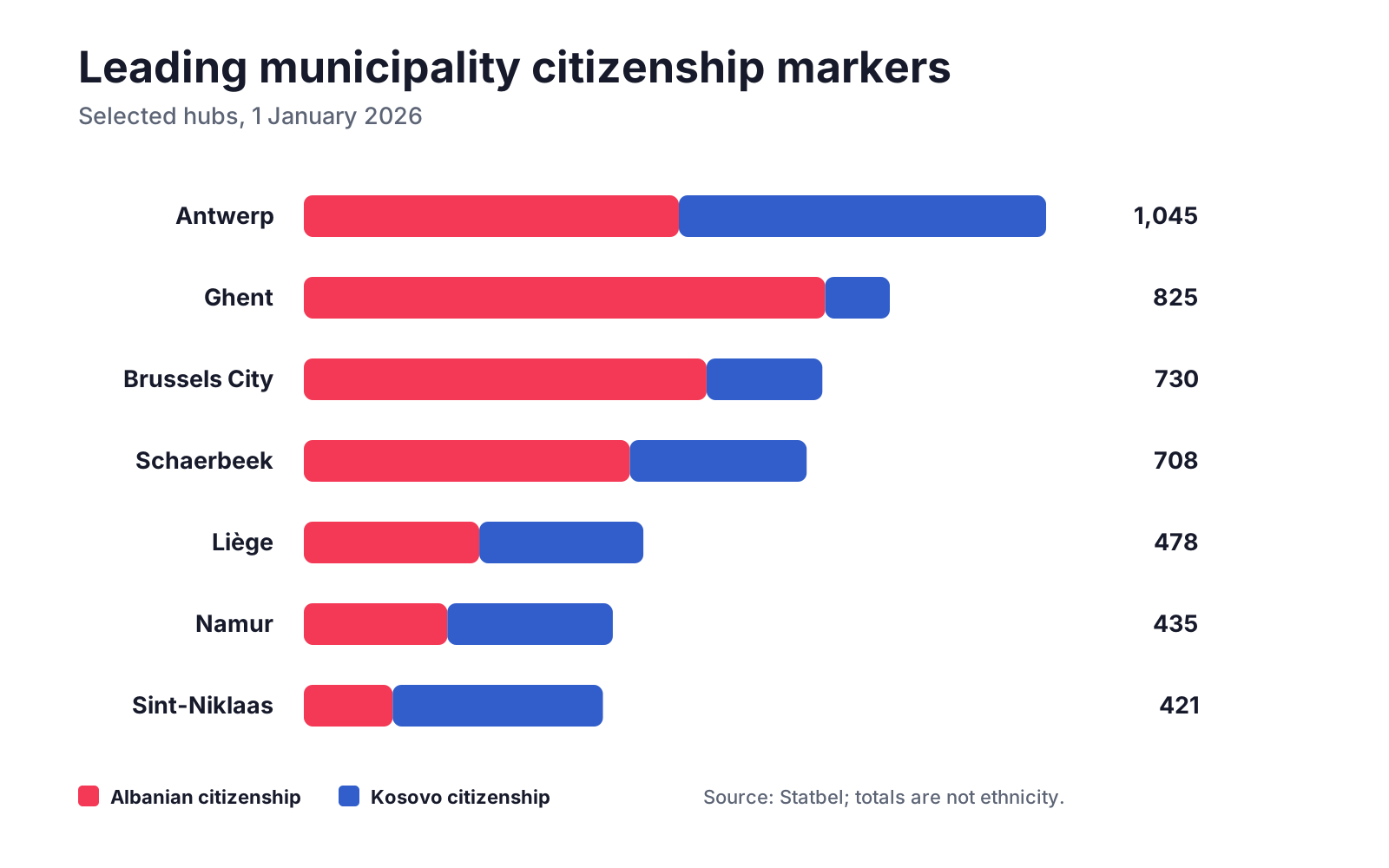
Brussels City counted 567 Albanian and 163 Kosovo citizens; Schaerbeek 459 and 249; Anderlecht 249 and 99; Evere 269 and 138; Molenbeek 217 and 92. These municipal rows show a Brussels network rather than a single enclave. Earlier community research described Schaerbeek, Anderlecht and Neder-over-Heembeek as important settlement areas, while the embassies, associations and Albanian-language activities give the capital a wider national role.
Brussels also brings a distinctive language setting. Its 19 municipalities are officially bilingual French/Dutch, while international workplaces add English and other languages. Albanian families may therefore move between Albanian at home, French or Dutch at school, and English at work—sometimes in one day.
Antwerp and the Flemish hubs
Antwerp has the largest selected municipal two-row marker: 528 Albanian and 517 Kosovo citizens. Ghent has Belgium's largest Albanian-citizenship municipality row at 734, alongside 91 Kosovo citizens. Sint-Niklaas has 125 and 296 respectively; Bruges 104 Kosovo citizens; Eeklo 132. These patterns underline why a Brussels-only portrait misses much of Kosovo-linked Flanders.
Liège, Namur and Wallonia
In Wallonia, Liège counted 247 Albanian and 231 Kosovo citizens; Namur 202 and 233. Charleroi and smaller municipalities add to a dispersed regional map. Wallonia's free newcomer integration route, French-language institutions and local family networks shape settlement differently from Dutch-speaking Flanders.
Swipe horizontally to explore the full chart.
Migration waves: from Brussels publishing to the Kosovo years
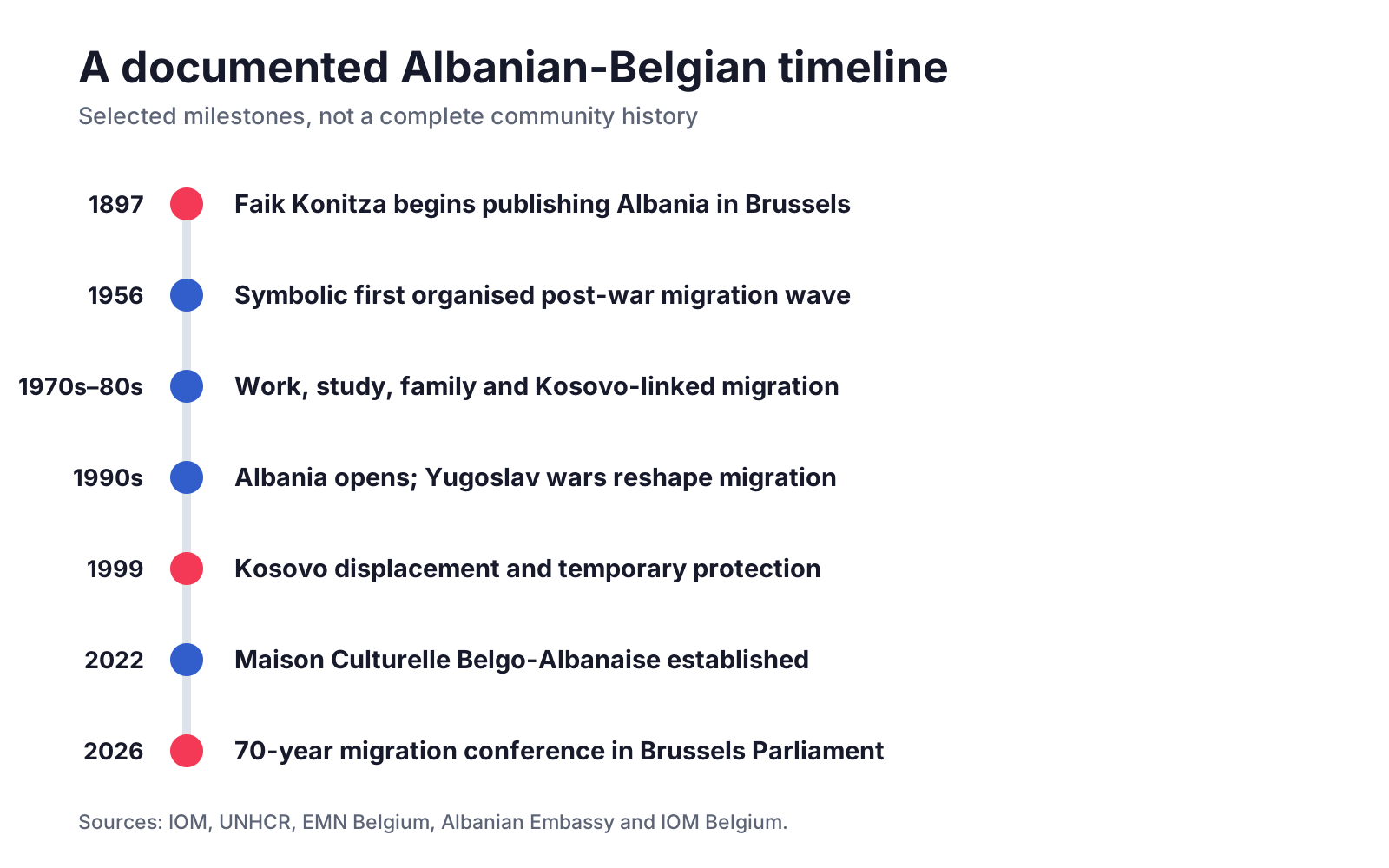
The Belgian-Albanian story predates modern migration. On 25 March 1897, diplomat and writer Faik Konitza began publishing the journal Albania in Brussels. The journal made the city part of the Albanian national awakening's European intellectual network even though no mass community yet existed.
Swipe horizontally to explore the full timeline.
The organised post-war wave
The Albanian Embassy's 2026 commemoration uses 1956 as the beginning of an organised post-war migration wave. Political refugees from communist Albania formed part of a wider East European intake. Exact claims about the Albanian contingent conflict across retrospective accounts; this page therefore records the milestone without repeating an unverified headcount.
In the 1960s through 1980s, students, workers, political exiles and families arrived from Albania, Kosovo and Albanian-speaking parts of Yugoslavia. Belgian records often classified them by Yugoslav or Turkish citizenship, not language or ethnicity. That statistical invisibility is not a new problem: Kole Gjeloshaj's historical chapter noted that an accurate count was already difficult because Albanian speakers appeared in many passport categories.
The 1990s and Kosovo displacement
The fall of Albania's communist system opened new movement just as Yugoslavia broke apart. Migration included asylum, family reunion, education and work, and the categories changed as states changed. By 1998–1999, repression and war in Kosovo turned an established mobility network into a humanitarian emergency.
UNHCR's 1999 Global Report records 1,220 humanitarian-evacuation departures to Belgium from FYR Macedonia through 31 October and 13,100 asylum applications by people from the Federal Republic of Yugoslavia, mostly Kosovars. The first figure is a programme movement; the second is applications, not unique long-term residents. Neither can be carried forward as today's population.
EMN Belgium documents a temporary-protection circular from 19 April 1999 for 1,200 UNHCR-selected evacuees and eligible family, later extended to Kosovar Albanians with pending asylum. New grants stopped in September 1999 and the status ended in 2000. The policy detail matters because it shows how protection, asylum and residence could describe the same life at different moments.
Settlement, citizenship and new migration
After the war came family rebuilding, study, EU-linked work, professional migration and Belgian citizenship. Today's community includes first-generation arrivals from Tirana, Pristina, Tetovo, Ulcinj and the Preševo Valley; children raised in Belgian schools; mixed families; and adults whose legal nationality no longer signals their origin. Mobility remains transnational, but the community is also firmly Belgian.
Languages, generations and belonging
Belgium has no official Albanian-speaker total. Its constitutional language geography recognises Dutch-, French- and German-language areas, with bilingual French/Dutch Brussels. Language censuses were abolished by law in 1961, so a home-language figure cannot be inferred from Belgian official statistics.
For families, that absence hides several different realities. A recent arrival may learn French in Brussels or Wallonia and Dutch in Flanders. A Belgium-born child may understand a Gheg variety spoken by parents or grandparents, answer in French or Dutch, and learn standard Albanian through weekend teaching. Some families linked to Albania use Tosk-influenced speech; many Kosovo-linked families use Gheg; others move easily between varieties.
The Albanian Embassy's March 2026 recognition of Brussels Albanian-language teachers offers qualitative evidence that language, history and traditions are being transmitted. It does not provide an audited enrolment count. That is the honest boundary: schools and teachers prove organised continuity, not the number of speakers.
Institutions and community infrastructure
The Embassy of Albania and the Embassy of Kosovo in Brussels provide the formal diplomatic and consular anchors. They serve different states and citizenships, while community events frequently operate across a wider Albanian-speaking public. That coexistence reflects the page's central statistical lesson: state categories and cultural networks overlap without being identical.
Maison Culturelle Belgo-Albanaise, also known as ShqipVille, established in Brussels in February 2022, is documented by IOM Belgium as a support, participation and integration hub. Its activities have included needs assessment, an Albanian-language digital-rights resource, sessions with asylum centres and collaboration with BON, Duo for a Job and Radio Panik. IOM's diaspora newsletter also documents the Sunday programme Radio Jehona e Shqipes.
Konica Association works in the cultural field; an Albanian Embassy account records its partnership with Saint-Gilles for an Arbëresh culture event in November 2025. In sport, FC Kosova Schaerbeek appears in the official RBFA/ACFF club-label documentation. These are examples, not a complete association census.
| Organisation | Role | Link |
|---|---|---|
| Embassy of Albania | Consular and diplomatic services; Avenue Louise 179, Brussels | Official site |
| Embassy of Kosovo | Consular and diplomatic services for Belgium and Luxembourg | Official site |
| Maison Culturelle Belgo-Albanaise / ShqipVille | Community support, culture, radio, participation and integration; Grand Place 39, Brussels | Official site · IOM profile |
| BON | Free civic orientation, counselling and Dutch in Brussels | BON |
| Brussels Expat Welcome Desk | Administrative orientation for international residents | Brussels-Capital Region |
| Flanders integration path | Civic integration guidance for newcomers in Flanders | Flanders |
| Wallonia integration path | Free newcomer integration route in Wallonia | Wallonia |
Community events in Belgium: upcoming, recurring and archived
The listings below were checked on 12 August 2026. A scheduled date is linked to the organiser's own agenda. Annual windows and past editions are labelled separately, because a previous celebration is evidence of community life—not confirmation that the same programme will return.
| Status | Date | Event | Place and verification |
|---|---|---|---|
| Planned by organiser | 30–31 October 2026 | Questions pour une Régularisation, theatrical performances by Konitza | Evere · Konitza agenda |
| Planned by organiser | 12 November 2026 | Questions pour une Régularisation, theatrical performance by Konitza | Ottignies–Louvain-la-Neuve · Konitza agenda |
| Recurring programme | Sundays; confirm the latest broadcast | Radio Jehona e Shqipes, Albanian-language community radio | Brussels / online · IOM documentation · official video channel |
| Annual window—not yet confirmed for 2026 | Around 28 November | Albanian Flag Day and Independence celebrations | Check the Embassy newsroom, ShqipVille and associations; the Embassy documented a Manneken Pis gathering in 2025. |
Confirm time, venue, admission and language with the organiser before travelling. Konitza's agenda supplies the three future dates above but does not yet publish complete booking details on the page we reviewed.
Recent verified editions and official photo stories
- 25 March 2026, Brussels Parliament: a conference marked 70 years since the symbolic first post-war migration wave and discussed the community's contribution. Embassy report and photographs.
- 12 March 2026, Brussels: a diaspora meeting recognised teachers passing Albanian language, history and traditions to younger generations. Embassy report and photographs.
- 2 March 2026, Bruges: Albania participated in Balkan Culture Week at the College of Europe, with a student contribution and a display of cultural material and products. Embassy report and photographs.
- 29 November 2025, Saint-Gilles: Konica Association and local partners presented an evening dedicated to Arbëresh culture and tradition. Embassy report and photographs.
- 28 November 2025, Brussels: Manneken Pis wore Albanian traditional dress for Albania's Independence Day as community members gathered nearby. Embassy report and photographs.
For more community-made documentation, browse ShqipVille's exhibitions and event archive and Konitza's association gallery. We link to their original photo stories instead of copying photographs whose reuse rights are not stated.
Voices from the community on video
These interviews and programmes were published by Maison Culturelle Belgo-Albanaise / ShqipVille. They are embedded from the organisation's official YouTube channel in privacy-enhanced mode; they document real community voices and past cultural activity, not a current event schedule.
Culture, memory and public space
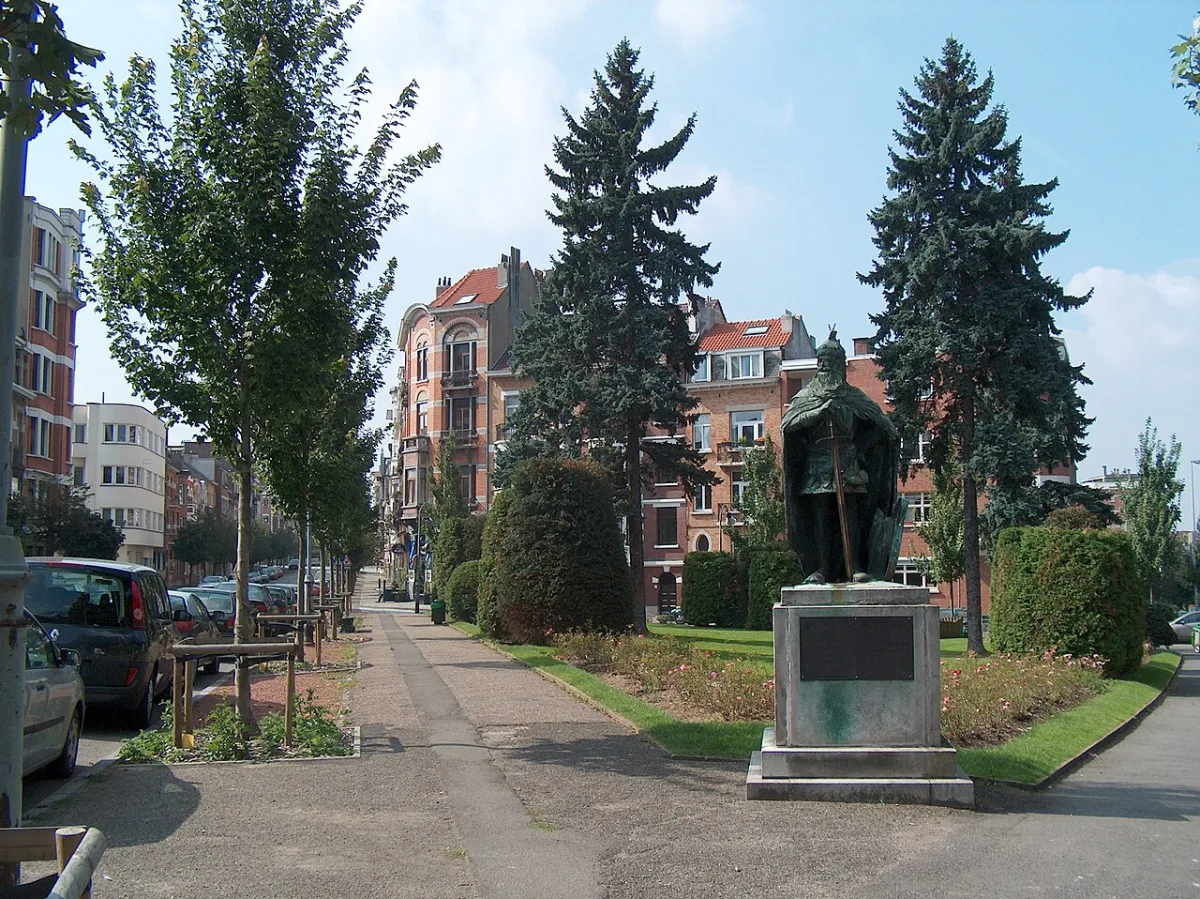
At Square Prévost-Delaunay in Schaerbeek, a bronze statue of Skanderbeg has stood since January 1968. Brussels' heritage inventory records the monument, while Schaerbeek's patrimony guide notes its trilingual plaque. It is more than decoration: the statue links Albanian historical memory to a Belgian municipal landscape that generations of families pass through.
Flag Day around 28 November, Kosovo Independence Day in February, concerts, football, dance, book events and family celebrations create a recurring calendar. The dated community-events section separates scheduled programmes from annual windows and archives so readers can see what is current.
Culture is also less visible: Albanian radio on a Sunday, a child learning the alphabet, an Arbëresh programme in Saint-Gilles, food shared across regions, or a family wedding that brings relatives from several countries to one Belgian hall. There is no single religious or political profile. Muslim, Catholic, Orthodox, Bektashi, secular and mixed families participate in overlapping networks.
People in the Belgian-Albanian story
Faik Konitza
The writer and diplomat made Brussels a centre of Albanian publishing when he launched Albania there in 1897. His presence belongs to intellectual history before mass migration.
Enver Hadri
A Kosovo human-rights activist whose work was based in Brussels. The Belgian Senate records that he was shot in Saint-Gilles on 25 February 1990, a major episode in Kosovo diaspora memory.
Adnan Januzaj
The Brussels-born Belgian international footballer has Kosovar-Albanian parents. His career illustrates a generation whose biography is Belgian while family history crosses borders.
Bleri Lleshi
Born in Albania and in Belgium from age eighteen, he studied at VUB and became known through philosophy, writing and youth work in Brussels.
Kristela Bytyçi
The Albanian Embassy describes the Brussels parliamentarian as being of Albanian origin. Her profile signals participation in Belgian public life beyond the older migration frame.
This is an illustrative list, not a ranking. It deliberately avoids turning surname, birthplace or a parent's passport into an unsupported ethnic claim. Living people are described only as narrowly as the cited sources support.
Practical resources and services
For documents and consular questions, start with the relevant embassy: Albania and Kosovo operate separate services. Check appointment systems, fees and opening hours on the official site rather than relying on an old directory.
For settlement support, the correct route depends on where you live. BON serves Brussels with civic orientation, counselling and Dutch. Flanders publishes a civic-integration path; Wallonia publishes its own free newcomer route. The Brussels Expat Welcome Desk helps with selected administrative questions for international residents.
For language and community life, follow embassy notices, Maison Culturelle Belgo-Albanaise and established associations. Ask teachers directly about age groups, location and enrolment. For football, consult the official federation record before relying on a club's social profile.
For events, use the checked calendar and official photo stories above, then confirm details with the organiser. For new listings after 12 August 2026, check the Embassy newsroom, ShqipVille and Konitza directly.
How the community connects today—and what dua.com can actually say
A dispersed, multilingual community does not always meet through one neighbourhood or one association. Families and friends move between Belgian cities, Albania, Kosovo and other diaspora countries. Digital connection can complement schools, sport, culture and family networks—especially for people whose Albanian identity is not visible in a passport row.
dua.com offers another route for friendship, cultural connection and serious relationships across Belgium and the wider diaspora. Explore Albanians in Brussels, the worldwide Albanians hub, or compare the evidence systems behind Albanians in Switzerland, Albanians in Germany and Albanians in France.
Evidence ledger: what each number can support
| Tier | Evidence | Safe wording | Do not claim |
|---|---|---|---|
| A: official stock | Statbel current citizenship, first nationality, national origin framework; Eurostat birthplace | Residents in a specified legal category on a stated date | Ethnicity, language or total ancestry |
| A: official flow | Nationality acquisitions, asylum applications, humanitarian evacuation | Events in a period under a defined process | Unique people still resident today |
| B: institutional record | IOM, EMN, Myria, embassies, regional services, heritage inventory | Documented policy, institution, event or milestone | An audited national community count |
| C: historical/community estimate | LDK estimate quoted for 1994; 30,000–50,000 Albanophone range reported in 2005; 60,000 press/community figure in 2026 | Contemporary estimate under its original label and date | Official or methodologically equivalent time series |
| C: editorial model | 50,000–70,000 triangulated planning range | Transparent range under stated definitions and limits | Official Albanian population, confidence interval or measured maximum |
| D: first-party product data | dua.com Flight Mode extract | Selections by members in the stated window | Population, travel taken or representativeness |
Reproduction notes
The 2026 citizenship result filters Statbel's municipality CSV to country codes AL and XK. The national row uses NIS 01000. Municipality rows are joined to the official 2026 structure workbook on NIS code and summed by region; both regional sums reconcile exactly to the national totals. In the IBSA/Statbel workbook, the national total is read from sheet 1.3.2.4: 16,949 under Albania and 57,258 under “Serbia and former Yugoslavia”; sheet 1.3.1.4 gives the matched current-nationality values 8,097 and 6,838. The research ledger records source URLs, sheet names and SHA-256 checksums.
The legal-population denominator excludes people on the asylum-seeker waiting register while claims are pending. Statbel's origin framework uses current nationality, first registered nationality and parents' first nationalities; parent information is incomplete, especially for older residents. These design choices are why the page never describes its model as an official ethnic census.
Update policy
Current citizenship should be refreshed annually after Statbel's release. First-nationality and nationality-acquisition tables should be checked on the same basis. The 50,000–70,000 range should be revisited whenever Belgium publishes more detailed first-nationality or parental-origin data, or when a representative country-specific ancestry or language study appears. Associations, consular details and events need link checks at each editorial review.
A community larger than one register row
The official rows are clear: 8,358 Albanian citizens and 6,498 Kosovo citizens on 1 January 2026. What they mean is narrower. Naturalisation, Belgian-born descendants, shifting state codes and identities that cross passports make the living community larger and more complex than either number.
The strongest story is not that Belgium hides one exact Albanian total. It is that several generations built institutions, public memory, schools, careers and family lives across a multilingual country—from Konitza's Brussels press and post-war refugees to Kosovo displacement and today's Belgian-born citizens. A transparent 50,000–70,000 planning range can orient readers, but the evidence ledger matters more than the headline.
Frequently asked questions about Albanians in Belgium
How many Albanians live in Belgium?
Belgium officially counted 8,358 Albanian citizens on 1 January 2026 and separately counted 6,498 Kosovo citizens. Neither is an ethnic total. Historical and current evidence supports roughly 50,000–70,000 as an editorial planning range for the wider Albanian-origin community, centred near 60,000—not as official statistics.
Are Kosovo citizens included in the Albanian figure?
No. Statbel publishes Albania and Kosovo as separate current citizenship rows. This page displays both but does not call their sum an Albanian ethnic count, because not every Kosovo citizen identifies as Albanian and many Albanian-identifying people hold other citizenships.
Is 50,000–70,000 an official Belgian estimate?
No. It is dua.com's planning range, triangulating official first-nationality rows with historical and contemporary community estimates. Belgium does not publish an Albanian ethnic total or the Albanian share of its Serbia/former-Yugoslavia row.
Could the community be as large as 100,000?
It is possible only as a very broad outer hypothesis. A calculation can exceed 100,000 by treating every person in the mixed Serbia/former-Yugoslavia first-nationality row as Albanian and then adding descendants, but that assumption is false for many residents and risks double-counting. The page therefore uses 50,000–70,000, not 100,000, as its working range.
Where do most Albanian and Kosovo citizens live?
Flanders has the largest combined citizenship marker. Important municipalities include Antwerp, Ghent, Brussels City, Schaerbeek, Sint-Niklaas, Namur and Liège. Albanian- and Kosovo-citizenship maps differ, so no single city represents the whole community.
When did Albanians first settle in Belgium?
Faik Konitza published in Brussels from 1897, before mass migration. The Albanian Embassy commemorates 1956 as a symbolic first organised post-war wave. Work, study, family migration and political exile expanded the community from the 1960s onward.
What happened during the Kosovo war?
UNHCR recorded 1,220 humanitarian-evacuation departures to Belgium in 1999 and 13,100 FRY asylum applications, mostly Kosovars. Belgium also created temporary protection for selected evacuees and eligible Kosovar Albanians. These are programme and application counts, not today's population.
How many people speak Albanian in Belgium?
No official total exists. Belgian language censuses were abolished in 1961. Community schools and teachers document active language transmission, but they do not provide a representative national speaker count.
Where is the Albanian Embassy in Belgium?
The Embassy of Albania lists Avenue Louise 179 in Brussels. Check its official website for current consular services, appointments and opening information. Kosovo has a separate embassy serving Kosovo citizens.
Are there Albanian community organisations in Brussels?
Yes. IOM documents Maison Culturelle Belgo-Albanaise as a support and participation hub, and its newsletter documents Radio Jehona e Shqipes. Konica Association, language teachers and FC Kosova Schaerbeek are other verified examples.
What languages do Albanian families use in Belgium?
It varies by region and generation: Albanian varieties and standard Albanian may combine with French, Dutch, German or English. Brussels is officially bilingual French/Dutch; Flanders is Dutch-speaking and Wallonia mainly French-speaking.
How can I meet Albanians in Belgium?
Community routes include associations, language activities, football, embassy cultural programmes and verified public events. dua.com adds a digital route across Belgium and the wider diaspora. Its Flight Mode data is product activity, not a demographic claim.