
Albanian Bern comes into focus west of the old town: on the Bodenweid football pitches, in language classrooms, and in the associations that connect the city to its neighbours. At the end of 2025 Bern counted 1,056 Kosovan and 1,059 North Macedonian citizens. Neither figure counts a whole ethnic community. To understand who belongs here, follow the language, the institutions and the people who keep making room for another generation.
A child who speaks Albanian confidently and a child struggling to find the words can sit in the same class. In her October 2024 interview with Dielli, teacher Mirsime Muja Durmishi, working in Bern and Kirchberg, described precisely that challenge. Her pupils differed in age as well as fluency; cooperation with parents was central to her work. There is no single starting line for inheriting a language.
That classroom offers a better introduction to Albanian Bern than a list of famous surnames. A community is renewed when someone teaches a child to read, volunteers at a screening, or keeps a football club going through another season. In Bern, those activities have addresses, histories and people behind them. This guide follows their public record.
For more on this topic, read Albanians in Switzerland and Albanians in Zurich.
How many Albanians live in Bern?
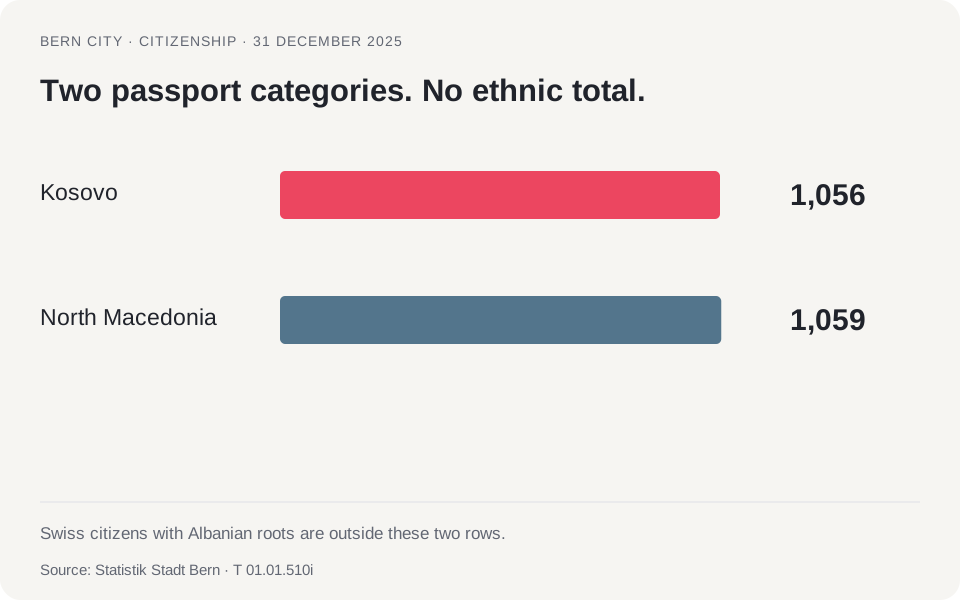
There is no verified headcount of everyone of Albanian origin in Bern. The city’s population structure table for 31 December 2025 records 1,056 Kosovan and 1,059 North Macedonian citizens within a total registered population of 146,867. These are citizenship categories, not ethnic groups. The table lists countries with more than 500 residents individually; Albania is not separately listed, which does not mean no Albanian citizens live here.
Adding the two published rows gives 2,115 people, but calling that “2,115 Albanians” would make two mistakes at once. Not every citizen of Kosovo or North Macedonia is Albanian. And Swiss citizens with Albanian family backgrounds, along with Albanians holding other citizenships, are outside those two categories. A surname, an app profile or a country of birth cannot repair that gap automatically.
A language count answers a different question
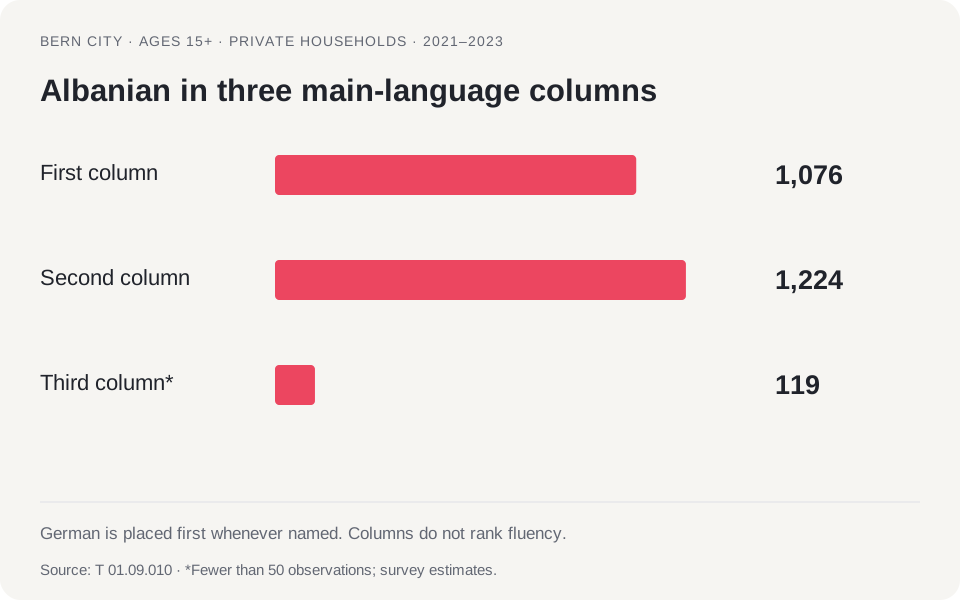
The city’s pooled 2021–2023 Structural Survey estimates 1,076 people with Albanian in the first main-language column, 1,224 in the second and 119 in the third. Together that is approximately 2,400 adults naming Albanian as a main language. The estimates cover permanent residents aged 15 or older in private households, including Swiss citizens. They exclude children under 15, collective households and holders of diplomatic identity cards.
These are survey estimates, with uncertainty. The third-column estimate is explicitly flagged as based on fewer than 50 observations. The three published relative confidence margins cannot simply be added to create a confidence interval for their sum. We therefore round the combined figure and retain the source’s limitations rather than imply a precise count.
“Second main language” does not mean a language spoken badly. Respondents could name several main languages, and the city placed German first whenever it was included. Someone who thinks and feels at home in both German and Albanian can therefore appear in the second Albanian column. That administrative rule is part of the story of bilingual Bern.
The community’s centre of gravity is in Bern-West
The city’s 2024 district register gives the clearest local geography. Bümpliz-Oberbottigen, the large western Stadtteil VI, contained 721 of Bern’s 1,084 Kosovan citizens and 936 of its 1,116 North Macedonian citizens: 66.5% and 83.9% respectively. These are shares of each citywide citizenship group living in the west, not percentages of western residents who are Albanian.
Within that district, Bümpliz and Bethlehem stand out. Bümpliz counted 336 Kosovan and 421 North Macedonian citizens; Bethlehem counted 339 and 492. The old town, by comparison, recorded four and three. This is a pattern in the register, not a licence to describe whole neighbourhoods as belonging to one ethnicity.
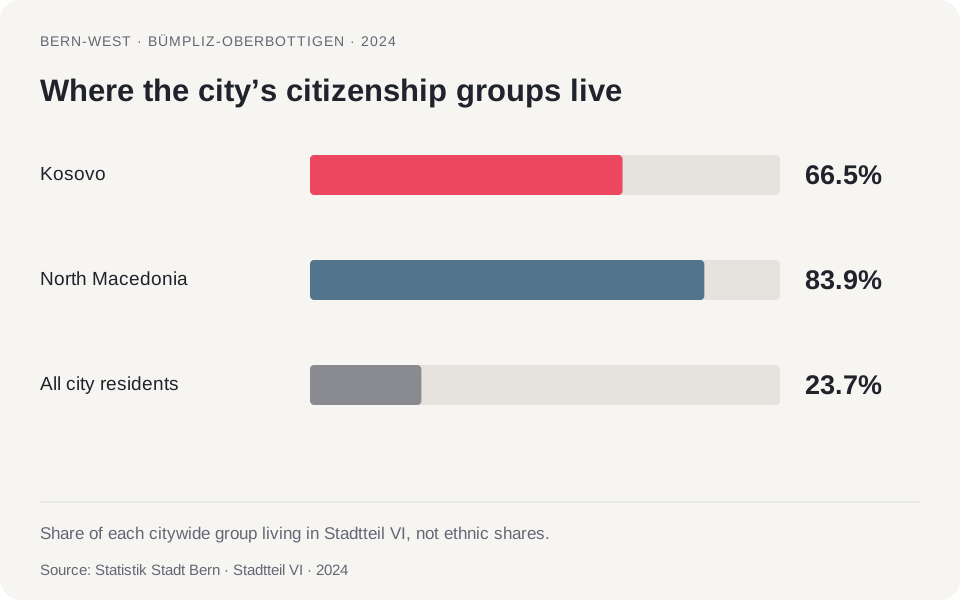
The district profile puts this in proportion: Bern-West was home to 23.7% of the city’s total population. Community life is embedded in a much broader, multilingual part of Bern. Football grounds, schools and religious associations are useful points of entry because they bring people together repeatedly, rather than only on a national holiday.
When “Bern” means somewhere else
Ostermundigen, Muri bei Bern and Zollikofen are separate municipalities. Their institutions can be essential to people living in Bern without their residents belonging in Bern city totals. Kirchberg, Burgdorf, Thun and Biel/Bienne are also part of the wider canton, not neighbourhoods of the capital. This guide names those places when the story moves there; it does not turn the canton’s community into a city population estimate.
That distinction matters practically. An Albanian cultural programme in Ostermundigen, a consular appointment in Muri and a football match in Bümpliz are three different journeys. Community networks cross municipal boundaries more easily than a statistical table does.
From temporary work to lasting institutions
The federal study of the Kosovar population in Switzerland traces successive phases of seasonal employment, family migration and displacement. Workers arriving from Yugoslavia from the mid-1960s onward were classified by citizenship, so Albanian-speaking people did not necessarily appear under “Albania”. The repression and war in Kosovo later changed both the reasons for leaving and the needs of families already in Switzerland.
This is the Swiss background to Bern’s history, not a claim that every Bern family arrived together. Some came from Kosovo, others from North Macedonia, Albania or other Albanian-speaking regions. Some arrived as adults; others inherited a migration story without ever migrating themselves.
A local date makes settlement tangible: FC Prishtina Bern was founded in 1990. The club’s own history places its beginnings before Kosovo’s 1998–1999 war. A football team meant finding fellow players, organising fixtures and making a shared commitment in the place where people now lived. The name remembered Prishtina; the weekly work took place in Bern.
The Bundesplatz becomes a place of celebration
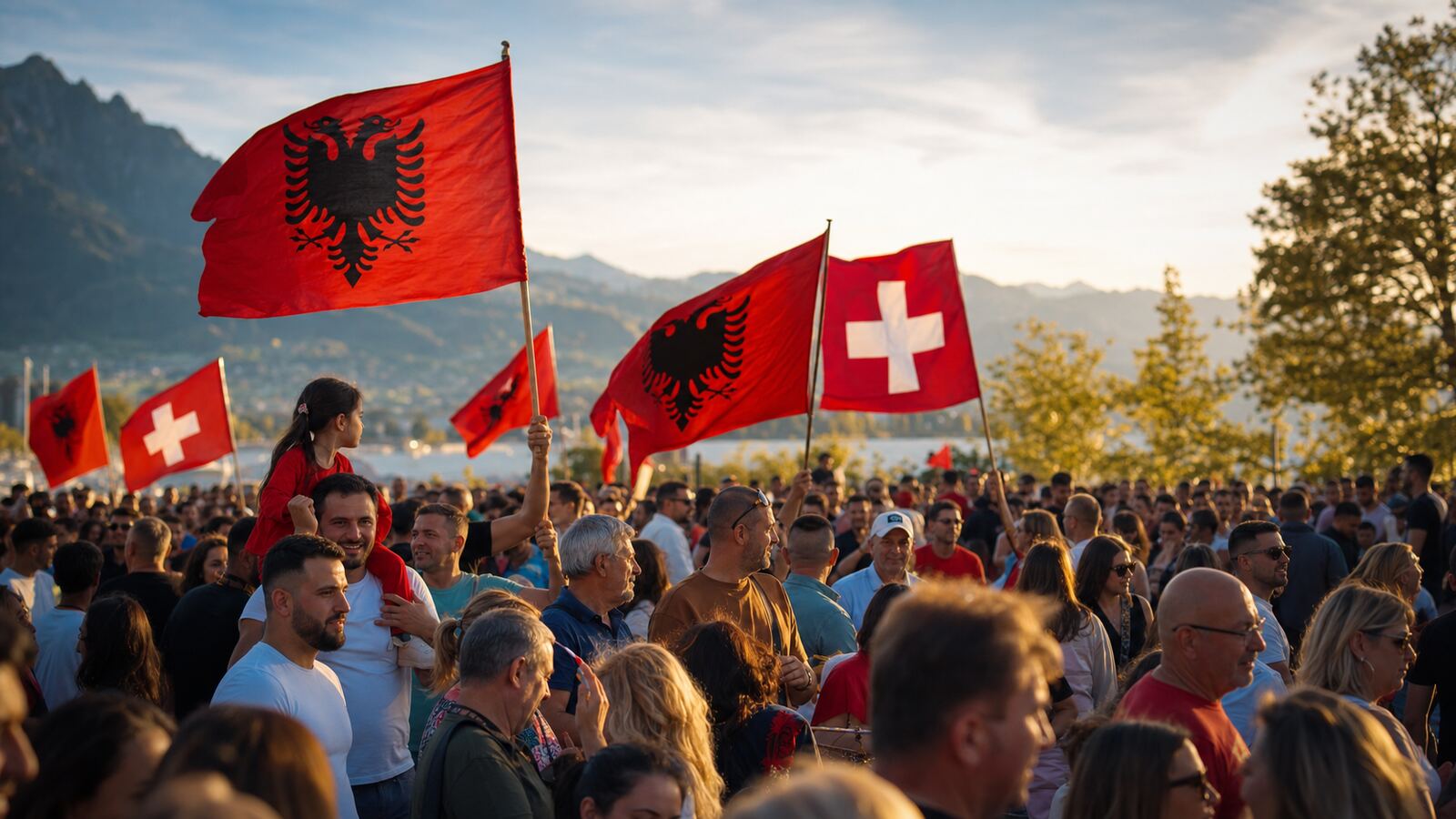
On 17 February 2008, Kosovo’s declaration of independence brought crowds to Bern’s Bundesplatz. Albanian, Swiss and American flags filled the square in front of the Federal Palace.

Switzerland recognised Kosovo on 27 February 2008. Kosovo’s embassy history records the establishment of its Bern embassy in January 2009. There is a particular resonance in that sequence: people celebrating in the federal square, then a diplomatic institution opening in the city to represent a newly independent state.
A falling passport count is not a migration verdict
Bern counted 1,217 Kosovan citizens in 2015, 1,168 in 2020 and 1,056 in 2025. North Macedonian citizenship counts moved from 1,176 to 1,196 to 1,059. The city’s historical table supports those changes; it does not tell us how much reflects naturalisation, moving away, deaths or other demographic events.
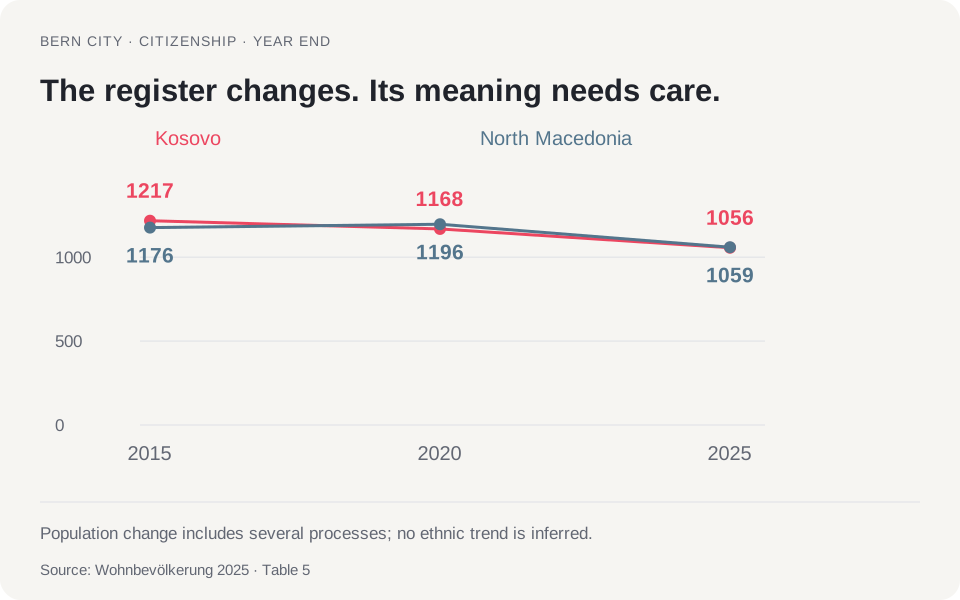
Becoming Swiss changes a person’s category in foreign-citizen statistics. It need not change the language spoken with grandparents or the team supported on a Sunday. Equally, we should not assume that every decline is naturalisation. The responsible conclusion is narrower: the legal categories have changed in size; the full community cannot be read from them alone.
Keeping Albanian alive beyond the kitchen table
Heritage-language classes give Albanian a place alongside ordinary schooling. In Bern these are known as HSK, Heimatliche Sprache und Kultur. The cantonal education authority describes a politically and religiously neutral programme delivered by recognised associations or diplomatic providers, with the canton coordinating and supporting quality. It complements the regular school day.
Speaking with family and learning to read and write are different opportunities. A child may understand an adult perfectly but answer in German; another may speak fluently and need help with written Albanian. A class can provide a setting in which both have something to learn. That is why Durmishi’s account of mixed language levels belongs at the beginning of this story.
“Parents’ involvement is essential”
Mirsime Muja Durmishi, teacher, to Dielli (26 October 2024; translated from Albanian)
Finding a class for the coming school year
The safest starting point is the official HSK course directory, which links to the searchable timetable. Filter by Albanian, municipality and school level, then contact the provider. Bern says new-school-year listings open in mid-September and are completed progressively until the autumn holidays. This guide was checked on 11 September 2026, so the 2026/27 list may still be changing.
The Statthalter, Manuel and Wittigkofen venues named in Durmishi’s 2024 interview are useful historical examples of teaching across the city. They should not be treated as a confirmed 2026 timetable. Her Kirchberg class was outside the city. A familiar school name in an older article is a lead to check, not a promise of a place.
According to the current cantonal registration guidance, parents register children themselves. The usual deadline is the end of March, while some providers accept later registrations. Confirm the class, teaching level, cost and available places with the coordinating organisation. Those details are more useful than a copied list of teachers’ old telephone numbers.
The institutional work behind the classes continues too. In January 2024, the Albanian embassy hosted a meeting between representatives of Shkolla Shqipe and LAPSH, supported by the ambassadors of Albania, Kosovo and North Macedonia, to begin work on closer cooperation and unification. In her October 2024 interview, Durmishi reported that the two networks had come together in March and were working as one body. Her account shows the effort moving from a diplomatic meeting into the teachers’ everyday organisation.
Bashkimi: Albanian culture in a shared town festival
In neighbouring Ostermundigen, Bashkimi’s participation in the 2025 Mundigefescht placed Albanian culture inside a wider local celebration. Albinfo’s account, attributed to the association’s board, records the association’s presence and the recognition of municipal president Thomas Iten. It is a small but telling form of belonging: taking part in the town’s own event.
The association also announced a Flag Day evening for 29 November 2025 at Restaurant Ambiente in Bern. The published announcement is evidence of a programme, not an attendance report and not an invitation for 2026. When looking for the next celebration, check a current announcement and its actual municipality.
Kino Kosova brings another conversation into central Bern
Kino Kosova’s seventh edition is scheduled for 9–13 September 2026 in Bern. Its official programme connects films, discussions and encounters under the theme Where Is Everybody?, with South Korea as the focus country. This is Albanian and Kosovar cultural life looking outward, making space for experiences from beyond its own diaspora.
One person behind that work is Sabahet “Sabo” Meta. DokuFest’s 2023 jury biography identifies him as a co-founder of Bern-based Kulturalink and artistic director of Kino Kosova. His work helps explain why a festival belongs in a community guide: programming and organising create a public place where people can question what identity means, rather than simply display it.
Kino Kosova’s own photographs from its second day in September 2026 bring that work into view: audiences, filmmakers and volunteers sharing the spaces between screenings. The festival’s story is also made in those conversations, when a film gives strangers something to talk about.
Young people become the filmmakers
Re:Connect, organised by DokuFest and Kino Kosova, takes that idea further. Young people from Kosovo and Switzerland work together on documentary filmmaking, exploring memory, family and belonging. The project includes work in Prizren; it should not be described as footage shot entirely in Bern.
The 2026 festival listing schedules a Re-Connect screening at Kino REX on 12 September. Its programme duration is distinct from the short trailer above. Neither is a claim that a viewer can watch the full films here. Check the organiser for the latest screening details, access and tickets.
For someone seeking a way into cultural life, the festival’s volunteer information is another starting point. A screening audience and an organising team offer different kinds of participation. Both make community life possible without requiring everyone to have the same language background or the same relationship with Kosovo.
FC Prishtina Bern: a name from home, a club in Bümpliz
FC Prishtina Bern plays at Bodenweid in Bümpliz. The club describes its role as providing organised football for people who want to take part, with attention to young players and social contact. Its official site carries current match reports and links to the Swiss football association’s results. Use those live records for fixtures and league information.
A club founded by migrants can carry a place of origin in its name while becoming part of the sporting life of a Swiss city. Training and match days ask for repeated commitment. That continuity is easy to overlook when a community appears in the news only during a tournament or a political debate.
People whose paths run through Bern
Florent Hadergjonaj: from Langnau to Young Boys
Young Boys’ 2013 announcement traces Florent Hadergjonaj’s route from FC Langnau through Thun and Luzern to YB’s under-18 side and then the first team. The club explicitly identifies his Kosovar roots. This is a canton-to-city connection: Langnau is in the Emmental, not a district of Bern.

Elina Duni: a musical return through Bern
Born in Tirana and raised partly in Geneva, Elina Duni studied singing and composition in Bern’s jazz department between 2004 and 2008. Her UN Geneva biography places the formation of her quartet in that period, bringing Balkan folk song into conversation with jazz. The HKB’s own award announcement also names her among its first BEST-Trächsel scholarship recipients.
Faith, difference and the work of living together
Religious life offers further meeting places, but it cannot stand in for the whole Albanian community. Relinfo documents IKRE in Bern as an Albanian-oriented Sunni-Hanafi association founded in 2004, with premises purchased in 2007 at Morgenstrasse 148. Its local history includes contact with school classes. This is distinct from the IKRE organisation in the Thun area.
Dialogue has public records too. The 2024 Nacht der Religionen programme brought IKRE Bern together with Catholic Bern-West and the Reformed parish of Bümpliz at St. Antonius. Such occasions make the neighbourhood’s religious variety visible without assuming all Albanian residents share one faith.
At the Haus der Religionen on Europaplatz, Albanian imam Mustafa Memeti was a prominent figure in the Muslim association’s move into the new building. Swissinfo’s December 2014 report documented both the hope of sharing a building with other communities and opposition to the move. This is a historical account; it is not a statement about who holds an office today.
Albanian-speaking Catholic life also reaches into the region. The Aarau mission’s 2025 calendar lists services in Zollikofen, outside Bern city. Consult the mission’s current programme before travelling: an archived calendar establishes a community connection, not today’s service time.
Everyday life: when the useful connection is practical
For a new arrival, belonging can begin with understanding a school letter or knowing where to ask for advice. Bern’s official directory of specialised counselling lists isa-Fachstelle Migration, including personal advice in Albanian. Its migration and integration advice is available to foreign and Swiss residents. Language access can matter long after a family’s first arrival.
Consular services have their own geography. Kosovo’s embassy is at Zähringerstrasse 25 in Bern. Albania’s consular office is at Pourtalèsstrasse 45A in Muri bei Bern. Use the Kosovo or Albania mission’s current instructions for the service you need; shared Albanian language does not make the two states’ documents interchangeable.
Meeting Albanians in Bern
The practical choices follow from the story: a club, an association’s public programme, a film screening, or a parent network around a language class. Start with the kind of connection you want. A newcomer seeking advice and someone seeking a relationship need different settings, even when both want to speak Albanian.
dua.com offers another way to meet people with shared Albanian cultural ties. Discover people nearby or across the diaspora, alongside the introductions that grow through friends and community life.
Discover Albanians near you on dua.com. For the wider context, read Albanians in Switzerland, explore Zurich’s community, or visit the worldwide Albanian community hub.
Bern’s Albanian story is visible in a square filled with flags. It is sustained in less spectacular places: a classroom that welcomes different levels of fluency, a pitch where a team returns each week, a cinema where young people see their own questions on screen. Those are places where an inherited connection becomes something people can choose to carry forward.
Useful local starting points
Public sources checked on 11 September 2026. Confirm current schedules and availability with each organisation.
- Albanian HSK classes — official canton-wide course search, with municipality and school-level filters.
- FC Prishtina Bern — Bodenweid, Bümpliz; club and match information.
- Kino Kosova / Kulturalink — Bern film festival and cultural programme.
- Bashkimi in the Bern area — original report of participation in Ostermundigen’s town festival.
- isa-Fachstelle Migration — city-listed migration advice, including Albanian.
- IKRE Bern — association profile and official website link.
- Embassy of Kosovo — Bern.
- Embassy of Albania — Muri bei Bern.
Frequently asked questions about Albanians in Bern
How many Albanians live in Bern?
No complete ethnic count is established. Bern city recorded 1,056 Kosovan and 1,059 North Macedonian citizens at the end of 2025. Separately, its 2021–2023 survey suggests about 2,400 adults named Albanian as a main language. These measures have different dates and coverage and must not be added.
Where is the community concentrated?
In 2024, Bümpliz-Oberbottigen held 66.5% of Bern’s Kosovan citizens and 83.9% of its North Macedonian citizens. These are citizenship-based concentrations. Bümpliz and Bethlehem are prominent local centres; they are diverse neighbourhoods, not exclusively Albanian areas.
Do Bern’s figures include Ostermundigen?
No. Ostermundigen, Muri bei Bern and Zollikofen are separate municipalities. Their organisations can serve people in Bern, but their residents are outside the city totals quoted here. The canton is a much larger area again.
Where can children learn Albanian?
Use the canton’s official HSK directory and filter by Albanian and municipality. New-school-year listings are released from mid-September and updated until autumn holidays. Confirm the provider, school level and place directly; the school venues mentioned in the 2024 interview are historical examples.
Is Kino Kosova in Bern?
Yes. Its seventh edition is scheduled for 9–13 September 2026 in Bern. The official programme includes films, talks and a South Korean focus. Consult its current site for venues and access; the Re-Connect video on this page is a short project trailer, not a full screening.
Which football club has Albanian roots?
FC Prishtina Bern, founded in 1990, is based at Bodenweid in Bümpliz. Its official site and football-association links provide current fixtures. The Radio Vala video here documents a home match in June 2022.
Are all Kosovo or North Macedonia citizens Albanian?
No. Citizenship and ethnicity are different. Both countries have multiple ethnic communities, while people with Albanian roots can hold Swiss and other citizenships. This is why the guide labels each statistic by what it actually measures.
How can I meet Albanians locally?
Public cultural events, football, volunteering and language-school parent networks offer local connections. For dating, dua.com helps people discover others nearby and across the Albanian diaspora. Choose a setting that matches your intention and check event details with the organiser.