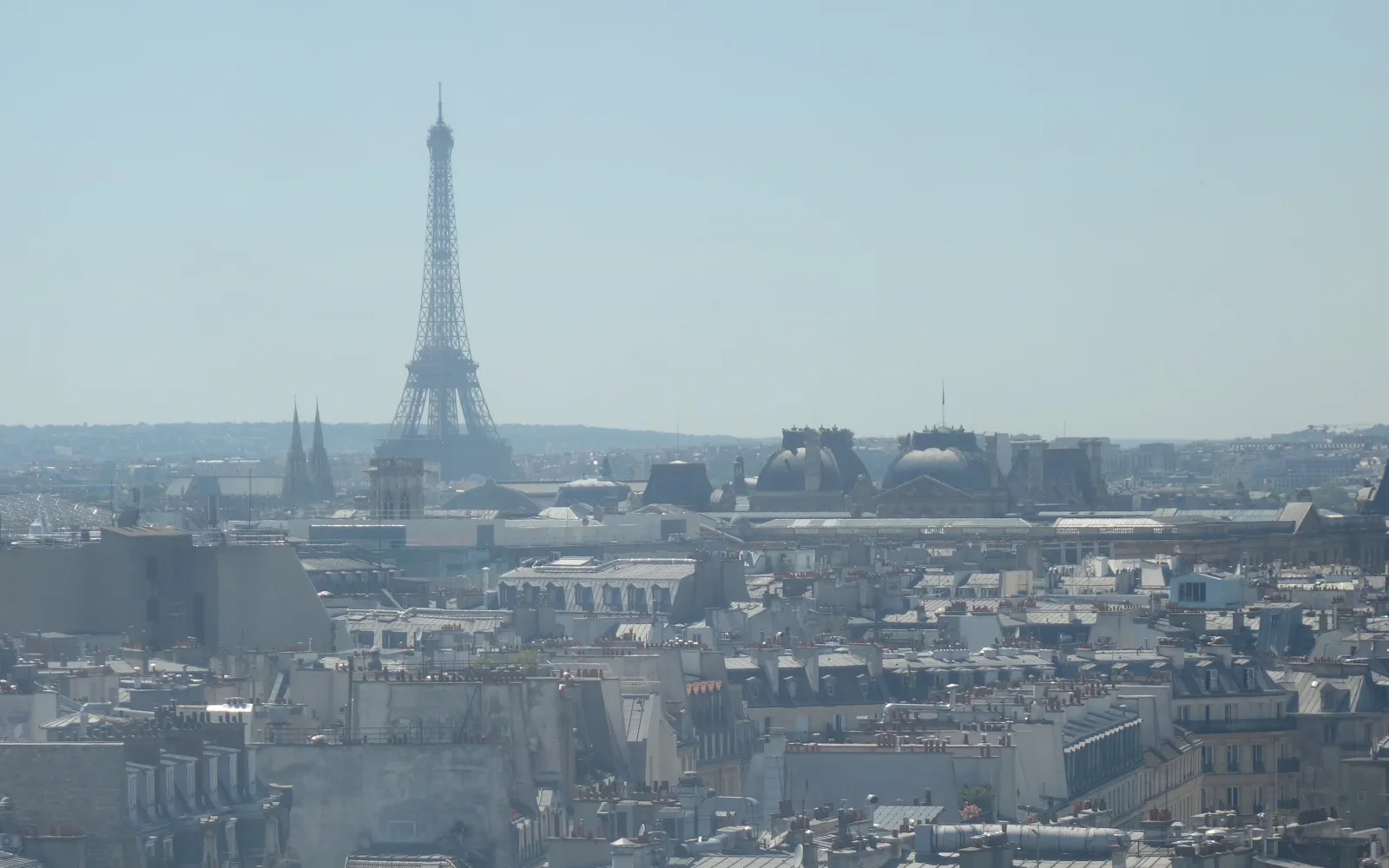
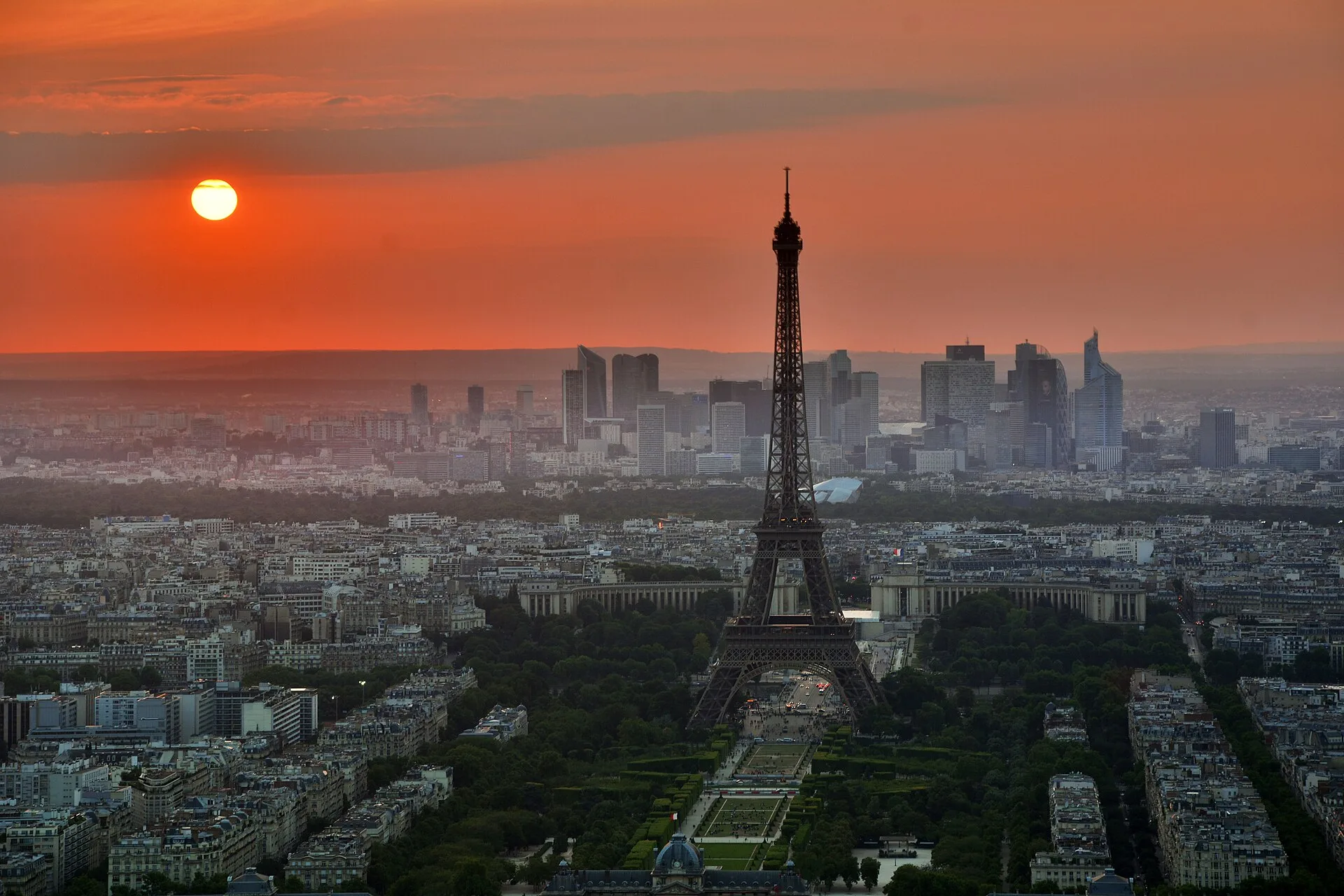
Albanians have been part of Paris for longer than many people realise.
The city’s connection with Albania stretches back more than a century, through diplomats, writers, artists and political exiles. Later came families looking for work and opportunity, people displaced by the Kosovo War, students, professionals and a generation that has now grown up in France.
Today, there’s no single Albanian neighbourhood in Paris. The community is spread across the city and the wider Île-de-France region, connected through family, cultural centres, language classes, universities, community events and the places where Albanians continue to meet.
For more on this topic, read Albanians in France: Population and Community and Albanians in London: Population, History and Community.
So, how many Albanians actually live here?
There’s no official ethnic-Albanian count in France. Census data can tell us about citizenship and country of birth, but it doesn’t fully capture naturalised French citizens, French-born children of Albanian families or Albanians whose roots are in Kosovo and other parts of the Balkans.
Based on the available data, a reasonable working estimate is around 20,000 people of Albanian origin across Greater Paris and Île-de-France. It’s an estimate, not an official census figure.
But numbers only tell part of the story. To understand Albanian Paris, you have to look at the people, institutions and cultural connections that have made the city part of the Albanian story for generations.
Last evidence review: 12 August 2026. The population ledger uses the harmonised Eurostat 2021 census tables released in their current form in May 2025. Institution pages and practical contacts were rechecked in August 2026.
How many Albanians live in Paris?
There’s no official number for everyone of Albanian origin living in Paris.
French statistics can tell us where someone was born or what citizenship they hold, but they don’t provide a simple count of ethnicity or ancestry. That matters for a community that includes naturalised French citizens, children born in France and Albanians whose families come from Kosovo or elsewhere in the Balkans.
What do the official numbers tell us?
- 475 Albania-born residents were recorded in Paris itself.
- 2,602 Albania-born residents were recorded across Île-de-France.
- 1,739 residents with Albanian citizenship were recorded across Île-de-France.
These figures overlap, so they shouldn’t be added together. Someone born in Albania may also hold Albanian citizenship, for example.
They also leave a significant part of the community out.
Who doesn't show up clearly in these numbers?
Official citizenship and birthplace figures may not fully capture:
- Albanians who have become French citizens
- Children and grandchildren born in France
- Albanians with roots in Kosovo
- Albanians from North Macedonia and other parts of the Balkans
- People from mixed Albanian-French families
This is why counting the Albanian community through passports alone gives us an incomplete picture.
So what’s a realistic estimate?
Using the available census data alongside evidence on naturalisation, migration and the wider Albanian-speaking population, our current working estimate is around 20,000 people of Albanian origin across Greater Paris and Île-de-France.
That number should be read for what it is: an informed estimate, not an official French census count.
The exact total is difficult to prove. What the evidence does show clearly is that Albanian Paris is much bigger than the number of people currently holding an Albanian passport.
Swipe horizontally to explore the full chart.
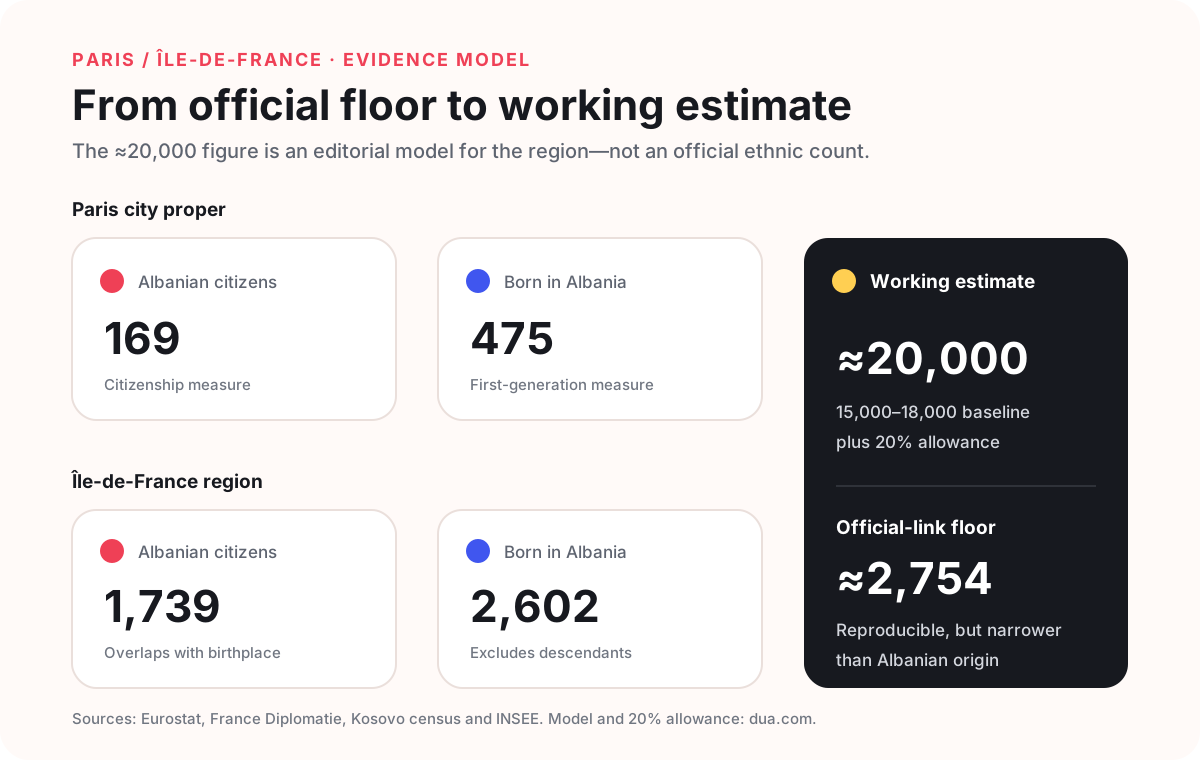
| Measure | Paris city | Île-de-France | Interpretation |
|---|---|---|---|
| Albanian citizenship | 169 | 1,739 | Current Albanian citizens; excludes naturalised French citizens who no longer have Albanian citizenship |
| Born in Albania | 475 | 2,602 | First-generation Albania-born residents, whatever their current citizenship |
| Conservative Albania-linked floor | 475 | ≈2,754 | Larger official count in every disjoint age band; not ethnicity or ancestry |
| Triangulated wider-community range | Not estimated | 15,000–18,000 | Editorial model using national Albania/Kosovo anchors, observed regional shares and broad INSEE sensitivity ratios |
| Editorial working estimate | Not estimated | ≈20,000 | The baseline plus a 20% uncounted-community allowance; rounded, assumption-sensitive and not official |
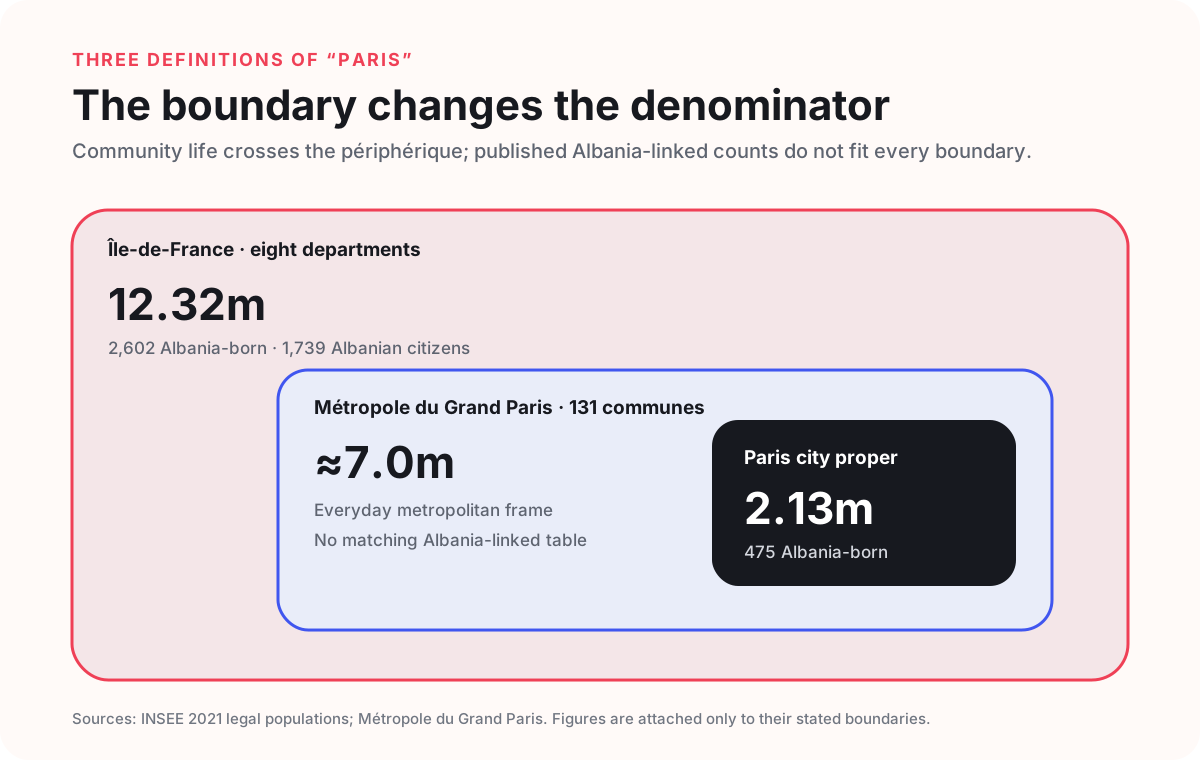
Which “Paris” does the number describe?
“Paris” can mean three incompatible territories. Paris city proper is the 105-square-kilometre municipality and department, with 2,133,110 residents in the 2021 census. The Métropole du Grand Paris is the dense core of roughly seven million people across Paris and its inner metropolitan communes. Île-de-France is the eight-department region, with 12,317,277 residents in 2021.
| Geography | 2021 population | Albania-born count available here? | Use |
|---|---|---|---|
| Paris city proper | 2,133,110 | Yes: 475 | Strict answer for the municipal boundary |
| Métropole du Grand Paris | About 7.0 million | No directly aggregated Albanian-origin table used | Best lived metropolitan frame; not a denominator for an invented count |
| Île-de-France | 12,317,277 | Yes: 2,602 | Reproducible regional context and the page's broad evidence ledger |
The Métropole matters because everyday Paris crosses the périphérique: work, rent, schools, weddings and community events do not stop at the municipal line. But the available country-of-birth table does not publish the Albanian figure for that exact intercommunal boundary. This page therefore describes metropolitan life qualitatively and keeps its population numbers attached to Paris city or Île-de-France.
How Paris became part of the Albanian story
The Albanian story in Paris didn’t begin with the migration waves of the 1990s.
Long before large numbers of Albanian families settled in France, Paris was already a meeting point for Albanian diplomats, writers, artists, students and political figures.
From diplomacy and culture to a community that stayed
- 1919–1920 — Albania comes to Paris
The Paris Peace Conference was an important moment for the young Albanian state, as Albanian representatives worked to defend the country’s borders and international recognition. - Mid-20th century — Writers, intellectuals and political exiles
During Albania’s communist period, Paris became an important place for Albanian voices outside the country. Writers, artists, students and political exiles helped build a cultural connection between Albania and France. - 1990s — Migration changes the community
After the fall of communism, more Albanians arrived in France looking for work, education and new opportunities. What had largely been a diplomatic and cultural presence increasingly became a family and diaspora community. - Late 1990s — Kosovo adds another chapter
The Kosovo War and the displacement surrounding it brought Kosovo Albanians to France, adding new experiences, dialects and family histories to the community. - 2000s onward — Putting down roots
Families became more established, children grew up in French schools, and Albanian cultural organisations, language programmes and community events helped maintain connections across generations. - Today — Paris is home too
For many younger Albanians, France isn’t simply the country their parents or grandparents migrated to. It’s where they were born, studied, made friends and built their own lives.
From arriving in Paris to belonging here
That history means there isn’t one typical Albanian story in Paris.
One family may have arrived from Albania in the 1990s. Another may have roots in Kosovo. Someone else may have come recently to study, while another grew up in France and knows Albania mainly through family, language and summer visits.
What connects those stories isn’t one migration wave or one neighbourhood.
It’s the way Albanian identity has continued to find a place in Paris — first through diplomacy and culture, later through migration, and today through generations who increasingly see both worlds as their own.
Where do Albanians live in Paris?
There is no evidence for a single Albanian quarter. The reviewed official data is too small and imprecise at arrondissement or commune level to publish a reliable neighbourhood ranking. Albania-born residents are more numerous outside Paris city than inside it: 2,127 of the region's 2,602 lived in the other seven Île-de-France departments.
That distribution fits the practical geography of Greater Paris. More space, family housing and community venues are often found beyond the city boundary, while the embassies, cultural institutions, universities and workplaces draw people back into central Paris. The network is organised through transport lines, family ties and events—not a continuous enclave.
Language, French schools and the second generation
Paris hears more than one Albanian. Standard Albanian is based largely on Tosk; Gheg varieties are common among families from northern Albania, Kosovo and parts of North Macedonia and Montenegro. French becomes dominant quickly through school, work and mixed friendship networks. A French-born child may understand Albanian, speak it only with grandparents, or learn standard Albanian later.
France's census does not publish a current Paris Albanian-main-language total comparable to the language tables used in Switzerland or England and Wales. Language therefore cannot be used as a substitute population count here. It is better treated as a transmission question: who speaks, reads and writes; which variety; and in which setting.
Two very different routes to learning
- Community learning: the Centre Culturel des Albanais 28-11 says its cultural and language school is opening in 2026. Families should confirm current registration and teaching arrangements directly.
- University learning: INALCO is the only French higher-education institution offering a complete Albanian language-and-culture pathway from undergraduate through postgraduate study. It teaches standard Albanian and introduces Gheg from the third licence year.
The distinction matters. A weekend community school is designed for heritage transmission and children; INALCO is an academic programme for adult students, translators and researchers. Neither enrolment list is a community census.
Associations and institutions: a small but durable network
| Institution | Role | Evidence and caution |
|---|---|---|
| Embassy of Albania | Passports, civil-status, notarial and consular support; cultural diplomacy | Official mission at 57 avenue Marceau; appointments and services should be checked online |
| Embassy of Kosovo | Kosovar consular services and diplomatic contact | Official mission; the cultural centre cooperates with it |
| Centre Culturel du Kosovo à Paris | Concerts, exhibitions, books, residencies and French–Kosovar exchange | Founded in 2006; a Law 1901 association and FICEP member |
| Centre Culturel des Albanais 28-11 | Albanian culture, youth transmission, planned school and bilingual library | New Paris association; school announced for 2026 and library for 2027, so verify delivery |
| Maison de l'Albanie | Cultural meeting place and promotion of Albania | Opened in 2018; public contact information has moved, so verify before visiting |
| INALCO and BULAC | Teaching, research and Albanian-language collections | Academic infrastructure open beyond the diaspora itself |
No one body represents every Albanian in Greater Paris. Albania and Kosovo have separate state institutions; families may also have roots in North Macedonia, Montenegro or southern Serbia. Cultural associations overlap with student, professional, religious and informal family networks. The diversity is part of the evidence, not a gap to smooth over.
Paris as an Albanian cultural capital abroad
Paris's importance is disproportionate to the city's measurable Albania-born population. It is a publishing city, a diplomatic centre and a stage where Albanian and Kosovar artists enter French cultural life without working only inside an ethnic circuit.
A calendar built around culture, not a single festival
Useful recurring anchors include Kosovo Independence Day on 17 February, Albania's Flag Day on 28 November, FICEP's foreign-culture programme, book talks, concerts, screenings and embassy events. The Centre Culturel du Kosovo has presented Kosovo through Jazzycolors, literature nights, exhibitions and artist exchanges. Dates and venues change, so this guide links to organisers rather than promising an annual event at a fixed address.
Recent community activity: a verified snapshot
These are dated examples of activity that took place, not promises of future events. They show what Paris's Albanian and Kosovar organisations have recently organised across national celebrations, language transmission, visual art, film, books and music.
| Date | Event | Organiser and evidence |
|---|---|---|
| 20 February 2026 | Kosovo Independence evening with art, music, Kosovar wine and traditional Albanian dancing | Centre Culturel des Albanais 28-11 event record |
| Spring 2026 | First semester of community Albanian-language classes, followed by a pupil-and-family closing programme | Centre 28-11's current programme; check registration and age groups directly |
| 24 April 2026 | Artur Muharremi evening combining painting, conversation and animated-film screenings | Centre 28-11 organiser archive |
| 29 May 2026 | Albania in nineteenth-century French painting, a Luan Rama book presentation and the film Odes for the Temples We Have Not Forgotten | Centre 28-11 organiser archive |
| 5 June 2026 | Sindi Tona's Pas dyerve të Parisit literary evening, with guest singer Manjola Nallbani | Centre 28-11 organiser archive |
| 24 May 2025 | Writer Ag Apolloni at Paris's Night of Literature | Centre Culturel du Kosovo à Paris |
Looking for the next date? Check the organisers' current pages before travelling. This ledger is deliberately archival: event venues, capacity, registration and public access can change.
Community life in pictures
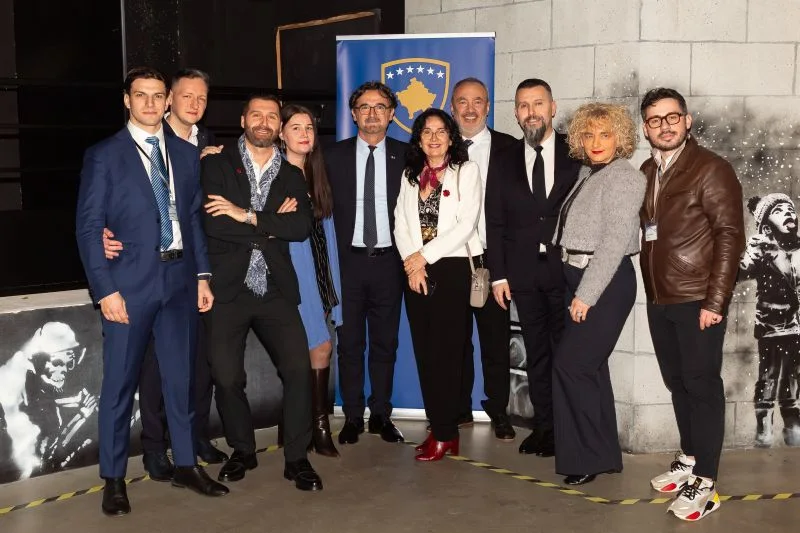
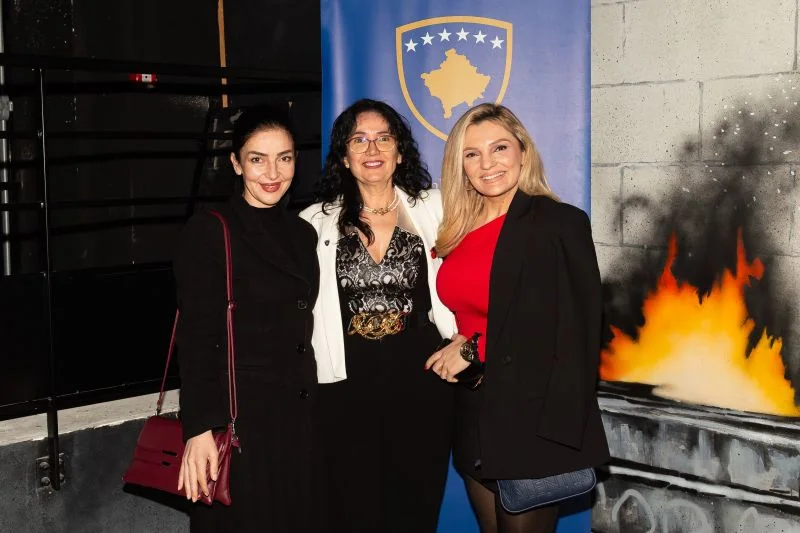
These photographs were published by Centre Culturel des Albanais 28-11 after its February 2026 Kosovo Independence gathering in Paris. They document the community itself rather than using generic Paris imagery.
Watch the Paris community in motion
The first recording is RTK's March 2026 report from Centre 28-11; the second is community-uploaded footage from Albania's Flag Day in Paris in 2010. Together they show a current institution and a longer public tradition. Both are documentary examples, not an event calendar.
Notable people in the Paris story
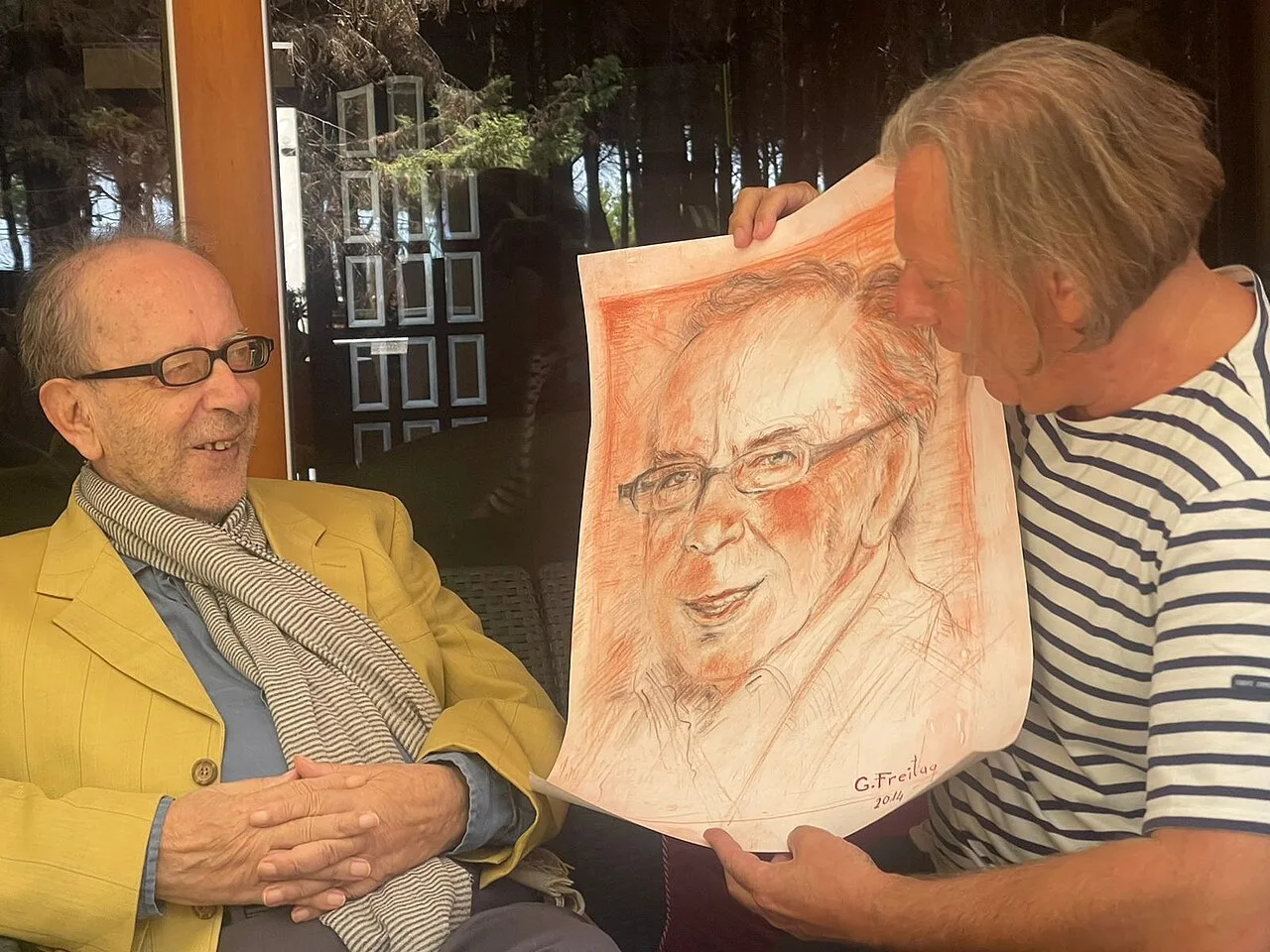
- Ismail Kadare (1936–2024) — Albania's most internationally known novelist; sought asylum in Paris in 1990 and worked for decades between France and Albania.
- Angelin Preljocaj — French choreographer born in Sucy-en-Brie to Albanian parents, a clear second-generation Greater Paris story.
- Tedi Papavrami — Tirana-born violinist who arrived in France as a child, studied in Paris and also translated Kadare into French.
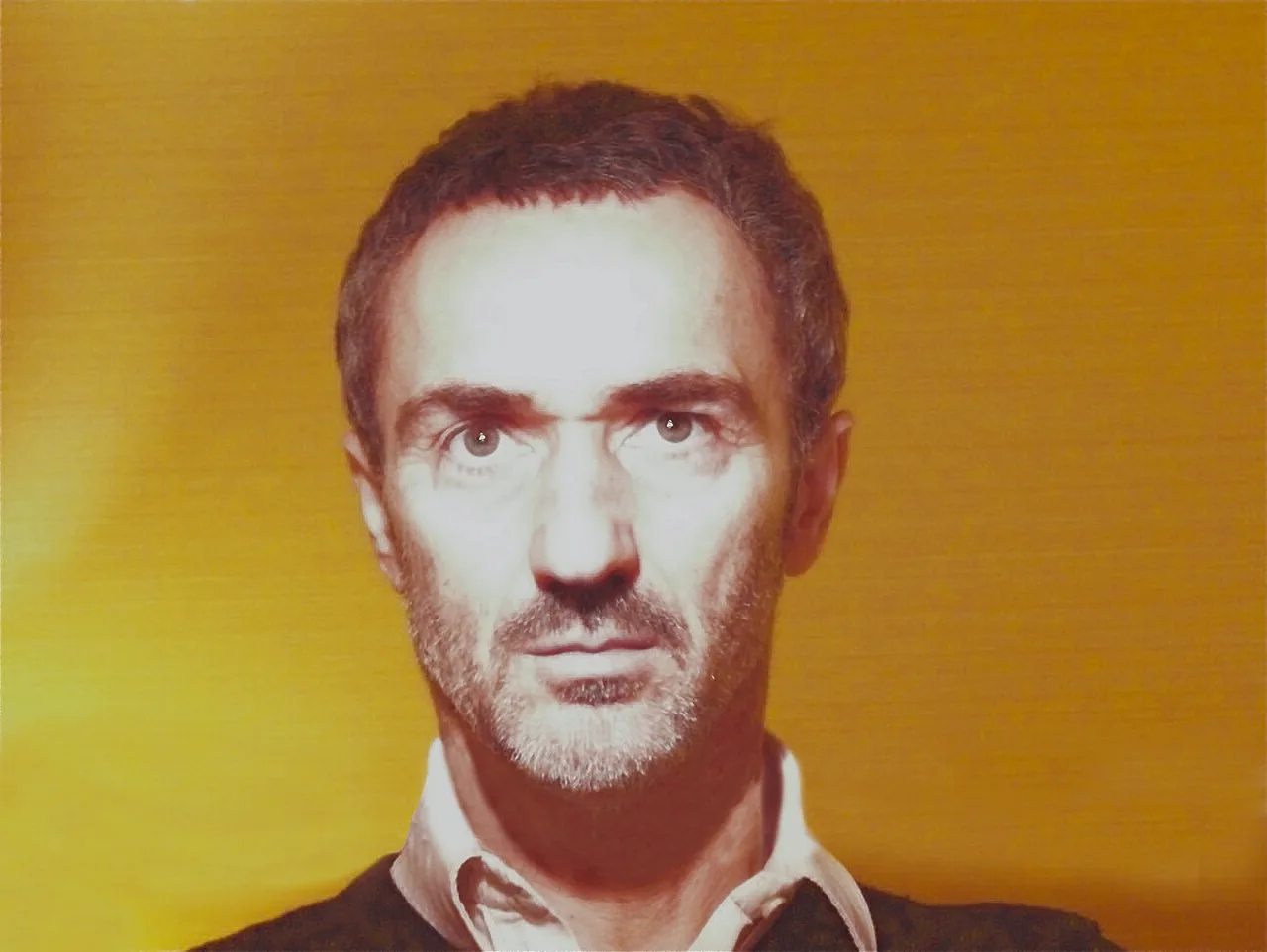
- Anri Sala — Tirana-born contemporary artist educated and long active in Paris before establishing an international practice.
This is not a ranking of “famous Paris Albanians”. It shows different pathways: exile, a French-born generation, education, translation, visual art and political advocacy. Residence and connection vary over time; each person is included for a documented Paris chapter rather than assigned a fixed identity label.
Practical Paris directory
Checked 12 August 2026. Organisations, appointments and programmes change. Confirm with the provider before travelling; do not rely on an address copied from an old directory.
Documents and official support
- Embassy of Albania: 57 avenue Marceau, 75116 Paris · official site. Use the online consular information before attending.
- Embassy of Kosovo: 7 rue de Monceau, 75008 Paris. Confirm current consular instructions through the official Kosovo foreign-ministry channel.
- Sworn translators: the Albanian embassy publishes an indicative list of Albanian–French court-approved translators; verify current court status and fees directly.
Culture, language and research
- Centre Culturel du Kosovo à Paris: programme and contact.
- Centre Culturel des Albanais 28-11: 31 boulevard Saint-Martin, Paris 3e · school and project updates.
- INALCO: 65 rue des Grands Moulins, Paris 13e · Albanian studies.
- BULAC: 65 rue des Grands Moulins, Paris 13e · library catalogue and access.
How to find current events
Start with the two embassies, the two cultural centres and FICEP. Search the organisers' current programme for 17 February and 28 November rather than trusting an undated “Albanian events Paris” listing. For children's classes, ask what variety and curriculum are taught, the age range, safeguarding arrangements and whether the announced 2026 programme is operating.
How Albanians in Paris connect through dua.com
Greater Paris is precisely the kind of geography in which a community app has practical value: the population is dispersed across city and suburbs, while family roots may run through Albania, Kosovo, North Macedonia, Montenegro or Serbia. dua.com helps people discover other Albanians without pretending the app is a census.
The route pattern is modest but revealing: Paris members connect within France, toward Kosovo and across the nearby Francophone diaspora. It describes how this particular platform was used during a dated window—not how every Albanian Parisian moves or whom they date.
Methodology and evidence ledger
This guide uses a hierarchy: official census and government data for population and migration; official institutional pages for services; first-party organisations for their own programmes; licensed or public-domain media for illustration; and dua.com platform data only for platform behaviour. It does not use restaurant lists, social media anecdotes or unreferenced “diaspora totals” as demographic evidence.
| Claim | Evidence | Confidence | Do not reinterpret as |
|---|---|---|---|
| 475 Albania-born in Paris | Eurostat 2021 census, FR101 | High for the defined cell | All Albanians or all descendants |
| 2,602 Albania-born in Île-de-France | Eurostat 2021 census, FR10 | High for the defined cell | Greater Paris or an ethnic count |
| ≈2,754 regional floor | Maximum of citizenship/birthplace in six disjoint age bands | Reproducible lower bound | Official estimate or final community size |
| 15,000–18,000 baseline | National Albania/Kosovo anchors, 8–10% regional signals and broad INSEE sensitivity ratios | Moderate; model-dependent | A directly observed census range |
| ≈20,000 working estimate | Baseline × 1.20, producing 18,000–21,600 and rounded to the centre | Editorial planning estimate | An official ethnic total or Paris-city count |
| No Kosovo subtotal | Eurostat's France cells report zero; Serbia/former-Yugoslav categories are mixed | High caution | Evidence that no Kosovars live in Paris |
| 8,000 displaced Kosovars received in 1999 | French government review | High as national flow history | People who permanently stayed in Paris |
| 1,389 dua.com Paris members | Internal 27 July 2026 snapshot published in repository | High for registered profiles | Residents, ethnic count or unique active users |
Reproducible Eurostat query
Use datasets cens_21ctz_r3 and cens_21cob_r3; geography FR101 for Paris and FR10 for Île-de-France; country AL; sex total; year 2021. For the lower bound, retrieve the six age bands listed above and sum the larger citizenship/birthplace value in each. Small disclosure and estimation effects mean all derived figures should be reported with their definitions.
Editorial conclusion: lead with approximately 20,000 people of Albanian origin across Greater Paris and Île-de-France, while keeping 15,000–18,000 as the triangulated baseline and 18,000–21,600 as the visible result of the 20 percent allowance. Keep 475, 2,602 and 2,754 as narrower official or reproducible floors. None is an official French ethnic count, and the 20,000 estimate does not apply to Paris city proper alone.
Frequently asked questions about Albanians in Paris
How many Albanians live in Paris?
Approximately 20,000 people of Albanian origin may live across Greater Paris and Île-de-France. This is a rounded dua.com working estimate, not an official ethnic count or a Paris-city figure. The model starts with a 15,000–18,000 baseline and adds a 20 percent allowance, producing 18,000–21,600.
Is 20,000 an official estimate of ethnic Albanians?
No. France publishes no current ethnic-Albanian total for Paris. The approximately 20,000 figure is an editorial model: a 15,000–18,000 triangulated range multiplied by 1.20 and rounded. The reproducible official-link floor remains 2,754 across Île-de-France, while the strict Paris-city birthplace count is 475.
Why are Kosovars missing from the population table?
The harmonised 2021 France cells report zero under Kosovo, while many people born before independence are classified under Serbia or older Yugoslav categories. Serbia totals include multiple identities and cannot be converted into an Albanian subtotal without evidence. The omission is a limitation of the table, not proof that no Kosovar Albanians live in Paris.
What is the difference between Paris and Île-de-France?
Paris city proper is one municipality and department with 2.13 million residents in 2021. The Métropole du Grand Paris is the dense metropolitan core of about seven million. Île-de-France is the full eight-department region with 12.32 million. The 475 count is Paris city; the 2,602 count, 2,754 floor and approximately 20,000 estimate use the wider region.
Is there an Albanian neighbourhood in Paris?
No reviewed official source identifies one. Families and institutions are dispersed across Paris and the suburbs. Belleville, Montreuil or other areas may contain Albanian venues and households, but anecdotes do not establish an ethnic enclave or population ranking.
When did Albanians arrive in Paris?
Diplomats, students, exiles and artists created a small presence through the twentieth century. Larger family migration followed the end of communist Albania and the Yugoslav wars. France received about 8,000 displaced people from Kosovo in 1999, and arrivals from Albania rose strongly in the 2010s.
Where can children learn Albanian in Paris?
The Centre Culturel des Albanais 28-11 announced a cultural and language school opening in 2026. Contact it to confirm that classes are operating, the ages served and the curriculum. For university-level study, INALCO offers France's complete higher-education pathway in Albanian language and civilisation.
Where can adults study Albanian?
INALCO in Paris teaches standard Albanian through undergraduate and postgraduate programmes and introduces Gheg in later study. Community courses may suit heritage learners better; check current offerings directly with the Albanian cultural centre.
Which Albanian institutions are in Paris?
The embassies of Albania and Kosovo, Centre Culturel du Kosovo à Paris, Centre Culturel des Albanais 28-11, Maison de l'Albanie, INALCO and BULAC are useful starting points. They serve different diplomatic, consular, cultural, educational and research roles.
What Albanian events happen in Paris?
Common anchors are Kosovo Independence Day on 17 February and Albanian Flag Day on 28 November, alongside concerts, films, exhibitions and book events. Check the current embassy, cultural-centre and FICEP calendars because venues and dates change.
Which well-known Albanians are connected to Paris?
Ismail Kadare made Paris a major base after 1990; choreographer Angelin Preljocaj was born in Greater Paris to Albanian parents; violinist and translator Tedi Papavrami studied and worked in France; and artist Anri Sala studied in Paris.
Where can I get Albanian consular help?
Use the Embassy of Albania's official site for Albanian passports, civil status, notarial services and current appointment instructions. Kosovar citizens should use the Embassy of Kosovo. For urgent issues, rely on current official contact information, not an old directory.
Does France count ethnic or racial origin?
The public census tables used here report nationality and country of birth, not a comprehensive Albanian ethnicity or ancestry variable for Paris. Naturalisation changes citizenship, French birth changes the birthplace signal, and Balkan birth countries do not uniquely identify ethnicity.
How many dua.com members are in Paris?
There were 1,389 registered dua.com profiles listing Paris on 27 July 2026 and 15,595 listing France. These are first-party platform figures, not verified residents, active-user counts or population estimates, and they must not be added to census figures.
How can I meet other Albanians in Paris?
Follow cultural-centre and embassy programmes, attend language or public cultural events, and use community networks such as dua.com. Treat any first meeting as you would elsewhere: verify the person, meet in public and tell someone you trust where you are going.