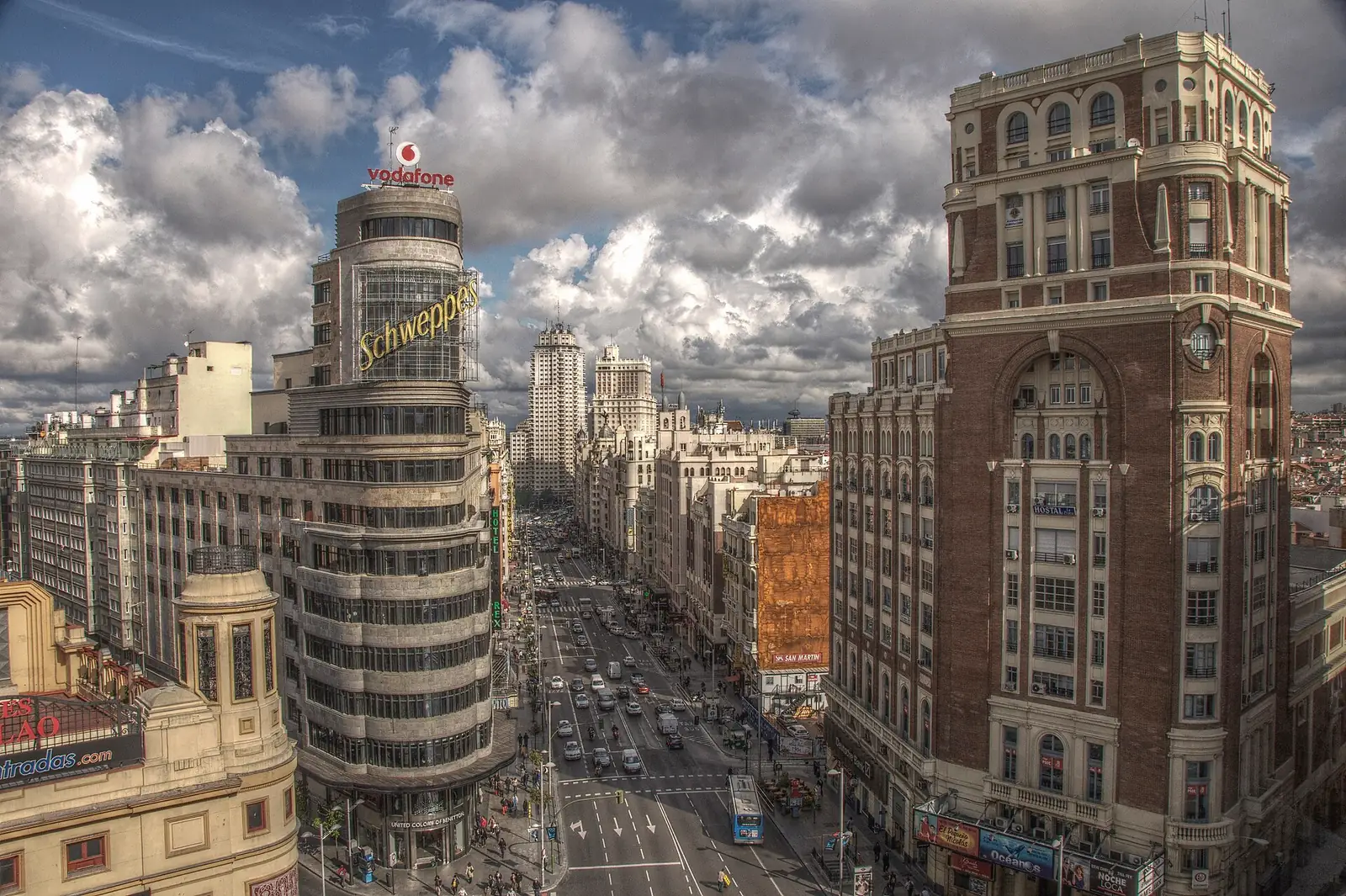
Gran Via, Madrid. Spain hosts the smallest and latest-arriving Albanian community in Western Europe: 6,688 Albanian nationals and 7,585 residents born in Albania on 1 January 2025, and 51.5% of them live in Catalonia rather than the capital. Photo: Felipe Gabaldon / Wikimedia Commons, CC BY 2.0; resized and converted to WebP by dua.com.
On 1 January 2025, Spain counted 6,688 Albanian nationals and 7,585 people born in Albania. More than half of those with Albanian citizenship live in Catalonia. But even these numbers don't tell the whole story.
Spain is one of the places the Albanian diaspora arrived late.
While hundreds of thousands of Albanians were building new lives in Italy and Greece during the 1990s, and communities in Germany and Switzerland had already grown around decades of migration, Spain was barely on the map. In 1998, just 218 Albanian citizens were recorded in the entire country. Even in 2015, there were fewer than 2,000.
Then something changed.
From around 2016, the numbers began climbing quickly. The community grew by 69% in just four years, and 2025 brought more first residence permits than any previous year on record. Today, Albanian life in Spain is still small compared with the big diaspora communities elsewhere in Europe, but it is no longer quite so easy to overlook.
It is also surprisingly difficult to count.
Spain's headline quarterly population statistics do not list Albania separately, placing it inside a broader category instead. Kosovo is even more complicated: because Spain does not recognise Kosovo as an independent state, the datasets used for this page do not provide a separate Kosovo population category. Albanians from North Macedonia, Serbia or Montenegro appear under those countries, while children born in Spain disappear from an Albania-born count altogether.
That's why we won't turn the gaps into a neat number. Spain counted 7,585 Albania-born residents. The wider Albanian community is larger, but nobody can reliably say by how much. This page explains what we know, what we don't, and where the limits of the data actually are.
And behind those numbers is a community trying to find its place.
That's also where dua.com fits naturally into the story. Our mission has always been to bring Albanians closer, wherever life has taken them. In a newer and more scattered diaspora like Spain's, that can mean finding another Albanian in Barcelona or Madrid, staying connected to the culture you grew up with, or meeting someone whose family story feels a little like your own. dua.com isn't a way of counting this community; it's one of the places where parts of it can find each other.
There is another reason Spain deserves its own chapter in the Albanian story. The modern community may be young, but the connection is anything but new. More than five centuries before today's migration began, letters connected to Skanderbeg were already making their way to the Crown of Aragon. Dozens of them have survived in Barcelona's archives since the fifteenth century.
So the Albanian story in Spain begins twice: once in the 1450s, on paper between rulers across the Mediterranean, and again in the 21st century, with a small diaspora quietly putting down roots.
Last evidence review: 27 August 2026. Official statistics, dua.com first-party data, historical record and editorial estimates are labelled separately throughout. Where a number is ours rather than an authority's, we say so.
How many Albanians live in Spain?
6,688. That is the number of Albanian nationals resident in Spain on 1 January 2025, from the Censo Anual de Población, the register-based annual census that INE now publishes in place of the old padrón series. It is an official Spanish figure, published on 2 December 2025, and it is the one to quote.
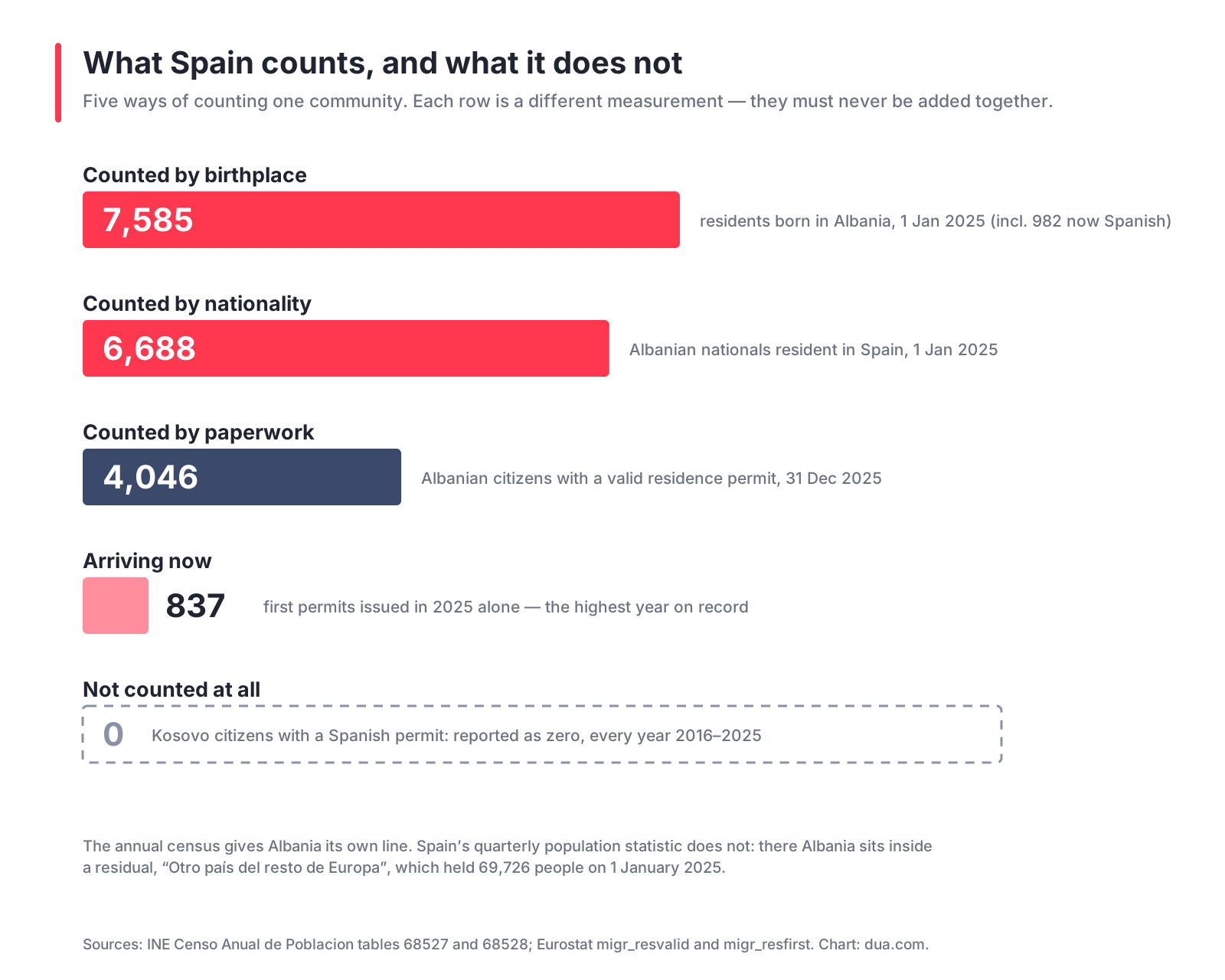
Count by birthplace instead and it rises: 7,585 people living in Spain were born in Albania. The gap is instructive. Of those 7,585, 6,603 are foreign nationals and 982 already hold Spanish citizenship — the first visible cohort of Albanians who have become Spanish.
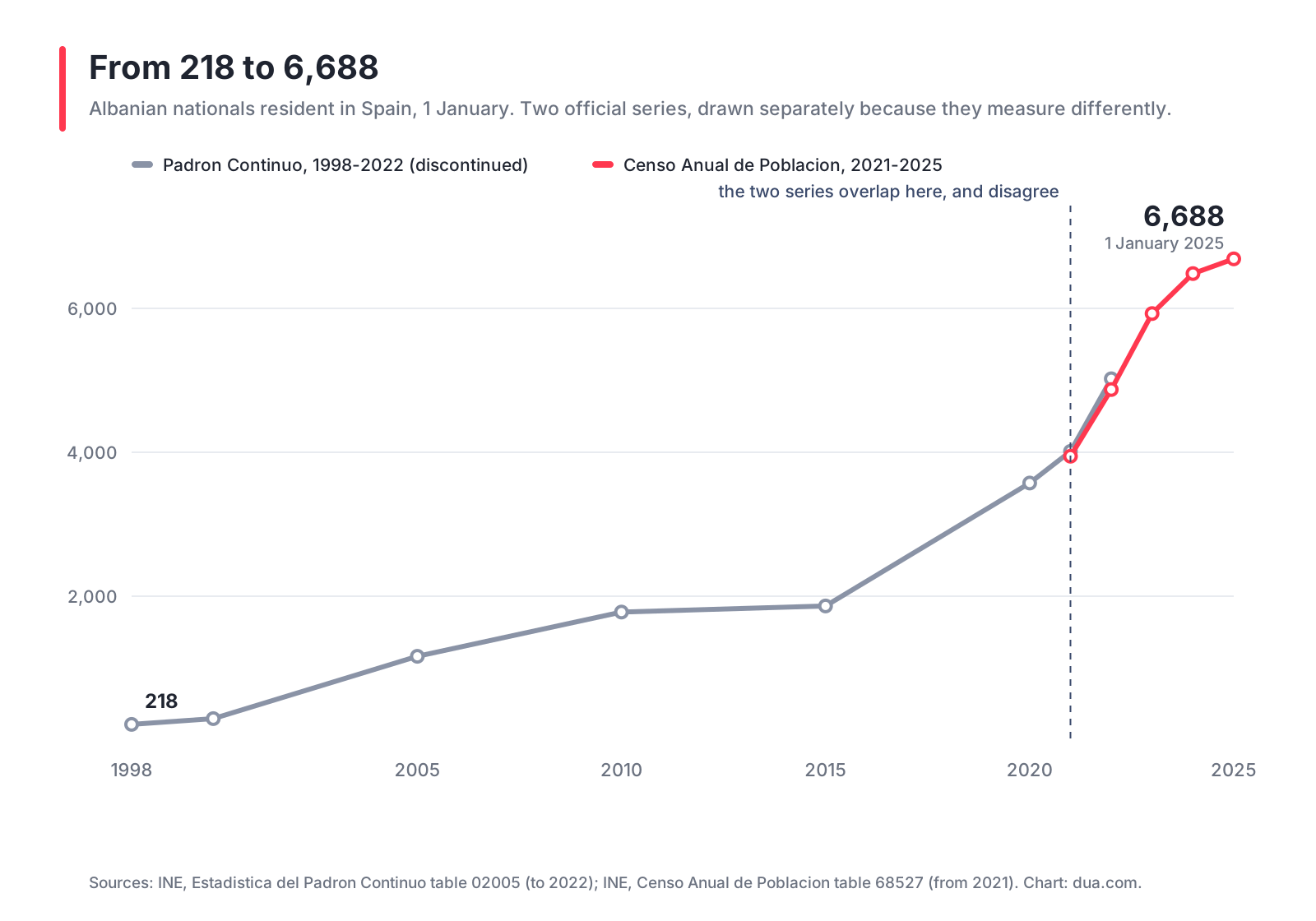
From 218 people to 6,688
In 1998 the Spanish padrón recorded 218 Albanian nationals in the entire country. By 2005 it was 1,165; by 2010, 1,779. Then, remarkably, almost nothing for five years — 1,864 in 2015, because Spain spent those years shedding migrants rather than attracting them. Growth only really began after 2015.
The chart above deliberately draws two lines rather than one, and the reason matters. The Estadística del Padrón Continuo was discontinued; its last reference date is 1 January 2022. The Censo Anual de Población replaced it. The two series overlap in 2021 and 2022 — and they disagree, giving 4,013 against 3,945 for 2021 and 5,022 against 4,872 for 2022. They are not the same measurement, so we do not splice them into a single line, and neither should anyone else.
On the newer series the trajectory is steep: 3,945 (2021), 4,872 (2022), 5,928 (2023), 6,483 (2024), 6,688 (2025) — a 69 percent increase in four years.
Young, and more male than female
The profile is that of a community at its start. Of the 6,688, 3,917 are men and 2,771 women. The mean age is 32.79 years — against a Spanish national mean of 44.55. Albanians in Spain are, on average, close to twelve years younger than the country they live in.
People born in Albania have a higher mean age, 36.73, which is what you would expect when the group includes those who arrived as adults years ago while the nationality count keeps being refreshed by new arrivals.
A different number for a different question: residence permits
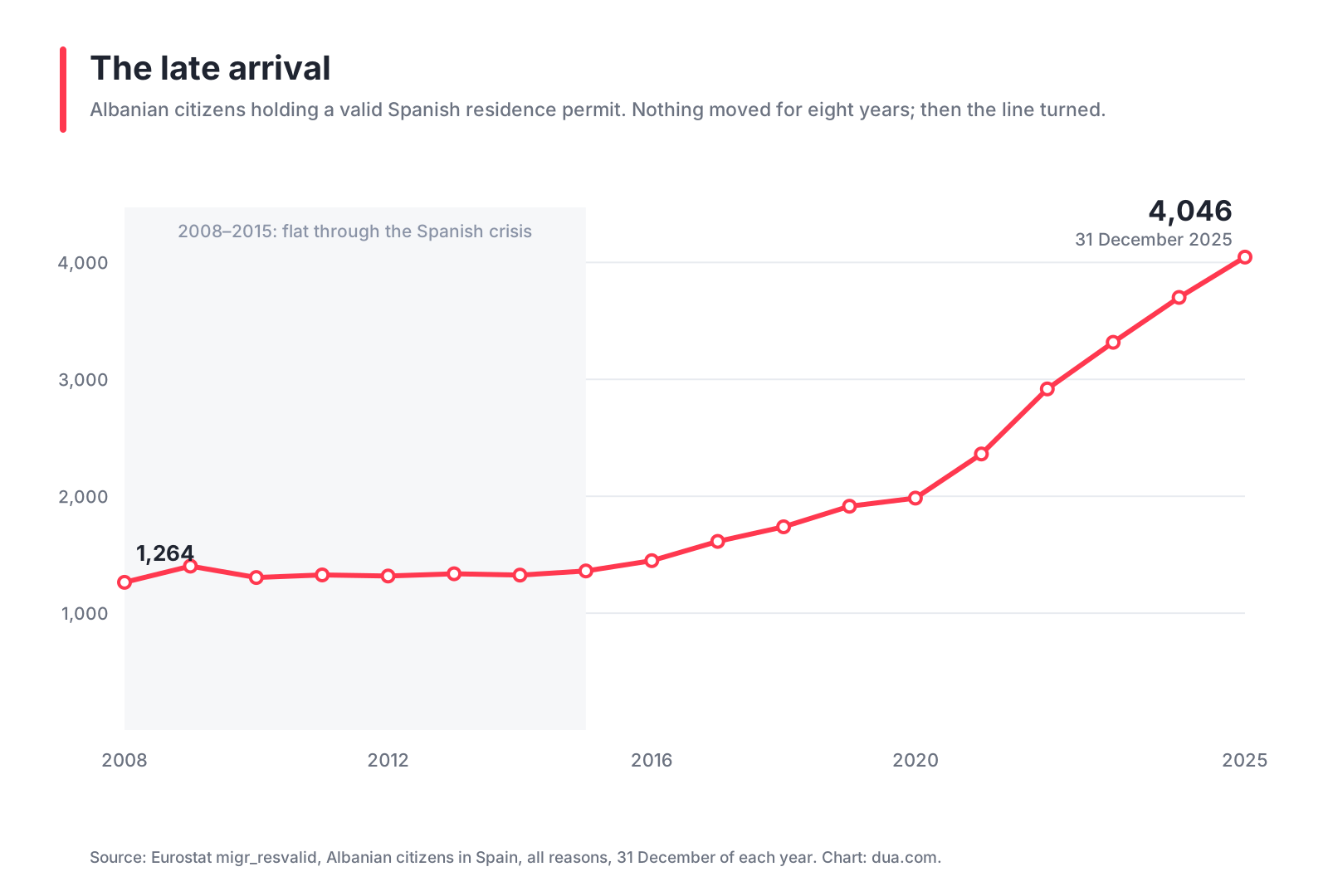
Alongside the census there is a second, narrower count: how many Albanians hold valid Spanish residence documentation. At 31 December 2025 that was 4,046 on Eurostat's harmonised measure, and 3,945 on the Spanish interior ministry's own count — the two do not match exactly, and we report both rather than choosing. By 31 March 2026 the ministry's figure had risen to 4,119.
This is a smaller number than 6,688 for a simple reason: it counts documentation, not people. It cannot see the 982 Albania-born residents who are already Spanish citizens, and it cannot see EU citizens of any kind — though, as the next section shows, that last group turns out to be far smaller than we expected.
The permit series tells the arrival story more sharply than the census does. It was 1,264 in 2008 and did not move for eight years — 1,305 in 2010, 1,326 in 2014, 1,361 in 2015 — then nearly tripled between 2016 and 2025, from 1,449 to 4,046. First permits, which count people arriving rather than staying, reached 837 in 2025: the highest figure on record, and almost seven times the 121 issued in 2010.
So the honest headline is not «there are very few Albanians in Spain». It is that Spain is where the Albanian diaspora arrived last, and is still arriving.
Why they hold the permits they hold
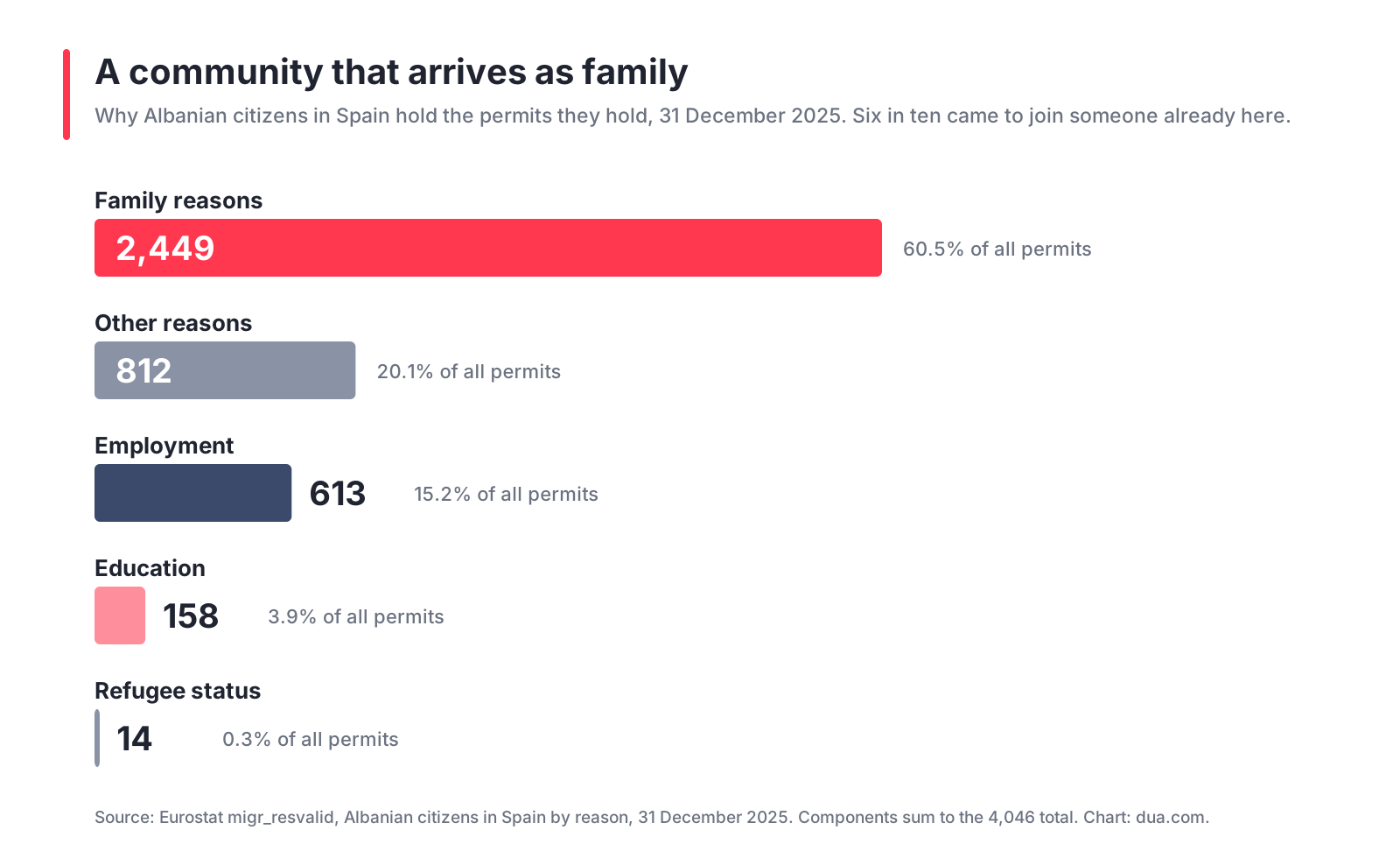
Break the 4,046 permits down by the reason each was granted and the community's character appears immediately.
2,449 of them — 60.5 percent — are family permits. Employment accounts for 613, education for 158, and refugee status for exactly 14 people. Other reasons account for 812 permits. The components sum to the total without a residual, so this is the whole picture and not a sample of it.
That distribution is unusual, and it is worth sitting with. The Albanian communities of Switzerland and Germany were built by labour recruitment; the communities of Greece and Italy were built by a border and a decade of crossings. The Albanian community of Spain is being built by family reunification — person by person, each new arrival joining someone already here. Communities that grow this way grow slowly, then compound.
Where in Spain do Albanians live?
If you guessed Madrid, you'd be wrong.
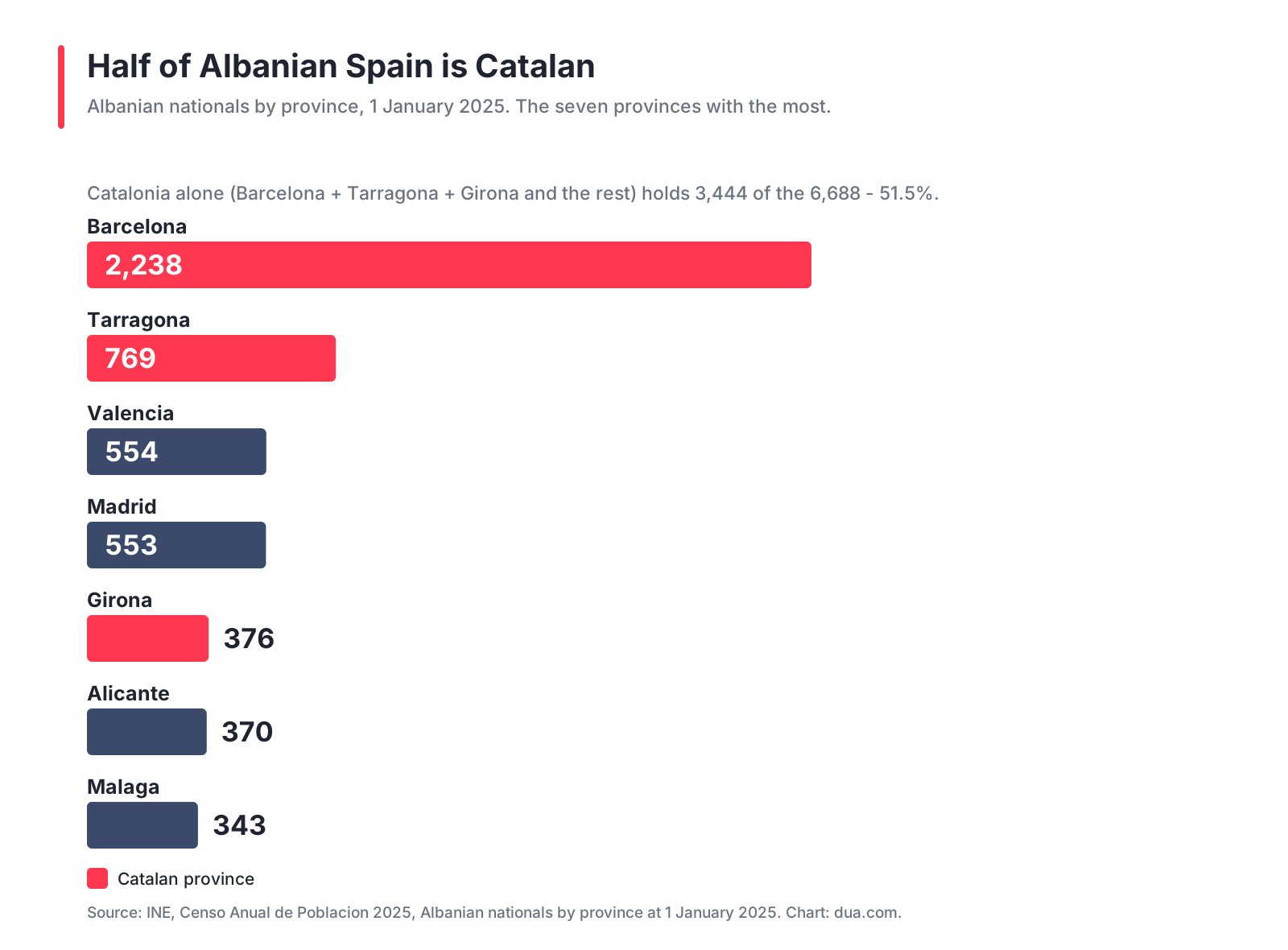
More than half of Spain's Albanian nationals live in Catalonia. On 1 January 2025, the region was home to 3,444 of the country's 6,688 Albanian citizens — 51.5% of the total.
And Barcelona leads by quite a distance.
Barcelona province alone has 2,238 Albanian nationals, roughly four times as many as Madrid province. In fact, Madrid comes only fourth among the provinces, just behind Valencia and well behind Tarragona.
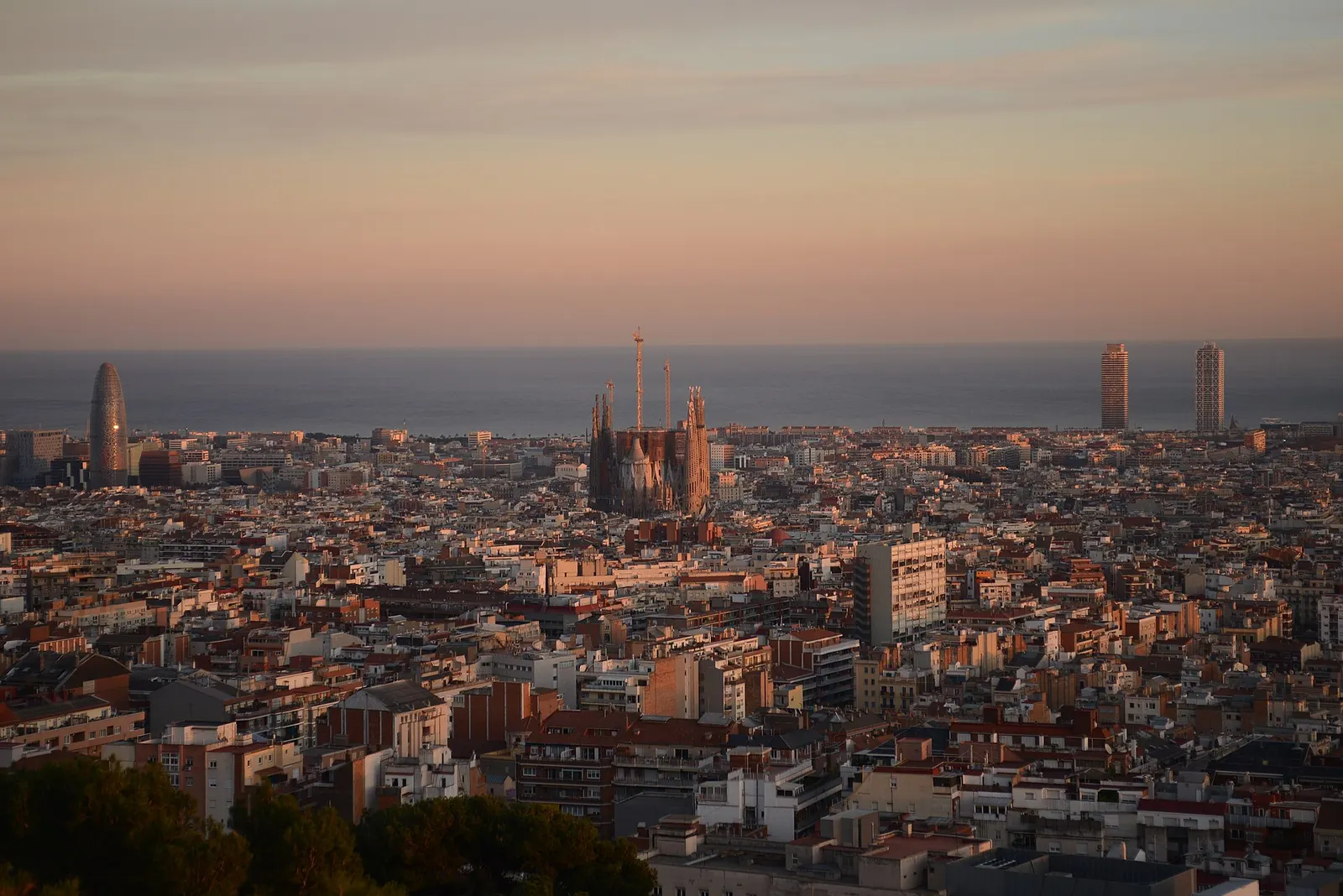
Barcelona from Park Güell. Barcelona province has the largest concentration of Albanian nationals in Spain. Photo: Jcca76 / Wikimedia Commons, CC BY-SA 4.0.
Tarragona is the surprise
Barcelona makes sense. Tarragona is the number that makes you look twice.
Almost 800 Albanian nationals live in Tarragona province, despite the entire national total being fewer than 7,000. Girona adds another 376. Together with Barcelona, those numbers make Catalonia the clear centre of Albanian life in Spain.
Why Tarragona in particular? The statistics can't tell us that. But concentrations like this often grow through personal networks: someone settles somewhere, finds work, brings family, tells a friend that life is good there, and slowly a place that wasn't an obvious destination becomes one.
Spain's family-residence data is consistent with that kind of community growth, although it can't prove the story on its own.
Beyond Catalonia, follow the Mediterranean
Zoom out and another pattern appears.
After Catalonia, some of the largest Albanian populations are in Valencia, Alicante and Málaga. Albanian Spain leans heavily towards the Mediterranean coast, while the numbers become much smaller across much of the interior, north-west and parts of northern Spain.
There isn't one Albanian neighbourhood or even one city that defines the community here. That's very different from diaspora places where generations of migration have created obvious Albanian hubs.
And it changes something as simple as meeting another Albanian.
You might live in Barcelona and already have an Albanian circle around you. You might be in Valencia, Málaga or a smaller Spanish town and know almost nobody. Family introductions and community networks still matter, but they work differently when a diaspora is this young and spread across several parts of the country.
That's one place where dua.com can make the map feel a little smaller. Albanians in Spain can find one another beyond the people they happen to know already — whether that's someone in the same city or elsewhere in the country.
One important thing about this map
These figures are for provinces, not cities, and they count Albanian nationals, not everyone with Albanian roots.
That matters. The nationality figures above don't include the 982 Albania-born residents who had already acquired Spanish citizenship. They also cannot identify the wider groups of Kosovo Albanians, Albanians from neighbouring Balkan countries or Spain-born children of Albanian families.
So we can confidently say that Catalonia is the centre of the measured Albanian population in Spain. What we can't tell you is which Barcelona neighbourhood has the most Albanians, which streets they live on, or exactly how large the wider community around them has become.
The data simply doesn't go that far.
What Spain does not count
Every page in this series has a section about the gap between a community and its statistics. Spain's version of that gap is the widest we have found anywhere, and it has three distinct causes.
1. Whether Albania exists depends on which Spanish statistic you open
The Censo Anual de Población gives Albania its own line, as we have just seen. Spain's other headline population statistic does not.
The Estadística Continua de Población (ECP), the quarterly series most often quoted for Spain's foreign population, publishes a fixed list of 72 nationality categories — Italy, Romania, Morocco, Colombia, Pakistan, Senegal and so on. Albania is not one of them. It falls into a residual called «Otro país del resto de Europa», which held 69,726 people on 1 January 2025.
The same happens at European level. Spain reports about 60 citizenship categories into Eurostat's population statistics, and Albania is not among them: a query for Albanian citizens in Spain returns no observation for any year from 1998 to 2025. Spain does report Albanian residence permits to Eurostat, which is why a permit figure exists where a population figure does not.
None of this is a Spanish failing; it is a reporting threshold, and Albania sits below it. But the practical consequence is real: most of the places a journalist or researcher would naturally look for «Albanians in Spain» return nothing at all, which is a large part of why no reliable figure circulates.
2. The people who became Spanish leave the count
Of the 7,585 people in Spain born in Albania, 982 already hold Spanish nationality — and on the day each of them naturalised they moved from the Albanian row to the Spanish one. Their children, born Spanish, never appeared in an Albanian row at all.
The flow is accelerating: Eurostat records 1,157 Albanian citizens acquiring Spanish nationality between 2002 and 2024 — 11 in 2002, 42 in 2011, 96 in 2020, 131 in 2022 and 144 in 2024. Against a community of under seven thousand this is not yet the hollowing-out that naturalisation has produced in Switzerland or Germany. It is that same process, twenty years earlier in its life.
3. Kosovo does not exist in Spanish statistics at all
This is the part with no equivalent anywhere else in the series, and it is worth stating carefully because it is easy to get wrong.
Spain is one of five European Union member states that have never recognised Kosovo's independence, with Cyprus, Greece, Romania and Slovakia. What is less known is how completely that propagates into the statistical machinery.
INE's official standard list of countries and territories, dated 10 December 2024, assigns Albania code 101, North Macedonia 156, Serbia 157 and Montenegro 158. There is no Kosovo row of any kind — no code, no name, and no mapping to another state «for statistical purposes». The list does carry non-sovereign territories such as Gibraltar, Jersey and the Faroes, each mapped to a recognised state. Kosovo is simply not in it. The interior ministry's residence statistics use the same list and likewise have no Kosovo line.
The residence-permit data says the same thing more starkly. Spain reports permits by citizenship to Eurostat every year, and for Kosovo it reports zero, in every year from 2016 to 2025, across every reason category. Not missing data, which Eurostat marks differently. A reported zero. On the same measure at the end of 2024, Germany reported 246,990 Kosovo citizens, Switzerland 117,263 and Italy 43,230.
One tempting inference has to be ruled out. The interior ministry does publish a residual category called «País no reconocido» — unrecognised country — holding 900 people. It is documented in the published methodology as the destination for Saharawi nationality, not Kosovar. It is not a Kosovo proxy and must not be read as one.
What can be said is where the ceiling sits. The annual census's detailed country list contains Albania and Serbia but no Kosovo, Bosnia, North Macedonia or Montenegro; all of those fall into «Otros países de Europa», which held 4,343 nationals in 2025. That single figure is a hard upper bound on every remaining European nationality in Spain combined — Kosovars among them.
The only place a Kosovo code appears anywhere in Spanish reporting is asylum statistics, and it is barely used: five first-time Kosovar applicants in 2024, and zero in every other year from 2009 to 2025.
Spain has reported exactly zero Kosovo citizens holding a Spanish residence permit, every year for a decade. Kosovars in Spain are not absent. They are unrecordable.
Kosovar Albanians do live in Spain — they study, work, marry and raise children here. They are simply entered into the system as something else: under another citizenship they also hold, under the Serbian code, or inside that European residual. The zero is not a measurement. It is the absence of a category.
The figures on this page — 6,688 Albanian nationals, 7,585 Albania-born residents and 4,046 residence permits — cannot separately identify Kosovo Albanians. Some people with roots in Kosovo may already be included, for example if they hold Albanian nationality or were born in Albania. These categories do not establish how many Kosovo Albanians live in Spain. The practical effects of non-recognition have a section of their own below.
Spain and Kosovo: what non-recognition actually costs
For most of the Albanian diaspora, the Kosovo question is politics. In Spain it is paperwork, and the paperwork reaches into ordinary lives — marriages, birth certificates, university diplomas, residence files.
The position, stated precisely
Spain has never recognised Kosovo's declaration of independence, and had not changed that position as of August 2026. The reasoning has been consistent since Foreign Minister Miguel Ángel Moratinos set it out on 18 February 2008: Spain does not accept unilateral declarations of independence, and considers Kosovo's declaration not to respect international law in the absence of either agreement between the parties or a Security Council resolution. Commentators routinely connect this to Catalonia and the Basque Country; Spain's own formulation stays on the legal ground.
What changed on 1 January 2024 — and what did not
On 1 January 2024, under Regulation (EU) 2023/850, Kosovo passport holders became exempt from the Schengen short-stay visa requirement: 90 days in any 180. This is widely reported as «Spain now recognises Kosovo passports». That is not quite what happened, and the difference matters.
Spain notified the European Commission of a narrow, carefully worded acceptance. The Commission's live table of recognised travel documents carries a Spanish footnote which reads, in full:
“Spain recognises, from 1 January 2024, ordinary passports issued by Kosovo. This change does not constitute, by any means, an official recognition of Kosovo as an independent state.”
European Commission, DG HOME — table of travel documents issued by third countries and territorial entities, based on member-state notifications to 15 August 2026
Two things follow. First, it is the ordinary passport only: Kosovo's diplomatic and official passports remain unrecognised by Spain, as by Romania and Slovakia. Second, Foreign Minister José Manuel Albares said so out loud on 8 January 2024 — Spain's position had not changed, and Spain still did not recognise Kosovo. Before the regulation applied, Spain had said it would not implement visa liberalisation for Kosovo at all. The footnote was the compromise.
So a Kosovar can now board a flight to Barcelona without a visa. That is a real and welcome change. It is also the entire extent of the change.
The apostille problem
Here is where it stops being abstract. The Hague Apostille Convention does not operate between Spain and Kosovo. Spain objected to Kosovo's accession in 2015, and Spain sits on the depositary's list of contracting states for which the Convention did not enter into force with Kosovo.
In practice that means a Kosovo-issued birth certificate, marriage certificate, criminal-record extract or university diploma cannot be apostilled for use in Spain — the apostille has no effect. Nor is there a straightforward Spanish diplomatic legalisation route instead, because there is no Spanish embassy in Kosovo: Spanish consular competence for the territory is assigned to the Spanish Embassy in Skopje, in North Macedonia. And Kosovo has no embassy or consulate anywhere in Spain to help from the other side.
Every ordinary act of settling somewhere — registering a marriage, enrolling a child, having a degree recognised, applying for residence — runs through documents that Spain has no agreed way to authenticate. This page is not able to say how individual cases are resolved in practice, and we found no authoritative current guidance; that in itself is part of the problem. But it is a substantial explanation for why the Kosovar presence in Spain is small, and why the people who are here often arrive holding some other country's passport.
Football, which is where the two countries actually meet
The sporting relationship is better than the diplomatic one, and one story is usually told wrong.
Before the World Cup qualifier in Seville on 31 March 2021, Spanish media reported an approved match protocol that referred to Kosovo only as a «territory». Kosovo threatened to withdraw; the Spanish federation disavowed the protocol; and the match was played under standard FIFA and UEFA protocol, with the usual flag and anthem. Spain had already committed, in November 2018 after a row over a karate event in Madrid, to allow Kosovo delegations their flag and anthem on Spanish soil.
Five months later, on 8 September 2021, the Spanish national team travelled to Pristina and played at the Fadil Vokrri stadium, with Luis Enrique publicly praising the reception. There has been no Spain–Kosovo fixture since. Politics has not entirely left the pitch, though: Spanish parliamentarians voted against Kosovo's Council of Europe membership at the Parliamentary Assembly on 16 April 2024.
One hundred to one
Put Spain beside its neighbours using one dataset, one universe and one date, and the picture is unambiguous.
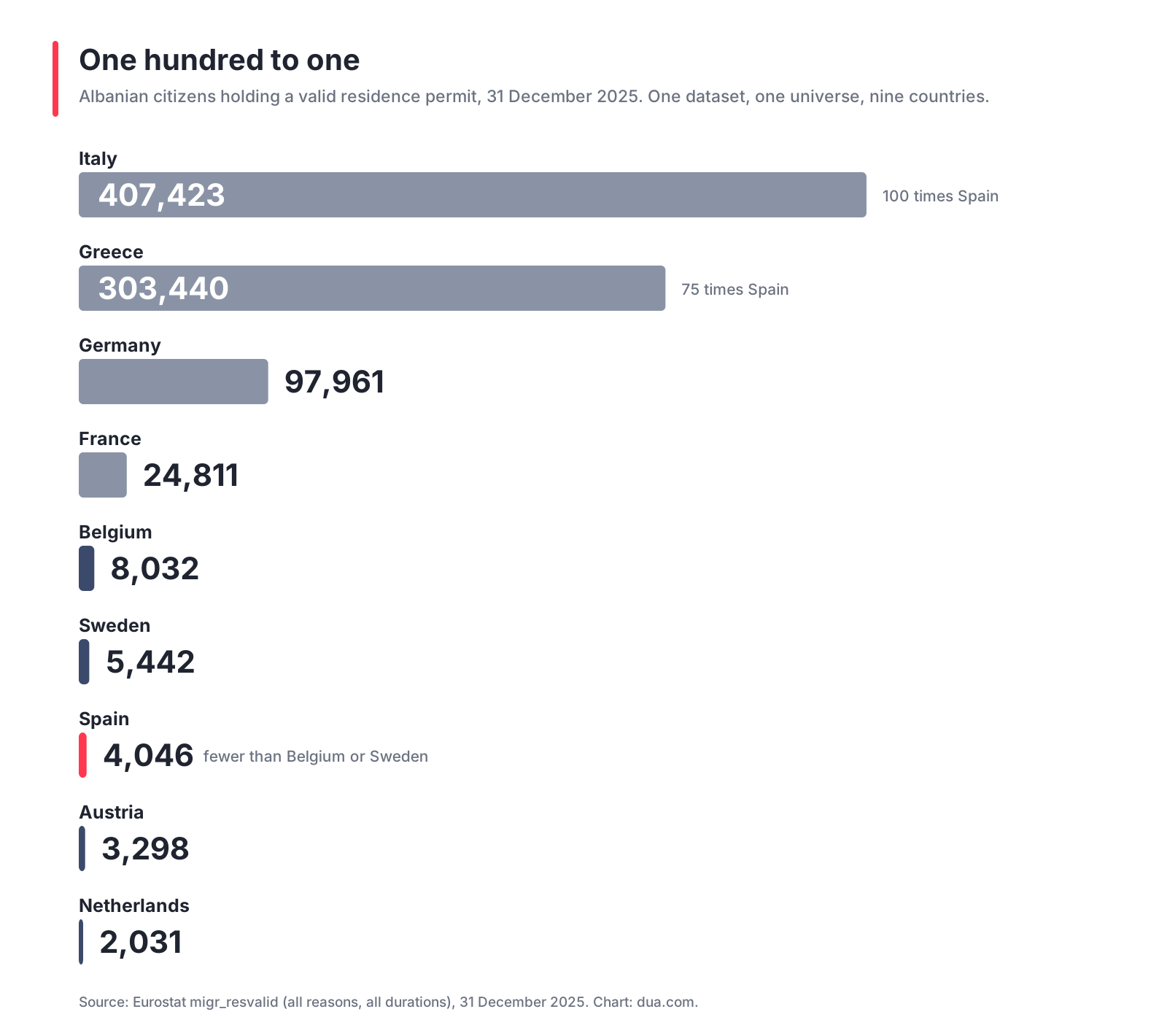
On 31 December 2025, Albanian citizens holding a valid residence permit numbered 407,423 in Italy, 303,440 in Greece and 97,961 in Germany. In Spain: 4,046.
Italy has almost exactly one hundred times as many Albanian permit-holders as Spain, and Greece seventy-five times, on populations that are broadly comparable in size to Spain's. France has six times more. Even Belgium and Sweden — countries with a fraction of Spain's population — have more Albanian permit-holders than Spain does.
This is the single most important fact about Albanian Spain, and it is the reason the rest of this page reads differently from the Zurich or Stuttgart guides. There is no Albanian quarter in Madrid. There is no chain-migration town. What Spain has is something earlier and more scattered: a community at the beginning of itself.
Why the diaspora skipped Spain
Two countries of roughly comparable size, both Mediterranean, both Latin, both booming in the 2000s. Italy has 407,423 Albanian permit-holders. Spain has 4,046. At the 2011 census round the gap was starker still: Greece held 329 Albanian citizens for every one in Spain.
That is not an accident of history to be shrugged at. It has specific, documented causes.
Proximity, language, and the price of getting there
Kosta Barjaba's country profile for the Migration Policy Institute puts the mechanism plainly: for Albanian migrants the decisive factors in choosing a destination were geographical, cultural and linguistic proximity, as well as legal accessibility. Every one of those pointed away from Spain.
Greece shared a land border, and crossing it, as Barjaba notes, did not require a large financial investment — which mattered enormously to people leaving the poorest country in Europe in 1991. Italy was a night's sailing across the Adriatic, and the March 1991 flotillas went to Brindisi and Bari because that is where the boats could reach.
The language part is the most remarkable, and it is worth telling properly. Under communism Albanian television sets received VHF only, so Albanians built illegal aerials and a home-made contraption known as a canoçe to pull in Italian channels. It worked. Research by Nicola Mai found that among Albanians who arrived in Italy on the 1991 boats, 97 percent had watched Italian television regularly and 89 percent said they had learned Italian from it.
So an entire generation grew up already half-fluent in Italian and with a vivid, televised picture of Italy in their heads. Nobody in Albania was watching Spanish television. Spain was not a worse choice than Italy; it was not a choice at all.
And then the legal wall. Albanians needed Schengen visas until December 2010. For the two decades in which the diaspora formed, going to Spain legally meant a visa Spain had no particular reason to grant, and going illegally meant crossing the whole of Europe rather than a strait or a border.
Two explanations, and what the data can tell us
The historical nationality series helps trace the growth of the recorded Albanian-national population. It cannot identify every migration route or follow everyone who changes citizenship.
They did not come for the construction boom. Between 2000 and 2008, Spain's total foreign population grew by about 4.34 million people. Albanians grew by 1,254 — 0.029 percent of the increase. Whatever pulled Romanians, Moroccans and Ecuadorians into Spain in those years did not reach Albania at all.
Onward migration after the financial crisis is a different question. Some Albanians may have moved to Spain after acquiring Italian or Greek citizenship. Spain’s recorded Albanian-national population rose by just 312 people between 2008 and 2015, while Spanish unemployment reached 26.1% in 2013. That shows limited growth in the nationality series during the crisis; it cannot rule out arrivals holding other passports. The literature describes post-2008 onward migration by EU-naturalised Albanians towards Germany, Austria, Belgium and the UK, but does not let this page quantify that route into Spain.
A separate question is how many Albania-born residents hold Italian, Greek or other passports. On 1 January 2025, Spain counted 7,585 residents born in Albania and 6,688 Albanian nationals. Of the Albania-born residents, 982 held Spanish citizenship, leaving 6,603 with a foreign nationality.
Those 6,603 people and the 6,688 Albanian nationals are not the same group. Albanian nationals can have been born in Spain or elsewhere, while Albania-born foreign nationals can hold another country's passport. Comparing the totals cannot tell us how many hold Italian, Greek or other passports, or set a reliable upper limit on that group. That requires a breakdown combining birthplace and citizenship. Albania-born residents with another passport are already included in the 7,585 and must not be added again.
What actually happened is more recent, and duller
The real growth is post-2015: Albanian nationals in Spain rose 169 percent between 2015 and 2022, and have kept climbing since. That timing lines up with three things that have nothing to do with the 1990s — visa-free travel from December 2010 finally making Spain reachable, Spain's economy recovering while Albania's emigration pressure stayed high, and, from 2021, direct flights.
Albanian Spain is not a diaspora that failed to grow. It is a diaspora that started thirty years after the others, and is growing now.
The oldest Albanian archive in Spain is medieval
There is a paradox at the centre of this page. Spain has one of the smallest Albanian communities in Western Europe — and one of the oldest and best-documented Albanian connections of any European state. Both things are true, and they belong to different centuries.
In the Archive of the Crown of Aragon in Barcelona there are more than forty documents on Albania, written between 1447 and 1457: chancery registers, letters, instructions to officers. They are the single richest surviving administrative record of Skanderbeg's dealings with a Western power, and they have been in Barcelona for five and a half centuries.
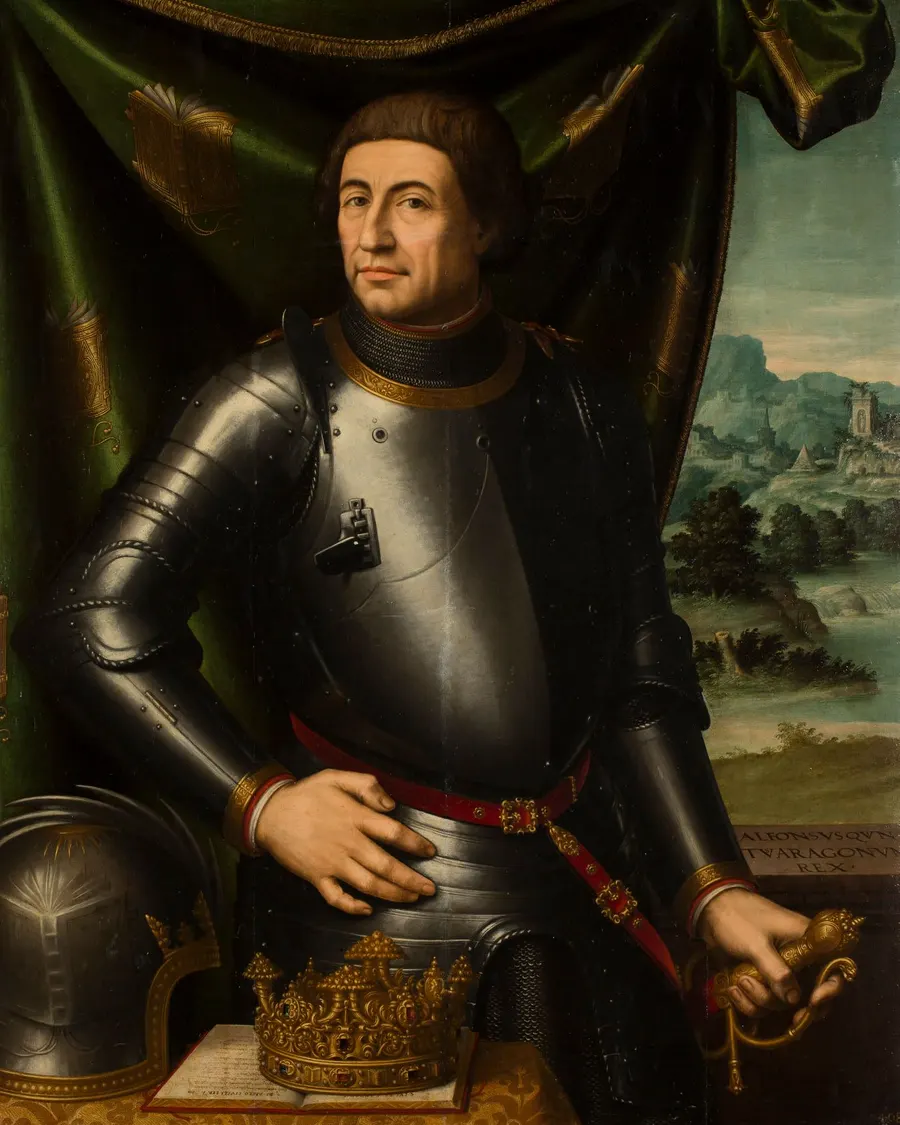
Alfonso V of Aragon, «the Magnanimous» — King of Aragon from 1416 and of Naples from 1442, and Skanderbeg's patron. Portrait by Juan de Juanes, c.1557. Public domain, via Wikimedia Commons.
What the Treaty of Gaeta actually said
First, a correction that matters, because the popular version of this story is wrong. Skanderbeg did not sign a treaty with Spain. In 1451 there was no Spain. Castile and Aragon were separate crowns and would not be joined until Ferdinand and Isabella. The man Skanderbeg dealt with was Alfonso V of Aragon, called the Magnanimous — King of Aragon from 1416, and from 1442 also King of Naples and Sicily. The treaty's own heading styles him king of Aragon and of Sicily on both sides of the Faro. Spain is what those crowns later became.
The Treaty of Gaeta was concluded on 26 March 1451. Alfonso did not sign it personally; his protonotary Arnaldo Fonolleda signed in his name. Skanderbeg was represented by two churchmen — Stefan, the Orthodox Bishop of Krujë, and the Dominican Nikollë de Berguçi, a Catholic. That an Orthodox bishop and a Catholic friar negotiated together on behalf of the same Albanian prince is worth noticing on its own.
The terms: an oath of fidelity to the Aragonese crown; an undertaking that any city in danger would be handed to the Neapolitan crown; tribute to be paid to Alfonso once the Albanian lands were freed of the Ottomans, with autonomy and self-government retained; and salt to be bought only from Alfonso's warehouses, at the price the Ottomans charged.
Whether this made Skanderbeg an ally or a vassal is a live argument among historians, and this page does not settle it. The scholar Gjon Berisha, working from the published text, points out that the vassalage and tribute clauses were conditional on a victory that never came, and that Krujë's tribute obligation continued a chain of earlier grants rather than creating a new subjection. Others read the oath of fidelity plainly. The honest position is that the document supports both readings, which is why the argument has lasted.
A related dispute: whether Skanderbeg ever paid anything. Fan Noli found no trace of a cash tribute in the Neapolitan archives, and noted that the money ran the other way — Alfonso paid Skanderbeg an annual pension of 1,500 gold pieces. Marinescu records loot, banners, horses and captives sent after victories as a token tribute. Both accounts are in the literature; we are not aware of evidence that resolves them.
A Catalan viceroy in Krujë
What Alfonso actually delivered was smaller than the legend and stranger than the legend. On 23 May 1451 he wrote that he was sending two officers and one hundred infantry, with food and supplies, to Krujë under Bernat Vaquer, a royal commissioner, who took the castle over on behalf of the Kingdom of Naples. One hundred men. Not an army.
The following April, something more remarkable happened. Alfonso appointed Ramon d'Ortafà, a Catalan noble from Roussillon, as his viceroy in Albania, based at Krujë; the additional title covering Greece followed in 1454. Ortafà rebuilt the walls, fortified Cape Rodon, installed another Catalan — Pere Escuder — as castellan, and was authorised to strike coin at Krujë bearing Alfonso's effigy and the cross of Saint George. The funds came from Aragonese saltworks revenue.
For a few years in the 1450s, in other words, a Catalan governed in an Albanian fortress and money was minted there in an Aragonese king's name. It is the deepest that Iberian and Albanian history has ever been entangled, and almost nobody in either country knows it happened.
The largest commitment ended badly. In May 1455 Alfonso agreed to send 1,200 infantry and 500 knights with siege artillery for an attack on Ottoman-held Berat. The siege failed in July 1455 and the Neapolitan corps was destroyed — around eight hundred of the thousand Neapolitan specialists were killed. Alfonso died at Naples on 27 June 1458, and the Aragonese crusade project died with him.
Skanderbeg repays the debt in Italy
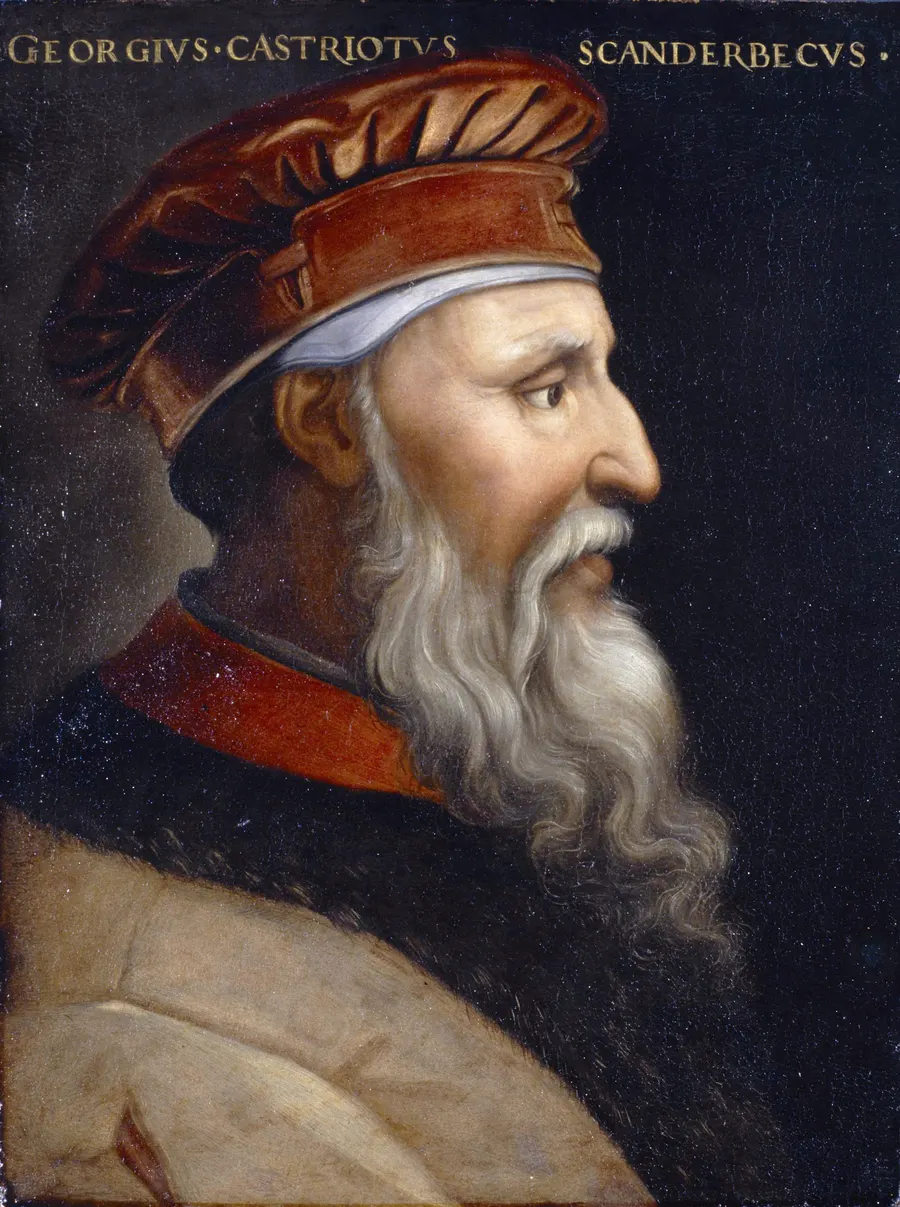
Gjergj Kastrioti Skanderbeg, painted by Cristofano dell'Altissimo for the Uffizi series. Public domain, via Wikimedia Commons.
Alfonso's son Ferrante inherited Naples and, almost immediately, a war for it against the Angevins. Skanderbeg came to his aid — and the popular version of this story is wrong too, in three separate ways worth correcting.
It was not a single expedition in 1461. It ran from 1460 to 1462, and it began with 500 cavalry under Skanderbeg's nephew Kostandin Kastrioti, sent on 17 September 1460. Skanderbeg himself came later.
He did not personally raise the siege of Barletta. The Angevins lifted it on 24 August 1461, when Ivan Strez Balshiq landed with 500 horse and 1,000 foot and they feared Skanderbeg had arrived. He was at Ragusa that day, and reached Barletta on 3 September.
And he did not win the battle of Orsara. His own victory was at Seggiano, on a hill between Troia and Lucera, over Jean d'Anjou; Trani was taken by a ruse on 28 December 1461. He left Apulia for Albania in January 1462. Ferrante's decisive victory between Orsara and Troia came on 18 August 1462, seven months after Skanderbeg had gone home, and Albanian participation in it is not documented.
What he did do was enough. Pontanus, writing in De Bello Neapolitano, judged the Albanian landing essential to Ferrante keeping his kingdom. Ferrante paid it back in land: Monte Sant'Angelo and San Giovanni Rotondo, and 1,200 gold pieces a year. Those estates in Apulia are where the Kastrioti family went after Albania fell.
The Arbëresh centuries — and one claim this page will not make
The Albanian villages of southern Italy and Sicily — the Arbëresh — were founded, in the main, inside territory ruled by the Crown of Aragon and then by the Spanish Habsburgs. Sicily was Aragonese from 1282 and passed to Charles V in 1516; Naples was Aragonese from 1442. Hassiotis dates the mass emigration that formed the Albanian-speaking substrate to the first decades of the fifteenth century — before Skanderbeg, not after him — and the settlers were placed in villages emptied by plague and by the great earthquake of 1456.
The Spanish crown's dealings with them are documented and concrete. At the petition of the «griegos, albaneses y esclavones» of the kingdom, Charles V issued patents at Barcelona on 25 February 1519 protecting their position. Albanian captains entered Spanish service: Lázaro Mates left Albania at the end of the fifteenth century, became a captain of cavalry under Ferdinand the Catholic in Naples and founded a family of stradioti who served the Spanish crown for generations. Between 1516 and 1520 Charles V confirmed Alfonso Castriota-Granai as Marquis of Atripalda, made him governor of Bari and Otranto, and licensed him to build three casali and settle them. After the imperial fleet abandoned Coron in 1534, Charles V granted the Greek and Albanian refugees exemption from duties in any of his kingdoms, and paid them pensions and wheat.
But here is the claim this page will not make, because we checked it and it is wrong: the Spanish crown did not grant the Arbëresh the right to keep the Byzantine rite. That came from the papacy — Paul III's bulls of 1536 and 1544, Clement VIII's Instructio super ritibus Italograecorum of 31 August 1595, Benedict XIV's Etsi pastoralis of 1742 — and, locally, from charters agreed with feudal and archiepiscopal lords. What Spain gave was land, tax exemptions, wheat and military commissions. It is a real relationship. It is not the one usually described.
We should also flag a number that circulates freely and should not. The claim that 8,000 refugees from Coron settled in Naples and Sicily in 1534 is rejected by the specialist who edited the archival record: judging from the alms registers, Floristán counts around 85 beneficiary heads of household in 1535–36, and Hassiotis roughly 150–200 heads of family. At four or five people per household that is well under two thousand, not eight.
Albanians in Spain itself: thin, but not empty
Almost all of the above happened in Italy, under Spanish crowns. Albanians in Iberia are much harder to find, and we found no evidence of any Albanian settlement in Spain proper in this period. What is documented is presence rather than settlement.
Spanish military lexicography defines the estradiote as a mounted soldier of Albanian origin, and records that on 20 July 1507 a new corps of estradiotes joined the Spanish cavalry. In 1569 Demetrio Ferigo, of a leading Coron family, travelled to Madrid as procurator of his community and was granted an ayuda de costa of 25 ducats. And Giorgio Basta (1550–1607), born near Taranto to an Arbëresh stradioti family, began his career in the Spanish Army of Flanders before becoming one of the Habsburg empire's senior generals.
The modern relationship is younger than most people assume
Then, for three hundred years, essentially nothing — and the modern relationship is remarkably recent.
Spain recognised Albania as a sovereign state in 1922; the Albanian embassy in Madrid dates mutual recognition to 27 August 1922. But formal diplomatic relations between modern Spain and Albania were established only on 12 September 1986, after first informal contacts in 1977 — later than almost any comparable pair of European states.
Albania opened its first embassy in Madrid on 22 June 1995, when Zef Simoni presented his credentials to King Juan Carlos I; it is at Calle Lagasca 68. Spain's resident embassy in Tirana is younger still: created by royal decree in January 2006 and opened on 18 July 2006. Before that, Albania was covered from Belgrade until 1993 and from Rome until 2006.
Read that sequence next to the residence-permit curve at the top of this page and the two fit together exactly. Spain and Albania have only had a working, resident, everyday relationship since 2006. The community arrived on the same schedule as the paperwork.
The people: Albanian Spain is mostly a football story
No list of names stands in for a community. But in Spain the names are unusually concentrated, and the concentration is itself evidence. Where the Zurich guide can point to politicians, rappers, a world champion kickboxer and a festival, Albanian Spain is visible almost entirely in one place: the football pitch. That is what a community of four thousand looks like from outside — not a neighbourhood, but a handful of individuals who arrived on professional contracts.
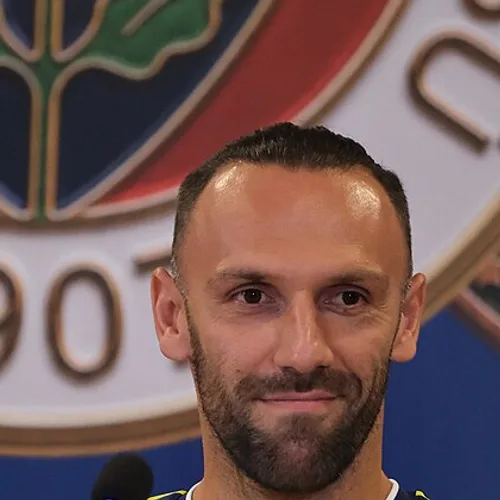
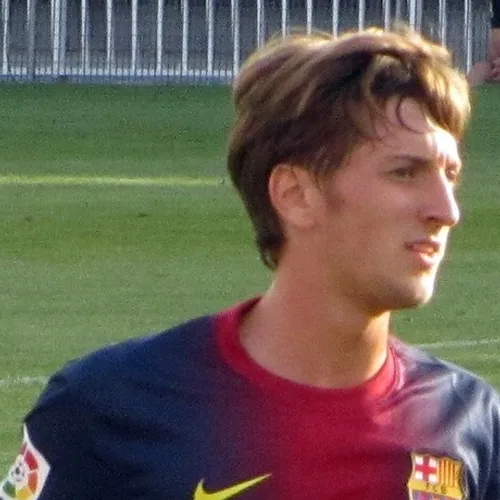
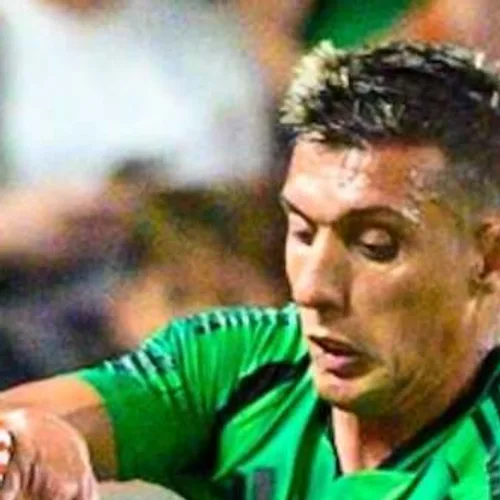
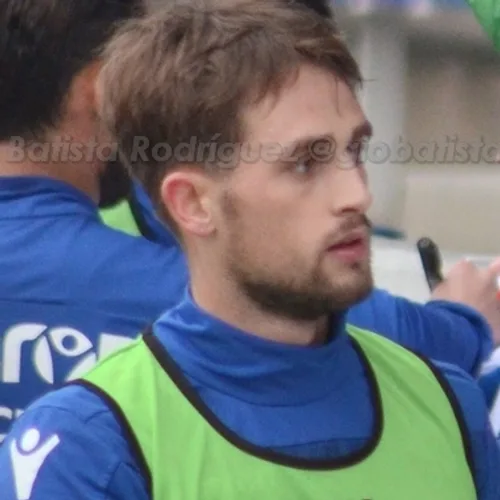
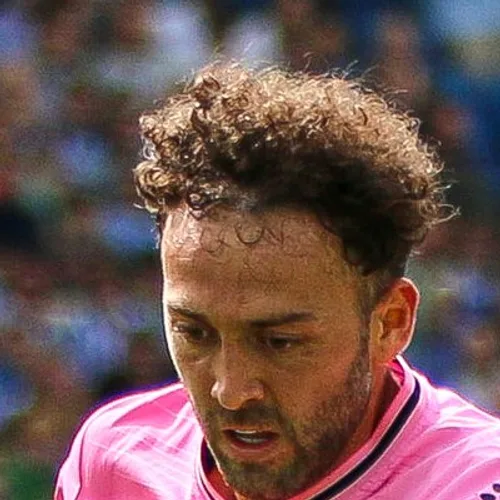
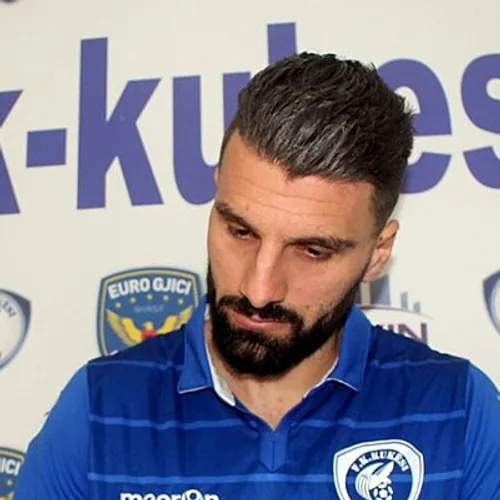
Vedat Muriqi Mallorca’s all-time top-flight scorerIván Balliu Born in Catalonia · La Masia · plays for AlbaniaMyrto Uzuni Pichichi of the Segunda, 2022–23Adnan Januzaj Nine seasons in La LigaKosovare Asllani Scored Real Madrid Femenino’s first goalKeidi Bare First Albanian to wear the Atlético shirtValdet Rama The first Albanian in La Liga, 2013
Photos via Wikimedia Commons: Vedat Muriqi — Zafer (CC BY 4.0); Iván Balliu — Javier Segura (CC BY 2.0); Myrto Uzuni — u/reepers_hellcat (CC BY 4.0); Adnan Januzaj — Giovanni Batista Rodriguez (CC BY-SA 2.0); Kosovare Asllani — Real Madrid (CC BY 3.0); Keidi Bare — jamesboyes (CC BY 2.0); Valdet Rama — Sadamiinzhjikss (CC BY-SA 4.0).
Iván Balliu: the surname that came back
If this page has a single emblematic figure, it is Iván Balliu Campeny, and the reason is that he is not an immigrant at all — and neither, it turns out, was his father.
He was born on 1 January 1992 in Caldes de Malavella, a town of six thousand people in the province of Girona. He came through Girona's youth system and then La Masia, Barcelona's academy. He played for Spain at under-16 and under-17 level. And in 2017, as a grown man, he declared for Albania.
How he got there is contested, and the contested version is the more interesting one. English-language reference works describe an Albanian father. Balliu himself has told it differently in the Spanish press: that his father was born in Catalonia and his mother is Catalan — her surname is Campeny — and that he learned only at around twenty-four that the Albanian line in his family was a tatarabuelo, a great-great-grandfather. The Albanian federation, by his account, came to him after noticing the surname. We flag the discrepancy rather than resolving it; what both versions agree on is that Balliu grew up entirely Catalan.
He made 54 Segunda appearances for Barcelona B, spent 2019–21 at Almería, and joined Rayo Vallecano on 14 July 2021, where he has since made 145 La Liga appearances — far more top-flight football in Spain than any other Albania international.
Read that against everything else on this page and it lands hard. To find an Albanian footballer who was already in Spain, Albania had to reach back four generations to a surname. In Switzerland or Germany the national team picks from tens of thousands of second-generation kids. In Spain there was no second generation to pick from — because there had been no first one.
Vedat Muriqi: the record that belonged to Eto'o
Vedat Muriqi, born in Prizren on 24 April 1994 to ethnic Albanian parents, arrived at RCD Mallorca on loan on 31 January 2022 and permanently that July. What followed is the largest thing an Albanian has done in Spanish football.
On 12 April 2026, scoring twice in a 3–0 win over Rayo Vallecano, Muriqi reached 55 La Liga goals for Mallorca — passing Samuel Eto'o's 54 to become the club's all-time leading scorer in the Spanish top flight. He finished 2025–26 with 23 league goals, two short of the Pichichi. Mallorca were relegated anyway, finishing eighteenth, and he left for Fenerbahçe on 19 June 2026.
A Kosovar from Prizren holds the top-flight scoring record at a club Samuel Eto'o once led. That fact sits oddly beside the other fact on this page — that Spain officially records zero Kosovo citizens holding a residence permit.
Myrto Uzuni: the Pichichi from Berat
Myrto Uzuni, born in Berat on 31 May 1995, signed for Granada CF on 31 January 2022 and made his La Liga debut a week later, away to Real Madrid. In 2022–23 he scored 23 goals in 38 matches and won the Trofeo Pichichi of the Segunda División as the division's top scorer.
He is often said to have won the Zarra Trophy. He did not, and could not: the Zarra goes only to the highest-scoring Spanish player. The Pichichi is the one open to everyone, and it is the one he won.
On 8 December 2024, with a brace against Racing de Santander, Uzuni became the highest-scoring foreign player in Granada's history — 46 goals in 103 official matches, passing Morocco's Youssef El Arabi. He left for Austin FC on 24 January 2025 for a reported $12.3 million, a record for the Texan club.
The rest of the roster
Valdet Rama, born in Mitrovica in 1987, was the first Albanian ever to play in La Liga — debuting for Real Valladolid on 9 March 2013 against Málaga, and later the first to score in it. Thirty-one appearances over two seasons; a small career, and a first.
Adnan Januzaj, born in Brussels in 1995 to Kosovar Albanian parents, has had the longest Spanish career of any of them: five seasons at Real Sociedad from July 2017, then Sevilla from 31 August 2022 until 1 July 2026 — nine consecutive seasons in Spain.
Keidi Bare, born in Fier on 28 August 1997, is the academy story. Atlético Madrid signed him on 26 December 2013 after a trial at a tournament in Tbilisi where he was named best midfielder. On 10 January 2017 he came on in the 78th minute for Ángel Correa in a Copa del Rey tie against Las Palmas — the first Albanian to wear the Atlético Madrid shirt. He made two senior appearances for the club, both in the cup, and never a La Liga match for them. His real Spanish career came afterwards: Málaga, then RCD Espanyol from 2020 to 2024 with 105 league appearances and a Segunda title in 2020–21, then Real Zaragoza until he left Spain for Greece in August 2026.
Kosovare Asllani — born in Kristianstad, Sweden, on 29 July 1989 to a family from Koshutovë in Leposavić, Kosovo, with a double-headed eagle tattooed on her ankle — belongs on this page for one reason. She signed for CD Tacón on 18 July 2019, the first signing of the side that became Real Madrid Femenino, and on 11 October 2020, with a header away to Valencia, she scored the first goal in Real Madrid Femenino's history, earning the section its first point. She made 63 league appearances and scored 24 goals before joining Milan in 2022.
Others passed through: Marash Kumbulla, born near Verona to parents from Shkodër, on loan at Espanyol in 2024–25 and Mallorca in 2025–26; Armando Sadiku, whose La Liga career was six appearances for Levante in 2017–18 — the Málaga and Las Palmas spells often attributed to him were in the Segunda; Rey Manaj, at Granada, Albacete and Barça Atlètic, registered with Barcelona's first team for 2021–22 but never capped by it in a competitive match; and, earliest of all, Ervin Fakaj of Vlorë, who played five Segunda matches for CD Toledo in 1997–98.
Beyond football: a laureate, a stadium tour, and an honest gap
Spain gave Albanian literature its most prestigious Iberian honour. Ismail Kadare won the Premio Príncipe de Asturias de las Letras in 2009, announced in Oviedo on 24 June and presented that October, the jury citing the beauty and depth of his literary work.
In music the connection is commercial rather than communal, but it is real. Dua Lipa's Radical Optimism reached number one on the Spanish albums chart in 2024; Future Nostalgia is certified double platinum in Spain. She sold out the Palau Sant Jordi in Barcelona on 1 June 2022 — 18,342 tickets — and the WiZink Center in Madrid two nights later, and opened the European leg of the Radical Optimism Tour at Madrid's Movistar Arena on 11 and 12 May 2025, singing Enrique Iglesias's «Héroe» in Spanish on the first night and Manu Chao's «Me Gustas Tú» on the second. Ava Max, of Albanian parentage, took «Sweet but Psycho» to number 18 in Spain and double platinum.
One popular story does not survive checking: Dua Lipa and Rosalía have never released or announced a collaboration. The rumour rests on the two being photographed at a Los Angeles studio in December 2023.
And one gap should be stated rather than filled. We searched in Spanish, English and Albanian for Albanian-origin chefs, academics, entrepreneurs or fighters resident in Spain with real press coverage, and found none we could document to the standard this page uses. That is not a claim that no such people exist — in a community this size they will — only that Spanish public life has not yet noticed them. In every other country in this series, it already had.
Community life: an absence that can be documented
Every other page in this series has a directory. Zurich has mosques, a football club, two travel agencies twenty metres apart and Europe's biggest Albanian festival. Stuttgart has a consulate, an Islamic centre, a students' association and a Catholic mission. For Spain we went looking for the same thing, and what we found is worth reporting precisely because of how little there is — and because the emptiness is documented, not merely unfound.
On 27 August 2026 we checked four public registers, two Albanian state directories and Kosovo's own diplomatic list. Here is what they say.
One association, and no sign of it since 2017
Albania's National Diaspora Agency maintains a directory of Albanian organisations worldwide. For Spain it lists exactly one: the association «Shqiptarët në Spanjë» / Asociación de los Albaneses en España, whose registration the Albanian Embassy in Madrid welcomed in a notice dated 6 April 2017. The directory entry is a single line: a street in Madrid, a Gmail address, no phone, no website.
We found no evidence of any activity by it since 2017 — no site, no press coverage, no event.
The comparison is the point. The same directory lists 41 organisations for Italy, 32 for Greece, 30 for Croatia and 29 for the United States. For Spain, one.
The regional registers say the same thing from the Spanish side. Catalonia's register of legal entities — 90,623 active entities, refreshed on 12 August 2026, covering the region with the largest Albanian population in Spain — contains no Albanian community association at all. The Comunidad de Madrid register, 22,458 rows, likewise returns none.
What those registers do contain are two things it would be easy to mistake for Albanian community bodies, and which are not. The Associació Catalana d'Amics d'Albània, registered in Barcelona on 21 June 1989, is a Catalan friends-of-Albania society. Asociación Casa Balcanes, Madrid, 2013, is explicitly pan-Balkan. Neither is a diaspora organisation, and this page does not count them as one.
One honest limit: Spain's national association register could not be queried on the day we checked, so we cannot say whether the 2017 association is registered nationally. We can only report what the regional registers and the Albanian state directory show.
One Albanian class in the whole country
Albania's publications centre for the diaspora lists the addresses where Albanian-language classes are taught abroad. In Spain there is one: at the Centro Social Comunitario Josefa Amar, Calle de Matilde Landa 30, in Tetuán, Madrid.
The same directory lists 75 addresses for Switzerland, 65 for Greece, 52 for Sweden, 49 for Germany, 45 for Italy and 44 for England. Spain is joint last, with Ireland.
That single number explains more about the future of this community than any population figure. Language transmission is what turns a set of migrants into a diaspora, and in Spain the infrastructure for it consists of one room in Madrid.
No Albanian religious institution of any kind
Spain's Registro de Entidades Religiosas, kept by the Ministry of Justice, returns no Albanian entity. There is no Albanian mosque, no Albanian Catholic mission — unlike Switzerland, Germany and Austria — and no Albanian Orthodox parish; the Orthodox assembly of bishops for Spain and Portugal has no Albanian jurisdiction.
This is the sharpest contrast in the whole series. In Zurich the community's first institution was a mosque, in 1987, and religious life became the frame that everything else hung on. In Spain that frame has never been built.
The events are the embassy's, not the community's
Albanian public life in Spain does exist, but it is diplomatic rather than communal. The embassy in Madrid held a reception for the 113th anniversary of independence on 24 November 2025 at the Gran Meliá Fénix; a culinary reception around the November holidays in 2024; and an evening of Albanian literature at the Círculo de Bellas Artes in Madrid for the ninetieth anniversary of Ismail Kadare's birth, reported in May 2026.
We found no Dita e Verës celebration anywhere in Spain, and the Albanian pop circuit — which fills halls in Zurich, Stuttgart, London and Stockholm every year — skips the country entirely.
Business, media, and Kosovo's missing scaffolding
One Albanian-run business in Spain could be verified with press coverage: «Oda», opened in December 2025 in Puig d'en Valls, Ibiza, by Dorel Hepaj and his Catalan partner Alba. We could not verify an Albanian restaurant or bakery in Madrid or Barcelona. Two Madrid and Barcelona establishments that appear in searches — one Balkan, one whose name merely resembles the word — are not Albanian, and we have left them out. Online, Albanian Spain amounts to a Facebook page and a Facebook group; there is no Albanian-language media based in the country.
And there is a structural reason for part of this that connects straight back to the Kosovo section. Kosovo's official directories of embassies and consular posts do not list Spain at all. In Germany, Switzerland and Sweden, Kosovo's consulates are a large part of the scaffolding that diaspora associations, schools and cultural events are built around. In Spain there is no consulate, no diaspora-ministry channel, and therefore none of the scaffolding.
One association with no trace since 2017. One language class. No mosque, no mission, no parish. This is not a community that has failed to organise. It is a community that has not yet reached the size at which organising begins.
Eight routes and one language class
Here is the paradox that defines Albanian Spain in 2026. The community has one association with no visible activity since 2017, one Albanian-language class and not a single Albanian religious institution. And yet Spain and Albania are now joined by eight scheduled air routes across three airlines, none of which existed six years ago.
The infrastructure of connection has arrived years ahead of the community that would normally build it. That is the single best explanation for the permit curve at the top of this page.
How Spain and Albania got connected
Almost all of it is Wizz Air, which built a base at Tirana and used it to open Spain city by city:
Barcelona — the first, announced 23 June 2021 and flying from 31 July 2021.
Madrid — announced 11 August 2021, flying from December 2021.
Valencia — from 6 June 2024, with Wizz the first airline ever to operate the route.
Málaga — from 27 October 2025.
Santander — from 29 March 2026.
Palma de Mallorca — from 23 June 2026.
All six were live and bookable when we checked on 27 August 2026. Spanish carriers followed. Iberia opened Madrid–Tirana on 28 March 2024 with A320neos, though it has stayed a seasonal summer route rather than going year-round as the airline suggested it might. Vueling flew to Albania for the first time on 2 July 2025, four times a week from its Barcelona hub.
One correction, because aggregator sites repeat it: Ryanair does not fly between Spain and Albania. Its Tirana base, announced in August 2025 with three aircraft and ten new routes, includes no Spanish city.
The traffic is mostly Spaniards going the other way
The corridor is not, for the most part, Albanians travelling to Spain. It is Spanish tourists discovering the Albanian coast.
Spain's foreign ministry put the number at approximately 110,000 Spanish tourists visiting Albania in 2025, describing the increase as exponential and noting that demand for Spanish-language teaching in Albania had grown enough to interest the Instituto Cervantes. At a Turespaña event in Tirana in May 2026, Spain's ambassador gave figures of roughly 100,000 Spanish visitors to Albania against about 40,000 Albanians travelling to Spain. These are official estimates offered in speeches rather than a published table — Albania's statistical office does not publish arrivals by country of citizenship — and we report them as such.
The Spanish presence runs the other way too, in capital: the Mallorcan hotel group Meliá opened a resort at Durrës in May 2023, inaugurated with Prime Minister Edi Rama and Meliá's chief executive both present.
Trade, students, and one thing that does not exist
The trade balance is a surprise. In 2024 Spain imported $136.9 million from Albania and exported $94.6 million to it — Albania runs a persistent surplus with Spain. Seventy-two percent of what Spain buys is crude and mineral fuels; the largest single thing Spain sells to Albania is ceramic tiles, at $22.2 million.
Students are few but the trend is unmistakable: Eurostat counted 99 Albanian degree-mobile students in Spain in 2024, up from 44 in 2019 — and 72 percent of them are on master's or doctoral programmes. This is not undergraduate drift; it is people arriving with degrees already in hand.
And one absence worth naming, because it shapes everything above. Spain has no labour-migration agreement with Albania. Spain maintains formal convenios de flujos migratorios laborales with exactly seven countries, and Albania is not among them. There is no recruitment channel, no seasonal-worker scheme, no institutional route into the Spanish labour market. Which is precisely why six in ten Albanian permits in Spain are family permits: with no work channel, the way in is somebody already here.
How Albanians in Spain find each other
A community of this size and this shape has a specific problem, and it is not the one people assume. It is not that Albanians in Spain are isolated from Spaniards. It is that they are scattered too thinly to run into each other.
When friends and relatives live in different parts of the country, meeting another Albanian can take a little more effort. People keep in touch through family, visits home and community networks. Online connections can help bridge the distance between those circles.
2,978 people in Spain were members of dua.com in our snapshot of 27 July 2026. That is our own first-party figure: a count of accounts on one platform, not a census. It cannot be compared with the population or residence-permit figures to estimate the size of the Albanian community or the share using dua.com. It shows one place where people in Spain can find a connection.
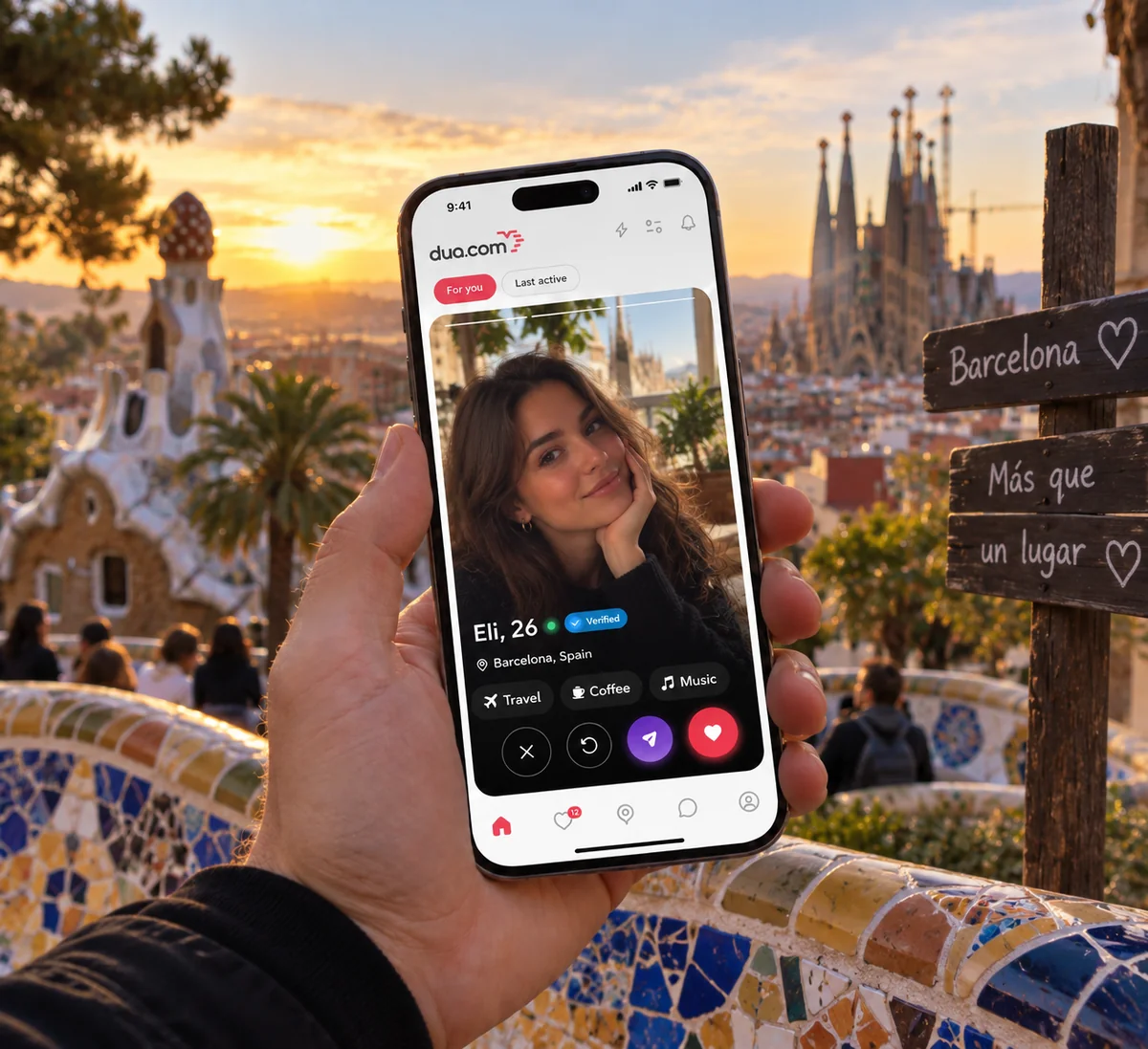
Finding a familiar connection in Barcelona. Editorial illustration supplied for dua.com; not demographic evidence.
dua.com is the dating and community app for Albanians worldwide, with over a million registered members across 178 countries. It was built for exactly the situation this page describes: people who share a language and a set of expectations about family, spread across places where there are not enough of them to find one another by accident.
Elsewhere in this series
Albanians in Italy — 407,423 permit-holders and a very large naturalised population beyond them. A hundred times the size of Albanian Spain, and the destination that got the migration Spain never did.
Albanians in Greece — the other great 1990s destination, and the other passport route into Spain.
Albanians in Switzerland — Europe's densest Albanian community, and the clearest contrast with this page: mosques, clubs, schools and a festival, all built by a community that arrived forty years earlier.
Albanians in Germany — a million people, and 309,435 Kosovo citizens counted in a statistical system that has a category for them.
Albanians in the Netherlands — the closest comparison in size, and a country that publishes far more about its Albanian residents than Spain does.
Evidence ledger: what each number can and cannot support
Every figure on this page belongs to one measurement universe. Adding numbers from different rows of this table together produces nonsense, and most published claims about Albanians in Spain do exactly that. This is the ledger.
Figure
What it measures
What it cannot see
Source and date
6,688
Albanian nationals resident in Spain
Albania-born residents who are now Spanish; Kosovar Albanians; Albanian speakers holding other citizenships
INE, Censo Anual de Población table 68527, 1 Jan 2025
7,585
Residents of Spain born in Albania (6,603 foreign + 982 Spanish)
Their Spain-born children; ethnic Albanians born outside Albania
INE, Censo Anual de Población table 68528, 1 Jan 2025
3,444 / 51.5%
Albanian nationals living in Catalonia
Anything below province level; no municipal breakdown is published
INE, Censo Anual de Población 2025, by province
4,046
Albanian citizens holding a valid Spanish residence permit
Naturalised Spaniards; EU citizens of Albanian origin; Kosovar citizens; anyone irregular
Eurostat migr_resvalid, 31 Dec 2025
837
First residence permits issued to Albanian citizens during 2025
Arrivals who needed no permit; re-entries; internal EU moves
Eurostat migr_resfirst, calendar year 2025
2,449 / 60.5%
Of those 4,046 permits, the number granted for family reasons
Why anyone actually moved; motives are not recorded, only permit categories
Eurostat migr_resvalid by reason, 31 Dec 2025
1,157
Albanian citizens who acquired Spanish nationality, cumulative 2002–2024
Their children born Spanish; anyone who naturalised before 2002; dual nationals counted once
Eurostat migr_acq, summed 2002–2024
0
What Spain reports for Kosovo citizens holding permits, every year 2016–2025
Everything. It is the absence of a category, not a measurement of people
Eurostat migr_resvalid, citizenship XK, geo ES
69,726
Everyone in the ECP residual «Otro país del resto de Europa». The ECP has no Albania line; the annual census does
How many of them are Albanian — the category is not broken down
INE, Estadística Continua de Población, table 56936, 1 Jan 2025
407,423 / 303,440
Albanian permit-holders in Italy and Greece, for scale
Naturalised Italians and Greeks of Albanian origin — both far larger than the permit rows
Eurostat migr_resvalid, 31 Dec 2025
2,978
dua.com members located in Spain in our own snapshot
Anyone not on dua.com; it is a platform count, not a population estimate, and is not comparable to any official row above
dua.com first-party data, 27 Jul 2026
At least 7,585; wider total not reliably measurable
The directly counted Albania-born population already reaches 7,585. The wider Albanian-speaking community also includes groups Spanish statistics cannot isolate, including Kosovo Albanians, Albanian speakers from neighbouring Balkan countries and some Spain-born descendants
No defensible total can be calculated from the available categories
INE baseline + dua.com editorial assessment, Aug 2026
What we can count — and what remains invisible
The clearest starting point is 7,585 people born in Albania and living in Spain on 1 January 2025. That figure already includes 982 people who had acquired Spanish citizenship, so it captures more of the established Albania-origin population than nationality alone.
But it is still not a count of Spain's entire Albanian community. Several groups remain partly or completely outside that number. Others, including Albania-born residents with another passport, are already included but cannot be identified separately from this total:
Albanians from Kosovo. Spain does not publish a separate Kosovo population category in the datasets used here, so their number cannot be isolated reliably.
Albanians holding another citizenship. Some Albania-born residents may hold Italian, Greek or another passport. They are already included in the birthplace count. Comparing the nationality and birthplace totals cannot establish how many hold each passport or a reliable upper limit for this group.
Albanians from North Macedonia, Serbia and Montenegro. They appear, where recorded, under those countries rather than under an Albanian ethnic category.
Spain-born descendants. Children born in Spain do not appear in the Albania-born count, and Spanish population statistics do not provide an Albanian-ethnicity category that would allow them to be added back.
For that reason, 7,585 is best treated as a measured demographic floor, not as an estimate of the whole Albanian-speaking community. The real community is larger, but the available Spanish data does not support a defensible upper estimate. Birthplace itself is not a measure of ethnicity.
What the evidence does show is scale: Spain's Albanian community remains relatively small compared with those in Italy, Greece, Germany or Switzerland. What it does not justify is turning the unmeasured groups above into a precise population total.
Frequently asked questions about Albanians in Spain
⌄
How many Albanians live in Spain?
Spain counted 6,688 Albanian nationals and 7,585 residents born in Albania on 1 January 2025. The birthplace figure is the broader of the two and includes 982 people who had already acquired Spanish citizenship.
Neither number represents Spain's entire ethnic-Albanian or Albanian-speaking community. Kosovo Albanians cannot be isolated in the relevant Spanish statistics, while Albanian speakers from North Macedonia, Serbia and Montenegro and Spain-born descendants appear under other categories.
For that reason, 7,585 is the clearest measured floor available, but there is no reliable official total for the wider Albanian community in Spain.
⌄
Where in Spain do Albanians live?
Overwhelmingly in Catalonia, which holds 3,444 of the 6,688 Albanian nationals — 51.5 percent. Barcelona province alone has 2,238, four times as many as Madrid. The full top seven at 1 January 2025 is Barcelona 2,238, Tarragona 769, Valencia 554, Madrid 553, Girona 376, Alicante 370 and Málaga 343. Spain's capital comes fourth, which is unusual for any migrant group in Spain. No Spanish source publishes a municipal breakdown for a community this small, so there is no official answer to which neighbourhood of Barcelona is the Albanian one.
⌄
Why are there so few Albanians in Spain?
Because the diaspora's routes were fixed before Spain was an option. Italy is a short crossing from the Albanian coast and Greece shares a land border, and both absorbed enormous numbers during the 1990s; Germany and Switzerland had recruitment channels and existing Kosovar networks. Spain had none of those, and no everyday diplomatic relationship either — Spain and Albania only established formal relations in 1986, Albania opened its Madrid embassy in 1995, and Spain's resident embassy in Tirana opened in 2006. Once chain migration sets a direction it reinforces itself, and Spain was simply not the direction. The population count reflects it exactly: 218 Albanian nationals in the whole of Spain in 1998, 1,779 in 2010, and still only 1,864 in 2015.
⌄
Is the Albanian community in Spain growing?
Yes, and faster than anywhere else in the series. Albanian nationals in Spain rose from 3,945 to 6,688 between 2021 and 2025 — a 69 percent increase in four years — and residence permits nearly tripled between 2016 and 2025, from 1,449 to 4,046. First permits — new arrivals rather than renewals — reached 837 in 2025, the highest figure on record and almost seven times the 2010 number. Naturalisations are climbing too: 144 Albanians became Spanish citizens in 2024, against 11 in 2002.
⌄
Does Spain recognise Kosovo?
No. Spain is one of five EU member states that have never recognised Kosovo's independence, alongside Cyprus, Greece, Romania and Slovakia, and that position was unchanged as of August 2026. Spain's stated reasoning, set out by Foreign Minister Miguel Ángel Moratinos on 18 February 2008 and repeated since, is that it does not accept unilateral declarations of independence. What changed on 1 January 2024 was narrower than usually reported: Spain notified the European Commission that it accepts Kosovo's ordinary passport, in a footnote that states the change «does not constitute, by any means, an official recognition of Kosovo as an independent state». Kosovo's diplomatic and official passports are still not recognised.
⌄
Can Kosovars travel to Spain without a visa?
Yes, since 1 January 2024. Under Regulation (EU) 2023/850, holders of a biometric Kosovo passport can enter the Schengen area, Spain included, without a visa for 90 days in any 180-day period. Documents are a different matter: because Spain objected to Kosovo's accession to the Hague Apostille Convention, an apostille on a Kosovo birth certificate, marriage certificate or diploma has no effect in Spain, and there is no Spanish embassy in Kosovo — Spanish consular competence for the territory sits with the embassy in Skopje. Kosovo has no embassy or consulate in Spain.
⌄
Who is the most successful Albanian footballer in Spain?
By record, Vedat Muriqi. On 12 April 2026 the Prizren-born striker scored twice against Rayo Vallecano to reach 55 La Liga goals for RCD Mallorca, passing Samuel Eto'o's 54 to become the club's all-time leading scorer in the Spanish top flight. Myrto Uzuni won the Trofeo Pichichi of the Segunda División in 2022–23 with 23 goals and became Granada's highest-scoring foreign player ever. Iván Balliu, born in Catalonia to an Albanian father and formed at La Masia, has made more La Liga appearances than any other Albania international. And Valdet Rama was the first Albanian ever to play in La Liga, for Real Valladolid on 9 March 2013.
⌄
Did Skanderbeg have a connection with Spain?
Not with Spain, which did not yet exist — but with the Crown of Aragon, which later became part of it. On 26 March 1451 Skanderbeg's ambassadors concluded the Treaty of Gaeta with Alfonso V of Aragon, who was also King of Naples and Sicily. Alfonso sent two officers and a hundred infantry to Krujë that May, and in 1452 appointed a Catalan, Ramon d'Ortafà of Perpignan, as his viceroy in Albania; coin was struck at Krujë bearing Alfonso's effigy. Skanderbeg later returned the favour with a campaign in Italy between 1460 and 1462 in support of Alfonso's son Ferrante. More than forty documents on Albania from 1447 to 1457 survive in the Archive of the Crown of Aragon in Barcelona.
⌄
Is there an Albanian embassy in Spain?
Yes. Albania's embassy in Madrid is at Calle Lagasca 68, and it opened on 22 June 1995, when the first resident ambassador, Zef Simoni, presented his credentials to King Juan Carlos I. Modern diplomatic relations between the two countries were established on 12 September 1986, and Spain's own resident embassy in Tirana opened only on 18 July 2006 — before that, Albania was covered from Belgrade and then from Rome.
⌄
How do Albanians in Spain meet each other?
Through relatives, community networks, visits home and online connections. In a young community spread across several parts of Spain, those circles do not always overlap. 2,978 people in Spain were members of dua.com in our snapshot of 27 July 2026. This is a dated count of platform accounts, not a population estimate or a measure of how much of the Albanian community uses the app.
Editorial methodology: Spain’s quarterly population series does not publish Albania separately, so this guide uses the annual census and other clearly defined official measures. The headline counts - 6,688 Albanian nationals and 7,585 residents born in Albania at 1 January 2025 - come from INE's Censo Anual de Poblacion (tables 68527 and 68528), the register-based annual census that replaced the discontinued Padron Continuo; the two series overlap in 2021-22 and disagree, so they are charted as two segments and never spliced. A narrower universe, valid residence documentation, gives 4,046 at 31 December 2025 (Eurostat migr_resvalid) and excludes Kosovar citizens, EU citizens of Albanian origin and anyone irregular. Albania-born residents with Italian, Greek or other passports are already included in the birthplace figure; comparing 6,603 Albania-born foreign nationals with 6,688 Albanian nationals cannot establish the exact passport breakdown. Residence permits, first permits, naturalisations, national population categories and dua.com platform data are four different universes and are never added together; the evidence ledger sets out what each can support. The 7,585 Albania-born residents form the clearest measured demographic floor, already including 982 Spanish citizens. Birthplace is not ethnicity, and the wider Albanian-speaking community has no reliably measurable total or defensible upper estimate. Spain's absence of a Kosovo category was verified directly against the INE metadata API on 27 August 2026 across four separate country and nationality classifications. Historical claims were checked against the published archival literature, and several widely repeated errors - that Skanderbeg signed a treaty with Spain, that he won the battle of Orsara, that the Spanish crown granted the Arbereshe their rite, that Myrto Uzuni won the Zarra Trophy - are corrected in the text rather than repeated.
We use cookies to enhance your browsing experience, serve personalized ads or content, and analyze our traffic. By clicking "Accept All", you consent to our use of cookies.