Stuttgart’s Albanian story does not fit inside Stuttgart.
There is no single official number for how many Albanians live here. The district-level data used on this page records citizenship, not ethnicity or language. What it does show clearly is that the community extends far beyond the city limits.
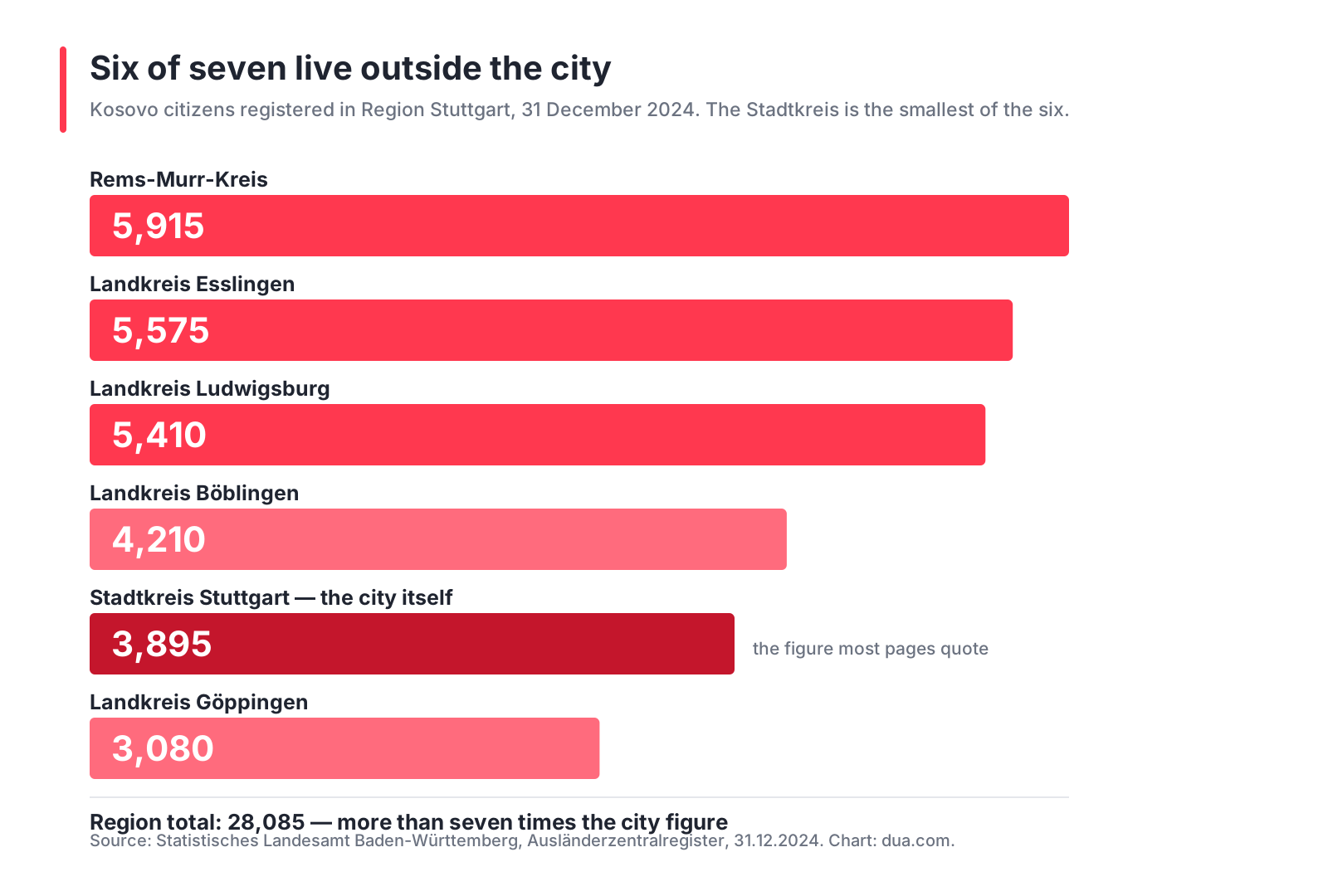
On 31 December 2024, Germany’s central foreigners register counted 3,895 Kosovo citizens in the city of Stuttgart and 28,085 across Region Stuttgart, the six-district region comprising the city and five surrounding districts. About six out of every seven Kosovo citizens in the region live outside the Stadtkreis, across Rems-Murr-Kreis and the districts of Esslingen, Ludwigsburg, Böblingen and Göppingen.
For more on this topic, read Albanians in America: A Community Estimated at 750,000 to 1 Million and Albanians in Copenhagen: A Community Beyond the Numbers.
That distinction matters. Looking only at Stuttgart’s city limits misses most of the regional Kosovo-citizen population, as well as naturalised Germans of Albanian origin who no longer appear in Kosovo, Albanian or North Macedonian citizenship statistics. This page therefore starts with Region Stuttgart and works inward. Wherever the available data cannot tell us exactly how many Albanians live here, we say so and distinguish official counts from our own calculations.
Last evidence review: 16 August 2026. Every figure on this page carries its reference date and its source; where a number is ours rather than an authority’s, we say so.
How many Albanians live in Stuttgart?
There is no official number, and the available statistics do not support a precise estimate.
German population statistics record citizenship rather than Albanian ethnicity or language. That matters particularly in Stuttgart, where the community includes people with roots in Kosovo, Albania, North Macedonia and elsewhere in the Balkans, as well as naturalised German citizens and later generations born in Germany.
What is actually counted
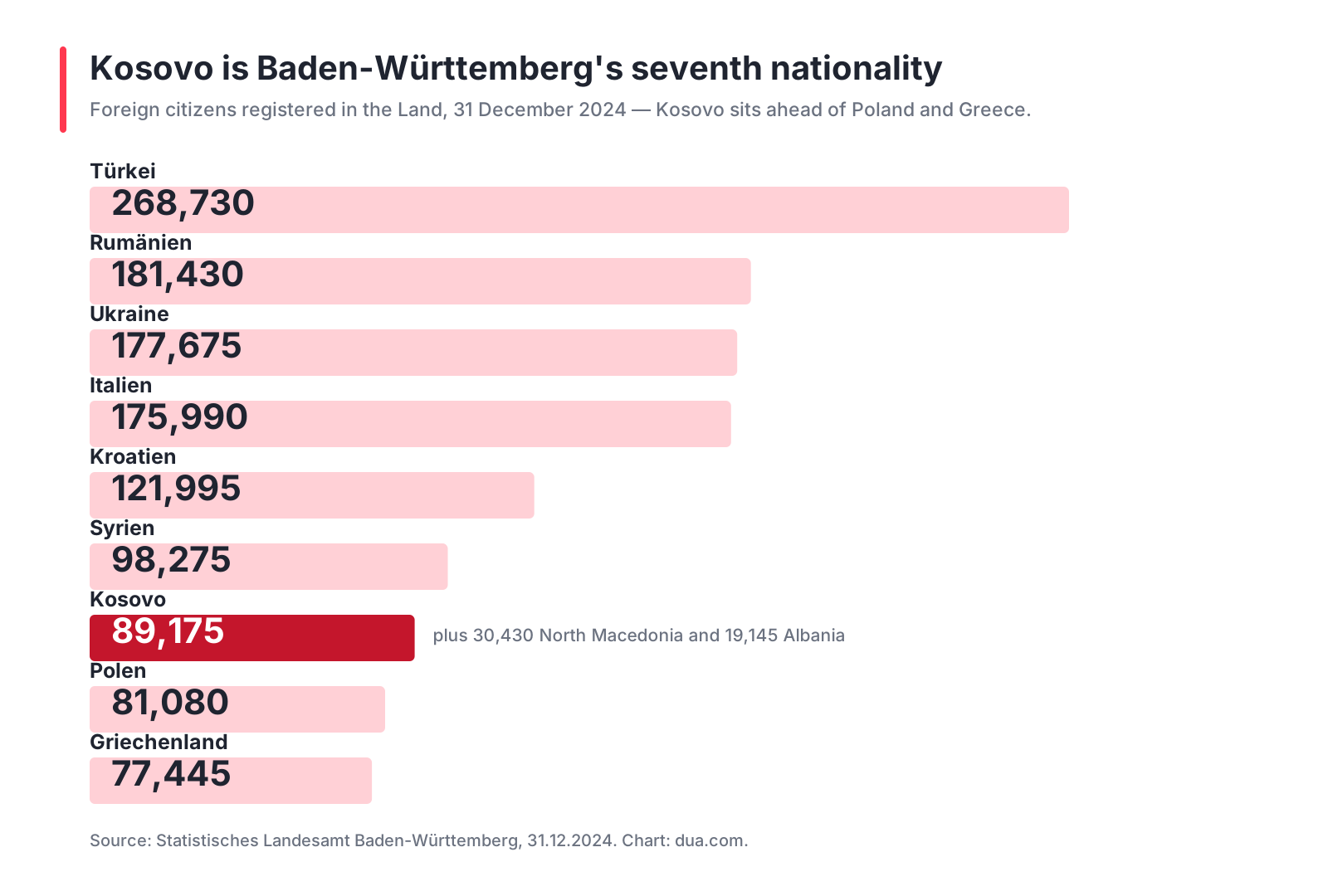
The base source is the Statistisches Landesamt Baden-Württemberg’s report on the foreign population at 31 December 2024, drawn from the Ausländerzentralregister. It gives citizenship counts down to district level. For Baden-Württemberg as a whole it records 89,175 Kosovo citizens, 30,430 from North Macedonia and 19,145 from Albania, inside a total foreign population of 2,188,075. Kosovo is the state’s seventh-largest foreign nationality, behind Türkiye (268,730), Romania (181,430), Ukraine (177,675), Italy (175,990), Croatia (121,995) and Syria (98,275), and ahead of Poland and Greece.
At the end of 2024, 3,895 Kosovo citizens lived in the city of Stuttgart. Across the wider Region Stuttgart, the number reached 28,085. These figures show the scale and geography of one major part of the community, but they should not be read as a count of Albanians: not every Kosovo citizen is ethnically Albanian, while many people of Albanian origin no longer appear in foreign-citizenship statistics at all.
North Macedonian citizenship adds another layer. There were 1,635 North Macedonian citizens in Stuttgart and 8,100 across the region. Ethnic Albanians make up a substantial part of North Macedonia’s population, so some of these residents belong to Stuttgart’s Albanian-speaking community. The German data does not tell us how many.
Albanian citizens form another part of the picture. The state report counts 19,145 across Baden-Württemberg, but the cited Stuttgart statistics do not publish a separate city figure. The available data therefore cannot support scaling these separate citizenship groups into a reliable Albanian population total.
The six districts of Region Stuttgart
Region Stuttgart is the Stadtkreis plus five Landkreise, and on the Kosovo line the city ranks fifth of the six. The North Macedonia column, which includes an Albanian-speaking population that the citizenship data cannot separate, ranks it second.
| District | Kosovo citizens | Share of region (our arithmetic) | North Macedonia citizens |
|---|---|---|---|
| Rems-Murr-Kreis | 5,915 | 21.1% | 915 |
| Landkreis Esslingen | 5,575 | 19.9% | 1,365 |
| Landkreis Ludwigsburg | 5,410 | 19.3% | 1,605 |
| Landkreis Böblingen | 4,210 | 15.0% | 1,955 |
| Stadtkreis Stuttgart | 3,895 | 13.9% | 1,635 |
| Landkreis Göppingen | 3,080 | 11.0% | 625 |
| Region Stuttgart | 28,085 | 100% | 8,100 |
Two things follow. First, the region’s 28,085 is 31.5% of Baden-Württemberg’s entire Kosovo population — our arithmetic, and a concentration that no other part of the state matches. Second, the distribution is remarkably flat: four districts sit between 4,210 and 5,915, and the city is not the anchor of any of them. This is a community that settled along the region’s industrial belt rather than in a single urban quarter. Within the region’s 632,705 foreign residents, Kosovo citizens are about one in twenty-three.
Naturalisation makes the community harder to count
Citizenship statistics become less complete the longer a community has been settled in Germany. Once someone acquires German citizenship, they no longer appear in the foreign-citizen figures used throughout this page.
That matters in Stuttgart. The city registered 2,702 naturalisations in 2024, its most since 2017, while the monthly average rose from 197 in the first half of the year to 260 in the second after the dual-citizenship law took effect on 27 June 2024. Baden-Württemberg naturalised a record 37,806 people in 2024 and 39,790 in 2025.
Kosovo citizens in Baden-Württemberg have lived in Germany for an average of 14.0 years, while 15,575 have been in the country for 30 years or more. Decades of migration, naturalisation and children born into German citizenship mean that part of Stuttgart’s Albanian-origin population is no longer visible in Kosovo, Albanian or North Macedonian citizenship counts.
How large is that missing group? The available Stuttgart data does not identify German citizens by Albanian ethnicity or language, so any precise number would be speculation. The safest conclusion is that foreign-citizenship statistics show only part of Stuttgart’s Albanian community, not its full size.
Two registers, one date, different answers
A caveat worth stating plainly. For 31 December 2024 the Ausländerzentralregister puts Stuttgart’s foreign population at 171,100, while the city’s own statistical office, working from the Melderegister, reports 173,371 of 609,334 residents without German citizenship, or 28.5%. Same city, same day, a gap of 2,271 people. The registers have different purposes, different update lags and different treatments of departures. The gap is small in relative terms — about 1.3% — but it is a reminder that these figures are administrative artefacts, not headcounts, and that a difference of a few hundred at district level means nothing.
Why a city-limit count is the wrong yardstick
Readers comparing this page with our Munich page should hold one thing in mind: counts taken at the city boundary are shaped by where that boundary was drawn, not by where a community lives. Stuttgart is a compact Stadtkreis wedged into a valley, and in 2024 alone it lost a net 3,234 residents to the surrounding Region — a spillover that has run for decades and that the 2023 figure of 3,791 shows is structural. The families who left the city for Fellbach, Kornwestheim or Leinfelden did not leave Stuttgart’s economy, its schools, its Sunday mass or its football clubs. They left its statistical boundary. Compare like with like — metropolitan region against metropolitan region — and Region Stuttgart’s 28,085 Kosovo citizens amount to 9.0% of every Kosovo citizen in Germany, by our arithmetic, in a country that counted 313,615 of them at the end of 2024 and 323,260 a year later.
One last honest limit: no official statistic breaks Stuttgart’s Albanians down by Stadtbezirk. Where this page describes neighbourhoods, it does so from institutions, addresses and district-level context — never from a count that does not exist.
The community does not meet in one place
Available evidence does not identify a single Albanian neighbourhood in Stuttgart. Families and younger generations are spread across the city and into Esslingen, Ludwigsburg, Böblingen and Rems-Murr-Kreis, connected through family networks, associations, events and the institutions described below.
Some of that connection also happens online. In a 27 July 2026 snapshot, 1,736 dua.com members were associated with Stuttgart in our internal location data. It is not a population statistic and should not be read as one, but it offers a first-party glimpse of a community whose members may live in Fellbach, Sindelfingen or Esslingen rather than around the corner.
For Albanians looking to meet someone from the wider community, meet Albanians around Stuttgart on dua.com.
How Stuttgart’s Albanian community was built
There is no single founding moment for Albanian Stuttgart. There are six, layered on top of each other across nearly sixty years: a recruitment treaty, an assembly line, an exile politics, a war and the return policy that followed it, an asylum wave and a work permit. Each layer left people in the region, and each left them counted — or uncounted — in a different way. Reading the layers in order is the only honest way to explain how the district figures above came to look the way they do, while the city’s own registers name almost none of those people as Albanian.
1968: the last recruitment treaty, and the machine that used it
The German-Yugoslav Anwerbeabkommen was signed on 12 October 1968 — the last of the eight recruitment agreements the Federal Republic concluded. It carried a clause the others did not: Yugoslav recruits received ein zeitlich unbefristetes Aufenthaltsrecht, an unlimited right of residence. That single legal detail matters more for Stuttgart’s Albanian story than anything else in the 1960s. Workers who arrived under it were not, on paper, temporary. When the Anwerbestopp came in the autumn of 1973, they were the group least obliged to leave, and best placed to bring families.
By 1973 Germany’s resident Yugoslav population had reached 673,300 (BAMF Working Paper 63, citing Herbert 2001), and Germany absorbed 50.1% of all Yugoslav labour migrants — half of an entire migration, concentrated in one country’s industrial regions. Stuttgart was one of the most concentrated of those regions, because of one employer above all.
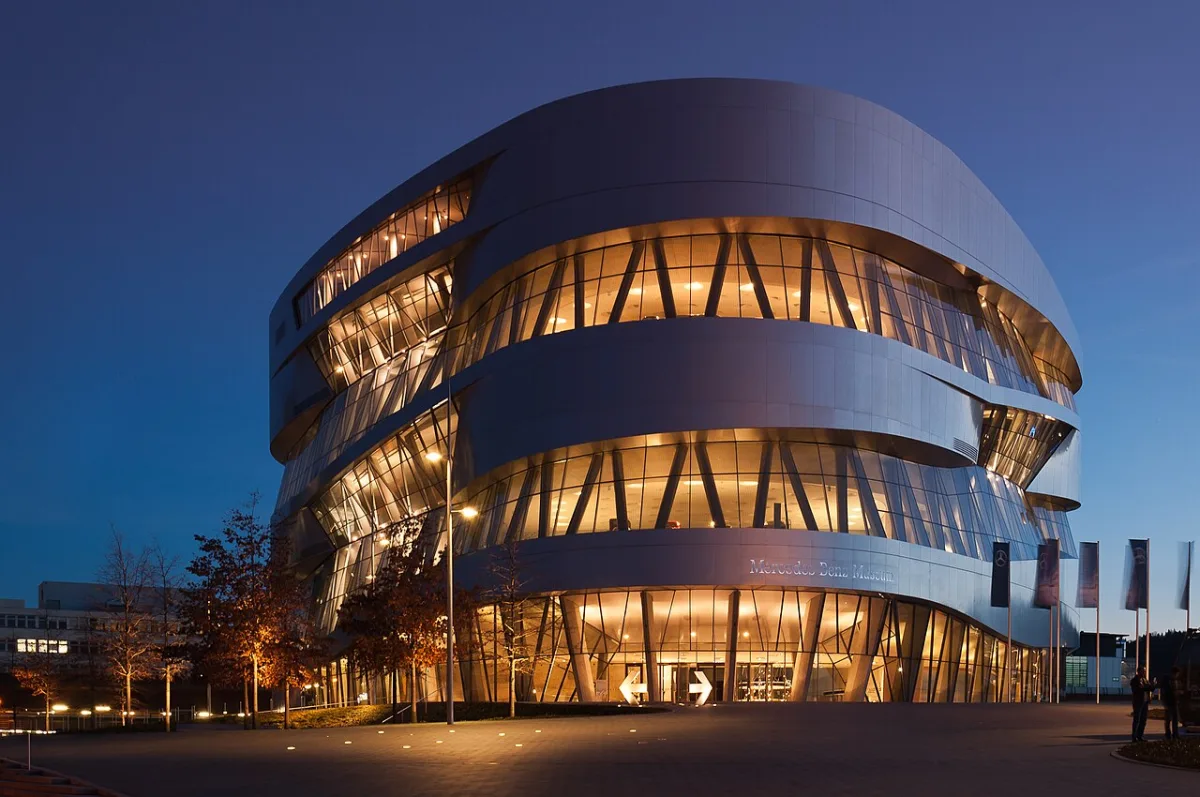
Daimler-Benz expanded its foreign workforce from 3,538 in 1963 to 25,858 in 1972 — by the company’s own account close to a third of the total payroll. The main origin countries were Italy, Greece, Spain, Turkey and Yugoslavia, and the recruitment was centred on the plants at Untertürkheim and Sindelfingen (IG Metall’s history of the Mercedes-Benz works). In 1971 just over 7,000 foreign Daimler workers were living in 45 company dormitories. That housing is the physical ancestor of the settlement pattern the statistics still show: the Albanian presence in Region Stuttgart is not centred on the city at all but on the industrial districts around it. The people followed the factories, and the factories were in the Kreise.
The exile decade, and the killings at Untergruppenbach
A population with permanent residence does not rotate home; it settles, argues, publishes and organises. Kosovo Albanians inside the Yugoslav category built a political life in Baden-Württemberg during the 1970s and early 1980s, and Jusuf Gervalla founded the LPRK in exile in this Land.
On 17 January 1982, Jusuf Gervalla, his brother Bardhosh Gervalla and Kadri Zeka were assassinated at Untergruppenbach. Precision matters here, because the killing is often loosely described as having happened “in Stuttgart”: Untergruppenbach lies in Landkreis Heilbronn, roughly 50 kilometres north of Stuttgart, and not in the city. The three men were killed in a small Swabian municipality, in a Land where tens of thousands of their compatriots were working shifts in car plants and construction firms.
The attack has been widely attributed to the Yugoslav state security service, the UDBA. We report that as the attribution it is — the account carried across decades of reporting and Kosovar public memory — rather than as an adjudicated finding. What is not in dispute is the effect. Three exile organisers were shot dead on West German soil, and the political current they belonged to did not stop; it hardened, and it kept its centre of gravity in southwest Germany. The line from that night into the present is direct and personal: Jusuf Gervalla’s daughter, Donika Gervalla-Schwarz, later became Kosovo’s foreign minister.
Counted as Yugoslavs: four decades of statistical invisibility
Here is the difficulty that makes this history hard to write, and worth writing carefully. For most of the period in question, Albanians from Kosovo and Macedonia do not appear in German statistics as Albanians. They appear as Yugoslavs.
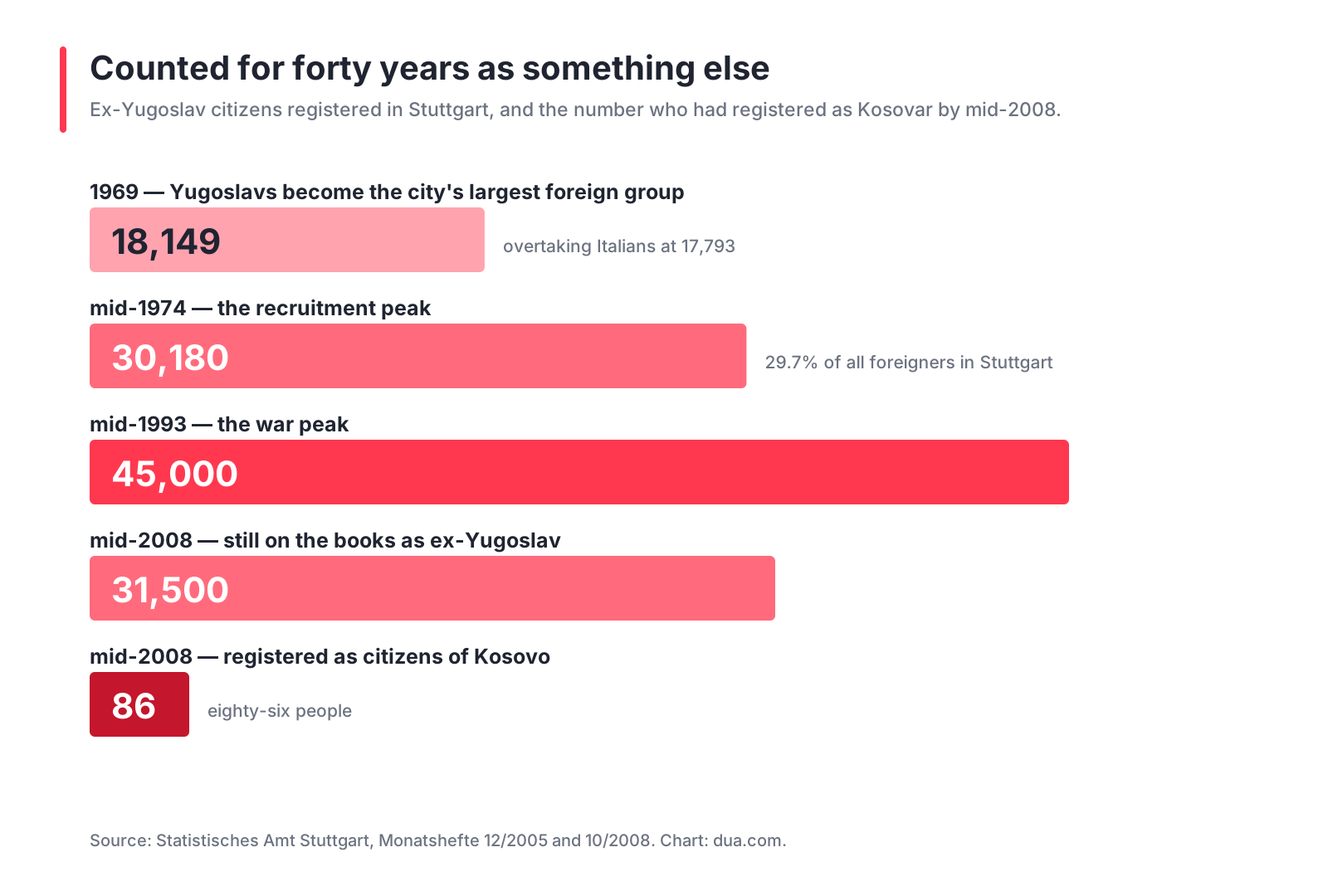
The Statistisches Amt Stuttgart has traced that group precisely. Yugoslavs became Stuttgart’s largest foreign nationality in 1969, when 18,149 of them overtook the 17,793 Italians. The group peaked in the middle of 1974 at 30,180 people — 29.7% of every foreigner in the city — and then held at roughly 28,000 through the 1980s (Statistisches Amt Stuttgart, Monatsheft 12/2005 and 10/2008). Somewhere inside those totals were the first Kosovo Albanian families in the Neckar valley, invisible by construction: the passport said Yugoslavia, and the passport was what the register recorded.
The invisibility did not end when Yugoslavia did. The city’s own Monatsheft 10/2008 recorded that by the middle of 2008, only 86 Stuttgart residents had registered the new Kosovo citizenship — while 31,500 ex-Yugoslav citizens were living in the city and 5,500 still carried the old Yugoslavia country code. Kosovo had declared independence in February of that year. Six months later, the register knew about 86 of its citizens. Nothing had happened to the population; the paperwork simply had not caught up, and would take years to.
This is why any claim about how long Albanians have been in Stuttgart has to be made from the Yugoslav series, not the Kosovar one, and why the residence-length figures are so striking when they finally do appear: Kosovo citizens in Baden-Württemberg have an average residence of 14.0 years, and 15,575 of them have lived in Germany for thirty years or more (31.12.2024). Thirty years back from 2024 is 1994 — and that points at the next layer.
The 1990s: war arrivals along Gastarbeiter lines
When Yugoslavia collapsed, the people fleeing it did not choose destinations at random. They moved along the lines the 1968 treaty had already drawn — to the towns where an uncle worked a shift at Untertürkheim, where a cousin had a flat in Bad Cannstatt, where a village’s worth of relatives had already spent twenty years. Stuttgart’s Yugoslav population, stable at around 28,000 through the 1980s, rose from 29,700 in mid-1991 to a civil-war peak of 45,000 in mid-1993 — a gain of more than fifteen thousand people in two years, in one city. It then settled back to 33,146 by 2005 and 31,500 by mid-2008 as citizenship changes, onward moves and returns took effect.
By the late 1990s the political question was no longer arrival but removal. On 8 July 1998 the petitions committee of the Baden-Württemberg Landtag took up petitions demanding an Abschiebestopp — a halt to deportations — for Kosovo Albanians (Landtag Drucksache 12/3486). The petitions were a local expression of a fear that was about to be vindicated. From 8 September 1998, a flight ban imposed on Yugoslav airlines made collective deportations effectively impossible, and the argument was overtaken by the war itself.
1999: the evacuation, and the return that was planned
In the spring of 1999 Germany took people directly out of the refugee camps in Macedonia. By 11 June 1999 it had admitted 14,726 evacuated Kosovars (BAMF Working Paper 63), after the federal government and the Länder agreed on 6 May 1999 to raise the intake by a further 10,000, to 20,000.
The reception was framed from the start as temporary. The Innenministerkonferenz of 19 November 1999 called on all Kosovo Albanians without permanent residence to go back, with repatriation to be completed im Wesentlichen by the end of 2000; about 13,000 had already returned by 13 November 1999. Baden-Württemberg implemented the policy through Innenministerium return regulations dated 2 February and 23 May 2000 (Drucksache 12/5804). Many did return. Those who stayed were, in the main, the ones with the deepest prior anchoring — the families whose presence ran back through the Gastarbeiter decades, exactly the cohort that now shows up in the thirty-years-plus column.
2015: the wave, and the door that closed
The next surge was not war but economics, and it was brief and almost entirely unsuccessful. Kosovo first-time asylum applications in Germany rose from 6,908 in 2014 to 33,427 in 2015 — an increase of 383.9%, making Kosovo the third-largest origin country that year. 90.9% of the decisions were rejections (BAMF, Das Bundesamt in Zahlen 2015). On 24 October 2015 Kosovo was declared a safe country of origin, and the asylum route closed.
Context matters here: Kosovo had been excluded from the EU’s 2009/2010 Western Balkans visa liberalisation, and Kosovars only gained visa-free Schengen travel on 1 January 2024, last in the region. For fifteen years, the realistic channel for a Kosovar hoping to work where relatives already lived ran, for practical purposes, through the asylum system. When that closed, something had to replace it.
The Westbalkanregelung: Stuttgart in the national top three
What replaced it was a labour rule. The Westbalkanregelung (§26 Abs. 2 BeschV) took effect on 1 January 2016: a confirmed job offer and an approval from the Bundesagentur für Arbeit, and an ordinary work visa followed. The Bundesagentur issued 204,799 approvals between November 2015 and June 2019, and Kosovars were the largest single user group — 41,105 of 117,325 applications to June 2017, about 35%. Roughly 44% of the jobs were in construction, 13% in hospitality and 11% in health and social care (BMAS Forschungsbericht 544 / IAB). Asylum applications from the six Western Balkan states collapsed from 120,882 in 2015 to 4,399 in 2018.
The study naming those numbers also names the places. The three regions with the most approvals nationwide between November 2015 and June 2017 were die Metropolregionen Frankfurt am Main, München und Stuttgart — and four of the study’s twelve construction-firm case studies were in Region Stuttgart. That is as close as German research comes to stating plainly what the Kreis-level figures imply: the Stuttgart region has been one of the country’s principal destinations for Kosovar labour migration for a decade.
The channel then widened. On 1 June 2024 the annual quota doubled from 25,000 to 50,000, and by 31 December 2024 Germany held 61,171 Westbalkanregelung permit-holders (Bundestag Drucksache 21/1126, 1 August 2025). Six decades after Daimler began filling dormitories at Untertürkheim, the same region is still recruiting from the same villages, under a different law.
Consulate, mosques, schools and clubs
Institutions are the part of a diaspora that shows up in a register. Stuttgart’s Albanian-speaking institutional map is thinner than the population numbers would suggest, and it is regional rather than central — it sits in Bad Cannstatt, Heslach, Zuffenhausen, Filderstadt, Fellbach and Kernen at least as much as in the inner city. The narrative comes first; the working address book, with telephone numbers and postcodes, is at the end of this section.
One consulate, for a whole Land
The Consulate of the Republic of Kosovo sits on Johannesstraße in Stuttgart-West and is headed by Hamdi Bërbatovci. Its consular district is the entire Land Baden-Württemberg. It is listed both by the Auswärtiges Amt and in the City of Stuttgart’s own register of consular representations.
The title is worth getting right, because German and Albanian usage diverge in print. Kosovo’s foreign ministry lists Stuttgart as a Konsullata — a consulate. The Generalkonsulat is in Munich. Calling the Stuttgart post a general consulate, as some listings do, upgrades it by one rank.
In late February 2026 the consulate inaugurated new premises during Kosovo’s eighteenth independence anniversary. The folk-dance groups “Besa” from Heilbronn and Shoqata Kulturore Shqiptare “Kosova” from Fellbach performed — a small detail that says something structural, since neither group is based in Stuttgart itself.
Set that single office against the caseload. Baden-Württemberg holds 89,175 Kosovo citizens at 31 December 2024 (Statistisches Landesamt Baden-Württemberg, AZR), plus naturalised Germans of Kosovar origin who no longer appear in that count at all.
Albania has no career consulate in Stuttgart. The Generalkonsulat der Republik Albanien in Munich, Albert-Schweitzer-Straße 62, covers Bayern, Baden-Württemberg, Rheinland-Pfalz and Saarland. What Stuttgart has is an honorary post on Stafflenbergstraße listed under Rezzo Schlauch, the former Green Bundestag member and Parliamentary State Secretary, appointed in the summer of 2015; he is not himself of Albanian heritage — his wife, Ema Ndoja, is of Albanian origin — and his consular email address sits on his own private domain, which is a fair tell that this is an honorary rather than a career office. Its current status is genuinely unclear: a separate honorary consular post for Albania covering Baden-Württemberg received its exequatur at Satteldorf on 20 January 2026. Readers should confirm which post is live before relying on the Stuttgart entry. North Macedonia likewise maintains no Stuttgart post — its Munich Generalkonsulat covers Bayern and Baden-Württemberg together.
Mosques, and a union founded in Stuttgart
The oldest continuously identifiable Albanian institution in the city is religious. Qendra Islame Shqiptare Stuttgart — the Islamisch-Albanisches Zentrum e.V. — sits on Kölner Straße on the Bad Cannstatt side and is raising funds for a purpose-built mosque (qendraislame.com). Its founding date needs one caveat: secondary listings give 1987, four years before Yugoslavia began to come apart, while the centre’s own pages claim close to forty years of tradition. Treat 1987 as likely rather than confirmed. It describes itself as a humanitarian-religious centre unaffiliated with any political party, with a salaried imam holding a higher theological qualification, and it runs religious education, weekend youth programmes with sport, Albanian-language lessons and women’s programmes; it also publishes under the name Drita Islame.
A second congregation, the Islamischer Verein für Kosovo-Albaner e.V., is registered on Böblinger Straße in Heslach, per the City of Stuttgart’s own register. That building has done double duty for years: it is also where the association Pavarësia restarted Albanian supplementary-school classes in 2011.
Stuttgart also gave the national body its founding address. The Union der Islamisch-Albanischen Zentren in Deutschland (UIAZD) was founded in Stuttgart on 16 June 2007. Its regional member centres include the Islamischer Albanischer Kulturverein in Kirchheim unter Teck and Qendra Islame Shqiptare “LËVIZJA” in Schwäbisch Gmünd — again, the Land rather than the city.
Sunday at St. Konrad
Stuttgart’s Albanians are not uniformly Muslim, and the Catholic mission is the clearest evidence. The Misioni Katolik Shqiptar, the Albanische Katholische Gemeinde, holds Albanian-language Sunday mass at 12:00 at St. Konrad, Stafflenbergstraße 52, 70184 Stuttgart, and belongs to the Gesamtkirchengemeinde Stuttgart-Mitte in the Diocese of Rottenburg-Stuttgart, alongside the Italian, Croatian and Slovenian congregations. Directory listings name Pfr. Albert Krista as its contact, which is a secondary source rather than a diocesan one.
The diocese profiled the community on 11 October 2023 and quoted a member, Laureta Nrecaj, then 22: “Bei uns steht das Nationalgefühl im Vordergrund, eher als die Religion.” National feeling comes before religion. It is a sharper description of Albanian associational life in Germany than most analysts manage — and, as the people section below explains, the woman who said it now writes this city’s newspaper coverage of the community she was describing.
Albanian on the timetable
Albanian is taught in Baden-Württemberg’s schools, but not by Baden-Württemberg. The Land runs the so-called Konsulatsmodell, under which fourteen sending states organise mother-tongue supplementary lessons — muttersprachlicher Zusatzunterricht — outside state school supervision. Kosovo is among them, and Albania joined in 2019/20. The lessons are organised through the consulate, which is why enrolment enquiries go to Johannesstraße rather than to a school office, and why the same address that issues passports also convenes teachers: on 7 March 2025 it hosted Albanian supplementary-school teachers from across the Land for Teacher’s Day.
One figure needs a caveat. Around 27,000 pupils took consulate-model lessons in Baden-Württemberg in 2021/22 — but that is the total across all fourteen languages, not an Albanian count. No Albanian-specific enrolment figure is published.
Students, and Saturday afternoons
Albanische Studenten und Akademiker Stuttgart e.V. (ASA) is the professional-class institution: founded, per the association itself, in 1998, formally registered as an e.V. since 2021, working überparteilich und überkonfessionell, with a weekly Wednesday Kafe Mesjave as its social spine (asa-stuttgart.de). It raised €21,000 at its 2023 charity gala for education projects in Albania, Kosovo and North Macedonia, and on 21 March 2025 won a grant of €41,360 for a project called “Future Green Leaders of Kosovo”. A student society moving money and programmes back to Kosovo is the diaspora’s second generation behaving like an institution rather than a homesickness club.
Then there is football, which in this region is where the community is most visible on a Saturday. KF Kosova Bernhausen, founded in 1990 and based in Filderstadt, won Kreisliga B Staffel 4 in 2024/25 with a single defeat and plays 2025/26 in Kreisliga A2. FC Kosova Kernen, in the Rems-Murr area, finished eleventh in Kreisliga A1 Rems/Murr in 2025/26 on 39 points, in roughly its twenty-fifth year. FC Besa Stuttgart is the third name in the city’s Albanian football history and the hardest to pin down — it has a kicker.de profile and it was a youth station of the Stuttgart-born international Engjëll Hoti in 2012, but no address, league or founding year could be retrieved. And Shoqata Kulturore Shqiptare “Kosova” Fellbach maintains its own club premises — a permanent room of one’s own, which in German associational life is the real threshold of arrival.
Dancers, doctors and a network of mosques
Three additions complete the map. The Deutsch-Albanischer Verein für Kultur, Jugend und Sport Pavarësia e.V., in Zuffenhausen-Rot, is the city’s folklore institution: two dance groups — one for children, one for youth and adults — performing at city festivals and weddings, plus cultural evenings of poetry and music, and the annual Lladrovci memorial tournament described in the calendar below. It is recognised as gemeinnützig and registered at the Amtsgericht Stuttgart under VR 720917. It should not be confused with the older Pavarësia founded on 30 January 2011 at Böblinger Straße 203, which restarted the Albanian school classes; the relationship between the two is unverified.
The professional layer has a national body rather than a Stuttgart one. The Gesellschaft der Albanischen Ärzte in Deutschland e.V. — the association of Albanian doctors, dentists and physiotherapists in Germany — was founded and is chaired by Dr. Marsela Ceno, with a seat reported in Rastatt in Baden-Württemberg and more than 200 members. Those details come from aggregator listings rather than from an Impressum, and its domain did not resolve when we checked, so treat the association as real and its published particulars as unconfirmed.
And the mosques run as a state-wide network rather than a city one. The Union of Albanian Imams’ own directory for Baden-Württemberg lists, beyond the two Stuttgart addresses, Albanian centres in Schwäbisch Gmünd, Kirchheim unter Teck, Pforzheim, Rheinstetten near Karlsruhe and Mannheim.
Read the addresses together and the pattern is unmistakable. Filderstadt, Fellbach, Kernen, Kirchheim unter Teck, Schwäbisch Gmünd, Heilbronn: the institutions cluster where the people are, which is to say in the Kreise rather than the Kessel.
The working address book
What follows is the contactable version of everything above: institutions with a legally required Impressum, a published telephone number or an entry in the City of Stuttgart’s own register. Everything reviewed as of 16 August 2026. Where an organisation’s current activity could not be confirmed, that is said in the card rather than hidden.
Konsulat der Republik Kosovo
Johannesstraße 47b, 70176 Stuttgart. Tel. +49 711 627 677 0, [email protected]. Head of the consulate: Hamdi Bërbatovci; consular district the whole of Baden-Württemberg. Opening hours are reported as Mon–Thu 10:00–17:00 with Friday by arrangement, but listings differ — call before travelling. mfa-ks.net
Honorarkonsulat der Republik Albanien
Stafflenbergstraße 44, 70184 Stuttgart, listed under honorary consul Rezzo Schlauch since 2015. Status unclear: a separate honorary consular post for Albania covering Baden-Württemberg received its exequatur at Satteldorf on 20 January 2026, and Albania’s career representation for the state is the Munich Generalkonsulat. Confirm which post is current before relying on the Stuttgart entry.
Qendra Islame Shqiptare Stuttgart
Islamisch-Albanisches Zentrum e.V., Kölner Str. 12, 70376 Stuttgart (Bad Cannstatt). Tel. 0711 604810, [email protected]. Religious teaching, weekend youth programmes with sport, Albanian-language lessons and women’s programmes; also publishes as Drita Islame. qendraislame.com
Islamischer Verein für Kosovo-Albaner e.V.
Böblinger Straße 203, 70199 Stuttgart (Heslach). Mobile 0176 48626217. The same building is where the association Pavarësia restarted Albanian supplementary classes in 2011 — one address doing two jobs for a long time.
Misioni Katolik Shqiptar
Albanische Katholische Gemeinde, Wagnerstraße 45, 70182 Stuttgart. Tel. 0711 233978, [email protected]. Sunday mass in Albanian at St. Konrad, Stafflenbergstraße 52. Directory listings name Pfr. Albert Krista as contact — a secondary source, worth verifying. kath-kirche-stuttgart.de
Albanian supplementary lessons
Organised through the consulate under Baden-Württemberg’s Konsulatsmodell, not by the Land’s school authorities, which is why enrolment enquiries go to Johannesstraße rather than to a school office. Teachers from across the state are convened there each 7 March. No Albanian-specific pupil figure is published.
Albanische Studenten und Akademiker Stuttgart e.V.
[email protected], asa-stuttgart.de. Represented by Arber Osmanaj and Arber Guri; Vereinsregister 725525, Amtsgericht Stuttgart. Note the registered seat in the Impressum is Wölstraße 37, 73312 Geislingen an der Steige — the activity is in Stuttgart, the letterbox is not. asa-stuttgart.de
Deutsch-Albanischer Verein Pavarësia e.V.
Tapachstr. 95 F, 70437 Stuttgart (Zuffenhausen/Rot). Tel. +49 177 1649075, [email protected], shoqata-pavaresia.de. Vereinsregister 720917. Board: Beqir Sopa (chair), Vlorë Gegaj-Veseli, Kaltrinë Elshani, Besmira Sopa.
Shoqata Kulturore Shqiptare „Kosova“ Fellbach
Active in the Rems-Murr-Kreis and performing at consulate events, but it runs on Facebook rather than a website: no public street address, email or board could be confirmed. Contact through its page before assuming a venue.
KF Kosova Bernhausen
Filderstadt-Bernhausen, south of Stuttgart; first team plus reserves, profile on fussball.de. A business directory gives Im Weiher 16, 70794 Filderstadt and Shpetim Mushkolaj as contact — verify both locally. fussball.de/verein/kf-kosova-bernhausen-wuerttemberg/-/id/00ES8GNBEG000078VV0AG08LVUPGND5I
F.C. Kosova Kernen
Kernen-Rommelshausen, Rems-Murr-Kreis; ground Kunstrasen Rommelshausen, Kelterstraße 81. Reported founded in 2001, colours red and black, first chairman Syla Tahiri — all from secondary listings. The club was involved in a 2024/25 league dispute that went to a final DFB ruling; check the outcome before repeating any version of it.
FC Besa Stuttgart
Listed on kicker.de and confirmed indirectly as a youth station of the Stuttgart-born international Engjëll Hoti in 2012. No address, league, chairman or founding year could be retrieved. Included for completeness, not as a usable contact.
The Albanian mosque network in Baden-Württemberg
Per the Union of Albanian Imams’ own directory: Qendra Islame Shqiptare „LËVIZJA“, Buchstr. 21, 73525 Schwäbisch Gmünd; Islamischer Albanischer Kulturverein, Holzmadenerstr. 24, 73230 Kirchheim unter Teck; Qendra Islame Shqiptare Pforzheim, Kronprinzenstraße 25; Qendra Islame Shqiptare Karlsruhe, Kutschenweg 18, 76287 Rheinstetten; Xhamia Shqiptare Mannheim – DAI e.V., Pettenkoferstr. 8, 68169 Mannheim.
Gesellschaft der Albanischen Ärzte in Deutschland e.V.
The national association of Albanian doctors, founded and chaired by Dr. Marsela Ceno, with its seat reported in Rastatt and more than 200 members. Flagged: the seat, chair and member count come from aggregator listings rather than an Impressum, and the domain albanischerzteindeutschland.de did not resolve on checking. Approach via its Facebook page.
One deliberate omission. Albanian-language lists circulate naming further Stuttgart-region associations — “Malësia” and “Rugova” in Stuttgart, an LDK information centre, “Isa Boletini” in Sindelfingen, “F. Grejçevci” in Bernhausen, “Bardhosh Gërvalla” in Ludwigsburg. Those lists are undated and unsourced, and several entries appear to predate 2015. Publishing a dead association’s address helps nobody, so they stay off this page until each can be checked independently.
Work, money and the Prishtina corridor
The institutions sit where the work is, and the work has changed shape once already: from the assembly lines of the 1960s and 1970s to the building sites of the 2010s and 2020s. The Westbalkanregelung numbers show that second shape clearly, provided the two halves of the evidence are not mistaken for one series.
| Sector | Share of jobs (BMAS/IAB evaluation) | Permit holders, Germany, 31 Dec 2024 |
|---|---|---|
| Construction | 44% | 36.3% (22,195) |
| Hospitality | 13% | 14.8% (9,061) |
| Health and social care | 11% | not separately reported |
| Transport and logistics | not separately reported | 11.9% (7,249) |
| All sectors | 204,799 approvals, Nov 2015 – Jun 2019 | 61,171 permit holders |
The left-hand column comes from the BMAS/IAB evaluation; the right-hand column from Bundestag Drucksache 21/1126 of 1 August 2025. They measure different things — a flow of approvals versus a stock of valid permits — so read them as two snapshots, not a trend line. Both point the same way: this is a construction-first, hospitality-second migration, landing in a region whose building trade has been short of hands for a decade.
The Prishtina corridor
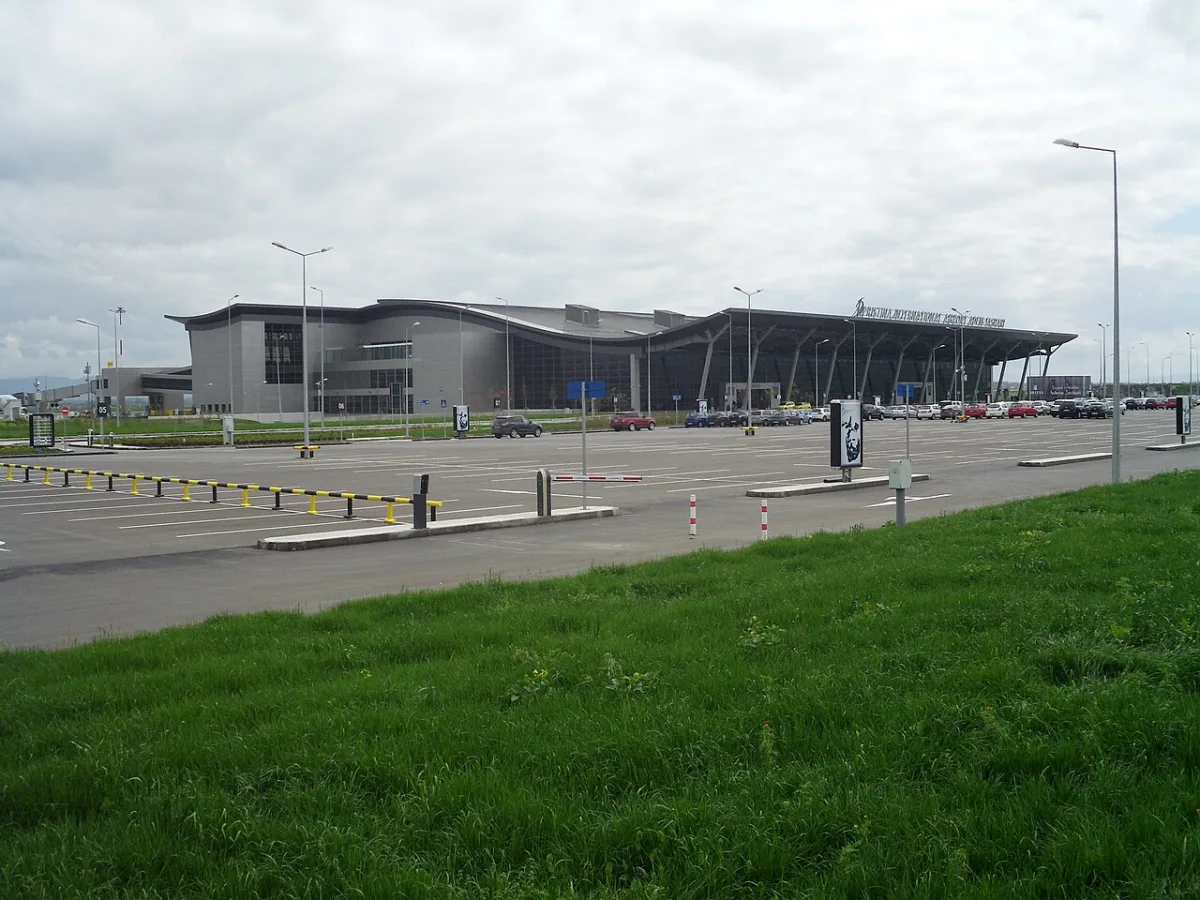
The route home is thinner than the size of the community suggests. As of August 2026, Eurowings is the only scheduled carrier flying Stuttgart Airport to Prishtina nonstop, at six flights per week — roughly two hours, 1,139 kilometres. Alongside it run full-charter flights sold by Air Prishtina and operated by GP Aviation, which is how a large share of summer family traffic actually moves. Until visa-free Schengen travel arrived on 1 January 2024, every relative travelling in the other direction needed an appointment, a file and a fee.
Money travels the same corridor, in the other direction. Kosovo received about €1.35 billion in diaspora remittances in 2024 (Central Bank of Kosovo, as reported by Kosovar media), with Germany the largest source at roughly 40% per CBK data as reported by Kosovar media, ahead of Switzerland at around 20%. No source splits that money by German region. But Region Stuttgart holds 28,085 Kosovo citizens — by our arithmetic 31.5% of Baden-Württemberg’s 89,175 — so it is reasonable to read a meaningful share of the German contribution as earned on building sites, in hotel kitchens and on the shop floors between Sindelfingen and Waiblingen.
Where Albanian Stuttgart is visible
Start with what cannot be said. There is no official statistic that breaks Stuttgart’s Albanians down by Stadtbezirk. The Ausländerzentralregister counts citizenship at city level — Kosovo 3,895, North Macedonia 1,635, Serbia 4,675 at 31 December 2024 — and stops there. Albania’s citizens are not reported for the city at all. Anyone who tells you which Stuttgart quarter is “the Albanian one” is describing an impression, not a dataset. What follows is what the record does support.
District context, clearly labelled
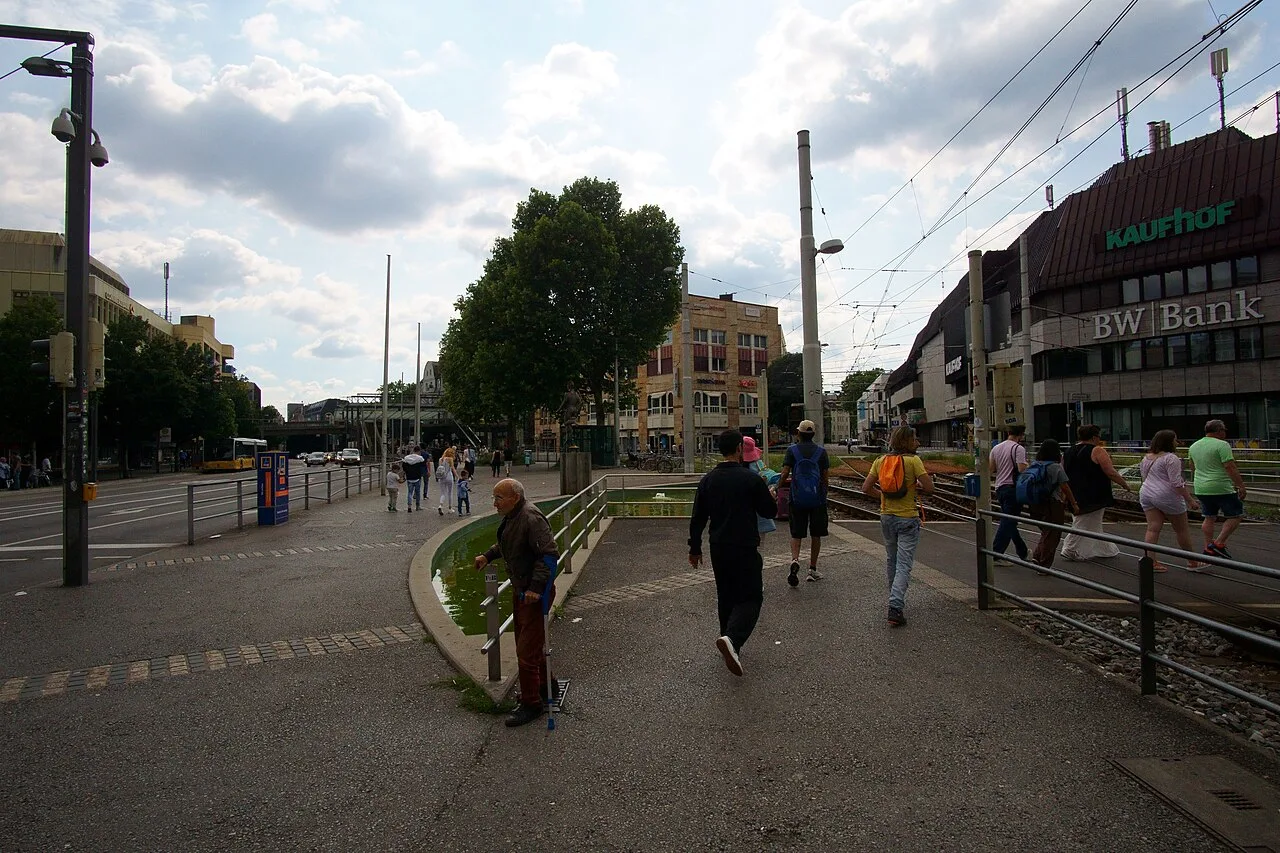
The Hallschlag quarter in Bad Cannstatt is the neighbourhood most often invoked in conversations about Balkan Stuttgart. Its published profile, from the city-backed Zukunft Hallschlag project, is striking: about 7,200 residents, 72.5% with a migration background and 41.9% without German citizenship, against city-wide figures of 43.3% and 24.6%; among under-18s, 86.3% have a migration background. Those numbers are not Albanian-specific and should never be read as such. They describe a district with a young, largely immigrant population, and they are offered here only as context for the kind of place where a community without its own statistics tends to be present.
The centre of gravity is suburban
The clearer pattern is regional rather than municipal, and the district table above sets it out: the city ranks only fifth of six on Kosovo citizens, and Böblingen (1,955) outranks it on North Macedonian ones. The geography is not accidental. Sindelfingen, one of the two Daimler recruitment plants of the 1960s, sits inside the Böblingen district that leads the region on North Macedonian citizens; Waiblingen anchors the Rems-Murr district that leads it on Kosovar ones. Add a city that lost a net 3,234 residents to its surrounding districts in 2024 alone (Statistisches Amt Stuttgart, Einwohnerbilanz 2024), and the result is that Albanian family life in Greater Stuttgart is disproportionately lived in the towns around the basin rather than in the Kessel — which is exactly where the clubs and centres listed above are registered.
The nights the city counts itself
Because the registers stay quiet, the community becomes most legible on specific evenings: a convoy of flagged cars on the Cityring in late November, another after a national-team win. Those police counts of vehicles are the closest thing the public record offers to a headcount of the city’s Albanian street presence, and they are estimates of cars rather than of people. The section that follows sets out the dates, the numbers and the sources.
Commercial culture supplies the other visible markers. Azet — Granit Musa, born 1993, Kosovo-Albanian, of the KMN Gang, whose 2018 debut Fast Life went to No. 1 in Germany, Austria and Switzerland — plays the Porsche-Arena on Friday 11 December 2026 at 20:00, tickets from €65 (Eventim). An arena booking of that size in Stuttgart is a market signal that no census captures. And in Murr, in the Ludwigsburg district, VABA Restaurant & Bar at Dorfweg 9, run by Familie Tahiri, advertises traditionelle albanische Spezialitäten and an Albanian Sunday brunch; the same family also runs Tahiri Gartenbau. It is a small, ordinary example of the pattern that runs through this section — the community’s fixed points are scattered across the region’s towns, and the map has to be assembled from clubs, kitchens, concert dates and one loud night in October rather than from a table of district statistics.
The Albanian year in Stuttgart
The calendar is where a community without statistics keeps its own record. The Albanian year here has two fixed poles — 28 November for the flag, 17 February for Kosovo’s independence — and a scatter of weekly, seasonal and result-triggered fixtures around them. Almost all of it happens after dark, and much of it happens outside the city limits.
28 November: the loudest night
The Stuttgarter Zeitung documented the 2024 flag-day Autokorso precisely. Around 250 vehicles moved through the city centre on the evening of Thursday 28 November 2024, starting on the Cityring at about 20:00 and running until roughly 23:30 — more than three hours of flags, horn concerts and onlookers. Police set up closures and diverted traffic; a spokesman said officers had taken measures “um die Behinderungen für den übrigen Verkehr so gering wie möglich zu halten”. More than 30 traffic offences were recorded (report by Laureta Nrecaj, 29.11.2024). That count is verified for 2024 only. The date is fixed; the size of the convoy is not, so treat 250 as one year’s figure rather than an annual constant.
Wins produce the same scene without warning. After Albania beat Serbia in a World Cup qualifier on the night of 11/12 October 2025, police counted about a hundred cars in Stuttgart, with parallel convoys in Reutlingen — where the Eberhardstraße junction came to a standstill around 23:00 — and in Ulm, where officers broke the corso up because streets were fully blocked. In Stuttgart there were no incidents (Stuttgarter Zeitung, 12.10.2025, red/dpa/lsw).
17 February, and what the community argues about
In 2025 Stuttgart marked Kosovo’s seventeenth independence anniversary twice on the same day: once at the Qendra Islame Shqiptare on Kölner Straße, once at the Misioni Katolik Shqiptar. The detail is on record only because the consulate was publicly criticised for attending the first, and replied to Gazeta Express that the event “është organizuar nga Qendra Islame në Shtutgart” and that it took part “vetëm si pjesëmarrëse”, having likewise attended the Catholic mission’s event the same day (18.02.2025). Two celebrations, one guest list — a more accurate picture of the community’s confessional geometry than any single-venue account.
A week later, on Sunday 23 February 2025, Albanische Studenten und Akademiker Stuttgart filled all 159 seats at Kino Cinema for “Afterwar”, Birgitte Stærmose’s film following Kosovar children over fifteen years, with the director present and an accompanying exhibition on Kosovo’s development. Chairman Arber Osmanaj said the group had found the film at the Prizren documentary festival in summer 2024, and framed the evening as deliberately not “eine gewöhnliche Festveranstaltung” with dancing and loud music.
Spring, autumn and the pitch
On 7 March the Kosovo consulate hosts the Albanian supplementary-school teachers working across Baden-Württemberg for Dita e Mësuesit, described in 2025 as those who “mbajnë gjallë gjuhën, kulturën dhe identitetin shqiptar” for the next generation. In late September the Deutsch-Albanischer Verein Pavarësia runs the Fehmi & Xhevë Lladrovci memorial volleyball tournament under the motto “Nder & Bashkim”, six-a-side, with a barbecue beside the pitch; the association lists the 2026 edition for Sunday 27 September, from 11:00 at Allmandring 28.
Football supplies the rest. In June 2025 KF Kosova Bernhausen booked the Stuttgart-born rapper Dardan for its Kreisliga B championship party (Stuttgarter Zeitung, 19.06.2025) — the clearest link between the region’s grassroots clubs and its best-known Albanian artist. On the concert side, Alban Skënderaj played the Porsche-Arena on 16 May 2026 (Eventim and Easy Ticket Service both list Saturday the 16th at 19:30; several aggregators wrongly say the 17th), and Azet is booked there for 11 December 2026. The long-running “We Love Albania” series — Reutlingen from October 2016, then the Carl Benz Arena from December 2017, about 2,800 guests at its December 2018 peak — lists no upcoming dates on its own ticket shop as of 16 August 2026; treat it as dormant until it announces otherwise.
One date carries no celebration. Sadri Berisha, a 55-year-old Albanian guest worker, was murdered in Ostfildern on the night of 7–8 July 1992, when seven young neo-Nazis attacked two sleeping men with baseball bats in a container hostel for Yugoslav workers; the second man, Sahit Elezaj, survived with severe head injuries, and the main assailant received a life sentence. In June 2025 the artist Klaus Illi mounted a four-day exhibition at the Städtische Galerie with photographs and press clippings, together with a work of three baseball bats and rough stone blocks inscribed “Sadri Berisha ermordet 8. Juli 1992”, and proposed naming a local intersection Sadri-Berisha-Platz. The city offered an “immaterial memorial” — a website. As of that reporting there is no permanent memorial and no fixed annual ceremony.
| When | What | Where | Note |
|---|---|---|---|
| Every Wednesday | Kafe Mesjave, students’ meet-up | Stuttgart; venue not published online | Run by ASA; the association says it has run for four years |
| Every Sunday, 12:00 | Albanian-language mass | St. Konrad, Stafflenbergstraße 52 | Misioni Katolik Shqiptar; contacts in the address book above |
| 17 February | Kosovo independence day | Kölner Str. 12 and Wagnerstr. 45 | Two separate events in 2025; the consulate attended both as a guest |
| 7 March | Dita e Mësuesit reception | Kosovo consulate, Johannesstraße 47b | For supplementary-school teachers state-wide; documented for 2025 |
| Late September | Lladrovci memorial volleyball tournament | Allmandring 28, Stuttgart | 2026 edition scheduled for Sunday 27 September, 11:00 — confirm with the organiser |
| 28 November | Autokorso, Dita e Flamurit | Cityring, city centre | About 250 cars in 2024, roughly 20:00–23:30; size varies by year |
| Irregular | Autokorso after national-team wins | City centre; also Reutlingen and Ulm | About 100 cars in Stuttgart on 11/12 October 2025 |
| Irregular | Arena concerts | Porsche-Arena; formerly Carl Benz Arena | Alban Skënderaj played 16 May 2026; Azet booked for 11 December 2026 |
| 8 July | Anniversary of the murder of Sadri Berisha, 1992 | Ostfildern | No permanent memorial and no fixed civic ceremony as of mid-2025 |
Dated 2026 entries above are as scheduled at the time of writing, not as confirmed to have happened. Community events here are announced late, often on Instagram rather than on a website, and venues change. Check with the organising association before travelling.
People who carry the Stuttgart story
No list of names can stand in for a community of tens of thousands. What the following biographies do is give the statistics a shape: they show where Albanian families settled in and around Stuttgart, which institutions raised their children, and how a migration that began in Daimler dormitories now runs through the Bundesliga, the Porsche-Arena, a hospital operating theatre and German-language literature. Every date and connection below is drawn from public record.








Music, media and letters
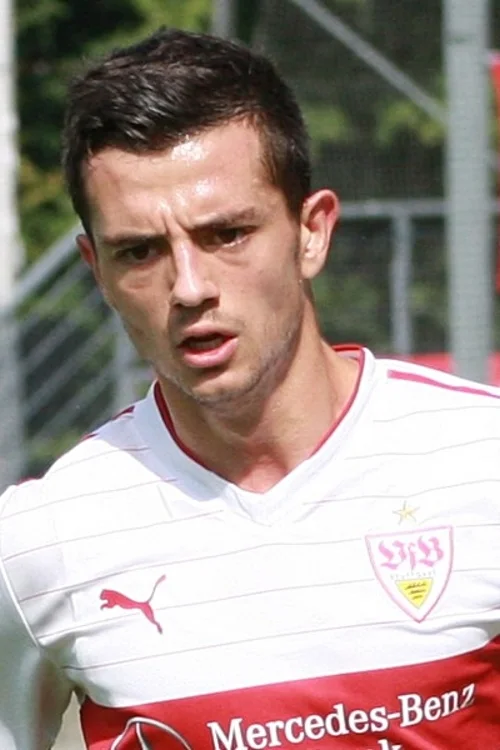
Dardan Mushkolaj was born on 2 October 1997 in Stuttgart to Kosovo-Albanian parents from Deçan, and grew up in the Rot quarter of Stuttgart-Zuffenhausen. His breakthrough came in 2016 with “Wer macht Para?” alongside Eno. Four albums followed: “Sorry” (2019) reached No.19 in Germany and went Gold; “Soko Disko” (2020) also No.19 in Germany and Platinum in Switzerland; “Mister Dardy” (2021) peaked at No.9; and “Catch Me If You Can” (2025) landed at No.16 in Germany and No.7 in Switzerland. Those Swiss numbers — a Platinum record, and a chart peak nine places above the German one — are themselves a map of the Albanian diaspora’s second great centre.
Laureta Nrecaj is the reason parts of this page can be written at all. A journalist trained in Crossmedia-Redaktion und Public Relations at the Hochschule der Medien, she did her Volontariat at the Stuttgarter Zeitung and Stuttgarter Nachrichten and has worked on the paper’s digital desk since June 2025 — and she carries the byline on its reporting of both the 28 November Autokorso and the Kosovo independence-day film evening described in the section above. She is also the 22-year-old quoted earlier on this page: the member of the Albanian Catholic congregation who told the Diocese of Rottenburg-Stuttgart in October 2023 that national feeling comes before religion. The circle is worth naming plainly. Her father’s family fled Kosovo under political persecution, her grandfather found lifelong friends in the Stuttgart Albanian community and her parents met there — and the community’s own story is now being reported in the city’s main newspaper by someone from inside it.
The writer Beqë Cufaj was born 3 December 1970 in Deçan and settled in Gerlingen, in Kreis Ludwigsburg on Stuttgart’s border, after 1995. He lived and worked there for more than two decades, writing for the Frankfurter Allgemeine Zeitung and the Neue Zürcher Zeitung, before serving as Kosovo’s ambassador to Germany from 2018 to 2021. His presence in the Stuttgart orbit is a corrective to the assumption that this migration was only about labour: the mid-1990s brought writers and future diplomats into the same Kreise as the construction crews.
On the pitch
Diant Ramaj, a goalkeeper born 19 September 2001 in Stuttgart to Kosovo-Albanian parents from Gjakova, is the clearest example of the city’s football pipeline doing what it is designed to do. He passed through SpVgg Cannstatt, VfB Stuttgart and Stuttgarter Kickers between 2015 and 2018, then moved on to Eintracht Frankfurt, Ajax and Borussia Dortmund, with a loan spell at 1. FC Heidenheim. He has represented Germany from U18 to U20 — a reminder that for many Stuttgart-born Albanians the question of which national team to play for is answered by where they were raised, not by heritage alone.
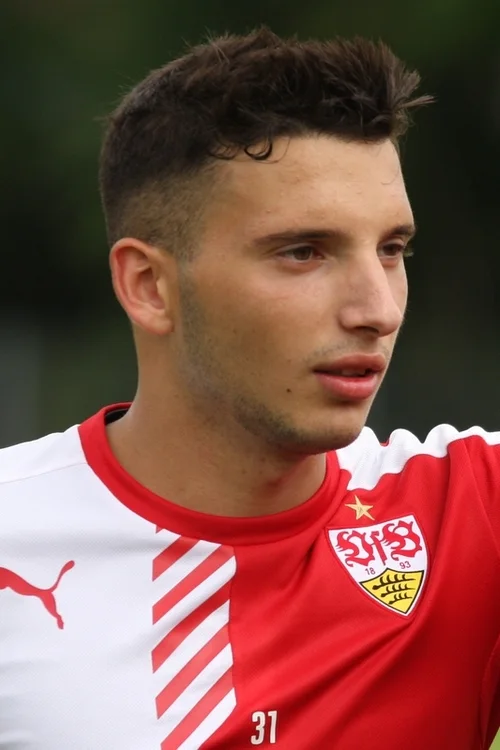
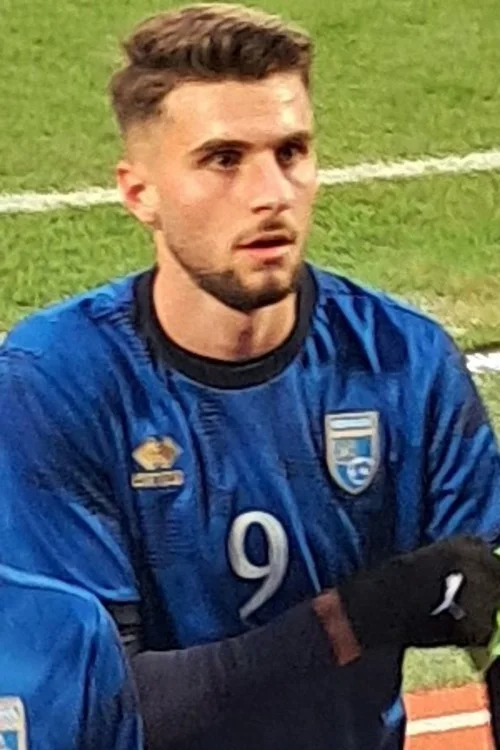
Arianit Ferati, born 7 September 1997 in Stuttgart to Albanian parents from Mitrovica, entered the VfB Stuttgart academy in 2013 and made four first-team appearances in 2015–16. He made his senior debut for Kosovo in November 2022, and signed for SV Sandhausen on 14 July 2026. His career traces the other half of the same choice Ramaj faced, resolved the other way.
Leon Dajaku was born 12 April 2001 in Waiblingen, in the Rems-Murr-Kreis, into a Kosovo-Albanian family from Skenderaj. That birthplace matters: Rems-Murr holds 5,915 Kosovo citizens, more than Stuttgart city itself, and Dajaku’s route is a regional one rather than an urban one. He joined VfB Stuttgart in 2014 and made his Bundesliga debut in December 2018, then moved to FC Bayern in 2019, followed by Union Berlin, Sunderland, St. Gallen, SSV Ulm and Hansa Rostock in 2026.
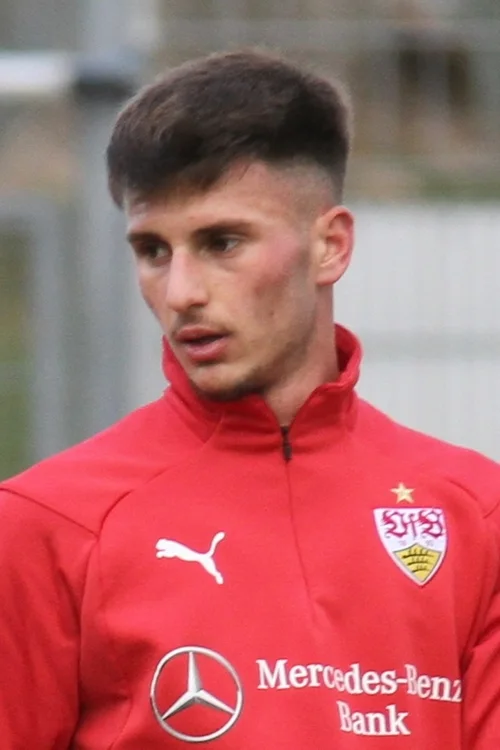
Eliot Bujupi, a striker born in Böblingen on 3 July 2006, is the region’s pipeline in miniature: VfL Sindelfingen, then Stuttgarter Kickers, then the VfB Stuttgart academy from 2017, and now VfB Stuttgart II with a 2025-26 loan at KVC Westerlo in Belgium. His family comes from Arllat in Drenas, and his heritage is a matter of formal record rather than inference — he played for Germany at U16 and U17, then switched to Kosovo in 2023 and has since been capped at U19, U21 and senior level.
Engjëll Hoti, born in Stuttgart on 26 February 1997, made the same declaration twice over: five caps for Albania’s U21 in 2016, then two for Kosovo’s in 2017. His youth clubs read like a map of Albanian football in the city — FSV Waiblingen, then Besa Stuttgart, then VfB Stuttgart — before Kaiserslautern, Aalen and Braunschweig. Recent listings place him at Ümraniyespor in Turkey; check his current club before quoting one.
Two further players have real but narrower ties to the city, and the distinction is worth drawing precisely rather than blurring. Klaus Gjasula, born 14 December 1989 in Tirana, was raised in Freiburg, not in Stuttgart. His Stuttgart connection is a single half-season at Stuttgarter Kickers in the 3. Liga in 2016, comprising 18 league appearances and one goal. He has 29 caps for Albania and is best remembered internationally for Euro 2024, where he scored both an own goal and a 95th-minute equaliser against Croatia in the same match. He belongs on this page as a Baden-Württemberg figure, not a Stuttgart-raised one. Besar Halimi was born 12 December 1994 in Frankfurt to Kosovo-Albanian parents and spent two formative years in the city’s clubs: VfB Stuttgart II in 2013–14 and Stuttgarter Kickers in 2014–15. He has since won 34 caps for Kosovo. Like Ramaj and Ferati, he came through the Stuttgart academy system — one more Albanian-heritage player, and not a locally born one, formed by the region’s clubs.
In the ring
Luan Krasniqi was born 10 May 1971 in Junik, the youngest of eight children, and came to Baden-Württemberg in 1987 when his family moved to Rottweil — arriving as a teenager in the years just before Kosovo’s crisis broke open. He took Olympic heavyweight bronze at Atlanta in 1996 and became EBU European heavyweight champion. The night that belongs to Stuttgart is 14 February 2004, when he won the EBU belt against Sinan Şamil Sam in front of 5,500 spectators in a sold-out Hanns-Martin-Schleyer-Halle.
Medicine and academia
Prof. Dr. med. Dr. phil. Halil Krasniqi — a cousin of the boxer — was appointed head of vascular surgery at Helios Klinikum Pforzheim in March 2016 with more than 13,000 operations behind him, left at his own request in autumn 2020, and now runs his own surgical practice at Marktplatz 10 in Calw, some 35 kilometres from Stuttgart. He is a Gutachter for the Gesundheitsamt Pforzheim, teaches anatomy and surgery at UBT Prishtina, and invented the bidirectional vascular lock “KRASSA”, which allows dilatation and stenting in both directions from a single needle puncture. In January 2020 he addressed the meeting of the Gesellschaft der Albanischen Ärzte in Deutschland — the association named in the directory above.
Community leadership
Arber Osmanaj, 24 at the time, and Diana Musaj, then 20, chair and sit on the board of Albanische Studenten und Akademiker Stuttgart, and organised the sold-out “Afterwar” screening in February 2025. Osmanaj’s verdict on watching it — “Das war für uns ein Reality-Check” — is the sharpest published line about diaspora self-perception in this region; Musaj’s is the more forgiving one, that the post-war years should not be forgotten because “alles Schlechte nicht mit dem Ende des Krieges aufhört”. Beqir Sopa chairs Pavarësia e.V. and its dance groups, alongside Vlorë Gegaj-Veseli, Kaltrinë Elshani and Besmira Sopa; his role is documented in the association’s Impressum, his heritage inferred from that role and from the association’s bilingual self-presentation rather than from any statement of his own.
Now the honest part. We found no Albanian-heritage member of Stuttgart’s Gemeinderat or the Landtag, no visual artist, actor or television figure with a Stuttgart tie, no professor of Albanian origin at the University of Stuttgart or Hohenheim, and — the largest gap — not one named, press-verified Albanian business owner in the region, in a community of tens of thousands where restaurants and construction firms plainly exist. Dardan remains the only Albanian-German rapper of the first tier from Baden-Württemberg; there is no second. That absence is the story: a community large enough to close the Cityring for three hours has almost no representation in the record that a city keeps of itself.
Method and evidence ledger
This page keeps three categories strictly apart, and it is worth stating which is which before anyone quotes a number from it.
Official counts. The citizenship figures come from the Ausländerzentralregister via the Statistisches Landesamt Baden-Württemberg’s report on the foreign population at 31 December 2024: Kosovo 3,895, North Macedonia 1,635 and Serbia 4,675 for Stuttgart city; Kosovo 28,085 across Region Stuttgart; Kosovo 89,175, North Macedonia 30,430 and Albania 19,145 for Baden-Württemberg as a whole. Germany-wide Kosovo citizen counts (313,615 at end-2024, 323,260 at end-2025) come from Destatis via the same register. City population and naturalisation figures come from the Statistisches Amt Stuttgart’s Einwohnerbilanz for 2024. These are counts, not estimates.
Our arithmetic. Several ratios on this page are ours, computed from the official counts above and labelled as such wherever they appear: Region Stuttgart’s 28,085 Kosovo citizens represent 31.5% of the Baden-Württemberg total and 9.0% of the German total, while Baden-Württemberg holds 28.4% of Germany’s Kosovo citizens. We do not add or scale the separate citizenship categories into an Albanian population estimate.
The register divergence. Two official registers disagree about the same city on the same date. The AZR records 171,100 foreigners in Stadtkreis Stuttgart at 31 December 2024; the city’s own statistical office reports 173,371 residents without German citizenship. The gap of 2,271 reflects different register logic, not an error in either. We use the AZR series for nationality breakdowns because it is the only source that publishes them consistently, and the city series for city-level totals.
Institutions, events and people. The address book, the calendar and the biographies rest on a different kind of evidence: legally required Impressum pages, the City of Stuttgart’s register of addresses and consular representations, the Union of Albanian Imams’ own mosque directory, dated reporting in the Stuttgarter Zeitung, Gazeta Express, Bota Sot, Kontext:Wochenzeitung and the Diocese of Rottenburg-Stuttgart, and primary ticketing systems for concert dates. Where a detail comes from an aggregator or a business directory rather than the organisation itself — the Bernhausen street address, the Kernen founding year, the doctors’ association particulars — the page says so on the spot. Where a card says a fact could not be retrieved, that is a finding, not an omission.
What is not published. Three gaps shape everything above. First, no official statistic breaks Stuttgart’s Albanians down by Stadtbezirk — any claim that a specific quarter is the Albanian district is inference, not data. Second, the city’s own Jahrbuch has no Albania row: Republic of Albania citizens sit inside the aggregate “Übriges Europa”. Third, and most fundamentally, German statistics record citizenship and migration background, never ethnicity. Albanians from North Macedonia, Serbia and Montenegro are counted under those states’ passports, and every Albanian who naturalises leaves the foreign-population series entirely — which is why the historical record shows only 86 Stuttgart residents registered as Kosovo citizens by mid-2008, while 31,500 ex-Yugoslav citizens lived in the city.
What this page does not claim. We do not claim a total number of ethnic Albanians in Stuttgart, because no source can support one. We do not claim that naturalised Albanians, their German-born children, or Albanians holding Macedonian, Serbian or Montenegrin passports are captured in the citizenship figures — they are not. We do not combine separate citizenship categories into an Albanian population estimate or present press reporting as official statistics. We do not repeat the circulating Albanian-language lists of Stuttgart-region associations, because they are undated and several entries look defunct. Where a figure is contested, undated or unsourced, it is absent from this page rather than hedged.
Frequently asked questions
How many Albanians live in Stuttgart?
There is no official total because the available German data records citizenship rather than Albanian ethnicity or language. At 31 December 2024 Stuttgart city recorded 3,895 Kosovo citizens and 1,635 North Macedonian citizens, while Region Stuttgart recorded 28,085 and 8,100 respectively. These figures describe parts of the community, but they cannot be added into an Albanian population estimate: not every person in those citizenship groups is Albanian, and naturalised Germans and German-born later generations are absent from the foreign-citizen register.
Why does the region matter more than the city itself?
Because the citizenship data shows that much of the relevant population lives outside Stuttgart’s city boundary. Region Stuttgart holds 28,085 Kosovo citizens, of whom 3,895 live in the city. Rems-Murr-Kreis (5,915), Esslingen (5,575), Ludwigsburg (5,410) and Böblingen (4,210) each hold more than Stuttgart. The city figure therefore captures only about one seventh of the region’s Kosovo-citizen count.
Are these figures official?
The citizenship counts are official: they come from the Ausländerzentralregister as published by the Statistisches Landesamt Baden-Württemberg for 31 December 2024, and from the Statistisches Amt Stuttgart for city population and naturalisations. Percentages and shares on this page are our calculations on those counts and are labelled as such. The page does not present a total estimate for Stuttgart’s Albanian population because the available data cannot support one.
Why does this page include North Macedonia?
Because North Macedonian citizens include part of Stuttgart’s Albanian-speaking community, while German registers record only the issuing state. Region Stuttgart counts 8,100 North Macedonian citizens, concentrated in Böblingen (1,955), Stuttgart (1,635) and Ludwigsburg (1,605). The data cannot show how many are ethnically Albanian, so the page reports the passport figure without treating it as an Albanian count.
When did Albanians first come to Stuttgart?
In numbers, from the German-Yugoslav recruitment agreement signed on 12 October 1968, the last of Germany’s eight such treaties — and the only one granting recruits an open-ended right of residence. Daimler-Benz’s foreign workforce grew from 3,538 in 1963 to 25,858 in 1972, close to a third of the total, with recruitment centred on Untertürkheim and Sindelfingen. Later waves followed: political exiles in the 1980s, war refugees in 1998–99, and labour migrants under the Westbalkanregelung from 2016 onward.
Where in Stuttgart is the Albanian community concentrated?
No official statistic breaks Stuttgart’s Albanians down by Stadtbezirk, and we will not invent one. What can be said is where the institutions sit: the Albanian Islamic centre in Bad Cannstatt, the Kosovo-Albanian association in Heslach, the consulate in Stuttgart-West, and the Albanian Catholic mass at St. Konrad on Stafflenbergstraße. As district context only — not as an Albanian-specific figure — the Hallschlag quarter of Bad Cannstatt has around 7,200 residents, 72.5% with a migration background against 43.3% city-wide.
Where can children learn Albanian in Stuttgart?
Through Baden-Württemberg’s Konsulatsmodell, under which fourteen sending states — including Kosovo, and Albania since 2019/20 — organise mother-tongue supplementary lessons outside state school supervision. Classes are arranged by the consulate rather than the Land. Around 27,000 pupils across all fourteen languages took part in Baden-Württemberg in 2021/22; no Albanian-specific figure is published. On 7 March 2025 the Stuttgart consulate hosted Albanian supplementary-school teachers from across the state for Teacher’s Day.
Which consulate serves Albanians in Stuttgart?
The Consulate of the Republic of Kosovo, Johannesstraße 47b, 70176 Stuttgart, headed by Hamdi Bërbatovci, with a consular district covering all of Baden-Württemberg. It moved into new premises in late February 2026 during Kosovo’s 18th independence anniversary. Albania has no career consulate in Stuttgart: its Generalkonsulat in Munich covers Baden-Württemberg alongside Bayern, Rheinland-Pfalz and Saarland, with an honorary consul for the state listed at Satteldorf. North Macedonia’s Munich Generalkonsulat likewise covers Baden-Württemberg.
Where are the Albanian mosques in Stuttgart?
Two associations anchor Albanian Muslim life in the city. Qendra Islame Shqiptare Stuttgart (Islamisch-Albanisches Zentrum e.V.), whose founding is given as 1987 in secondary listings, sits at Kölner Str. 12 in Bad Cannstatt and is raising funds for a purpose-built mosque. The Islamischer Verein für Kosovo-Albaner e.V. is registered at Böblinger Straße 203 in Heslach. Stuttgart also has a national role here: the Union der Islamisch-Albanischen Zentren in Deutschland was founded in the city on 16 June 2007.
Is there an Albanian Catholic community in Stuttgart?
Yes. The Misioni Katolik Shqiptar, led by Pfr. Albert Krista, holds Albanian-language Sunday mass at 12:00 at St. Konrad, Stafflenbergstraße 52, with a community office on Wagnerstraße. The Diocese of Rottenburg-Stuttgart profiled the mission on 11 October 2023, quoting a 22-year-old member, Laureta Nrecaj, to the effect that national feeling comes before religion in the congregation — a line that captures how Albanian Catholic and Muslim families in the region tend to describe their own relationship.
Which famous Albanians come from Stuttgart?
The rapper Dardan (born 2 October 1997 in Stuttgart, raised in Zuffenhausen-Rot) and goalkeeper Diant Ramaj (born 19 September 2001 in Stuttgart) are the two born-and-raised names. Midfielder Arianit Ferati was also born in the city in 1997, and Leon Dajaku in nearby Waiblingen in 2001. Boxer Luan Krasniqi won the European heavyweight title in the Hanns-Martin-Schleyer-Halle on 14 February 2004, and the writer Beqë Cufaj, later Kosovo’s ambassador to Germany, lived in Gerlingen for over twenty years.
What Albanian events take place in Stuttgart during the year?
The two fixed poles are 28 November, Albania’s flag day, when a car convoy takes the Cityring — around 250 vehicles in 2024, roughly 20:00 to 23:30 — and 17 February, Kosovo’s independence day, which in 2025 was marked at two separate venues on the same day, the Albanian Islamic centre and the Catholic mission. Around them sit the consulate’s Teachers’ Day reception on 7 March, the Lladrovci memorial volleyball tournament in late September, a weekly Wednesday students’ meet-up, Sunday mass in Albanian, and irregular arena concerts and post-match convoys. Sizes and venues vary year to year, so check with the organiser before travelling.
Which Albanian associations exist in the Stuttgart region?
The contactable ones are the Deutsch-Albanischer Verein Pavarësia e.V. in Zuffenhausen-Rot, which runs the city’s Albanian dance groups; Albanische Studenten und Akademiker Stuttgart e.V. for students and graduates; the two mosque associations in Bad Cannstatt and Heslach; the Albanian Catholic mission; Shoqata Kulturore Shqiptare “Kosova” in Fellbach; and the football clubs KF Kosova Bernhausen, FC Kosova Kernen and FC Besa Stuttgart. Full addresses and contacts are in the address book above. Older Albanian-language lists name several further Stuttgart-region associations whose current existence we could not verify, so this page leaves them out.
How can I meet Albanians in Stuttgart?
The offline routes are the ones this page has already described: the mosque associations in Bad Cannstatt and Heslach, Sunday mass at St. Konrad, KF Kosova Bernhausen and FC Kosova Kernen on the pitch, Shoqata Kulturore Shqiptare “Kosova” in Fellbach, and the weekly Wednesday “Kafe Mesjave” run by Albanische Studenten und Akademiker Stuttgart. Online, 1,736 dua.com members were associated with Stuttgart in an internal location snapshot on 27 July 2026. That is a platform figure, not a population statistic, but it can help people connect across a community spread through Rems-Murr, Esslingen and Ludwigsburg. You can download dua.com here.