How many Albanians live in Thessaloniki? The most reliable starting point is the 2021 Greek census, which counted 35,918 residents born in Albania in the Thessaloniki regional unit. A separate citizenship measure recorded 34,753 Albanian citizens. Neither figure is a complete count of everyone with Albanian roots.
People who arrived from Albania after 1991 have built families and, in many cases, acquired Greek citizenship. Those born in Albania remain visible in the birthplace count even after naturalisation. Their children born in Greece do not. They may have Albanian parents or grandparents, speak Albanian at home and remain connected to Albanian culture, yet Greece's census does not provide a single Albanian-origin category that brings these groups together.
There is therefore no single official answer for the whole community. There is a documented birthplace baseline, and there is a wider community whose size can only be explored through clearly labelled estimates. Birthplace itself does not establish ethnic identity.
For more on this topic, read Albanians in London: A Community of About 80,000 and Albanians in America: A Community Estimated at 750,000 to 1 Million.
The history also needs care. Albanians were present in Ottoman Salonica and appear in its military, administrative and commercial record, but the surviving evidence does not support claims of an Albanian-majority city. Today's community is primarily the result of migration after the fall of communism in Albania, followed by decades of settlement and a second generation growing up in Greece.
These are two connected but different timelines: older Albanian traces in a multilingual Ottoman city, and the much larger community that has made Thessaloniki home since the 1990s.
How many Albanians live in Thessaloniki today?
The 2021 Greek census counted 35,918 Albania-born residents in the Thessaloniki regional unit. This is the official birthplace baseline to cite, with its date and geography, rather than an estimate of everyone with Albanian roots.
The wider community also includes descendants born in Greece. Naturalised residents born in Albania already appear in the birthplace count; adding them again would double-count them. Citizenship and birthplace statistics cannot simply be added together to produce an Albanian-origin total.
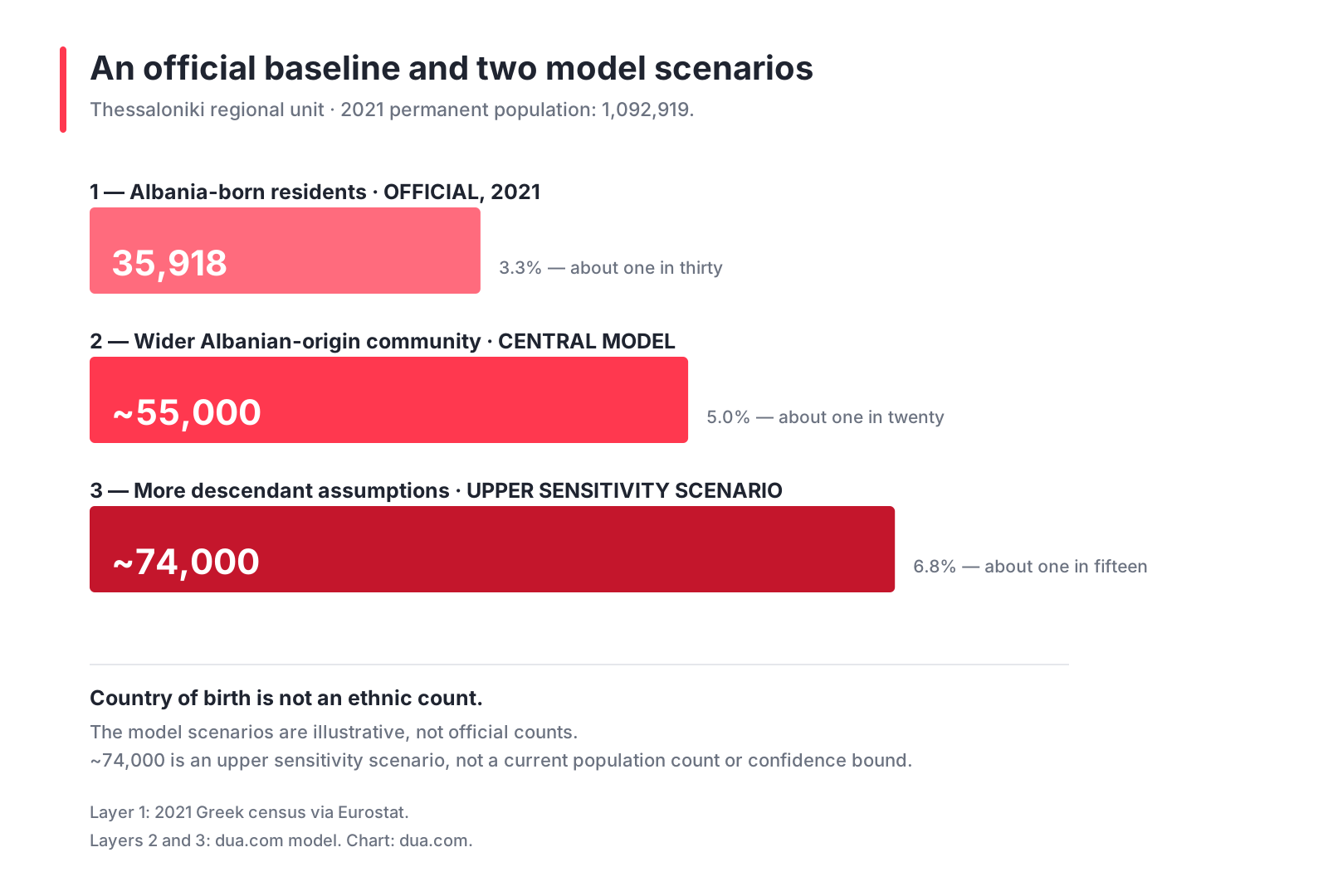
To explore the part these categories cannot capture, dua.com built an illustrative demographic model. Its central scenario gives roughly 55,000 people with Albanian roots across the regional unit. This is our model, not a new population count.
Broader assumptions produce approximately 74,000. This is an upper sensitivity scenario, showing how the result changes when more descendants are assumed. It should not be read as a claim that 74,000 Albanians currently live in Thessaloniki.
- 35,918 — officially counted Albania-born residents, 2021 census.
- About 55,000 — dua.com's central model for the wider community.
- About 74,000 — an upper modelling scenario, not an official population figure.
For a factual census answer, 35,918 Albania-born residents in the regional unit in 2021 is the number to cite. The larger figures illustrate assumptions about a wider community; they are not interchangeable with the census measure.
What the census and the model measure
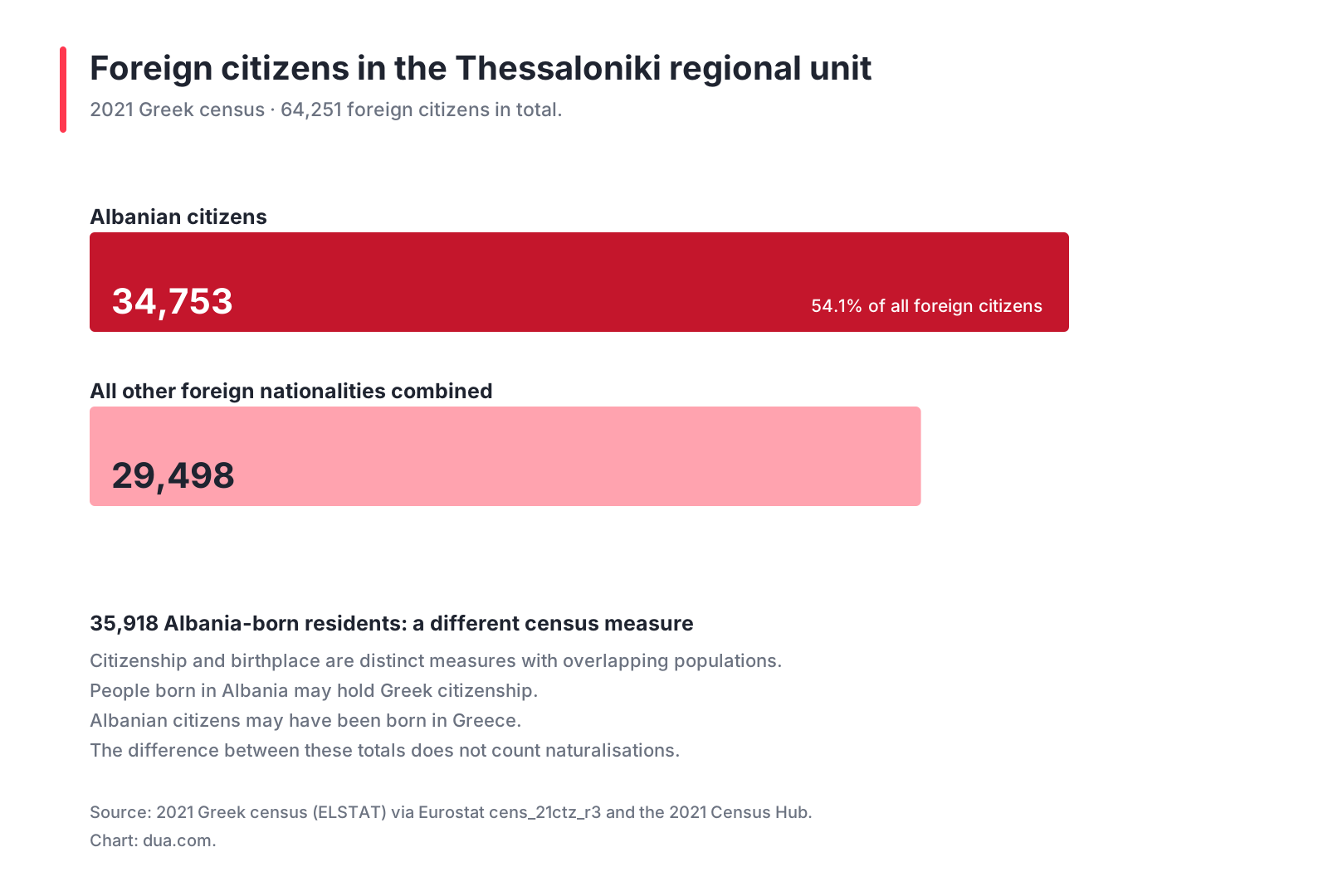
At the 2021 Greek census the regional unit of Thessaloniki counted 34,753 Albanian citizens — 18,153 men and 16,597 women — out of a permanent population of 1,092,919. That is 54.1% of all 64,251 foreign citizens living in the area. Albanians are not one immigrant group among many in Thessaloniki. They are the majority of the area's foreign population, on their own, by a margin no other nationality comes close to. The figures come from Eurostat's cens_21ctz_r3 table, supplied by ELSTAT.
One qualification has to travel with every number on this page. The regional unit (NUTS3 EL522) is much wider than the municipality: the Municipality of Thessaloniki had a permanent population of 319,045 in 2021, so the regional unit is roughly three and a half times larger and takes in Neapoli, Evosmos, Ampelokipoi and the surrounding municipalities. ELSTAT does not publish an Albania-specific count below regional-unit level. The census portal's Thessaloniki sub-pages that look as though they should carry it are unpopulated template stubs. Anyone quoting a figure for the municipality alone is either estimating or making it up.
The other administrative count has the same blind spot. At 31 March 2026 Albanian citizens held 257,523 of the 529,692 valid residence permits issued to third-country nationals in Greece — 48.6% of the total, 140,809 men and 116,714 women (Ministry of Migration and Asylum, Legal Migration monthly annex, Table 3). No breakdown by nationality is published for Thessaloniki; the finest geography the ministry publishes is the Decentralized Administration of Macedonia–Thrace.
| Census layer (2021) | Permanent population | Albanian citizens | All foreign citizens | Albanians as share of foreigners | Albanians as share of population |
|---|---|---|---|---|---|
| Regional unit of Thessaloniki | 1,092,919 | 34,753 | 64,251 | 54.1% | 3.2% |
| Region of Central Macedonia | 1,795,669 | 63,069 | 106,701 | 59.1% | 3.5% |
| Greece | 10,482,487 | 374,926 | 765,598 | 49.0% | 3.58% |
The regional and national rows come from ELSTAT Table A02 and the 2021 census release; the population shares in the final column are our arithmetic. Two things stand out. Albanians are a larger share of the foreign population in Central Macedonia (59.1%) than they are nationally (49.0%) — northern Greece is, proportionally, more Albanian in its migration mix than the country as a whole. And the regional share has barely moved in a decade: 59.8% in 2011, 59.1% in 2021, even though the absolute count fell from 69,888 to 63,069.
The age profile of the 34,753 describes a settled population rather than a workforce in transit. Under-15s number 6,001 — 17.3% of the total; 14,470 are aged 30–49, the family-forming and mortgage-paying years; only 1,258 are 65–84. This is a community with far more children than pensioners, which is what you expect thirty years after an arrival wave and not what you expect from circular labour migration.
The country-of-birth cross-check
The 2021 census records 35,918 Albania-born residents and, separately, 34,753 Albanian citizens in the Thessaloniki regional unit. These are overlapping groups, not a total and its subset: Albanian citizens can be born in Greece, while people born in Albania can hold Greek or another citizenship.
The difference of 1,165 between these totals is therefore not a count of naturalised residents, nor does their similarity establish that few people have naturalised. Albania-born residents remain in the birthplace measure after acquiring Greek citizenship.
The birthplace figure excludes descendants born in Greece and does not identify ethnicity. That is why it provides a documented starting point for this page, while the wider Albanian-origin community remains a modelling question.
The naturalisation engine
Between 2007 and 2024, 266,970 Albanian citizens acquired Greek citizenship (Eurostat migr_acq, updated 27 March 2026). By our arithmetic, this represents 82.2% of all Greek citizenship grants in that period. It is a national series, not a Thessaloniki population count or a count of ethnic Albanians. Naturalisation helps explain why citizenship totals change, but this series spans a different period from the 2011–2021 census comparison and cannot alone account for migration, births and deaths.
The mechanism has a date. Law 4332/2015, in force from 9 July 2015, opened a route by declaration for children born in Greece or schooled in Greece. Grants under that heading ran 305 in 2015, then 19,367, 25,528, 21,559, 12,868, 9,099, 5,154, 6,867 and 7,054 — our sum, 107,801 over nine years. Albanians were 78.87% of the category in 2023 (Greek Ministry of Interior figures via ELIAMEP Working Paper #131/2025). The annual naturalisation peaks match: 28,548 in 2016, 29,769 in 2017, 24,203 in 2018, down to 10,709 in 2024.
One caveat must always travel with these figures, and dropping it would be dishonest. After 1991 Greece issued roughly 200,000 homogeneis Special Identity Cards (EDTO) to Albanian citizens — a status covering ethnic Greeks from southern Albania as well as Orthodox Albanians and Vlachs; 14,577 such cards held by Albanian citizens were still valid according to the Ministry's March 2026 bulletin. A share of the 266,970 naturalisations, unquantified in any public source, went to people who identify as Greek and always did. Hatziprokopiou's Thessaloniki fieldwork found 34% of his Albanian sample was of ethnic Greek origin. Nobody should read the naturalisation series as a clean count of ethnic Albanians.
Three layers, not one number
“How many Albanians live in Thessaloniki?” is three questions wearing one coat. How many does the state actually count? How many are there once you include the children born here who now hold Greek passports? And what is the most the population could plausibly be if every assumption is pushed to its generous end? Those have three different answers, and the way bad numbers get made is by answering one of them and quoting it as though it had answered the others. So this page reports three layers and keeps them in separate lanes, the same way our albanians in Munich page does.
Layer 1 — the birthplace baseline: 35,918. The 2021 census counted this many Albania-born residents in the Thessaloniki regional unit: 3.3% of its 1,092,919 residents, roughly one in thirty. Status: official. It includes Albania-born residents who have naturalised, excludes descendants born in Greece, and does not identify ethnicity. It is a precise birthplace measure, not an exact ethnic minimum.
Layer 2 — descendant-aware: about 55,000. To the birthplace baseline add a deliberately conservative Greek-born second generation of about 16,000 — the bottom of the 16,000–24,000 range our reading of the Law 4332/2015 grant series and the 1990s arrival cohort supports — and a historic residue of about 3,000 for older Albanian-descended and Arvanite families. 35,918 + 16,000 + 3,000 = 54,918, which we round to about 55,000: 5.0% of the regional unit, roughly one in twenty. Status: our model. This is the figure we would defend if forced to print one.
Layer 3 — the upper scenario: about 74,000. Now swap the conservative second generation for a generous one of about 35,000 — one Greek-born descendant holding a Greek passport for every Albania-born resident the census counts, a one-for-one assumption that goes well past the top of our own range — and keep the 3,000 residue. 35,918 + 35,000 + 3,000 = 73,918, or about 74,000: 6.8% of the regional unit, roughly one in fifteen. Status: our model, and specifically an upper scenario. It is not a confidence bound, not a maximum anyone has measured, and not a number we believe. It exists so that nobody has to guess what our most generous reading would look like.
| Layer | What it counts | People | Share of the regional unit | Status |
|---|---|---|---|---|
| Layer 1 — birthplace baseline | Residents born in Albania, 2021 census, regional unit of Thessaloniki | 35,918 | 3.3% — about one in thirty | Official — Eurostat 2021 Census Hub, ELSTAT data |
| Component: Greek-born second generation, conservative | Children born in Greece to Albanian parents, now Greek citizens | about 16,000 | — | Our model, from the Law 4332/2015 grant series and the 1990s arrival cohort |
| Component: historic residue | Older Albanian-descended and Arvanite families in the area | about 3,000 | — | Our model; the Arvanite heartland is the south, so this term is small here |
| Layer 2 — descendant-aware | 35,918 + 16,000 + 3,000 = 54,918 | about 55,000 | 5.0% — about one in twenty | Our model |
| Component: Greek-born second generation, generous | One Greek-born descendant for every Albania-born resident counted | about 35,000 | — | Our model, deliberately set above our own 16,000–24,000 range |
| Layer 3 — upper scenario | 35,918 + 35,000 + 3,000 = 73,918 | about 74,000 | 6.8% of the regional unit — about one in fifteen | Our model — an upper scenario, not a confidence bound |
| Cross-check: Athens-page multiplier | 1.70x applied to 35,918 | about 61,000 | 5.6% — inside the band | Our arithmetic, using the method from albanians in Athens |
Three cross-checks, stated out loud
The Athens multiplier lands inside the band. Our albanians in Athens page derives a multiplier of 1.70x from counted residents to full descent. Applied to Thessaloniki's 35,918 it gives about 61,000 — above Layer 2, below Layer 3, which is where an independent method ought to land if the band is honest. Two routes built from different starting points bracket the same stretch of ground.
Kokkali’s research provides historical context. Her mapping of the 2001 census by postal code reported Albanian shares of 5% in Athens, 3% in Thessaloniki and 4% in Greece. Those earlier census-based spatial proportions do not measure today’s Albanian-origin population and cannot validate or set a ceiling for our ancestry model. The central scenario of about 55,000 and upper sensitivity scenario of about 74,000 depend on the assumptions set out above.
And a majority is not a near miss. Half of the regional unit's 1,092,919 residents is 546,459.5, so a majority would require more than 546,459 people of Albanian descent — more than seven times even the upper scenario, and about ten times the central one. That is not a figure to argue over. It is a different order of magnitude.
What that rules out
A majority of the Thessaloniki regional unit’s 1,092,919 residents would require more than 546,459 people. Neither our central model of about 55,000 nor the upper sensitivity scenario of about 74,000 comes close to that. These models are not population counts, and the historical sources discussed below do not establish an Albanian majority or plurality in the city.
What the numbers do support is more interesting than the myth. A community of about 35,900 counted residents, with a Greek-passported second generation we model at somewhere between 16,000 and 35,000, is the largest foreign-origin group in the area by a clear margin and has been since at least 2001, when the prefecture recorded 31,611 Albanians. The Thessaloniki stock rose from 31,611 to 34,753 over twenty years while the national Albanian count fell 22%, though the two censuses used different concepts (de jure in 2001, permanent population in 2021), so the comparison indicates direction rather than a precise delta. Northern Greece held on to its Albanians while the country as a whole recorded fewer of them. That is the community of the last thirty-five years. The harder question is what stands behind it — because Albanians were running this city, and working it, long before any of them appeared in a table.
Albanians in Ottoman Salonica
Albanians were present in Ottoman Salonica, but the historical record does not give us a reliable count of how many lived in the city. Ottoman statistics generally classified people by religion and administrative community rather than ethnicity as we understand it today, making an Albanian population difficult to isolate.
What we can document are individual people and connections. Ottoman officials of Albanian origin served in Salonica, while Albanian-speaking soldiers, workers, merchants and migrants were part of the movement of people through the city and its wider region.
That evidence shows that Albanians were part of Salonica's history; it does not establish an Albanian-majority city. Like many Ottoman ports, Salonica was shaped by several linguistic, religious and cultural communities living alongside one another.
The same care applies to historical figures. Someone born in territory that is now Albania was not automatically Albanian in the modern national sense. Birthplace, family origin, language and identity can point in different directions, especially in the Ottoman Balkans.
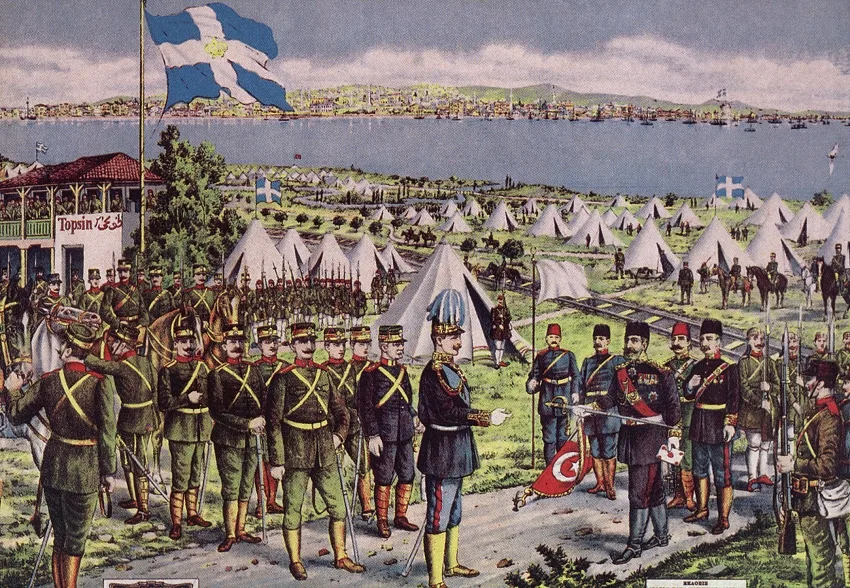
The Albanians who governed Salonica
The following people and episodes show some of the Albanian connections in Salonica’s history. They document participation in the life of a multilingual city, rather than establishing its population’s ethnic composition.
Mazower's chapter: the men in the bathhouses
Mark Mazower gives Albanians a chapter of their own in Salonica, City of Ghosts: Christians, Muslims and Jews 1430–1950. By the mid-eighteenth century, he writes, several thousand Albanians worked in the city — in the hammams, as boza-sellers, gunsmiths, stonemasons and guards — with others arriving seasonally as shepherds and cattle-dealers. Set that against a city of 50,000 to 60,000 people, and our arithmetic puts the Albanian presence at somewhere between five and ten per cent of the population. Not a community with its own quarter, its own school, its own recorded name. A workforce.
Armed labour was part of the same market. Mazower notes that the pashas of the region kept retinues “recruited from young men, mostly Albanians from poor mountain villages”, and that a single landowner at Doiran who controlled most of the pashas of Salonica could put 3,000 Albanians into the field. He adds that many of the leading beys of the Macedonian hinterland were themselves of Albanian origin. The pattern is consistent across the Ottoman Balkans: Albanians supplied the coercive and manual underlayer of provincial power, and a slice of the provincial elite besides. Neither role generated paperwork that named them.
Two governors named in the record
The province of Salonica was governed by a vali, and the chair rotated among the whole imperial elite — Turks, Arabs, Circassians, Albanians, converts and career bureaucrats from every corner of the empire. It is not evidence of Albanian control that it came round to Albanians. It is evidence that Albanians were inside the pool from which the empire drew its governors, which is exactly the fact Greek and Ottoman statistics have no way of showing.
Two of them are documented. “Arnavut” Mehmed Âkif Paşa, from Kalkandelen — today Tetovo — held the governorship of Salonica three separate times: January 1860 to January 1865, June 1867 to February 1869, and May to September 1873. That is roughly six years in the post across thirteen years, an unusually long association for a provincial governorship. He went on to serve as Minister of Justice and twice as President of the Council of State, according to Kuneralp's standard prosopography of the late Ottoman ruling elite. His epithet — Arnavut, “the Albanian” — travelled with his name in the record.
Âbidin Paşa Dino of Preveza governed Salonica in the spring of 1880 and left the post to become Ottoman Foreign Minister. Two years earlier he had been a founder of the League of Prizren and its central-committee man for Chameria. The TDV İslâm Ansiklopedisi, the Turkish religious foundation's scholarly encyclopaedia, confirms both the governorship and that he spoke Albanian. A man who had helped organise the first modern Albanian national movement was, two years later, governing the Salonica vilayet — and then directing the empire's foreign policy. The empire did not read those two roles as a contradiction, and neither should we.
Hasan Tahsin Pasha and the surrender
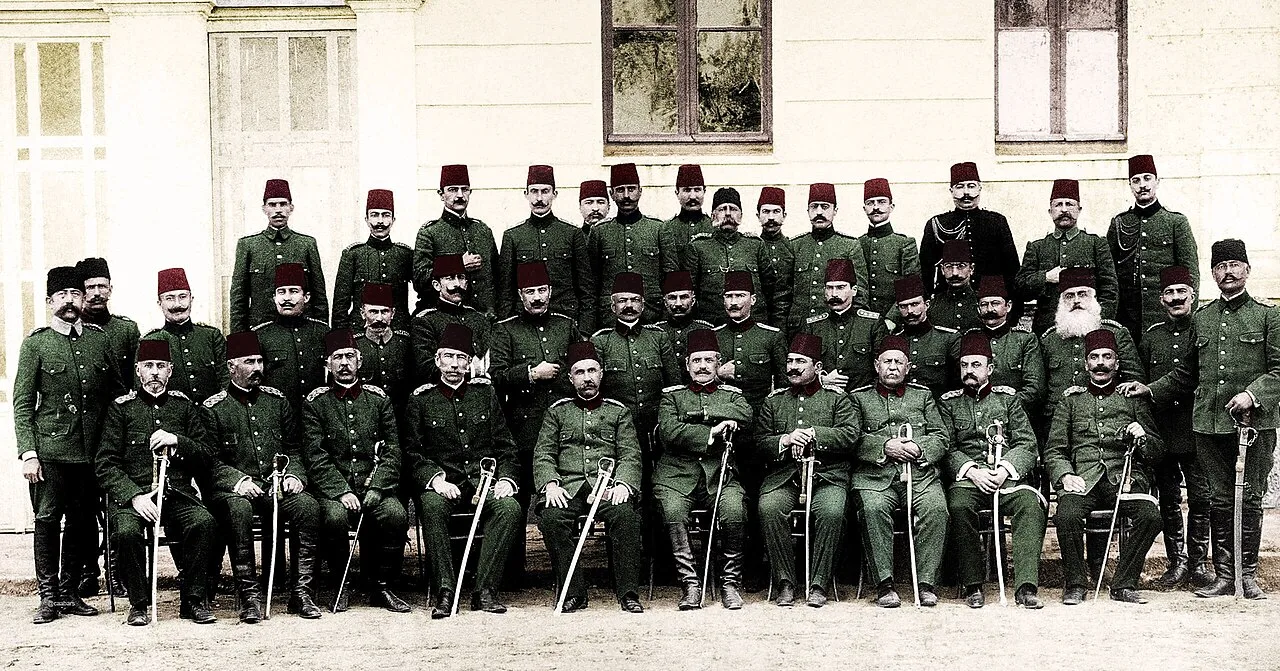
The best-documented Albanian career in the city ends with its transfer to Greece. Hasan Tahsin Pasha was born in 1845 at Mesarë — Çarçovë — in the kaza of Leskovik, in what is now southern Albania. He entered service as a gendarme at Katerini, rose to command the Ottoman Gendarmerie at Ioannina by 1881, and became garrison commander of Thessaloniki from around 1900. He later commanded III Corps and served as governor of Yemen.
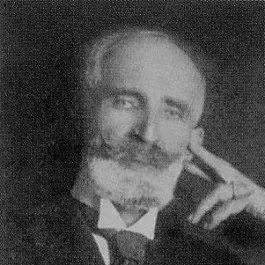
On 8 November 1912, with the First Balkan War closing on the city, he signed the surrender protocol and handed Thessaloniki to the Greek army along with 26,000 men. Istanbul sentenced him to death in absentia. Albanian and Turkish nationalist writing has spent a century arguing about what he did and why; the charge that he gave the city up “without a fight” is a polemical formula, not a sourced finding, and we do not repeat it. What is documented is the birthplace, the command, the protocol, the number of men and the death sentence.
His son, Kenan Messare, stayed, acquired Greek citizenship and became a painter of Thessaloniki; his works are held in the Municipal Art Gallery of Thessaloniki. Their biographies document a family connection between the city and a place in present-day Albania. Birthplace and family history alone do not establish how either man understood his national identity.
1908–1912: the city where Albanian was printed
For four years after the Young Turk revolution, Salonica was where the Albanian national movement did its publishing. An Albanian club was founded in the city on 24 August 1908, its president elected by 400 Albanian delegates: Mid'hat Frashëri, who wrote as Lumo Skendo. He was no outsider — he served as an official in the Ottoman administration of the Salonica vilayet from 1905 to 1910, an Albanian nationalist drawing an Ottoman salary in the vilayet's own capital.
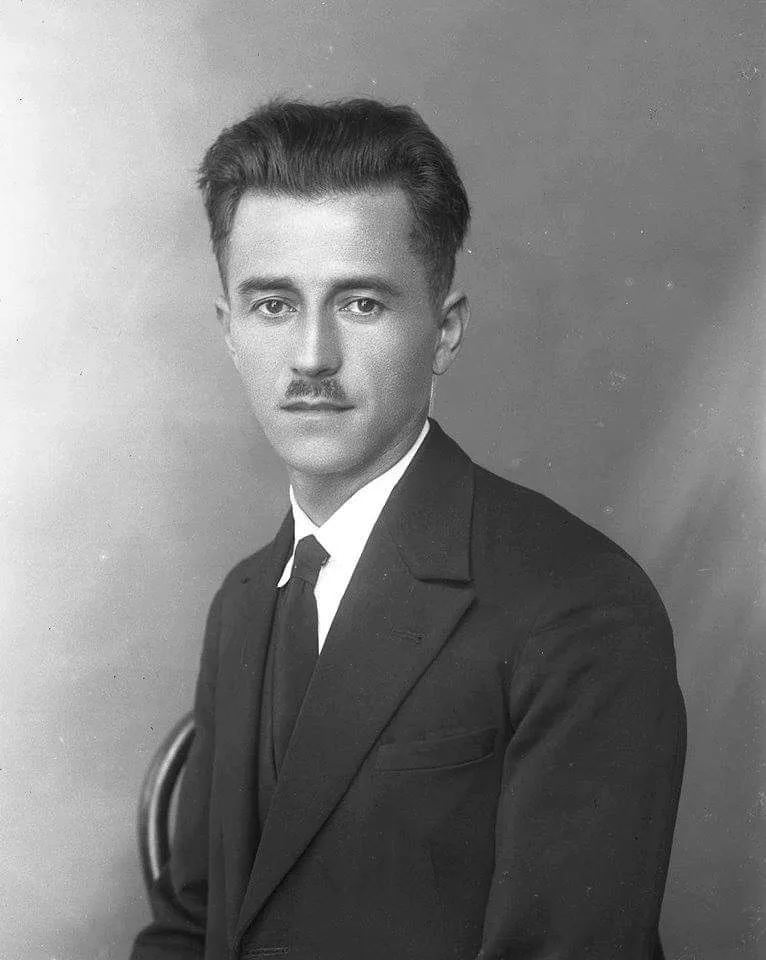
From the city he ran two titles. The weekly Lirija (“Freedom”) appeared from 1908 to 1910; the monthly Diturija (“Knowledge”) from January 1909. Both were produced at Kristo Luarasi's Mbrothësia press. In a period when writing Albanian at all had been a political act for decades, Salonica had the type and the press.
It did not become the movement's capital, and the reason is worth stating plainly. Frashëri wanted the Salonica club to serve as headquarters of the Bashkimi society. The other clubs refused. They were wary of how much Young Turk influence ran through the city — this was the Committee of Union and Progress's own base — and chose Monastir (Bitola) instead. The honest summary is that Salonica was the movement's printing house and one of its recruiting grounds, while its centre of gravity sat elsewhere.
April 1909: the march on Istanbul
The clearest single measure of how many Albanians the city could mobilise comes from the counter-coup of April 1909. When the Action Army — the Hareket Ordusu — mustered at Salonica and marched on Istanbul to put down the mutiny against the constitutional regime, it was supplemented by 15,000 volunteers. Roughly 9,800 of them were Albanians: Çerçiz Topulli and Bajram Curri brought 8,000, and Major Ahmed Niyazi Bey brought 1,800 from Resne. The figures are Gawrych's, in The Crescent and the Eagle (I.B. Tauris, 2006, pp. 167–168).
That made Albanians the largest national contingent in the force — our arithmetic puts them at roughly two in three of the volunteers. The army that saved the Ottoman constitution set out from Thessaloniki, and two-thirds of the men who joined it there were Albanians. Four years later a Greek census of the same city would offer them five nationalities to choose from, none of them their own.
1916–17: the Arvanite triumvirate
The pattern survived the change of sovereign. From August 1916 to May 1917, Thessaloniki was the capital of a separate Greek state — the Provisional Government of National Defence, set up in opposition to the royal government in Athens. Two of the three men in its ruling Triumvirate came from Albanian-speaking families.
Admiral Pavlos Kountouriotis spoke only Arvanitika whenever he was on Hydra, according to his own secretary. General Panagiotis Danglis came from a Souliot family that spoke Albanian at home. Around 1913, the Governor-General of Macedonia had been Emmanouil Repoulis — “of Arvanite origin and Albanian-speaking at home”.
These men were Greek patriots, and nothing here suggests otherwise; Arvanites were among the founding populations of the modern Greek state and understood themselves as Greeks. The point is narrower and stranger. In the space of four years, the same city was governed by an Ottoman general born in Albania, then by a Greek revolutionary government two-thirds of whose leadership spoke Albanian at home. Neither administration recorded the fact, because neither had any reason to.
An establishment without a community
Read together, the record shows something unusual. Thessaloniki accumulated Albanians at the top and the bottom of its social structure — governors, generals, ministers, publishers and beys at one end; bathhouse workers, gunsmiths, stonemasons, shepherds and armed retainers at the other — without ever developing the middle: no Albanian quarter, no Albanian school, no Albanian entry in any census the city ever took.
An establishment without a community leaves almost no archival trace as a community. It leaves individual careers, filed under empire, or under Greece, or under nothing at all. That absence is the subject of the next section — and it is not the same thing as an absence of people.
The column that never existed
In January and February 1925 the Thessaloniki Police Directorate compiled lists of the Albanians living in the city. The lists name about sixty people, described as “mostly guards and a few land owners” (Thessaloniki Police Directorate lists, 1925, published by 100sources.gr citing the historian Hekimoglou).
The date is the whole point. The Lausanne population exchange was under way, Muslims were being deported to Turkey on a religious criterion, and Greece and Turkey had agreed in principle that Albanians should be exempt. For a few months in 1925, declaring yourself Albanian in Thessaloniki was not a liability but a shield. Sixty people stepped forward.
That number is not a measurement of how many Albanians lived in the city. It is a measurement of how many had a reason to be named — and of how thin the paperwork was that could name them. Everywhere else in the archive, the category simply is not there.
No Ottoman register ever asked
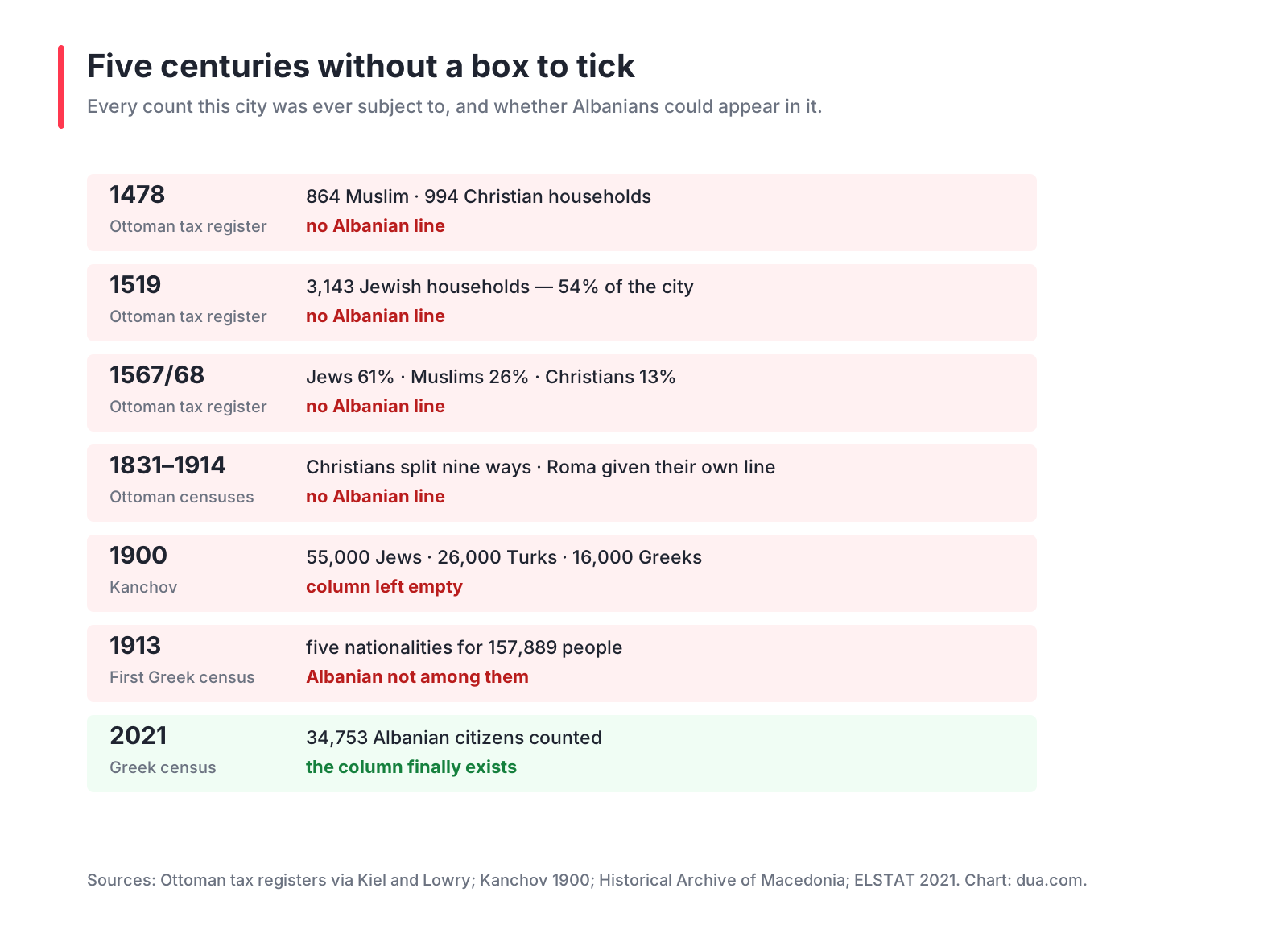
Across every Ottoman enumeration — 1831, the 1881/82–1893 general census, 1905/06, 1914 — there is no Albanian line. The 1881/93 census, the most detailed of them, split the population into Muslims, Greeks, Armenians, Bulgarians, Catholics, Jews, Protestants, Latins, Syriacs and Roma. Christians were divided nine ways or more; Roma were given their own row; every Muslim in the empire — Turk, Albanian, Bosniak or Circassian — was counted as a single undifferentiated group. Ottoman statistics never recorded mother tongue anywhere, at any date. A mother-tongue question appears for the first time in the Turkish Republic's census of 1927, fifteen years after Salonica had stopped being Ottoman.
So an Albanian Muslim gunsmith in the city and a Turkish-speaking official from Anatolia entered the record as the same thing. The instrument had no way of telling them apart, and was not designed to.
Five nationalities, April 1913
The first Greek census of the city, taken on 28 April 1913, is headed explicitly “by nationality” — ΠΙΝΑΞ ΕΜΦΑΙΝΩΝ ΤΟΝ ΠΛΗΘΥΣΜΟΝ ΤΗΣ ΠΟΛΕΩΣ ΘΕΣΣΑΛΟΝΙΚΗΣ ΚΑΤ' ΕΘΝΙΚΟΤΗΤΑ ΚΑΙ ΦΥΛΟΝ — and offers exactly five options. Greeks 39,956; Israelites 61,439; Ottomans 45,867; Bulgarians 6,263; Foreigners 4,364. In total 32,131 families and 157,889 people across 21 census districts, signed by Th. Liverios, Director of the Labour Office. The document is held in the Historical Archive of Macedonia and was published by Vasilis Dimitriadis in Makedonika 23 (1983), pp. 88–116.
Look at the third column. “Ottoman” is an imperial administrative category built on faith, lifted whole out of the Ottoman register and set down in a Greek table that says it is measuring ethnicity. Muslim Albanians are inside those 45,867. Orthodox Albanians are inside the 39,956 counted as Greeks. Neither group can be pulled back out of the arithmetic, then or now, by anything anyone can do to that page.
Kanchov's zero, and what it actually says
The Bulgarian geographer Vasil Kanchov's 1900 statistics give the city 118,000 people: 55,000 Jews (47%), 26,000 Turks (22%), 16,000 Greeks (14%), 10,000 Bulgarians (8%), 2,500 Catholics and 8,500 “other”. There is no Albanian line at all.
This is not a case of a surveyor who lacked the category. Kanchov used a separate “Arnauts” heading freely elsewhere in Macedonia and devoted roughly sixteen pages of his ethnography to Albanians. Across the entire Salonica vilayet he counted 1,211 Albanians — 61 Christian, 1,150 Muslim — in a population of 1,164,539, or 0.10%, nearly all of them at Veles.
And then he explains his own zero. Writing on the settlement of Albanians in Macedonian towns towards the end of the eighteenth and the beginning of the nineteenth century — Bitola, Florina, Ohrid and Salonica among them — he records that “the Albanian settlers in Salonica have become Hellenized, while in the other towns they have been Bulgarianized” (ethnography, ch. B.7, p. 86). He watched the same process live at Kastoria: about fifty households of Christian Albanians from Epirus, in his words almost Hellenized, the old people still speaking Arvanitic while the young used Greek.
Kanchov's zero for Salonica is therefore a statement about assimilation, not about absence. He is telling his reader that the Albanians of the city had already stopped registering as Albanians by 1900.
1923: a religious criterion, and an exemption nobody honoured
The Lausanne exchange sorted people by faith and nothing else. Greece and Turkey formally agreed to exclude Albanians from it; neither side adhered to that agreement. Around 25,000 Muslims lived in Thessaloniki in 1920 and left in 1924, while roughly 120,000 Christian refugees were settled in the city by 1928. The Albanian-speaking Muslims of Greek Macedonia were concentrated in the west, at Kastoria and Florina, not around Thessaloniki: the August 1924 departures record 7,949 from Kastoria and 1,068 from Florina.
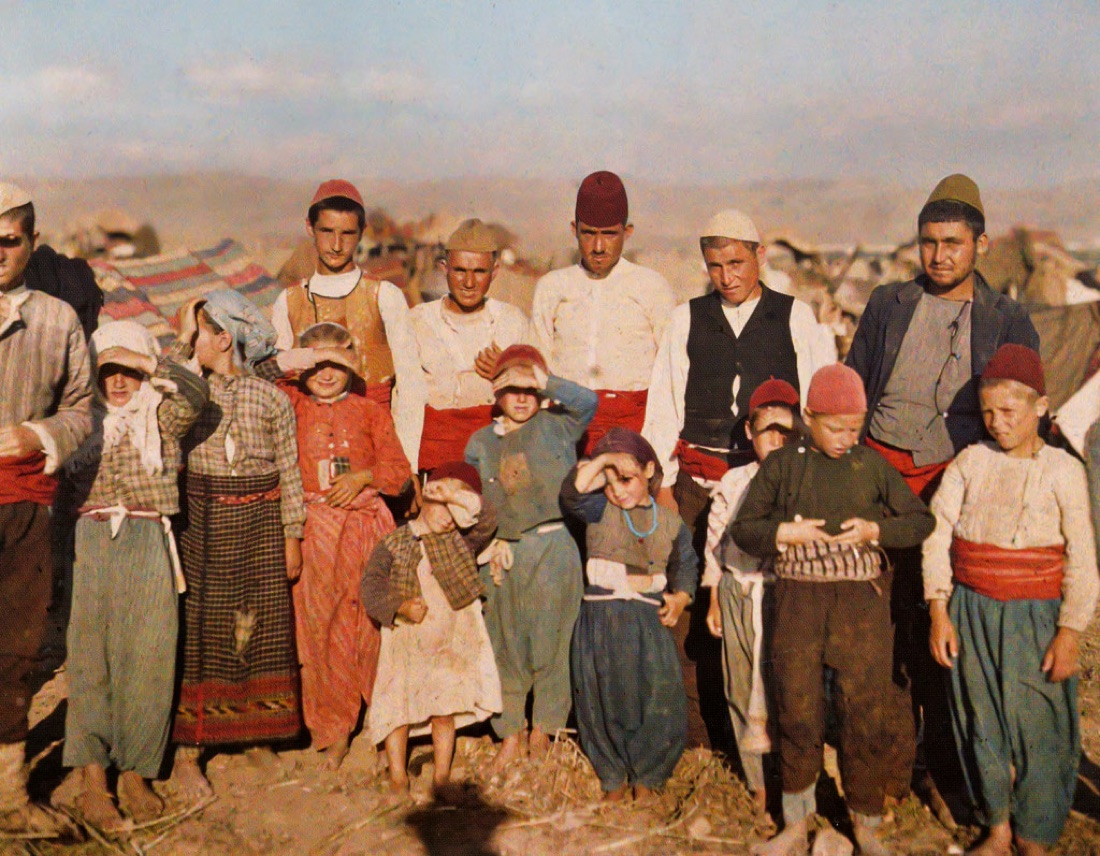
Read that against the police lists of a few months later and the sequence becomes legible. The mechanism that would have made an Albanian identity worth registering in Thessaloniki arrived just after the population it would have applied to had already been removed, converted into “Ottomans”, or absorbed into the Greek column.
The map, and the languages, redrawn
1,805 settlements in Greek Macedonia were renamed after 1913. Under the Metaxas dictatorship a Slavic language was banned even indoors (Kostopoulos, The Forbidden Language, 2000). The state that rewrote the map also decided how its inhabitants would be counted.
Lambros Baltsiotis has documented the counting itself. In his study for the European Journal of Turkish Studies (12, 2011) he shows that the 1920 census reported Albanian as absent from Epirus and returned 95 Orthodox Albanian speakers in the whole of Greece — while the same region returned 17,009 Albanian-speaking Muslims eight years later. Greek censuses recorded mother tongue until 1951: 50,975 Albanian speakers in 1907, 18,773 in 1928, 22,736 in 1951. Greece has published no mother-tongue figures since.
Anastasia Karakasidou's Fields of Wheat, Hills of Blood: Passages to Nationhood in Greek Macedonia 1870–1990 was dropped by Cambridge University Press in 1996, which cited fear for the safety of its staff in Greece; she received death threats, and the University of Chicago Press published the book in 1997. It belongs in this section as evidence of how contested the region's plural past remains — but honestly: the pasts Karakasidou recovers are Slav-speaking, Vlach, Muslim and Jewish. She is not writing about the Albanians of Thessaloniki.
A priest at Negovan, a cemetery at Triandria
What happened to those who did insist on the category is a matter of record. Papa Kristo Negovani (1875 – 12 February 1905), an Orthodox priest, poet and teacher from Negovan, today Flampouro in Florina, celebrated the Divine Liturgy in Tosk Albanian for the first time on 10 February 1905 and turned his own house into a school where more than a hundred people learned to read and write Albanian. Two days after that liturgy he was killed, together with his brother Papa Theodhosi and three other villagers, by a Greek guerrilla band. Albanian national historiography attributes the order to Bishop Germanos Karavangelis; that attribution rests mainly on Albanian sources and should be treated as contested. The killing itself is not.
Thessaloniki's Albanian cemetery is documented entirely from the Greek side. Greek local media (emakedonia.gr), the Greek-language Wikipedia and a Wikimapia entry titled “Πάρκο Τριανδρίας (Παλιά Αλβανικά Νεκροταφεία)” all describe the burial ground of the city's Muslim Albanians in Triandria, bounded by Eleftherias, Filikis Etaireias, Koundouriotou and D. Glinou streets, and call it the last remnant of the old Muslim cemeteries of Thessaloniki. It was dissolved in 1983; the remains were moved to the Malakopi ossuary and the site is now a park and a children's playground.
Hasan Prishtina, a former prime minister of Albania, was shot dead in Thessaloniki on 13 August 1933 while living there in exile, and was buried in that cemetery. His remains were repatriated to Kukës in 1977. The grave of an Albanian head of government sat in Thessaloniki for forty-four years, in a cemetery that no longer exists, in a city whose census forms had never once offered him a box to tick.
The number was never allowed to exist
Put the instruments in a row. From the first Ottoman survey of 1478 to the last Greek mother-tongue count in 1951, this city was enumerated by an empire and then by a nation-state for the better part of five centuries — and not once, not in 1831, not in the 1881/82–1893 general census, not in 1905/06, not in 1914, not on 28 April 1913, did any of them offer an Albanian box. Ottoman statistics recorded faith, and never, anywhere in the empire, at any date, mother tongue. The Greek census that replaced them offered five nationalities, one of which was an Ottoman religious category wearing an ethnic label.
Then take the one surveyor who did carry the category and watch what he does with it here. Vasil Kanchov used an “Arnauts” heading freely across Macedonia and gave Albanians roughly sixteen pages of his ethnography. For this city he wrote a zero — and then explained it himself: the Albanian settlers in Salonica, he says, “have become Hellenized”. That zero is not a measurement of absence. It is a receipt for an assimilation he had already watched happen, and at Kastoria he described it in progress, the old people still speaking Arvanitic while the young used Greek.
And then the test case, which is the closest thing this page has to an experiment. January and February 1925 is the one documented window in which saying “I am Albanian” to a Greek official was worth something: the Lausanne exchange was deporting Muslims by faith, Athens and Ankara had agreed on paper that Albanians were exempt, and for a few weeks the category had cash value. The Thessaloniki Police Directorate went looking, and produced about sixty names. Not sixty Albanians in the city. Sixty people for whom a form existed, at the only moment a form was worth filling in.
That sequence is the spine of this page, and it should be read as a finding rather than as a complaint. The reason no larger Albanian number can be proved for Thessaloniki is not that researchers have been idle, though almost nobody has looked. It is that five centuries of record-keeping were built so that the number could not be produced. The silence in the archive is not evidence about how many Albanians lived here. It is evidence about what the archive was for.
And one thing has to be said in the same breath, every time, or the argument above gets stolen. A missing column hides people inside another column; it never enlarges the column. The 1913 census put 45,867 “Ottomans” in a city of 157,889 — 29% of everyone — and roughly a third of the city's Muslims were Dönme, Sabbatean converts who were neither Albanian nor Greek. Grant the most extravagant assumption available, that every remaining Muslim in Thessaloniki in 1913 was an Albanian, and the arithmetic still stops under 20%. Jews were the plurality; Greeks and Ottomans were the two large blocks; Albanians sat inside one of those and inside the Greek column too, and no quantity of erasure moves any of those totals by a single person. What was suppressed was a category, not a majority. Anyone who takes the first half of this argument without the second is not reading the page. They are mining it.
From migration to a community that calls Thessaloniki home
For many Albanian families, the modern story of Thessaloniki begins in the 1990s. People arrived looking for work and stability. Some expected to stay temporarily; instead, they found jobs, raised families and gradually made a home in and around the city.
More than thirty years later, those first arrivals are only part of the picture. Their children have grown up in Thessaloniki, attended Greek schools and universities, entered the workforce and built lives of their own. Many families have acquired Greek citizenship. Others move naturally between Greek and Albanian language, culture and family networks.
There is no single Albanian neighbourhood that tells this story. The community is spread across the city and the wider regional unit, connected through families, friendships, businesses, associations, the Albanian Saturday school, cultural events and regular movement between Greece and Albania.
Council of Europe documentation records some 3,000 Albanian nationals entering Greece at the end of 1990 and an estimated 20,000 by mid-March 1991. Thessaloniki, the largest city in northern Greece, was one of the destinations, and the arrivals came in conditions of almost total illegality: there was no visa route, no work permit, and for most of the decade no status to apply for.
The skoupa years
What followed is documented in the open-access volume Migration in the Southern Balkans (Vermeulen, Baldwin-Edwards and van Boeschoten eds., Springer 2015, p. 19). The Greek police operations known as skoupa — “broom” — summarily expelled 277,000 Albanians without legal process in 1992 and 221,000 in 1993. Between 1992 and 1995 Greece expelled 250,000–282,000 immigrants a year, predominantly Albanians, with the same individuals repeatedly expelled and repeatedly returning.
Those numbers describe a decade in which the working assumption on both sides was that this population was temporary. It was not.
1998: the first count that counted them
The 1998 regularisation, the so-called white card, was the first moment the Greek state asked these people to identify themselves and offered something in return. Nationally 371,641 applied, 65% of them Albanians. In the prefecture of Thessaloniki 26,431 registered immigrants were recorded, more than 80% of them from Balkan countries, and Albanians were the great majority at 75% (Hatziprokopiou, Belgeo, 2005, citing Cavounidis and Hatzaki 1999).
State the base, because it matters and it is routinely misquoted: that 75% is a share of the 1998 regularisation register, not of the local migrant population. The 2001 census, counting everyone rather than everyone who applied, put Albanians at 47.2% of the prefecture's 66,941 foreign nationals. The register skews high because Albanians had both the strongest incentive and the longest presence.
What the surveys found
Two research programmes caught the community as it settled. A survey of 500 Albanian households in Thessaloniki in 2000, covering 1,297 people (Labrianidis and Lyberaki, Albanian Immigrants in Thessaloniki, Paratiritis 2001), found them living beside Greek working-class populations in the city centre and the western quarters of Neapoli, Evosmos and Ampelokipoi. 82% held steady employment and 57% paid regular social insurance. Among men, 30% worked in construction and 24% in small industrial firms; among women, 27% cleaned houses and 28% worked as housekeepers. Every woman in the sample had entered Greece legally, mostly on visas they then overstayed, while more than half the men had entered and remained irregularly.
Hatziprokopiou's fieldwork between September 2001 and February 2003, with 138 Albanian respondents, found 63.3% in central areas, 30.4% in western Thessaloniki and 7.25% in the east. 44.2% reported landlords refusing to rent to foreigners, against 31.4% of the Bulgarians surveyed. Just over a third of his Albanian sample — the 34% noted earlier — were of ethnic Greek origin. Men clustered in construction (26.5%) and manufacturing (22.7%); 31.6% of the women worked in domestic service and care.
The community you cannot see on a map
The most useful single finding about Albanians in Thessaloniki is a negative one. Ifigeneia Kokkali mapped the 2001 census by postal code and found no large concentration of Albanian households at any scale — the only over-representation was a very small area of the central municipality near the port. Her ratios were 5% for Athens, 3% for Thessaloniki and 4% for Greece overall.
She put the consequence plainly: in Thessaloniki “one cannot refer to an Albanian neighbourhood: there are few visible signs of the Albanians' numerically important presence that mark the urban space, such as Albanian cafés, restaurants, or grocers” — in sharp contrast to Georgians, Russians and Pontic Greeks, who did mark neighbourhoods ethnically (Kokkali 2006, Stanovništvo 44(2), and her chapter in Migration in the Southern Balkans).
This was a strategy, not an accident. Kokkali documents that the great majority of the migrants she interviewed in Thessaloniki used a Greek name in place of their own; that parents of Muslim or Catholic background had their Greece-born children christened Orthodox; and that Greek employers renamed Albanian employees outright — “I will call you Yiannis”. The community that the 1925 police lists could barely find had, seventy-five years later, arrived in force and again made itself hard to see. This time the decision was its own.
The crisis, and then the paperwork
The Greek financial crisis reversed the flow. An INSTAT/IOM survey found 133,544 adult Albanian migrants returned to Albania in 2009–2013, 70.8% of them from Greece and 94% voluntarily, with 53.4% of all returns falling in 2012–2013 alone.
For a geographically dispersed community, belonging is often found through these everyday connections. The institutions and meeting places below are another part of that shared life.
In a snapshot from 27 July 2026, 519 dua.com members were registered in Thessaloniki. That is not a population estimate; it is one view of how a community spread across the city continues to find and connect with one another online.
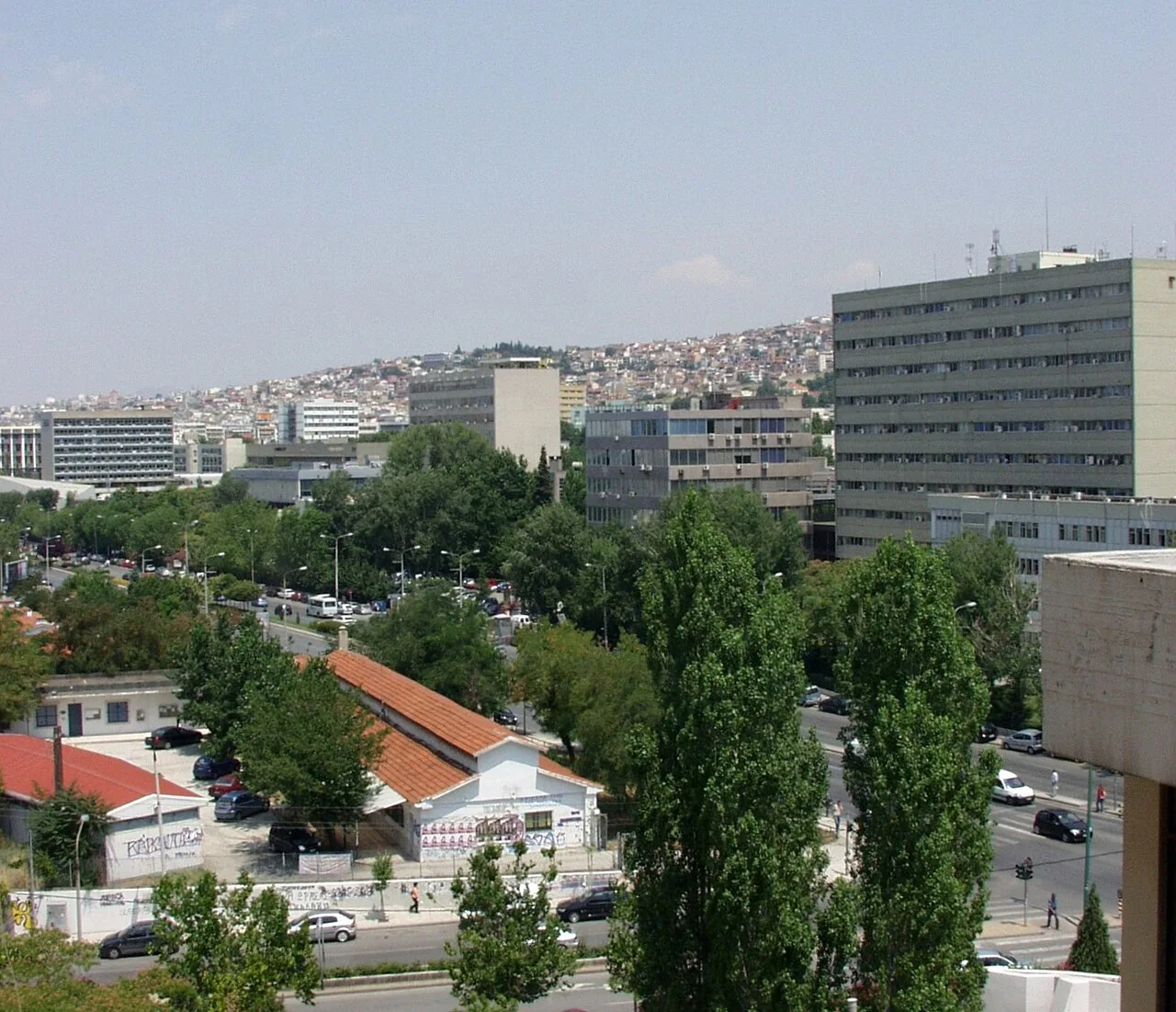
Photo: Ymblanter / Wikimedia Commons · CC BY-SA 4.0
Consulate, school, community — and the practical directory
An institutional map of Albanian Thessaloniki is short, and that shortness is itself a finding. There is a consulate, one long-running association with a Saturday school, a younger community organisation, a business network whose newsfeed stopped in 2022, and no Albanian place of worship at all. Everything else that holds the community together is a bus timetable. What follows is the narrative first and then a directory with every contact detail we could find, each one carrying an explicit note on how stale it is.
The consulate on Tsimiski
The Republic of Albania keeps a Consulate General in Thessaloniki at Tsimiski 43, TK 54623, headed by Consul General Erida Dobrushi, on 0030 2310257598, as listed by Albania's Ministry for Europe and Foreign Affairs.
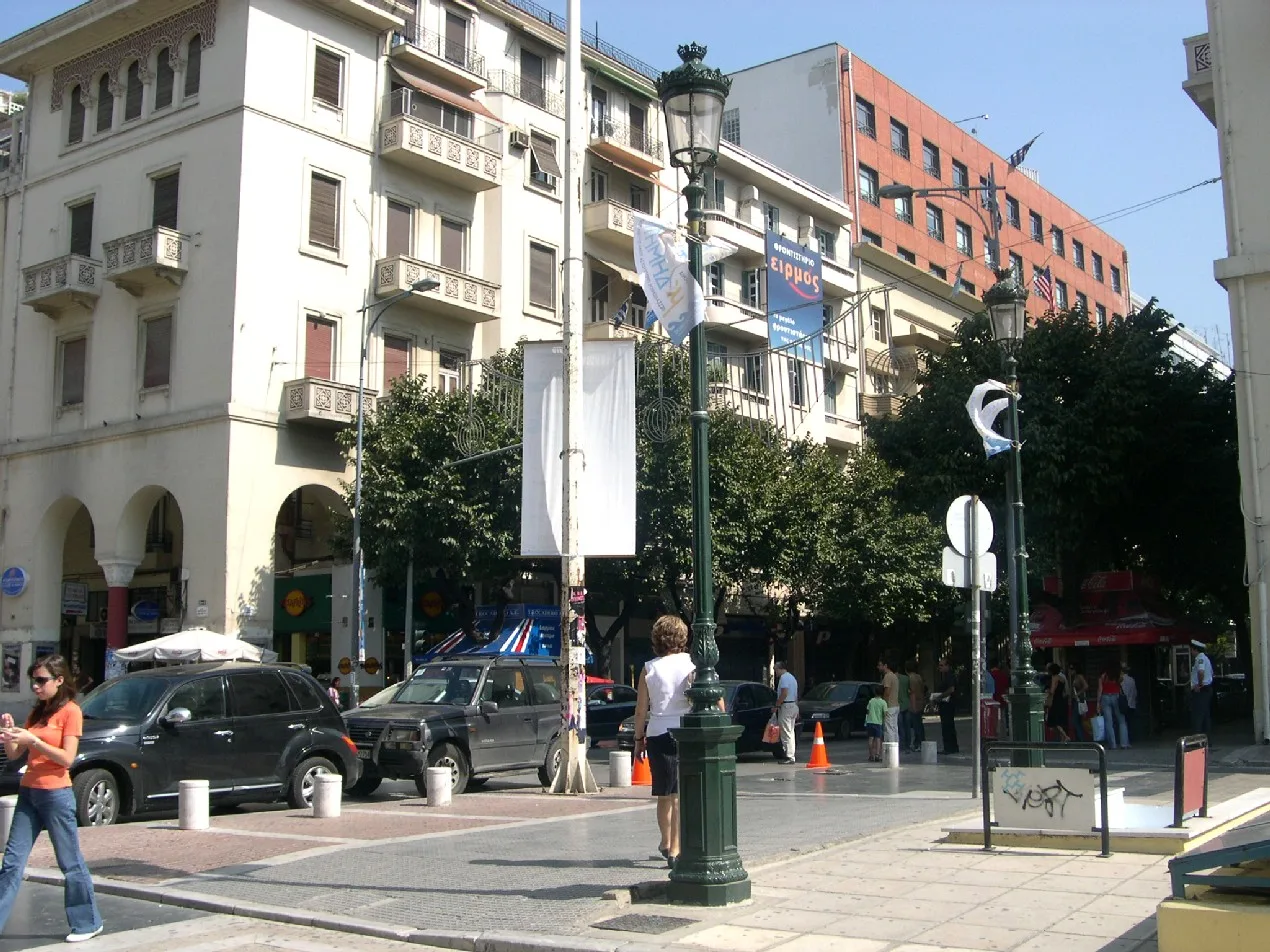
One thing about it is not published anywhere: its territorial jurisdiction. Neither the ministry's own listing nor the consulate's public material states which Greek regions it serves and where the Athens embassy takes over — whether it covers Central Macedonia alone or the whole of northern Greece. We looked, we did not find it, and we say so rather than guess. For anyone planning a passport or civil-registry appointment, that means calling first.
Shoqata “Nënë Tereza” and the Saturday school
The Shoqata e Emigrantëve Shqiptarë “Nënë Tereza” was founded in Thessaloniki in 2004 and runs the city's Albanian weekend school — the longest-running Albanian institution in the city we could document. As of August 2024 classes met on Saturdays, 15:00–17:00, at the Pedagogical Faculty of Aristotle University, with branches at Nea Raidestos and Giannitsa. Teaching follows the textbook Gjuha Shqipe dhe Kultura Shqiptare, issued by Albania's Publishing Centre for the Diaspora. The association counts more than 1,000 children passing through its classrooms in twenty years, and the teacher Lindita Budini was profiled by Gazeta Dielli on 12 August 2024.
Read that number against the population. If the regional unit holds roughly 6,000 Albanian citizens under 15 (2021 census), a thousand children over two decades is a real institution and a minority practice at the same time — most Albanian children in the city have not passed through it.
The Albanian state has begun to put money behind that gap. On 3 November 2024, at the Porto Palace hall in Thessaloniki, Prime Minister Edi Rama presented 8 of the first 50 state-contracted Albanian language teachers for Greece, assigned to teach in the Thessaloniki area. Whether eight teachers change the arithmetic above is a question for 2030, not 2026.
Komuniteti Shqiptar i Selanikut
Komuniteti Shqiptar i Selanikut (KSHS) was court-registered in Thessaloniki by Decision 5Σ/15.01.2021, but it began earlier and for a specific reason. On 30 November 2019, four days after the 26 November 2019 earthquake in Albania, a group in the city organised relief under the slogan “Nënë mos ki frikë, se ke djemtë në Selanik” — mother, do not be afraid, you have your sons in Salonica. The group went on to create a community blood bank with the AHEPA University Hospital and to publish a bilingual e-magazine, Voice of Diaspora Selanik.
Its website no longer resolves — diasporaselanik.eu is gone from DNS, not merely down — which for a while left us unable to say whether the organisation still existed. One document settles it. On 13 April 2026 KSHS issued a public statement from Thessaloniki announcing that it would not attend the Fourth Albanian Diaspora Summit, arguing that the diaspora needs real representation and solutions rather than ceremonial events. It is active. Its live channel is a Facebook page rather than a website, which is true of most of Albanian Thessaloniki.
A business association, on paper
The Greek-Albanian Commercial and Professional Association of Northern Greece was founded in Thessaloniki in 2020 to build a network of entrepreneurs across the two countries, with the declared goal of becoming a fully recognised Greek-Albanian Chamber of Commerce on the model of other bilateral chambers. It has been referenced in the newsletter of Albania's Diaspora Business Chamber. Its website loads, returns a current copyright line and offers a “President's Greeting” page that never names a president — and its newsfeed has published nothing since 21 April 2022. A live domain with a four-year-old news page is not evidence of a going concern. We list it as what it is: an organisation that exists on paper and may or may not be operating.
Faith: a city with no functioning mosque
Thessaloniki has no official functioning mosque. The Ottoman-era Yeni Tzami, built in 1902 and an exhibition space since 1963, has twice been opened temporarily by the Greek state for Muslim prayer — for Ramadan in April 2024 and for Eid al-Fitr on Sunday 30 March 2025, when the worshippers were described as mainly permanent-resident migrants. It is a discretionary, year-by-year ministerial grant rather than a standing permission, and the calendar section below sets out what was granted when. That is the whole provision, in a regional unit of over a million people.
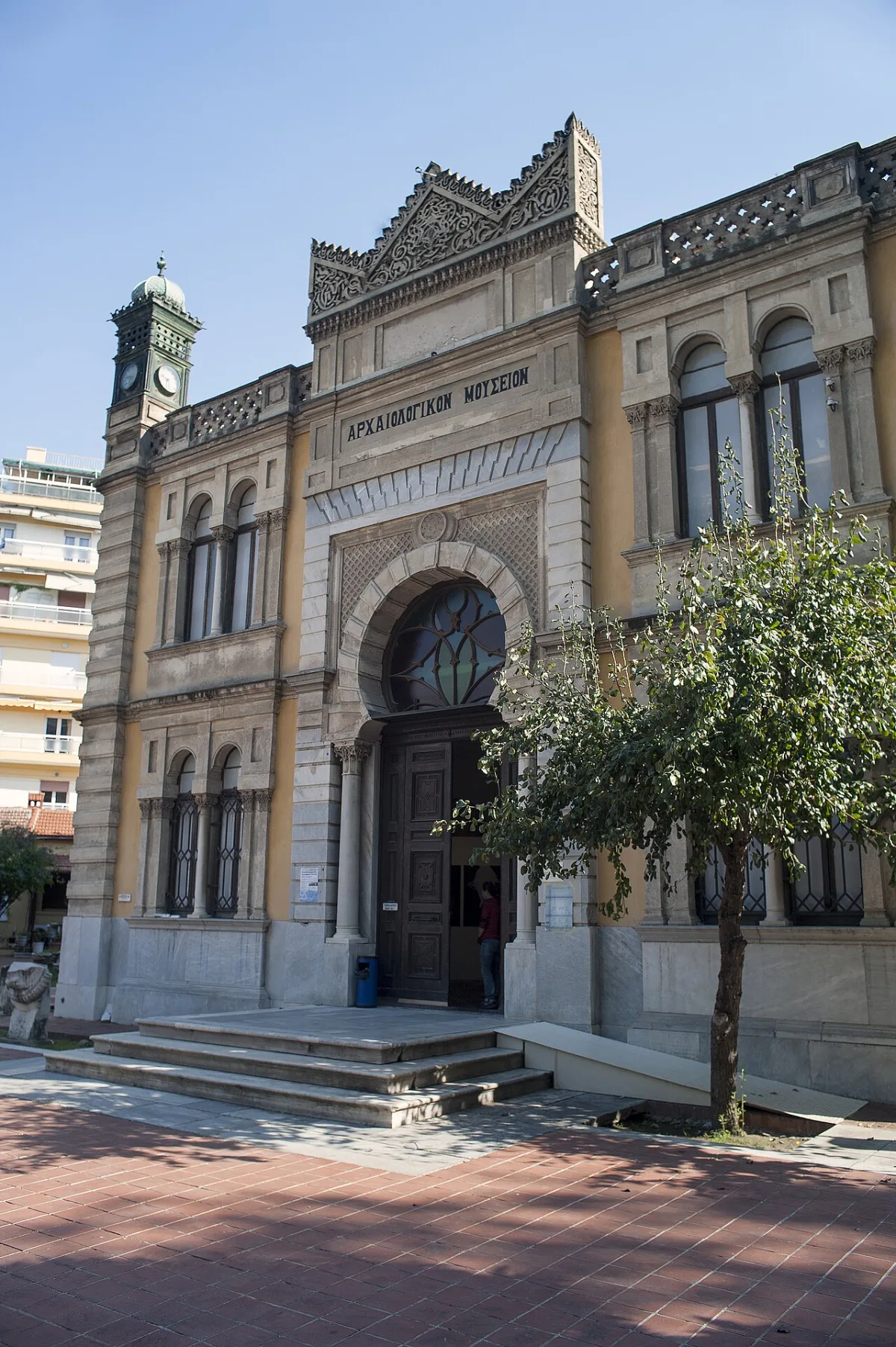
There is no Albanian-language parish of any denomination in Thessaloniki, and we found no active Bektashi presence. When KSHS held memorial services for the 2019 earthquake victims, it held them in the city's Orthodox churches and its Catholic church. For a community that arrived Muslim, Orthodox, Catholic and Bektashi, religious life in Thessaloniki has been conducted almost entirely inside Greek institutions — which is consistent with everything else on this page about how visible the community chose to be.
The practical directory
Here is every Albanian institution in Thessaloniki we could document, with the contact details we could find and an explicit note on how stale each one is. Two of the four entries rest partly on old sources, and we would rather print the caveat than a confident wrong address. Everything below was last checked in August 2026.
Consulate General of the Republic of Albania
Tsimiski 43, TK 54623, Thessaloniki. Telephone +30 2310 257598; emergency line +30 6983 661224; fax +30 2310 222571; [email protected]. Consul General Erida Dobrushi. Passports, ID cards, civil registry and powers of attorney; many procedures can be started online through e-Albania first. Opening hours are listed by a commercial directory as Monday–Friday 08:30–15:30, which is not an official source — confirm by phone. The consulate's territorial jurisdiction is not published anywhere we could find: neither the ministry listing nor the consulate's own material says which Greek regions it serves and where the Athens embassy takes over. If you are travelling in from outside Central Macedonia, call first. Live updates appear on its Instagram and Facebook channels rather than on any website. Official listing.
Shoqata e Emigrantëve Shqiptarë “Nënë Tereza”
Founded 2004; the oldest Albanian association in the city and the one that runs the weekend school. Its stated aims are solidarity and rights protection for Albanian migrants, integration into Greek society, and the teaching of Albanian language and culture; it also takes part in anti-racist work. Classes are free and taught by volunteer emigrant teachers, among them Lindita Budini, profiled by Gazeta Dielli on 12 August 2024; more than 1,000 children have passed through in about twenty years, using the textbook Gjuha Shqipe dhe Kultura Shqiptare. Address and telephone — Zaliki 2, 54631 Thessaloniki, tel/fax +30 2310 227311, with branch mobiles 6937 264170 for Nea Raidestos and 6945 102568 or 6973 221799 for Giannitsa — come from the association's own public notice as republished in 2010, and we could not re-verify them against anything more recent. The teaching is confirmed active to August 2024; the contact block is sixteen years old. Ring before travelling to the address.
Komuniteti Shqiptar i Selanikut (KSHS)
Alexandroupoleos 7, Thessaloniki. Formed 30 November 2019 in the days after the Albanian earthquake and given legal recognition by the Court of Thessaloniki under Decision 5Σ/15.01.2021. A non-partisan union of citizens of Albanian origin: memorial services in the city's Orthodox and Catholic churches, a community blood bank with six donation drives at AHEPA University Hospital, the bilingual e-magazine Voice of Diaspora Selanik, and advocacy on documentation, employment, pensions and Albania's EU accession. Status: active — confirmed by the public statement it issued from Thessaloniki on 13 April 2026 declining to attend the Fourth Albanian Diaspora Summit, on the argument that the diaspora needs real representation rather than ceremonial events. Two practical warnings: the website diasporaselanik.eu no longer resolves in DNS, so do not rely on it, and the telephone number circulating in directories has nine digits where Greek landlines have ten — treat it as mistyped. Use the association's Facebook page.
Greek-Albanian Commercial and Professional Association of Northern Greece
Aerodromiou 87, TK 57013, Thessaloniki; tel +30 6937 271837; gral-business.com. Founded in Thessaloniki in 2020 to build a network of entrepreneurs across Greece and Albania, with the stated goal of becoming a fully recognised Greek-Albanian Chamber of Commerce on the model of other bilateral chambers. It has been referenced in the newsletter of Albania's Diaspora Business Chamber. Status caveat, and it is a serious one: the site loads, returns a current copyright line and carries a “President's Greeting” page that never names a president, but its newsfeed has published nothing since 21 April 2022 — the last items being Easter greetings, a radio interview and the 2022 vasilopita cutting. A live domain with a four-year-old news page is not evidence of a going concern. Telephone before treating it as one. gral-business.com
What is not there
The gaps are as informative as the entries. We found no Albanian student association at Aristotle University — and no Albanian-language or Albanology department either; the university's only role in Albanian life here is lending a room to the Saturday school. We found no Albanian restaurant, grocer, bookshop, radio station or newspaper in Thessaloniki that we could name and verify, which matches Kokkali's finding, made two decades ago, that this community leaves almost no commercial mark on the urban map. The closest thing to Albanian media in the city is the KSHS e-magazine, and its site is dead. And there is no Albanian place of worship of any denomination. A community of the size modelled earlier on this page — 55,000 on our central model, 74,000 at the outside — is held together here by one consulate, one school, two associations and a bus timetable.
The corridor home
Thessaloniki's real link to Albania is a bus station. The locally based operator Crazy Holidays runs two daily lines from Monastiriou 28. One goes west through Krystallopigi to Korçë, Pogradec, Elbasan, Durrës and Tirana — departures 09:00 and 21:00 daily, about 8 hours, €40 single and €70 return. The other runs south-west through Kakavia to Gjirokastër, Sarandë (seasonal), Përmet, Tepelenë, Vlorë, Fier, Berat and Tirana, leaving 19:30 daily. There is no direct flight between Thessaloniki and Tirana — checked in August 2026, and worth re-checking, because that is exactly the kind of route that appears without warning.
The volume on that corridor is seasonal and enormous. On a single day in early August 2025, 6,242 people entered Albania at Kapshtica and 5,248 at Qafë-Thanë. The money moves the same way: remittances to Albania reached a record of about €1.1 billion in 2025, up 5.9% on 2024 (Bank of Albania, via Monitor.al). Greece's share was put at 44% of inflows in 2017 (Open Data Albania, from World Bank data) — a dated figure we cite as dated, because no comparable recent split has been published.
The Albanian year in Thessaloniki
The Albanian year in this city is short, and most of it is not organised by anybody. There is no annual Albanian festival in Thessaloniki, no cultural week, no parade with a permit and a route. What exists is a school term, a consular counter, an occasional ministerial visit, one evening on the waterfront, and — twice so far — a mosque opened for three days by decision of a Greek ministry. Set out honestly, that is the calendar, and its thinness is consistent with everything else on this page about a community that arrived in force and chose not to be visible.
Flag day at the White Tower
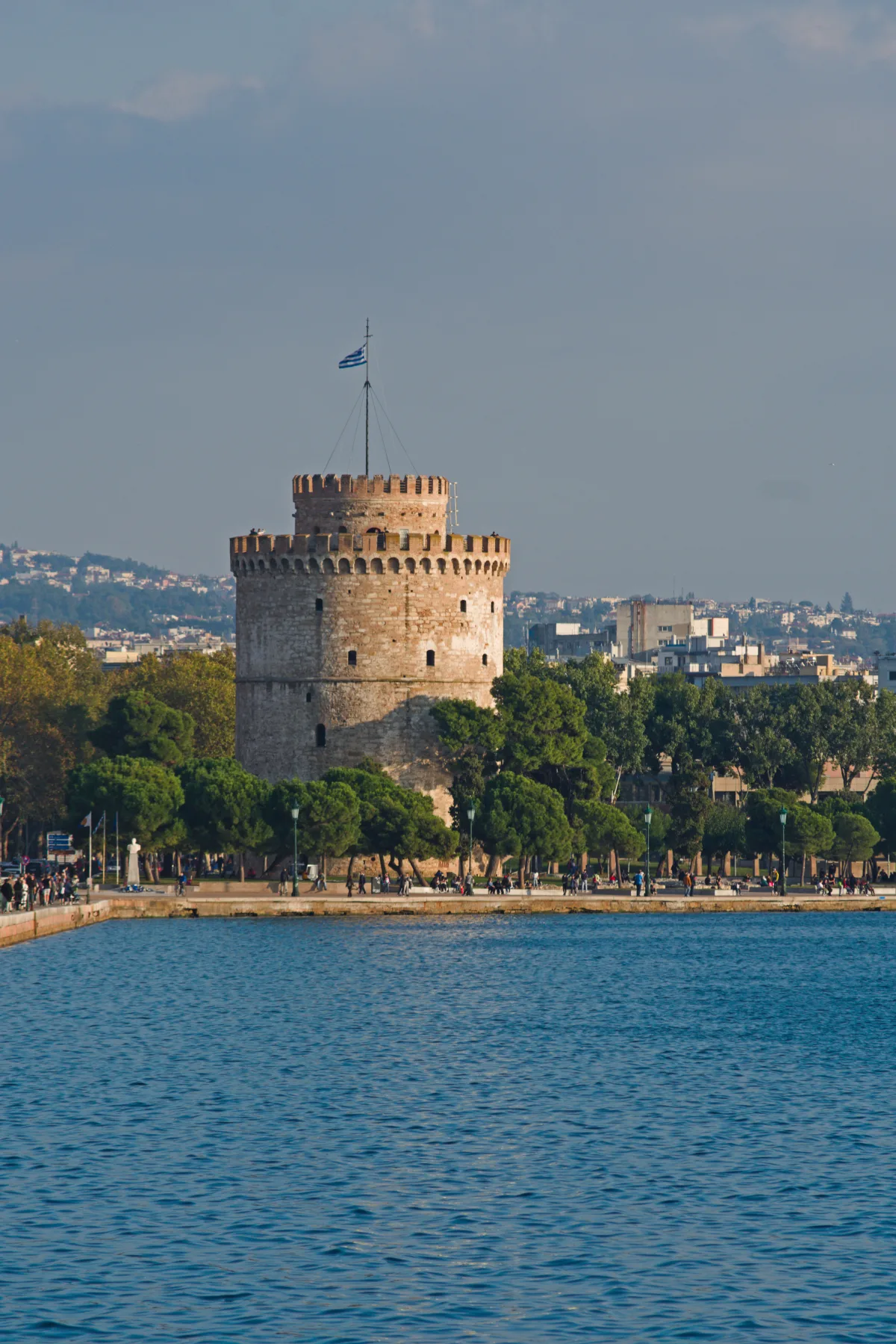
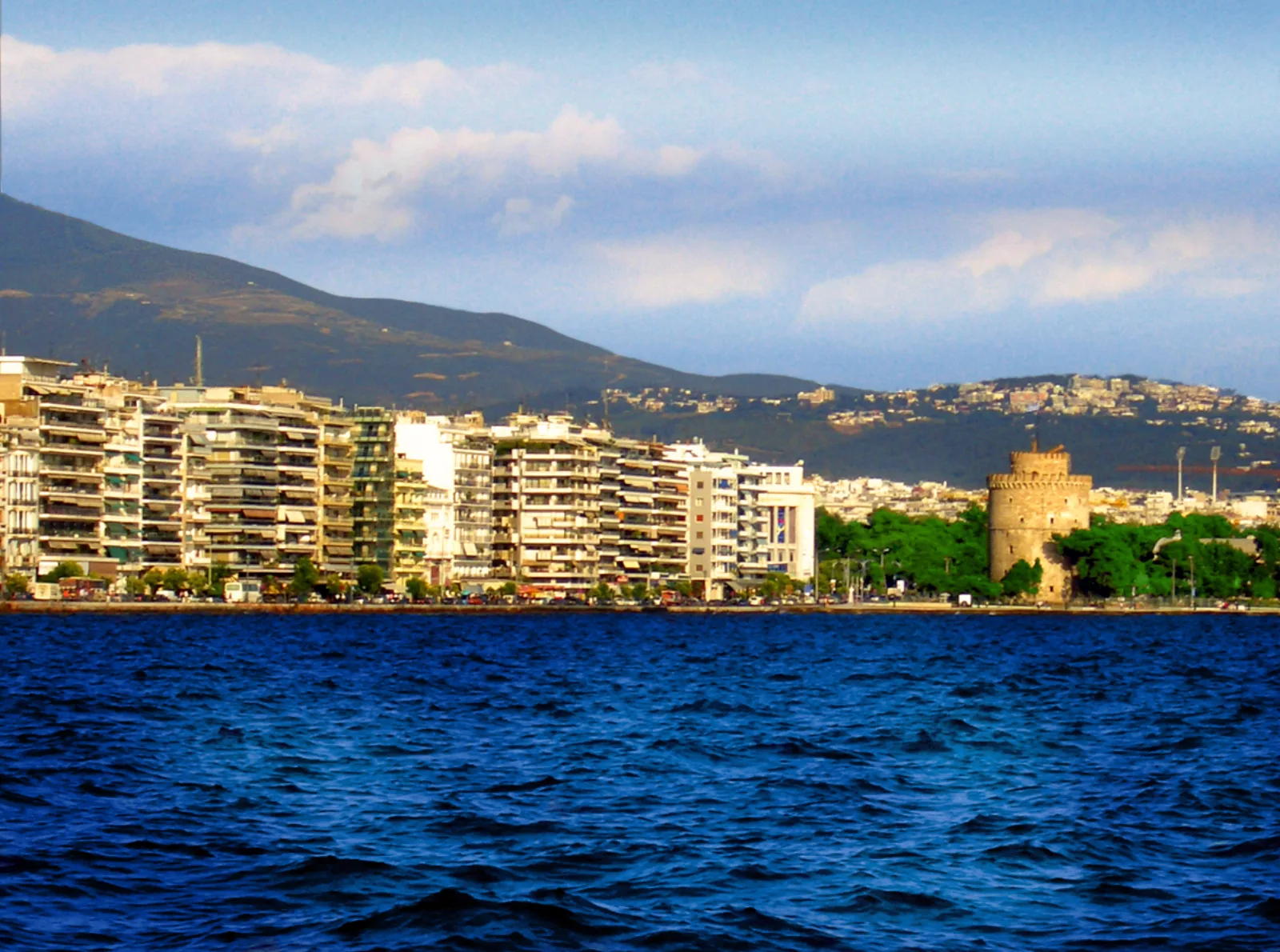
On the evening of Friday 28 November 2025, Albanians gathered on the seafront in front of the White Tower for 28 Nëntori, Albania's flag day. The factual core, consistent across at least five Greek outlets all publishing on 29 November 2025, is this: cars parked along the waterfront, music played through car sound systems, traditional dances, and flags. Newsbomb.gr was among the outlets that reported it. What it amounts to is a crowd, a monument, and one evening a year on which a community that spends the other 364 blending in does not.
Three cautions travel with that paragraph. First, no organising body is named in any report — this is a self-organised street gathering, not an association event, and nobody publishes a start time. Second, every available source is a Greek outlet writing in hostile terms, one of them calling the evening an “ethnicist fiesta” and foregrounding the Kosovo Liberation Army flags in the crowd; we take the observable facts and leave the framing where we found it. Third, we can verify one year only. It is very likely recurrent — a much larger gathering happens the same night at Syntagma Square in Athens, reported by mainstream Greek media in both 2024 and 2025 — but “annual” is our inference, not a documented fact, and we will not print it as one.
The school year, Saturday by Saturday
The steadiest fixture in the calendar is a classroom. The weekend Albanian course run by Shoqata “Nënë Tereza” met, as last published in August 2024, on Saturdays from 15:00 to 17:00 at the Pedagogical Faculty of Aristotle University, with branches at Nea Raidestos and Giannitsa. A 2010 notice from the same association gave an entirely different timetable — Sundays 11:30–13:00 and Saturdays 13:00–14:00 — which tells you the schedule drifts. We could not confirm the 2025/26 term times. Ring before turning up.
The consular and ministerial calendar
We looked for a public events programme at the Consulate General on Tsimiski and found none. What the consulate has is a working counter and two active social channels, and those channels — not any published calendar — are where one-off events appear. Ministerial visits do produce community gatherings: State Minister Taulant Balla met Albanian community representatives in Thessaloniki on 22 September 2024 about diaspora voting, and Prime Minister Edi Rama presented eight state-contracted Albanian teachers in the city that November. These are visits, not a season ticket.
Concerts, and the one that is booked
For 2026 there is exactly one Albanian-born act with a confirmed Thessaloniki date in our diary: Eleni Foureira at Theatro Gis on 8 July 2026. We checked the listings for Principal Club Theater, Fix Factory of Sound and the other mid-size venues and found no other Albanian booking for the year. The best historical precedent is six years old: in February 2020 the “Tre Musketjerët” of Albanian rock — Elton Deda, Aleksandër Gjoka and Redon Makashi — played Athens and Thessaloniki backed by the symphony orchestra of Greece's national broadcaster, billed as the first Albanian act to appear with a symphony orchestra in Greece. It recirculates online in a way that makes it look current. It is not.
Ramadan at Yeni Tzami
In April 2024 the Greek state opened Yeni Tzami to Muslim worshippers for Ramadan for the first time in 102 years; roughly 100 people attended. It happened again in 2025: Taraweeh prayers on Friday 28 March and the Eid al-Fitr prayer at 07:30 on Sunday 30 March 2025, after the General Secretariat of Religions asked the Central Archaeological Council for a temporary transfer of the monument. Two things must be said plainly. This is a general Muslim congregation, led in both years by Egyptian imams and described as migrant residents and visitors — not an Albanian community event, though Albanian Muslims in the city are part of it. And it is a discretionary, year-by-year ministerial grant: we found no report of an opening for Ramadan 2026, which ran roughly 17 February to 19 March, so nobody should assume it recurs.
| When | What | Where | Note |
|---|---|---|---|
| Saturdays in term, 15:00–17:00 | Albanian weekend school, Shoqata “Nënë Tereza” | Pedagogical Faculty, Aristotle University; branches at Nea Raidestos and Giannitsa | Times last published August 2024 and known to drift. Free. Call before attending. |
| Ramadan and Eid al-Fitr (17 February – 19 March in 2026) | Muslim prayers, if the monument is granted | Yeni Tzami, Archaiologikou Mouseiou 30 | Granted in 2024 and 2025 only, at ministerial discretion. Mixed congregation, not an Albanian event. No 2026 report found. |
| Each March | Thessaloniki International Documentary Festival | City-centre venues | “Albgreko” had its world premiere here at TiDF27, March 2025. |
| 8 July 2026 | Eleni Foureira in concert | Theatro Gis | The only Albanian-born act with a confirmed 2026 Thessaloniki date. |
| 5–15 November 2026 | Thessaloniki International Film Festival, 67th edition | Olympion and the port venues | Announced dates, worth re-checking. No Albanian strand or retrospective announced. |
| 28 November | 28 Nëntori gathering | White Tower waterfront | Informal and self-organised; no named organiser, no start time. Directly verified for 2025 only. |
| Weekdays, listed as 08:30–15:30 | Consular services | Consulate General, Tsimiski 43 | Hours come from a commercial directory, not the ministry. No published public-event calendar. |
People who carry the Thessaloniki story
The city's Albanian biographies cluster in four places: football, because a football academy was one of the few institutions in 1990s Greece that would take a migrant child on merit; a school parade; a drama school; and a Saturday classroom. Every name below rests on documented heritage — a birthplace, a national-team appearance, a published profile or a self-statement in the person's own words.
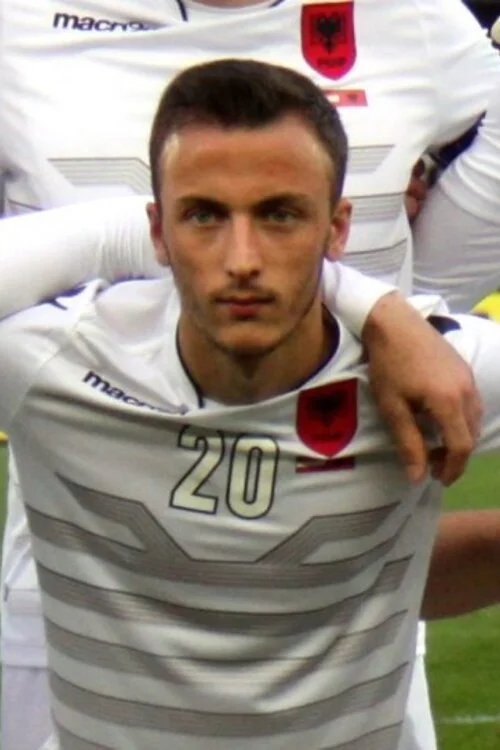
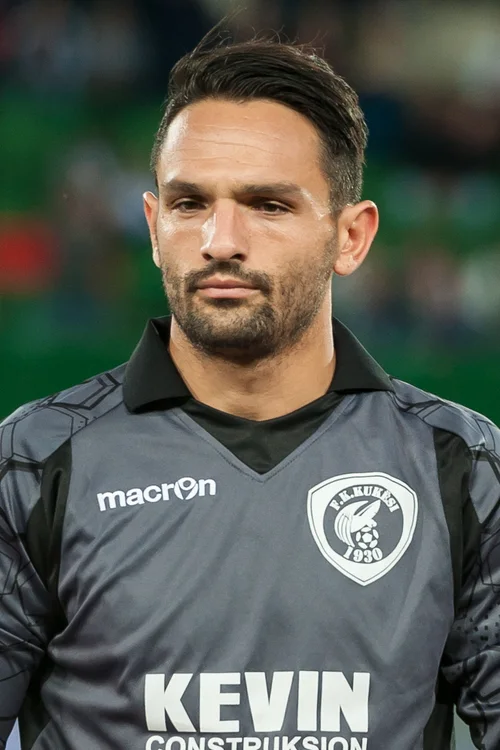
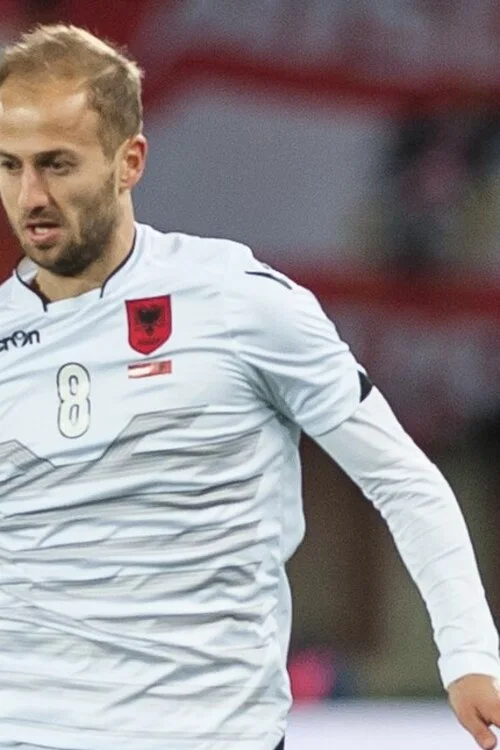









Odise Cenaj
Odise Cenaj (Οδυσσέας Τσενάι) was born in Shkodër in 1985 and moved to Thessaloniki at 12. At the school in Nea Michaniona, the top-ranked student earns the right to carry the Greek flag at the national parade. Cenaj earned it twice — in 2000 and again in 2003 — and twice stood down after protests by parents.
What happened next is the part usually left out. He was admitted to the Polytechnic School of Aristotle University in 2004, took a scholarship to Boston College, entered Harvard Medical School in 2009, and is today an assistant professor of pathology at NYU Langone Health.
We hold two things at once. The parade protests were real and documented, and they were not the whole of Greece: the same school ranked him first, twice, and a Greek university admitted him. The story is a wound and a competence record in one file.
Ergys Kaçe
Ergys Kaçe, born in Korçë on 8 July 1993, came to Greece at three. He started at Achilleas Triandrias — the neighbourhood club of Triandria, the same district that once held the Albanian cemetery — and joined PAOK's academy in 2005. Between 2010 and 2020 he made 113 league appearances and scored 7 goals for PAOK, and he has 25 caps for Albania, including Euro 2016. A boy raised entirely in Thessaloniki who plays internationally for the country he left at three: that double belonging is the ordinary condition here, not the exception.
Kristi Vangjeli
Kristi Vangjeli was born in Korçë on 5 September 1985 and moved to Thessaloniki around the age of 12. He came through the academy at Aris, made 106 league appearances between 2003 and 2011 and 11 more in 2013–14, and won 35 caps for Albania. Same city, the other big club.
Artur Lekbello
Artur Lekbello, born in Tirana on 23 February 1966, belongs to the first wave rather than the second. He spent seven seasons at Aris, 1991–1998, with 135 league appearances, and won 30 caps for Albania. He arrived as an adult professional in the year the borders opened, and stayed long enough to become a fixture.
Sokol Kushta and the 1991 wave
Sokol Kushta, born in Vlorë on 17 April 1964, was Albania's record scorer of his era — 31 caps, 10 goals — and played for Iraklis in 1991–1993, making 36 appearances. He was not alone. Mirel Josa (born Tirana, 1 June 1963; 27 Albania caps) played 22 matches for Aris in 1991–92. Later came Enea Koliçi (born Pogradec, 13 February 1986), in Iraklis's youth setup 2004–2006 and back for 12 appearances in 2013–14, and Migjen Basha (born Lausanne, 5 January 1987, to Kosovar Albanian parents from Suhareka; 33 Albania caps), who played 21 times for Aris in 2018–19.
The pattern is worth naming. In the seasons when the skoupa round-ups were expelling Albanians in the hundreds of thousands, Thessaloniki's big clubs were signing Albanian internationals and playing them every week. Both facts are true, in the same city, in the same years.
Kristian Kushta
One more footballer closes a loop opened a few paragraphs above. Kristian Kushta, born in Elbasan on 16 December 1997, joined PAOK's academy at the age of five in 2003 and made his professional debut for the club on 17 December 2015 in a Greek Cup tie. Since 2023 he has played for Iraklis, wearing the number 9 as club captain, with 85 league appearances and 22 goals recorded across the 2022–2026 seasons. He played three times for Albania's under-17 side in European Championship qualifying in October 2013 — documented heritage, not an inference from a surname. He is the nephew of Sokol Kushta, who played for the same Thessaloniki club in 1991–1993. Two generations of one family, the same badge, thirty years apart.
Set beside the footballers above, the artistic record is thin — and we would rather say that than pad it. Most of the widely recycled lists of “Albanian artists in Greece” are Athens lists: Danilo Zeka, Laertis Vasileiou, Mirela Routsi, Bujar Alimani and the rest have no Thessaloniki tie we could establish. Of that whole cohort, one name belongs to this city. Several other names attached to the work below carry Albanian surnames and nothing else — no interview, no self-statement, no profile — and we leave them out on principle, because a surname is not evidence of heritage.
Enke Fezollari
Enke Fezollari (Ένκε Φεζολλάρι), born in Albania in 1981, trained in Thessaloniki: he is a graduate of the Drama School of the State Theatre of Northern Greece, the national theatre institution based in the city. He worked as an actor with established directors at the National Theatre, Theatro tou Neou Kosmou, Chora and Apo Michanis between 2005 and 2019, directed Hamlet at the Experimental Stage of the National Theatre of Albania in 2015, and staged Elvira Dones' Sworn Virgin at the Athens Festival in 2017. Greek reference sources record him as Albanian by nationality and naturalised in Greece, and he has discussed that identity in the Greek press. His Thessaloniki chapter is a training, not a residency — but it is the training that produced the career.
Ilir Tsouko, “Albgreko” and the sentence that holds the page
The most significant recent work about Albanians in Greece had its world premiere in Thessaloniki, at the 27th Thessaloniki International Documentary Festival in March 2025. “Albgreko” — Greek title «Και ΕΛ και ΑΛ», “Both EL and AL” — is a 28-minute documentary directed by Ilir Tsouko, born in Albania and raised in Athens, produced by Onassis Culture, with cinematography by Carlos Muñoz and editing and music by Leart Rama. Its four protagonists — Denisa-Lydia Bairaktari, Dimitris Kapouranis, Stefania Kosta and Orestis Shqau — are children and grandchildren of the 1990s migration. It went on to Tirana, Chania, Beyond Borders and DocFest–Chalkida across 2025. None of the four is a Thessaloniki figure; Kosta was raised on Crete, Bairaktari in Athens, and the city's claim on the film is that it showed it first. What Kosta says in it is nevertheless the plainest statement of everything this page has been circling: “I am not only Albanian or only Greek; I'm both, and you cannot tell me that I am not both.” The festival's own page carries the full credits.
Lindita Budini
The steadiest Albanian institution in this city is a classroom, and for years it has had a teacher. Lindita Budini teaches on the free supplementary Albanian course run by Shoqata “Nënë Tereza” at the Pedagogical Faculty of Aristotle University, and is described as directing the association's Albanian-language teaching — the programme that has taken more than 1,000 children through it in about twenty years, on volunteer labour and a diaspora textbook. She was profiled by the Albanian-American paper Gazeta Dielli on 12 August 2024, and is reported among the cohort of teachers engaged by Albania's education ministry to serve Albanian children in Greece. She belongs on this list for an unglamorous reason. In a city with no Albanian quarter, no Albanian parish, no Albanian bookshop and no Albanian newspaper, the language is passed on for two hours on a Saturday afternoon by people like her, or it is not passed on at all.
Eleni Foureira
Eleni Foureira was born Entela Fureraj in Fier on 7 March 1987 and performs across the Greek-speaking world. She plays Theatro Gis in Thessaloniki on 8 July 2026 — the one Albanian-connected concert date the city's 2026 diary actually holds. Her career is not a Thessaloniki story, but the concert is: a Greek-language audience in this city, for a singer born in Albania who has never hidden it.
Last evidence review: 15 August 2026. Every figure on this page is dated and sourced at first use; official counts, published models and dua.com's own arithmetic are labelled separately throughout.
Method and evidence ledger
This page mixes three kinds of number, and mixing them silently is how bad claims get made. So here is the ledger.
| Claim | Status | Source and date |
|---|---|---|
| 34,753 Albanian citizens in the Thessaloniki regional unit | Official | 2021 Greek census via Eurostat cens_21ctz_r3, ELSTAT data |
| 35,918 people born in Albania, same regional unit — the birthplace baseline, Layer 1 | Official | Eurostat 2021 Census Hub |
| 374,926 Albanian citizens in Greece | Official | 2021 census, ELSTAT |
| 266,970 naturalisations, 2007–2024 | Official | Eurostat migr_acq, updated 27 March 2026 |
| 257,523 Albanian residence permits at 31 March 2026 | Official, national only | Ministry of Migration and Asylum, Table 3 |
| 82.2% of all Greek citizenship grants went to Albanians | Our arithmetic on official data | dua.com, from Eurostat migr_acq |
| 107,801 grants by birth or study in Greece, 2015–2023 | Our sum of official annual figures | dua.com, from Greek Ministry of Interior via ELIAMEP WP #131/2025 |
| About 55,000 of Albanian descent in the regional unit — Layer 2, descendant-aware | Our model, explicitly | dua.com, 2026: 35,918 counted + 16,000 second generation + 3,000 historic residue |
| About 74,000 of Albanian descent — Layer 3, upper scenario | Our model, explicitly — an upper scenario, not a confidence bound | dua.com, 2026: 35,918 counted + 35,000 generous second generation + 3,000 historic residue |
| Albanian share 5% in Athens, 3% in Thessaloniki, 4% in Greece | Published research | Kokkali 2006, Stanovništvo 44(2), mapping the 2001 census by postal code |
| Albanian population of the municipality of Thessaloniki | Not published | ELSTAT publishes no Albania-specific count below regional-unit level |
| Albanian permit holders in Thessaloniki | Not published | Finest geography is Macedonia–Thrace |
| Consulate's territorial jurisdiction | Not published | Albanian MFA listing, checked 2026 |
Frequently asked questions
How many Albanians live in Thessaloniki?
The 2021 Greek census counted 35,918 Albania-born residents in the Thessaloniki regional unit, which is wider than the municipality. A separate measure recorded 34,753 Albanian citizens. Neither is a complete ethnic count. The dua.com model gives about 55,000 for the wider Albanian-origin community; about 74,000 is an upper sensitivity scenario. Those larger figures are models, not official population counts or a claim that 74,000 Albanians currently live here.
Were Albanians really governors of Salonica?
Twice, at least. “Arnavut” Mehmed Âkif Paşa of Kalkandelen held the governorship three times between 1860 and 1873, about six years in total. Âbidin Paşa Dino of Preveza, a founder of the League of Prizren, governed in spring 1880 and left to become Ottoman Foreign Minister. The chair rotated among the empire's whole elite; it came round to Albanians more than once.
Who was Hasan Tahsin Pasha?
An Ottoman general born in 1845 at Mesarë, kaza of Leskovik, in present-day Albania. He commanded Thessaloniki's garrison from about 1900 and on 8 November 1912 signed the surrender protocol handing the city and 26,000 men to Greece. Istanbul sentenced him to death in absentia. His son, the painter Kenan Messare, stayed in the city as a Greek citizen.
Why does no old census show Albanians in Thessaloniki?
Because no census offered the category. No Ottoman count — 1831, 1881/82–1893, 1905/06 or 1914 — had an Albanian line; Ottoman statistics recorded faith and never mother tongue. The first Greek census of the city, on 28 April 1913, listed five nationalities: Greeks, Israelites, Ottomans, Bulgarians and Foreigners. Muslim Albanians sit inside “Ottomans”, Orthodox Albanians inside “Greeks”, and neither is separable.
What happened in 1925?
In January–February 1925 the Thessaloniki police compiled lists of the city's Albanians, at the one moment when declaring Albanian identity was protective: the Lausanne exchange was deporting Muslims to Turkey, and Greece and Turkey had agreed in principle to exempt Albanians. The lists name about sixty people, described as mostly guards and a few landowners. That is the whole documented Albanian community of the city at that date.
Is there an Albanian neighbourhood in Thessaloniki?
No, and that is well documented. Mapping the 2001 census by postal code, Ifigeneia Kokkali found no large concentration of Albanian households at any scale, with the only over-representation in a very small area near the port. She notes there are few Albanian cafés, restaurants or grocers marking the urban space, unlike Georgian, Russian and Pontic Greek areas. The presence is numerically large and spatially invisible.
Where can children learn Albanian in Thessaloniki?
At the weekend school run by Shoqata e Emigrantëve Shqiptarë “Nënë Tereza”, founded in 2004. As of August 2024 it met Saturdays 15:00–17:00 at the Pedagogical Faculty of Aristotle University, with branches at Nea Raidestos and Giannitsa, and has taught over 1,000 children in twenty years. On 3 November 2024 Albania's government presented eight state-contracted Albanian teachers assigned to the Thessaloniki area. Confirm current times before turning up.
Where is the Albanian consulate in Thessaloniki?
The Consulate General of the Republic of Albania is at Tsimiski 43, TK 54623, headed by Consul General Erida Dobrushi, telephone 0030 2310257598. Its territorial jurisdiction — which Greek regions it covers, and where the Athens embassy takes over — is not published anywhere we could find, so call before travelling from outside the city.
What happened to the Albanian cemetery?
The cemetery of the Muslim Albanians of Thessaloniki stood in Triandria, bounded by Eleftherias, Filikis Etaireias, Koundouriotou and D. Glinou streets — described in Greek sources as the last remnant of the city's old Muslim cemeteries. It was dissolved in 1983, the remains moved to the Malakopi ossuary, and the site is now a park and playground. Hasan Prishtina, shot dead in the city on 13 August 1933, was buried there; his remains went to Kukës in 1977.
Are Arvanites the same as Albanians?
They share a linguistic origin and not a modern history. Arvanites are long-settled Albanian-speaking Orthodox Christians of Greece whose heartland is the south — Attica, Boeotia, the Argolid, Euboea — and Euromosaic's distribution ends around Phthiotis. They are not a Thessaloniki population, and a southern Arvanite fact must never be used to describe this city. Recent Albanian migrants are a separate, 1990s story.
How do you get from Thessaloniki to Albania?
By bus. Crazy Holidays runs two daily lines from Monastiriou 28: one via Krystallopigi to Korçë, Pogradec, Elbasan, Durrës and Tirana (09:00 and 21:00, about 8 hours, €40 single, €70 return), and one via Kakavia to Gjirokastër, Sarandë in season, Përmet, Tepelenë, Vlorë, Fier, Berat and Tirana (19:30). There is no direct flight to Tirana as of August 2026.
How many Albanians hold Greek citizenship?
Between 2007 and 2024, 266,970 Albanian citizens acquired Greek citizenship (Eurostat migr_acq, updated 27 March 2026). By our arithmetic, this represents 82.2% of all Greek citizenship grants in that period. It is a national series, not a Thessaloniki population count or a count of ethnic Albanians. Naturalisation helps explain why citizenship totals change, but this series spans a different period from the 2011–2021 census comparison and cannot alone account for migration, births and deaths.
What Albanian events take place in Thessaloniki?
Fewer than most people expect. There is no annual Albanian festival, no cultural week and no parade with a permit and a route. The fixed points are the Saturday weekend school in term time, and an informal 28 Nëntori gathering on the White Tower waterfront on 28 November — self-organised, with no named organiser and no published start time, and directly verified by us for 2025 only. One-offs matter more here than a calendar: “Albgreko” had its world premiere at the Thessaloniki International Documentary Festival in March 2025, and Muslim prayers were held at Yeni Tzami in 2024 and 2025 at ministerial discretion, with no 2026 opening reported. The only Albanian-born act with a confirmed 2026 date in the city is Eleni Foureira at Theatro Gis on 8 July 2026.
Which Albanian organisations exist in Thessaloniki?
Four that we could document. The Consulate General of the Republic of Albania at Tsimiski 43; Shoqata e Emigrantëve Shqiptarë “Nënë Tereza”, founded in 2004, which runs the weekend school; Komuniteti Shqiptar i Selanikut, formed on 30 November 2019 and court-registered under Decision 5Σ/15.01.2021, confirmed still active by a public statement it issued on 13 April 2026; and the Greek-Albanian Commercial and Professional Association of Northern Greece, founded in 2020, whose website is live but has published nothing since April 2022. There is no Albanian student association at Aristotle University, no Albanian place of worship of any denomination, and no Albanian restaurant, grocer, bookshop, radio station or newspaper in the city that we could name and verify.
How can I meet Albanians in Thessaloniki?
Because there is no Albanian quarter, meeting people here is a matter of networks rather than streets: the Saturday school and its parents, the association events, and 28 November at the White Tower. Online, dua.com counted 519 members in Thessaloniki in a snapshot on 27 July 2026 — an app built for Albanians at home and in the diaspora, which is one way a scattered community finds itself. You can get the dua.com app here.