
Albanian Geneva is a network of classrooms, rehearsal rooms and people who learned to make a home in French without giving up shqip. The canton counted 8,267 residents with Kosovan or Albanian citizenship at the end of 2025. A different measure puts the number of people aged 15 or over naming Albanian as a main language at about 9,842 in 2024. Neither number contains the whole story. To find it, start with a woman who arrived as a student, a school playground in Meyrin, and an association that opened its doors to everyone.
When Albana Krasniqi Malaj arrived in Geneva in 1992, she already spoke French. Four years later she helped establish the Université populaire albanaise. Recalling its early days to journalist Xavier Lafargue in 2016, she described men watching Albanian television in the association’s rooms in the Charmilles, searching the images for people from whom they had heard nothing. Learning the language of a new country was urgent; knowing whether someone back home was alive could be more urgent still. Read Lafargue’s portrait, originally published by the Tribune de Genève.
Today the institution calls itself the Université des Cultures de Genève. That change tells us something about the city: an organisation built to welcome Albanian speakers became a resource for neighbours from many backgrounds. Geneva’s Albanian history is partly a story of arrival. It is also a story of institutions that stayed, adapted and became useful to the place around them.
How many Albanians live in Geneva?
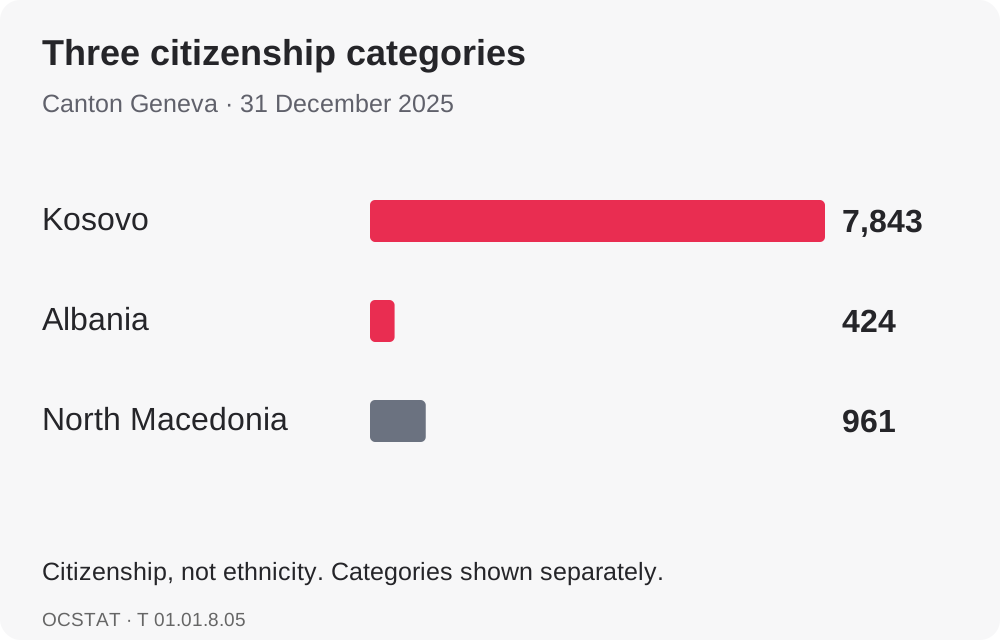
The canton of Geneva recorded 7,843 Kosovan citizens and 424 Albanian citizens on 31 December 2025: 8,267 people across those two citizenship categories. It separately recorded 961 citizens of North Macedonia. These are OCSTAT resident-register counts, not an ethnic census. They describe the whole canton, not just the municipality of Geneva.
The Federal Statistical Office’s 2024 Structural Survey offers another lens: an estimated 9,842 permanent residents aged 15 or over named Albanian as a main language, around 2.4% of its Geneva survey population. The published relative confidence interval is ±9.55%, approximately 8,902–10,783 people. It is an estimate from a sample, not a count precise to the last person.
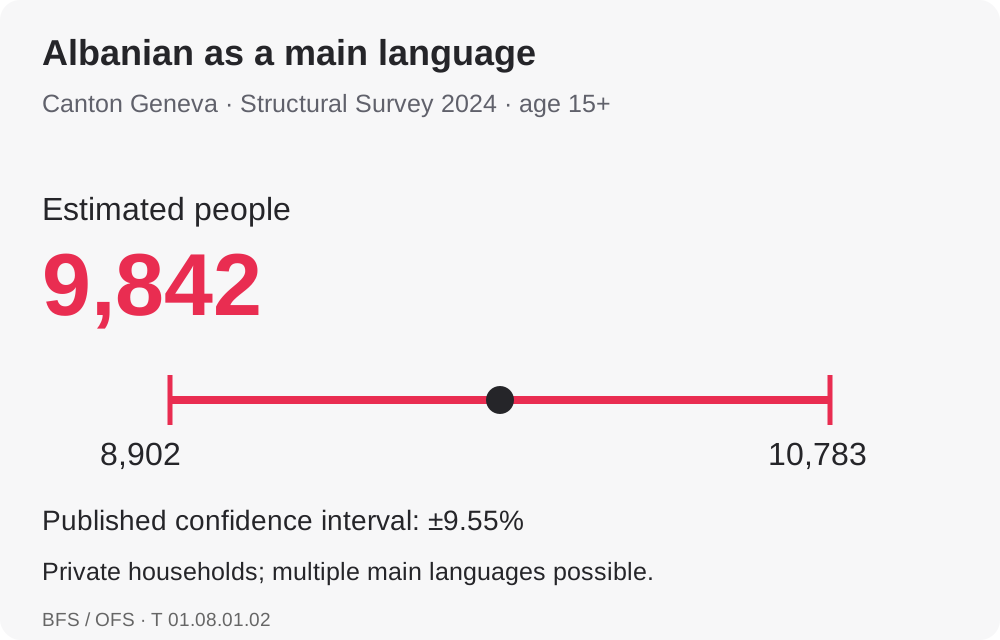
The two results cannot be added. They overlap, refer to different years and have different populations. The language survey covers people aged 15 or over in private households and excludes diplomats, international officials and their families. The citizenship register covers all ages. A Swiss citizen who speaks Albanian can appear in the language estimate while being absent from the foreign-national rows. A child can appear in a citizenship count while being too young for this language survey.
Sources: OCSTAT T 01.01.8.05, updated 27 February 2026; FSO T 01.08.01.02, 2024. Neither source establishes a total for Albanian ancestry. North Macedonian, Kosovan and Albanian citizenship are not interchangeable with Albanian ethnicity; nor can all Serbian or Montenegrin residents be counted as Albanians. We do not apply an invented multiplier to fill those gaps.
One city name, several different geographies
At the end of 2025, the municipality of Geneva had 210,601 residents; the canton had 537,191. Onex, Meyrin, Vernier, Lancy and Plan-les-Ouates are separate municipalities inside that canton. Events there belong in a Geneva community guide, with their locations made explicit. They do not become events inside the city boundary because their organisers use “Genève” in their name.
The Grand Genève cooperation area extends into the district of Nyon in Vaud and neighbouring France. Lausanne belongs to the wider Lake Geneva region, but it is neither the city nor the canton of Geneva. A family may cross these boundaries for work, rehearsals or relatives. A statistic needs to stop at the boundary it actually measures.
A useful local map therefore begins with institutions: UPA in the Charmilles; the university student association at Uni Mail; Gëzuar in Onex; and Dituria in Plan-les-Ouates. School provision reaches still further across the canton. These are documented places to participate, not evidence for labelling any neighbourhood an “Albanian quarter”. OCSTAT’s municipal population table supplies the geographic denominators.
From temporary work to a lasting home
Geneva’s Albanian community did not arrive in a single wave. The Swiss history of labour migration from Yugoslavia, political exile and the Kosovo war produced different experiences, sometimes within one family. People from Kosovo or Albanian-speaking parts of Yugoslavia were not historically recorded under the citizenship of Albania. Searching only that country’s row makes much of the earlier migration disappear.
Geneva has also begun to revisit what temporary work meant for families. In February 2024, Cinélux programmed Katharine Dominicé’s documentary Lettres ouvertes with UPA. The film, in French, Albanian and Portuguese, deals with the seasonal-worker system and separation. It makes a useful companion to the dates: permits shaped whether families could live together, not just where someone could earn a wage.
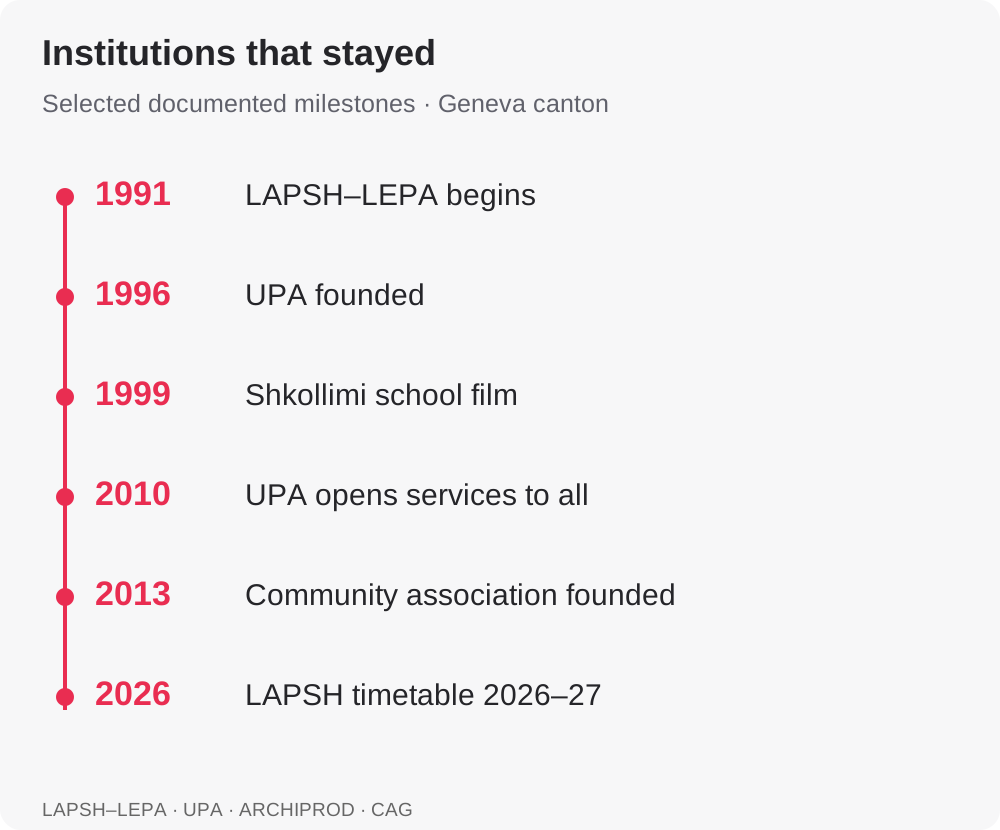
By 1991, the Geneva branch of the Albanian teachers’ and parents’ league was organising heritage-language teaching. UPA followed in 1996. These dates matter because both precede the end of the Kosovo war. They show a community building local continuity while events elsewhere remained deeply uncertain. After the war, the practical work of schooling, learning French and finding a place in Geneva continued.
A popular university built by Albanians, shared by Geneva
UPA’s own history records its foundation in 1996 as a reception centre for Albanian-speaking people and the opening of its services to the wider Geneva population in 2010. Its present name, Université des Cultures de Genève, makes that wider purpose visible. The acronym UPA remains in use. It is an association for adult learning and social participation, distinct from the degree-granting University of Geneva.
Albana Krasniqi Malaj and Ueli Leuenberger belong in this story because of the work they did. Her recollection credits Leuenberger with securing the support the new institution needed. Its current programme joins French courses to practical help: a social advice service, assistance with administrative matters, activities for families and preparation for naturalisation. The organisation describes participation from more than 80 nationalities; that is its own institutional description, not a census of Albanians.
For a newcomer, the useful question is often small and immediate: how to understand a letter, find a suitable course or help a child through school. UPA’s current website publishes its programme, including 2026–27 French-course registration. Its contact page is the starting point for current reception arrangements. The wider story is in its association history: belonging can begin with help and turn into a contribution to the city.
In July 2026, that welcome moved outdoors to Parc Sarasin in Grand-Saconnex. UPA described more than 80 registrations for its summer French activities, with children and parents exploring shared themes together. An institution founded by Albanian speakers was making room for families from many backgrounds to learn side by side.
French at school, Albanian across generations
In an interview published by Servette FC in December 2018, Kastriot Imeri met the reporter at Bellavista, his childhood school in Meyrin. He described a family mixing languages and trying to speak Albanian with his little brother because French came more easily through school. The footballer’s account gives a concrete local shape to a familiar question: a child can feel entirely at home here while needing deliberate opportunities to keep the language of family.
The LAPSH–LEPA Geneva association, active since 1991, organises Albanian language and culture teaching. Its website now identifies the timetable as 2026–2027. Use that current timetable and registration information to choose a class; an old list of school addresses is not a promise that the same lesson still runs at the same time.

The canton’s published LCO provider list identifies LEPA Genève for Albanian and lists primary-school pupils from 1P to 8P. That document is labelled 2024–2025, so it supports the provider’s identity rather than this year’s schedule. The association’s annual report describes collaboration with public schools and municipalities. Heritage-language classes are additional learning; they do not replace a child’s ordinary schooling.
A film made for Albanian-speaking parents
In 1999, Geneva’s education authorities produced Shkollimi: l’école genevoise in Albanian. The official ARCHIPROD archive describes it as an intercultural film explaining Geneva schooling to a community enlarged by the wars. The needs were practical: understanding the school’s principles and what teachers expected, from the earliest classes towards vocational training.
Watch on the original publisher’s site · Shkollimi: Geneva’s schools explained in Albanian (1999). Full historical film, published by Geneva’s education archive ARCHIPROD; Albanian audio. This is not current school guidance.
The archive link opens the complete work on the publisher’s site. Watch it as a historical document: parents making decisions today should use current canton information and speak with their school.
What the younger generation changes
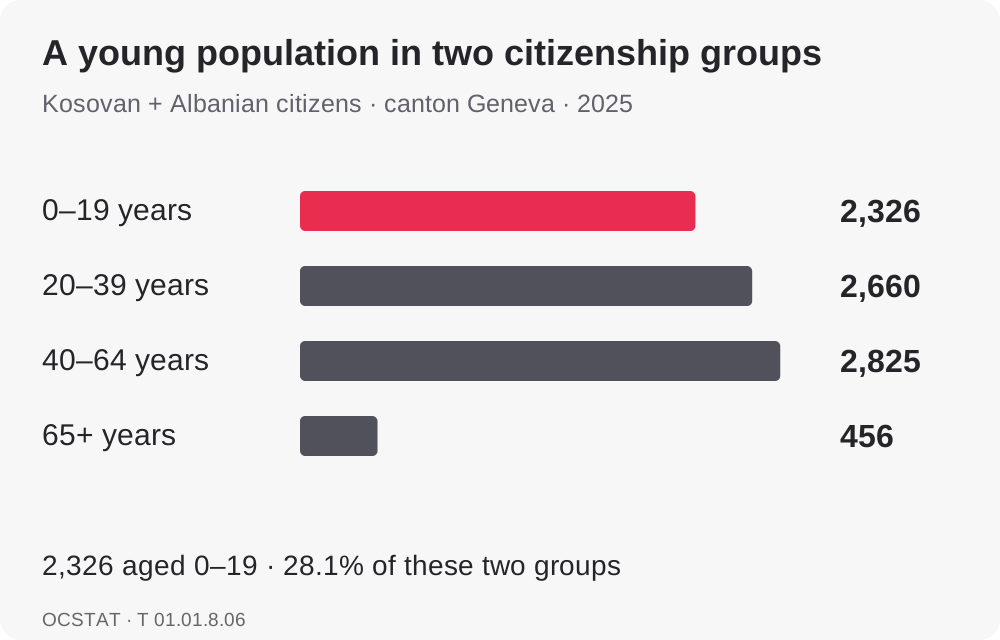
The citizenship figures show why schools and youth activities matter. Among the 8,267 Kosovan and Albanian citizens resident in the canton at the end of 2025, 2,326 were aged 0–19: 28.1%. Another 2,660 were 20–39. This describes these two citizenship groups, including young adults in the first band; it is not the age profile of everyone with Albanian ancestry.
LEPA’s report headed “2023”, signed in November 2024, gives a useful institutional snapshot: 210 regular pupils and 17 classes, with municipalities helping provide rooms. Its text mixes school-year labels and contains inconsistencies, so those totals should not be presented as 2026 enrolment. The report’s account of a year-end gathering in Aïre, in Vernier, is more straightforward: children and parents from different classes came together, with parents contributing food and practical help.
That work makes a language social. A lesson supplies reading and writing; meeting children from another class gives someone a reason to use them. The University of Geneva’s Albanian student association, AEAUG, extends the network into higher education through cultural, academic and social activities, including film screenings and discussions. Its membership is not restricted to people of Albanian origin.
Gëzuar, Flag Day and the work behind a celebration
The municipality of Onex lists Association Gezuar-GE among its cultural associations. Its stated purpose is to pass Albanian culture to younger generations through activities including dance. Onex’s listing describes a third generation taking part. A stage performance is the visible part of that work; rehearsals and the people who organise them make its continuity possible.
The video above comes from the Geneva Albanian community’s own channel and is linked on its website. It documents Shkurte Fejza with Gëzuar and the community in Geneva. The singer is a visiting artist, not presented here as a Geneva resident. The setting is local; the cultural connections reach beyond Switzerland.
The association’s footage of Flag Day in 2018 offers a second record of collective life. Later programmes bring together schoolchildren, singers and several organisations. In its account of the 2023 celebration, LEPA names Gëzuar, Rinia Contact and Hareja alongside its pupils. A national anniversary becomes a local occasion because people who usually meet in different rooms share one programme.
These are dated recordings, not advertisements for an upcoming edition. The Communauté albanaise de Genève’s event calendar is the place to check new announcements. Dates, venues and booking conditions can change, and a celebration of 28 November need not take place on that exact evening.
Books, films and a voice that travelled from Geneva
At a Geneva presentation of Slogans on 20 October 2012, visiting Albanian writer and diplomat Ylljet Aliçka joined a public discussion. Film and literature created another meeting place between Geneva and Albania.
For Elina Duni, the connection is a childhood home. Born in Tirana in 1981, she moved to Geneva with her mother in 1992. Her official biography and ECM profile trace her later study of jazz in Bern and the development of music joining Balkan songs with improvisation. Songs about departure and love can travel without becoming detached from where they began.

Meyrin’s playground, Servette’s academy
In his 2018 interview with Servette FC, Kastriot Imeri returned to Bellavista, his childhood school in Meyrin. Born in Geneva to parents who came from Kosovo in the 1990s, he remembered playing under the school shelter in winter and joining Meyrin FC as a child. His route into professional football began in that neighbourhood.
The interview also contains the ordinary consequences of a sporting career: less time to visit family in Kosovo, a sister’s wedding that required a short trip, and affection for the neighbourhood where he grew up. These details belong to his 2018 recollection, not a new interview. For children wanting to play, Meyrin FC is a local institution in its own right; neither it nor Servette is an exclusively Albanian club.
Work, enterprise and a different kind of introduction
Egin Telqiu arrived in Geneva in 1999, worked in luxury hospitality and then spent more than twelve years in banking before co-founding Alba Impex in 2021. In a 2025 account published by Geneva’s chamber of commerce, CCIG, he described introducing Albanian wines to Swiss customers. The task involved explaining a country through products people had rarely encountered.
CCIG reports more than 150 tastings since 2022 and introductions to Manor’s buyers. For Telqiu, explaining an unfamiliar wine also meant introducing its place of origin. Skills and contacts acquired in Geneva had become a bridge to producers in Albania.
Faith, solidarity and a place in public life
Dituria, the Albanian Islamic cultural centre in Plan-les-Ouates, is one of the canton’s documented community institutions. Its activities belong in a guide to Geneva without making religion a test of who is Albanian. The community includes people with different beliefs and different relationships to religious practice; citizenship and language statistics do not settle those questions.
A first-person account published by the Roman Catholic Church in Geneva describes a November 2023 interreligious visit to Dituria. Visitors were welcomed for lunch and an exchange in the prayer room about the centre’s activities. It is a modest but specific example of people meeting through an institution rather than through assumptions about one another.
The Communauté albanaise de Genève describes itself as non-partisan and non-confessional. Founded on 14 April 2013 at Théâtre d’Onex-Parc with 96 founding members, it brings together cultural and practical concerns. Its founders’ number records one association meeting, not the size of the entire community.
Becoming part of Geneva without disappearing
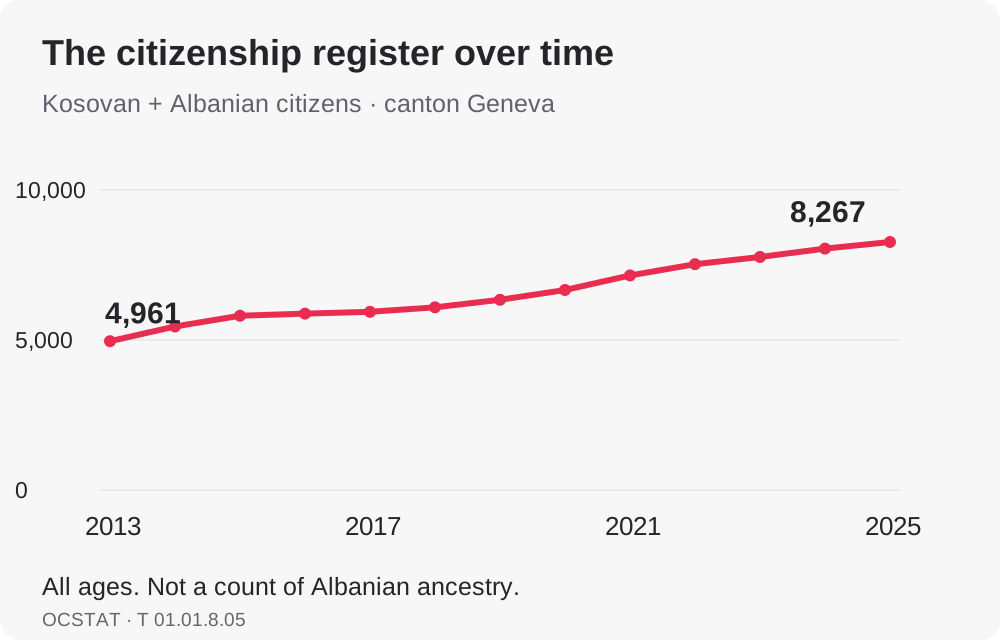
OCSTAT’s combined Kosovan and Albanian citizenship count grew from 4,961 in 2013 to 8,267 in 2025. A rise in that register is not the same as growth in an ethnic population: migration, births, deaths and citizenship changes all affect it. Nor does a person cease to have an Albanian family history when they acquire a Swiss passport.
There is also a route into local civic life before naturalisation. Under the canton’s current guidance, foreign residents aged 18 or over who have a legal domicile in Geneva and at least eight uninterrupted years of legal domicile in Switzerland can vote in their municipality. Those rights do not extend to cantonal or federal ballots. Check the canton’s full eligibility guidance for individual circumstances and current rules.

At Parc Barton, a bust of Skanderbeg places an Albanian historical figure in Geneva’s public landscape. A monument is one kind of visibility. A class that continues for another school year, a public cultural discussion and an association helping someone read a letter are others. The strongest account of belonging needs all of them.
Finding your own community in Geneva
Start with the activity you actually want to share. Parents can explore LAPSH–LEPA; students can follow AEAUG; people interested in dance can use Onex’s Gëzuar listing; and those seeking courses or practical support can begin with UPA. The Geneva community association’s programme is useful for public gatherings. Check the organiser’s current details before travelling, especially when an event is outside the city itself.
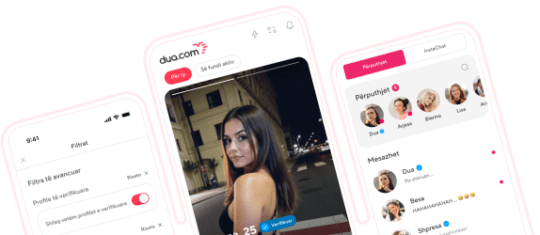
For adults looking for a relationship, dua.com offers another way to meet people who share Albanian language or cultural ties across the canton and beyond. It can sit alongside the relationships built through friends, work and associations.
The wider context continues in Albanians in Switzerland and the worldwide Albanian community hub. Geneva’s particular contribution is visible in the arc from UPA’s first rooms to today’s classrooms and cultural gatherings: a community that sought a place for itself also created places where other people could belong.
Useful Geneva resources
Checked in September 2026. These are starting points for current programmes and enquiries; inclusion is not an endorsement of every service or event.
- Université des Cultures de Genève (UPA) — French courses, family activities and practical support.
- LAPSH–LEPA Genève — Albanian language and culture classes, 2026–27 timetable and registration.
- Communauté albanaise de Genève — association information, events and original community videos.
- Onex cultural directory — Association Gezuar-GE’s public contact.
- AEAUG at the University of Geneva — student culture and academic life.
- Dituria Genève — Albanian Islamic cultural centre in Plan-les-Ouates.
- CCIG — Geneva’s chamber of commerce.
- Canton Geneva: voting as a foreign resident — current municipal voting guidance.
Questions about Albanian Geneva
How many Albanians live in Geneva?
Canton Geneva counted 7,843 Kosovan and 424 Albanian citizens at the end of 2025. The separate 2024 language survey estimates about 9,842 Albanian speakers aged 15 or over. These overlapping measures have different scopes and cannot be added. Neither is a complete count of Albanian ancestry.
Are the figures for the city or the canton?
The demographic figures in this guide cover the canton. The city of Geneva is one municipality within it. Meyrin, Vernier, Onex and Plan-les-Ouates are separate municipalities. Grand Genève extends into Vaud and France; Lausanne is part of the wider Lake Geneva region.
Where can children learn Albanian?
LAPSH–LEPA Genève organises Albanian language and culture classes. Its website publishes the 2026–2027 timetable and registration information. Consult those current details to choose a class; heritage-language teaching supplements ordinary schooling.
What is the Université populaire albanaise called today?
It uses the name Université des Cultures de Genève while retaining UPA. Founded in 1996 to welcome Albanian speakers, it developed services for the wider population. It is an adult-learning and community association, separate from the University of Geneva.
Where can I find Albanian cultural events?
Check the Communauté albanaise de Genève’s calendar, Gëzuar’s public listing in Onex and AEAUG’s university page. The videos here record past events. Confirm the current venue, date and admission arrangements with the organiser.
Which people have a documented Geneva connection?
Albana Krasniqi Malaj helped build UPA after arriving in 1992. Elina Duni moved to Geneva with her mother that year. Kastriot Imeri was born in Geneva and grew up in Meyrin. Writer Ylljet Aliçka appears here as a visiting cultural guest, not a resident.
Can foreign residents vote locally?
The canton’s current guidance provides municipal voting rights for foreign residents aged 18 or over with legal domicile in Geneva and at least eight uninterrupted years of legal domicile in Switzerland. These rights do not cover cantonal or federal votes. Check the official eligibility information.
How can I meet Albanians in Geneva?
Choose a shared interest: language classes for children, student activities, dance, public community events or UPA courses. Adults looking for a relationship can also use dua.com to connect through shared language and cultural ties in Geneva and beyond.