Albanian Ljubljana is easier to find in a classroom, a concert programme or a bilingual book than in a modern ethnicity table. Its history runs through the capital’s cultural institutions and the ordinary work of keeping a language alive. This is a guide to the people, places and evidence behind that history: a community with roots across the Albanian-speaking Balkans, and a future being made in Slovenia.
When Besnik Ademi describes his life, the route does not run straight from Albania to Slovenia. He was born in Rovinj, Croatia, to an Albanian family with roots in Kamjan in North Macedonia, and later moved with his family to Ljubljana. In a September 2026 interview with Dielli, the teacher and Migjeni organiser describes a family restaurant tradition now carried by a third generation. Today he also works to keep the Albanian school going.
The restaurant and the classroom carry different parts of the family’s inheritance. One passes on a livelihood; the other gives children the words to speak with their grandparents. Ademi now brings that experience to Migjeni, where teaching joins the association’s work in publishing, music and public gatherings.
For more on this topic, read Albanians in Slovenia and Albanians in Zurich.
How many Albanians live in Ljubljana?
There is no verified current ethnic-Albanian headcount for Ljubljana in the sources reviewed for this guide. There is a useful historical anchor: in the 2002 census, 1,239 residents of the municipality of Ljubljana recorded Albanian as their mother tongue. The corresponding figure was 1,832 in the Osrednjeslovenska statistical region and 7,177 across Slovenia. These are three geographical views of the same language measure. Ljubljana is inside the region, and the region is inside the country; the numbers must not be added.
That census answers a specific question about mother tongue, not ancestry, passport or the language someone uses most often today. A person can identify as Albanian without reporting Albanian as a mother tongue. A bilingual household cannot be fully described by a single statistical label. Nor is a 2002 observation a reasonable substitute for a September 2026 count, after more than two decades of births, migration and naturalisation.
Slovenia’s register-based censuses, introduced in 2011, do not supply a comparable ethnic-affiliation or mother-tongue count. The Council of Europe has documented this gap. It is why we do not project the 2002 municipal figure forward, apply a national estimate to the capital, or rank today’s Ljubljana neighbourhoods by an ethnic percentage the available evidence cannot establish.
Sources: SURS · SURS · Council of Europe
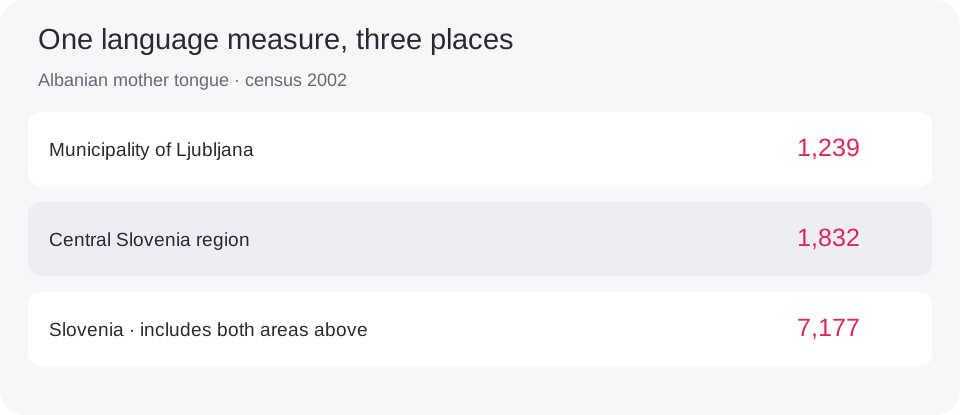
The values and definitions are also stated in the text.
| Municipality of Ljubljana | 1,239 |
|---|---|
| Central Slovenia region | 1,832 |
| Slovenia · includes both areas above | 7,177 |
A passport tells a different story
The current national statistics show how misleading the label “Albanian nationals” can be when it is used to mean the entire community. On 1 January 2025, Slovenia recorded 29,905 residents with Kosovo citizenship, 16,997 with North Macedonian citizenship and 303 with Albanian citizenship. Those are countrywide citizenship categories. They are not Ljubljana totals, and adding them does not produce a count of ethnic Albanians.
Kosovo and North Macedonia are home to more than one ethnic community. Albanian families also have connections to Montenegro, Serbia and elsewhere, and many people of Albanian origin have Slovenian citizenship. The categories overlap with Albanian identity without defining it. The family route in Ademi’s account is a reminder that birthplace, family origin and present home may be three different places.
Our country guide explains the wider Slovenian evidence and its explicitly labelled origin model. Here the editorial choice is narrower: give the verified local language observation, show what the newer national register measures, and let the city’s institutions and people supply the detail the population table cannot. A transparent gap is more useful than a confident but untraceable number.
Sources: SURS · Dielli · Sokol Paja
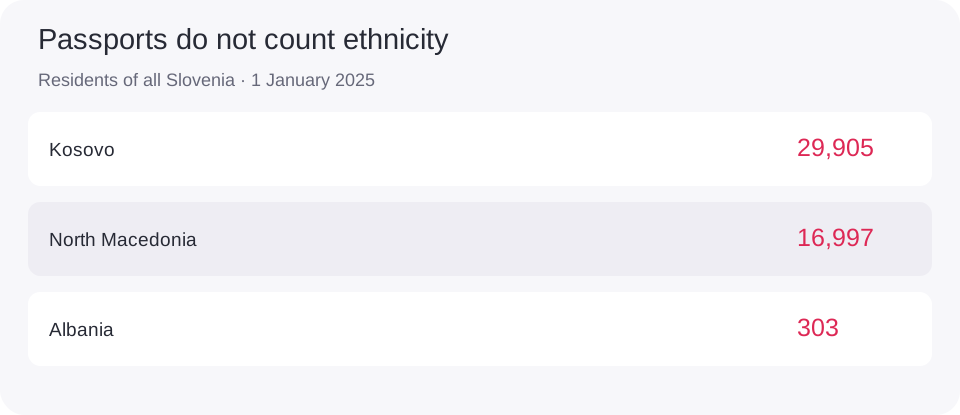
The values and definitions are also stated in the text.
| Kosovo | 29,905 |
|---|---|
| North Macedonia | 16,997 |
| Albania | 303 |
A city of meeting places, not one Albanian quarter
Start with Celovška cesta 177, the Ljubljana address associated with Migjeni and the renewed Albanian classes. Then follow the story south towards the old town: the City Museum at Gosposka 15, the literary collections of the municipal library, and the festival venues that have put Albanian music in front of a wider audience. These are addresses of public activity, not evidence that the people attending them all live nearby.
That distinction matters in Ljubljana. A school can bring families across the city; a national association can draw visitors from other Slovenian towns; a concert in the centre can feature artists whose working lives cross borders. None of those observations supports calling a district an exclusively Albanian neighbourhood. The useful map is a network of places where people can participate.
For a newcomer, this changes the search. Begin with a published programme and a real organiser rather than a presumed ethnic street. For a family, ask the school about the current term. For someone curious about the city’s history, start with the museum archive. For music, check the organiser’s latest calendar. The same city can offer several entrances into the community, depending on what you hope to find.
Sources: Albinfo · Museum and Galleries of Ljubljana · Imago Sloveniae
1989: when Ljubljana became a public platform
Albanian settlement in Slovenia predates its independence. During socialist Yugoslavia, moving from Kosovo or Macedonia to Slovenia was movement within one federation. Employment, study and family connections brought people north. Later accounts often compress these paths into a single story of foreign immigration; that misses the change in political borders that happened around people who were already here.
Ljubljana’s particular place in Albanian political memory is tied to Cankarjev dom in 1989. The solidarity gathering over events in Kosovo brought Slovenian public figures into a dispute that would help shape the federation’s last years. Historian Alenka Bartulović examines both the solidarity and its limits: support for Kosovo existed alongside Slovenia’s own political ambitions. Remembering the event need not mean turning a complicated alliance into a simple national friendship story.
Migjeni’s own history describes the struggle to register an Albanian cultural association that year. The first proposed name, Besa, met resistance. The association eventually took the name of the Albanian writer Migjeni; its account gives 4 December 1989 as the registration decision. That administrative date sits alongside earlier organising and founding activity. It should not be used to pretend the association suddenly began from nothing in December.
The cultural work was practical as well as symbolic. A magazine could carry writing between languages. A public meeting could bring dispersed families into the same room. A recognised association could offer a point of contact to people who previously had to rely entirely on personal networks. The archive film below is presented by Migjeni itself: a community’s own telling of its history, with all the value and perspective that implies.
Sources: Shoqata Kulturore Shqiptare Migjeni · Alenka Bartulović · Comparative Southeast European Studies · National and University Library of Slovenia
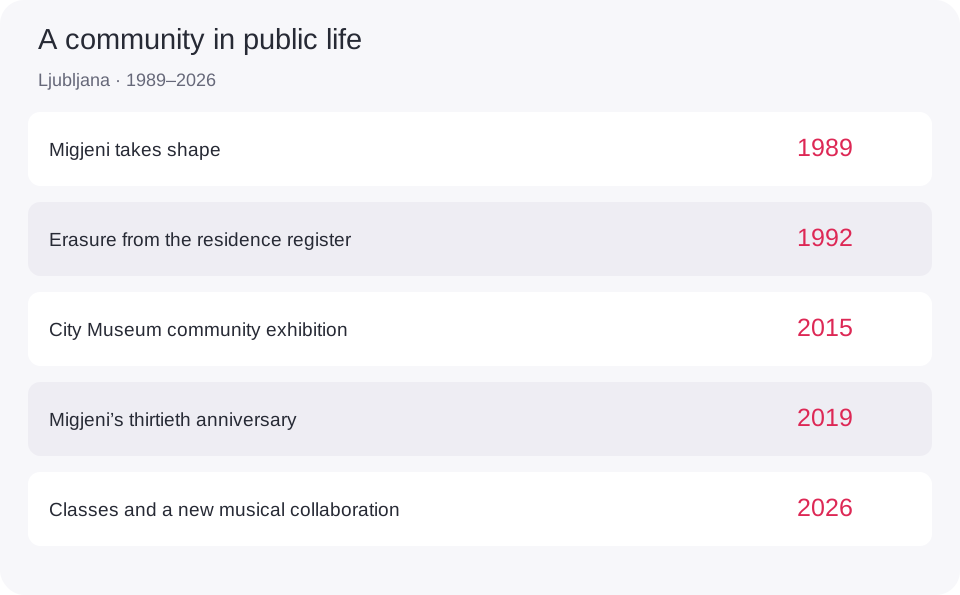
The values and definitions are also stated in the text.
| Migjeni takes shape | 1989 |
|---|---|
| Erasure from the residence register | 1992 |
| City Museum community exhibition | 2015 |
| Migjeni’s thirtieth anniversary | 2019 |
| Classes and a new musical collaboration | 2026 |
Independence also brought a rupture
The hopeful account cannot carry the whole history. On 26 February 1992, people originating in other Yugoslav republics who had not acquired Slovenian citizenship were removed from the permanent-residence register under the circumstances documented by the Slovenian government and later court proceedings. They became known as the Erased, or izbrisani. The government’s retrospective total is 25,671 people across Slovenia; it is not an Albanian total or a Ljubljana total.
This belongs in a community history because legal status shapes ordinary life: whether an established home is recognised on paper, whether work and services are accessible, and whether a family can plan with confidence. It would nevertheless be wrong to assume that every Albanian resident was erased, or to infer an ethnic share from the national total. Individual circumstances differed.
The distinction also helps explain why citizenship is not a neutral shortcut for cultural belonging. Someone’s place in an association or family can endure while their administrative category changes. Readers dealing with a personal residence or citizenship issue should use the current official information and qualified advice. This historical section cannot decide an individual case or replace a legal assessment.
Sources: Government of Slovenia
Keeping Albanian in the next generation
The school initiative associated with Migjeni makes the generational question concrete. An announcement reported Albanian classes at Celovška 177, on Saturdays at 10:00, with support from the Albanian and Kosovan embassies. That is the published announcement, not a guarantee that the same timetable applies every week. Before travelling, families should confirm the current term, age groups and arrangements through the association.
In his 3 September 2026 interview, Besnik Ademi describes the teaching as free and the reopening as a continuation of earlier supplementary education. He distinguishes understanding family conversation from learning to read and write the language. The practical ambition is clear: children should have more than a few familiar phrases available when they visit relatives or choose a book. The source is the organiser’s account, not an independently audited enrolment report.
Albanian classes and Slovenian learning serve different needs. Heritage teaching helps maintain a family language; Slovenian is essential to participation in the local school system and everyday city life. Parents can ask their child’s school about support and consult Ljubljana adult-education providers such as Cene Štupar for Slovenian courses. Eligibility, fees and enrolment depend on the programme and should be checked directly.
This is also where the association becomes more than an events organiser. Regular learning brings parents into contact repeatedly, gives children a reason to use Albanian outside the home, and turns cultural transmission into a shared responsibility. The guide does not claim a measured effect on language retention. It points to the real local institution through which families are trying to make that effect possible.
Sources: Albinfo · Dielli · Sokol Paja · Cene Štupar
The neighbours entered the museum
In May and June 2015, the City Museum of Ljubljana partnered with Migjeni on Museums Connect: Albanian Community at the MGML. The programme named people and activities: Naser Gashi demonstrating confectionery, Dino Murtezani showing burek preparation, and evenings of Albanian music and stories. These were scheduled museum events in 2015, not a standing programme available to book today.
The choice of setting matters. A craft that someone encounters over a counter becomes something to learn about; a neighbour becomes a person with knowledge to share. The museum’s own description explicitly linked the exhibition to the lives of Albanians in Ljubljana and Slovenia. It placed the community within the city’s public cultural story.
Food offers an accessible meeting point, but it can also narrow the picture. Knowing a pastry or a bakery does not mean knowing the people behind it. The rest of this story extends beyond that familiar doorway: publishing, singing, teaching and translation. The museum archive is valuable precisely because it names participants and records a programme, rather than treating an entire community as an anonymous cuisine.
Sources: Museum and Galleries of Ljubljana
Albanian songs, shared across the city
The musical story contains an unexpected partnership. Kvali, a Ljubljana women’s vocal group initially formed around Georgian polyphonic singing, began adding Albanian songs with Alma Bejtullahu’s involvement. The singers were mainly Slovenian. In the research by Bartulović and Bejtullahu, stages such as Hostel Celica and Zlati Zob became places where Albanian repertoire could reach listeners who had scarcely encountered it before.
Their study draws on fieldwork in Ljubljana and Kočevje in 2023–2024. It describes collaborations between Kvali and Migjeni’s musicians, and later work involving younger generations. It also records a post-COVID hiatus for Kvali. A historical performance record should therefore not be turned into a promise that the group currently rehearses or accepts members on a particular evening.
The point is not that outsiders discovered a culture its own community lacked. Albanian music already existed in family and community life. The change was in who could hear it, and where. A public stage opened another route between neighbours. The NaGlas! report below provides a broadcaster’s view of Albanian music in Slovenia; it gives context for the Ljubljana collaborations rather than serving as a complete survey of the capital.
Sources: Alenka Bartulović & Alma Bejtullahu · Traditiones
A new chapter in the 2026 festival programme
The published programme for Noči v stari Ljubljani, 21–22 August 2026, gives this story a recent continuation. It listed The Albanian Music Experiment on 22 August at Gornji trg, with a rain alternative at the City Museum: Alma Bejtullahu on vocals, Vasko Atanasovski on saxophone and Zoran Majstorović on guitar, in cooperation with Migjeni.
Imago Sloveniae described a new interpretation of Albanian musical traditions by the trio. The billing places Albanian repertoire among the city’s wider programme of music, rather than in a separate cultural enclosure. It is evidence of an announced programme and a named collaboration; we do not infer attendance figures or the exact performance conditions from the announcement.
For readers planning an evening out, August’s dates are now an archive, not a forthcoming invitation. Use the festival’s current calendar and Migjeni’s announcements for the next event. The value of retaining the dated example is that it shows what to look for: a named performer, an actual Ljubljana venue and an organiser who can confirm the details.
Sources: Imago Sloveniae · Imago Sloveniae
The community’s own camera
Migjeni’s thirtieth anniversary in June 2019 left a particularly useful visual record. The association’s gallery describes a symposium at Ljubljana’s Museum of Contemporary History, an exhibition by Gani Llalloshi, a festive musical evening and a concert involving Kvali and the association’s music section. Albania’s diaspora agency independently records the anniversary and the association’s recognition.
The photographs show a formal public gathering: speakers, guests and presentations of recognition. They document one occasion, not a representative sample of all Albanian life in the city. The short film by Driton Idrizi is embedded on Migjeni’s own website and lets readers see the event in motion. It is community documentation, separate from the dua app banners elsewhere on the page.
The linked original gallery preserves the photographs of the gathering. The film plays here through the original publisher’s YouTube player. The longer archive film earlier in this guide offers a different timescale; this anniversary footage records how a community chose to remember three decades of work.
Sources: Shoqata Kulturore Shqiptare Migjeni · Albanian National Diaspora Agency
The people who carry words between places
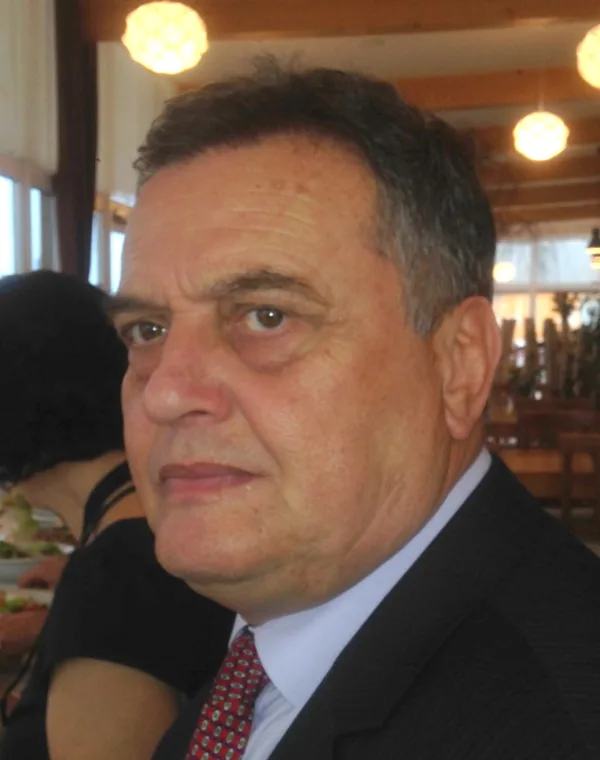
Nikollë Berishaj offers another Ljubljana story, one that did not end with permanent settlement. In his first-person biography for Festival Pranger, the translator says he lived, studied and worked in Ljubljana from 1977 to 1989, then returned to his native Tuzi in Montenegro. His Slovenian–Albanian and Albanian–Slovenian dictionary appeared with Cankarjeva založba in Ljubljana in 1989. He belongs here as a former resident and a literary intermediary, not as a claimed current Ljubljana resident.
That work remains visible in the city’s reading life. The municipal library lists Ag Apolloni’s Iskra upanja, iskra vžigalice in Berishaj’s Slovenian translation. A reader can encounter a Kosovo story through a Slovenian-language book without first entering an Albanian association. Translation creates another kind of meeting place—one that can be reached alone, at a library shelf.
Alma Bejtullahu appears in this guide through her documented roles as singer and ethnomusicologist, and through the festival’s named trio. Her musical and scholarly work connects the performance of Albanian traditions with questions about who gets heard in public. Besnik Ademi appears through his own account of teaching and organising. These are distinct contributions; no one person stands for a whole diaspora.
Sources: Festival Pranger · Mestna knjižnica Ljubljana · Imago Sloveniae · Dielli · Sokol Paja
Work, family networks and the limits of a permit chart
Employment remains part of the story, but the numbers are easy to misuse. A 24ur investigation reported 2,773 single residence-and-work permits issued or extended to Kosovo citizens by the Ljubljana administrative unit over 2018–2022. The corresponding figure for Kranj was 8,668. An administrative unit is not identical to the city municipality, and a five-year total of issues and extensions is not a count of different workers.
The comparison helps explain why the capital cannot stand in for the entire Slovenian Albanian experience. Other towns have their own labour and family networks. It does not reveal how many ethnic Albanians work in Ljubljana today, how many own businesses, or whether a particular workplace is Albanian-owned. Citizenship, ethnicity and permit processing remain different measures here too.
For someone arranging a move, the useful step is to consult the Employment Service’s current single-permit guidance and the relevant administrative unit. Do not assume that visa-free entry for a short visit grants permission to work or settle. Employers and applicants should confirm which procedure applies to their circumstances. Cultural associations can be a social connection; they do not replace the competent authority.
Sources: 24ur / POP TV · Employment Service of Slovenia
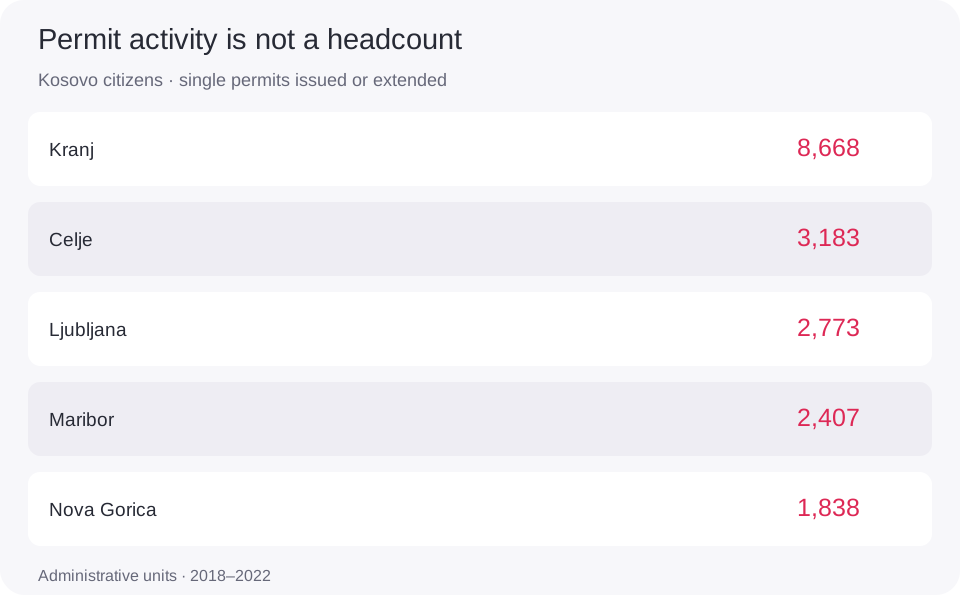
The values and definitions are also stated in the text.
| Kranj | 8,668 |
|---|---|
| Celje | 3,183 |
| Ljubljana | 2,773 |
| Maribor | 2,407 |
| Nova Gorica | 1,838 |
Faith without assuming everyone is the same
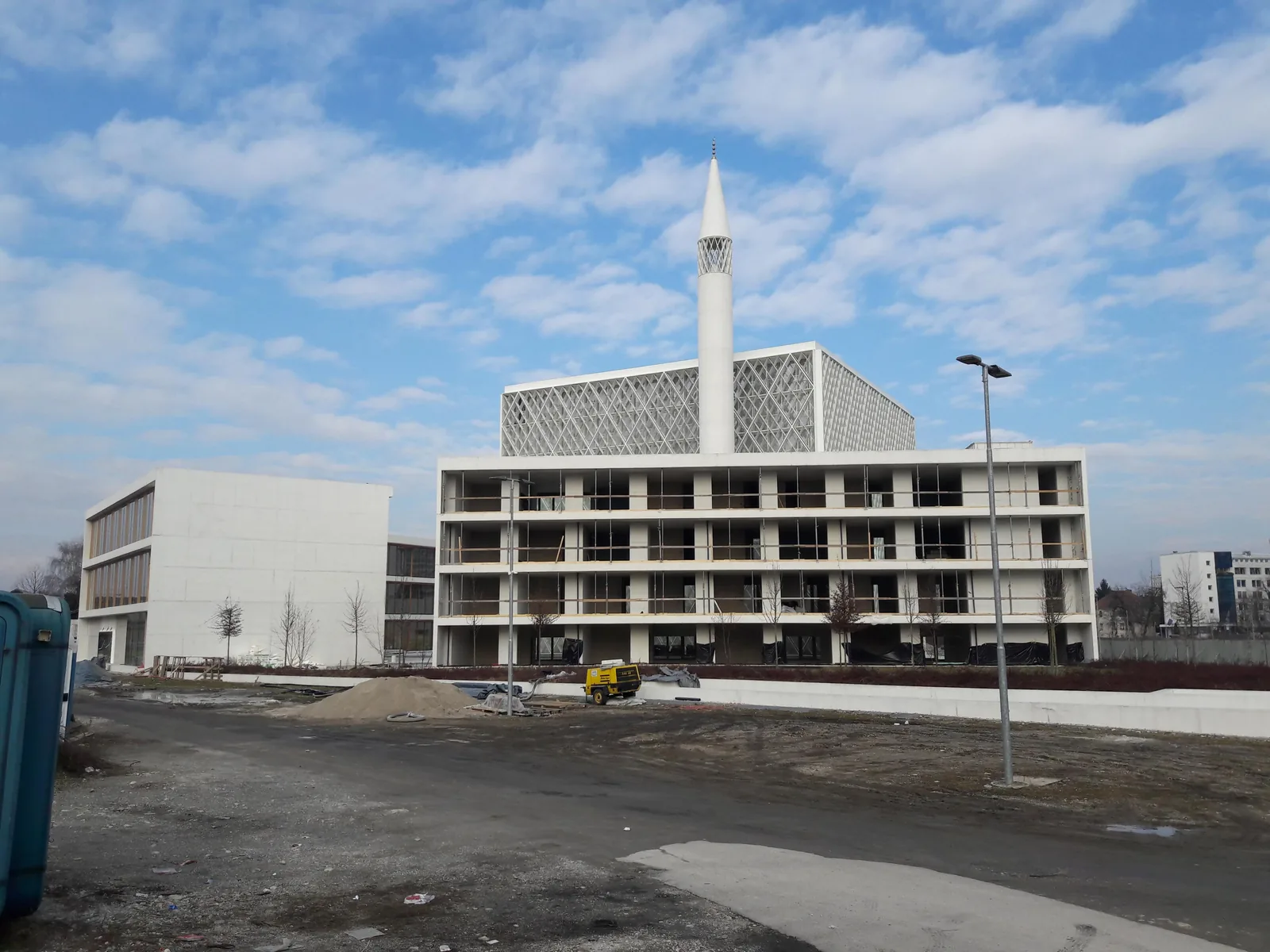
Albanian identity does not specify a person’s religion or level of observance. Ljubljana’s Muslim Cultural Centre is a city institution of the Islamic Community in Slovenia; its announcement records the start of access for worshippers on 7 February 2020. It should not be described as an exclusively Albanian mosque, nor should the city’s entire Muslim population be counted as Albanian.
The photograph here shows the complex during construction in February 2019, before that opening. Keeping the date in the caption matters: an attractive image must not silently become a false picture of the present. For visits, services or community activities, consult the centre’s own current information.
Sources: Islamic Community in Slovenia · Alenka Bartulović & Alma Bejtullahu · Traditiones
Useful starting points in Ljubljana
Migjeni: start with the association’s website for its history, publications and contact information. For Albanian classes, ask about the current programme at Celovška cesta 177. The 2026 school announcement and Ademi interview are useful background, but check arrangements before attending.
Culture and reading: the Museum and Galleries of Ljubljana maintains the 2015 community exhibition record; Imago Sloveniae publishes festival programmes; Mestna knjižnica Ljubljana offers a route into translated literature. The digital library dLib.si preserves historical publications. An archive entry is not an upcoming event.
Language and official procedures: Cene Štupar is a Ljubljana starting point for adult education and Slovenian learning. Use the Albanian embassy’s official website for its services and the Slovenian Employment Service for work-related procedures. Services depend on citizenship and circumstances; choose the authority relevant to your case.
For a first visit, contact the organiser to confirm the current programme, opening arrangements and language. The links below connect you with the associations and public services mentioned in this guide.
Sources: Albanian Embassy in Slovenia · Cene Štupar · Employment Service of Slovenia
Finding one another today
The city’s Albanian story now has several generations and several kinds of distance inside it. There is the distance between Slovenia and the family’s place of origin. There is also the distance between someone who arrived as an adult and someone whose first school memories are Slovenian. Associations, translations and music do not erase those differences. They give people ways to keep talking across them.
For dating, dua.com offers another way for Albanian adults to discover people nearby and across the diaspora. It can sit alongside the community’s established places of meeting, with the intention made clear: a school or a cultural event has its own purpose, while a dating app lets people look for a relationship. This guide makes no claim about a measured Ljubljana user population or a local success story we have not documented.
A city becomes home through repetition: the next class, the next conversation, the next performance, the next book passed to a friend. Ljubljana’s Albanian community has left traces of that work in public institutions and in its own archive. Following those traces gives a richer picture than any single number—and a more useful place to begin participating.
Questions about Albanians in Ljubljana
How many Albanians live in Ljubljana?
No current ethnic-Albanian total is established here. SURS counted 1,239 people reporting Albanian as their mother tongue in the municipality in 2002. That is a historical language count, not a September 2026 ethnic or citizenship figure.
Is Ljubljana’s Albanian population the same as Slovenia’s?
No. Ljubljana is a municipality within the Osrednjeslovenska region, within Slovenia. The 2002 Albanian mother-tongue figures were 1,239, 1,832 and 7,177 respectively. These populations are nested and cannot be added.
Where can children learn Albanian?
Migjeni’s renewed initiative was announced at Celovška 177 in Ljubljana, on Saturdays at 10:00. Besnik Ademi described the teaching as free in September 2026. Confirm the present term, ages and timetable with the association before attending.
What is Migjeni?
An Albanian cultural association founded in Ljubljana in 1989. Its work includes publishing, cultural events and supplementary language education. Its own archive includes an association film and a photographic record of its thirtieth anniversary.
Are there Albanian cultural events in Ljubljana?
Yes. Documented examples include the City Museum’s 2015 community exhibition, Migjeni’s 2019 anniversary and the Albanian Music Experiment in the published August 2026 festival programme. Those dates are historical; check organisers’ current calendars for future events.
Are all Kosovo citizens or North Macedonian citizens Albanian?
No. Both states have multiple ethnic communities. Citizenship categories cannot be equated with Albanian ethnicity, and they exclude Albanians who hold Slovenian or other citizenships. The national figures on this page are not Ljubljana counts.
Is the Muslim Cultural Centre an Albanian-only institution?
No. It belongs to the Islamic Community in Slovenia and is a wider city institution. Albanian identity also includes people of other religions and people who do not practise a religion.
How can I meet Albanians in Ljubljana?
Start with public cultural programmes, Migjeni’s activities and the relevant family or language networks. For dating, dua.com offers a way to discover Albanian adults locally and across the diaspora. Check current event details and approach each setting according to its purpose.