Slovenia asked people to name their nationality for the last time in 2002. Six thousand one hundred and eighty-six said Albanian. Then the country stopped asking — and everything we know since has had to be rebuilt from passports, birthplaces and court files.
Slovenia's censuses since 2011 are assembled from administrative registers, and those registers carry no question about ethnicity, mother tongue or religion. The Council of Europe's monitoring body recorded in its 2022 opinion that the state held no such register data and planned no survey to collect it. There is therefore no official ethnicity count after 2002. Future policy could change, but a current answer has to work with the evidence that exists: what each register counts, what it leaves out, and which assumptions an estimate requires.
How many Albanians live in Slovenia?
Our register-based model gives a central scenario of around 38,000 residents of Albanian origin, with a coarsely rounded scenario range of 35,000 to 45,000. This is our illustrative reconstruction on a 1 January 2025 base, not an official figure or a statistical confidence interval. The ethnic shares of the migrant cohorts are unmeasured. Different reasonable assumptions, and people the model misses, can put the actual population outside this range.
For more on this topic, read Albanians in Croatia and Albanians in Switzerland.
It is also nothing like the numbers in circulation. English Wikipedia's infobox says “ca. 10,000” and has carried no citation for that figure since an anonymous editor added it in 2019; the likely source is a sentence on an Albanian embassy page with no year and no statistical office behind it. Wikipedia's other figure, 6,228, turns out to be the 2002 census share — 0.31% — re-applied to a later population total, laundered through a defunct directory site. Joshua Project's 6,500 cites Wikipedia, which makes it circular.
In January 2026 N1 discussed just under 30,000 people using the qualifier citizens of Kosovo; two days later a party leader's reported wording dropped that qualifier and referred to “30,000 Albanians”. The register supports the citizenship count, not an ethnic count in either formulation. Retaining the passport qualifier helps readers identify the source population, but does not establish that every person in it is Albanian.
The count that stopped
Slovenia counted ethnic Albanians in six post-war censuses and then stopped. In 1953 there were 169. In 1991, 3,534. In 2002 — the last census to ask — 6,186 people declared Albanian nationality, 0.31% of a population of 1,964,036.
Two official series exist for those years and they must never be mixed. The figures above are recalculated to 2002 methodology, which subtracts zdomci, residents working abroad; the as-published series for the same censuses runs 216 in 1948, 1,281 in 1971, 1,985 in 1981 and 3,629 in 1991. Both are the statistical office's own. Any page quoting one has to say which.
The 6,186 declarations are not a comprehensive count of everyone with Albanian origins. Declaring ethnicity was voluntary: 126,325 people were recorded as unknown and a further 48,588 explicitly refused to answer, leaving affiliation unavailable for roughly a tenth of the population. The same census recorded 7,177 people whose mother tongue was Albanian — 991 more than declared Albanian ethnicity. Language and identity are different answers, however; that difference is not a measured ethnic undercount.
From 2011 the census is assembled from administrative registers. There was no separate 2011 census act; the exercise rests on European census rules and Slovenia's statistics law. Ethnicity, mother tongue and religion are not among the register variables. This explains the end of the published series, without predicting what future governments or statistical programmes might collect.
| Census | Declared Albanian ethnicity, 2002 methodology | Share | Declared Albanian ethnicity, as originally published |
|---|---|---|---|
| 1948 | – | – | 216 |
| 1953 | 169 | 0.01% | 169 |
| 1961 | 282 | 0.02% | 282 |
| 1971 | 1,266 | 0.08% | 1,281 |
| 1981 | 1,933 | 0.11% | 1,985 |
| 1991 | 3,534 | 0.18% | 3,629 |
| 2002 | 6,186 | 0.31% | – |
| 2011 → | Register-based censuses: ethnicity is not collected | ||
Source: SURS, SLO-T-07SLO · Popisi na Slovenskem 1948–1991.

Different ways to count the community
| Layer | Figure | What it actually counts |
|---|---|---|
| Declared Albanian nationality, 2002 | 6,186 | Self-declared ethnicity in the last census to collect it; answering was voluntary. |
| Albanian mother tongue, 2002 | 7,177 | First language, same census. Runs 16% above declared nationality. |
| Citizens of Albania, 2025 | 303 | Citizenship of the Republic of Albania. It excludes Albanians holding Kosovo, North Macedonian, Slovenian or other passports, so it cannot stand in for the community. |
| Citizens of North Macedonia, 2025 | 16,997 | Passport of North Macedonia. Contains both ethnic Macedonians and ethnic Albanians in a ratio nobody publishes. |
| Citizens of Kosovo, 2025 | 29,905 | Passport of Kosovo. Kosovo has had its own code in Slovenian statistics since 2008. |
| Valid residence permits, August 2026 | 62,222 | Valid documents for Kosovo, North Macedonia and Albania citizens combined. Permit holders and registered residents can overlap; adding the two counts would double-count people. |
| Residents with first residence in Kosovo and Slovenian citizenship, 2021 | 3,478 | First residence in Kosovo and Slovenian citizenship in 2021. This includes an older settled cohort; its ethnic composition and route to citizenship are not published. |
| Our reconstruction, people of Albanian origin | 35,000–45,000 | An illustrative origin model on a 2025 base, rounded from stated scenarios. Neither an official count nor a confidence interval. |
These are five different populations and they are not interchangeable. Declared nationality, mother tongue, citizenship, country of first residence and residence permits each count something else, and treating any two as the same thing is how every wrong number about this community has been produced.

Building an estimate, and where it breaks
The model starts with residents on Slovenia's population register at 1 January 2025 holding Kosovo, North Macedonian or Albanian citizenship. Each stock is multiplied by an assumed Albanian-origin share. We then include residents whose first residence was Kosovo or North Macedonia and who already held Slovenian citizenship in 2021, plus the corresponding acquisitions of Slovenian citizenship during 2021–2024. That last calculation approximates a later stock; it is not a new census of naturalised Albanians.
Kosovo's 2024 census provides context, not a measurement of Slovenia's migrants: Albanians were 91.76% of the 1,585,566 people enumerated, or 90.79% of the headline population including estimates for the four northern municipalities. We choose 88% for the central model, and test 85%–91.76%. These are editorial assumptions. Minority migration and different passport choices mean neither Kosovo's national share nor our adjustment establishes the share in Slovenia.
For North Macedonia, the resident census share is 24.30%, or 26.18% among those with a recorded ethnicity. Our aggregation of the official settlement table puts the Polog region at 68.91%; the documented confectioner migration came from that region, but the entire North Macedonian cohort cannot be assumed to share its composition. We choose 35% and test 30%–50%, holding the older North Macedonia-origin Slovenian-citizen layer at 30%. None of those migrant shares has been measured. The North Macedonian citizenship assumption alone moves the model by 3,399 people across this band.
The central calculation is: 29,905 × 0.88, plus 16,997 × 0.35, plus 303 × 0.91, plus (3,478 + 519) × 0.88, plus (5,343 + 921) × 0.3. The unrounded sum is 37,937.64, or 37,938 rounded to the nearest person; the useful public description is around 38,000. The low and high share scenarios give 36,070.73 and 41,761.91. Rounding those endpoints outward to multiples of 5,000 produces 35,000–45,000. That coarse display range is a choice about presentation, not a claim that all possible answers lie inside it.
The assumptions, stated
- Citizenship stocks are dated 1 January 2025, the latest country-level vintage available in the table when checked. Later aggregate releases do not identify the Albanian-origin population, so the model is not presented as a September 2026 headcount.
- The Kosovo share of 88% and the North Macedonian share of 35% are model inputs, not findings from Slovenian ethnicity data. Sending-country censuses contextualise these choices; they do not validate them. The scenarios vary those shares and hold Albania's assumed 91% and the older North Macedonia-origin layer's 30% constant.
- The Kosovo-first-residence Slovenian-citizen cohort may differ substantially from recent Kosovo passport holders. Applying the same share to both is a simplification, particularly given older migration and changes in country coding. Alternative cohort shares would change the answer independently of the displayed scenarios.
- Birth in Slovenia does not automatically confer Slovenian citizenship. Children who retain their parents' foreign citizenship are already in the citizenship stock and must not be added again. Children who acquired Slovenian citizenship before the 2021 base, and descendants of already-naturalised parents, may be missing from a base defined by foreign first residence.
- The model does not separately count children with mixed parentage or Albanian-origin residents holding Serbian, Montenegrin or other passports. We have no defensible count for these omitted groups and assign them no invented numerical allowance. They should not be interpreted as people who do not belong to the community.
- The Slovenian-citizen layer adds later citizenship acquisitions to a 2021 stock without subtracting subsequent deaths or emigration. That can overstate this layer, while omitted descendants can understate the total. These uncertainties are not measured and cannot be assumed to cancel each other.
- The result is an origin model, not a prediction of how people would answer an ethnicity question. The displayed range is neither a confidence interval nor an exhaustive bound. We do not forecast a hypothetical census result or treat several analysts reusing the same registers as independent corroboration.
What this page will not do
- Add residence permits to resident citizens. The measures overlap, and the published sources do not quantify a separate population that could safely be added.
- Add citizenship counts to country-of-birth counts, or declared nationality to mother tongue.
- Call 29,905 Kosovo citizens “30,000 Albanians”.
- Attribute our model to the statistical office, which publishes no such ethnicity figure.
- Draw a population trend from the 2002 ethnicity count to the present origin model. One is a voluntary self-declaration and the other is a reconstruction from different registers.
- Guess how many of the Erased were Albanian. No such breakdown exists.
Where they live
The official sources we checked do not provide a current municipal map of ethnic Albanians in Slovenia. Our search of the SiStat catalogue found no table crossing municipality with individual countries of citizenship or first residence. At municipal level, the available origin grouping is broader, including a combined category for countries of the former Yugoslavia. This limits the precision a community guide can responsibly offer.
For 2002 there is another limit. The municipal ethnic-affiliation tables we located do not isolate Albanians: special minority tables identify Italians, Hungarians and Roma, while other municipal reporting uses broader groups. We therefore use the Albanian mother-tongue table as a clearly labelled historical signal, rather than relabelling language as ethnicity.
So what follows is a three-layer stack, and each layer is labelled with what it actually measures.
By statistical region
At regional level the 2002 nationality figures do exist, and they sum exactly to the national total of 6,186 — a small internal check that passes. Central Slovenia held 1,685, the Savinja region 899, the Drava region 785, Upper Carniola 664.
Two decades later the register data tells a different story about where the weight sits. Among residents whose first country of residence was Kosovo, at the start of 2021, the Savinja region led with 4,742 and Upper Carniola followed with 4,112 — both ahead of Central Slovenia's 4,061. The Ljubljana region does not dominate this community the way it dominates most things in Slovenia. For people from North Macedonia the pattern inverts: Central Slovenia holds 7,582, far ahead of anywhere else. These are separate snapshots of different populations and regional boundaries, not a like-for-like growth series.

| Statistical region | Albanians (2002) | First residence Kosovo (2021) | First residence North Macedonia (2021) |
|---|---|---|---|
| Central Slovenia | 1,685 | 4,061 | 7,582 |
| Savinja | 899 | 4,742 | 1,164 |
| Drava | 785 | 3,752 | 1,784 |
| Upper Carniola | 664 | 4,112 | 2,634 |
| Coastal–Karst | 538 | 2,010 | 2,670 |
| Gorizia | 476 | 1,588 | 1,810 |
| South-East Slovenia | 276 | 836 | 628 |
| Lower Sava | 242 | 989 | 306 |
| Inner Carniola–Karst | 225 | 521 | 554 |
| Carinthia | 135 | 438 | 163 |
| Mura | 133 | 222 | 281 |
| Central Sava | 128 | 420 | 248 |
| Slovenia | 6,186 | 23,691 | 19,824 |
The columns use each year's regional boundaries and measure different populations; they are not a growth comparison. Lower Sava and Inner Carniola–Karst use their later names in the 2021 source. In 2015 Radeče and Bistrica ob Sotli moved from Savinja to Lower Sava, and Litija moved from Central Slovenia to Central Sava. The name matching below does not adjust these boundary changes.
Source: SURS, Popis 2002 (05W2209S) · SURS 05E4021S, 1.1.2021; SURS NUTS 2015.
By municipality — as far as the data goes
The closest thing to a municipal map is the 2002 mother-tongue table: Ljubljana 1,239, Maribor 918, Kranj 374, Celje 325, Koper 240, Velenje 197, Krško 196, Nova Gorica 183. Ninety of the 192 municipalities are suppressed for statistical confidentiality, which leaves 236 of the 7,177 speakers unattributable to anywhere.
That table measures language, not ethnicity. Its national total is about 16% above the declared Albanian ethnicity figure, which illustrates why the two cannot be exchanged. It offers a historical municipal view, not a current headcount.
| Municipality | Albanian mother tongue |
|---|---|
| Ljubljana | 1,239 |
| Maribor | 918 |
| Kranj | 374 |
| Celje | 325 |
| Koper/Capodistria | 240 |
| Velenje | 197 |
| Krško | 196 |
| Nova Gorica | 183 |
| Piran/Pirano | 141 |
| Novo mesto | 136 |
Source: SURS, Popis 2002 (05W1007S).
The Kranj anomaly
One modern figure cuts against every expectation. Between 2018 and 2022, single residence-and-work permits issued or extended to Kosovo citizens by Slovenian administrative unit ran: Kranj 8,668, Celje 3,183, Ljubljana 2,773, Maribor 2,407, Nova Gorica 1,838. Kranj processed more than three times Ljubljana's number. For contrast, the same office issued 102 to citizens of Albania.
Read it carefully, though: that is a five-year flow of documents by administrative unit, not a stock of people by municipality. It says where permits were processed. It is still the sharpest geographic signal in the modern data, and it points at Upper Carniola rather than the capital.
| Administrative unit | Residence permits 2018–2022 |
|---|---|
| Kranj | 8,668 |
| Celje | 3,183 |
| Ljubljana | 2,773 |
| Maribor | 2,407 |
| Nova Gorica | 1,838 |
How they came: the confectioners of Polog
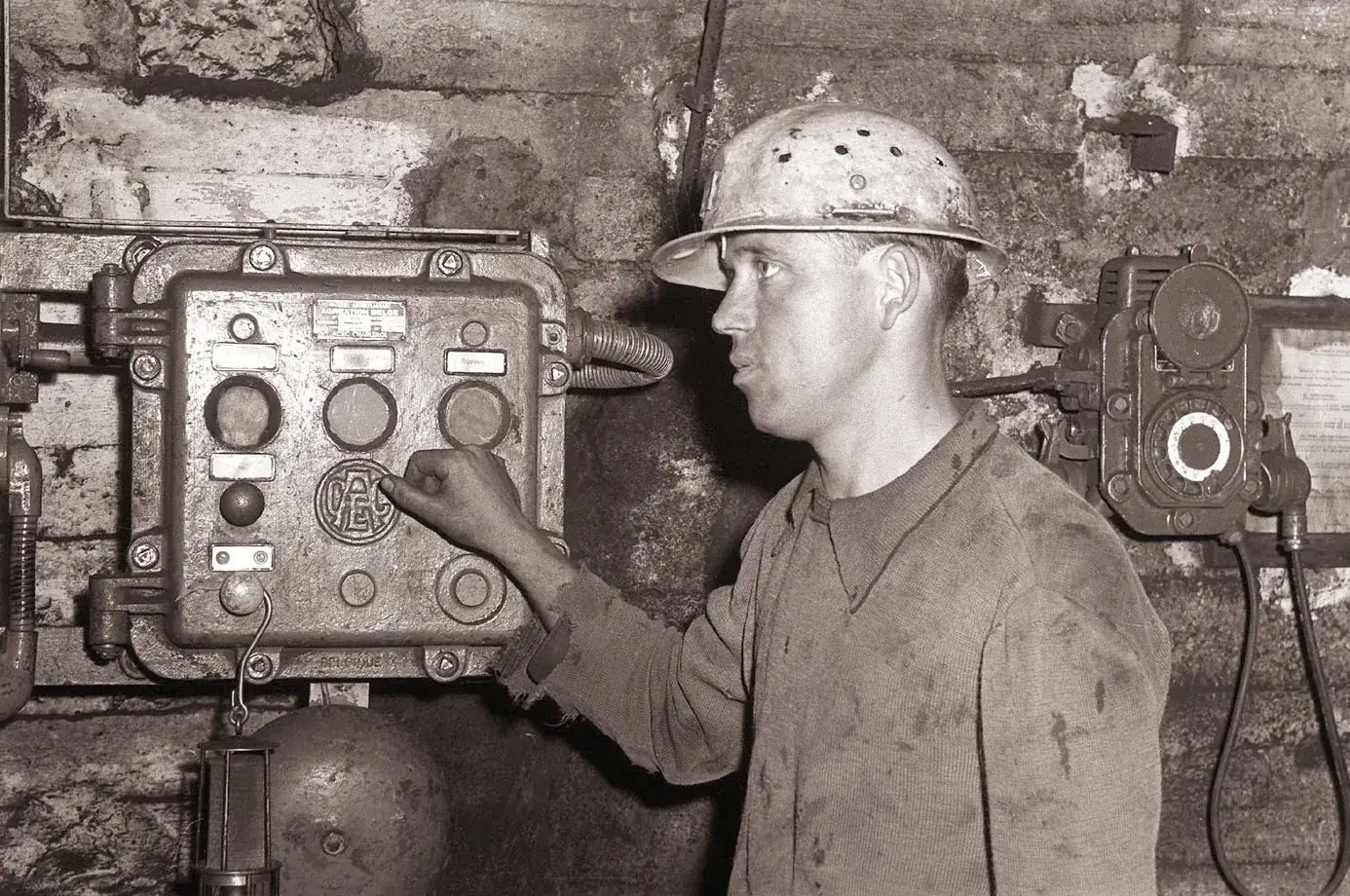
Industrial recruitment is an important part of post-war migration to Slovenia: workers arrived at the Jesenice ironworks, the Velenje coal mine and the industrial towns of the Zasavje valley. Albanian migration also followed a distinctive small-business route. Research published since 2019 has documented confectioners and ice-cream makers whose seasonal networks are easily missed by an account centred on large factories.
This confectioner migration was often private and seasonal — a kurbet or pečalba tradition traced to the period around the First World War. Its village networks help explain one strand of the community's history; they do not establish a single origin or occupation for every Albanian family in Slovenia.
Two villages between Tetovo and Gostivar
Mladen Zobec's research traces a dense network of Albanian confectioners to villages in the Polog basin of north-western North Macedonia, between Tetovo and Gostivar. Two names recur: Pirok and Dobri Dol. In the 2021 settlement census Pirok had 3,963 residents, including 3,695 recorded as Albanian and none recorded as Macedonian; Dobri Dol had 3,546 residents, including 3,401 Albanian and two Macedonian declarations. Residents with no recorded ethnicity are included in the totals.
Our aggregation of the official settlement data gives Polog an Albanian share of 68.91%, against 24.30% of North Macedonia's resident population nationally. This is a derived regional figure. It explains why the sending region matters, but does not tell us the ethnic composition of all North Macedonian citizens in Slovenia.
“Oriental confectioners”: a licence category of their own
Zobec's archival research describes a separate administrative licence category, orijentalski slaščičar, or oriental confectioner, used from the pre-war period into the 1950s. His analysis shows how sanitary and cultural judgements shaped the treatment of these businesses. This is an attributed historical finding, rather than a claim that every permit refusal had the same motive.
A local heritage account of Slaščičarna Berzo in Vrhnika gives the pattern a family history. Berzat Aliriza, born in 1910 near Tetovo, trained as a confectioner in Ljubljana in 1928 and settled in Vrhnika in 1932. The account describes the shop passing through later generations. One family's experience makes the migration tangible without standing in for the whole community.
Zobec distinguishes the older confectioner networks from the expansion of Albanian bakeries in recent decades, and traces the spread of burek through Macedonian Albanian craftsmen.
Summary of Mladen Zobec's research, discussed in Delo, 6 March 2023; not a verbatim quotation
A smaller presence in the industrial towns
The census settles the industrial question. In 1991, Jesenice — the ironworks town, the classic destination of Yugoslav labour migration — had a population of 22,548 that included 3,271 people declaring themselves Muslimani, 1,665 Serbs, 700 Croats, 435 Macedonians, and 52 Albanians. Velenje, the mining town, had 103 against 2,178 Muslimani.
The contrast shows that Albanians were a much smaller group in these industrial towns than several other Yugoslav communities. It does not show that industrial employment played no role: Jesenice's Albanian share was actually above the national share in that census, and individual Albanian family histories include work in Slovenian ironworks. The responsible conclusion is that factories were one channel alongside commerce and family networks, with different importance for different groups. The absence of an Albanian society in the Jesenice administrative register is not evidence that no Albanians settled there.
| Community | people | Share |
|---|---|---|
| Slovenci | 14,953 | 66.32% |
| Muslimani | 3,271 | 14.51% |
| Srbi | 1,665 | 7.38% |
| Hrvati | 700 | 3.10% |
| Makedonci | 435 | 1.93% |
| Črnogorci | 87 | 0.39% |
| Albanci | 52 | 0.23% |
Source: SURS, Popis 1991 (0556502S). Municipality Jesenice, 22,548.
1991: internal migrants become foreigners
Because these were seasonal men who kept a household in Polog, the censuses undercounted them structurally — the family stayed, the residence stayed, and the count followed the residence.
Then in 1991 the ground moved. People who had spent decades as internal migrants inside one country woke up as foreigners in another. Some of them were about to lose their legal existence entirely.
- 1918→ · Seasonal confectioners and ice-cream makers begin arriving from the Polog villages of Pirok and Dobri Dol.
- 1928 · Berzat Aliriza trains as a confectioner in Ljubljana; he settles in Vrhnika four years later.
- 1948 · The first post-war census records 216 Albanians in Slovenia.
- 1960s · The Islamic Community records a large arrival of Albanian Muslims from Macedonia and Kosovo at the end of the decade.
- 1976 · The Islamic Community in Slovenia is entered in the state register of religious communities.
- 1981 · After the Kosovo protests, Berishaj records that the Albanian students' club no longer existed and a new club was not permitted. The earlier club had published Besa.
- 1989 · The Migjeni cultural society is founded in Ljubljana, days after the Cankarjev dom rally for Kosovo.
- 1991 · Independence changes the legal framework for internal Yugoslav migrants; the census records 3,629 Albanian declarations in the as-published series.
- 1992 · On 26 February permanent-residence registrations are deleted. The ministry's later recount identifies 25,671 people affected.
- 1999 · The Constitutional Court rules the erasure unconstitutional.
- 2002 · The last census to ask about nationality: 6,186 Albanians, 7,177 Albanian mother tongue.
- 2008 · Slovenia recognises Kosovo on 5 March; Kosovo gets its own code in Slovenian statistics.
- 2012 · The Grand Chamber of the European Court of Human Rights decides Kurić and Others v. Slovenia.
- 2020 · The Ljubljana mosque opens to worshippers on 7 February, fifty-one years after it was first proposed.
- 2024 · Slovenia's first statute on the cultural rights of the former-Yugoslav communities enters force.
The Erased, 26 February 1992
On 26 February 1992, municipal offices removed people from Slovenia's register of permanent residents without individual notice or a hearing. The ministry's later recount, reported as at 24 January 2009, identified 25,671 people affected. They had been lawful residents; many had lived in Slovenia for years. They became known as the izbrisani — the Erased.
This belongs on a page about Albanians in Slovenia for a specific reason, and not a rhetorical one: it is a large part of why this community's paper trail looks the way it does. People who lost their status lost their documents, their work, their pensions and in many cases their ability to be counted at all.
How the erasure worked
The mechanism was two statutes meeting. The Citizenship Act, in force from 25 June 1991, gave citizens of other Yugoslav republics six months to apply for Slovenian citizenship; that window closed on 25 December 1991. Under the Aliens Act, its provisions became applicable to them two months after the deadline expired — that is, by 26 February 1992.
On that date the deletions were carried out administratively. Nobody was told.
The provisions of the Aliens Act became applicable to the former SFRY citizens either two months after the expiry of the time-limit (that is, by 26 February 1992), or two months after a decision issued in administrative proceedings rejecting their application.
Kurić and Others v. Slovenia [GC], no. 26828/06, 26 June 2012
The Constitutional Court, then Strasbourg
The Constitutional Court ruled on it twice. In decision U-I-284/94 of 4 February 1999 it found the erasure unconstitutional. In U-I-246/02 of 3 April 2003 it went further, ordering the interior ministry to issue supplementary decisions restoring permanent residence retroactively, running from 26 February 1992.
Strasbourg followed. In application no. 26828/06 a Chamber of the European Court of Human Rights found violations in July 2010; the Grand Chamber decided the case on 26 June 2012, finding breaches of the right to private and family life, the right to an effective remedy and the prohibition of discrimination. It was a pilot judgment: Slovenia was ordered to set up a domestic compensation scheme within a year, and six applicants were awarded 20,000 euros each. A further judgment on 12 March 2014 set pecuniary awards ranging from 29,400 to 72,770 euros.
What was paid
The 2013 compensation act established an administrative award of 50 euros for each completed month of erasure. Its original cap on judicial damages was subsequently removed: the Constitutional Court ruled on the restriction in March 2018, and the amendment took effect on 30 December 2018. The government's current explanation distinguishes full damages established in court from interest, which is limited to the principal. The historical administrative figures, dated the end of 2017, were 8,161 claims received, 8,012 decided and 5,784 granted; they are not a current total.
The figure of 25,671 is itself worth handling carefully. It is not a 1992 count: it is the result of an internal ministry recount on an upgraded system, reported as at 24 January 2009. An earlier official figure of 18,305, from 2002, is the same event counted less completely — roughly 2,400 of those had been refused citizenship.
Who was erased — and what is not known
Of the 25,671, the ministry published two breakdowns and only two: 14,775 men and 10,896 women, and an age distribution in which 5,360 were children. By January 2009, 7,899 had acquired Slovenian citizenship, 3,630 had a residence permit, and 13,426 still had no regulated status and could not be located.
Those three categories add up to 24,955, not 25,671. The missing 716 are people who died without regularising: 1,302 of the erased had died by 2009, of whom 586 were among the naturalised. The arithmetic closes, but the three published figures are not a complete breakdown, and they are often presented as though they were.
No ethnic breakdown appears in the ministry statistics or the judgments used here. These sources cannot tell us how many of the Erased were Albanian, and we do not estimate a share.
| Status in January 2009 | people | Share |
|---|---|---|
| Had acquired Slovenian citizenship | 7,899 | 30.8% |
| Had acquired a residence permit | 3,630 | 14.1% |
| No regulated status, whereabouts unknown | 13,426 | 52.3% |
| Died without regularising | 716 | 2.8% |
| Total | 25,671 | 100.0% |

Constitutional recognition and cultural rights
Slovenia's constitution provides special arrangements for the Italian and Hungarian national communities and for Roma. Albanians do not have the same constitutional status, but this does not mean they have no rights or are absent from later legislation.
Article 64, and who is not in it
Article 64 grants collective rights — schooling, media, guaranteed seats in the National Assembly — to the autochthonous Italian and Hungarian communities. Article 65 provides for the Roma. Everyone else, Albanians included, falls under Article 61: an individual right for each person to express their national belonging and cultivate their culture, language and script.
The distinction concerns the kind of protection: the Italian and Hungarian communities have constitutionally specified collective arrangements, while Albanian cultural rights are supported through general rights and later legislation. Representatives of six former-Yugoslav communities jointly requested recognition as national minorities on 14 October 2003. The Council of Europe's 2022 opinion records that the requested recognition had not been granted.
In 2011 the National Assembly adopted a declaration naming the six communities, acknowledging that their collective rights were not specially regulated in the constitution and committing to a framework of support. A government council followed that year. These developments did not confer the constitutional status held by the Italian and Hungarian communities.
The first statute, 2024
A dedicated statute was adopted on 23 May 2024. It assigns responsibilities for cultural projects and for mother-tongue and culture teaching, requires a register of representative organisations, and places the government council on a statutory footing with twelve members, six representing the communities. The council's published membership lists Alma Bejtullahu as the Albanian representative.
The act establishes duties and support arrangements, but its text alone does not demonstrate that a particular school now offers Albanian or that every earlier access problem has been solved. Whether classes run still needs to be checked locally. Constitutional status, statutory cultural rights and the practical availability of teaching are related but distinct questions.
The money gives the sharpest measure of where the community sits. In 2021 Slovenia's public tenders approved 3,100 euros for Albanian cultural projects — the lowest of the seven minority communities listed, against 21,362 for Bosniak, 22,122 for Croatian and 56,644 for Serbian. The culture ministry's first call under the new law made 200,000 euros available for all six communities together, rising to 250,000 for 2026.
| Community | Amount |
|---|---|
| Albanian | €3,100 |
| Montenegrin | €8,358 |
| Macedonian | €13,582 |
| Bosniak | €21,362 |
| Croatian | €22,122 |
| German | €32,108 |
| Serbian | €56,644 |
Language and faith
The Council of Europe's 2022 opinion found no teaching in or of Albanian as a minority language within the mainstream system. A documented route is supplementary mother-tongue and culture teaching for children with migrant backgrounds. Under the 2023/24 invitation, a host school received 45 euros per pupil for premises and materials, with teaching arranged separately. Albanian is among eleven languages the scheme had supported since its beginnings in 1993. This describes the cited programme and period, not an exhaustive statement about every present-day educational opportunity.
Albanian in Slovenian schools
What that means in practice is documented for one city. In Celje, supplementary Albanian teaching repeatedly failed to happen — not for want of pupils, parents or teachers, but because no school would host it.
When the national ethnic-studies institute surveyed parents about the scheme in 2025, the responses were dominated by the Serbian community, which supplied 74.3% of 222 valid answers. The Albanian language group returned none at all.
The mosque that took fifty years
The Islamic Community in Slovenia was entered in the state register in 1976. Its own account is that most Slovenian Muslims are of Bosniak origin, and that a large number of Albanian Muslims from Macedonia and Kosovo arrived at the end of the 1960s. Research published in 2025 notes that Albanian representatives are absent from its structures.
The 2002 census recorded 47,488 people of Islamic faith in Slovenia, 2.4% of the population. That is a figure for all Muslims, overwhelmingly Bosniak, and no cross-tabulation of religion by nationality was ever published — so it cannot be used to say anything about Albanians specifically.
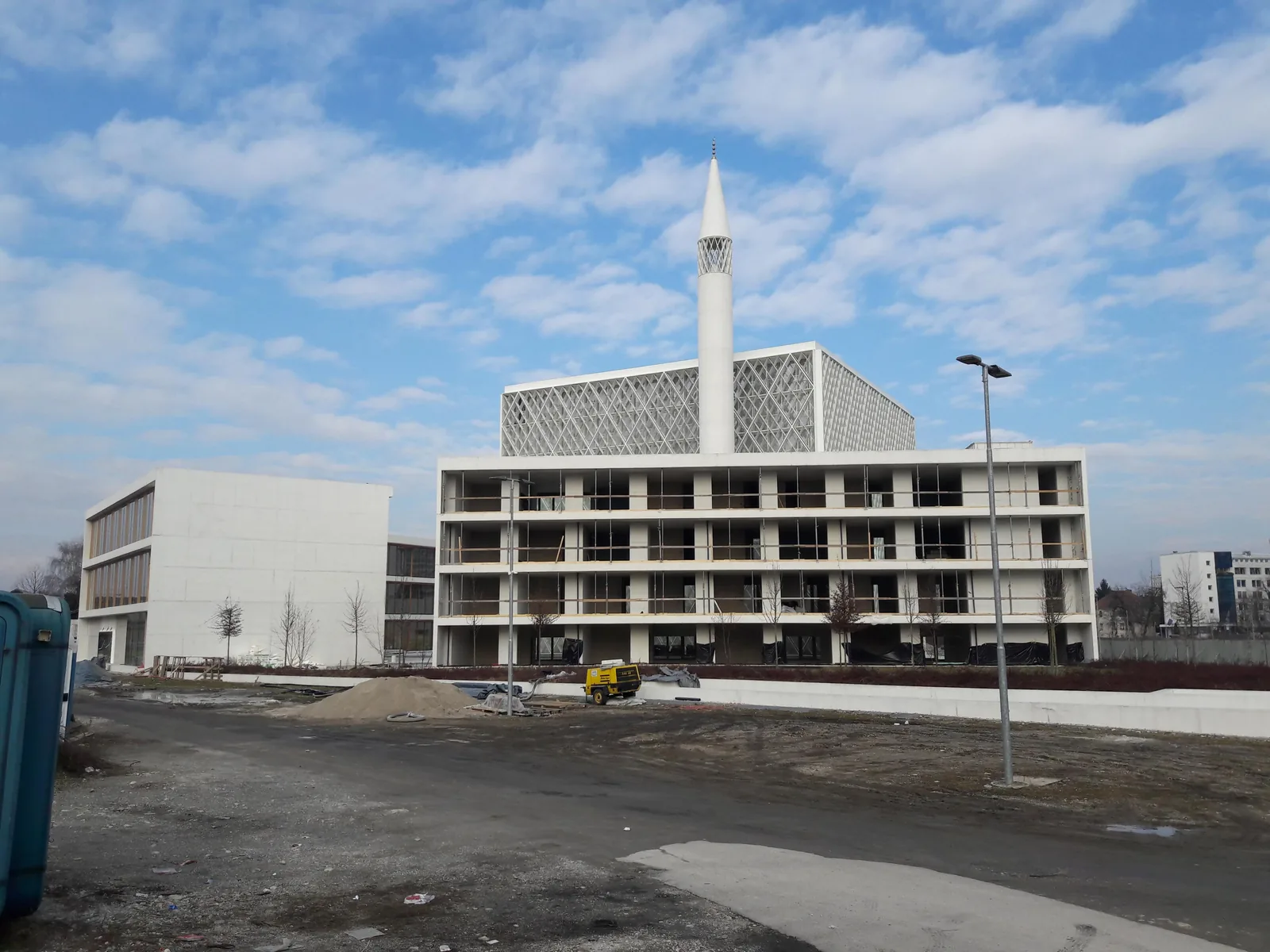
Ljubljana's mosque took decades of organising. The first initiative dates to 1969; the land was bought from the city in 2008 and the design chosen in 2011. The Islamic Community dates construction from 2014, while some reporting uses 2015. Doors opened to worshippers on 7 February 2020. Reporting put the total investment above 35 million euros, including 25.8 million from Qatar. The photograph here is explicitly dated to the construction period, not the finished building.
Albanian Catholics in Slovenia have no resident structure of their own. Mass is said in Albanian twice a year, in Kranj and Velenje, by priests who travel from the Albanian Catholic Mission in Zagreb.
Work, permits and the shape of the migration
At 31 August 2026, citizens of Kosovo held 39,656 valid residence permits in Slovenia, citizens of North Macedonia 21,950, and citizens of Albania 616 — 62,222 together, a quarter of all 245,235 third-country permits in the country. Kosovo was the second-largest third-country group after Bosnia.
Those are documents, not people, and they must never be added to the resident register. But their shape says something the headcounts do not.

A settled population, not a guest-worker flow
About two thirds of the Kosovo permits are permanent rather than temporary. During the months of 2026 covered by the source, temporary permits fell while permanent permits rose. That is consistent with longer-term settlement and some changes of status, but these aggregate stocks cannot measure how many individual people converted permits or rule out simultaneous arrivals and departures.
The inflow is unusually family-shaped, too. Of the first temporary permits issued to Kosovo citizens in 2024, 47.5% were for family reunification against 48.3% for employment. The comparable family share was 24.5% for Bosnia, 13.9% for Serbia and 2.0% for India.
Slovenia has bilateral employment agreements with only two countries, Bosnia and Serbia. There is none with Kosovo or North Macedonia, whose citizens use the ordinary single permit with a labour-market test. And the EU's visa liberalisation for Kosovo on 1 January 2024 changed nothing here — it is a short-stay exemption for biometric passport holders and confers no right to live or work. First permits to Kosovo citizens actually fell afterwards, from 6,492 in 2023 to 4,062 in 2024 and 3,733 in 2025.
Net migration of Kosovo citizens was −390 in 2025, the first negative year in the published series. This is not the same as a fall in the Albanian-origin population: births, deaths, other citizenship groups and changes of citizenship all matter. Eurostat records 1,119 Kosovo and 3,944 North Macedonian citizens acquiring Slovenian citizenship in 2013–2024 and 2002–2024 respectively. Naturalisation removes a person from a foreign-citizenship stock without removing them from the community.
Two registers also disagree at nearly the same reference date. The interior ministry counted 39,368 valid Kosovo residence permits on 31 December 2024; SURS counted 29,905 resident Kosovo citizens on 1 January 2025, a difference of 9,463. The sources use different definitions of documents and usual residence. We found no published reconciliation assigning that difference to particular causes, so it is not added to the model or presented as proof of an undercount.
| Year | Kosovo citizens | North Macedonia citizens | Albania citizens |
|---|---|---|---|
| 2016 | 16,580 | 12,039 | 104 |
| 2018 | 21,930 | 14,491 | 134 |
| 2023 | 40,236 | 18,980 | 441 |
| 2024 | 39,368 | 20,055 | 461 |
| 2025 | 39,291 | 21,288 | 508 |
| 2026-08 | 39,656 | 21,950 | 616 |
Source: MNZ RS, veljavna dovoljenja za prebivanje.

Burek, and where it actually came from
In his Delo interview, Zobec distinguishes the long confectioner tradition from the later spread of Albanian bakeries, especially after 1991. He traces many of the later bakers to Has in Kosovo rather than to the Polog villages associated with confectionery. That is an attributed account of networks and trades, not an occupational description of every Albanian migrant.
The same research traces an important route for burek into Slovenia through Macedonian Albanian craftsmen. Food histories often cross several regions and communities; the point is to recover that documented contribution without treating a dish as the exclusive property of one people.
Associations and community life
Slovenia's business register lists eight societies whose name contains “Alban”: the Migjeni cultural society and the union of Albanian societies, both at Celovška cesta 177 in Ljubljana; Iliria in Koper; Forum Ilirida in Ljubljana; Lirija in Velenje; Besa in Celje; the Teuta women's society; and the Ymer Elshani writers' society.
That is a name filter, and it is worth saying so — an Albanian-run society without “Alban” in its title is invisible to it.
Eight names in the register
Migjeni is the oldest. It was founded in Ljubljana in 1989, days after the Cankarjev dom rally at which Slovenian intellectuals and politicians first publicly denounced the treatment of Kosovo's Albanians, and it has published the journal Alternativa ever since.
Three separate counts of the community's organisations disagree with each other: eight in the Slovenian register, six on Albania's diaspora agency list, six in a 2025 academic footnote. Two of the diaspora agency's six have no counterpart in the Slovenian register at all. This page gives the register list and notes the disagreement rather than picking a winner.
Nothing in Albanian
The broadcasting arrangements described in the cited sources provide regular minority-language services in Italian, Hungarian and Romani, but no equivalent Albanian-language service. NaGlas!, the programme about former-Yugoslav communities, has run since February 2015 in Slovenian. This does not mean Albanian voices or music never appear on public television.
The culture ministry's examples of supported minority print media list Bosnian, Croatian and German titles. They do not establish that every Albanian-language publication is wholly privately financed. Community publishing, including Migjeni's Alternativa, remains an important part of the record.
People
The sourced profiles below show two visible strands of Albanian life in Slovenia: athletes moving through Slovenian clubs and national teams, and people building cultural, scholarly and linguistic connections. This is a selected list, not a claim to rank the community's influence or to prove that other fields lack notable figures.
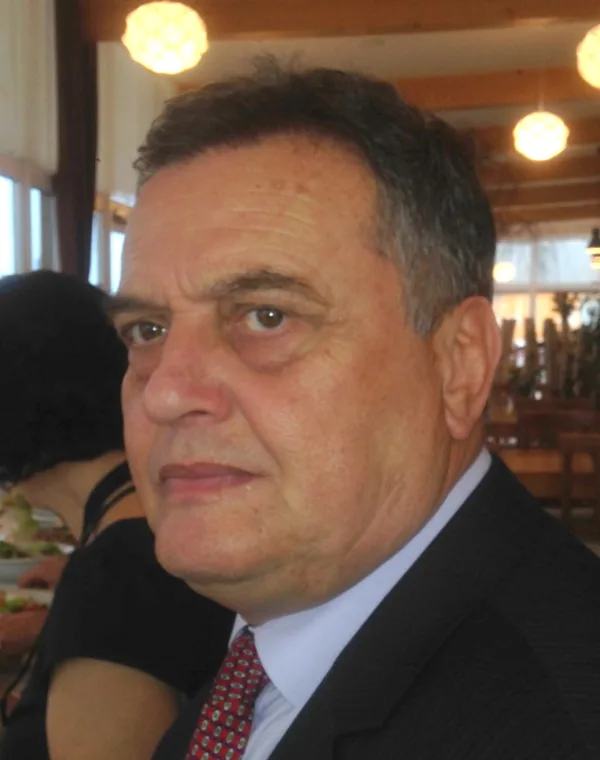
- Albin Tahiri — Alpine skier, born in Slovenj Gradec to a Kosovo Albanian father who came to Slovenia in 1973 and worked at the Ravne ironworks; he swapped his Slovenian racing licence for a Kosovar one in 2009, became Kosovo's first Winter Olympian and carried its flag at Pyeongchang 2018 and Beijing 2022, while working as a dentist. Sportklub
- Nikollë Berishaj — Poet and translator, born in Tuz in Montenegro in 1958, taught mathematics and physics at a Ljubljana primary school from 1981 to 1986 and compiled the first Albanian–Slovene and Slovene–Albanian dictionary, published in 1989. Novi slovenski biografski leksikon
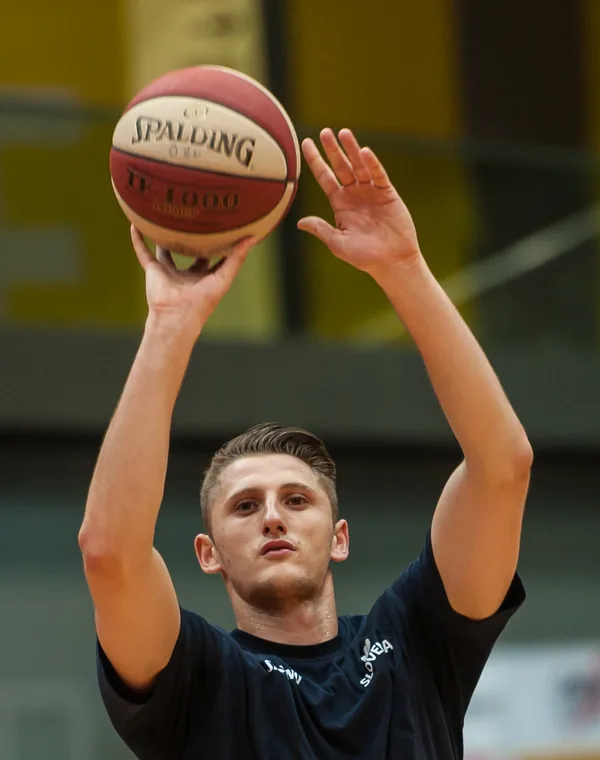
- Gëzim Morina — Basketball player, spotted at a tournament in Skopje at thirteen and brought to Olimpija Ljubljana in 2008; FIBA ruled in 2012 that he could play for Slovenia as a Slovenian rather than a naturalised player, and he did, before later switching to Kosovo. RTV Slovenija
- Martin Berishaj — Political scientist who came from Podgorica to Ljubljana at seventeen, wrote his doctorate on Albanian customary law, edited the Migjeni journal Alternativa for years, and was serving as Kosovo's ambassador to Croatia by March 2025. RTV Slovenija
- Alma Bejtullahu — Ethnomusicologist and singer, schooled in Prishtina and educated at the University of Ljubljana, whose 2024 monograph examines music and dance among women with migrant backgrounds in Slovenia. Založba ZRC
- Armenda Amiti — Lawyer from Gradec near Gostivar who taught herself the task and self-published the first Slovene–Albanian legal dictionary in October 2016 — 57,343 entries over 369 pages, four years' work, from Ruše. RTV Slovenija
- Arman Durmiši — Footballer born and raised in Koper, who moved from NK Koper to Juventus at sixteen in 2024 and chose Albania over Slovenia at international level that November. Planet Nogomet
- Agim Ibraimi — Footballer from Tetovo, described by Delo as a Macedonian player of Albanian roots; he joined Olimpija in 2008 and left his biggest mark at Maribor before ending his Slovenian career at Domžale in 2018. Delo
- Dino Murtezani — Multi-instrumentalist from Pirok near Tetovo — one of the two Polog villages the confectioner migration came from — who made his home in Slovenia in the late 1980s and performs Albanian repertoire in Ljubljana. RTV Slovenija
- Agostino Bruti — Bishop of Koper from 1733 to 1747, of Albanian descent; his family had moved to Koper in the sixteenth century, and the city's central library is housed in their palace to this day. RTV Slovenija
Trained in Slovenia, capped by Kosovo
The pattern in sport is consistent enough to be a phenomenon. Slovenia's youth systems develop players of Albanian origin who then, at the point of senior selection, choose Kosovo or Albania. Altin Kryeziu was born in Kranj, played for Slovenia at cadet level and then for Kosovo's under-21s. Arman Durmiši was born in Koper, went through Slovenia's youth teams and declared for Albania. Gëzim Morina actually played for Slovenia in EuroBasket qualifying before switching.
The other pattern is quieter and more remarkable: two of the most substantial pieces of Albanian-language infrastructure anywhere — the first Albanian–Slovene dictionary and the first Slovene–Albanian legal dictionary — were made in Slovenia, by two people, largely unpaid.
Slovenia, Kosovo and Albania
Slovenia recognised Kosovo on 5 March 2008, the twenty-fifth state to do so, while holding the rotating presidency of the EU Council. It has an embassy in Pristina; Kosovo has one in Ljubljana. Relations with Albania are older: the agreement establishing them was signed in Ljubljana on 10 March 1992 and entered into force the same day.
Slovenian troops have been in Kosovo since January 2000, and in February 2007 the Slovenian Armed Forces fielded a battalion-sized unit with its own area of responsibility for the first time in their history. In December 2025 Slovenia had 109 personnel in KFOR.
Trade runs almost entirely one way. In 2025 Slovenia exported 217.6 million euros of goods to Kosovo and imported 4.3 million — a ratio of about fifty to one. With Albania the figures were 94.7 million and 19.6 million; with North Macedonia, 263.9 million and 178.0 million.
And then there is football. Slovenia and Kosovo were drawn together in qualifying for the 2026 World Cup. They drew 0:0 in Pristina in October 2025, and on 15 November 2025 Kosovo won 2:0 at Stožice in front of 15,382 people, eliminating Slovenia. The Slovenian federation afterwards published a statement explaining why so many Kosovo and Albania flags were in the home sections, citing diaspora arriving from Austria, Germany and Italy and the legal impossibility of screening ticket buyers by nationality. It was, by some distance, the most visible the community has ever been in Slovenian public life.
The community today
Two ideas from recent research describe this community better than any statistic. The first is that it is, in the words of a 2025 study, a hidden heritage — hidden partly by Slovene indifference, and partly on purpose, by Albanians who have concluded that visibility costs more than it returns.
N1's long report in January 2026, built around Albanian women's experiences, also describes onward migration to Germany, Austria and Switzerland. The negative 2025 net-migration figure for Kosovo citizens is compatible with that reporting, but it does not identify where every emigrant went or establish the direction of movement for all Albanians.
Neither the interviews nor one citizenship group's migration balance settles whether the community as a whole is growing. Births add people, deaths remove them, and migration can run in both directions. Naturalisation and permanent-residence conversion change status rather than headcount. Later statistics for all former-Yugoslav foreign citizens are broader than the Albanian community and cannot resolve its size.
It is worth being careful with the research on attitudes, too. The most-cited study of Slovene opinion toward Albanians, based in Celje, reports strikingly hostile numbers — but it is an online convenience sample of 176 people gathered through social media in August 2020, not a representative survey, and it should never be quoted as what Slovenes think.
For families spread across Kranj, Ljubljana, Velenje, Celje, Maribor and the coast, cultural societies, personal networks and language activities are important meeting places. Their coverage and resources vary, and meeting someone who shares an Albanian language or family background may still take an effort beyond the immediate neighbourhood.
That is the gap dua was built for. It is an app for Albanians to meet Albanians, wherever they happen to live, and Slovenia is exactly the kind of place where that matters: close enough to Kosovo and North Macedonia that families keep the connection, dispersed enough that the community rarely gathers in one room.
Directory
| Place | Organisation | Note |
|---|---|---|
| Ljubljana | Kulturno društvo Albancev Migjeni | Founded 1989; publishes the journal Alternativa |
| Ljubljana | Zveza albanskih društev v Sloveniji | Umbrella body; listed in Albania's diaspora-organisation directory |
| Koper | Iliria — Albanian society of Slovenian Istria | Community centre documented by RTV Slovenija; linked report is historical |
| Velenje | Lirija | Listed in the public business-register extract; search the registered name |
| Celje | Besa | Listed in the public business-register extract; search the registered name |
| Ljubljana | Islamska skupnost v Republiki Sloveniji | Registered 1976; the Ljubljana mosque opened 2020 |
| Ljubljana | Embassy of the Republic of Kosovo | Official diplomatic directory; verify contact details before visiting |
| Ljubljana | Government Office for National Minorities | Handles the former-Yugoslav communities |
Albanians around the world — the full country hub
Frequently asked questions
How many Albanians live in Slovenia?
The last ethnicity census was in 2002, when 6,186 people declared Albanian ethnicity. Our model using citizenship stocks on a 1 January 2025 base gives a central scenario around 38,000 and an outward-rounded scenario range of 35,000–45,000 residents of Albanian origin. This is an illustrative reconstruction, not an official figure or confidence interval. The ethnic shares are assumptions, and unmeasured cohort differences and omitted descendants can put the actual number outside the range.
Why doesn't Slovenia just publish the number?
The 2002 census was the last to collect ethnic affiliation. Since 2011 the census has used administrative registers without ethnicity, mother-tongue or religion variables. The Council of Europe's 2022 opinion recorded no planned survey to collect ethnic data at that time; this does not rule out future policy changes.
Is it true that 30,000 Albanians live in Slovenia?
That figure is 29,905 citizens of Kosovo, resident on 1 January 2025. It is a citizenship count, not an ethnicity count: it excludes Albanians holding North Macedonian, Albanian, Slovenian or other passports, while including Kosovo citizens with other ethnic identities. Media wording cannot turn a passport register into an ethnic census.
Where in Slovenia do Albanians live?
The checked official tables do not provide a current municipal ethnic-Albanian map. Useful historical signals are the 2002 mother-tongue figures — Ljubljana 1,239, Maribor 918, Kranj 374 and Celje 325 — and first-country-of-residence data by region in 2021. Savinja and Upper Carniola then had more Kosovo-first-residence residents than Central Slovenia. These measures and dates must remain explicit.
When did Albanians first come to Slovenia?
Research traces seasonal confectioners and ice-cream makers from the Polog basin to the period around the First World War. Later arrivals also involved employment, study and families. The industrial towns held smaller Albanian communities than some other Yugoslav groups, but industrial work was not absent from Albanian family histories.
Are Albanians a recognised minority in Slovenia?
Albanians do not have the special constitutional status accorded to the Italian and Hungarian communities or the constitutional provision for Roma. They have general rights and statutory cultural protections. Six former-Yugoslav communities jointly requested recognition in 2003; the Council of Europe's cited review records that this had not been granted. A dedicated cultural-rights statute was adopted in 2024.
What were the Erased, and were Albanians among them?
On 26 February 1992 Slovenia removed lawful residents who were citizens of other Yugoslav republics from its permanent-residence register. A ministry recount reported in 2009 identified 25,671 people affected. The Constitutional Court found the treatment unconstitutional, and the European Court of Human Rights found violations in Kurić and Others v. Slovenia in 2012. Albanians were among those affected, but the official sources reviewed do not give an ethnic breakdown.
Is Albanian taught in Slovenian schools?
The cited monitoring report found no Albanian minority-language teaching in the mainstream system. One documented route is supplementary mother-tongue teaching for children with migrant backgrounds: the 2023/24 programme offered host schools 45 euros per pupil for premises and materials. Research describes hosting barriers in Celje. Current classes and access need to be checked locally.