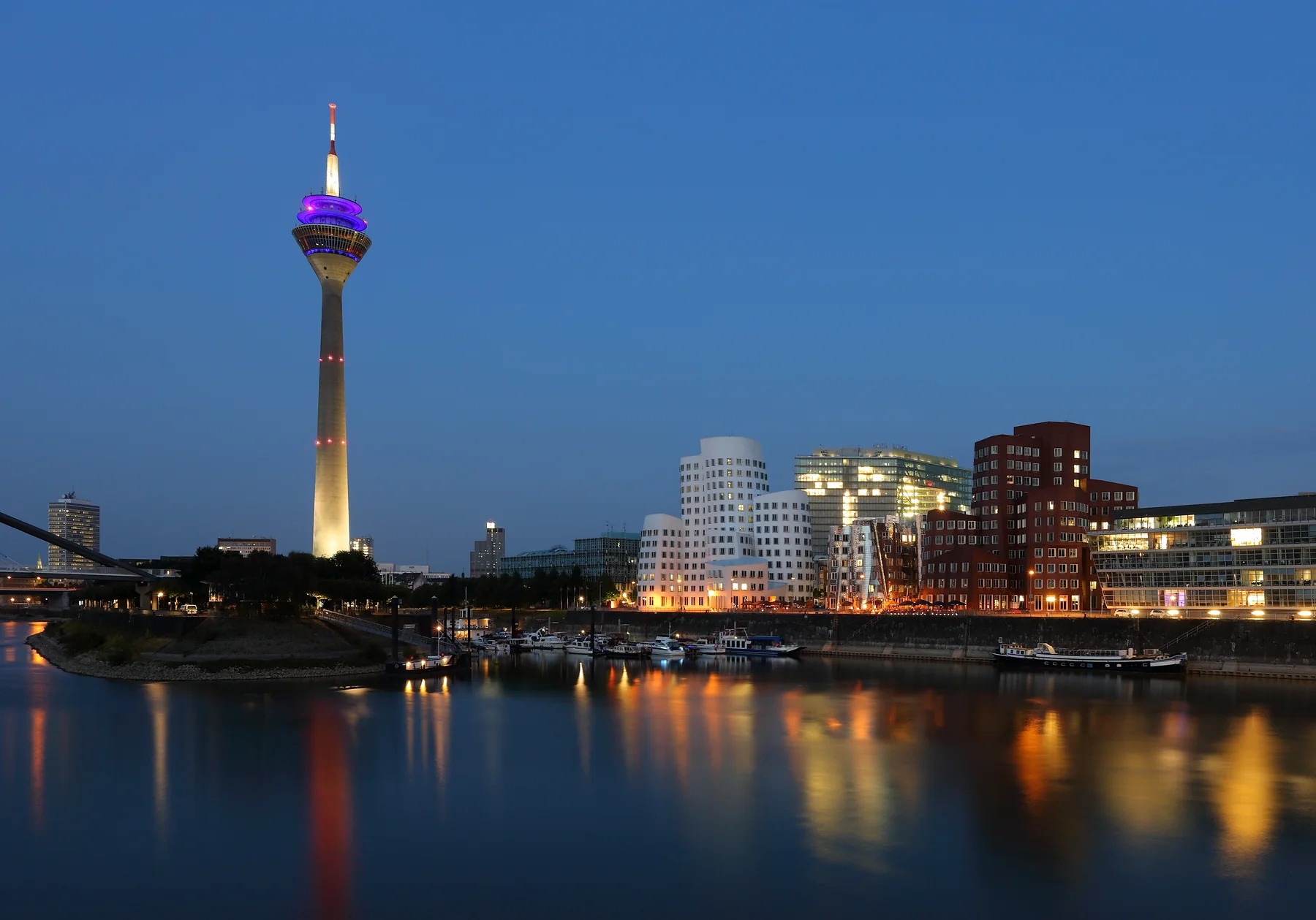
Albanians in Düsseldorf are part of a community whose daily life reaches well beyond one city. Its story runs from language classrooms and theatre stages to the Rhine waterfront — and, today, to more than 3,000 local users on dua.com. This guide follows the people and places that make Düsseldorf home, and the ways to meet new Albanians, build a connection and find someone to share that life with.
On 24 June 2024, a red procession moved through Düsseldorf. Almost 10,000 Albanian supporters left Rheinpark on foot, followed Cecilienallee and headed toward the stadium in Stockum. The city’s account of the evening describes singing, dancing and celebrations that were peaceful overall. For a few hours, a community usually encountered in smaller settings became impossible to miss.
That crowd was an international football audience. The everyday community remained after the match: parents looking for Albanian lessons, people building careers, and families whose friendships cross municipal boundaries. To understand Albanian Düsseldorf, it helps to hold both pictures together: the extraordinary day on the riverbank, and the ordinary places people return to.
Meet Albanians in Düsseldorf on dua.com
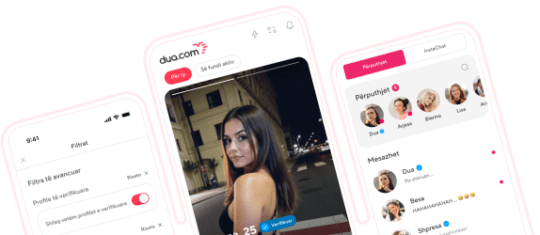
More than 3,000 users in Düsseldorf are already on dua.com. The community is here; the next step is finding the people you have yet to meet. dua.com gives Albanians in the city a way to connect beyond their usual circle, start a conversation and discover someone who shares their language, culture and hopes for the future.
Perhaps you have just moved here and want to meet Albanians nearby. Perhaps Düsseldorf has always been home, but the right person is still outside your everyday circle. Shared roots can give a first conversation a familiar starting point, while getting to know someone reveals what else you have in common.
If you are looking for a serious relationship — or hoping to find your soulmate — dua.com brings that possibility into everyday life. A first message can become a coffee, a walk by the Rhine and a reason to meet again. For Fidani and Samira, that is how their Düsseldorf story began: they matched on dua.com, then took a 14-kilometre walk from the MedienHafen along the Rhine.
How many Albanians live in Düsseldorf?
Düsseldorf’s population register counted 1,919 Albanian citizens and 2,539 Kosovan citizens in 2024. It also recorded 4,124 citizens of North Macedonia, a country with an Albanian population alongside other ethnic communities. These are city figures for people with their main residence in Düsseldorf, taken from the municipal nationality dataset.
The distinction matters as soon as someone asks how many “Albanians” live here. They may mean citizens of Albania, Albanian speakers, or people with Albanian family roots in Albania, Kosovo, North Macedonia and elsewhere. Those questions require different evidence. A German citizen whose parents came from Kosovo may identify strongly as Albanian without appearing in a foreign-nationality count.
| Citizenship recorded | Residents | What the figure describes |
|---|---|---|
| Albania | 1,919 | Residents counted under Albanian citizenship |
| Kosovo | 2,539 | Residents counted under Kosovan citizenship |
| North Macedonia | 4,124 | Residents of several ethnic backgrounds |

The people a passport table cannot identify
The register is useful because its boundary and date are clear. Its limit is equally clear: citizenship does not tell us a resident’s language or ethnicity. People who share Albanian roots can have different passports; people who share a passport can have different roots. That is why this guide does not turn the three rows into an ethnic total or label their sum a minimum.
This also changes how we read a personal story. A child born and raised in Düsseldorf, a recent arrival from Tirana, and an older family with roots in Tetovo can all belong to Albanian community life. They need not appear under the same heading in a statistical publication. Institutions, language and people help fill out the picture; they cannot be used to manufacture a missing census.

What has changed since 2020?
The city’s recent series shows a particularly clear change in the Albanian-citizenship category: from 1,007 residents in 2020 to 1,919 in 2024, an increase of about 91 percent. The Kosovan-citizenship figure rose from 2,078 to 2,539 over the same period, about 22 percent. These are changes in registered populations over four years, not counts of new arrivals.

The practical consequence is that established family networks and newcomers can be part of the same local community. A parent who has lived here for decades and someone learning their way around the city this year may need different introductions. A useful community guide should make room for both: history for understanding how people arrived, and clear local contacts for finding a way in now.
Where does Albanian Düsseldorf come together?
Rath, Gerresheim, Eller and Oberbilk offer documented starting points for community life. The evidence here is the location of schools and associations, not a residential ranking. Düsseldorf’s Albanian heritage-language directory lists teaching locations in the first three districts. Dituria identifies itself with Rath, while the Islamic-Albanian umbrella organisation’s NRW directory lists the Düsseldorf cultural centre in Oberbilk.
These places suggest a city with several points of connection. A family may travel to a class outside its own neighbourhood. A religious centre may serve people from across Düsseldorf. A concert brings together an audience for one evening. Looking for a single “Albanian quarter” can obscure that everyday movement.

One city in a larger network
Düsseldorf sits inside North Rhine-Westphalia, usually shortened to NRW. Duisburg, Cologne and Neuss are separate cities. A Düsseldorf event can draw people from all of them, while a Düsseldorf resident may have relatives, work or community commitments somewhere else in the region. A consulate’s catchment area can be broader still.

This is more than a geographical footnote. When Samira and Fidan began meeting here, she lived in Duisburg and worked in Düsseldorf; he travelled from the Cologne area. Their shared place was the MedienHafen, where they took their first walk together. A city can be central to someone’s life without being the address entered on their registration form. Their full story on dua.com makes that regional connection personal.
How did the community take root?
The wider German history helps explain why Albanian family stories have different starting points. West Germany’s recruitment agreement with Yugoslavia in 1968 opened a labour-migration route from a state that included Kosovo and today’s North Macedonia. In the records of that era, “Yugoslav” was a citizenship category; it did not identify who was Albanian. The Federal Agency for Civic Education’s migration history also describes the importance of family reunification after the recruitment stop of 1973.
Those national milestones provide context, rather than an exact arrival date for Düsseldorf’s first Albanian residents. The movement from temporary work to family life changed what people needed from their new city. A job and a place to sleep could become a school place, a language class and an organisation that would still be there the following year.

In 1999, the consequences of the Kosovo war reached local support services. The Psychosoziales Zentrum Düsseldorf’s account of that year describes cooperation with a treatment centre in Cologne to provide stabilisation groups and therapy for Kosovo refugees in reception centres. For years afterwards, Kosovars remained its largest client group. The connection between the two cities was, in this case, a way to organise care.
Later biographies brought other experiences. Artist Leunora Salihu’s path from Prishtina to the Düsseldorf art world belongs to the history of displacement and study as well as professional achievement. The institutions described in this guide have their own timelines: the Rath congregation opened as a branch in 2008 and became independent in 2020. Over time, a connection maintained by individuals also acquires classrooms, organisations and public recognition.
Keeping Albanian in the next generation
Düsseldorf lists Albanian heritage-language teaching at three schools: Ferdinand-Heye-Schule, GHS Rather Kreuzweg and Dieter-Forte-Gesamtschule. The city’s official HSU directory is the best starting point for parents because it names a subject contact as well as the locations.
| School | District | Address |
|---|---|---|
| Ferdinand-Heye-Schule | Gerresheim | Heyestraße 91 |
| GHS Rather Kreuzweg | Rath | Rather Kreuzweg 21 |
| Dieter-Forte-Gesamtschule | Eller | Heidelberger Straße 75 |
Source: Landeshauptstadt Düsseldorf: Albanian teaching locations and advice, checked in September 2026. Ask the listed contact about registration, class level and the current timetable; the directory is not a promise of a place in a particular class.
Thirty-six pupils, and the work of bringing families together
The school story reaches back much further than the current directory. In a 2020 interview with Dielli, teacher Rifat Hamiti recalled that Düsseldorf’s Albanian supplementary school began in 1985 with Pal Përgjokaj. When Hamiti started teaching in October 1989, he found 36 pupils. After a school year of working with parents, he remembered the number reaching 120.
These are a teacher’s recollections of his school, rather than a citywide enrolment series. Their force lies in the work they describe: parents had to be contacted, children brought in, and a class made into a lasting commitment. The language did not preserve itself. People gave it a place in the week.

A language carried through family conversation and a language learned on the page ask different things of a child. Knowing how to speak to a grandparent does not automatically mean being comfortable reading a story or writing a letter. A regular class offers a place to work on those skills, and a reason to use Albanian outside a visit home.
For parents, the useful first question is practical: what teaching is appropriate for this child, at this stage? Families bring different dialects, fluency and schooling experiences. That variety is part of the task. The three school locations give the conversation a concrete starting point, whether the family has recently arrived or the child has always lived in Germany.
A city story with children in it
The city’s statistical publication for EURO 2024 offers another perspective, using an Albania-related migration-background category rather than the later citizenship table. Its age profile includes 516 children under 18 out of 2,035 people in that category: just over a quarter. The graphic below keeps the publication’s categories visible.

The children in that table are one reason a community’s future is also a question about everyday infrastructure. Who teaches the language? Where can parents find advice? Which local places can a young person enter on their own terms? A public directory of classes can be as valuable to a family as a large celebration, because it connects an inherited language with the next school week.
Faith, community and a place called “knowledge”
Dituria e. V. is an Albanian Muslim congregation in Düsseldorf-Rath. Its own history dates the mosque’s opening to 2008, as a branch of the Islamisch-Albanisches Kulturzentrum Düsseldorf in Oberbilk. It became independent in 2020 under the name Dituria, Albanian for “knowledge”. The association describes prayer, education and community as parts of its purpose.
That short institutional history has a human scale: a branch opened, people sustained it, and eventually it became an organisation in its own right. A recurring place of worship also offers continuity for people whose working and family lives may be spread across the city. The Oberbilk centre and the Rath congregation are distinct institutions; check the relevant organisation before visiting.
Faith is one route into Albanian Düsseldorf. It does not define the whole community. Religious observance varies, and cultural belonging can be expressed through language, music, friendships or family without taking part in a congregation. The school directory and the cultural venues in this guide provide other starting points.
Leunora Salihu: a Düsseldorf story in sculpture
Leunora Salihu connects Prishtina with Düsseldorf’s contemporary art world. Sammlung Philara’s presentation of her 2020 exhibition, Shifting Entities identifies her as a Prishtina-born artist who lives and works in Düsseldorf. The city’s visual-arts prize register lists her as a 2012 recipient. Her presence here is recorded in the work and institutions of the city itself.
Philara describes a practice involving materials such as clay, wood and metal, with forms that bring movement and tension into apparently solid objects. That is a useful way to encounter her work: through what it asks the viewer to notice. An artist with roots in Kosovo can contribute to Düsseldorf’s cultural life without every sculpture having to explain migration.
Her gallery biography gives that connection a longer history. Salihu fled to Germany in 1999 and continued her studies first in Kiel, then at the Kunstakademie Düsseldorf. A life interrupted by war became a career in sculpture. Looking at the work alongside that biography gives the reader both a specific person and a place in the city’s cultural history.
From Albanian rock to a city-centre stage
Albanian culture in Düsseldorf also appears in the city’s established venues. Capitol Theater’s archive for Elita 5’s Deutschland tour lists a concert on 1 October 2025. The venue introduces the band as having formed in Tetovo, North Macedonia, in 1990, and identifies Albanian Sundowner as the organiser. This is a past concert listing, rather than an upcoming date.
The example adds something a nationality chart cannot convey. A band from Tetovo can sing to an Albanian audience in a German theatre; the cultural connection passes across several state borders without losing its meaning. The audience does not need one shared place of birth to recognise a song.
A different setting brought music into public community life in February 2026. An account published by Albania’s honorary consul in NRW documents Kosovo’s independence-anniversary reception in Düsseldorf and a performance by Rona Nishliu. That was a consular event, with its own invitation context. It should not be treated as a standing public concert series.
For new events, follow the venue or organiser’s current programme. An old poster can tell a story about a community’s cultural life; it cannot tell you where to be next Saturday. The enduring point is the range: rock music, contemporary sculpture, national celebrations and smaller educational settings all belong in the picture.
The evening the Rhine turned red
EURO 2024 gave Düsseldorf a particularly visible Albanian moment. The city counted 46,586 spectators at the Albania–Spain match on 24 June, while the procession of almost 10,000 Albanian supporters made its way from Rheinpark toward Stockum. Spain won 1–0. The city’s report the following day recorded a positive overall assessment from the public-order and fire services.
A tournament temporarily changes the scale of belonging. People who usually meet in separate family circles can find themselves among thousands wearing the same colours. Visitors and residents share a street, and the city becomes the stage for a memory carried elsewhere afterwards.
The distinction between those visitors and residents brings us back to the opening question. The crowd demonstrated the reach of Albanian connection across Europe. The classrooms and institutions show its continuity in Düsseldorf. Both are real parts of the story; only one is about who lives inside the municipal boundary.
Why Düsseldorf matters beyond the city boundary
Kosovo’s Consulate General in Düsseldorf serves North Rhine-Westphalia. The German Federal Foreign Office’s directory lists it at Bilker Straße 29. The NRW gazette records that its work began on 25 November 2019. The city became a point of contact for a much wider regional community.
For someone arranging consular business, that regional role is practical: check the current official instructions for the service you need before travelling. Kosovo’s consulate and Albania’s honorary consular representation are different institutions. A shared Albanian language does not make their responsibilities interchangeable.
This is also a useful way to read Düsseldorf’s place on a community map. The city can have significance for people who are not its residents. A trip for documents, an evening of music and a visit to family create different connections with the same place. None changes the boundary of the municipal population figures at the start of this guide.
Fourteen kilometres beside the Rhine
There is a quieter Düsseldorf story in dua.com’s own archive. Fidani and Samira met on dua.com before their first date in the MedienHafen on 11 January 2021. She brought coffee in a thermos, and their first date became a 14-kilometre walk along the Rhine. She lived in Duisburg and worked here; he came from the Cologne area. They later married in Monheim am Rhein in July 2023.
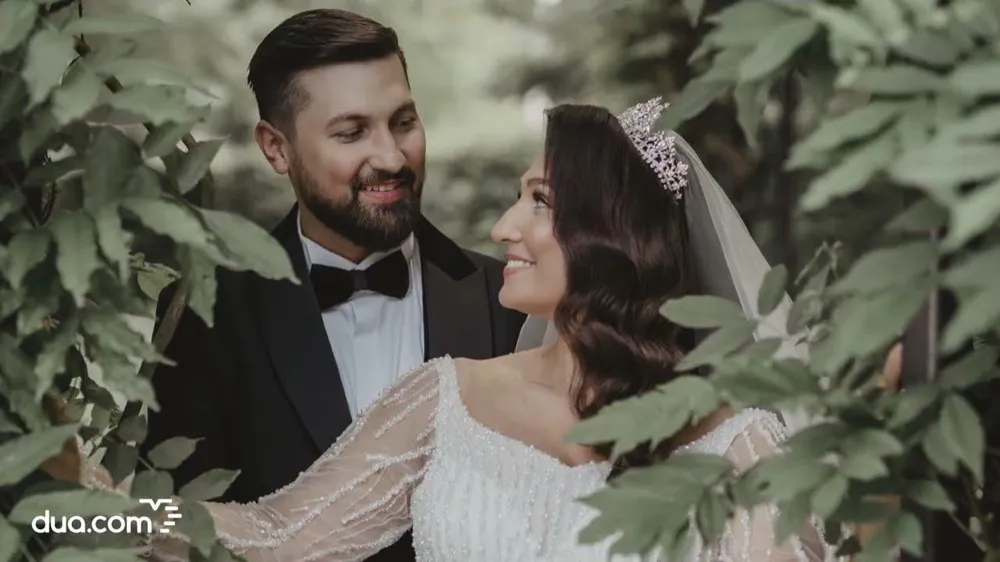
“At home we’re Albanian, at work German, and with each other we’re both.”
Fidan, in Fidani and Samira’s dua.com interview
Their account is one couple’s experience, not a formula for everyone. Its local meaning is simple: their lives crossed city boundaries, and Düsseldorf gave them a place to meet. The riverbank in this guide’s opening held thousands of supporters; on another evening, a stretch of the same river was enough for two people to begin a life together.
Finding your own place in the community
The best starting point depends on the connection you want. For a child’s language learning, begin with the municipal HSU contact. For religious community, contact a congregation. For art and music, follow public venue programmes. A newcomer does not need to know everyone, or attend everything, to start building a circle.
For meeting new Albanians and finding love, join more than 3,000 Düsseldorf users on dua.com. Your next connection could be close to home, or in the next city along the Rhine. Whether you are ready for a first conversation or looking for the person you want to build a future with, it starts with meeting someone. Fidani and Samira’s story began with that same possibility.
What makes Albanian Düsseldorf distinctive is the combination of public moments and steady work. There is the red procession to the stadium, but also the teacher preparing a class. There is a concert audience, but also an artist working in a studio. There is the date by the Rhine, followed by the journeys people make to see each other again. Community takes shape when those connections become part of ordinary life.
Useful starting points in Düsseldorf
Sources checked in September 2026. Use the organisation’s own page for current contacts, programmes and visiting arrangements.
- Albanian heritage-language teaching — Düsseldorf school authority: official locations and the subject contact for Rath, Gerresheim and Eller.
- Kosovo’s Consulate General in Düsseldorf: official listing for the NRW consular district, Bilker Straße 29.
- Dituria e. V.: Albanian Muslim congregation in Rath.
- UIAZD’s NRW directory: the Düsseldorf Islamic-Albanian cultural centre and other regional member organisations.
- Sammlung Philara: exhibitions and visitor information; its archive includes Leunora Salihu.
- Capitol Theater Düsseldorf: current programme; the Elita 5 event above belongs to the 2025 archive.
- Albania’s honorary consul in NRW: public institutional news and contact information; distinct from Kosovo’s consular services.
- Düsseldorf’s Municipal Integration Centre: a city starting point for integration information and local support.
- Fidani and Samira’s full story: the Düsseldorf first date and the relationship that followed.
For the national picture, read Albanians in Germany. Compare other city stories in Frankfurt and Zurich, or explore the Albanian community hub.
Frequently asked questions about Albanians in Düsseldorf
How many Albanians live in Düsseldorf?
There is no complete ethnic Albanian count in the city dataset used here. Düsseldorf recorded 1,919 Albanian citizens, 2,539 Kosovan citizens and 4,124 North Macedonian citizens in the 2024 register. Those are separate citizenship categories, not an Albanian population total. German citizens with Albanian family roots can fall outside all three.
Where can I find the Albanian community in Düsseldorf?
The city lists Albanian heritage-language teaching in Rath, Gerresheim and Eller. Albanian Muslim institutions are documented in Rath and Oberbilk. These are useful places to start, not a ranking of where Albanian residents live. Cultural and family connections also extend to Duisburg, Cologne and the wider region.
Where can children learn Albanian in Düsseldorf?
Düsseldorf’s official directory lists Ferdinand-Heye-Schule in Gerresheim, GHS Rather Kreuzweg in Rath and Dieter-Forte-Gesamtschule in Eller for Albanian heritage-language teaching. Use the city’s Albanian HSU page to check the responsible contact and ask about registration, suitable classes and the current timetable before attending.
Is Düsseldorf’s Albanian community the same as the community in NRW?
No. Düsseldorf is one city in North Rhine-Westphalia, abbreviated NRW. Duisburg, Cologne, Neuss and other municipalities have their own residents and institutions. This guide’s nationality figures cover main residences inside Düsseldorf. A regional consulate, a concert audience or a family network can serve people far beyond that boundary.
What happened when Albania played in Düsseldorf at EURO 2024?
On 24 June 2024, Albania played Spain in Düsseldorf. The city reported that almost 10,000 Albanian supporters walked from Rheinpark toward the stadium through Cecilienallee and Stockum, and described the celebrations as peaceful overall. This was a match-day gathering including visitors, not a census of local Albanians.
Are there Albanian cultural events in Düsseldorf?
Yes. Capitol Theater’s archive lists Elita 5’s Albanian rock concert for 1 October 2025, and an official consular account documents a Düsseldorf reception for Kosovo’s independence anniversary in February 2026 featuring Rona Nishliu. These are past examples. Check the venue or organiser for new dates and admission details.
Which artist connects Kosovo and Düsseldorf?
Sculptor Leunora Salihu was born in Prishtina and lives and works in Düsseldorf. Sammlung Philara presented her exhibition Shifting Entities in 2020, and Düsseldorf lists her among the recipients of its 2012 visual-arts encouragement prize. Her work offers a local connection through the city’s contemporary art institutions.
How can I meet Albanians in Düsseldorf?
More than 3,000 users in Düsseldorf are on dua.com. It is a way to meet new Albanians, connect beyond your usual circle and look for a serious relationship or your soulmate. Fidani and Samira met on dua.com before their first date in Düsseldorf’s MedienHafen. Local cultural events and community organisations offer further ways to get involved.