About 27,000 people with Albanian identity or family roots live in Vienna—roughly 1.3% of the city, within a defensible range of 24,900 to 31,600. There is no official ethnic count.
Vienna recorded 28,511 residents with an origin link to Albania, Kosovo or North Macedonia in 2025, but that figure is not the Albanian population: it counts non-Albanians from Kosovo and North Macedonia, and it misses Vienna-born Austrian citizens whose Albanian roots no longer appear in the city’s statistics at all.
You do not need a spreadsheet to know the community is here. You hear Albanian on the U-Bahn and at home. You see it in family businesses, football clubs, classrooms, cafés, cultural associations, mosques and churches. You find families whose stories lead back to Prishtina, Tetovo, Tirana, Presheva or Ulqin—and a younger generation whose answer to “Where are you from?” might simply be: Wien.
For more on this topic, read Albanians in Austria: A 100,000-Strong Community and Albanians in Zurich: Population, History and Community.
That is what makes Vienna different from the broader Albanian story in Austria. The community here grew through Yugoslav-era labour migration, family reunification, displacement during the Kosovo war and newer movement from Albania and across the Balkans.
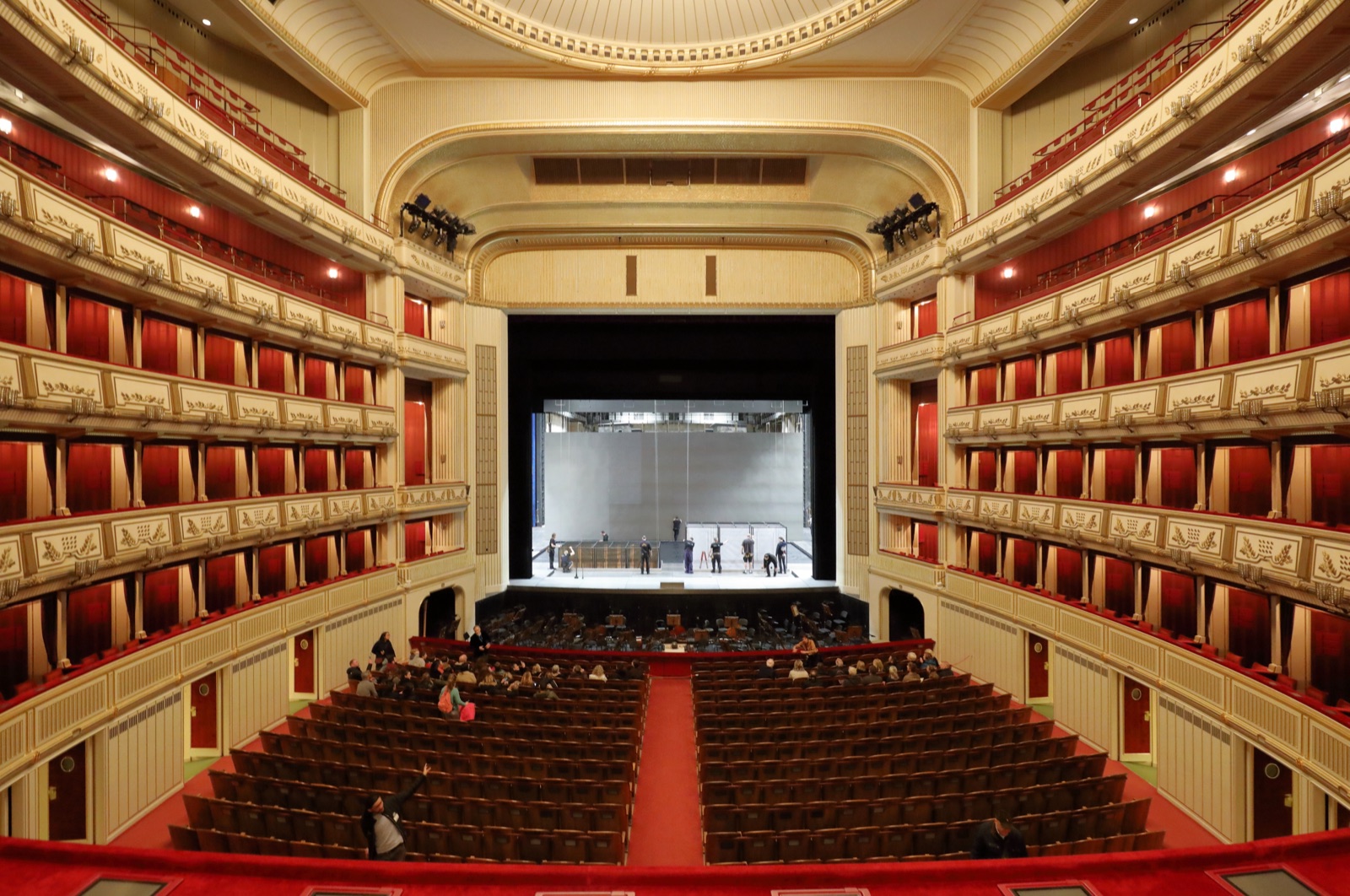
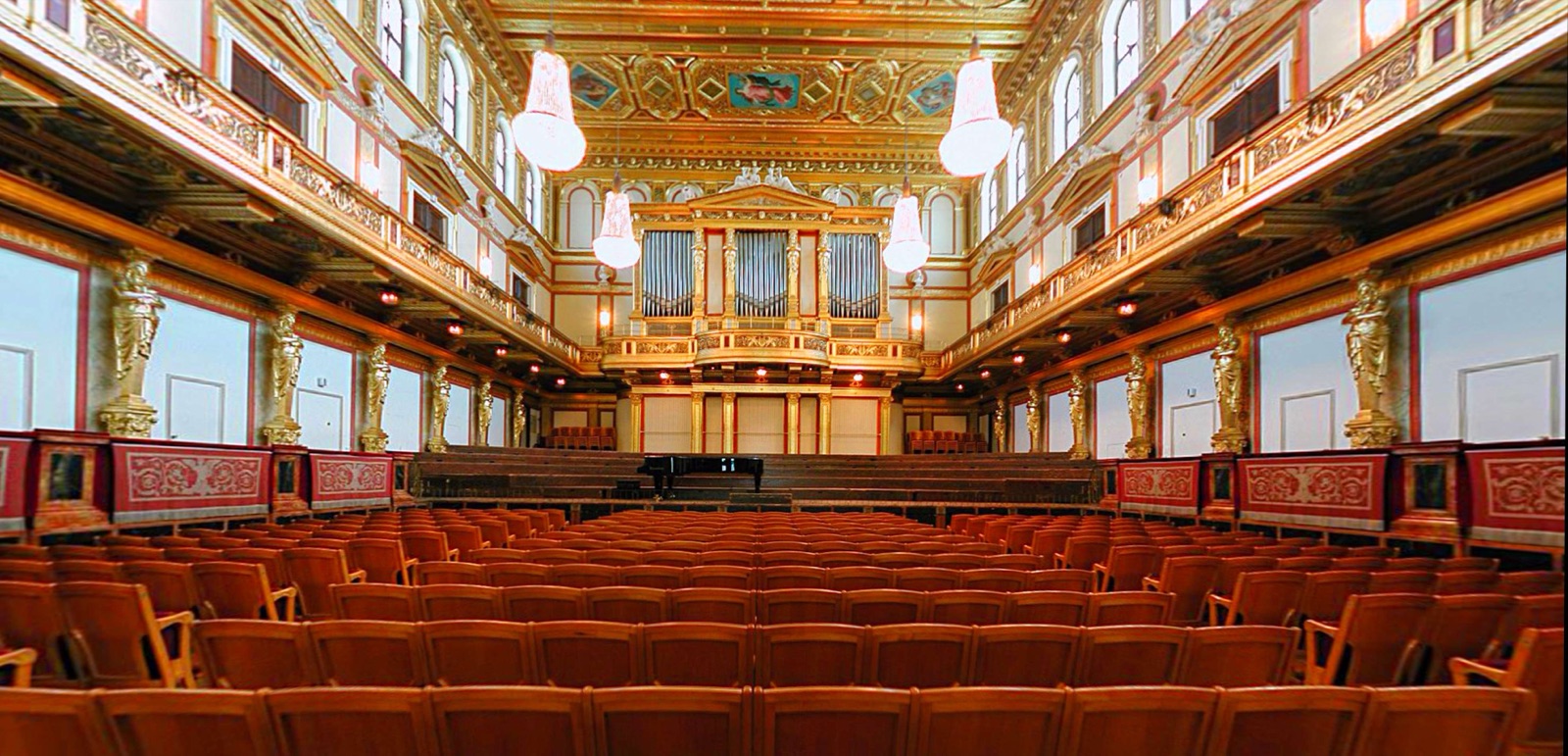
Its institutions run from Ottakring and Rudolfsheim to Meidling and Wieden; its cultural reach runs from first-language classrooms to the Musikverein and the State Opera. Today, Albanian Vienna stretches across districts, generations, dialects and different versions of what it means to belong.
And that is also where dua.com fits naturally into the story. dua was built for a diaspora that has never fitted neatly inside borders: a place built around Albanian identity and language that helps people find one another through shared roots, whether both grew up in Vienna, arrived from opposite sides of the Balkans, or live hundreds of kilometres apart.
It belongs here as diaspora infrastructure—which is exactly why the population evidence on this page stays independent of the product, and why no app metric is used as a population proxy. Vienna may be home to tens of thousands of Albanians. The harder question is how many of them you have actually met. 👀
Evidence and service links last checked: 28 August 2026. Vienna means the city and federal state, not the metropolitan region. The full calculation and claim ledger are retained in the repository research record.
Vienna is big. Your Albanian world does not have to feel small.Discover Albanians around Vienna who already understand the language, culture and little things you should not have to explain.
New to Vienna—or looking for your community? Start here
This is the page's practical front door. Choose the route that matches what you need; every button goes to a city, government or organisation page checked on 28 August 2026. Programmes and opening hours move, so confirm before travelling.
New in the city
Understand work, housing and daily life in Albanian
StartWien runs free orientation modules, including the Albanian-language “Working World in Vienna” route. It is the best first stop before relying on community hearsay.
See StartWien sessions →Parents & pupils
Ask for Albanian first-language teaching
Albanian is one of Vienna's supported first languages. Provision depends on demand, so use the federal guide and ask the child's school where the current course is held.
Open the school guide →Students & young professionals
Meet peers through AYSA Austria
AYSA's Vienna base connects students, graduates and young professionals through education, culture and networking—not only nightlife.
Visit AYSA Austria →Books, language & culture
Use Qendra IKRE as a community room
The Meidling centre combines a library, cultural programme and meeting place at Schönbrunner Straße 175. Check its current programme before visiting.
Explore Qendra IKRE →Faith & pastoral life
Find Albanian Muslim and Catholic services
ALKIG links recognised Albanian Muslim communities; the Archdiocese's Albanian Catholic mission worships in Albanian at Meiselstraße 1.
Compare faith contacts →Business & careers
Enter a diaspora professional network
Rrjeti's Austria branch connects founders and professionals and organises the Albanian Business Fair. Treat its directory as an introduction, then verify firms through WKO.
Open the Austria network →How many Albanians live in Vienna?
The best working answer is about 27,000, within a range of about 24,900 to 31,600. That is not the output of one official table. It is what remains after three different official measures are kept separate, the mixed country rows are adjusted transparently, and the generation missing from all three is treated as a scenario rather than invented precision.
Best evidence-led answer
Geography: Vienna city/state. The metro area and Lower Austria commuters are excluded. Snapshot inputs: 1 January 2025 and 1 January 2026.
Three official answers—and why none is “the Albanian population”
Swipe left to see all columns.
| Measure | Albania | Kosovo | North Macedonia | Total | What disappears |
|---|---|---|---|---|---|
| Current citizenship, 2026 | 2,315 | 7,501 | 11,039 | 20,855 | Naturalised Austrians |
| Country of birth, 2026 | 3,191 | 10,326 | 13,453 | 26,970 | Every Vienna-born generation |
| Stadt Wien “origin”, 2025 | 2,849 | 11,122 | 14,540 | 28,511 | Austrian-born Austrian citizens |
Vienna defines Herkunft as foreign citizenship or Austrian citizenship with a foreign birthplace. It is wider than passport and useful because it includes naturalised first-generation residents. But it still loses a Vienna-born child as soon as that child is Austrian, and it assigns a country, not an ethnicity.
The visible identity-linked base
The origin rows are therefore not added blindly. Albania contributes 2,849. Kosovo's 11,122 is weighted by the 90.79% Albanian share in the 2024 Kosovo census, giving 10,098. North Macedonia's 14,540 is weighted by the 66.36% Albanian share among the nonresident population enumerated in its 2021 census, giving 9,649. The result is 22,596.
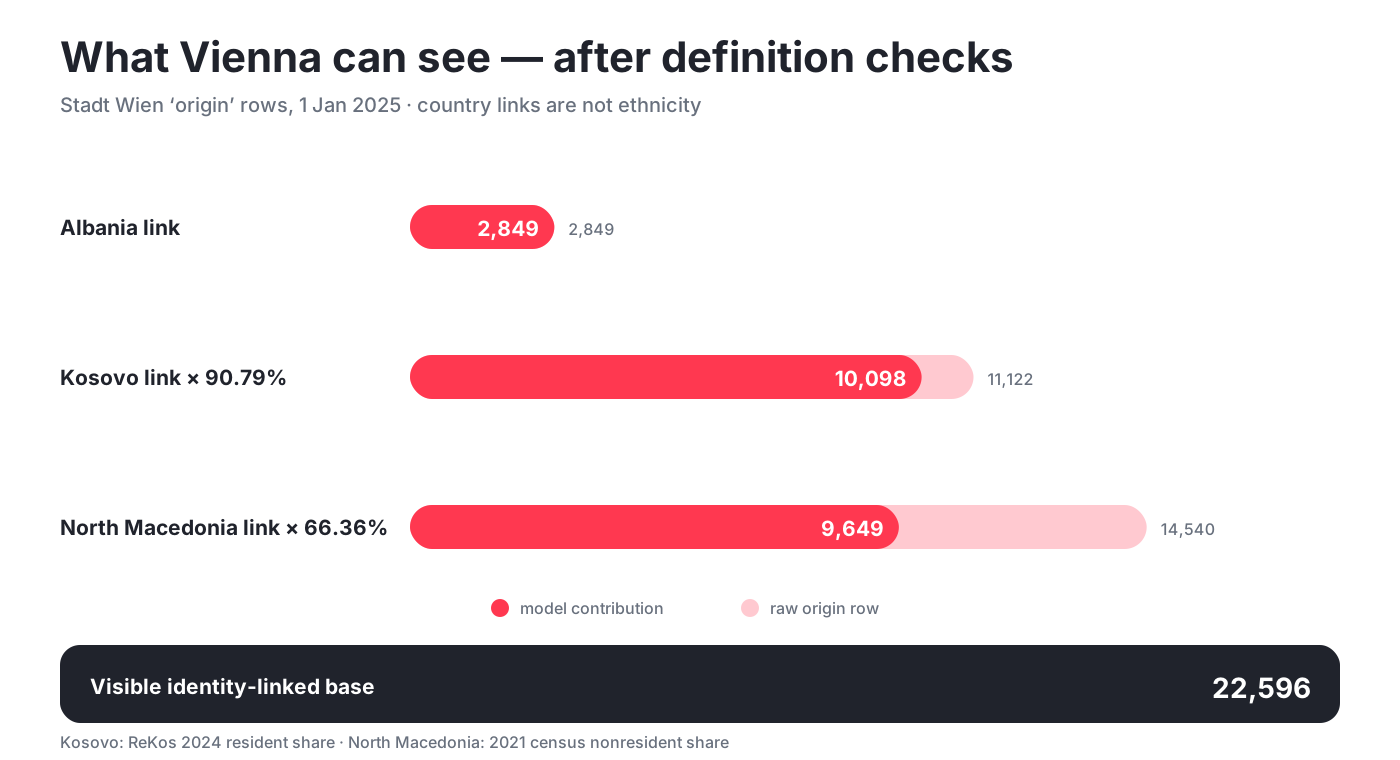
What Vienna can see — after definition checks
Stadt Wien ‘origin’ rows, 1 Jan 2025 · country links are not ethnicity
-
Albania link
- model contribution
- 2,849
- raw origin row
- 2,849
-
Kosovo link × 90.79%
- model contribution
- 10,098
- raw origin row
- 11,122
-
North Macedonia link × 66.36%
- model contribution
- 9,649
- raw origin row
- 14,540
Kosovo: ReKos 2024 resident share · North Macedonia: 2021 census nonresident share
The generation the statistics cannot see
Vienna’s official data gets us surprisingly far—and then it hits a blind spot. The 22,596 base can see foreign citizens and Austrian citizens born abroad. What it cannot see is Austrian citizens born in Vienna to Albanian families. On paper, part of the second generation—and increasingly the third—simply disappears. Disappearing from a dataset is not the same as disappearing from the community.
We know this group is not hypothetical. In the 2001 census, 7,833 people in Vienna reported Albanian as an everyday language, including 619 Austrian citizens who were themselves born in Austria. More than two decades later there is no equivalent current register row that tells us how large Vienna’s locally born Albanian population has become.
This is also where the story goes beyond statistics. Someone can be born in Favoriten, hold an Austrian passport and speak German all day—and still grow up with Albanian at home, Albanian family traditions and a strong connection to Prishtina, Tetovo, Tirana, Ulqin or the Preševo Valley. Statistics struggle to capture that kind of identity. Real life does not.
That is why we do not simply add 20% to an official number and call it Vienna’s Albanian population. Rather than turning the gap into a fake count, the model applies three visible assumptions to the definition-adjusted base: a 10% hidden-generation allowance produces 24,855; 20% produces 27,115; 40% produces 31,634.
Rounded, that is the 24,900 / 27,100 / 31,600 range, and the reason the working answer is stated as “about 27,000” rather than as a precise headcount. It is an evidence-informed range, not an official ethnic count.
Because when the statistics stop seeing a generation, the generation does not stop being Albanian.
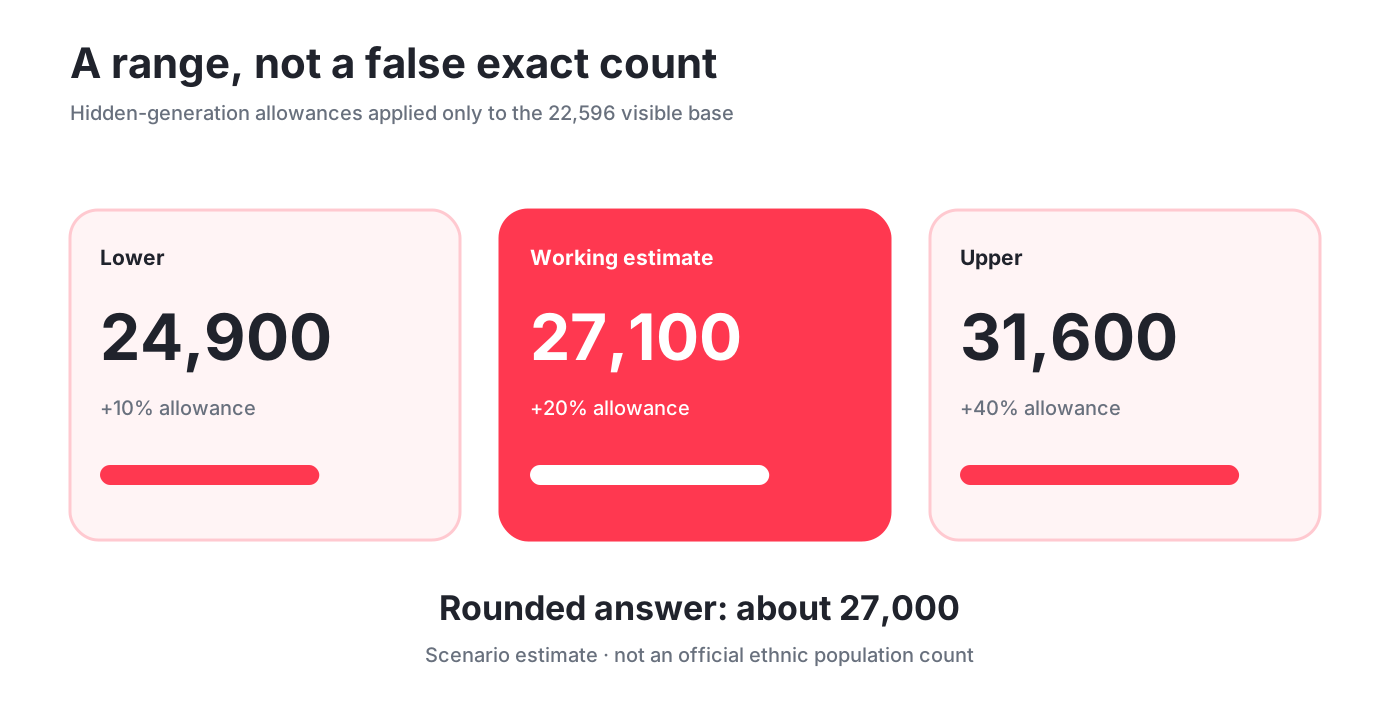
A range, not a false exact count
Hidden-generation allowances applied only to the 22,596 visible base
Lower
24,900+10% allowanceWorking estimate
27,100+20% allowanceUpper
31,600+40% allowance
Rounded answer: about 27,000
Scenario estimate · not an official ethnic population count
Did the stakeholder's 20% hypothesis hold?
Conditionally, yes—but only against the 22,596 adjusted base. Multiplying the raw official headlines fails. Passports × 1.2 gives 25,026, already below the birthplace total. Birthplace × 1.2 gives 32,364 while treating every North-Macedonia-born resident as Albanian. Origin × 1.2 gives 34,213 and repeats the same error. The central 27,100 is 20% above a definition-adjusted base, 30% above the three-passport total, and almost level with the unweighted three-country birthplace total.
Born in Vienna? Just arrived? Somewhere in between?On dua, your connection to the community does not need a statistical category.
Where is the Albanian community in Vienna?
The honest answer is that Vienna publishes no current Albanian-identity table by district. Official district files can show total foreign citizenship, broad birthplace groupings and general migration patterns, but not a defensible Albania–Kosovo–North Macedonia identity count. Claims that one district is “the most Albanian” are therefore not established.
What can be mapped is community infrastructure. The practical arc runs west and south of the centre: the Albanian Muslim association and AYSA in the 16th, the Catholic mission in the 15th, Qendra IKRE in the 12th, and both Albanian and Kosovar diplomatic services in the 4th. These are service points, not proof of where their users sleep.
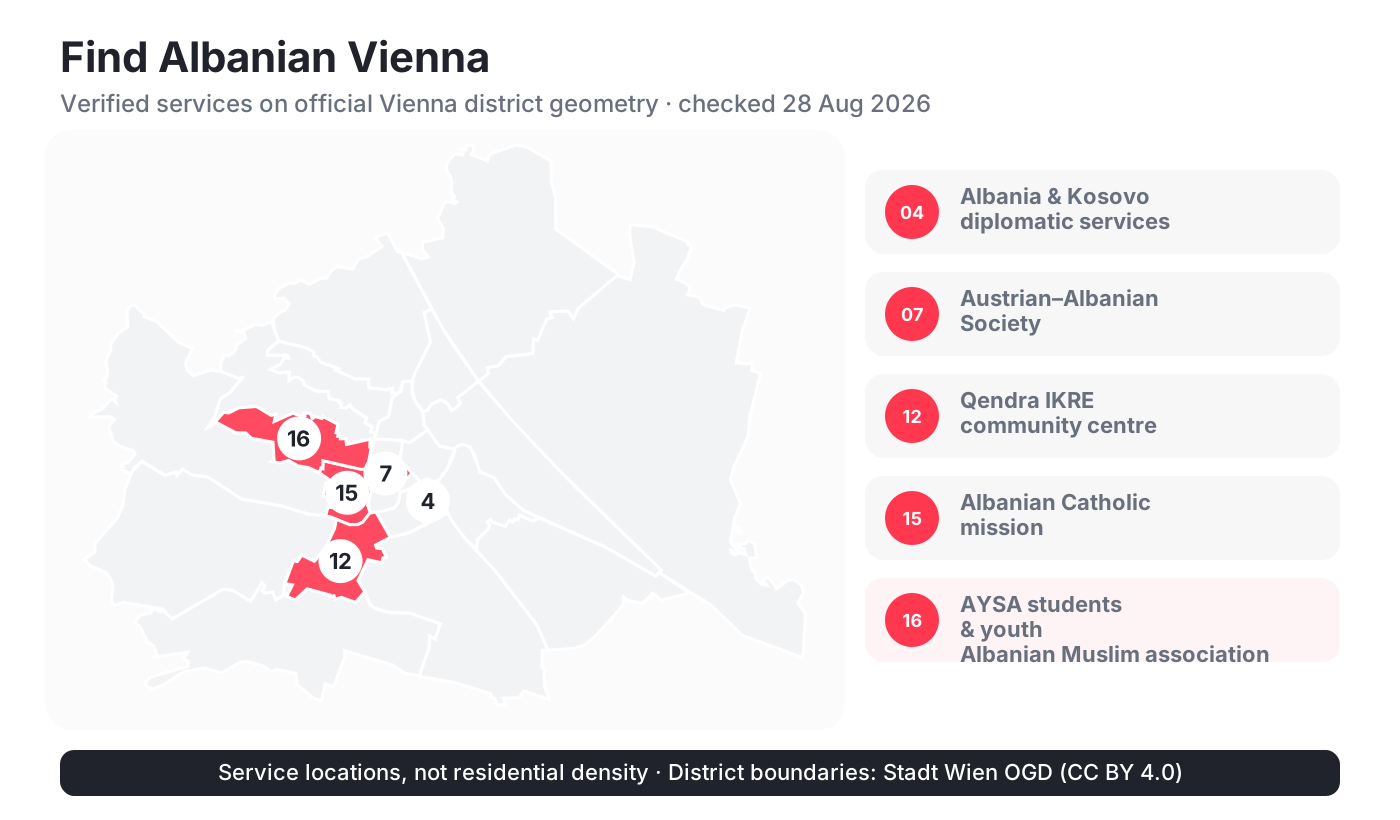
Find Albanian Vienna
Verified services on official Vienna district geometry · checked 28 Aug 2026
- district04Albania & Kosovo diplomatic services
- district07Austrian–Albanian Society
- district12Qendra IKRE community centre
- district15Albanian Catholic mission
- district16Albanian Muslim association
- district16AYSA students & youth
Service locations, not residential density · District boundaries: Stadt Wien OGD (CC BY 4.0)
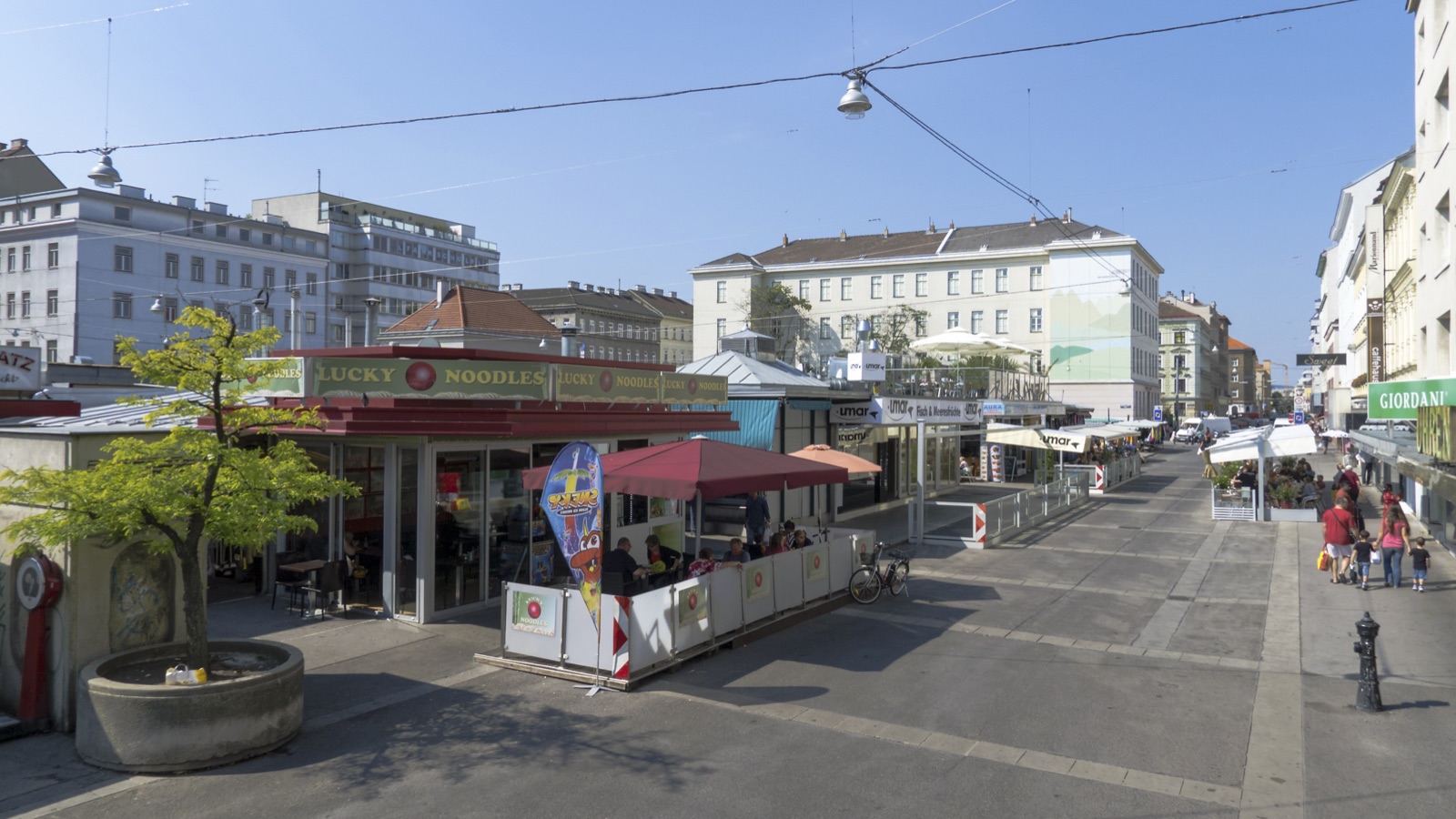
Favoriten
Vienna's largest district is a practical Balkan meeting ground through markets, transport, food and everyday commerce. It is appropriate neighbourhood context, not an Albanian population ranking.
Photo: Peter Gugerell / Wikimedia Commons · CC0.
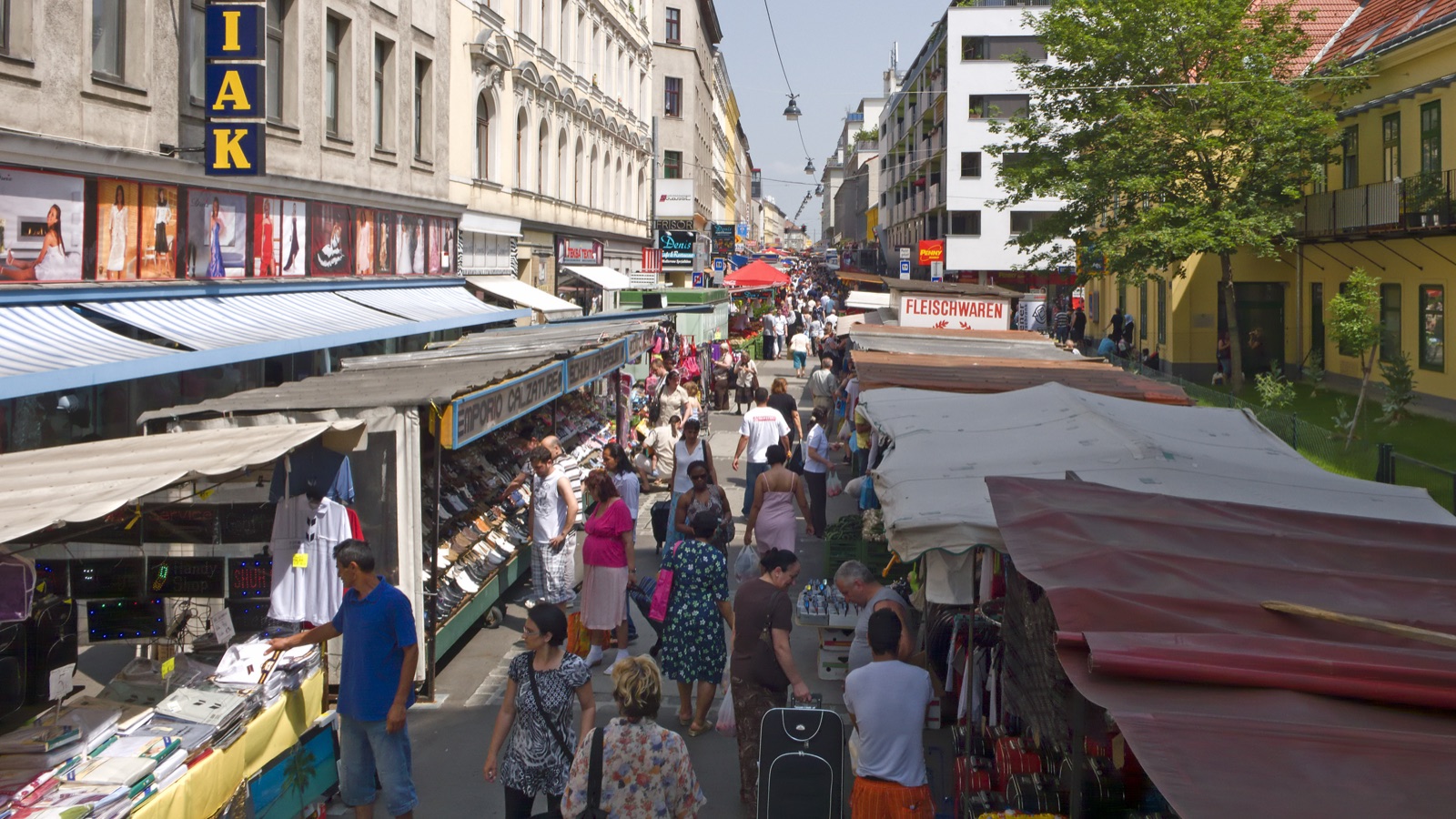
Ottakring
The 16th district holds some of the community's longest-running organisations. Brunnenmarkt and Yppenplatz make its multicultural public life visible without assigning ethnicity to passers-by.
Photo: Peter Gugerell / Wikimedia Commons · public domain.
Vienna also functions beyond its boundary. Family, work and association networks connect it daily with Lower Austria, while direct rail, road and air routes connect it with Linz, Graz, Munich, Zurich, Pristina, Skopje and Tirana. This page keeps commuters outside the headline estimate, because a city total that silently absorbs the metro area stops being reproducible.
A district field guide—not a population ranking
Use districts as a way to reach services and public life, not as ethnic labels. The same family may worship in the 15th, attend an event in the 16th, work in the 1st and live beyond the city boundary. This guide answers “where should I go for this?” without pretending to answer “where do all Albanians live?”
| District | Why it matters | Useful starting point |
|---|---|---|
1st — Innere Stadt | National cultural institutions and the University of Vienna's historical Albanology story | Opera, Musikverein and university collections; programmes change |
4th — Wieden | Albanian and Kosovar diplomatic and consular services | Use the embassy links in the directory and book appointments where required |
7th — Neubau | Long-running Austrian–Albanian cultural and bilateral association work | Check the society's programme before travelling |
10th — Favoriten | A major multilingual everyday centre with Balkan food, commerce and transport connections | Viktor-Adler-Markt as neighbourhood orientation, not an ethnic enclave |
12th — Meidling | Books, exhibitions, language and community programmes | Qendra IKRE, Schönbrunner Straße 175 |
15th — Rudolfsheim-Fünfhaus | Albanian Catholic worship and pastoral life | Albanian Catholic Mission, Meiselstraße 1 |
16th — Ottakring | Student/youth networking and some of the longest-established Albanian Muslim organisation | AYSA and ALKIG contacts; confirm the relevant event or mosque first |
Maybe your person is closer than you think. 👀Favoriten? Ottakring? Donaustadt? Somewhere across the Danube? Vienna has thousands of Albanian stories happening at once.
From recruitment to a multi-generation city
Vienna was the place where Austria's modern Balkan labour system was signed into law. On 19 November 1965, Austria and Yugoslavia signed their worker-recruitment agreement in the city. It was published in 1966 and preceded West Germany's comparable agreement by nearly three years. Albanian-speaking men from Kosovo and western North Macedonia arrived administratively as Yugoslavs, so no Vienna table of the period can separate them cleanly.
The first phase was designed as temporary male labour. The result was permanent family life. After recruitment slowed in the 1970s, men who stayed brought spouses and children; housing, schools, mosques, Catholic pastoral care and associations followed. By the 1980s and 1990s, Vienna no longer had a workforce passing through. It had a community raising children.
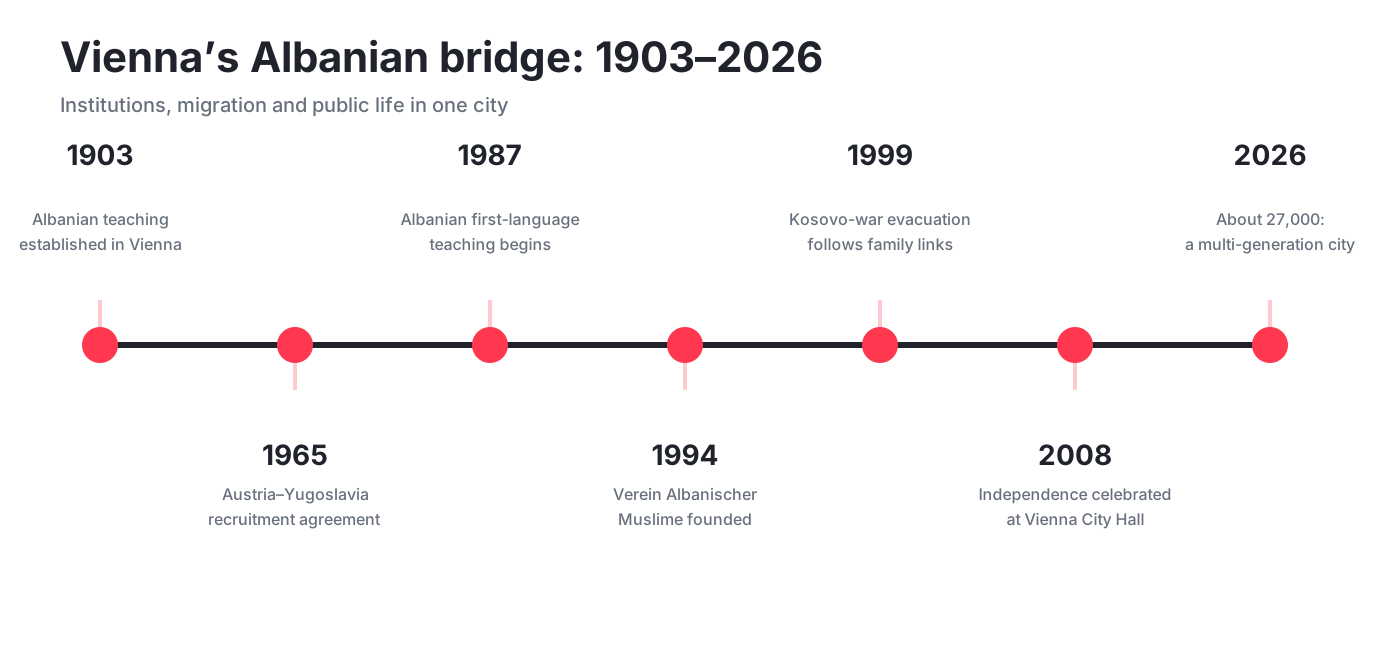
Vienna’s Albanian bridge: 1903–2026
Institutions, migration and public life in one city
- Albanian teaching established in Vienna
- Austria–Yugoslavia recruitment agreement
- Albanian first-language teaching begins
- Verein Albanischer Muslime founded
- Kosovo-war evacuation follows family links
- Independence celebrated at Vienna City Hall
- About 27,000: a multi-generation city
1998–1999: war follows the family map
The Kosovo war changed the community quickly. Austria received asylum seekers and also ran a formal evacuation programme. A later Interior Ministry answer to Parliament recorded 5,123 Kosovo Albanians evacuated from camps in Macedonia, plus 127 admitted through the embassy in Tirana.
Selection prioritised family links to guest workers, refugees and asylum seekers already in Austria. That is a national intake number, not a Vienna settlement count, but Vienna's established families and institutions were part of the receiving network.
17 February 2008: the community becomes visible
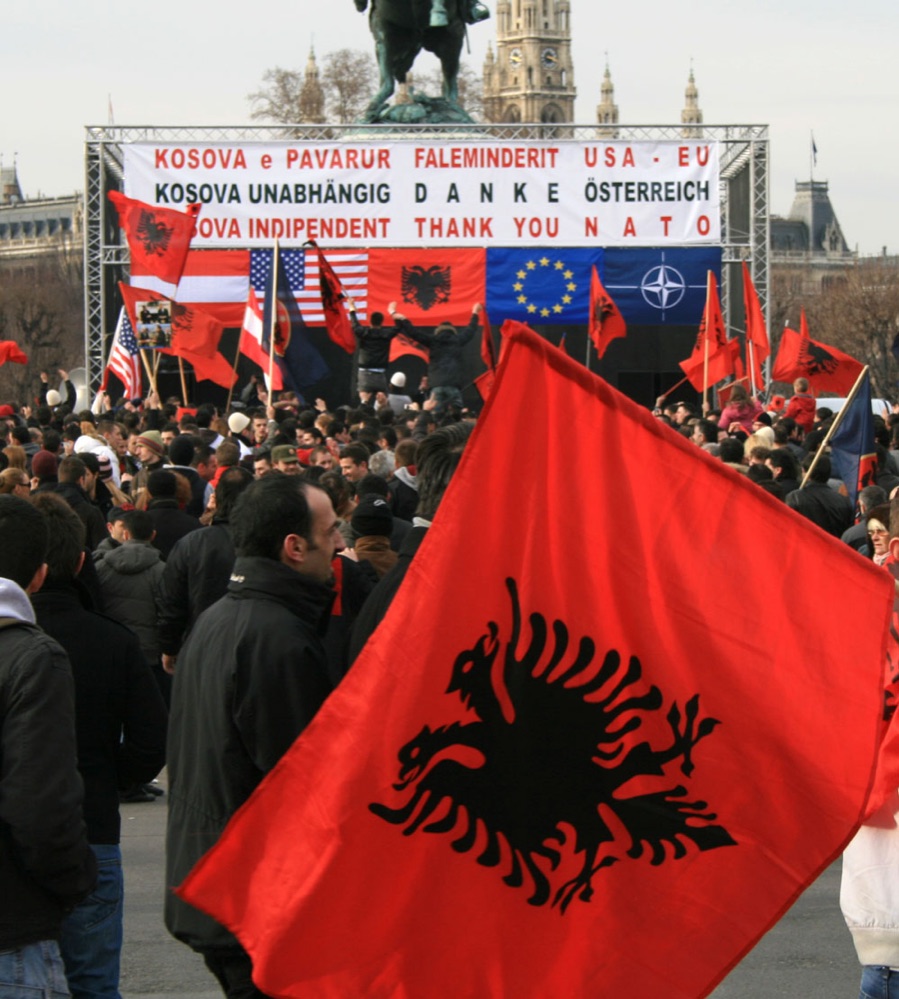
When Kosovo declared independence, thousands gathered by Vienna's Rathaus with Albanian and Kosovar flags. The photograph at the top of this page records a city community publicly naming itself after decades in which official tables had called its members Yugoslav, Serbian, Macedonian, Kosovar, Albanian or Austrian.
A newer route from Albania
The register series shows a different recent rhythm. Albania-born residents of Vienna rose from 516 in 2002 to 3,191 in 2026—more than sixfold. Over the same period, Kosovo-born residents rose from 4,133 to 10,326 and North-Macedonia-born residents from 7,020 to 13,453.
Stock data cannot tell whether each person came to study, work, join family or seek a different life. It does show that modern Albanian Vienna is no longer produced only by the old Yugoslav route.
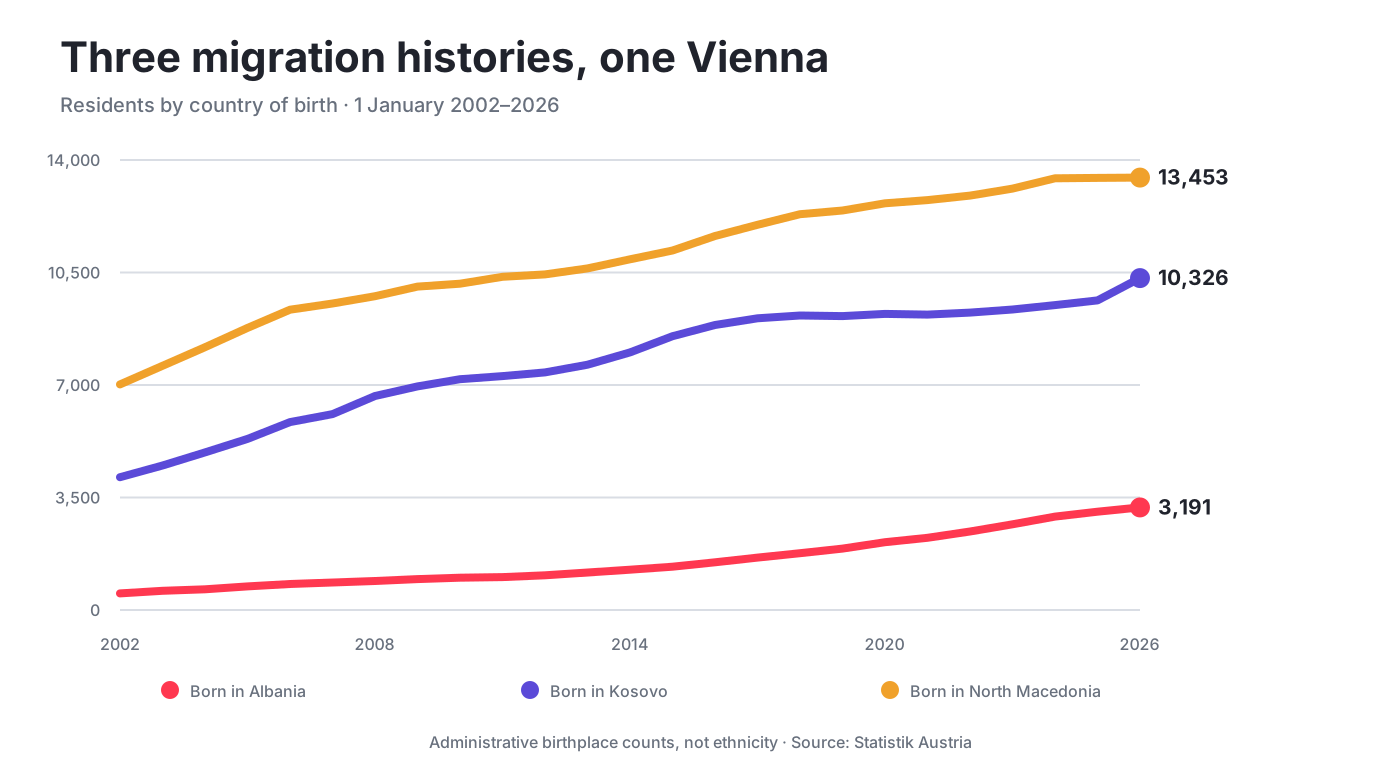
Three migration histories, one Vienna
Residents by country of birth · 1 January 2002–2026
- Born in Albania200251620263,191
- Born in Kosovo20024,133202610,326
- Born in North Macedonia20027,020202613,453
Administrative birthplace counts, not ethnicity · Source: Statistik Austria
2017–2018: Vienna puts the relationship on a major stage
The opening concert for the Austria–Albania Cultural Year, “Vienna salutes to Tirana”, filled the Wiener Konzerthaus on 16 November 2017 with artists including Inva Mula, Genc Tukiçi and Eno Peçi. The official 2018 programme then expanded to more than 100 events in both countries. This matters locally: Vienna was not merely where ministries signed an agreement; it was where Albanian artists, Austrian institutions and the diaspora shared one public stage.
Language, children and schools
Vienna's last all-population language benchmark is old but unusually useful. In 2001, 7,833 residents named Albanian as an everyday language. Of them, 1,479 were already Austrian citizens and 619 were both Austrian citizens and born in Austria. The passport undercount was therefore measurable before today's third generation had grown up.
Austria no longer asks the population a comparable census question. The current school table is national: in 2024/25, 16,412 pupils across Austria named Albanian as their first everyday language, while 17,562 reported it among all everyday languages. Those figures demonstrate transmission, but they cannot be relabelled as Vienna numbers.
What parents can use now is Vienna's state-supported Erstsprachenunterricht. In January 2025 the Bildungsdirektion said first-language teaching was offered at 204 schools in 25 languages, including Albanian. The federal Schule Mehrsprachig portal explains organisation and registration. Availability depends on demand and school planning, so families should confirm the current location with their school rather than rely on an old list.
Citizenship, voting and civic life
For many Albanian families, belonging to Vienna and having a vote in Vienna are two different things. Austria grants citizenship primarily through descent, not simply through birth in the country. A child born in Vienna does not automatically become Austrian, and a third-country national cannot vote in the Gemeinderat election that also chooses Vienna's state parliament.
The City of Vienna's 2025 election factsheet counted 610,795 residents of voting age—35.6% of the city's voting-age population—who could not vote in the municipal election because of citizenship. Among 16-to-30-year-olds the share was 44.4%; among 31-to-44-year-olds it was 46.4%.
These are citywide figures, not Albanian statistics. They matter here because Albania, Kosovo, North Macedonia, Montenegro and Serbia are outside the EU, while Vienna's own 2001 language evidence already showed an established Austrian-born Albanian-speaking generation.
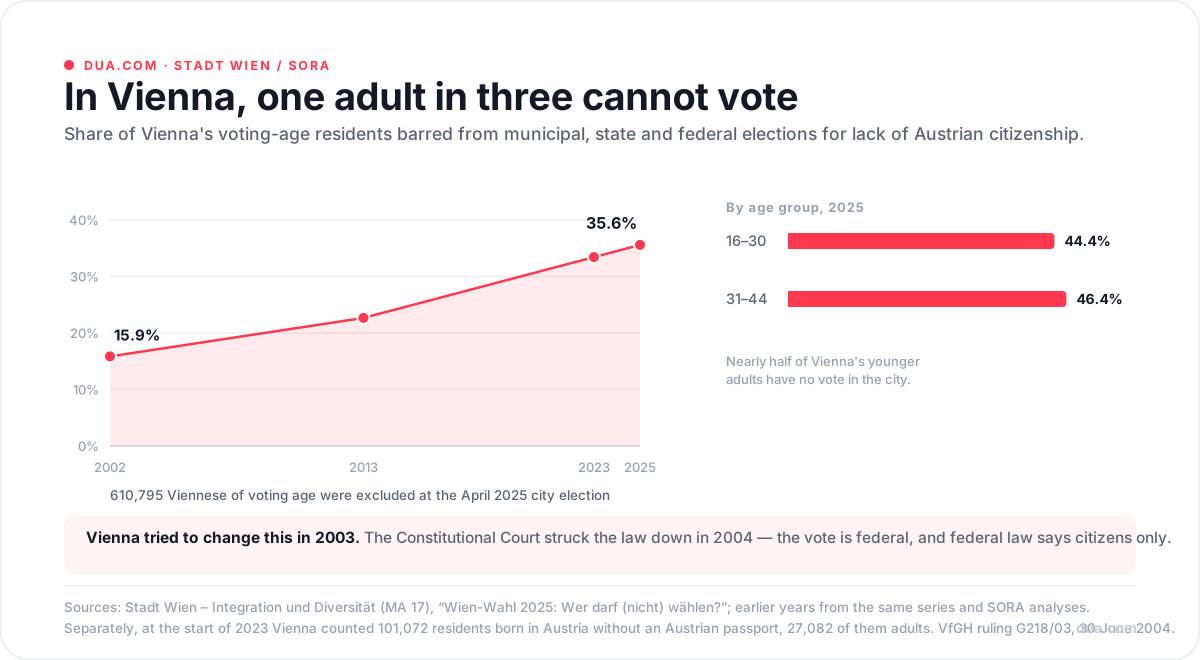
In Vienna, one adult in three cannot vote
Share of Vienna's voting-age residents barred from municipal, state and federal elections for lack of Austrian citizenship.
- 2002
- 15.9%
- 2013
- 22.7%
- 2023
- 33.4%
- 2025
- 35.6%
610,795 Viennese of voting age were excluded at the April 2025 city election
By age group, 2025
- 16–3044.4%
- 31–4446.4%
Nearly half of Vienna's younger adults have no vote in the city.
Vienna tried to change this in 2003. The Constitutional Court struck the law down in 2004 — the vote is federal, and federal law says citizens only.
Sources: Stadt Wien – Integration und Diversität (MA 17), “Wien-Wahl 2025: Wer darf (nicht) wählen?”; earlier years from the same series and SORA analyses.
Separately, at the start of 2023 Vienna counted 101,072 residents born in Austria without Austrian citizenship; 27,082 were aged 16 or over.
Born here can still mean no vote
At the start of 2023, Vienna recorded 101,072 people born in Austria without Austrian citizenship. Most were children, but 27,082 were already 16 or older and therefore old enough to vote if citizenship had not excluded them.
Again, no published row identifies how many were Albanian. The figure explains the structural experience behind the population model: some Vienna-born members of the community are invisible as “Albanian origin” and, at the same time, remain visibly non-Austrian in civic law.
Need official advice
Citizenship and residence questions
Use the City of Vienna's MA 35 information and official appointment routes. Community anecdotes cannot determine eligibility, required documents or whether a narrow exception applies.
Open official citizenship services →No city vote
Participation does not stop at elections
Parent associations, works councils, faith and cultural organisations, student groups, neighbourhood initiatives and Vienna's participation programmes remain real routes into public life.
See Vienna participation evidence →This section does not assign one politics to a diverse community. It explains a shared institutional constraint. A Vienna-born Austrian citizen with Albanian grandparents, a recently arrived Albanian professional and a long-settled Kosovar resident can have the same language and entirely different voting rights.
Faith, associations and cultural life
Albanian Vienna has never been organised by one institution or one faith. ALKIG represents Albanian Muslim communities inside Austria's legally recognised Islamic Religious Community. The Verein Albanischer Muslime in Wien dates to 1994 in Ottakring. In the 15th district, the Albanian Catholic community of the Archdiocese celebrates in Albanian at Meiselstraße 1. Their calendars overlap through language and family even where theology differs.
Secular life is just as structured. AYSA connects students and young professionals. Qendra IKRE in Meidling combines a cultural centre, library and community programme. The Coordinating Council and the official Albanian diaspora directory connect associations across Austria. The Austrian–Albanian Society, founded in 1966, belongs to a different layer: diplomacy, cultural exchange and the long relationship between the two countries.
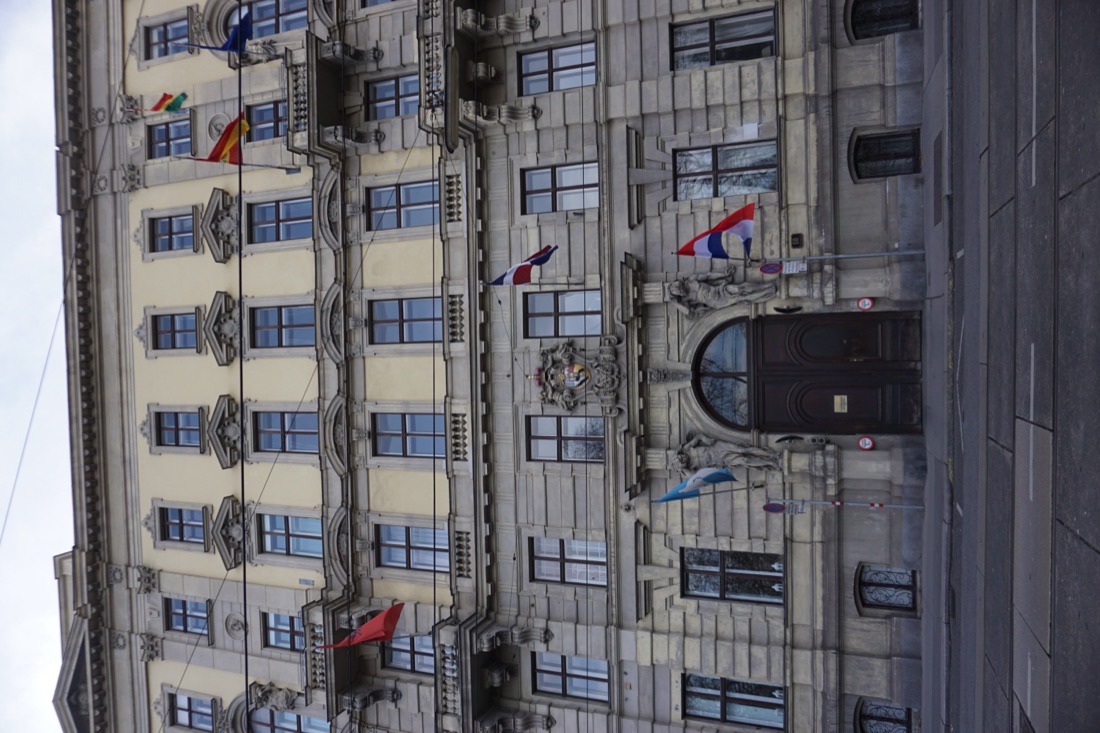
Diplomatic Vienna
Albania's embassy and Kosovo's embassy are both in the 4th district. Vienna also hosts Albanian and Kosovar missions to the UN, OSCE and other international organisations, making the city an institutional bridge as well as a diaspora home.
Photo: Erik Küng / Wikimedia Commons · CC BY-SA 4.0.
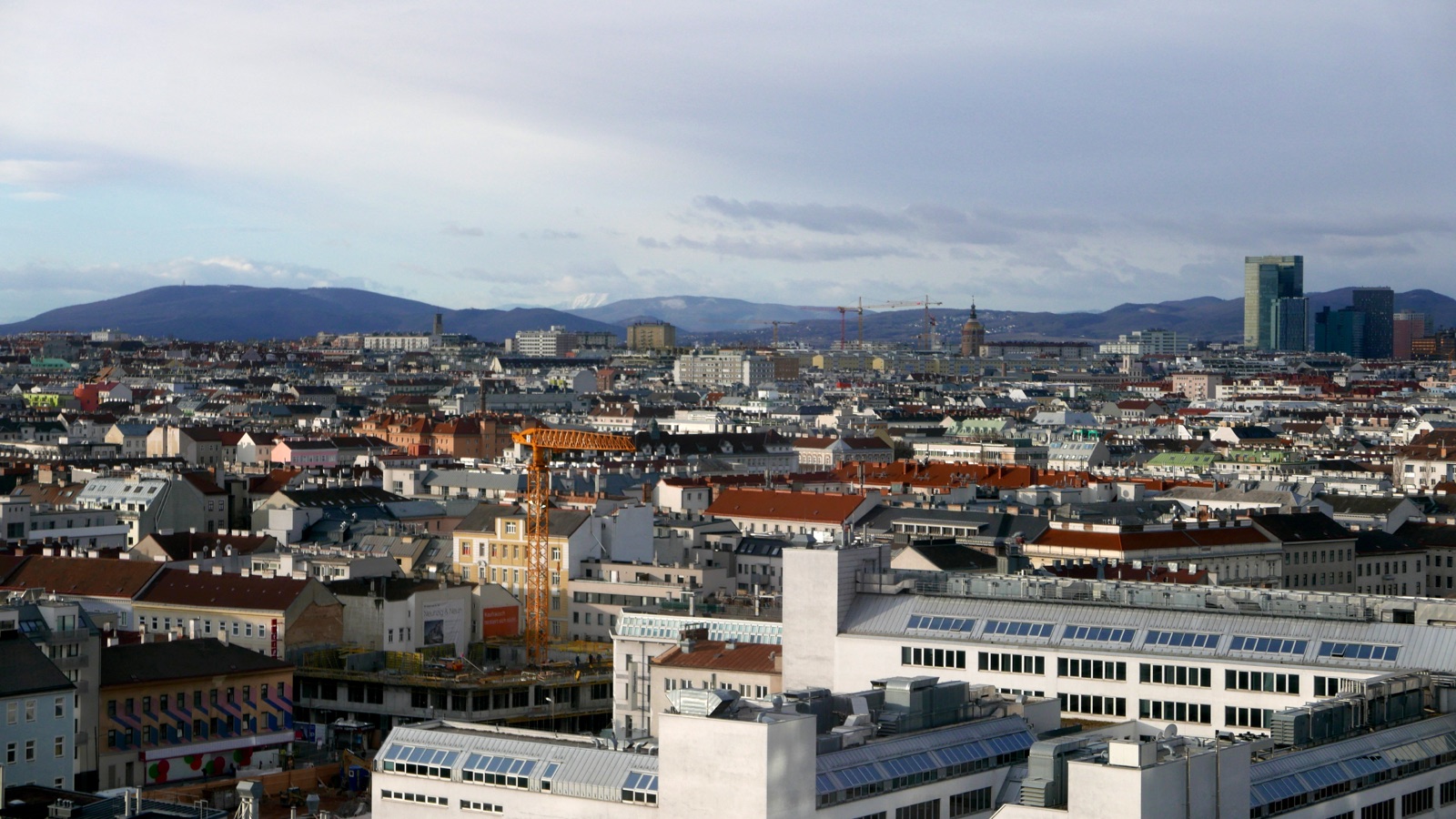
Public culture
Flag Day on 28 November, Kosovo Independence Day on 17 February, concerts, readings, mosque and parish celebrations, student events and business fairs create different public calendars. Dates move each year; the institutions in the directory are the reliable starting point.
Photo: Geolina163 / Wikimedia Commons · CC BY-SA 4.0.
Events worth putting in your calendar
17 February
Kosovo Independence Day
Look for embassy, association and cultural programmes around the anniversary. Vienna's largest historic public gathering took place outside City Hall in 2008.
Check official missions →28 November
Albanian Flag Day
Concerts, readings and receptions appear across different venues rather than one fixed festival site. AYSA, Qendra and the diaspora directory are the reliable starting points.
Find organisers →Current city listing
“Albania—Land of the Skipetars”
At this page's update, the City of Vienna listed a free illustrated lecture for 10 September 2026 at Amtshaus Hietzing. Use the official listing for time, access and any changes.
Open the City listing →Business, books & youth
Follow the smaller calendars too
The Albanian Business Fair, AYSA's student programme and Aleksandër Moisiu literary events open different doors into the community. Their dates move; follow the organiser, not an old flyer.
Use the verified directory →May 2026: Albanian culture on Vienna's biggest pop stage
When Vienna hosted the 70th Eurovision Song Contest, Shkodër-born Alis represented Albania with “Nân”, reached the Grand Final at Wiener Stadthalle and also appeared in the free Eurovision Village programme by Rathausplatz.
This was a national delegation, not a claim about the resident community. But for Albanian-speaking families and fans in Vienna it created a rare city-wide moment in which the language, dress and sound of home were part of the host city's main public event.