
Albanians have been part of Athens for more than three decades.
What began with the migration waves of the early 1990s has grown into one of the city's largest diaspora communities — families, students, business owners, artists and a generation that has grown up calling both Greece and Albania home.
Counting that community isn't straightforward. The 2021 census recorded 140,148 Albanian citizens and 176,989 Albania-born residents across Attica, but neither figure captures everyone of Albanian origin. Many have become Greek citizens, while a younger generation was born in Greece.
For more on this topic, read Albanians in Greece: A Community More Than 600,000 Strong and Albanians in Germany: A Million-Strong Community.
So there isn't one perfect number. What we can say with confidence is that Albanian life is deeply woven into modern Athens — even though you won't find a single “Albanian neighbourhood” on the map.
Last evidence review: 11 August 2026. Current population data is available for Attica and its regional units, not for Albanian ethnicity inside Athens municipality. Older neighbourhood, housing and pupil studies are clearly dated wherever used.
How many Albanians live in Athens?
There isn’t one official number for the Albanian community in Athens — mainly because it depends on what we mean by both “Albanian” and “Athens.”
The clearest official figures come from the 2021 Greek census. Across Attica, the wider region that includes Athens and its surrounding municipalities, there were:
- 140,148 residents with Albanian citizenship
- 176,989 residents who were born in Albania
These figures overlap, so they should not be added together. Someone born in Albania may still hold Albanian citizenship, while others may have since become Greek citizens.
And that is where official statistics start to miss part of the community.
Many Albanians who settled in Greece during the 1990s and 2000s have since acquired Greek citizenship. Their children may have been born in Greece and appear in official statistics simply as Greek. That means neither citizenship nor country of birth gives us a complete count of people with Albanian roots.
So what is a realistic estimate?
Based on census data, naturalisation and the growth of a second generation, a reasonable estimate puts the wider Albanian-origin population of Attica at around 200,000–250,000 people.
That should be treated as an estimate, not an official ethnic count.
It also matters that Attica is much larger than the Municipality of Athens itself. When people say “Albanians in Athens,” they often mean the wider metropolitan area, where families and communities are spread across dozens of municipalities rather than concentrated in one neighbourhood.
The exact number may be difficult to pin down. What isn’t difficult to see is how established the community has become.
Swipe horizontally to explore the full chart.
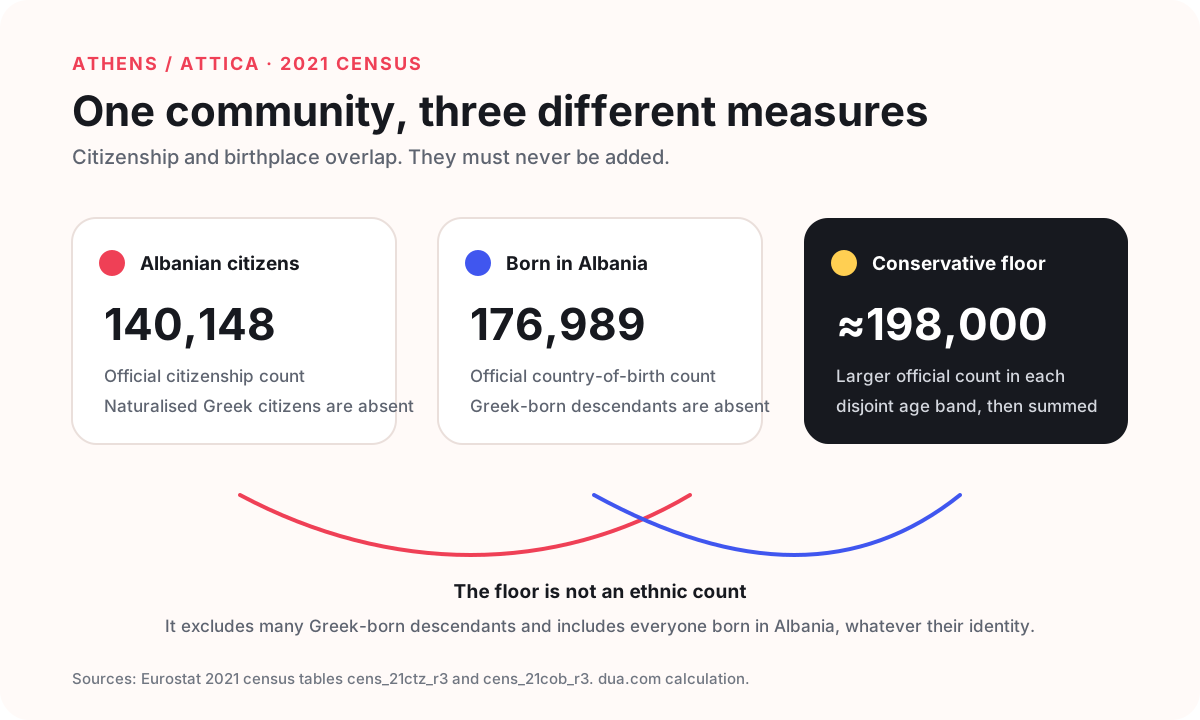
| Measure | Attica, 2021 | What it includes | What it misses |
|---|---|---|---|
| Albanian citizens | 140,148 | Residents holding Albanian citizenship | Naturalised Greek citizens without Albanian citizenship |
| Born in Albania | 176,989 | First-generation residents, whatever their current citizenship | Greek-born children and descendants |
| Conservative official-link floor | ≈198,000 | Minimum implied by the larger official count in every disjoint age band | Many naturalised Greek-born descendants and anyone outside both measures |
| Best wider community range | ≈200,000–250,000 | The floor plus Greek-born descendants and modest undercount | Estimated from the official floor, national community evidence and Attica's geographic share |
| High-end community hypothesis | Up to 300,000 | A wider allowance for Greek-born second and third generations; approximately one in ten across the 3.06-million Athens–Piraeus urban area | Not official and highly boundary-sensitive; across full Attica the same number is about one in thirteen |
What “Athens” means in the statistics
Athens can mean the municipality, the Central Athens regional unit, the built-up Athens–Piraeus area or the full Attica region. Those boundaries are not interchangeable. The detailed current census tables stop at the regional-unit level, so the honest headline is about Athens and Attica, not the 38.96-square-kilometre municipality alone.
| Geography | What it means | Current Albanian-linked evidence |
|---|---|---|
| Municipality of Athens | The central municipality; 643,452 total residents in 2021 | No detailed public 2021 Albanian citizenship figure found. The comparable 2011 country-of-origin table counted 66,825 residents from Albania. |
| Central Athens regional unit | Athens municipality plus seven neighbouring municipalities | 55,399 Albanian citizens; 71,805 Albania-born residents |
| Five Athens/Piraeus units | North, West, Central and South Athens plus Piraeus and Islands | 113,001 Albanian citizens; 146,741 Albania-born residents. Piraeus is bundled with islands. |
| Attica region | The complete capital region, including East and West Attica and islands | 140,148 Albanian citizens; 176,989 Albania-born residents; ≈198,000 conservative floor |
Calling 55,399 “the Albanian population of Athens” would therefore be wrong: it is the citizenship count for the broader Central Athens regional unit, not the Municipality of Athens. Calling 140,148 the city-proper count would be wrong in the other direction, because Attica reaches well into the eastern and western suburbs and includes islands.
Swipe horizontally to explore the full chart.
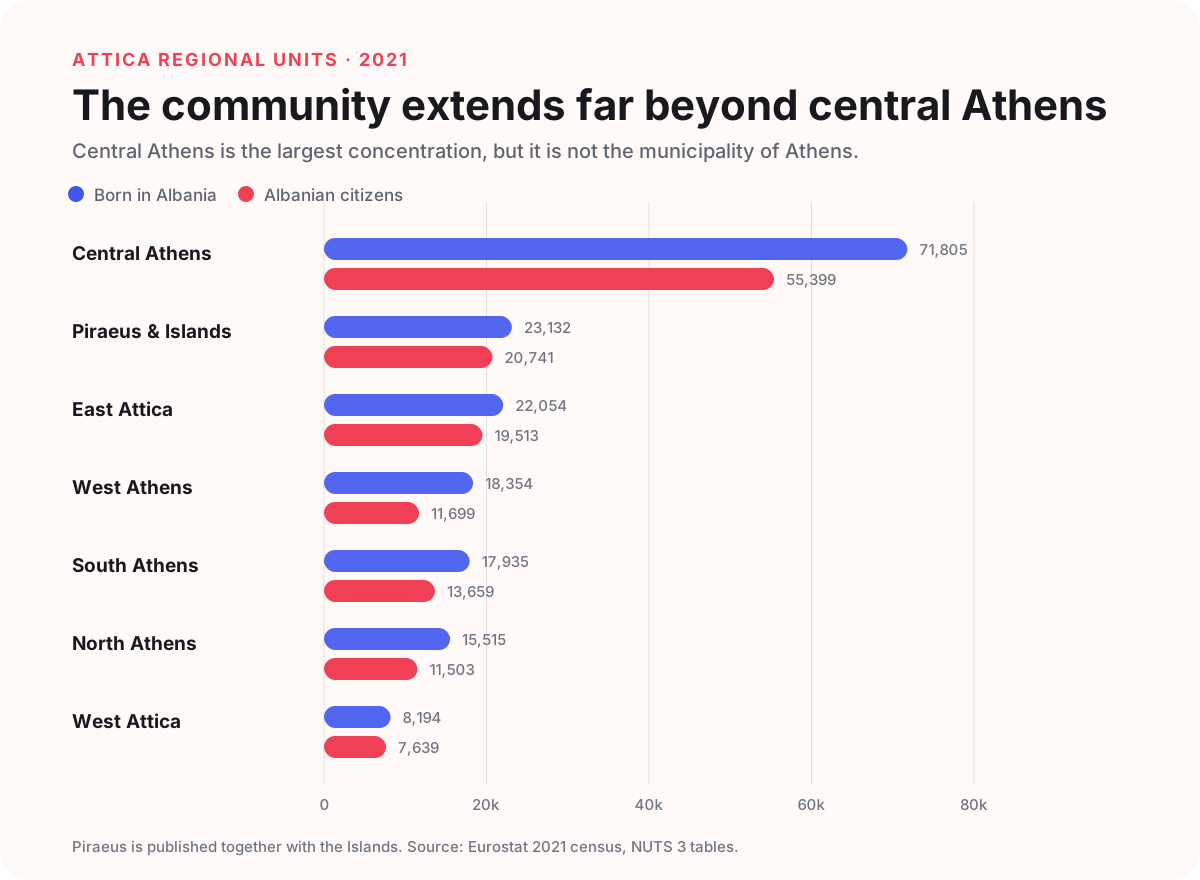
| Regional unit | Albanian citizens | Born in Albania | Approx. age-stratified floor |
|---|---|---|---|
| Central Athens | 55,399 | 71,805 | 79,800 |
| Piraeus and Islands | 20,741 | 23,132 | 26,200 |
| East Attica | 19,513 | 22,054 | 25,400 |
| West Athens | 11,699 | 18,354 | 20,000 |
| South Athens | 13,659 | 17,935 | 19,800 |
| North Athens | 11,503 | 15,515 | 17,300 |
| West Attica | 7,639 | 8,194 | 9,600 |
| Attica | 140,148 | 176,989 | ≈198,000 |
Where do Albanians live in Athens?
Across the city, not inside one Albanian quarter. The best recent housing research finds relative concentrations in Ampelokipi, Gyzi and northern Pangrati, with a smaller one in Neos Kosmos. It also finds Albanian residents underrepresented in Kolonaki and the eastern commercial centre. Those findings use 2011 census microdata and should be read as a dated urban pattern, not a 2026 ranking.
Kypseli, Patissia, Agios Eleftherios, Ampelokipi, Gyzi, Pangrati, Neos Kosmos, Kallithea and Piraeus all appear in the community's lived geography. Family and village networks can be dense within a street or apartment block, but no neighbourhood functions as an exclusive ethnic centre. The diaspora became visible in schools, construction crews, small businesses and apartment buildings while remaining almost invisible on shop signs.
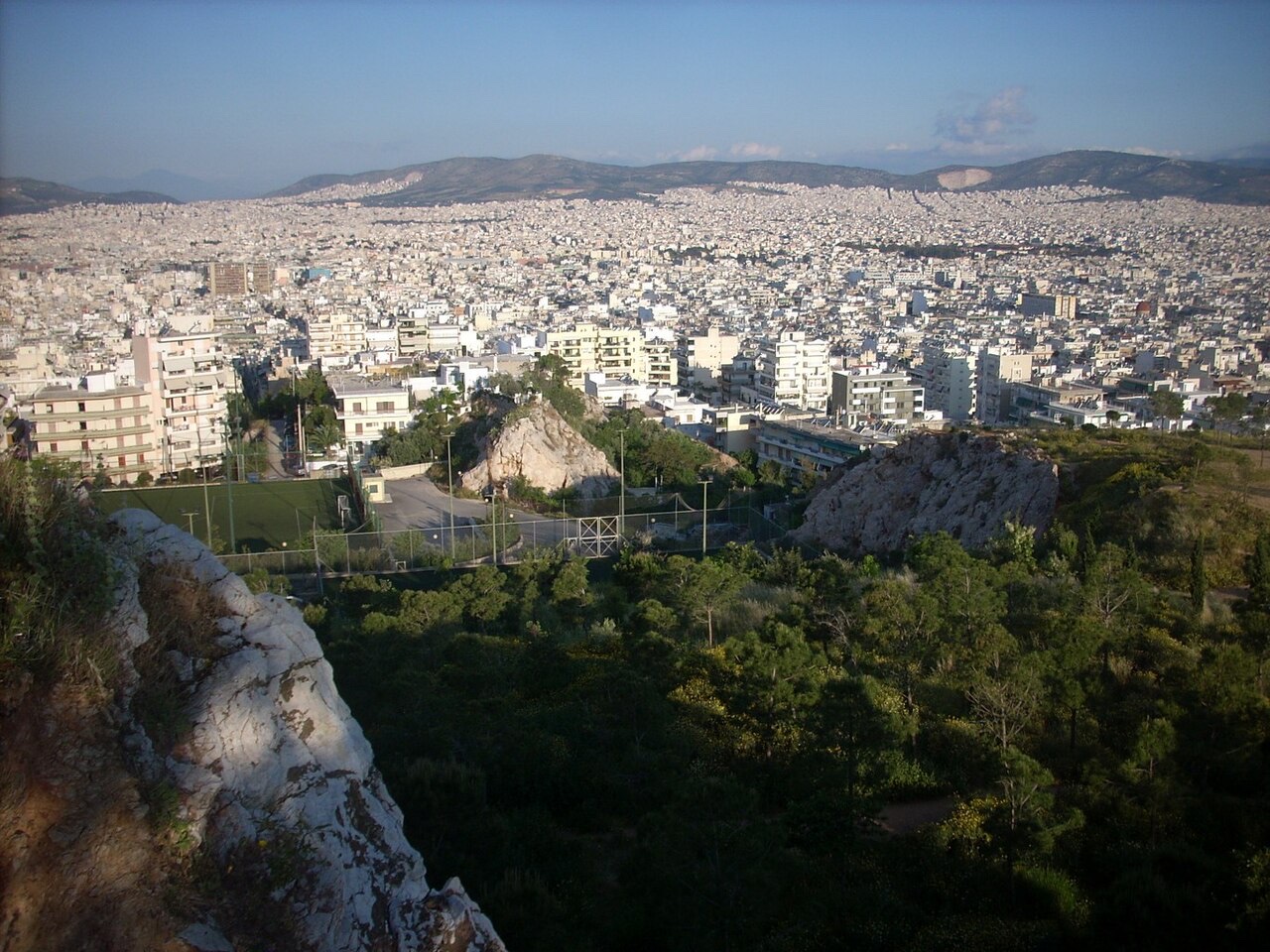
Why Athens produced dispersion instead of an enclave
New arrivals entered a private rental market rather than a public-housing system. Athens' dense polykatoikia apartment blocks placed different incomes and origins in the same building: more affluent owners on some floors, cheaper and darker units on others. Albanian families followed relatives to available flats, then moved as work, papers, schools and mortgages allowed. That mechanism created micro-concentrations without a single community boundary.
The word “invisible” needs care. It does not mean absent or fully equal. It means a community can be numerically immense and socially connected without an ethnic high street that a visitor can photograph in one afternoon.
How Albanians became part of Athens
For many Albanians, Athens became a destination almost overnight.
After the fall of Albania’s communist regime in the early 1990s, thousands crossed into Greece looking for work and a level of economic stability that was difficult to find at home. Athens, as the country’s largest city, became one of the main places where people tried to build a new life.
From temporary work to putting down roots
- Early 1990s — Arrival
Many came alone, taking whatever work was available and sending money back to family in Albania. - Late 1990s — A more settled community
Regularisation programmes gave more migrants a path toward legal residence, while spouses and children increasingly joined family members already living in Greece. - Early 2000s — Athens was changing too
Construction and other manual work provided employment for many Albanian migrants, particularly during the building boom ahead of the 2004 Athens Olympics. - 2000s onward — Families put down roots
Children entered Greek schools, families moved into more permanent homes and businesses and community organisations began to grow. - Today — A generation raised in Greece
Many younger Albanians in Athens were born or grew up here. For them, Greece isn't simply the country their parents migrated to — it's home.
That shift matters
What started largely as a story about migration and work gradually became a story about families building lives in Greece. Apartments that were supposed to be temporary became family homes. Children grew up speaking Greek with their friends and Albanian with their parents. Trips to Albania became summer visits rather than permanent returns.
Today, the Albanian community in Athens includes people who remember arriving in the 1990s, people who came much later for work or study, and a generation that has never known Athens as anything other than home.
There isn't one Albanian experience of Athens anymore — and that's probably the clearest sign of how much the community has changed.
The housing ladder: sofa, basement, middle floor, ownership
Housing is the most distinctly Athenian part of the migration. The 2024 study by Ioanna Polyzou and Stavros Spyrellis combines 2011 census microdata with eight detailed interviews conducted in 2023. Its families describe a recurring path: sharing with relatives, taking the cheapest independent flat, moving to a better floor and, when papers and income allowed, buying.
| Measure | Result | What it suggests |
|---|---|---|
| Homeowners | 25.9% | A meaningful settlement gain, though far below Greek households |
| Tenants | 72.3% | Continued dependence on the private rental market |
| Buildings from 1960–1980 | 76.5% | Concentration in the capital's ageing apartment stock |
| Residents on middle floors | 63.7% | Partial upward mobility inside the vertical hierarchy of the apartment block |
Ownership was not simply a financial asset. It marked a decision that the return to Albania might never happen. Yet the achievement remained fragile: the debt crisis cut income, while the growth of short-term rentals and investor demand later pushed rents higher in precisely the central neighbourhoods where families had settled.
The evidence therefore sits between two easy stories. Albanians in Athens were neither permanently trapped in the basement nor fully absorbed into equal housing outcomes. The researchers call this an “in-between” condition: real progress, uneven quality and continuing vulnerability.
Work, business and 4,600 Chamber members
Construction and domestic work explain the first decade, but they do not describe the community of 2026. Children educated in Greece moved into retail, services, the professions, arts and business ownership. The clearest current city proof comes from the Athens Professional Chamber (EEA), which created a Greek-Albanian Entrepreneurship Committee in 2023.
In February 2026, the Chamber said it counted 4,600 members of Albanian origin, the largest community of foreign entrepreneurs in the city. A separate June 2026 Chamber update referred to more than 4,600 Albanian businesses operating across Attica. These are related institutional measures, not a census of every Albanian-owned company, and they should not be treated as interchangeable.
The committee's significance is larger than the number. A community once discussed mainly through policing, permits and informal labour now has representation inside an Athenian business institution. The Chamber's February statement describes support for migrant-founded businesses; a Greece–Albania business forum at the Athens Chamber of Commerce and Industry in May 2026 placed that relationship inside bilateral trade.
Growing up Albanian in Athens
For many second-generation Albanians in Athens, the answer to “Where are you from?” isn't as simple as it sounds.
You might have been born in Greece, gone to a Greek school and spent your whole life in Athens — while still growing up with Albanian at home, summers with family in Albania and traditions that your Greek friends didn't always understand.
Sound familiar?
- Greek outside, Albanian at home.
For many families, switching languages happens without even thinking about it. - You understand Albanian better than you speak it.
Or you speak it perfectly but suddenly become very quiet when someone asks you to write it. - You don't feel like you have to choose.
Being Greek and being Albanian can exist together. One doesn't have to cancel out the other. - Your Albanian depends on who you're talking to.
Somehow, a conversation with your grandparents can bring out vocabulary you didn't know you had. - “Going home” can mean two places.
Athens is home. But the place your family comes from can feel like home too.
Keeping Albanian alive
That relationship with language changes from family to family. Some parents make a conscious effort to speak Albanian at home, while others find that Greek naturally becomes dominant as children grow up.
Albanian-language classes and community organisations in Athens also help younger generations learn to read and write the language — not just speak the version they picked up around the family table.
And sometimes the desire to reconnect comes later.
You might not think much about speaking Albanian when you're 15. At 25, being able to have a proper conversation with your grandparents, understand an Albanian song without translating it, or pass the language on to your own children can suddenly mean much more.
For a generation raised between two cultures, Albanian isn't only something inherited from their parents. It's something they get to decide how to carry forward.
Associations, schools and events in Athens
The Albanian community in Athens is not one building or one neighbourhood. It is an ecosystem: long-running associations, weekend classrooms, women's and professional networks, football teams, folk ensembles, artists, embassy programmes and public festivals. Its visibility is seasonal and distributed, which is why a visitor looking only for an “Albanian street” can miss a community numbering in the hundreds of thousands.
Athens community life, in pictures
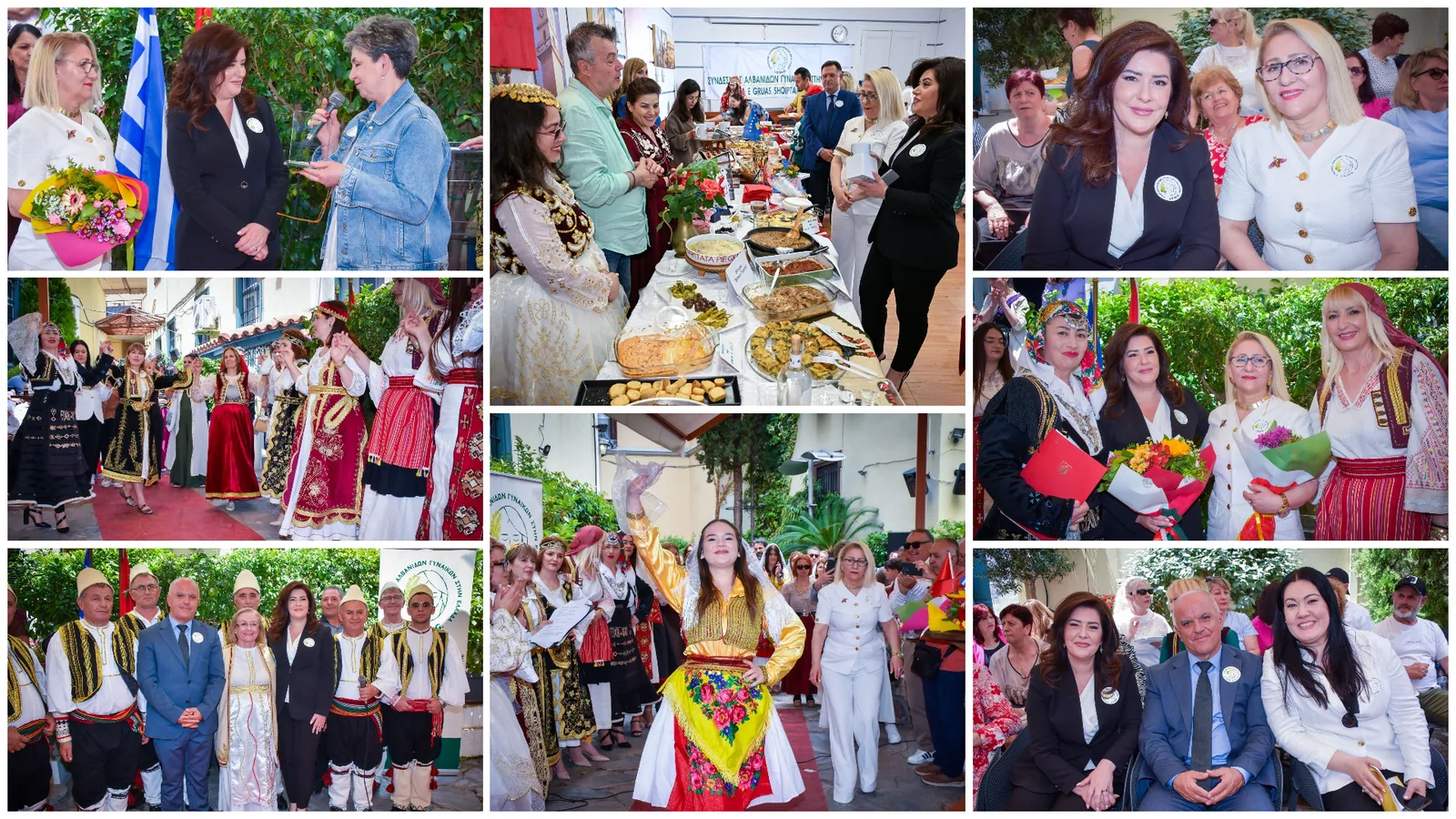
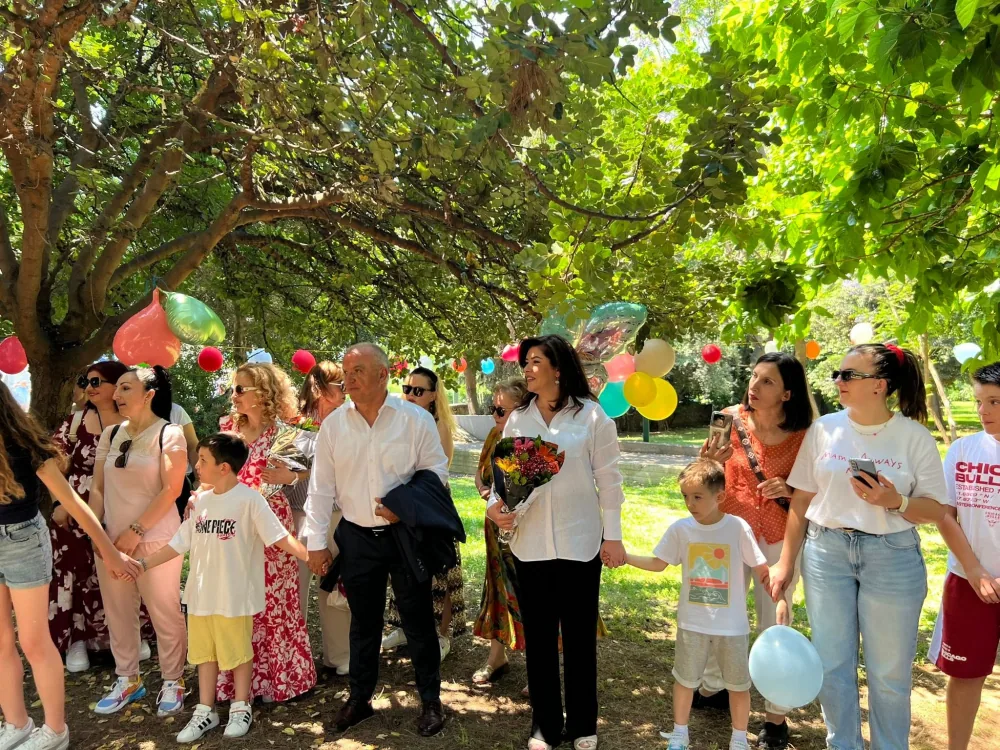
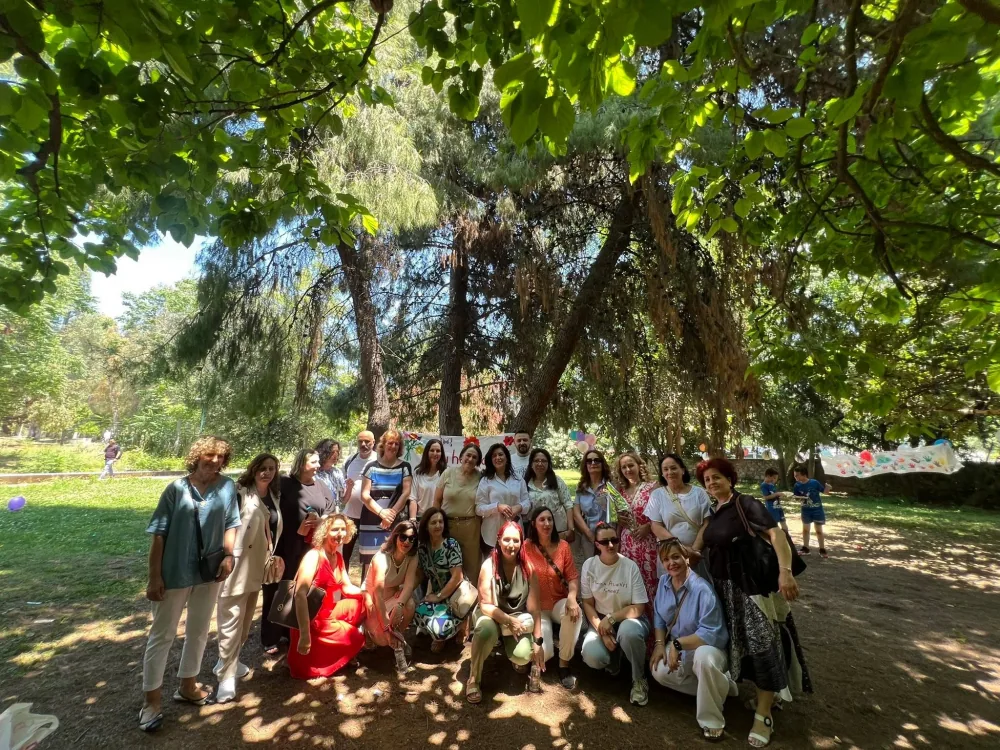
These are not generic diaspora images. They show Albanian community life in Athens in May and June 2026: women organisers, traditional food and dress, children, parents and language teachers occupying visible public and educational spaces in the capital.
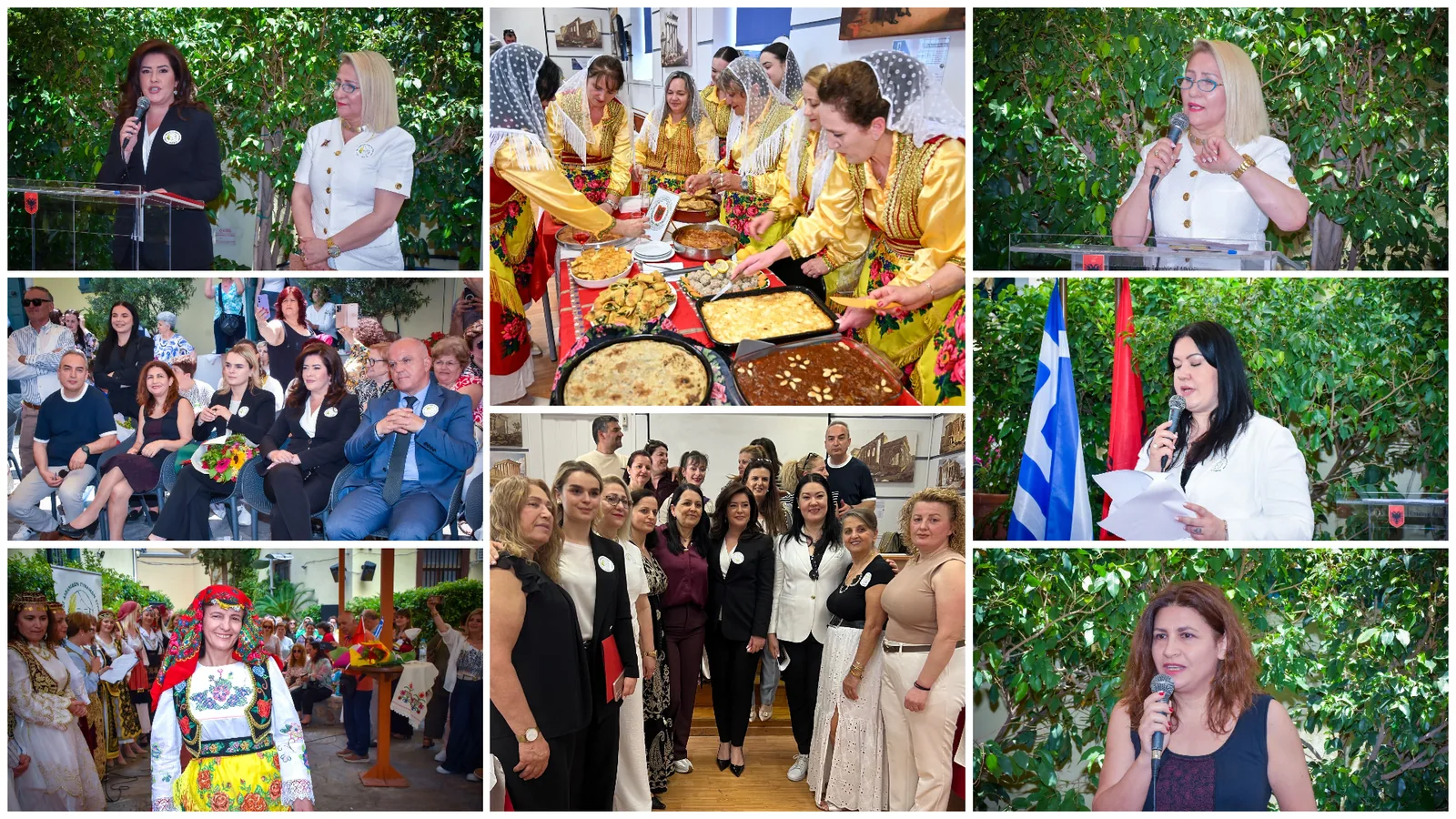
Several current organisations have enough official documentation to be listed confidently:
- Albanian Community in Greece, which marked its twentieth anniversary in November 2024 and works with the City of Athens and migrant organisations.
- Vellazerimi Association, described by the Albanian Embassy as the first Albanian association in Greece; it marked thirty years in Athens in September 2025.
- Albanian Women's Association in Greece, organiser of the sixth Albanian Gastronomy Festival in May 2026.
- Association of Albanian Language Teachers in Greece, the network behind the June 2026 language celebration.
- Tirona – League of Albanians in Greece, active in cultural programmes and diaspora cooperation.
- Apollonia FC of the Albanian Community, documented at the 2024 Kypseli Mundial football and culture festival.
The rhythm of an Albanian community year
This is a record of recently documented events, not a promise that every event returns on the same date. It shows when community life becomes most visible; always verify the current programme through the organisers or the Albanian Embassy newsroom.
| Season | Documented Athens events | What they reveal |
|---|---|---|
| February | International Mother Language Day programmes; the 13th FolcAlFest in 2025 with Vëllazërimi and Malli i Mërgimtarit | Language, polyphonic song, children's performance and Greek–Albanian cultural collaboration |
| March | Community literature and music, including the 2025 launch of We Are Together and Alban Skënderaj's March 2026 Athens concert | The community is both an audience for Albanian culture and a producer of it |
| May | The sixth Albanian Gastronomy Festival in 2026; Kypseli Mundial's football, food and culture programme; Greece–Albania business meetings | Women organisers, entrepreneurs and Apollonia FC place community life in public Athenian venues |
| June | “A Day Full of Colors and Albanian Language” at Rizari Central Park in 2026; school-year celebrations | Children, parents and teachers make language transmission visible |
| September | Association anniversaries and the opening of the school year; Vëllazërimi marked thirty years in September 2025 | The infrastructure is older than many of its second-generation members |
| November | Albanian November, Alphabet Day, Flag Day, film nights, exhibitions and CulturAlb programmes | The densest cultural month connects language, history, independence and contemporary art |
The sixth Albanian Gastronomy Festival took place at New York College in Athens on 28 May 2026. The language celebration followed at Rizari Central Park on 8 June. A Greece–Albania Business Forum at the Athens Chamber of Commerce and Industry on 22 May connected entrepreneurs from both countries. In November 2025, municipal arts spaces and the embassy hosted Albanian film, exhibitions, Alphabet Day and Flag Day programmes. Together, these events show food, language, sport, business and art moving from private networks into the public life of Athens.
Watch the community in motion
The photographs show the infrastructure; the videos reveal the atmosphere. The first follows the 2026 gastronomy festival from speeches and traditional food to costume, song and dance. The second records the much larger, spontaneous Flag Day gathering at Syntagma Square in November 2024.
From “immigrants” to Albanian Athenians
The strongest community story is the change in belonging. In 2021, then mayor Kostas Bakoyannis said Albanians in Athens are “as Athenian as I am”. A 2025 Panteion University conference described the second generation's identity less as a choice between Greek and Albanian and more as a non-competing sense of being both. That does not erase racism, unequal housing or the pressure that once made families hide names and language. It shows what three decades of school, work, citizenship, friendship and mixed families have produced.
Faith without a separate Albanian religious map
The community is religiously mixed and often worships through Greek or citywide institutions rather than separate Albanian ones. Orthodox residents generally attend Greek Orthodox parishes. Athens' state mosque at Votanikos serves Muslims from many origins and should not be labelled an Albanian mosque.
Albanian Catholics have a documented relationship with the Capuchins near Plateia Victoria. A mission visit reported in March 2026 described continuing demand for Albanian-speaking pastoral support, but this research did not verify a permanent dedicated Albanian parish or a reliable weekly Albanian-language schedule. The practical lesson is simple: check the current congregation directly before travelling.
When Athens “spoke Albanian”—and what that means today
The statement has a real historical core. Arvanite communities had lived across Attica, Boeotia and the Saronic islands for centuries, speaking Arvanitika, a Tosk-Albanian-rooted variety. Plaka retained a large Arvanite population into the nineteenth century, while many villages surrounding the capital were predominantly Arvanitika-speaking.
The line most often repeated comes from the French writer Edmond About. In a book published in 1855, he looked back roughly twenty-five years and wrote that “Athens … was only an Albanian village”; he also claimed that Albanian speakers formed almost all the population of Attica and that Greek was barely understood in some nearby villages. It is vivid traveller testimony, not a census. The scale matters: when Athens became the capital in 1834 it had only about 7,000–10,000 residents, clustered around the Acropolis, and was rapidly filling with newcomers from across the new Greek state.
So “Athens spoke Albanian” means that Arvanitika was a major language in a very small early capital and its surrounding Attica countryside. It does not mean that the modern four-million-person metropolis was once demographically comparable to today's city, and it does not turn a nineteenth-century language observation into a twenty-first-century population count.
Arvanites are Greek and overwhelmingly identify as Greek. Their descendants cannot be added to the post-1990 Albanian migration total without overriding their identity. The two histories belong beside each other because they make Albanian-rooted speech a recurring part of Attica's story—not because they form one continuous, countable ethnic population. The fuller identity and historical treatment is available on the Albanians in Greece page.
People who carry the Athens story
Athens produced a generation that is difficult to classify with one passport adjective. Some arrived as children, some were born in the city, and some built their creative life there after the border crossing. Their stories make the statistical categories human without pretending every biography is the same.
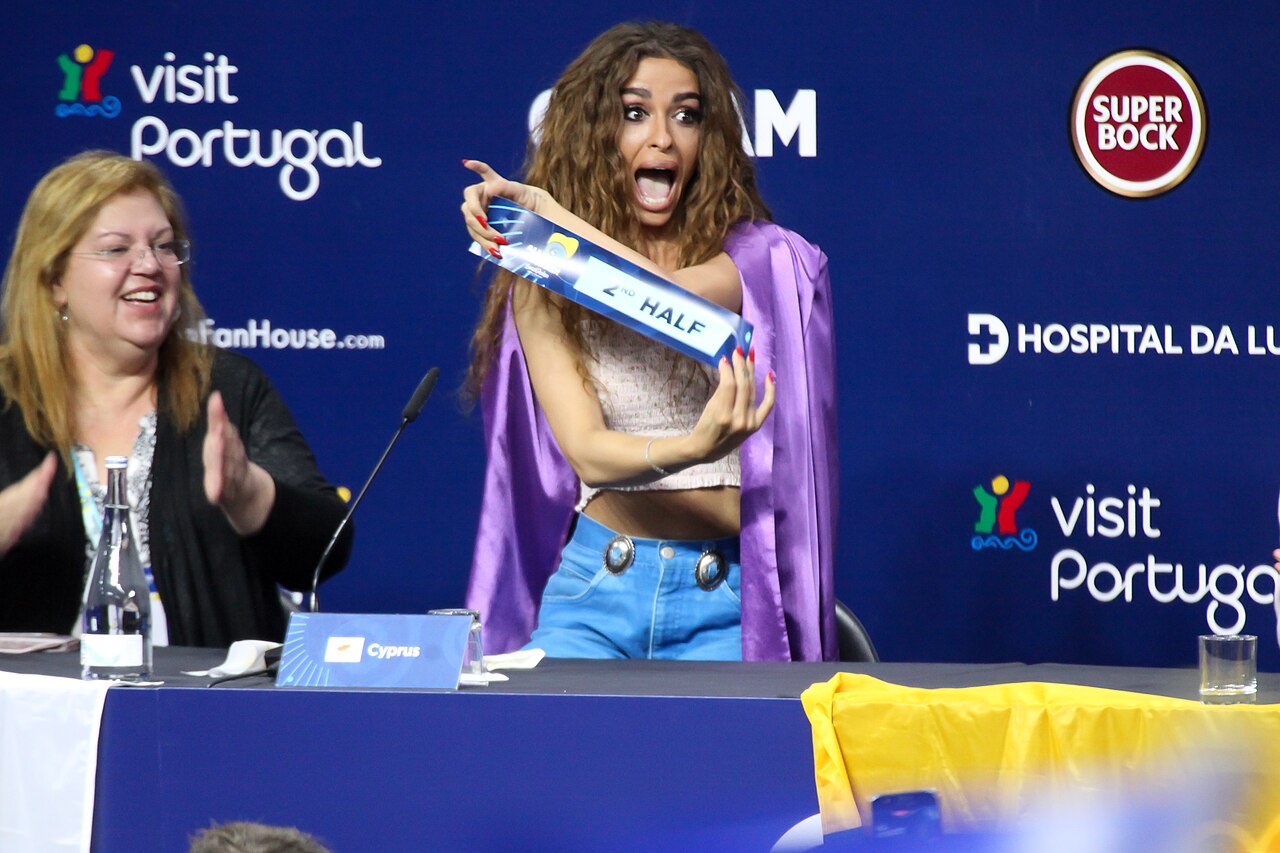
Eleni Foureira
Born in Fier and raised in Athens, Foureira became one of Greek pop's biggest stars. Her public account of hiding her Albanian origin early in her career captures the pressure to become visible only after succeeding.
Photo: Dewayne Barkley / Wikimedia Commons · CC BY-SA 4.0
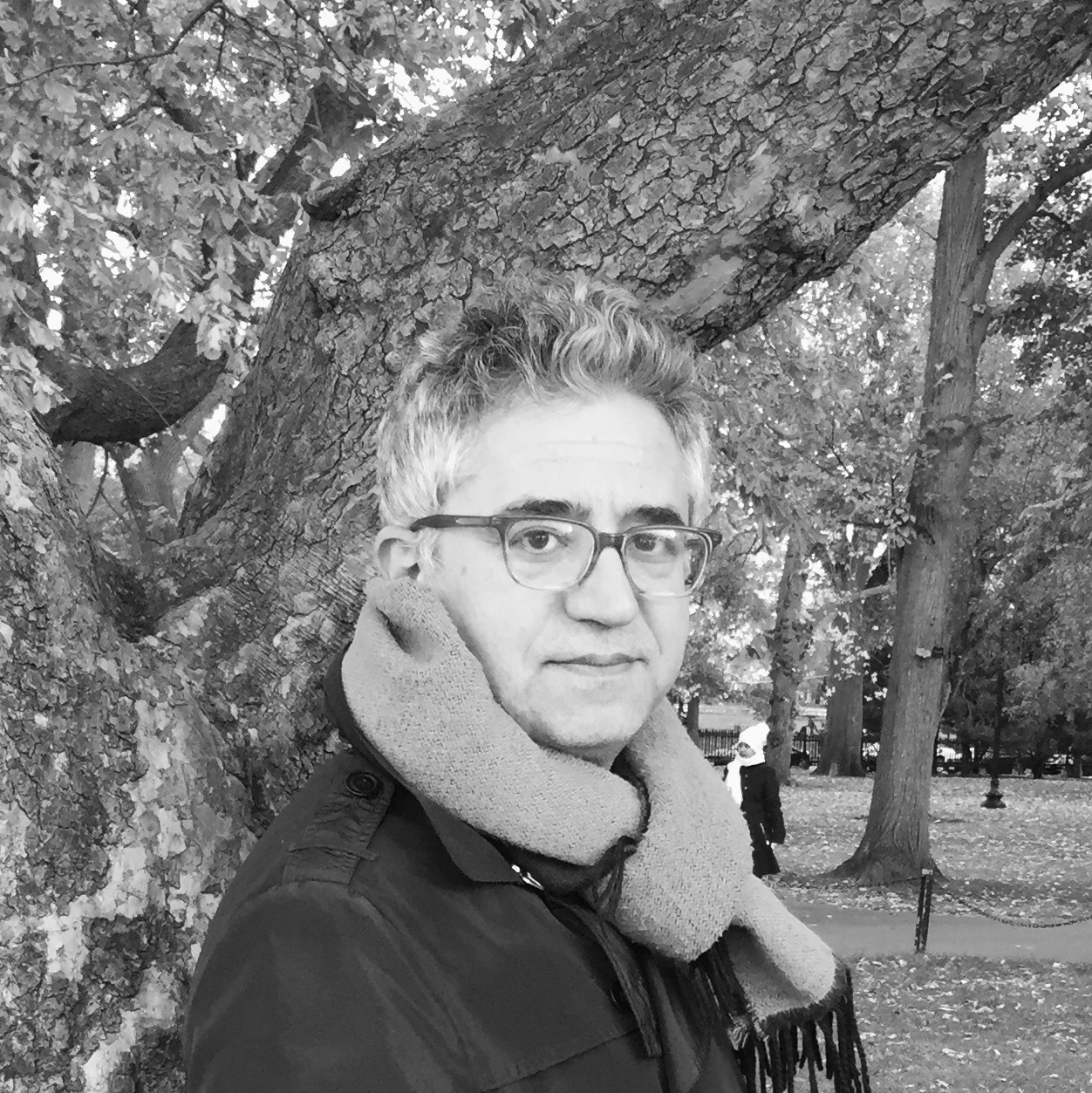
Gazmend Kapllani
Kapllani crossed into Greece in 1991, worked and studied in Athens, earned a doctorate at Panteion University and became the migration's defining literary chronicler through A Short Border Handbook.
Photo: ErnestoSaffo / Wikimedia Commons · CC BY-SA 4.0
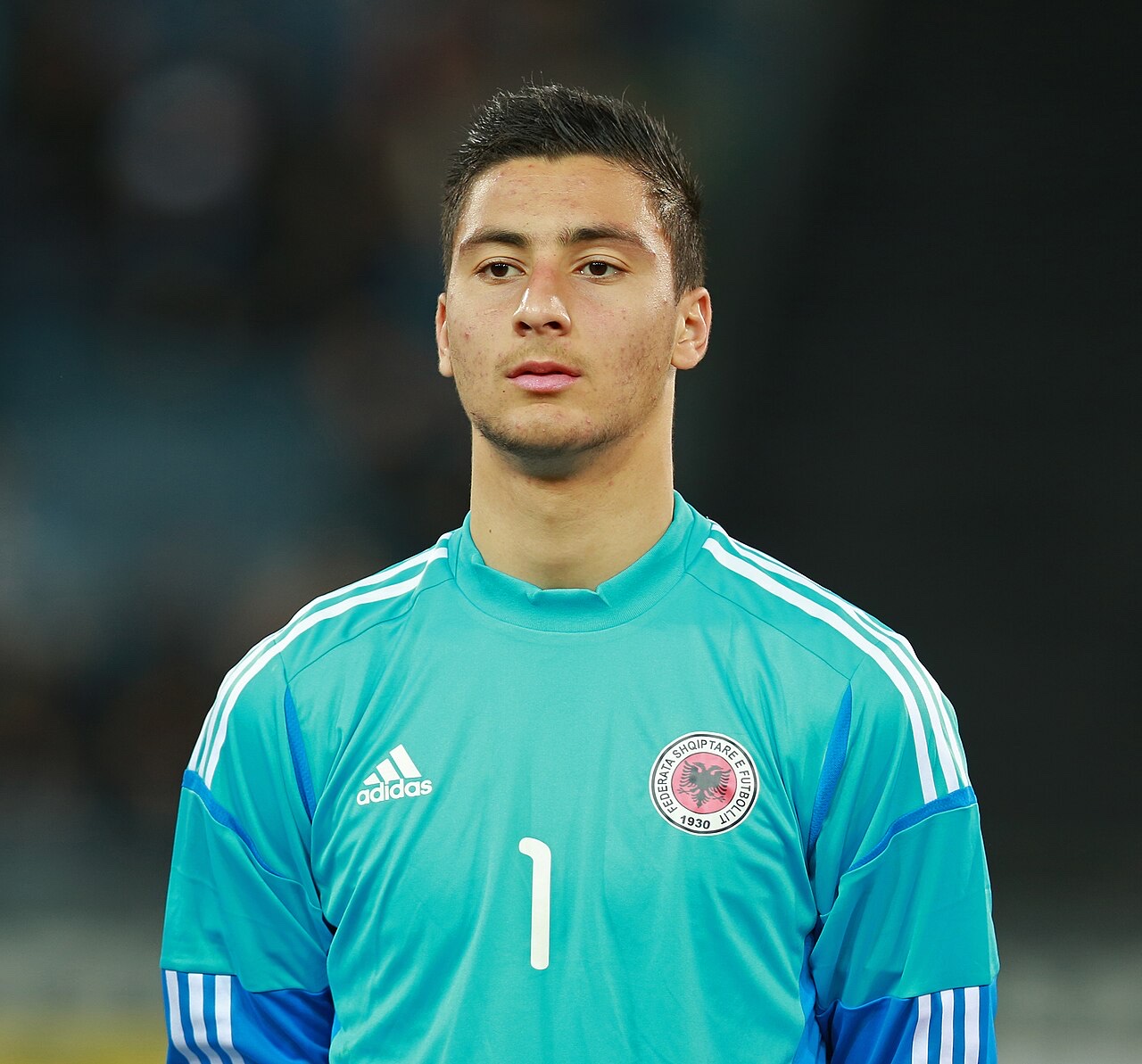
Thomas Strakosha
Born in Athens to an Albanian football family, Strakosha came through Greek football and represents Albania internationally — a direct second-generation bridge between the city and the country of origin.
Photo: Kulac / Wikimedia Commons · CC BY-SA 3.0

Neritan Zinxhiria
Brought to Greece as an infant, Zinxhiria formed his career inside the Greek cultural world and became an award-winning filmmaker. His generation is no longer only the subject of migration stories; it directs them.
Photo: Vera de Kok / Wikimedia Commons · CC BY-SA 4.0
Other Athens-linked names include actors Kostas Nikouli and Nikos Gelia, Athens-born artist Sin Boy, and the contemporary professional representatives working through the Greek-Albanian Entrepreneurship Committee. Biographies and current roles should be rechecked immediately before any future update.
How Albanians in Athens connect today
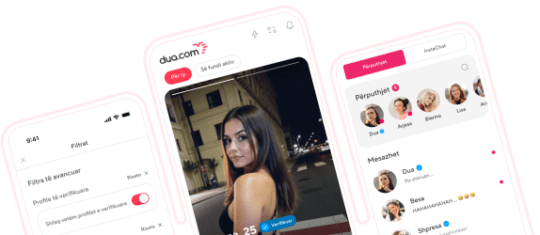
A dispersed city changes how people meet. There is no single square, café strip or neighbourhood where every Albanian in Athens passes through. Families still connect through schools, associations, friends, weddings and summer travel to Albania, but digital community now bridges distances inside Attica and across the diaspora.
That is the useful role of the platform in this city: not replacing community organisations, but making a community without a central district easier to find. People can connect within Athens or across Greece, Albania, Kosovo, North Macedonia and the wider diaspora while being explicit about language, roots and relationship intentions.
Practical Athens directory
Addresses, office hours and programme schedules can change. The entries below are verified starting points; check the linked official source before travelling.
| Need | Organisation | Current detail |
|---|---|---|
| Albanian consular services | Embassy of Albania in Greece | Vekiareli 7, Filothei 15237; use the official site for appointments, phone and emergency contacts |
| Legal, social and integration support | City of Athens Migrant Integration Center (KEM) | Mezonos 45 and Psaron; psychosocial support, legal guidance, benefits, language and citizenship-exam assistance |
| Citywide service search | Athens Coordination Center for Migrant and Refugee Issues | Municipal and civil-society service directory |
| Professional networking | Greek-Albanian Entrepreneurship Committee | Information, training and representation through the Athens Professional Chamber |
| Migrant rights and coordination | Greek Forum of Migrants | Long-running umbrella organisation and City of Athens partner |
| Schools, association events and culture | Albanian Embassy newsroom | The most reliable current feed reviewed for teacher, association and cultural events |
Methodology and evidence ledger
This page uses the 2021 population census because it is the latest full count with comparable citizenship and country-of-birth tables. Eurostat disseminates the Greek census at NUTS 2 and NUTS 3 levels. The direct API filters used for the Attica headline are geography EL30, Albania as citizenship or country of birth, both sexes and all ages.
- Official counts: 140,148 Albanian citizens and 176,989 Albania-born residents across Attica.
- Conservative floor: for each disjoint five-year age band, select the larger official count, then sum. Rounded result: approximately 198,000.
- Best evidence-led range: 200,000–250,000 allows for Greek-born descendants and modest undercount. It is anchored by the official floor, Attica's 37–42 percent share of the nationally visible community and the Greece-wide community discourse around 500,000–600,000 people.
- High-end community hypothesis: up to 300,000. This gives the capital half of a 600,000-strong national community and explicitly allows for descendants missing from official rows. Dividing by the 3,059,764-person Athens–Piraeus urban area produces the “approximately every tenth person” formulation; dividing by all Attica produces about one in thirteen.
- Neighbourhood and housing evidence: 2011 census microdata interpreted in a 2024 peer-reviewed paper, plus eight interviews from 2023.
- Current institutions: official Chamber, embassy, municipal and association reports checked through 11 August 2026.
- dua.com data: registered-member location count for July 2026; behavioural percentages use relevant Greece-wide responding cohorts and are never generalised to Athens residents.
What the page deliberately does not claim
- It does not add the citizenship and birthplace totals.
- It does not call 250,000 an official count or 300,000 a census result.
- It does not repeat 400,000–500,000 as an Athens estimate when the reviewed claims refer to all Greece.
- It does not claim every third or fourth Athenian is Albanian.
- It does not label 55,399 as the municipality population.
- It does not call Kypseli, Patissia or any other area “Little Albania”.
- It does not turn 2011 housing data or a 2009 pupil study into current rates.
- It does not add Arvanites to a modern migration total.
- It does not treat Albanian citizenship, Albania birthplace and Albanian ethnic identity as synonyms.
Frequently asked questions about Albanians in Athens
How many Albanians live in Athens?
The evidence-led answer is roughly 200,000–250,000 people of Albanian origin across Attica, with a high-end community hypothesis of up to 300,000 in Greater Athens. The hard Attica floor is about 198,000, derived from overlapping census measures: 140,148 Albanian citizens and 176,989 Albania-born residents. Greece publishes no official ethnic total.
Could 400,000–500,000 Albanians live in Athens?
No reviewed evidence supports that figure for Athens or Attica. Half a million is commonly used for the Albanian community across all Greece. Attica holds 37–42 percent of the officially visible national population, supporting roughly 200,000–250,000 people of Albanian origin. The page adopts up to 300,000 as the high-end community hypothesis and does not go beyond it.
Is every tenth person in Athens of Albanian descent?
That is a defensible high-end community hypothesis for Greater Athens, not an official statistic. Up to 300,000 people divided by the Athens–Piraeus urban area's 3,059,764 residents equals 9.8 percent, approximately one in ten. Across all Attica, the same 300,000 would equal 7.9 percent, or about one in thirteen.
Did Athens really speak Albanian in the nineteenth century?
Arvanitika, an Albanian-rooted language, was widely spoken in Plaka and villages around the small capital. Edmond About's 1855 description of Athens as an “Albanian village” is traveller testimony, not a census. Athens had only about 7,000–10,000 residents when it became capital in 1834. Arvanites are Greeks and are not added to the modern diaspora count.
Is that figure for Athens city or Attica?
Attica, the full capital region. Current detailed public census data is available for Attica and its regional units, not for Albanian ethnicity in the Municipality of Athens. Central Athens regional unit counted 55,399 Albanian citizens, but it includes the municipality plus seven neighbouring municipalities.
Where do most Albanians live in Athens?
Central Athens has the largest regional-unit total, followed by Piraeus and Islands and East Attica. Inside the municipality, research using 2011 census microdata found relative concentrations in Ampelokipi, Gyzi, northern Pangrati and Neos Kosmos. These are concentrations, not exclusive Albanian districts.
Is there an Albanian neighbourhood in Athens?
No single neighbourhood functions as “Little Albania”. Albanian families are dispersed across central apartment districts, western and southern municipalities, Piraeus and the outer suburbs. Family networks can be locally dense, but the strongest housing research describes a pattern of micro-concentration inside a broadly mixed city.
Why did the official Albanian population fall after 2011?
Naturalisation, return migration and onward migration. Greek citizenship moved people out of the Albanian-citizen row, while the debt crisis destroyed construction jobs and pushed some families back to Albania or elsewhere in Europe. The citizenship count fell faster than the Albanian-origin community itself.
How many Albania-born people in Attica have Greek citizenship?
The reviewed public totals do not provide one clean all-ages answer for that exact overlap. The gap between 176,989 Albania-born residents and 140,148 Albanian citizens signals extensive naturalisation, but the groups also differ for other reasons. Subtracting them would not produce a valid naturalisation count.
Do Albanian children in Athens still learn Albanian?
Many do through families and weekend programmes, but Greek is usually dominant for the Athens-born generation. Albania began supporting an initial group of 50 teachers across Greece in 2025, and the teachers' association organised a public Albanian-language children's event in Athens in June 2026.
Which Albanian associations are active in Athens?
Documented organisations include the Albanian Community in Greece, Vellazerimi, the Albanian Women's Association in Greece, the Association of Albanian Language Teachers in Greece and Tirona – League of Albanians in Greece. The Embassy of Albania newsroom is the most reliable current event feed reviewed.
Where can Albanian citizens get consular help in Athens?
The Embassy of Albania in Greece is at Vekiareli 7, Filothei 15237. Use the embassy's official website for the latest appointment process, telephone numbers, consular hours and emergency contacts before travelling.
Where can migrants get legal or integration support?
The City of Athens Migrant Integration Center at Mezonos 45 and Psaron provides psychosocial support, legal guidance, benefits assistance, language support and citizenship-exam preparation. The Athens Coordination Center for Migrant and Refugee Issues maintains a broader city service directory.
Are Arvanites part of the modern Albanian population?
No. Arvanites are Greeks with a centuries-old Arvanitika language heritage and overwhelmingly identify as Greek. Their history belongs in the cultural landscape of Attica, but adding them to a post-1990 migration count would misrepresent both their identity and the modern statistics.
How can you meet other Albanians in Athens?
Community associations, language events, business networks, festivals, football and family contacts remain important. For direct introductions, dua.com had 6,155 registered members in Athens in July 2026 and connects people locally as well as across Greece and the wider Albanian diaspora.






.jpg)