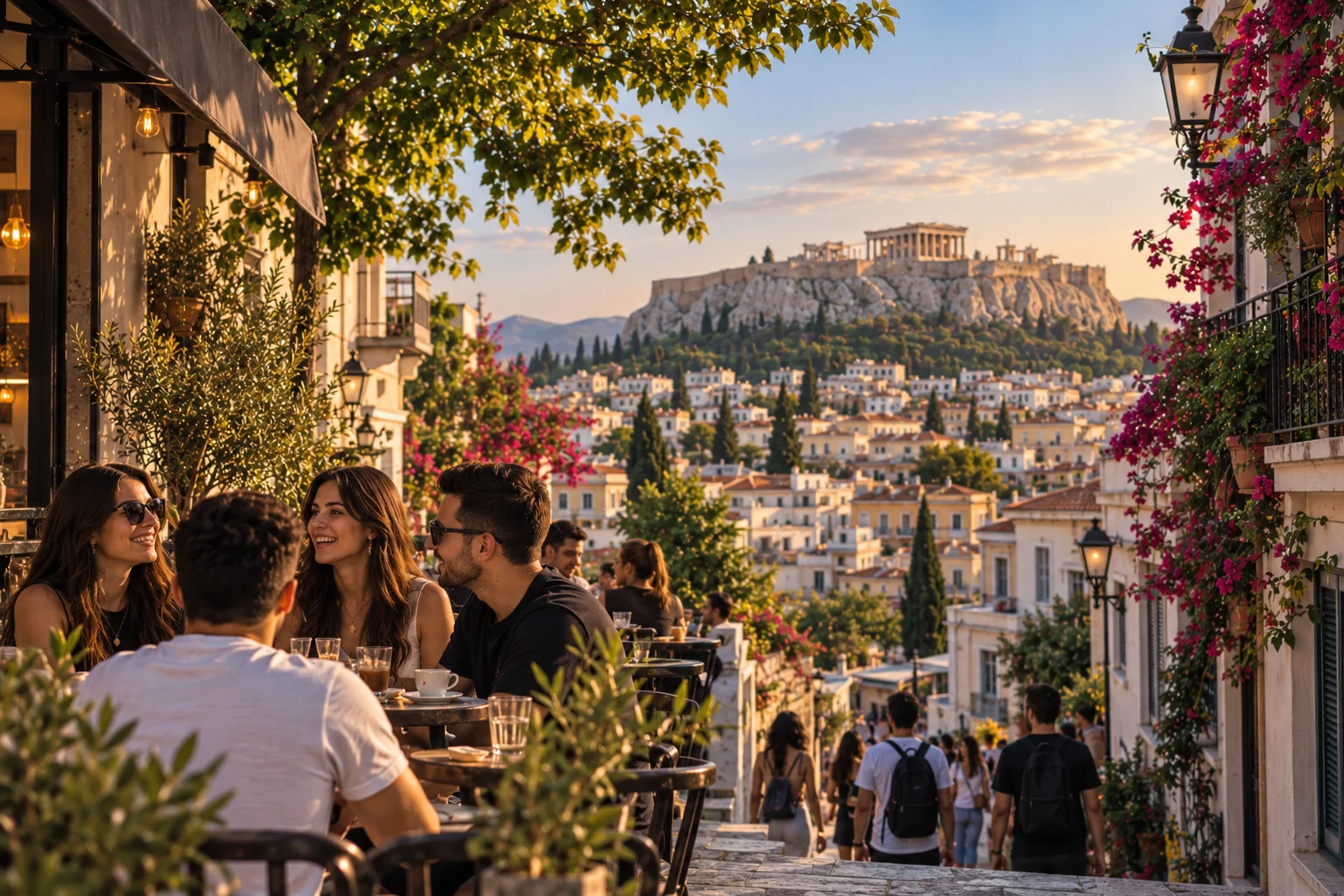
One of the largest migrations between two neighbouring countries in modern European history began on foot. In the winter of 1990–91, people left Albania across the mountain border at Kakavia and Kapshtica. More than three decades later, their story is also one of settlement, families and a generation growing up between Greek and Albanian life.
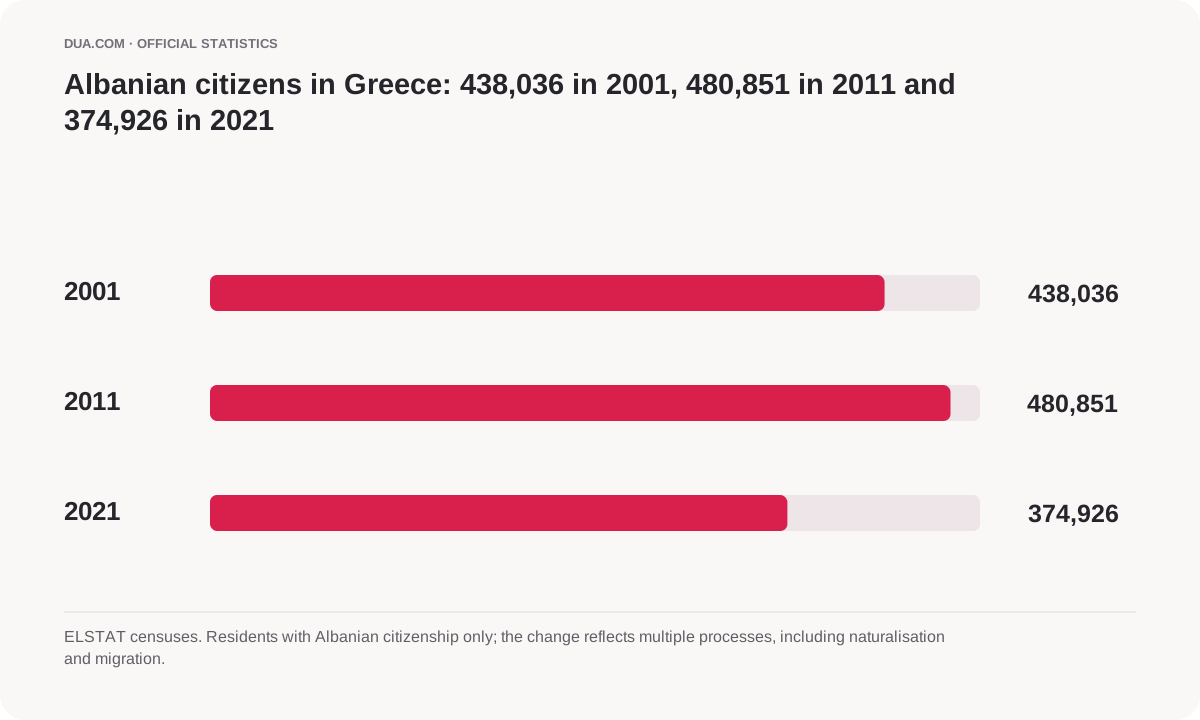
The 2021 census counted 374,926 residents with Albanian citizenship. That is a firm benchmark, but it does not count the whole community with roots in Albania. Many people have become Greek citizens, and citizenship, birthplace and ethnic identity describe different things.
This guide brings those distinctions into the story: the migration of the 1990s, naturalisation, the much older Arvanite language heritage, the contested history of Çamëria, and the ways Albanians in Greece find one another today.
For more on this topic, read Albanians in Germany: A Million-Strong Community and Albanians in Italy: A Community Approaching 900,000.
Editorial review: 11 September 2026. Each statistic retains its reference date. Citizenship, ethnic identity and language heritage are distinguished; contested historical interpretations are attributed.
How many Albanians live in Greece?
Albanians are part of everyday life in Greece — but putting an exact number on the whole community is surprisingly difficult.
The clearest starting point is the 2021 Greek census. ELSTAT counted 374,926 residents with Albanian citizenship, making them by far the largest foreign-citizen group: 49% of Greece’s 765,598 foreign citizens, compared with 4.6% for Bulgarians, the next-largest group.
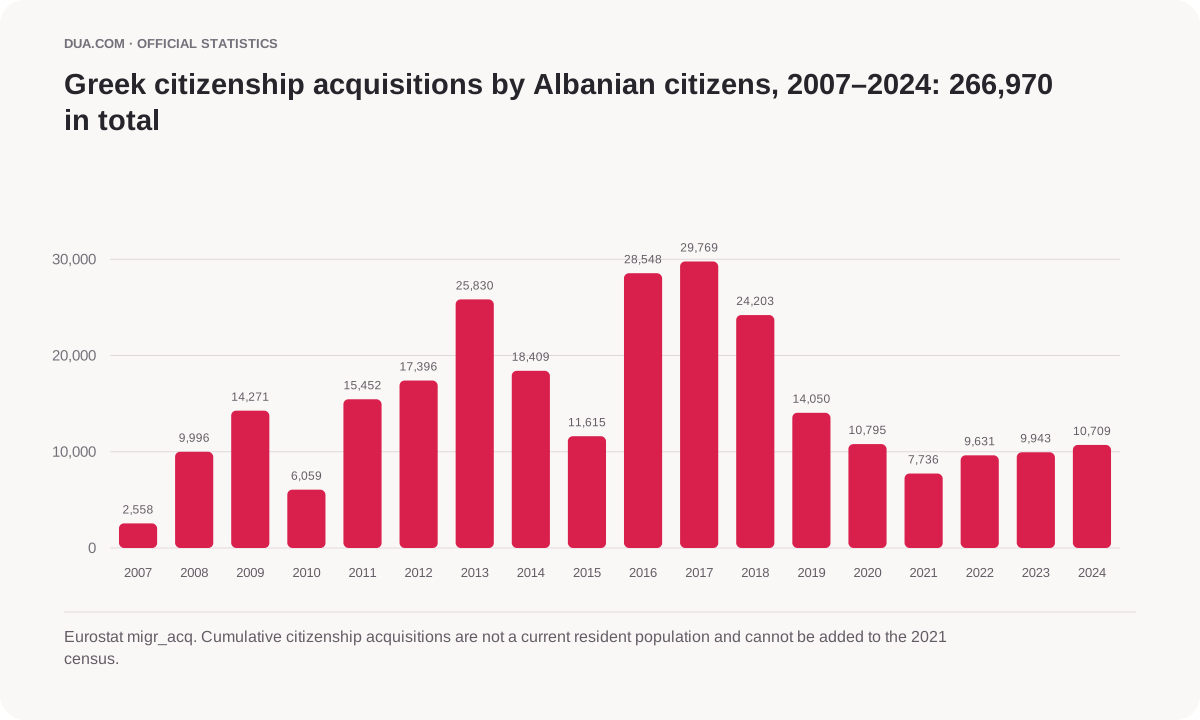
But 374,926 is only part of the story. Many people who arrived from Albania in the 1990s built their lives in Greece, raised families and acquired Greek citizenship. Their children may have been born and educated there and appear in official statistics simply as Greek. Between 2007 and 2024, 266,970 Albanian citizens acquired Greek citizenship, according to Eurostat.
Those two figures cannot simply be added together. They cover different periods and populations. Someone counted as an Albanian citizen in 2021 may also appear in the naturalisation figures for 2022–2024. The acquisition series includes Albanian citizens of different ethnic backgrounds; deaths, return migration and onward migration also mean that not everyone naturalised since 2007 necessarily lives in Greece today.
The census counted 480,851 Albanian citizens in 2011, compared with 374,926 in 2021. That decline does not simply mean that more than 100,000 people left. Return migration played a role, particularly during and after the economic crisis, alongside naturalisation, onward migration and demographic change.
There is therefore no single official current total for everyone of Albanian origin in Greece. The evidence describes several hundred thousand people with roots in Albania and one of the largest such communities outside the Albanian-speaking Balkans. It is now a story of settlement, families and a generation increasingly recorded by the Greek state as Greek.
That is part of the community dua.com was built to connect. Whether someone grew up in Athens, moved to Thessaloniki from Albania, or has family spread between Greece, Kosovo, Albania and the wider diaspora, shared language and experience can reach across the borders that statistics struggle to capture.
The walk: 1991 and the hard decade
Albania’s isolation broke at its southern border first. Roughly 3,000 people had crossed into Greece on foot by the end of 1990; by mid-March 1991 the count had passed 20,000, part of an exodus of more than 200,000 people who left Albania within the year. They came over the passes in winter — through Kakavia and Kapshtica, down the Pindus valleys, many walking for days — into a country whose language many of the first arrivals, the ethnic-Greek minority of southern Albania, already spoke.
The revolving door
What followed was the harshest reception any Albanian diaspora met. Greece’s 1991 immigration law was, in the judgement of the migration scholar Martin Baldwin-Edwards, “little more than a policy of exclusion and expulsion specifically aimed at Albanians”. Through the 1990s, police sweeps known as skoupa — the broom — produced summary expulsions on an extraordinary scale: around 200,000 expulsions a year through the decade, with reported peaks near 277,000 in 1992, and over two million expulsion events by 2001. That figure counts events, not people: the same men were deported, walked back over the mountains, and returned to the same building sites within weeks. Expulsion was even used as diplomatic signalling — tens of thousands deported in days after bilateral flashpoints in 1993 and 1994.
Legal status, when it finally came, arrived all at once. Greece’s first regularisation in 1998 drew 372,000 applicants — about 65 percent of them Albanian — and further rounds followed in 2001 and 2005. A workforce that had built Athens’ Olympic decade in legal shadow finally got papers; Greek social-insurance rolls and school registers filled with Albanian names.
The stigma years
The 1990s Greek press wrote “Albanian” and “criminal” as near-synonyms — the criminologist Vassilis Karydis documented the equation illegal immigrant = Albanian criminal as the media default of the decade. The stigma had real casualties. Its worst moment came on 4 September 2004, hours after Albania beat Greece in a World Cup qualifier, when 20-year-old Gramoz Palushi was stabbed to death on Zakynthos as post-match celebrations turned violent — a killing widely covered in both countries, in the very years attitudes had begun to turn. The years around it also carried the era’s defining argument: twice, in 2000 and 2003, the Albanian-born top student Odysseas Cenaj earned the right to carry the Greek flag at his school parade — and twice a national controversy followed over whether he could.
The crisis and the turn
The Greek debt crisis after 2010 hit Albanian families hard. Construction, a major source of work for the community, contracted by more than 80%. INSTAT and the IOM recorded 133,544 Albanian adults aged 18 and over returning to Albania between 2009 and 2013 from all countries of previous residence; 70.8% returned from Greece. Return migration was therefore an important part of the story. The census decline from 480,851 Albanian citizens in 2011 to 374,926 in 2021 reflects several processes, however: naturalisation, return migration, onward migration and demographic change. These figures do not let us divide the decline into just those who became Greek and those who went home.
Yet the same decade turned the legal story around. A 2010 law opened citizenship to the second generation, was struck down by the Council of State in 2013, and returned as Law 4332 of 2015 — citizenship through birth or schooling in Greece. The gates opened: 107,801 second-generation grants across all nationalities by 2023 — with Albanian children around four in five of the 2023 grantees. The community the skoupa had chased through the 1990s became, in the 2010s, the overwhelming majority of new Greeks.
Twenty-eight years after the skoupa, Greek EMAK crews were digging through rubble in Durrës after the earthquake of 26 November 2019 — and Albanian television showed them being applauded in the streets.
The Arvanites: an Albanian-speaking story centuries older than migration
Long before the migration waves of the 1990s, Albanian was already being spoken across parts of what is now Greece.
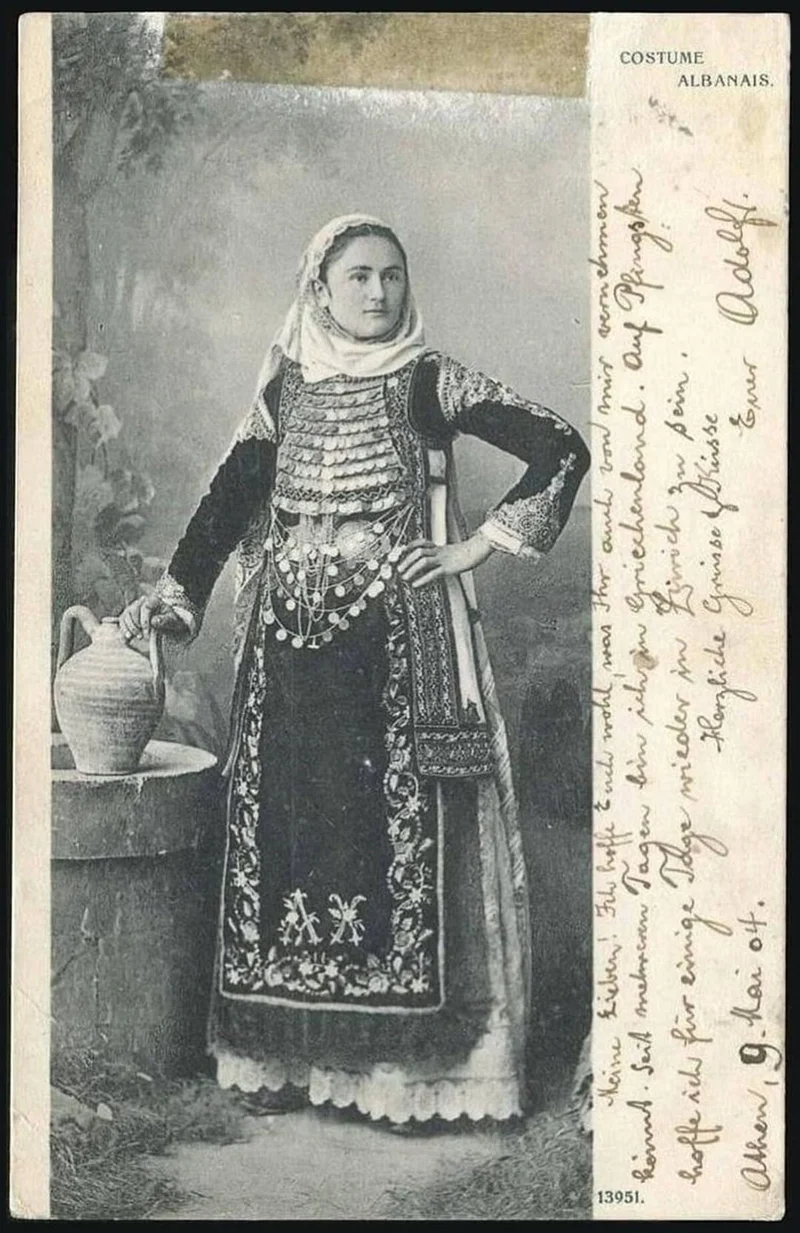
Between roughly the 14th and 16th centuries, Albanian-speaking communities settled in Attica, Boeotia, Euboea, the Peloponnese and on islands including Hydra, Spetses and Salamis. Many came as farmers and soldiers, granted land by Byzantine and Frankish rulers. Their descendants became known as the Arvanites.
When Athens became the Greek capital in 1834, it was a small town surrounded by villages where Arvanitika was widely spoken. Even Plaka, beneath the Acropolis, was described by 19th-century travellers as an Albanian-speaking quarter. Writing in the 1850s, Edmond About called earlier Athens “only an Albanian village” and claimed nearby communities barely understood Greek. His language was dismissive, but Arvanitika was part of the region’s everyday linguistic landscape.
Language and identity are not the same thing. Arvanites today overwhelmingly identify as Greek. In a major sociolinguistic survey, 97% of Arvanite respondents identified as Greek; some reject the modern label “Albanian” when applied to their identity.
The linguistic link is Arvanitika, a Tosk-rooted variety of Albanian that survived for centuries in Greece. Today it is severely endangered and spoken mainly by older generations. Estimates range from around 30,000 to 200,000, depending on whether researchers count fluent speakers, elderly semi-speakers or a broader heritage connection. These are differing definitions, not a precise speaker census.
In the 1990s, some Arvanites heard newcomers from Albania speaking a language that sounded unexpectedly familiar, close to words their parents or grandparents had once used at home. Linguists documented an encounter that could feel familiar and distant at the same time.
The linguistic connection was real; the identities were different. Arvanite history is part of Greece’s history, their identity is Greek, and their language preserves one of the oldest surviving links between the Albanian and Greek worlds.
Hear Arvanitika in the voices of its speakers
The heritage that helped build Greece
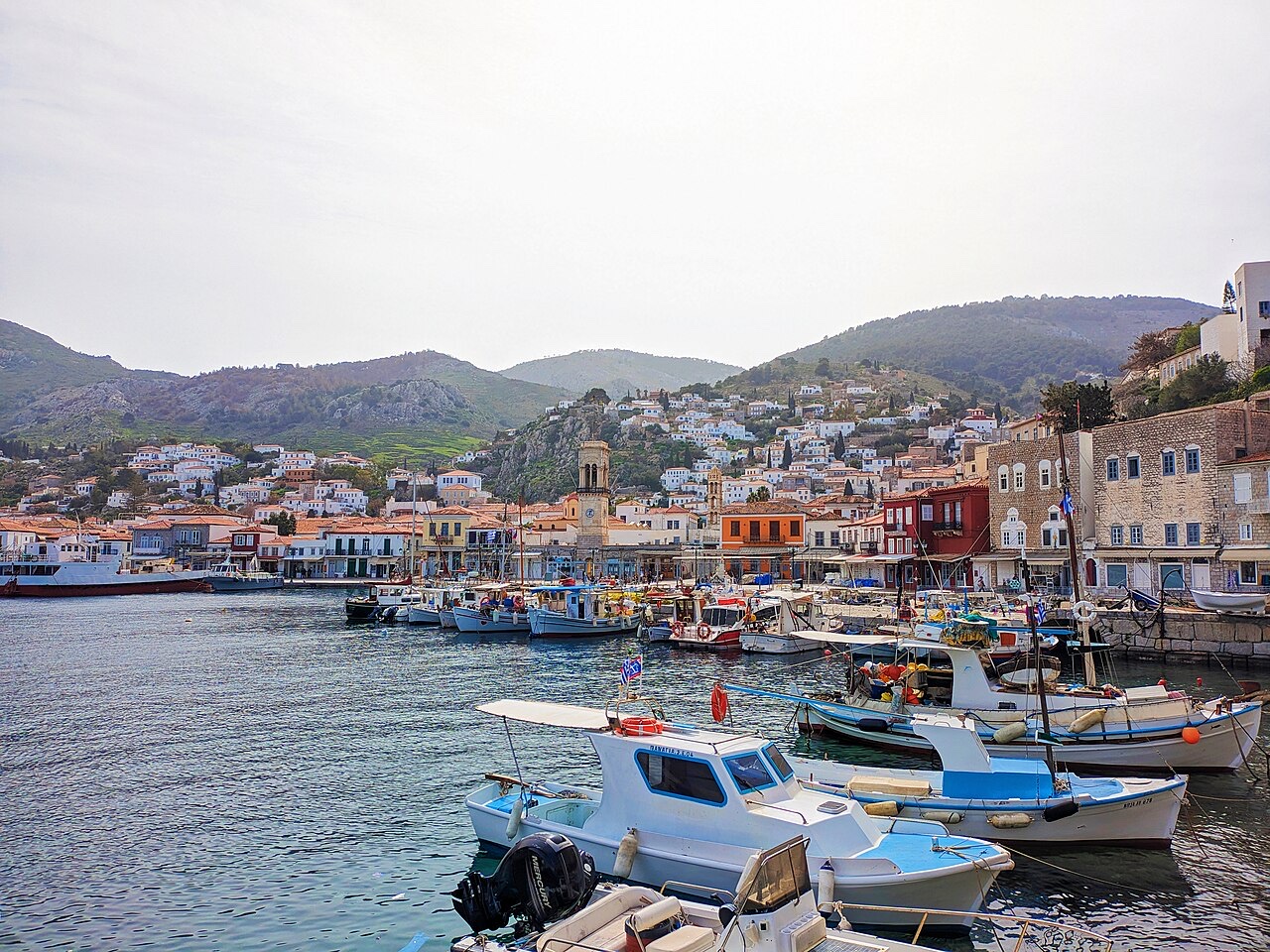
The Arvanite contribution to the Greek state includes the revolutionary fleet and part of the founding pantheon. The shipowning families of Hydra and Spetses, Arvanite-settled islands both, financed and crewed the revolutionary navy of 1821. The Souliotes — the Orthodox warrior clans of Epirus whose resistance to Ali Pasha entered European legend — descended, per the standard scholarship, from Albanian-speaking pastoral clans settled in Thesprotia around the sixteenth century; from 1821 they fought and died as Greeks among Greeks. Their story runs through this page’s people section: Markos Botsaris, whose own hand wrote a Greek–Albanian dictionary; the admirals Miaoulis and Kountouriotis; three Prime Ministers of Greece from Hydra’s Arvanite families. Greece’s national heroes include men and women whose grandmothers sang in Arvanitika — a measure of how deep the weave runs, and no claim on anyone’s identity.
Çamëria: a history with contested interpretations
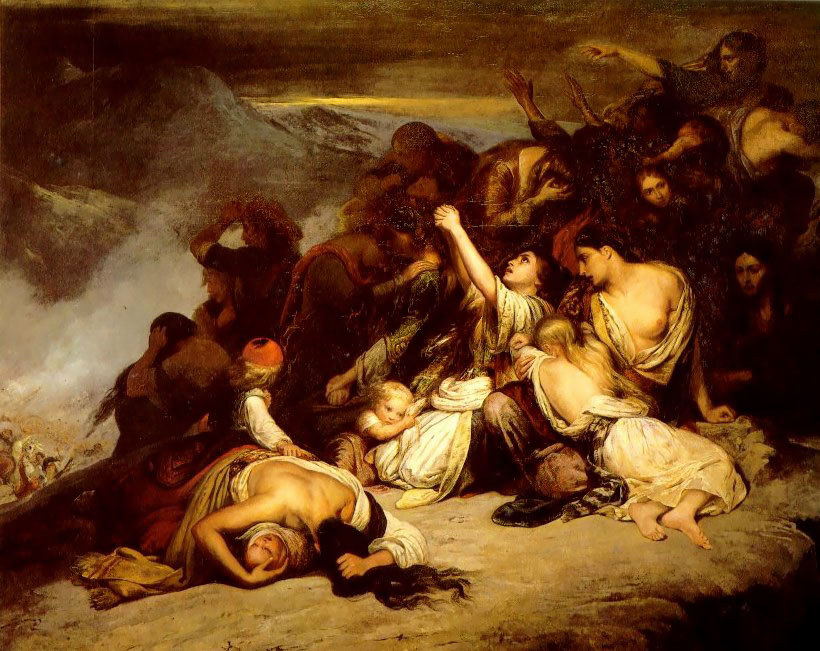
Before the Second World War, roughly 17,000 to 23,000 Muslim Cham Albanians lived in Thesprotia — an Albanian-speaking Muslim population established there since the Ottoman period. Greek official counts ranged from about 17,000 to 22,000; an Albanian consular count from 1936 recorded 23,048.
During the Axis occupation, members of the Cham community collaborated with Italian and German forces. The extent of that collaboration, and how representative it was of the wider community, remains debated by historians. Other Chams joined the resistance, including the mixed “Ali Demi” battalion of ELAS. Collaboration also had documented Greek victims: among the best-known cases were the 49 Greek notables of Paramythia, executed by German forces in September 1943 with the involvement of local Cham collaborators.
What followed in 1944–45 is well documented, even as its causes, character and death toll remain contested. As German forces withdrew, EDES units under Napoleon Zervas moved into Thesprotia. Violence against Muslim Cham civilians accompanied the advance, including killings in and around Paramythia in June 1944 and Filiates in March 1945. By the end of the conflict, the overwhelming majority of the Muslim Cham population had fled or been driven across the border into Albania.
Estimates of the human cost differ substantially. Historians cited in the literature put the number directly killed at more than 1,200, while Albanian and Cham sources give figures of roughly 2,000 to 2,877. Higher estimates of up to about 5,000 deaths include people who died from hunger, disease and hardship during the flight. Only a small Muslim Cham population remained in Greece after the war.
The historical sequence is clearer than the political interpretation attached to it. Collaboration by part of the Cham population is documented, as are crimes against Greek civilians; so are killings, forced displacement and the near-disappearance of the Muslim Cham community from Thesprotia. Historians, communities and the Greek and Albanian states continue to disagree over responsibility, terminology, legal consequences and how this history should be remembered.
Where the community lives
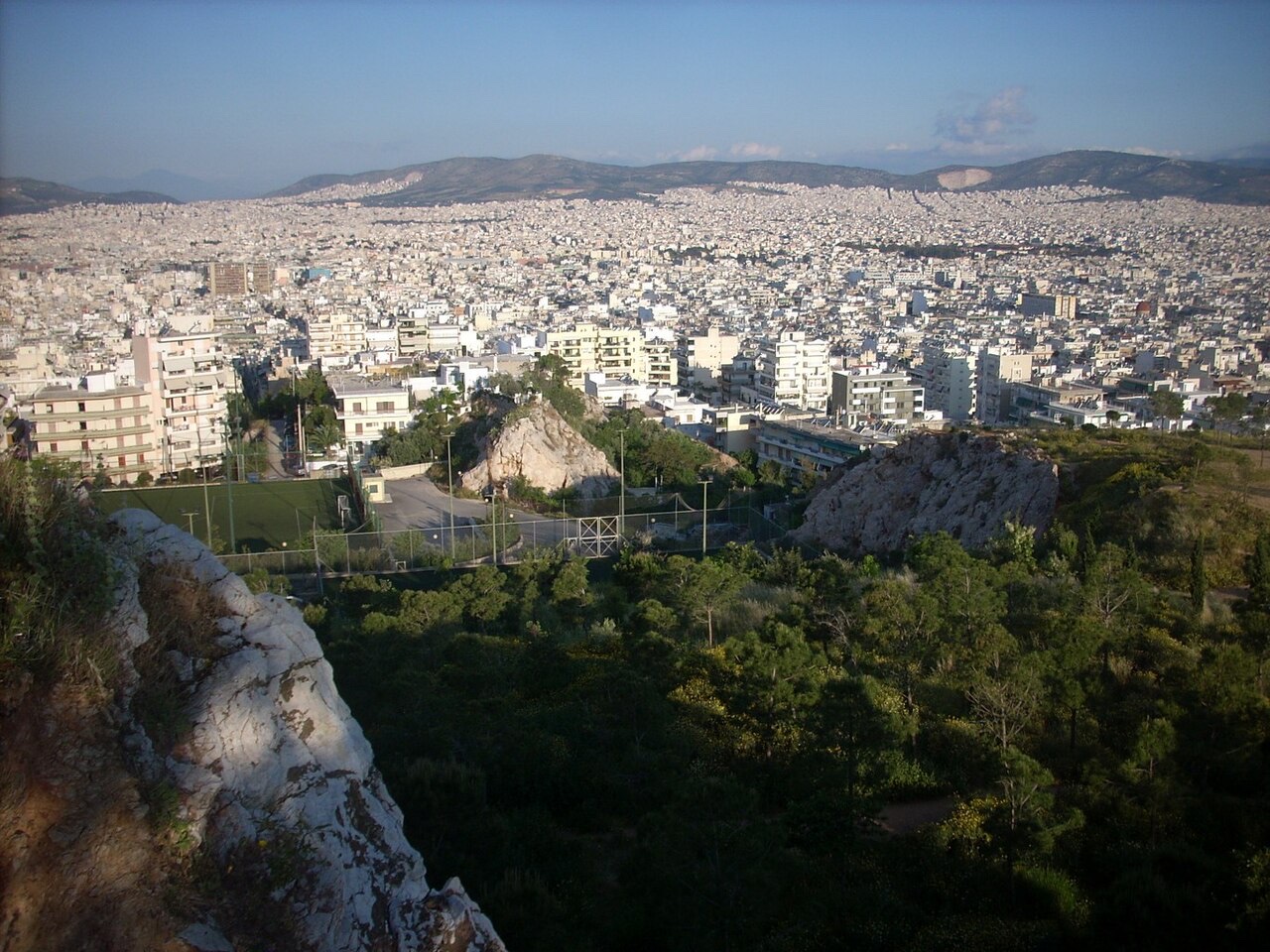
In Athens, above all. At the 2021 census, the Attica region held 140,146 Albanian citizens — more than a third of the national total — with Central Macedonia around Thessaloniki second at 63,069. The insured workforce maps the same way: 48.1 percent of Albanian-insured workers are employed in Attica. Where Italy’s Albanians scattered across a hundred provincial towns, Greece’s community concentrated in the capital’s neighbourhoods — Kypseli, Patisia, Kallithea — and in the agricultural belts and islands where the work was.
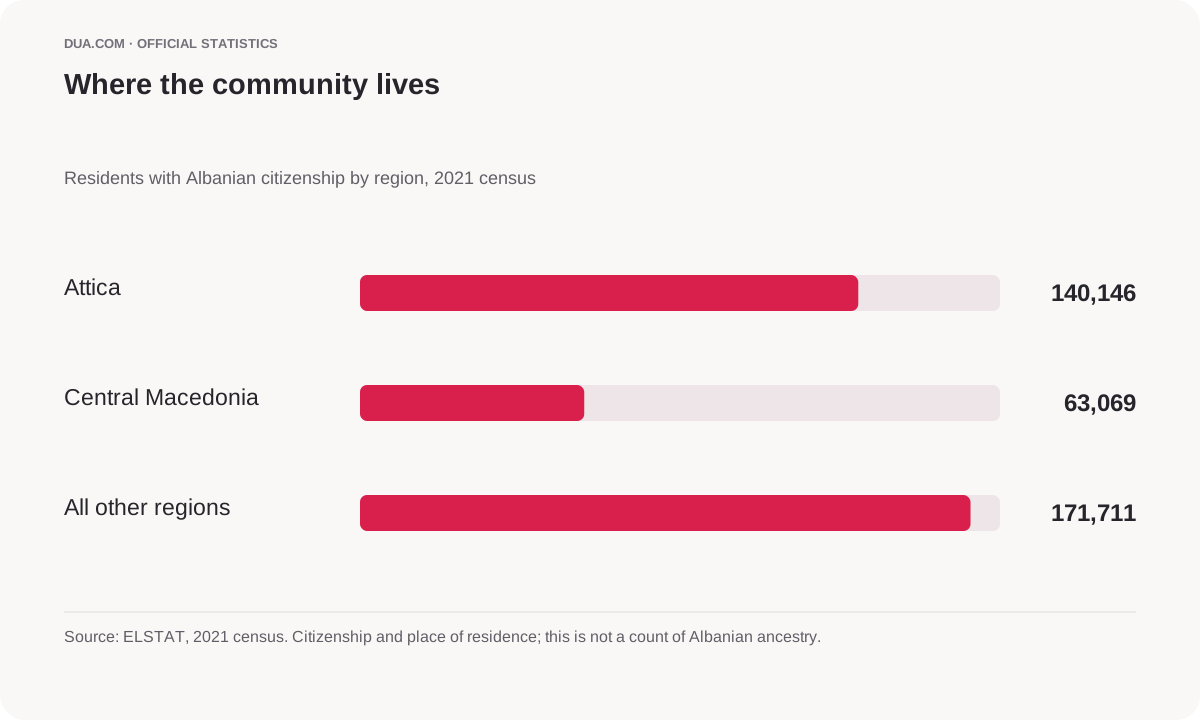
The dominance runs deepest where the numbers are smallest: in Western Macedonia, Albanians are 77.4 percent of all foreign citizens; across most of rural Greece, “the foreigners” and “the Albanians” have been the same people for thirty years. In Attica the share is 40.6 percent of a much more mixed foreign population — the capital is where Albanian Greece lives, but also where it blends.
The two doors: how Albanian citizens became Greek citizens
Greek citizenship reached people who migrated from Albania through different legal routes. Keeping those routes separate is essential to understanding the numbers.
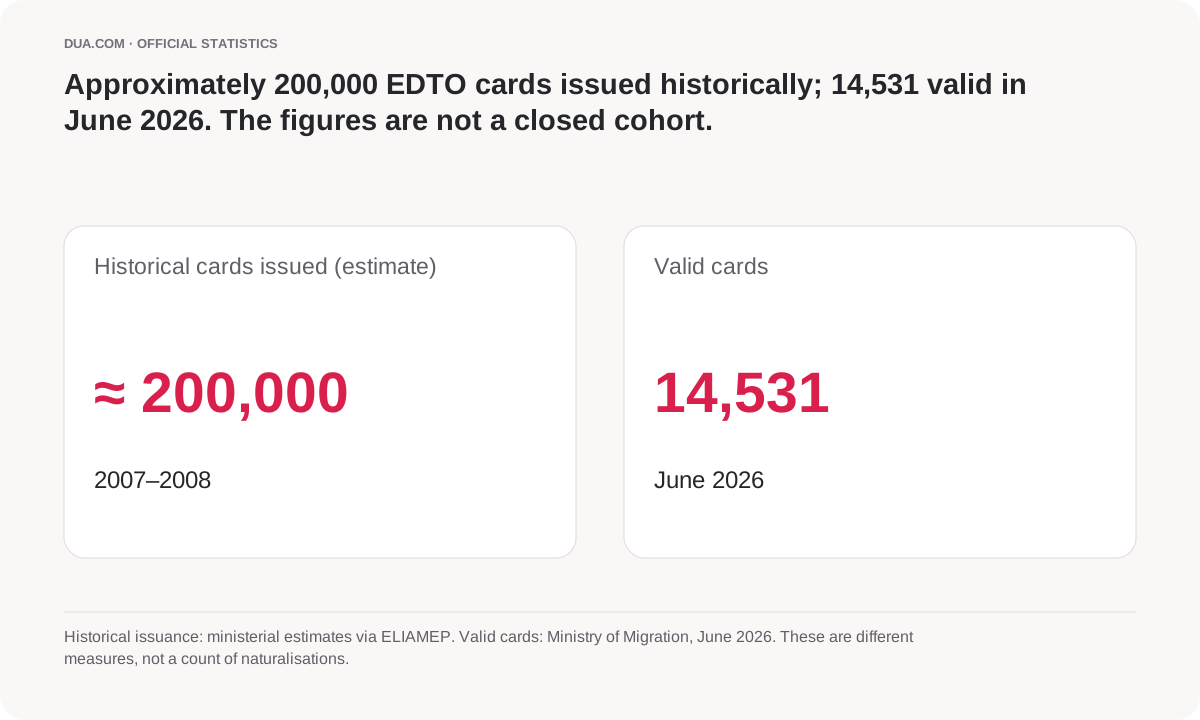
The first was the co-ethnic route. Albanian citizens recognised by Greece as being of Greek descent — the omogeneis, largely from the recognised Greek-minority areas of southern Albania — could receive Special Identity Cards (EDTO) and later access a facilitated path to Greek citizenship. Roughly 200,000 cards were issued historically; by June 2026, only 14,531 remained valid.
Naturalisation explains an important part of that decline, but historical issuance and today’s valid-card total are not a closed cohort. Deaths, expired status and migration elsewhere may also contribute. The gap is not a count of people who became Greek citizens.
The second route covered migrants and, increasingly, their children who qualified through legal residence, birth or schooling in Greece. Ordinary naturalisation was a long process for many first-generation migrants. Law 4332/2015 created a clearer route for children born or educated in Greece. By 2023, 107,801 second-generation citizenship grants had been recorded across all nationalities under this framework; Albanians accounted for about 79% of recipients in 2023.
Between 2007 and 2024, 266,970 Albanian citizens acquired Greek citizenship, according to Eurostat. Such acquisitions help explain why statistics based only on Albanian citizenship increasingly understate the community with roots in Albania. The second-generation grants are a separate administrative series, not an extra group to add to that total.
Naturalisation is only part of the explanation for the census decline from 480,851 Albanian citizens in 2011 to 374,926 in 2021. Greece’s economic crisis also triggered substantial return and onward migration. Legal status, migration and demographic change were happening at once.
A population that spent much of the 1990s struggling for regular residence now includes a large number of Greek citizens — many born, educated and building their lives in Greece.
Work and money
Albanian Greece was built — literally — on construction. At the end of 2024, 131,771 Albanian citizens were insured employees with EFKA, Greece’s social-insurance fund: 5.1 percent of all insured workers, and 47.3 percent of all insured foreigners. In construction, Albanians are 40.6 percent of the insured workforce — in the sector that raised the 2004 Olympic city, fewer than half the insured workers are Greek.
The remittance arc compresses the community’s economic history into one line. Before 2010, Greece and Italy together supplied more than 60 percent of a flow that peaked near €1.2 billion, with Greece then among the top two sources. The crisis broke it: total inflows to Albania fell by a fifth, and the Bank of Albania attributed the fall explicitly to Greece’s labour-market collapse. Today Albanian media, citing a Eurostat-attributed breakdown, put Greece fourth at about €202 million a year — behind Italy, the UK and Germany — less because families send less than because the community itself is now largely Greek: savings stay where the children are citizens.
Language, faith and community life
Linguistic assimilation ran faster here than in any other Albanian diaspora; the organised effort to pull the language back came later, and came hard. The first generation learned Greek on building sites within months; researchers in Thessaloniki documented Albanian families — Muslim-origin ones included — baptising their children Greek Orthodox and adopting Greek names in the 1990s and 2000s, a survival strategy in the stigma years that the scholarship calls exactly that. The second generation grew up Greek-speaking; by 2002/03, seven in ten foreign pupils in Greek schools were Albanian — 69,880 children — and almost none of them wrote Albanian.
The response is one of the largest weekend-school networks in the diaspora. The League of Albanian Teachers in Greece coordinates supplementary Albanian classes — the mësimi plotësues — with Albania’s Diaspora Publications Centre listing around 60 courses across Greece and shipping thousands of free textbooks each year. In Thessaloniki, the “Nënë Tereza” association has run free Saturday classes for two decades; in Athens, volunteer courses run from Kypseli to Pallini. The teachers are volunteers or state-contracted; the classrooms are borrowed; the stakes are whether the grandchildren of the walk will be able to speak to their grandparents.
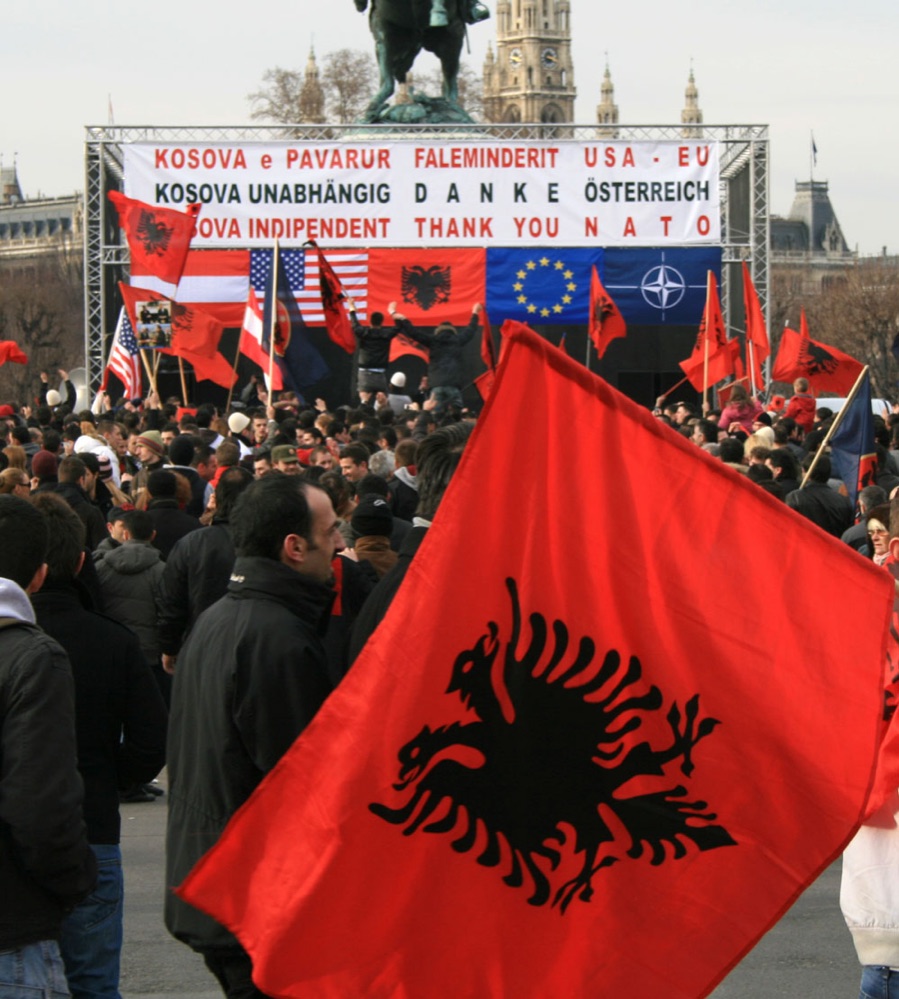
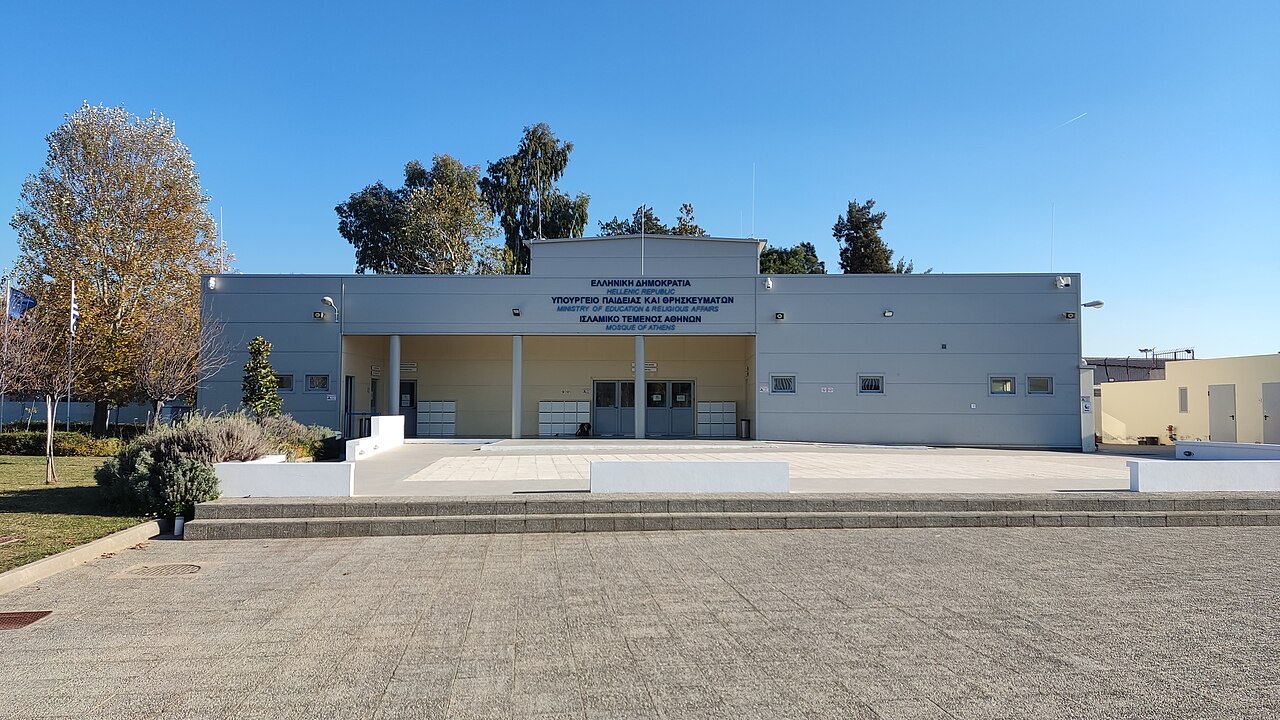
Faith in Albanian Greece is quiet and plural. Orthodox Albanians found the parish familiar; Muslim Albanians practised at home for a generation in a capital that — remarkably — had no official mosque until the state-built Votanikos Mosque opened in November 2020. A small Albanian Catholic community gathers with the Capuchins in central Athens. And on 28 November, Flag Day, the community is anything but quiet: Athens streets fill with red-and-black flags, and the embassy’s “Nëntori Shqiptar” programme runs concerts and receptions through the month.
The organisations that hold Albanian Greece together
The community organised late — the 1990s left no room for it — and is organising fast now. Three tiers do the work.
At the top, the Federation of Albanian Associations in Greece (F.SH.SH.G), based by Omonia in central Athens, is the historic umbrella — its successor community organisation marked twenty years in November 2024 under president Rovena Xhori. A newer coordination body, Diaspora Shqiptare në Greqi, was founded in Thessaloniki in February 2024 to knit dozens of associations together. Beneath them, Albania’s National Diaspora Agency registry lists 32 organisations across Greece — hometown associations for Korça, Lushnja, Përmeti and Lunxhëria, the emigrants of Arta and Ioannina, women’s and cultural groups — the best single directory of who is active where.
Alongside them: the League of Albanian Teachers running the weekend schools; the Greek Forum of Migrants, where Albanians hold senior roles across the migrant-rights movement; Albanian polyphonic and folk ensembles registered from Athens to the islands; and the scholarly infrastructure — ELIAMEP’s migration research tradition, and Albanian taught at the University of Athens’ language centre and Macedonia University’s Balkan studies department. The community’s newspaper era — Egnatia from 1993, Gazeta e Athinës from 1998 — has largely passed to portals and to the state-supported Diaspora Shqiptare, whose Greece desk covers the schools and associations continuously.
The people: from Botsaris to Foureira
Two very different rolls of honour meet on this page. The first belongs to Greece’s own history: national heroes of documented Arvanite and Souliote heritage — Greeks, presented here exactly as they saw themselves, whose family languages happened to be rooted in Albanian. The second belongs to the last thirty-five years: the migrants and their children, with each person’s identity stated precisely — in this community, the precision matters.
The heritage roll: heroes of Greece
Markos Botsaris
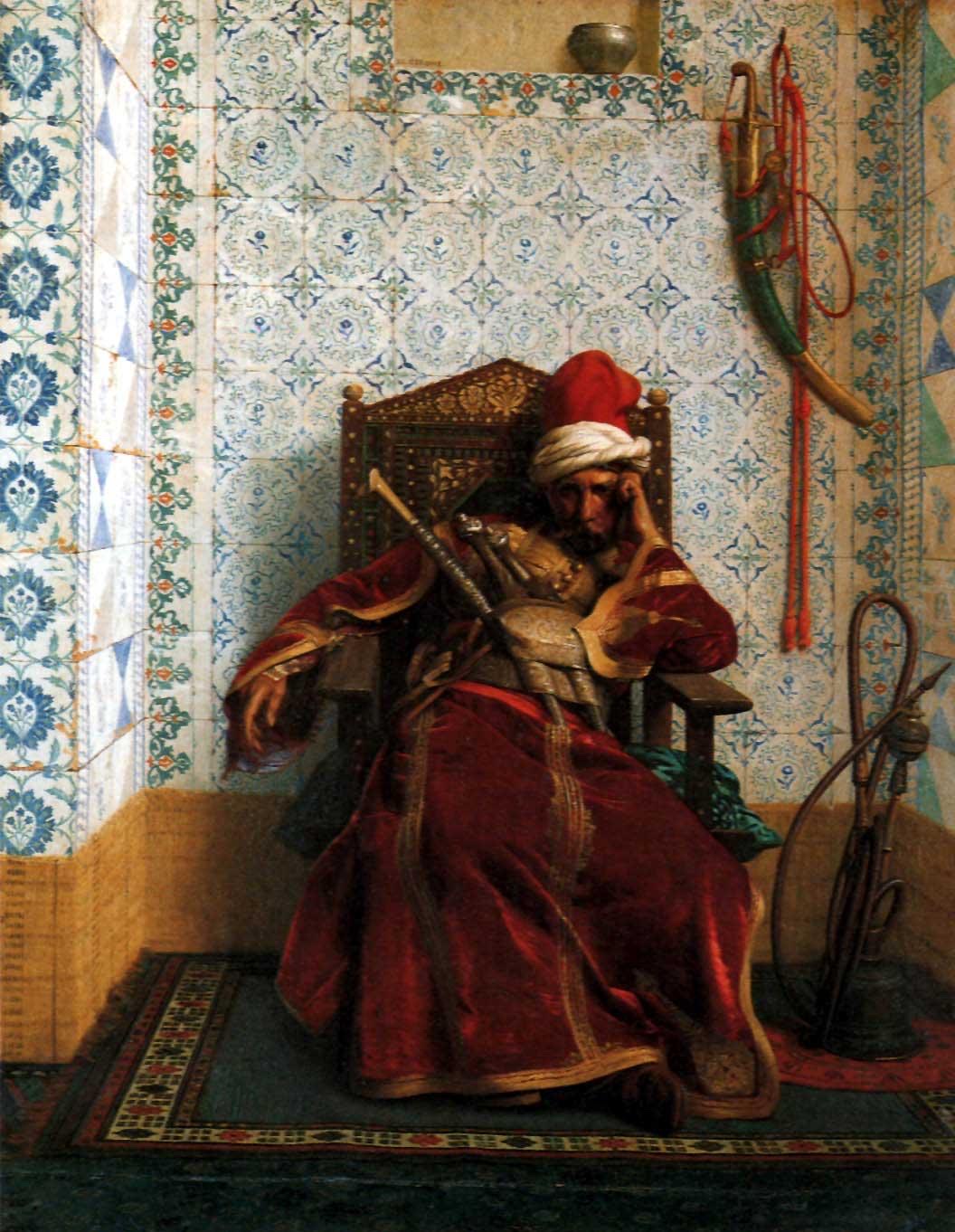
Leader of the Souliotes, general of Western Central Greece, killed leading a night attack at Karpenisi in August 1823 and mourned across Europe — Delacroix painted his fall. A Greek national hero of the first rank; and in Corfu in 1809 his own hand wrote a Greek–Albanian dictionary, today in the Bibliothèque nationale de France — the language of Souli, recorded by its most famous son. The standard scholarship holds that the Souliotes were Orthodox clans of Albanian-speaking origin who fought and died for the Greek Revolution — a framing Greek and Albanian historiographies still contest at the edges.
Painting: Jean-Léon Gérôme, 1874 · public domain
Laskarina Bouboulina
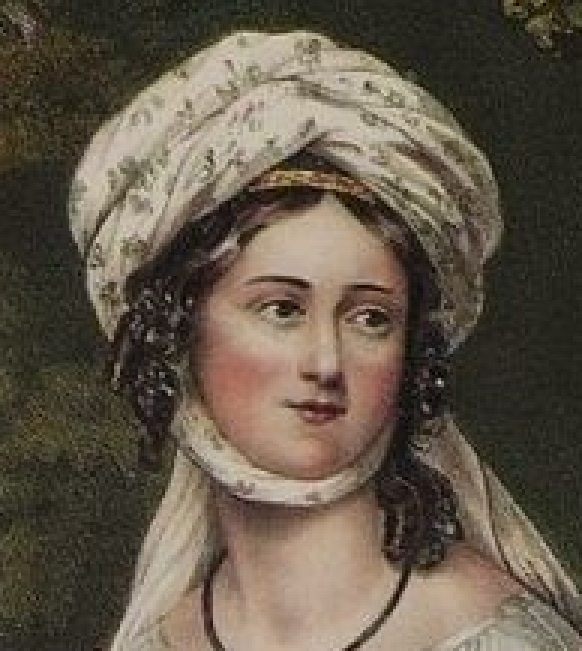
The naval heroine of 1821: she financed and commanded warships, blockaded Nafplio, and was named honorary Rear Admiral by the Greek Navy — in 2018, 193 years after her death. Her heritage is reported as Arvanite on her father’s Hydriot side by the standard biographical references — a claim some scholars dispute: attributed lineage on one line of a thoroughly Greek life. Spetses keeps her museum; the Greek Navy keeps her rank.
Engraving: Adam Friedel, 1827 · public domain
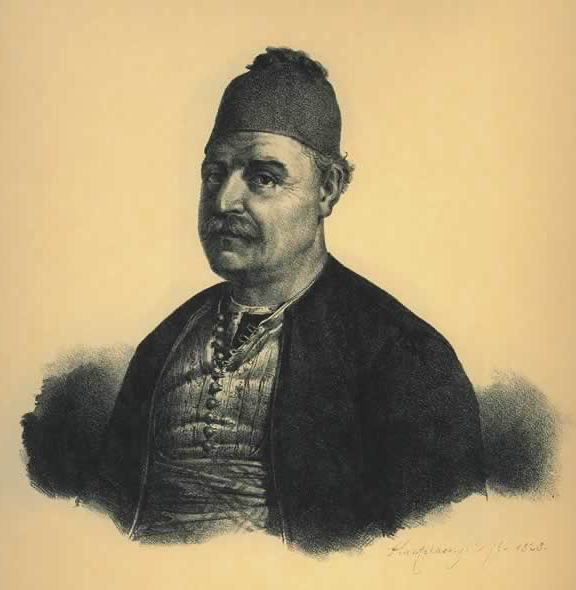
Andreas Miaoulis — and Hydra’s fleet
Admiral of the revolutionary fleet from 1822, victor of Nauplia and a string of sea battles that kept the Revolution alive. Born on Hydra to an Arvanite family from Euboea, he stands for something larger: the fleets of Hydra and Spetses — the Arvanite-settled islands — were the navy of the Greek War of Independence. His son Athanasios was Prime Minister of Greece for four and a half years; the Kriezis and Voulgaris families of the same Hydriot world gave Greece two more Prime Ministers, and Pavlos Kountouriotis — victor of Elli and Lemnos, first President of the Second Hellenic Republic — descended from Hydra’s great Arvanite shipping house.
Portrait: Karl Krazeisen · public domain
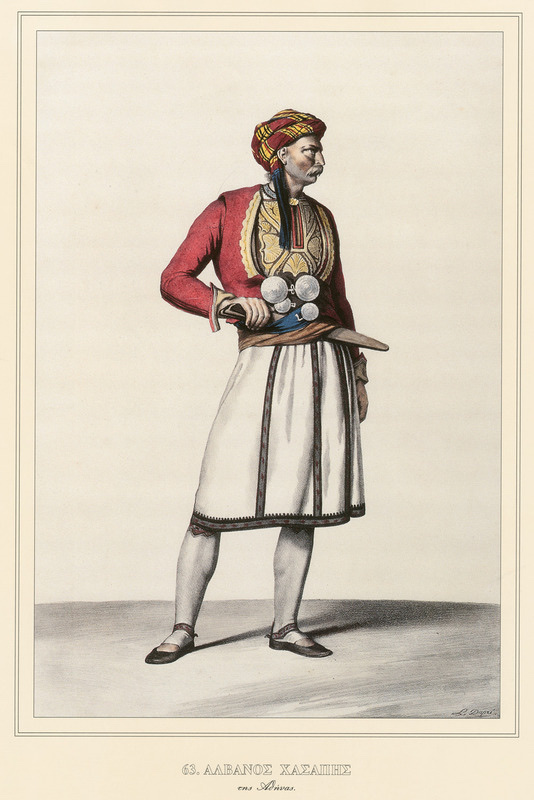
A heritage in plain sight
Louis Dupré’s 1827 lithograph of an “Albanian butcher in Athens” — drawn when Arvanitika could be heard across Attica’s villages. The heritage never hid: it is in place names, in songs, in the fustanella the Greek court adopted as national dress in 1835 (a garment both nations claim — a dispute worth noting and leaving there). The politician Theodoros Pangalos, Greek Foreign Minister of the 1990s, liked to say it plainly: his ancestors were Arvanites — and he was, therefore, exactly as Greek as Greece itself.
Lithograph: Louis Dupré, 1827 · public domain
The modern roll: the migration and its children
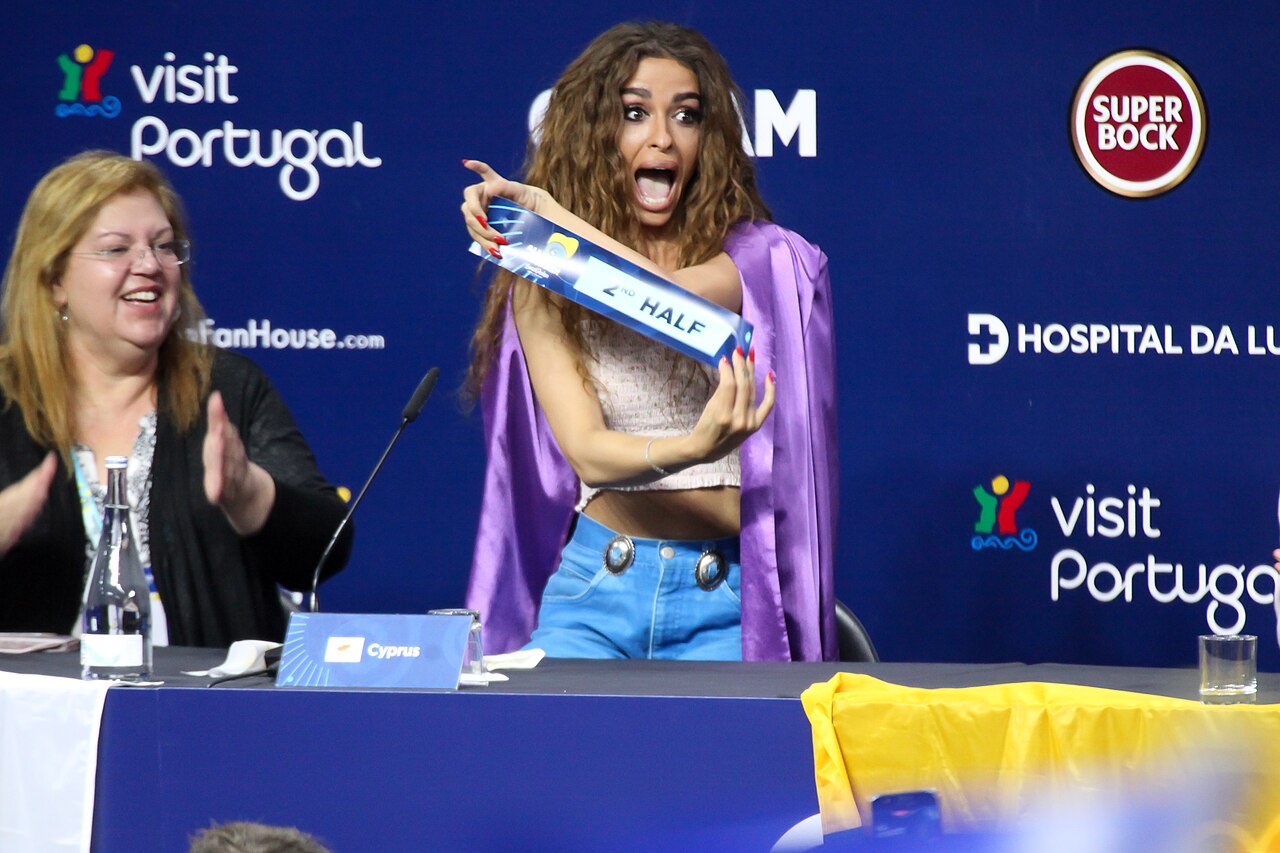
Eleni Foureira
Born Entela Fureraj in Fier in 1987, in Athens from childhood, and for a decade one of Greece’s biggest pop stars. At Eurovision 2018 she sang “Fuego” — for Cyprus — and finished second, the island’s best result ever. For years she kept her birthplace out of the story; Greek media reported it in 2013, and the following year she confirmed it, in words many of her second-generation peers have echoed: she had stayed silent “in order to be accepted”. Her openness since marks how far the country she grew up in has moved.
Photo: Dewayne Barkley, EuroVisionary / Wikimedia Commons · CC BY-SA 4.0
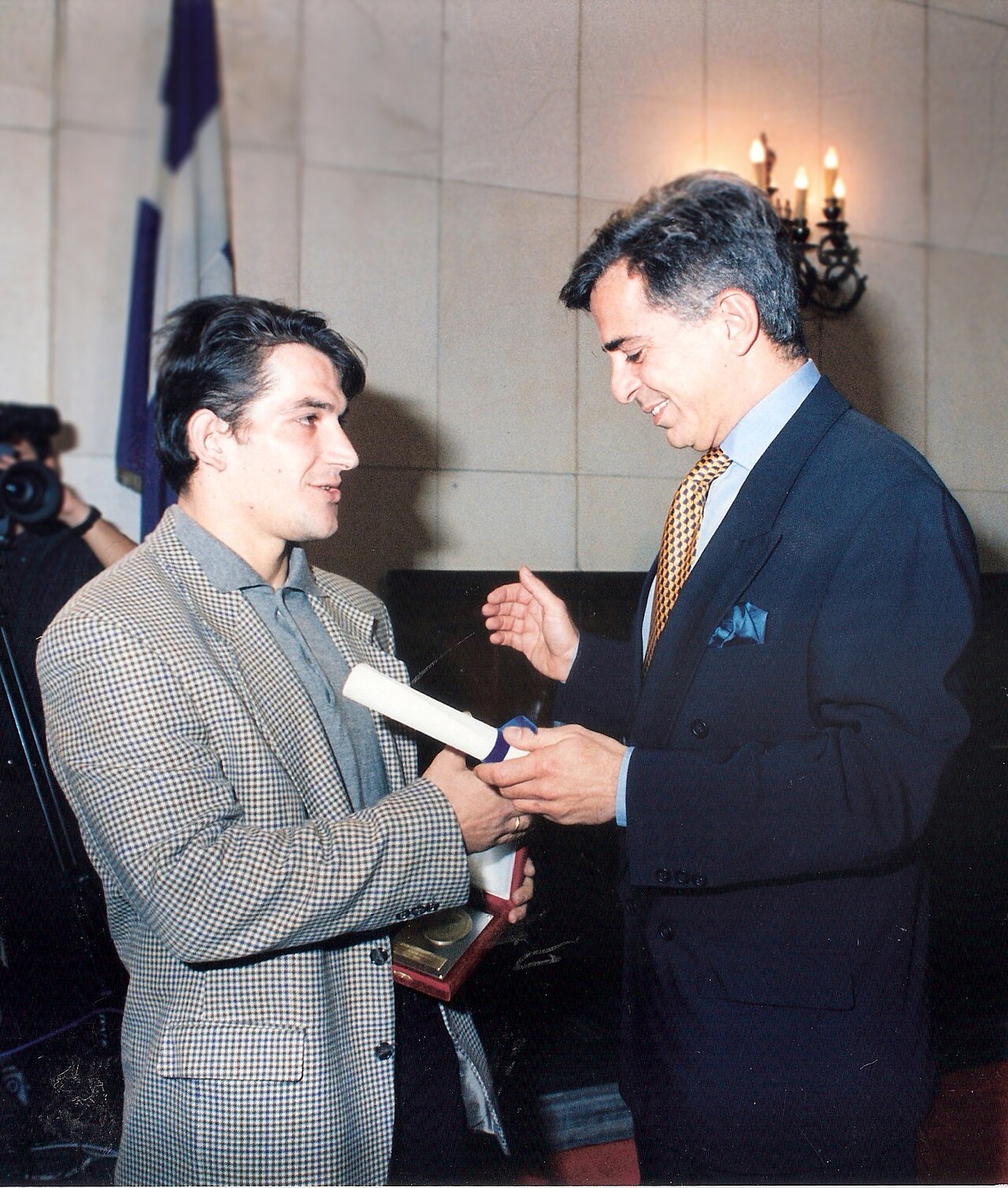
Pyrros Dimas
Three Olympic golds for Greece — Barcelona 1992, one year after crossing the border; Atlanta 1996; Sydney 2000 — and a bronze at Athens 2004 lifted on a wrecked knee to a stadium chanting his name. Born in Himarë in 1971, Dimas is not an ethnic Albanian: he is of the Greek community of Himarë in southern Albania, and says so plainly — “I am not of Albanian origin. I am a Greek, born in Albania, a child of the minority.” He belongs on this page because his road was this community’s road: the same 1991 crossing, with the weightlifting cohort who crossed in the same wave — Leonidas Kokas of Dropull’s minority villages, Leonidas Sabanis of Korçë, Viktor Mitrou of Vlorë — who between them lifted four more Olympic silvers for Greece (a fifth medal, a Sabanis bronze from Athens 2004, was stripped for doping) and were, for many Greeks, the first famous faces of the people walking in from the north.
Photo: DiviFilius / Wikimedia Commons · CC BY-SA 3.0
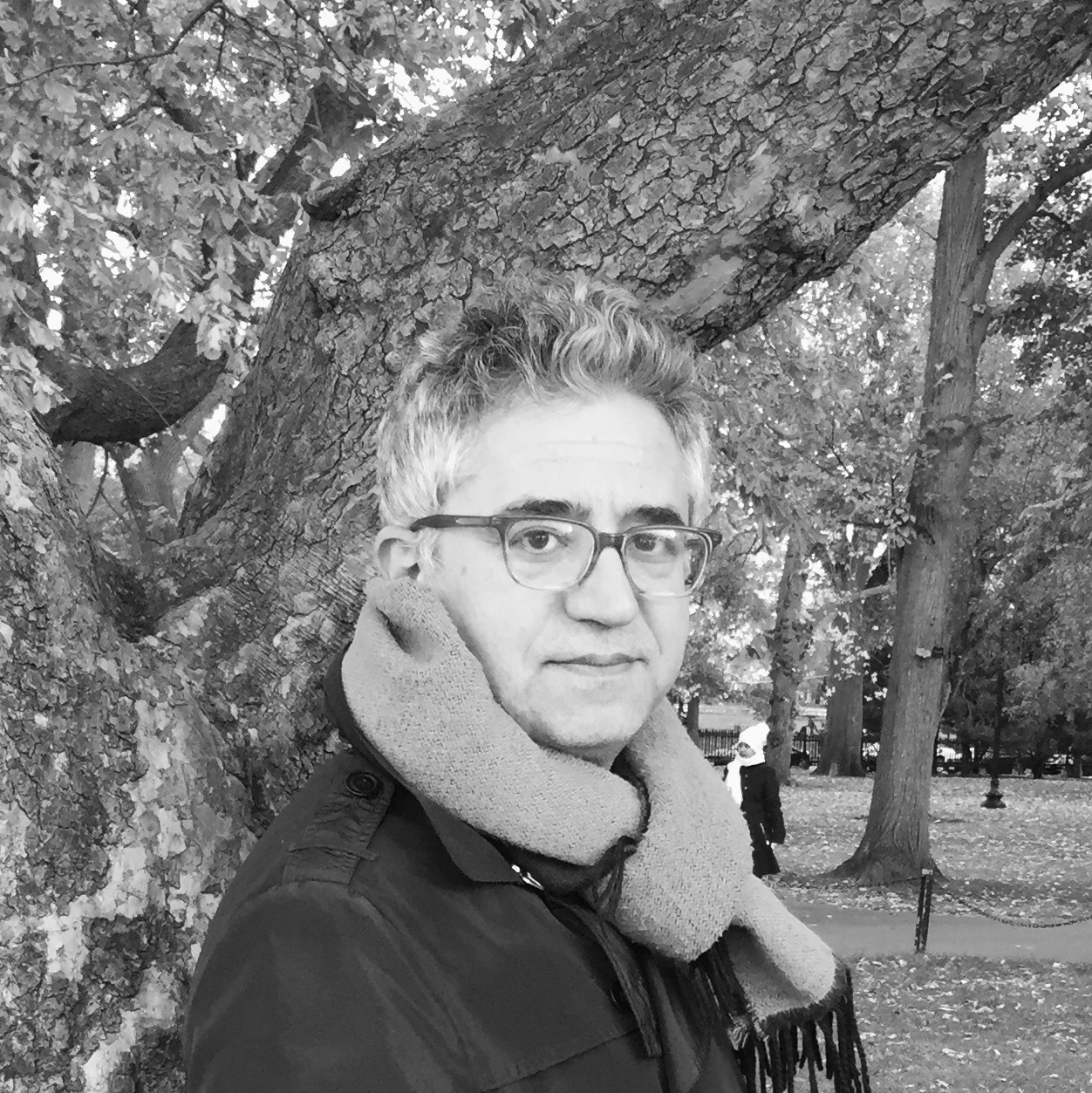
Gazmend Kapllani
The migration’s essential writer. By his own account, Kapllani crossed the border on foot in January 1991 and worked as a builder, cook and kiosk attendant; he took a doctorate at Panteion University in Athens — on how the Greek press wrote about Albanians — and became a Ta Nea columnist and the author of A Short Border Handbook, the book of this migration, a Greek bestseller translated across Europe. His ending is part of the record too: he applied for Greek citizenship in 2008, never received an answer, and left in 2015 for an American professorship. The country that made him its chronicler never made him its citizen.
Photo: ErnestoSaffo / Wikimedia Commons · CC BY-SA 4.0
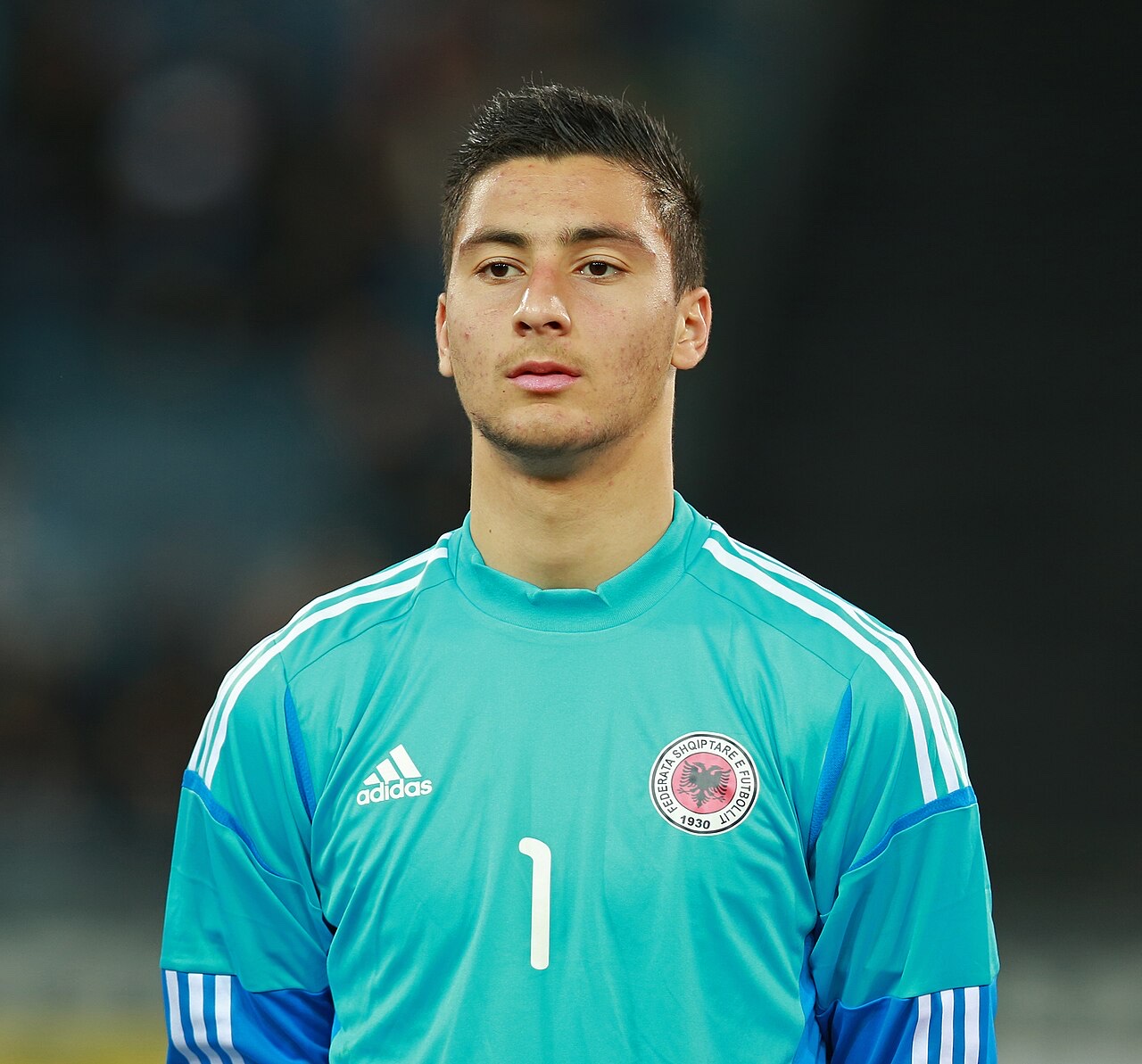
Thomas Strakosha
Born in Athens in 1995 to Foto Strakosha, Albania’s goalkeeper of the 1990s who kept goal for Greek clubs — a true second-generation story, and the living bridge between two pages of this series. Formed at Panionios, a decade at Lazio with two Coppa Italia wins, and since 2024 back in his birth city with AEK Athens, where he became a champion of Greece. Albania’s No. 1 at Euro 2024: born in Athens, starring in Athens, defending Albania’s goal.
Photo: Kulac / Wikimedia Commons · CC BY-SA 3.0
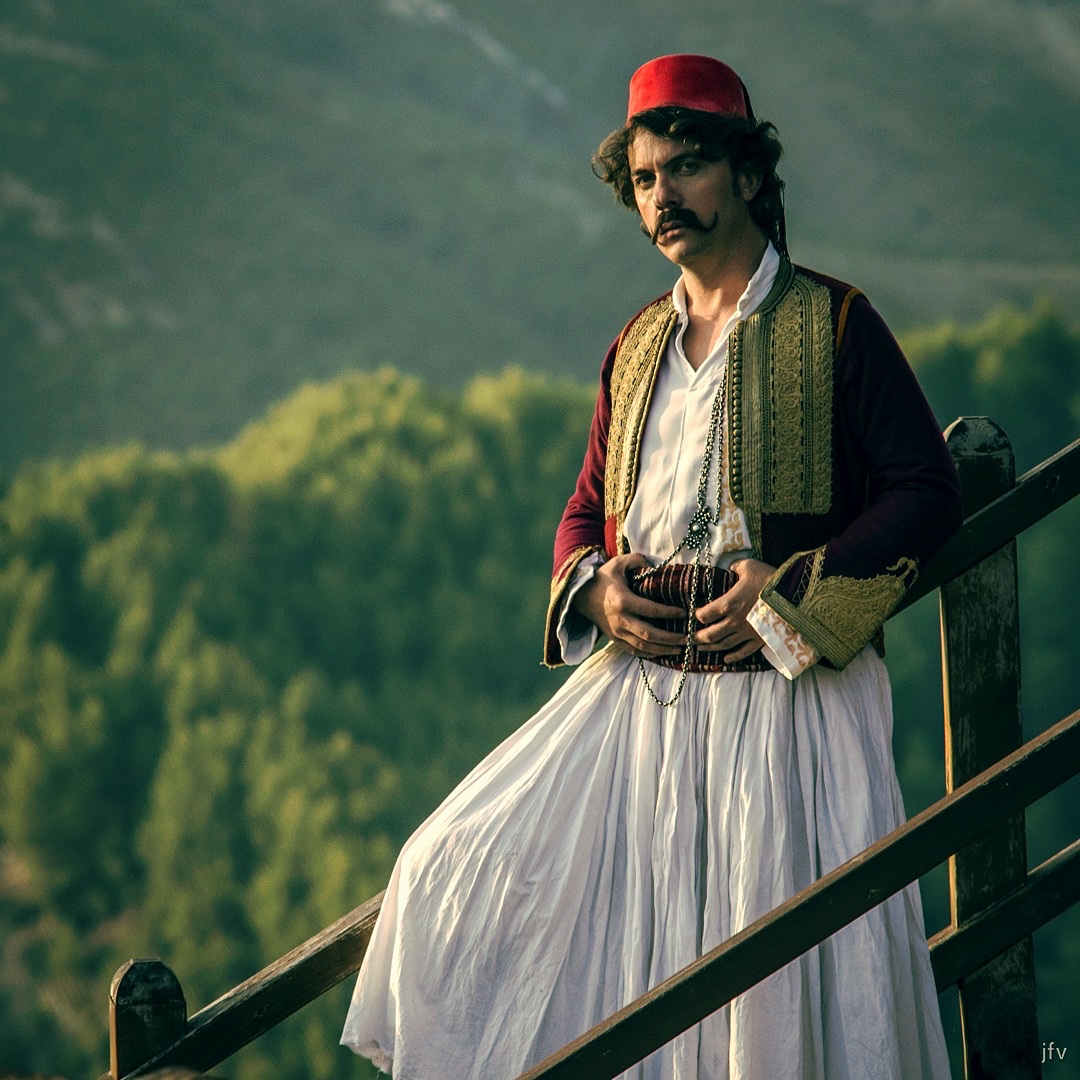
Laert Vasili
Born to an Albanian father and a Greek mother, Vasili came second among 750 applicants to the National Theatre of Greece’s drama school — and then put the immigrant experience itself on the Greek stage. He is photographed here in the fustanella: the garment both nations claim, worn without an argument.
Photo: Laertis Vasiliou / Wikimedia Commons · CC BY-SA 4.0
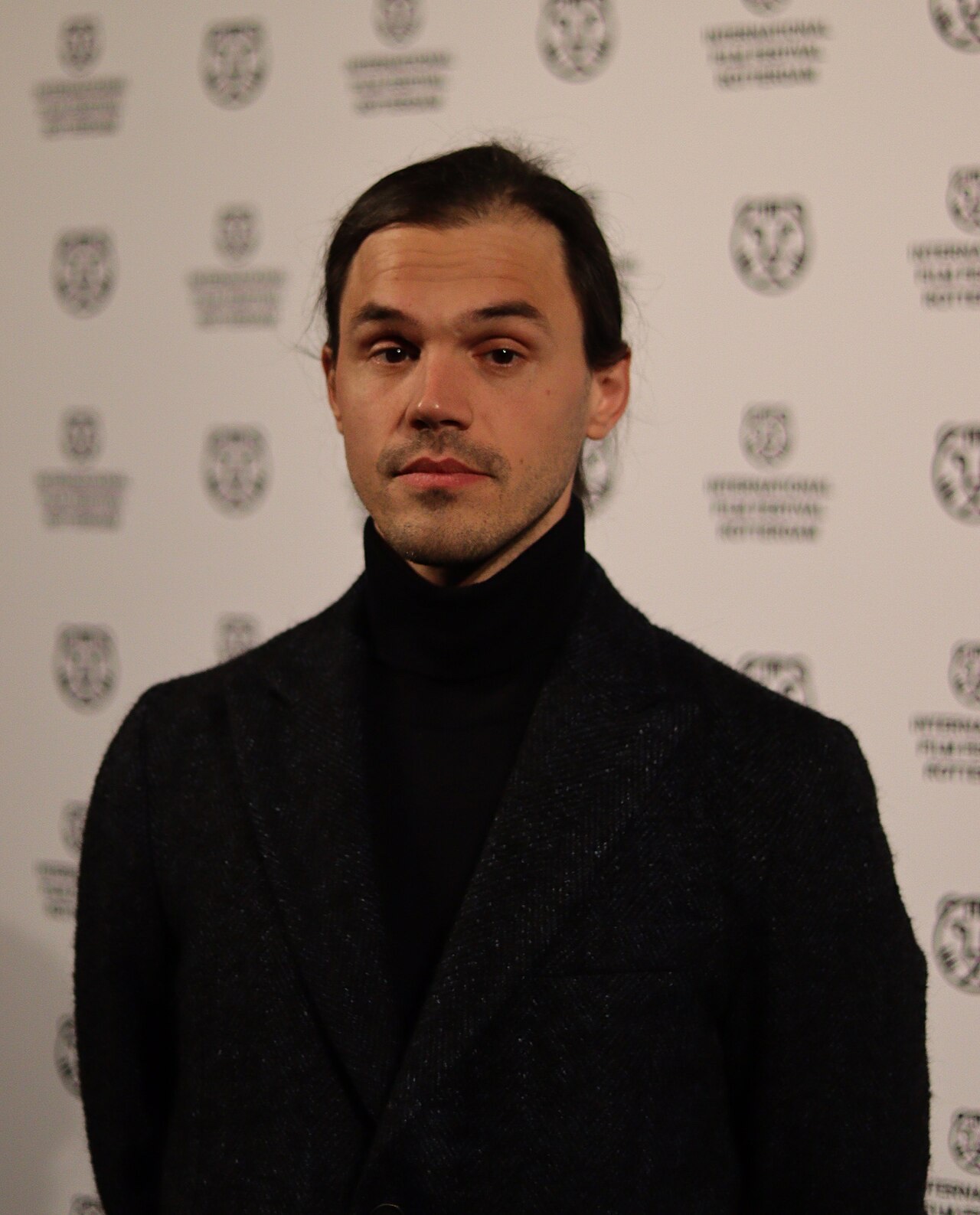
Neritan Zinxhiria
Carried across the border as an infant in 1990, Zinxhiria grew up to collect Greek cinema’s young-director laurels from Drama to Rotterdam — where he presented his short “Light of Light” at the 2023 International Film Festival. The migration’s second generation is no longer only in front of the story; it is directing it.
Photo: Vera de Kok / Wikimedia Commons · CC BY-SA 4.0
The football story runs in both directions, and the direction chosen is the clearest marker of identity this community offers. Sotiris Ninis — born in Himarë to an ethnic-Greek family, raised in Athens from infancy — became Panathinaikos’ golden boy and chose Greece, playing at Euro 2012. Panagiotis Kone, Tirana-born and Athens-raised, chose Greece too, reaching the 2014 World Cup squad — while saying, with disarming honesty, that in Greece he is Greek and in Albania he presents as “Kone the Albanian”. And Ergys Kaçe, brought to Thessaloniki at three and formed at PAOK, made the reverse choice: 25 caps for Albania and a place in the historic Euro 2016 squad — the emblem of a generation raised in Greece that chose the eagle. Around them: Enea Mihaj (Berat-born, Greek academies, Albania international, now in MLS) and the PAOK academy’s Albanian generation.
In music, the second generation now owns the Greek charts it grew up on. Sin Boy, born in Athens to Albanian parents, took Greek trap to No. 1 with “Gigi” and made “Mama” one of its most-watched hits — and has spoken openly about the racism that came with his surname. Toquel, born Klaudjo Dhespo in Tepelenë and in Crete from his first year, grew into one of the biggest names Greek trap has produced. Claydee (Klejdi Lupa, Tirana-born, Athens-raised) writes dance-pop hits across half of Europe — his “Mamacita Buena” was the first Greece-produced song past twenty million YouTube views. And the pop mainstream carries the migration’s other identity too: Christos Mastoras, frontman of MELISSES and a coach on The Voice of Greece, was born in the Greek-minority village of Vodino in Albania and calls himself “a proud Greek Northern Epirote” — recorded here, like Dimas, exactly as he says it.
The cinema of the migration has its own landmark: Xenia (2014), the story of two Albanian-Greek brothers crossing Greece, which made leads of two of the second generation’s actors. Nikos Gelia came from Tirana as a small child and says his first role came “precisely because I was an Albanian immigrant”; Kostas Nikouli, born in Athens to a family from Sarandë, went on to become a household face through the hit series Sasmos. In letters, Christos Armandos Gezos, born in Himarë of the Greek minority, won the Greek State Literary Award for best debut. And in the javelin, Savva Lika, born in Krujë, threw for Greece in world finals after a career begun under the Albanian flag — proof, alongside the Himarë cohort, that this migration’s athletes came from both of Albania’s communities.
How do Albanians in Greece connect today?
For Albanians in Greece, home has never felt quite as far away as the map suggests.
The road through Kakavia is part of family life. Buses link Athens and Thessaloniki with Albania, carrying people home for weddings, holidays, summer visits or a weekend with family. The crossings count journeys, not the size of the diaspora: one person may travel many times.
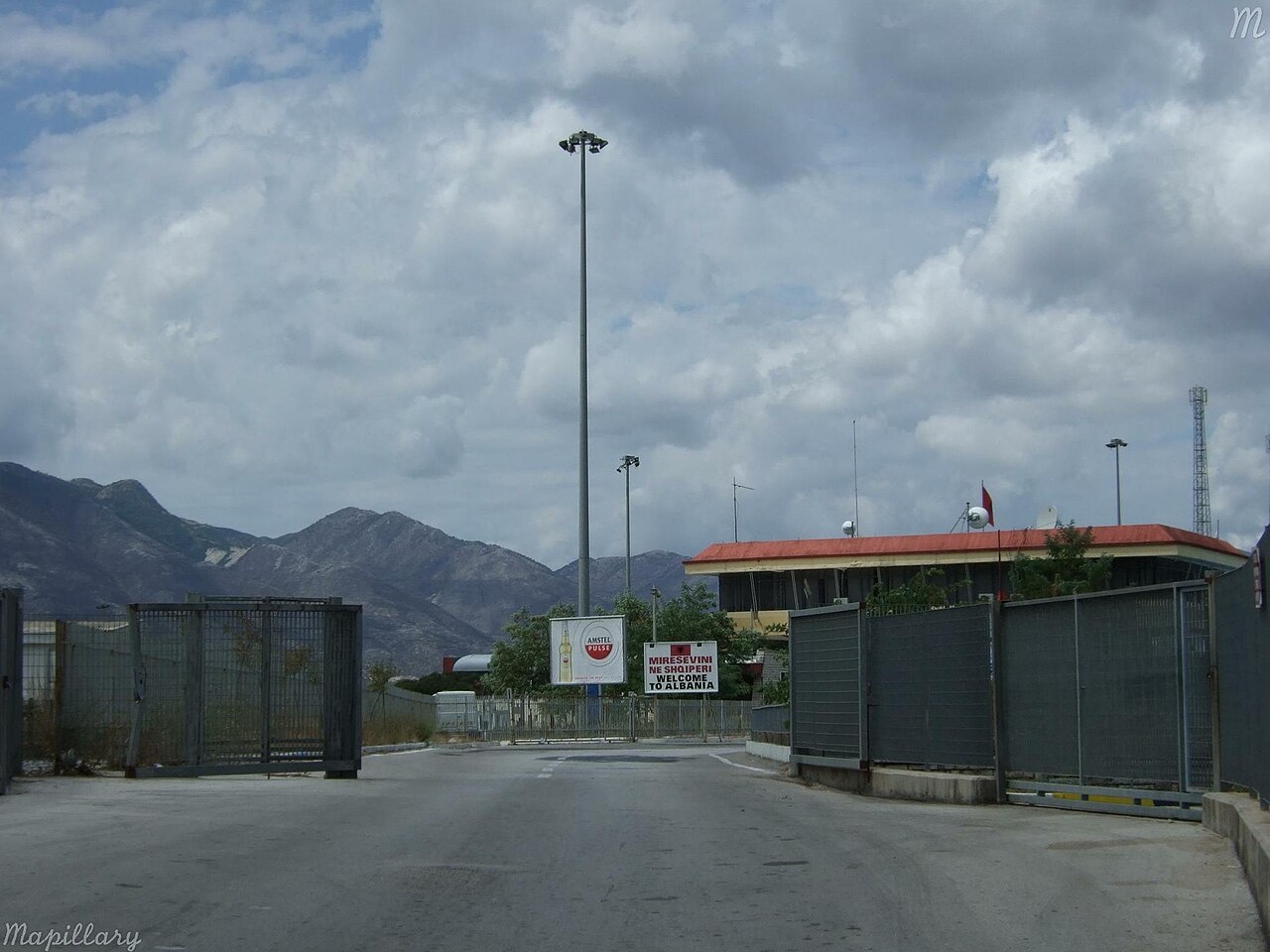
And it is not only the road. Summer ferries connect Corfu and Saranda, and direct flights link Athens and Tirana. Each August, towns and villages across southern Albania fill with cars carrying Greek plates. For thousands of families, an international border is simply part of the journey home.
Those connections are political and cultural too. Greece and Albania both permit dual citizenship, so becoming Greek does not necessarily mean giving up Albanian citizenship. In Albania’s first diaspora postal vote in May 2025, Greece had the second-largest registered diaspora voting bloc after Italy. Weekend schools receive textbooks from Tirana, associations take folk groups across the border, and families move between the countries in both directions.
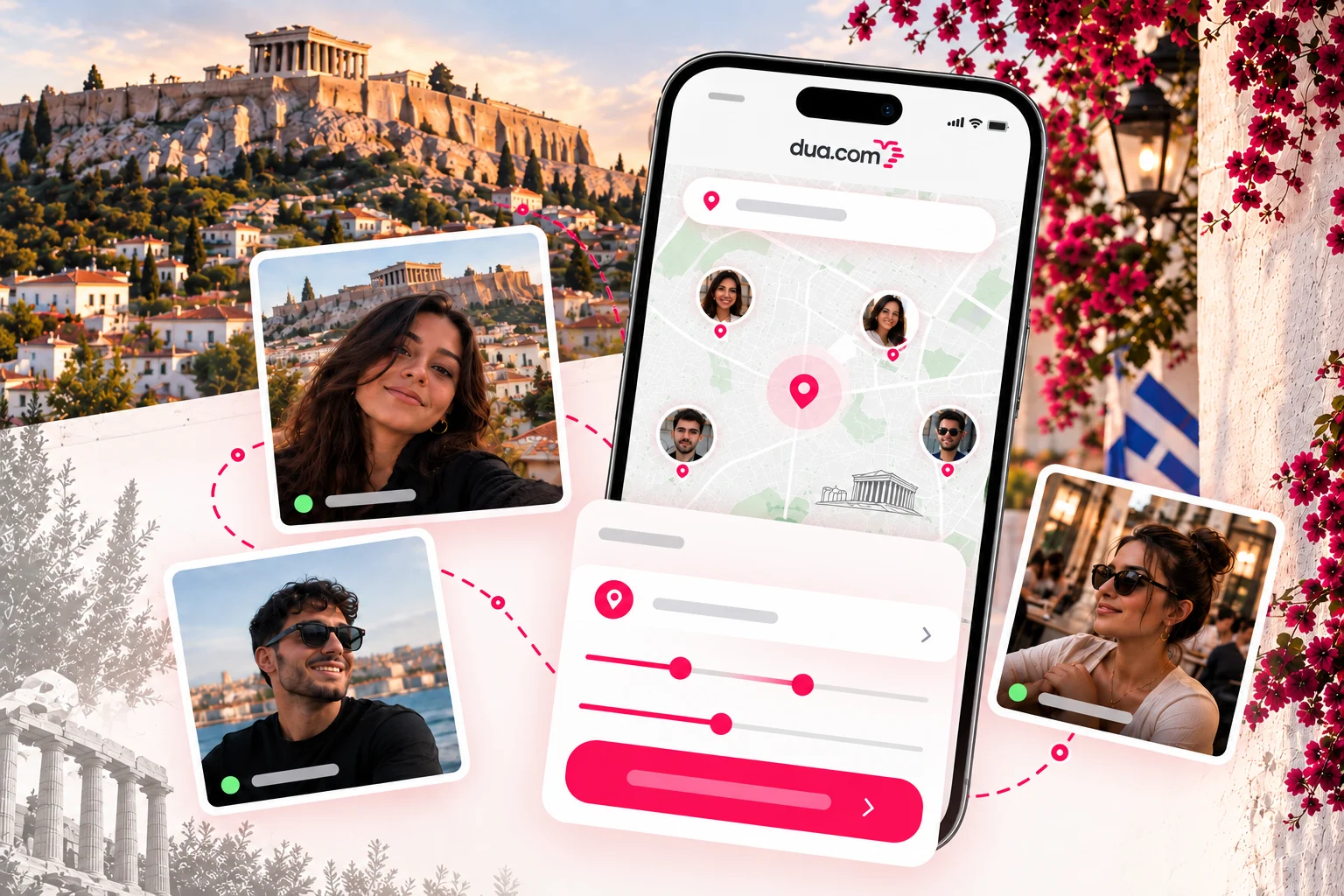
Today some of that connection happens without crossing a border at all. dua.com helps people in Athens, Thessaloniki and across Greece meet other Albanians locally, back in Albania and throughout the diaspora. Staying connected is also about keeping the language, relationships and sense of belonging alive wherever life takes you.
If you wanted to meet another Albanian, where did you go?
For years, the answer was pretty simple: family, friends, the neighbourhood, someone who knew someone. In Greece, those networks run deep. Families, hometowns and friendships have connected people across Greece and Albania for decades.
But even the strongest networks have limits.
A generation has grown up in Greece, speaking Greek at school, Albanian around the family table, and building lives that do not always fit inside the old circles. Your cousins might know everyone back home, but that does not mean they know the Albanian living two neighbourhoods away in Athens.
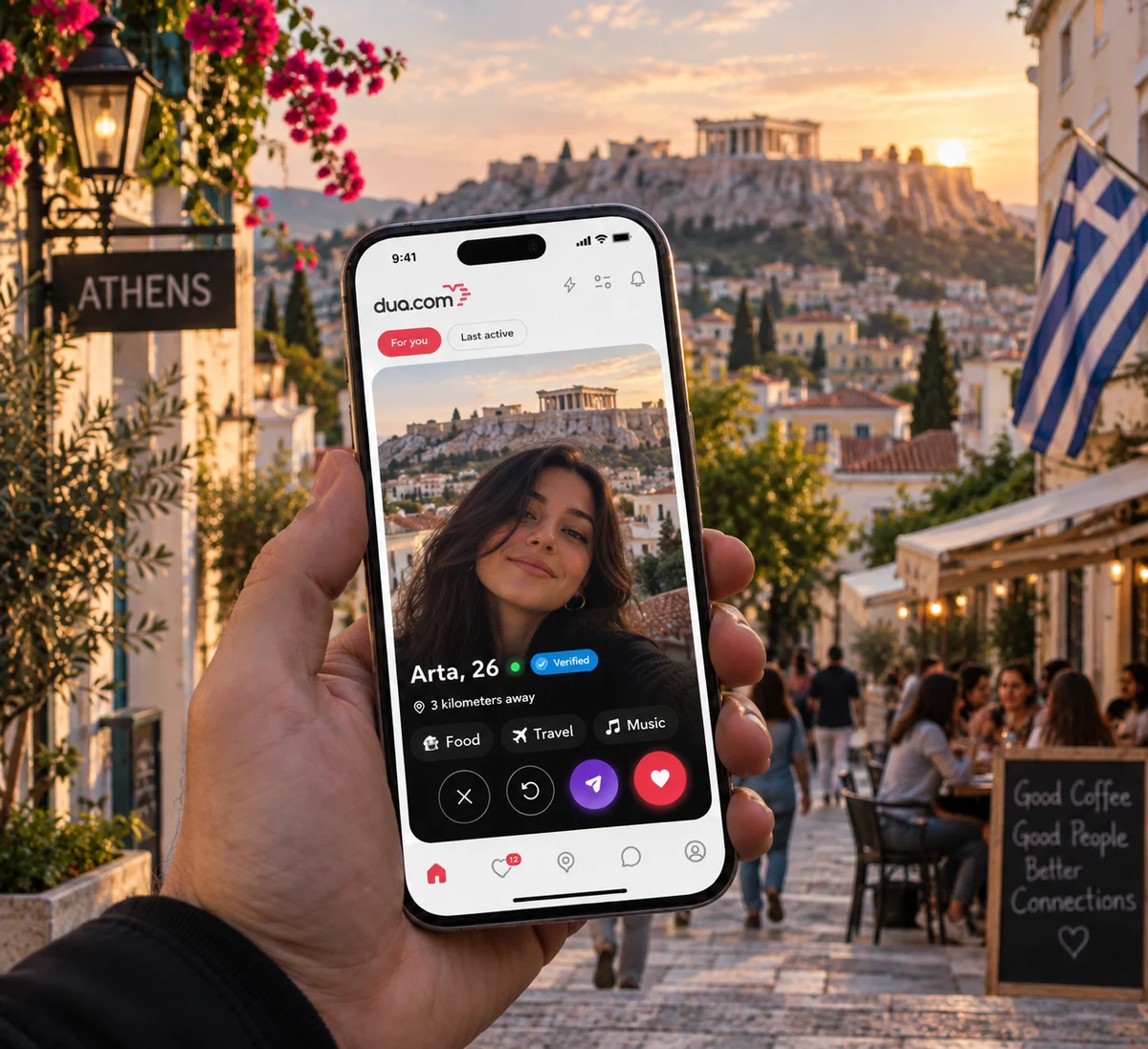
That is where dua.com adds something new. It opens up that familiar Albanian network beyond relatives, family friends and introductions. You can meet someone nearby who understands why your life can feel Greek and Albanian at the same time, without having to explain the whole story first.
Finding the right person is still the hard part. Finding another Albanian does not have to be.
Love, family and the next generation
The statistics stop at the front door. Arta and Dreni’s story started nowhere near Greece — a profile made secretly in Kumanovo, an entrepreneur in Stuttgart — but the life they built from it is a Thessaloniki life, which is how this diaspora works: the road in is rarely the address.

Arta & Dreni: when fate decides to find you love
Arta, a psychologist from Kumanovo, had her dua.com profile made secretly by her sister in December 2021. Dreni, an entrepreneur from Ferizaj living in Stuttgart, almost scrolled past — then couldn’t stop the conversation. He travelled to Kumanovo in early 2022 and knew. They married that year; their sons Rron and Lion arrived in 2022 and 2025 — and the family settled in Thessaloniki. They chose to keep their photos private; some of the best stories on this platform belong first to the people living them.
Practical directory for Albanians in Greece
Primary and community-run resources. Always verify current requirements on the linked site.
| Need | Where to start | Why this source |
|---|---|---|
| Albanian consular services | Embassy of Albania in Athens · consulates general in Thessaloniki and Ioannina | Official Albanian missions (Filothei, Athens; Tsimiski 43, Thessaloniki) |
| Greek residence and permits | Ministry of Migration and Asylum | Official permit categories, statistics and procedures |
| Greek citizenship | Ministry of the Interior — citizenship | Naturalisation and second-generation (L.4332/2015) routes |
| Co-ethnic (EDTO) matters | mitos.gov.gr — EDTO service page | The official process registry for the special identity card |
| Community organisations | National Diaspora Agency registry | 32 verified associations across Greece, with contacts |
| Albanian classes for children | QBD — courses in Greece | The official directory of ~60 weekend courses, with textbooks |
| Community news | Diaspora Shqiptare — Greqi | Continuous coverage of the community, schools and associations |
| Migrant rights | Greek Forum of Migrants | The umbrella body where the community’s advocates work |
| Buses and ferries home | METRO Europe (Thessaloniki–Tirana) · Corfu–Saranda ferries | Daily connections on the two main corridors |
Reading the numbers: what each measure can tell us
The 374,926 Albanian citizens counted in 2021 are residents at a particular date. The 266,970 citizenship acquisitions in 2007–2024 are events accumulated over eighteen years. These measure different things, and neither is a count of ethnic Albanians alone.
A person counted as an Albanian citizen in 2021 may have acquired Greek citizenship in 2022–2024 and appear in both series. People naturalised before 2007, children born Greek, deaths, return migration and onward migration further prevent these figures from yielding a current Albanian-origin population. They must not be added together or presented as a population floor.
The June 2026 administrative figures describe still other groups: 273,200 valid residence permits and 14,531 valid EDTO cards. EDTO is a separate co-ethnic status outside the residence-permit system. Historical issuance of roughly 200,000 EDTO cards is not a cohort that can be reconciled by subtracting today’s valid cards. The 107,801 second-generation citizenship grants across all nationalities through 2023 are not an additional population to add to Eurostat’s acquisition series.
Arvanites are Greeks with a much older Albanian-rooted language heritage and are not included in a migration total. The available evidence establishes a substantial community with roots in Albania; it does not establish a precise present-day total for everyone of Albanian origin in Greece.
Frequently asked questions about Albanians in Greece
How many Albanians live in Greece?
There is no single official current total for everyone of Albanian origin in Greece. The 2021 census counted 374,926 residents with Albanian citizenship. Eurostat recorded 266,970 acquisitions of Greek citizenship by Albanian citizens in 2007–2024. Those figures overlap, cover different dates and cannot be added to produce a current population.
Why does the official number of Albanians in Greece keep falling?
The census count fell from 480,851 Albanian citizens in 2011 to 374,926 in 2021. Naturalisation, return migration, onward migration and demographic change all contribute. Children growing up as Greek citizens also fall outside a count based only on Albanian citizenship. The fall cannot be read simply as people leaving.
Who are the omogeneis and what is an EDTO card?
The omogeneis are Albanian citizens recognised by Greece as being of Greek descent, largely from southern Albania’s Greek-minority areas. EDTO is their special identity-card status. Roughly 200,000 cards were issued historically and 14,531 remained valid in June 2026. Naturalisation is part of the change, but deaths, expired status and migration also matter; these totals are not a closed cohort.
Who are the Arvanites — are they Albanians?
Arvanites overwhelmingly identify as Greek. Their ancestors spoke Arvanitika, a Tosk-rooted variety of Albanian, and settled parts of Greece centuries before modern migration. The language connection does not determine national identity. A widely cited survey found that 97% of Arvanite respondents identified as Greek; speaker and heritage estimates use different definitions.
What happened in Çamëria?
Parts of the Muslim Cham community collaborated with Axis forces, while others joined the resistance. Greek civilians were among the victims of collaboration. During 1944–45, violence against Muslim Cham civilians and forced displacement accompanied EDES advances, and most fled or were driven to Albania. Historians and communities disagree on causes, terminology and death tolls: estimates of direct killings must be distinguished from totals including deaths during flight.
Where in Greece do most Albanians live?
Athens, decisively: the Attica region held 140,146 Albanian citizens at the 2021 census — more than a third of the total — with Central Macedonia around Thessaloniki second at 63,069. In rural regions the community is smaller but dominant: in Western Macedonia, more than three of every four foreign citizens are Albanian.
How many Albanians have become Greek citizens?
Eurostat recorded 266,970 acquisitions of Greek citizenship by Albanian citizens between 2007 and 2024. This includes people of different ethnic backgrounds. A separate administrative series records 107,801 second-generation grants across all nationalities by 2023; about 79% of recipients in 2023 were Albanian. The series must not be added together.
Can Albanians hold dual Greek and Albanian citizenship?
Both Greece and Albania permit dual citizenship. Acquiring Greek citizenship therefore does not necessarily mean giving up Albanian citizenship. Individual requirements should be checked with the relevant authorities.
Which famous people belong to this story?
Two rolls. From the modern migration and its children: Eleni Foureira, writer Gazmend Kapllani, rappers Sin Boy and Toquel, the “Xenia” actors Nikos Gelia and Kostas Nikouli, actor Laert Vasili, director Neritan Zinxhiria, goalkeeper Thomas Strakosha, and the 1991 weightlifting cohort around Pyrros Dimas — who is of the Greek community of Himarë, not ethnic Albanian, and says so. From the Arvanite heritage inside Greek history: Markos Botsaris and the Souliotes, Bouboulina, the admirals Miaoulis and Kountouriotis, and several Prime Ministers of Greece — Greeks all, presented as they saw themselves.
Do Albanians in Greece still speak Albanian?
The first generation does; the second grew up Greek-speaking faster than in any other diaspora — 1990s survival pressure even led many families to baptise children Orthodox and adopt Greek names, a documented strategy of the stigma years. The counter-movement is real: a weekend-school network of roughly 60 courses, coordinated by the League of Albanian Teachers in Greece and supplied with free textbooks from Tirana, teaches the language to the grandchildren of the walk.
How connected is the community to Albania?
Family visits, bus routes, flights and the Corfu–Saranda ferry connect the countries, alongside schools, associations and cultural events. Connections also happen online through family networks and dua.com. Passenger crossings are journeys and must not be read as counts of unique diaspora residents.
How do Albanians in Greece meet other Albanians?
Through family, friends, neighbourhood networks, associations and online communities. dua.com expands those circles so Albanians in Athens, Thessaloniki and elsewhere can meet locally and across the diaspora. Arta and Dreni’s story on this page shows one such connection leading to family life in Thessaloniki.