Albanian Dortmund has a place in European football history, but its everyday story is quieter: a clubhouse in the Nordstadt, children learning to write the language they hear at home, volunteers carrying an older generation's work forward. This guide follows those connections through schools, culture, faith, business and family life, with carefully scoped figures and practical places to begin.
On 15 June 2024, Agim Jusufi still had no ticket for Albania's match against Italy in Dortmund. The stadium was about six kilometres from K.F. Sharri's ground on Schumannstraße. Instead, the club's then chair and youth leader told FUSSBALL.DE that they planned to watch on a projector in their clubhouse. An international tournament had arrived in their city; a familiar local room would be their place in it.
That small scene offers a way into Albanian Dortmund. The red flags made the community visible for a spectacular evening. The clubhouse belonged to a longer story, one that continued when the visiting supporters went home. Following that story means moving between public celebration and the work of making a life here.
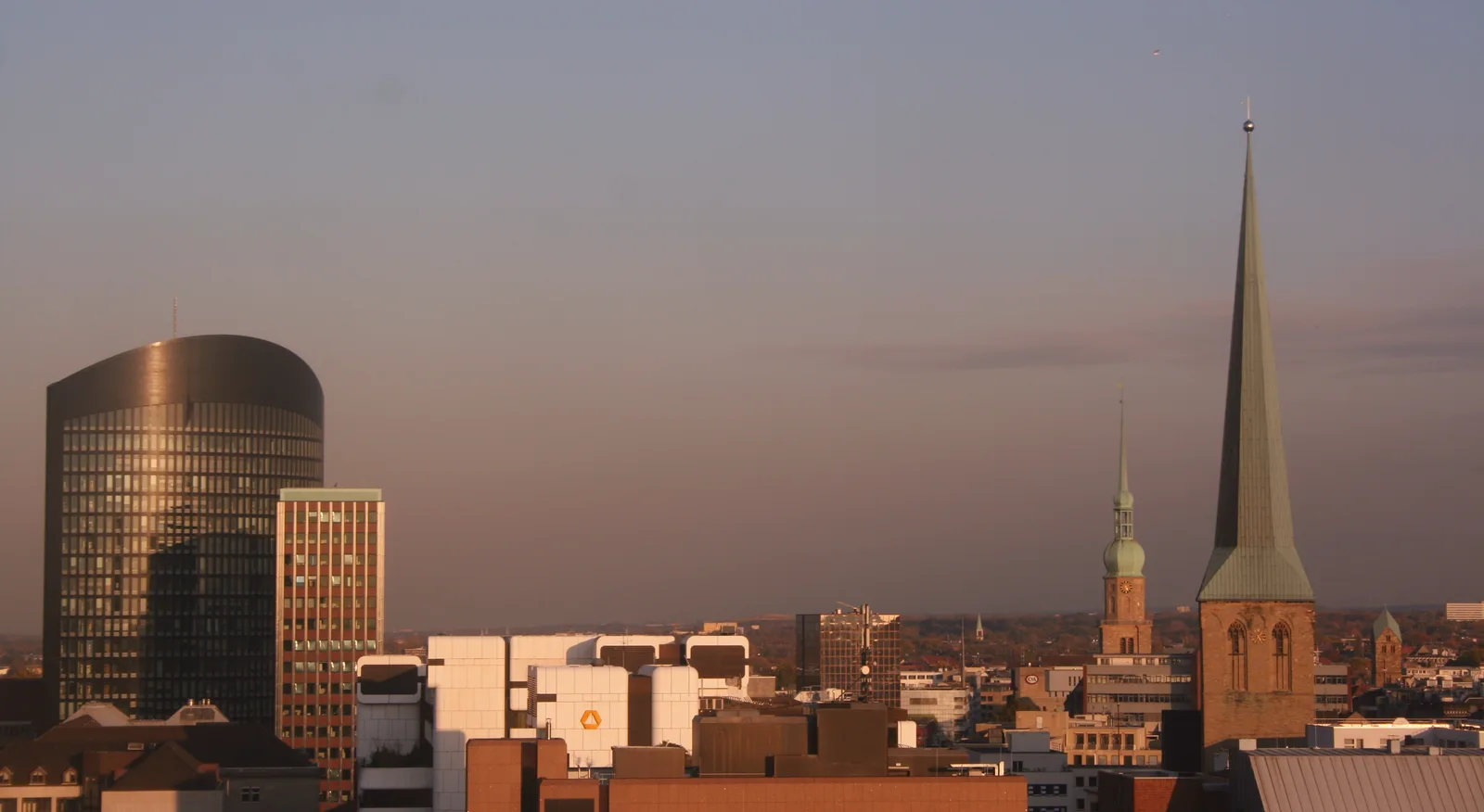
Cover photograph: Lucas Kaufmann/Dortmund, Wikimedia Commons, 28 October 2011 (CC BY-SA 3.0); resized and converted to WebP.
How many Albanians live in Dortmund?
Dortmund recorded 1,955 residents in its non-German Kosovo-citizenship category on 31 December 2025. That municipal main-residence figure is rounded to the nearest five. It is the clearest current city number established for this guide, but it answers a citizenship question. It does not tell us how many ethnic Albanians, Albanian speakers or people with Albanian ancestry live in Dortmund.
The city's selected-nationality series records 575 in the Kosovo category in 2010, 1,180 in 2015 and 1,605 in 2020. The count reached 1,940 in 2024 and 1,955 in 2025. These are observations of the same legal category at different dates. They cannot measure the growth of an ethnic community whose members may hold several different citizenships.

What the register cannot tell us
Someone may understand “Albanian” as a passport, a home language or a family identity. Those descriptions overlap without being interchangeable. A German citizen with Albanian parents is not identified by this non-German Kosovo category. Conversely, Kosovo citizenship does not establish an individual's ethnicity. North Macedonia also has several ethnic communities; its citizens must not be added wholesale to an Albanian total.
Albania has no separate row in this selected-country series. Its absence means the table does not provide that figure, rather than that Dortmund has no Albanian citizens. The municipal statistical glossary also explains how changing state classifications complicate older records. Kosovo appears separately from 2008; an empty earlier cell is not evidence that nobody from Kosovo lived here.
There is therefore no defensible all-origin Albanian population total in the sources used here. That limit need not make a community invisible. Its institutions, named participants and documented activities can be described precisely even where an ethnic headcount cannot.
Where does community life happen?
The Nordstadt is a useful starting point for documented community places. Both Albanian heritage-language teaching hosts in the current municipal timetable are in Innenstadt-Nord, and K.F. Sharri plays at Lortzingplatz. These are places to learn, join and meet. They are not evidence that every Albanian family lives nearby.
The city's history of Innenstadt-Nord describes a district planned around industrial work that later became an important place of migrant arrival. That history helps explain the setting. It does not supply an Albanian neighbourhood map, and this guide does not turn the district's general migrant history into an ethnic label.

There are also connections elsewhere in the city: a restaurant in Gartenstadt named as the venue for a national-day programme, a local business supporting a cultural association, the airport on the eastern side. A useful community guide follows those different purposes. The nearest institution, the right age group and a welcoming activity matter more to a newcomer than a speculative ranking of “Albanian districts”.
Dortmund, the Ruhr area and North Rhine-Westphalia are different boundaries. Essen and other Ruhr cities have their own residents and organisations; Düsseldorf belongs to the wider NRW network. A concert or football club can draw people across these boundaries, while the population chart above counts only registered main residences inside Dortmund.
How did the community take root?
The documented local institutional history reaches back to the early 1980s. In his 2024 interview, Jusufi traced Sharri to a cultural association established in 1981, with its football division following in 1996. A historical church-and-mosque directory separately records the foundation of the Albanian Hidajeti association in 1982. Neither date establishes the arrival of Dortmund's first Albanian resident.
Earlier national history supplies context. West Germany and Yugoslavia signed their labour recruitment agreement on 12 October 1968. People with Albanian family roots in Kosovo and today's North Macedonia could appear in German records as Yugoslav citizens. Reading those records today requires remembering the state under which people travelled, rather than treating its nationality label as a description of their language or identity.

It is tempting to fit every Ruhr family into a single coal-and-steel arrival story. Dortmund's experience was more uneven. The historical study A ‘Melting Pot’ City: Migration and Municipality in the Reconstruction of Dortmund describes relatively limited Yugoslav recruitment after 1968 as industrial change was already affecting the city. A familiar regional image should not replace evidence about who arrived, when, or for which job.
Jusufi's own route crossed the border more than once: born in Germany, he moved to his parents' homeland at six and returned to Dortmund in 1989. The club's own history remembers young people connected to Kërçova, previously playing for different teams, deciding to build something together. A community can take root through such shared decisions without every family following the same path.
Where can children learn Albanian?
Albanian HSU takes place at Diesterweg-Grundschule and Anne-Frank-Gesamtschule in the current 2026/27 municipal timetable. HSU means Herkunftssprachlicher Unterricht: supplementary heritage-language teaching alongside ordinary schooling. The hosts are German public schools, not separate Albanian schools.
| Host school | Formal school type | Location and stage |
|---|---|---|
| Diesterweg-Grundschule | Gemeinschaftsgrundschule: community primary school | Heroldstraße 29, Innenstadt-Nord; primary groups |
| Anne-Frank-Gesamtschule | Gesamtschule: comprehensive secondary school | Burgholzstraße 120, Innenstadt-Nord; years 5–10 |
Source: Dortmund's 2026/27 HSU timetable, updated 24 September 2026. The file name retains an older school-year label, but the document itself identifies the current year. Families should confirm their allocated group, room and campus before attending.

Finding the right class
The city's offer is for multilingual pupils in years 1–10 with basic knowledge of the heritage language. Start with the secretary of the child's regular school and the city's registration form. The routine annual deadline is 15 March; binding registration follows with the HSU teacher at the beginning of the school year. Families enquiring later should ask about the available process, rather than assume they can join immediately.
The NRW education ministry describes HSU as a way to develop spoken and written language and intercultural skills, taught by teachers employed by the state. Knowing how to answer a grandparent is different from reading a story, writing a letter or explaining a complex thought. Supplementary lessons can give children more ways to use a language that already matters at home.
For parents, the practical questions are straightforward: which group suits the child, how travel fits the school day, what materials are needed, and how to handle an absence. Asking these questions early can turn a good intention into a manageable weekly routine. The municipal HSU contact can help clarify the offer; a place in a particular group should be confirmed directly.
A language across generations
Albanian language learning in Dortmund is also a family question: what children can understand, what they feel comfortable saying, and how much of a conversation survives across generations. A classroom provides one setting; relatives, books, music and everyday messages provide others. Children can belong to German school life and deepen their Albanian at the same time.
A 2026 account of research involving young Dortmund residents discusses families with guest-worker roots in Kičevo/Kërçovë in North Macedonia. It explores the continuing importance of family language and how younger people negotiate belonging. These are particular Albanian family histories, not evidence that everyone from North Macedonia shares one ethnicity or one experience.
The host schools are themselves part of a changing city. Diesterweg pupils moved into a new building on the Heroldstraße site in June 2026, according to the municipal announcement. The building serves the whole school. Its presence in this story is a reminder that Albanian lessons take place within ordinary Dortmund education, among facilities and institutions shared with other families.
For a family choosing HSU, the aim need not be an abstract test of authenticity. It may be the ability to read a birthday message without help, speak with a cousin confidently, or understand a song beyond its chorus. Those are possibilities rather than promises, but they make the reason for a supplementary class easy to recognise.
Football after the visitors go home
K.F. Sharri offers a continuing local connection through amateur football. Its September 2026 fixture list identifies its first-team competition as Bezirksliga. That is a current amateur-football setting; the Kreisliga A mentioned in the 2024 interview belongs to that earlier season.
At Lortzingplatz, beside Schumannstraße and Carl-Holtschneider-Straße, participation has a practical address. The club's youth page lists age-group teams, training and contacts. A parent should check the current team and arrange a first visit; a new adult player can use the club's membership enquiry form.
Sharri's account of young people creating their own team gives the club a specific Albanian history. Its present public welcome is broader: the club describes a place for people who enjoy football, with youth development and local participation at its centre. These two things can coexist. A cultural origin does not require a closed membership.
There is a real connection to the next city guide, too: Jusufi described close contact with FC Kosova Düsseldorf. Such links show how the NRW community works through relationships between particular clubs, alongside each one's place in its own local league.
The night Dortmund turned red
On 15 June 2024, Albania's match against Italy made Dortmund the setting for a men's European Championship finals record. Nedim Bajrami scored after 23 seconds, the fastest goal in that tournament's history. Italy recovered to win 2–1, as UEFA's match report records. The precise achievement matters: a EURO finals record, not the fastest goal in all football.
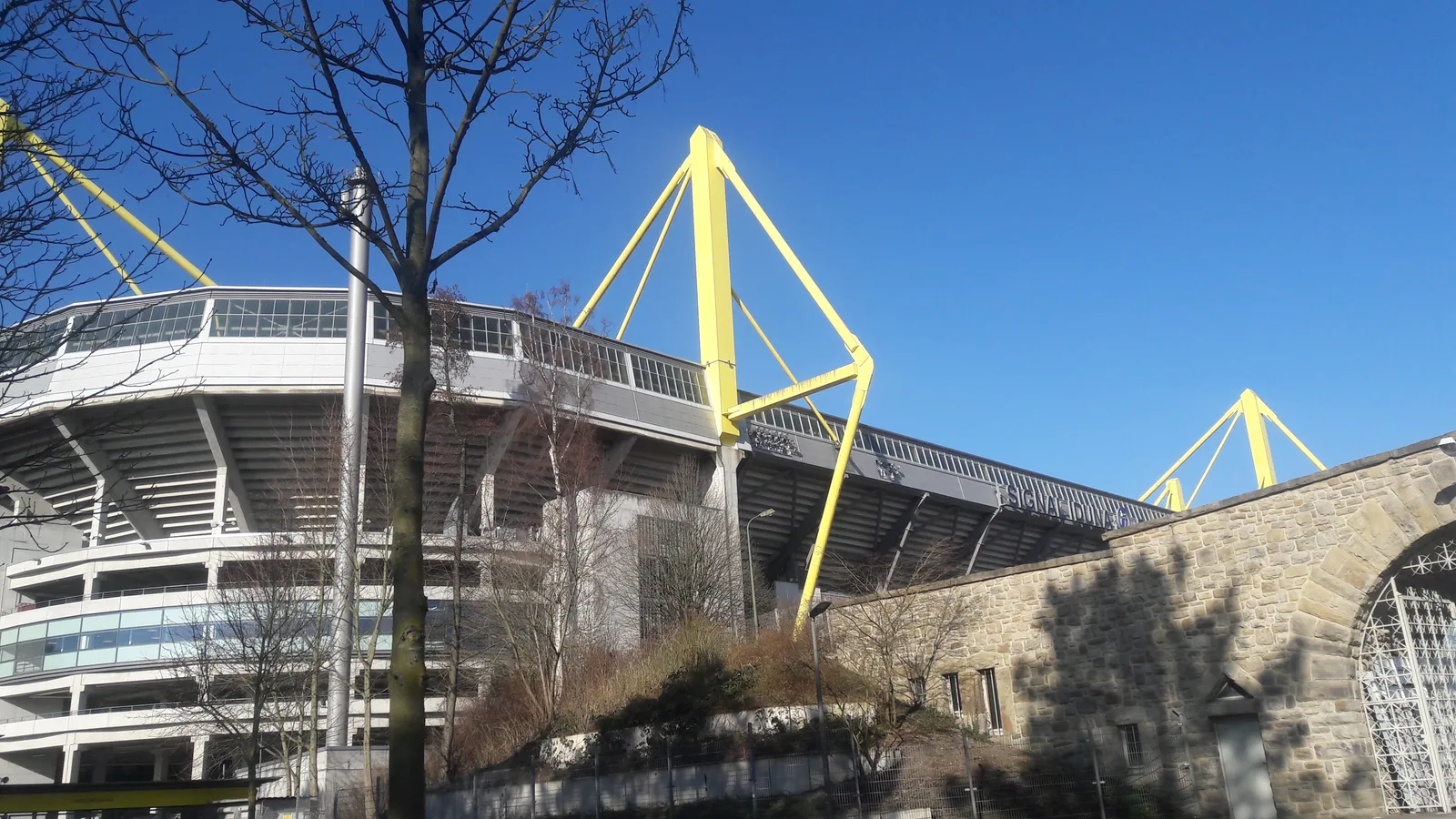
Dortmund's matchday account locates Albanian supporters around Reinoldikirche and in the city's fan areas. Its photographs show the public spaces through which the occasion spread. For someone watching in the clubhouse, the stadium or a fan zone, it was the same match experienced in different kinds of company.
Those crowds included visitors. They cannot be read as a count of local residents, or a picture of everyone's interests. What they do establish is a shared public memory: for one evening, the city that hosted everyday work and family life also hosted Albania on an international stage.
Culture carried forward by volunteers
Kulturverein Uskana documents cultural and humanitarian work rooted in Dortmund. In its December 2020 account, the association remembered the late cultural activist Llokman Kurtishi and described his sons and other young people carrying the work forward. Language, tradition and youth were central to its stated purpose.
This is a different kind of continuity from a building or an anniversary. Someone undertakes the practical work of an association, and another generation decides it is worth continuing. The archive records humanitarian support as well as culture: help organised in Dortmund could reach families in the Kërçova region. Those dated accounts show what the association did, without turning an old appeal into a current donation request.
The connection between culture and sport is explicit in Sharri's account of its partnership with Uskana. It names Valentin Rexhepi and Sheza Veliu and describes cooperation on youth, sporting and cultural projects. Reports disagree on the exact signing year, so this guide does not assign that partnership a precise anniversary.
For a newcomer, an organisation's current contact is more useful than assuming its archive is a live calendar. Uskana's website says its news moved to a Facebook feed in October 2021. Use the association's own channels to ask what is happening now, whether families can attend, and where an activity will take place.
Faith and meeting across differences
Albanian Muslim organisations have a documented history in Dortmund, alongside the secular settings of sport and culture. The historical Moscheen in Dortmund directory, printed in January 2002, records the Hidajeti association's foundation in 1982 and its former address at Bornstraße 111a. It describes youth and educational activities as well as worship. Its old membership figures and contact details are historical information.
For present-day orientation, the Islamic-Albanian umbrella organisation's directory lists an Albanischer Islamischer Kulturverein at Stahlwerkstraße 51 and an el-medina centre in Dortmund. Check directly for current visiting details, services and activities. A directory entry is a starting point, not confirmation that every old name or timetable remains in use.
A more recent scene shows faith as an encounter with neighbours. On 1 July 2025, Christians and Muslims met at the Albanian mosque near Borsigplatz to read passages from the Bible and Quran about creation and the environment. The University of Paderborn's report describes mixed discussion groups, with Naciye Kamcili-Yildiz moderating and Mohammed Abdelrahem introducing the texts and method.
That event cannot stand for every Albanian resident's religious life. It does offer a specific example of a local institution making room for people from different traditions. This research did not establish a current dedicated Albanian Catholic or Orthodox parish inside Dortmund; that is an unresolved directory question, not evidence that such believers are absent.
Businesses that support community life
Local business connections become clearest when there is a documented act of support. Uskana's archive thanks Shukri Imeri of Via Nuova for sponsoring membership booklets and stamps in December 2020. These are modest objects, but they belong to the practical infrastructure of an association: identifying members, keeping records and organising work.
Via Nuova's current legal notice names Imeri and the address Altfriedstraße 4. The business presents itself as a bistro, café and pizzeria. Its community connection is documented through support for an association; a restaurant's cuisine does not need to match its owner's heritage to become part of a diaspora story.
Another example is Albero Verde, at Lübkestraße 9 in Gartenstadt. Its own site describes Italian cooking. A national-day invitation hosted by Albania's honorary consulate in NRW thanked Edi and Arjola for opening the historic Villa Grüner Baum to a community celebration. The evidence concerns that particular venue and occasion, rather than a claim about Dortmund's entire restaurant economy.
No verified local survey established how many Albanian-owned businesses operate in Dortmund or which industries employ most Albanian residents. Named examples are more useful here than an attractive unsupported total. They show where a business intersects with cultural life, while leaving the wider economic picture open.
Music and dates worth distinguishing
An archived invitation documents an Albanian national-day programme in Dortmund on 28 November 2024. At Albero Verde, the advertised evening featured Albanian Spirit in NRW and DJ Elito, with a greeting to Albania scheduled for broadcast. The original invitation identifies the 112th anniversary and the Dortmund address.
This is evidence of an advertised past event, not a new booking for November 2026. Nor does an appearance in Dortmund establish that a performer lives here. Keeping those distinctions clear lets the event enrich the city's cultural story without sending someone to an old date or inventing a local celebrity connection.
For a current evening out, begin with the organiser's latest programme and confirm the date, venue and admission arrangements. For longer-term participation, a club or association offers a different rhythm from a one-night concert. Both can have a place in community life.
The airport connection to Tirana
Tirana was Dortmund Airport's second-busiest destination in 2025, with 255,886 passengers. The airport's annual report, published on 9 January 2026, places it behind Katowice's 353,202 and ahead of Bucharest's 225,174 and Palma's 213,323.

A busy route gives the city's connection with Albania a measurable transport dimension. It also needs careful interpretation. A person can travel repeatedly; visitors and tourists use the same flights as relatives; the airport serves a catchment beyond Dortmund. Dividing this number into a supposed local population, or treating every passenger as Albanian, would change what the source measures.
For families, the meaning of travel is more personal than a route ranking: a visit, a wedding, a reunion or a decision about where to live next. The following two published stories put names and places to those decisions. Neither requires treating a whole airport's traffic as one community.
Anila and Erioni's Dortmund chapter
When Erioni met Anila on dua.com, he had lived and worked in Dortmund for three years. He was a qualified psychologist from Pogradec; she was a hairdresser in Fier. Their published account dates the match to 18 February 2022. Their first face-to-face meeting came in Fier that May.
The relationship brought a decision that reversed the expected direction of travel. After their civil marriage on 16 September 2024, they lived together in Pogradec. Erioni had left Germany to be close to Anila. At the time of the account, they were preparing for a possible move to Düsseldorf, where his siblings lived, and waiting for work documents. That was a plan, not a verified later move.
Dortmund is one chapter in their story, not a claim about their current address. That makes the account especially useful here. A community guide is concerned with a place, but people's lives can leave it, return to a home country, or move toward another German city. The emotional connection is not confined to the boundary used for the population register.
Distance within Germany, too
Linda and Petriti's story connects Dortmund to other German cities. Petriti came from Fushë Kosovë on a work visa during the pandemic and worked in Dortmund. Linda had grown up in Germany and lived in Stuttgart. They connected on dua.com in 2021, and their first meeting took place in Cologne after two months of conversation.
They then maintained a Dortmund–Stuttgart relationship before marrying in Kosovo in May 2022. The account says Petriti later moved near Linda as they built their family in Germany. It does not establish that the family now lives in Dortmund. Their experience shows that shared language and heritage can bring people together while geography still asks something of them.

The two stories also broaden the map drawn by institutions. Classrooms, club grounds and cultural venues are fixed places. A relationship creates another kind of connection, built around where two people happen to be and the decisions that eventually bring them together.
Finding your place in Dortmund
Meeting Albanians in Dortmund can begin with an activity you actually want to return to: football, a cultural programme, volunteering or a conversation with other parents about language lessons. For people looking for a relationship, dua.com offers another way to meet beyond an existing social circle. Shared language can start a conversation; learning about the individual gives it somewhere to go.
Practical help belongs in the same picture. MigraDo, Dortmund's migration and integration service, offers free orientation on language learning and settling in. Its locations at Friedensplatz and in the Berswordt-Halle help people find the right services for matters including school, family, housing, work and qualification recognition. Video interpreting is available.
You do not have to solve every part of a new life through one organisation. A city service can help with a practical question, a team can become a weekly commitment, and a new relationship can change the map altogether. The Dortmund story that began with Jusufi's projector continues in those smaller connections: people making room for one another, then returning.
Explore the wider picture in Albanians in Germany, follow Sharri's regional connection in our Düsseldorf guide, or browse the Albanian community hub. To begin a conversation of your own, meet Albanians on dua.com.
Dortmund community directory
Public links and contact details were checked on 28 September 2026. Programmes and timetables can change; confirm an activity with its organiser. These entries are practical starting points, not an exhaustive list or a claim about an organisation's membership.
- Albanian HSU: Dortmund's official page, current timetable and registration guidance. Municipal contact: +49 231 50-22361; [email protected].
- Diesterweg-Grundschule: community primary school, Heroldstraße 29; school website; +49 231 5021130.
- Anne-Frank-Gesamtschule: comprehensive secondary school; HSU host in Innenstadt-Nord, Burgholzstraße 120. School contact; +49 231 5025930. Confirm the campus and room.
- K.F. Sharri: Lortzingplatz, Schumannstraße / Carl-Holtschneider-Straße. Youth teams and membership enquiries.
- Kulturverein Uskana: association website; [email protected]. Ask for the current programme and meeting place.
- Islamic-Albanian organisations: UIAZD directory, including the cultural association at Stahlwerkstraße 51. Confirm current services directly.
- Via Nuova: Altfriedstraße 4; business contact; +49 231 53081846. Documented supporter of Uskana.
- Albero Verde: Lübkestraße 9; venue website; +49 231 94148568. The national-day programme discussed above is from 2024.
- MigraDo: Friedensplatz 7 and Berswordt-Halle, Südwall 2–4; free newcomer advice; +49 231 50-10922; [email protected].
- Migration and youth advice: Dortmund's counselling directory lists adult services and Jugendmigrationsdienste, with provider contacts.
Frequently asked questions about Albanians in Dortmund
How many Albanians live in Dortmund?
No complete ethnic-Albanian count was verified. The municipal register recorded 1,955 residents in its non-German Kosovo-citizenship category on 31 December 2025, rounded to five. Citizenship does not establish ethnicity or language, and German citizens with Albanian roots are not identified by this figure. The selected-country series has no separate Albania row. Other citizenship categories must not be combined into a supposed Albanian total.
Where can I find Albanian community activities?
The Nordstadt has several documented starting points, including K.F. Sharri at Lortzingplatz and the two municipal Albanian HSU hosts. Kulturverein Uskana provides a cultural contact, while the UIAZD directory lists Islamic-Albanian institutions. These locations identify activities, not where every Albanian resident lives. Contact the relevant organisation for a current programme and a suitable first visit.
Are there Albanian schools in Dortmund?
Dortmund offers Albanian supplementary heritage-language teaching, called HSU, within the public education system. The 2026/27 timetable lists Diesterweg-Grundschule, a community primary school, and Anne-Frank-Gesamtschule, a comprehensive secondary school. They are German host schools, not separate Albanian schools. Use the municipal HSU page and the child's regular school office to ask about registration, class allocation and current arrangements.
What is K.F. Sharri Dortmund?
K.F. Sharri is a Dortmund amateur football club with Albanian cultural roots. Its public history describes young people connected to Kërçova building a team together. The club's September 2026 fixtures identify its first-team competition as Bezirksliga, and its website lists youth teams and membership enquiries. Its home ground is Lortzingplatz in the Nordstadt. Check the current team information before visiting training.
Why is Dortmund special in Albanian football history?
At EURO 2024 in Dortmund, Nedim Bajrami scored against Italy after 23 seconds on 15 June, setting the men's EURO finals fastest-goal record. Italy eventually won 2–1. Albanian supporters gathered across the city. K.F. Sharri also planned a clubhouse viewing. The visiting fans should not be confused with the city's resident population.
Where can I find Albanian cultural events?
Start with local associations and organisers' current channels. Uskana and Sharri document cultural cooperation, and an archived invitation records a national-day programme at Albero Verde on 28 November 2024 with Albanian Spirit in NRW and DJ Elito. That invitation is historical, not a 2026 event listing. Always check a new date, venue and admission details before making plans.
How strong is Dortmund's connection with Tirana?
Dortmund Airport reported 255,886 passengers on its Tirana route in 2025, making Tirana its second-busiest destination that year. This measures passenger traffic, not distinct people or the number of Albanians living in Dortmund. Travellers may come from a wider region and make repeated journeys. For a trip, consult the airport and airline for current schedules rather than relying on annual statistics.
How can I meet Albanians in Dortmund?
Community associations, sport, cultural events and family activities provide places to meet through shared interests. If you are looking for a relationship, dua.com can help you connect beyond your usual circle. The published stories of Anila and Erioni, and Linda and Petriti, each include a Dortmund chapter. No independently verified current Dortmund-only platform membership figure is claimed in this guide.