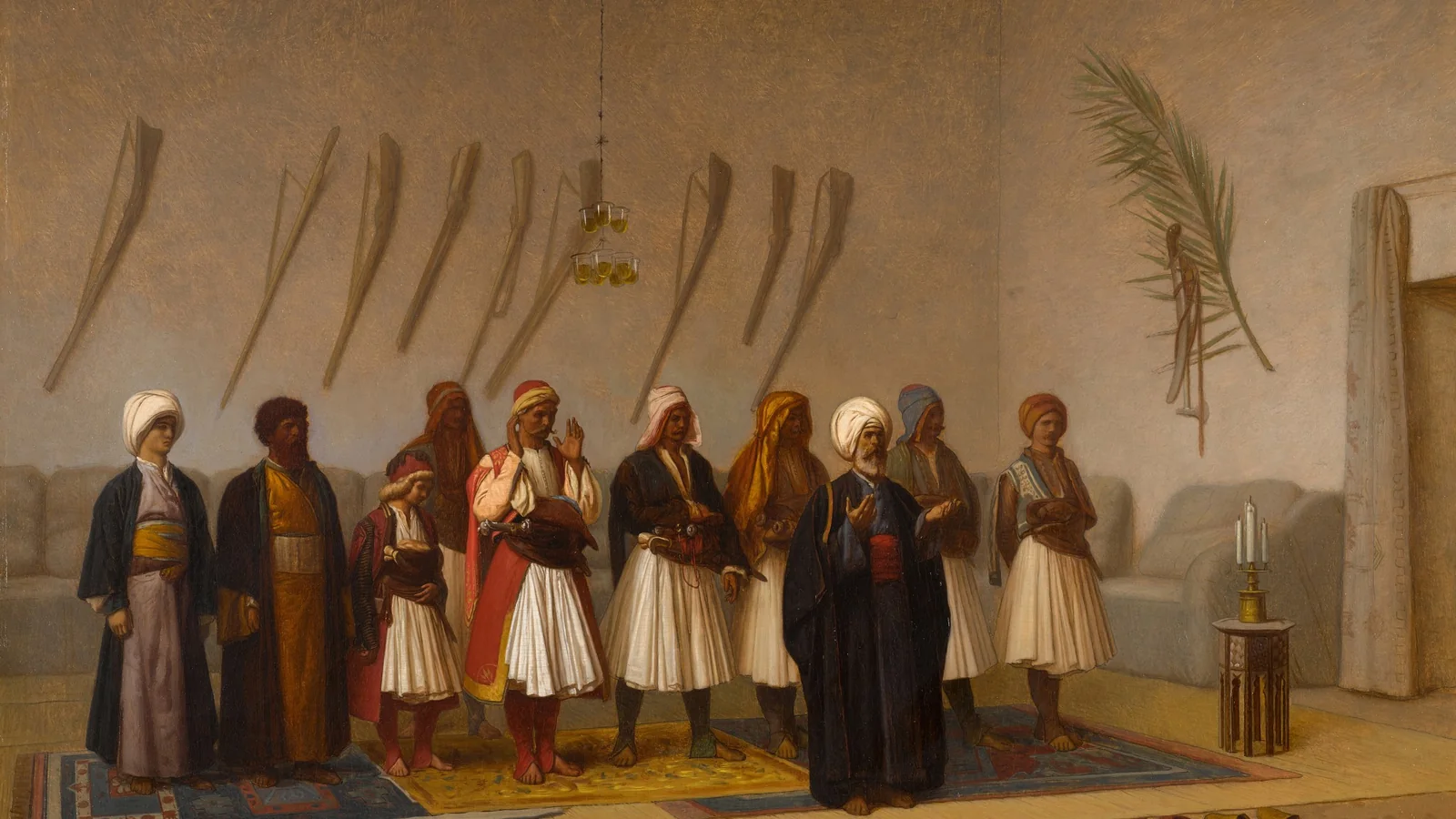
Soldiers who made a ruler, merchants who printed the songs of their homeland, a dervish lodge on a cliff above Cairo and a king in exile: for a century and a half Egypt had an Albanian story of its own. This is that story, and what is left of it.
In July 1952 two exiles on the seafront of Alexandria followed a ship through binoculars. King Zog of Albania and Queen Geraldine had rented back the villa they had sold on the Ramleh corniche, and from it, their biographer Jason Tomes writes, they "were able to watch through binoculars as the royal yacht carried ex-King Farouk into exile". A military coup had ended Farouk's reign that month.
The man on the yacht was the great-great-grandson of Muhammad Ali, the commander of Albanian troops who had taken power in Egypt in 1805 and whom many Albanians counted as one of their own. The man with the binoculars had come to Egypt six years earlier at Farouk's invitation, drawn in part by an Albanian community "dating back to the eighteenth century", as Tomes puts it. Within three years he was gone as well.
That scene comes near the end of the story. It begins with soldiers, and it includes landmark books of the national awakening, printed on the Nile, and a colony that slowly became Egyptian. It ends, for now, with Egyptians who want to learn the language of their ancestors.
Cover image: Jean-Léon Gérôme, Prayer in the House of the Arnaut Chief, 1857, oil on panel, sold at Sotheby's in London in 2021; the 2000 catalogue of Gérôme's work lists this panel as a smaller version made in his studio. Sotheby's sale photograph via Wikimedia Commons, public domain; cropped and converted to WebP.
Who were the Albanians of Egypt?
The Albanians of Egypt were never one community. They were several, and they arrived for different reasons over about 150 years. Soldiers came first, some already in the eighteenth century and many more from 1801. Then, from the 1860s, came merchants, professionals and workers, most of them from southern Albania. Beside them lived Bektashi dervishes, and after the Second World War a court in exile. What exists today is different again: Egyptian citizens of Albanian descent, and newer arrivals.

The soldiers: how Albanians came to hold Cairo
Albanian troops arrived in Egypt in the spring of 1801, as irregulars of the Ottoman army sent to end the French occupation. Muhammad Ali, a man of about thirty, came with them as second in command of a troop of about 300 men raised in his home port of Kavala, and soon commanded it. In Egypt that small troop joined a much larger Albanian force, "reported to be around 4000 strong", in the words of his biographer Khaled Fahmy, made up of irregulars "famous throughout the Ottoman Empire" for their unruly behaviour and equally for "their zeal and bravery". Their commander was Tahir Pasha. Older accounts, including Fahmy's own book of 1997 and the Encyclopaedia Britannica, give only the figure of 300.
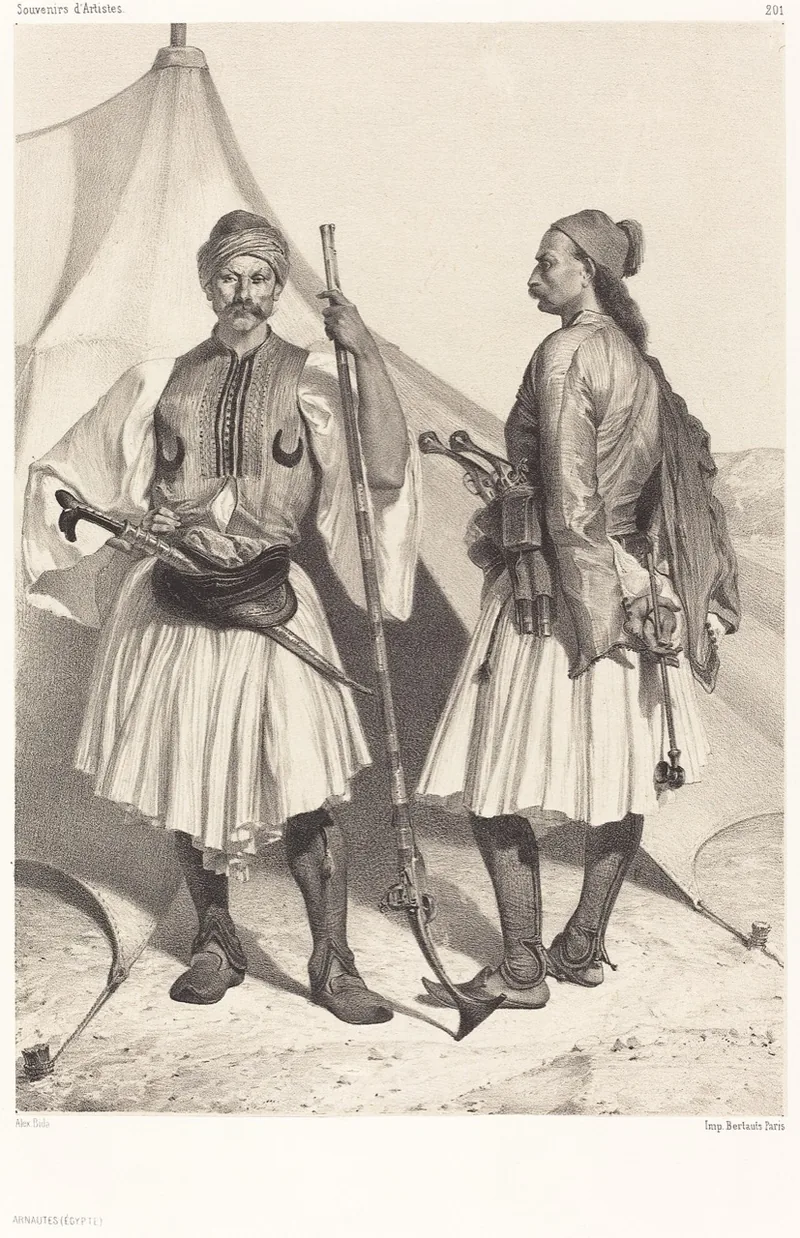
When the French had gone, the troops stayed, and nobody paid them. On 29 April 1803 the Albanians mutinied in Cairo over their arrears and drove out the Ottoman governor. On 26 May Tahir Pasha was killed in his own house. Fahmy's biography describes a quarrel over pay with Janissary soldiers; his earlier book says the killers were "apparently" Muhammad Ali's own men. Command of the Albanians passed to the deputy. Muhammad Ali had by then cultivated their leaders so well, Fahmy writes, that "he was often considered as an Albanian himself".
Two years of street politics followed. In 1805 the Albanian troops, together with Cairo's religious scholars and townspeople, fought the sultan's governor until Istanbul gave way. A decree of 9 July 1805 confirmed Muhammad Ali as governor of Egypt. The Albanians were one of the forces that had made him.
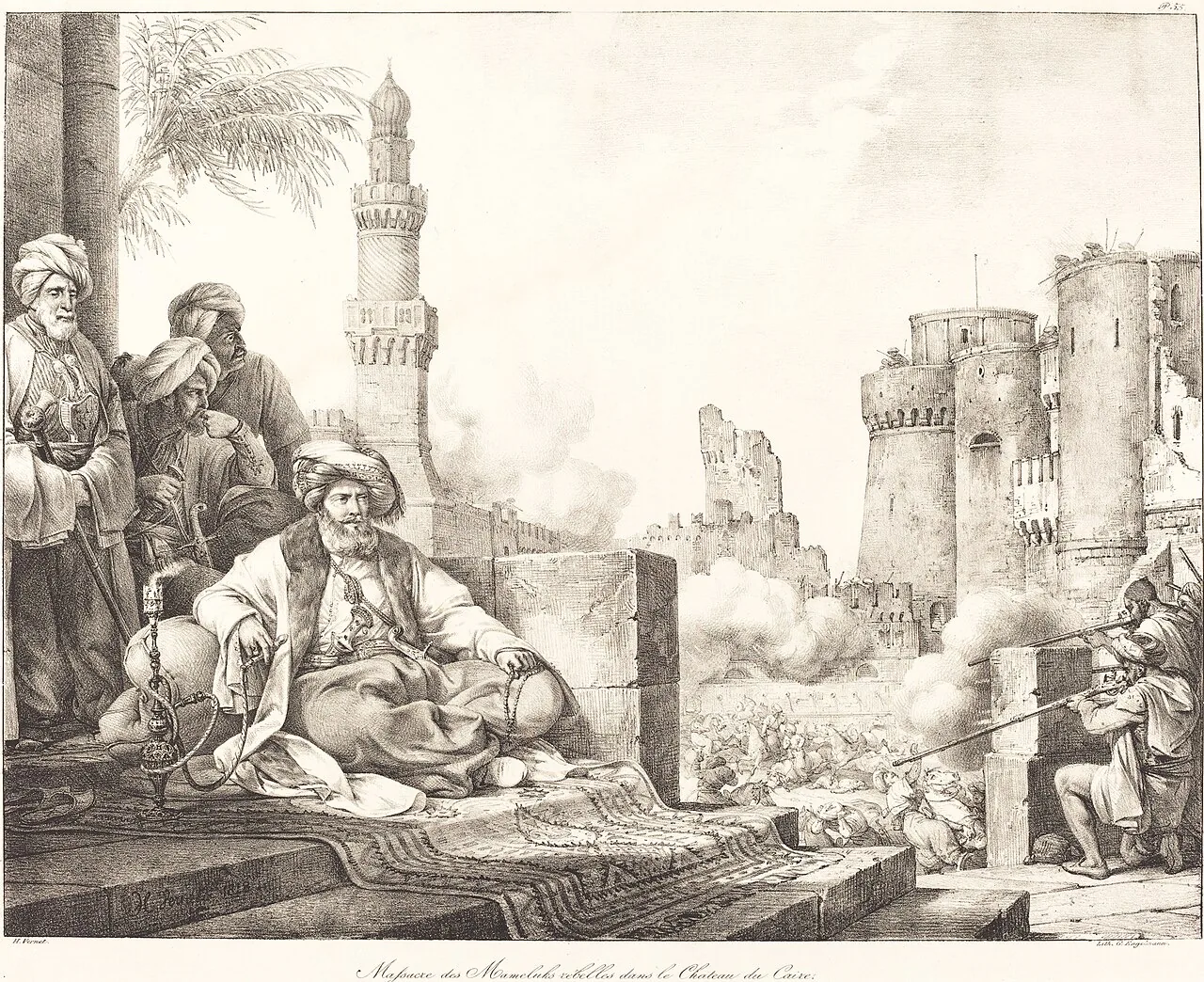
They were also the instrument of his most notorious act. In 1811 Muhammad Ali invited the leaders of the Mamluks, Egypt's old military elite, to a celebration at the Citadel and had them shot down in a narrow passage. In Fahmy's earlier book, All the Pasha's Men, it was "his Albanian soldiers" who were ordered to open fire. More than 450 Mamluk emirs died, and in the days that followed, Fahmy writes, the pasha's Albanian troops "were allowed to enter the Mamluks' houses in Cairo plundering their property and raping their women".
What became of them
A ruler who owed his position to mutinous troops had every reason to fear them. During the seven-year war against the Wahhabis in Arabia, Fahmy writes, Muhammad Ali "sent wave after wave of them to face their destiny" in the desert. Many Albanian soldiers had by then acquired tax farms, the right to collect the revenue of villages, and Fahmy notes that the pasha's reforms had made them "practically unprofitable". In August 1815 he gathered the Albanian soldiers at the foot of the Citadel and tried to drill them in the new European manner. They plotted to kill him the following night, and when the plot failed they went on the rampage through Cairo.
Albanians were among the troops sent to Sudan in 1820. In February 1822 the pasha decided to conscript Egyptians instead, and ordered 4,000 peasants into training camps at Aswan. The Albanian irregulars, for two decades the backbone of his power, had lost their central place.
Not all of them died or left, though nobody knows how many stayed. Some of today's Egyptians of Albanian origin may descend from these men. That is an inference, however: no known source follows a single family from a soldier of 1801 to the present.
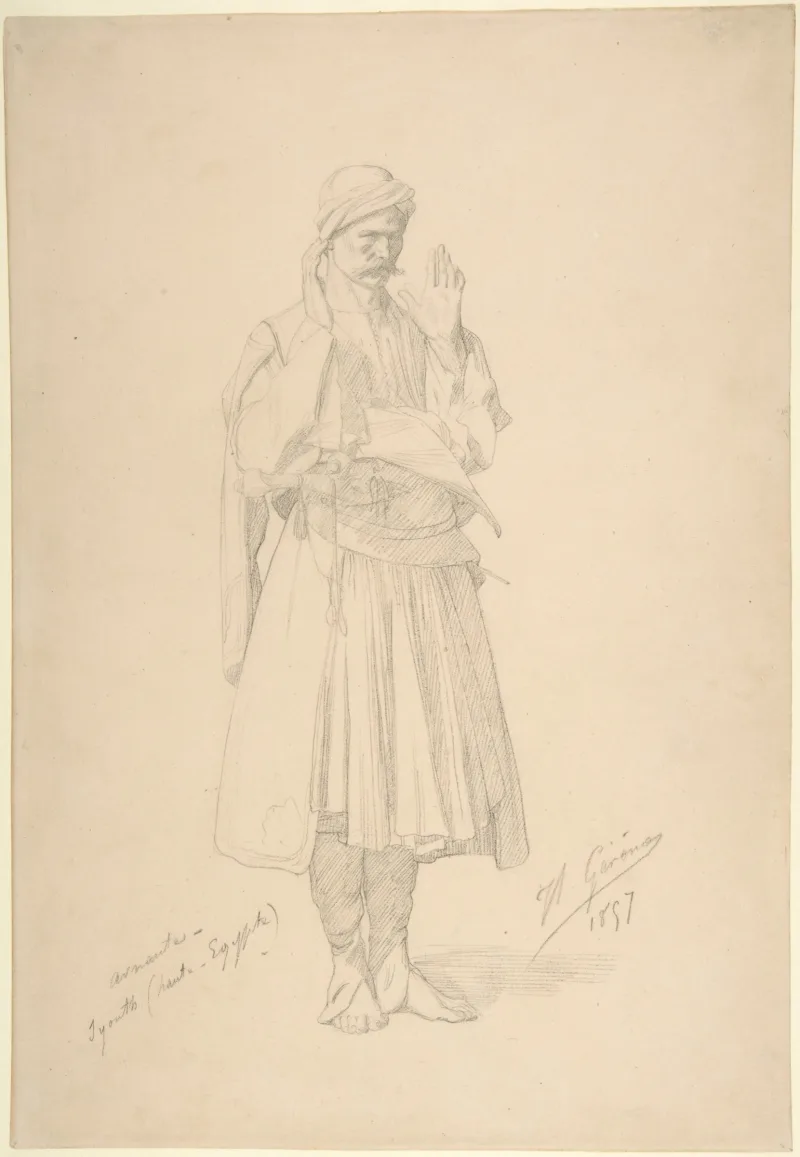
The Albanian soldier, the "Arnaut" as he was called after the Turkish word for Albanian (in Arabic al-Arna'ut, الأرناؤوط, still a surname in the Arab world), remained a familiar figure of Cairo long enough for European painters to find him. Jean-Léon Gérôme sailed up the Nile in 1857 and drew an "Arnaut Officer in Prayer" that year; the drawing is now in the Metropolitan Museum of Art in New York. The Walters Art Museum, describing one of his later paintings, identifies its musician as "an Albanian soldier, called an Arnaut". The museum adds a warning that still applies: paintings of this kind "stereotype their subjects".
Was Muhammad Ali Albanian?
Albanians have long counted Muhammad Ali, Mehmet Ali Pasha in Albanian, as one of their own, and some historians have written the same. His leading modern biographer does not. The honest answer is that his origin is not documented.
What is known is this. He was born in Kavala, a port then in the Ottoman Empire and today in northern Greece. He gave 1769 as the year; a medal struck in 1847 and the inscription on his tomb point to 1770, as Fahmy argues. His father, Ibrahim Agha, is described as the commander of a small local force. The Encyclopaedia Britannica puts the matter cautiously: his "ethnic background is unknown, though he may have been an Albanian and was certainly a Muslim and an Ottoman subject."
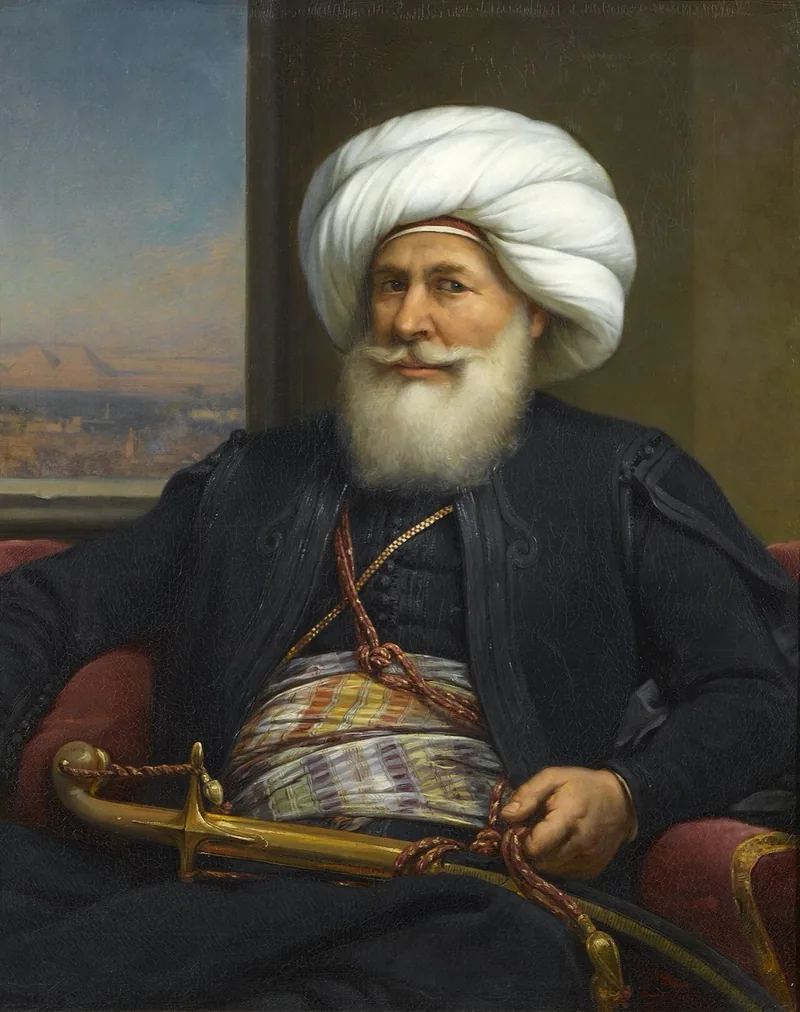
Khaled Fahmy, who has worked closely with the Egyptian archives, goes further. In his biography of 2008 he writes that the pasha's mother tongue was Turkish and that family tradition traced his father's line to Konya in central Anatolia, and before that further east, which led some to think the family had once been Kurdish. His "close association with the Albanians", Fahmy concludes, "gave rise to the erroneous idea that he was an ethnic Albanian".
The opposite view has a long history too. Henry Dodwell's classic study of 1931 calls him "an Albanian adventurer", while admitting on the same page that "of the origins of his family nothing is positively known" and that "Turkish and even Persian ancestry is claimed for him". Fahmy himself wrote in 1997 that "the Pasha was an Albanian himself". Robert Elsie's dictionary describes Muhammad Ali as the "founder of an Albanian dynasty". Jason Tomes, the biographer of King Zog, chose the most careful wording of all: the dynasty's founder "was said to have been of Albanian origin".
The household he founded was not Albanian in language. "Until the 1860s Turkish not Arabic was the first language of the court and government in Egypt," writes the historian Philip Mansel. Nothing in the sources suggests that Albanian was spoken at court.
A tie that lasted
What is not in doubt is that Muhammad Ali rose at the head of Albanian troops, and that many Albanians, and some outsiders, saw his house as an Albanian one. The connection outlived him by a century. When the great powers looked for a ruler for newly independent Albania in 1913, an early candidate was Prince Ahmed Fuad of Egypt, his great-grandson. According to a study of the throne question by Ilirjana Kaceli and Haxhi Ademi, "Albanians living in Egypt strongly supported his candidacy". Austria-Hungary rejected him as too close to Italy, and the powers chose a Christian prince. Fuad later became king of Egypt, and it was his son Farouk who received the exiled King Zog in 1946.
For the Albanians of Egypt, in our reading, the belief mattered more than the birth certificate. The scholar H. T. Norris described the effect: the dynasty's "affection" for Albanians, "and the haven it afforded to them", meant that Egyptian towns came to shelter Albanians who founded associations, published newspapers and wrote "significant masterpieces of modern Albanian literature".
The colony on the Nile: who came, and where they lived
From the 1860s a second and very different migration reached Egypt: merchants, professionals and workers, many of them Orthodox Christians from the Korçë region of southern Albania. Egypt was building railways and growing rich on cotton, and its ruling house had a name for welcoming Albanians.
The Korçë region sent people abroad throughout the nineteenth century, and an earthquake in 1879 deepened the poverty there. Romania was the main destination of those who left; a good number settled in Egypt.
The lives of the best-known settlers show who they were. Thimi Mitko, born in Korçë in 1820, had worked for several years as a tailor in Vienna before he moved to Egypt in 1865 and "set up a successful trading business in Beni Suef". Spiro Dine of Vithkuq followed in 1866, at about twenty, and made his home in the Delta town of Shibin el-Kom. Andon Zako Çajupi was the son of a tobacco merchant who did business in Kavala and Egypt; in 1882 he was sent to a French lycée in Alexandria. Milo Duçi was, in the words of the historian Isa Blumi, "the son of a powerful cotton merchant from Korçë". Not all were southerners: Filip Shiroka, educated by the Franciscans in Shkodër, emigrated in 1880, in the years of the League of Prizren, and worked as an engineer in railway construction in Egypt and Lebanon.
Nor was the colony only Christian. Muslim Albanians had come to Cairo to study long before the merchants arrived: the poet Muhamet Kyçyku, also known as Muhamet Çami, studied theology there for eleven years, in a city "where a sizeable Albanian colony had settled", before he returned to his village of Konispol, where he died in 1844. Ismail Qemali, who would declare Albania's independence in 1912, came to Cairo often; in 1901 he tried to revive the colony's Albanian Brotherhood. And the Bektashi lodge on the Muqattam, described below, drew Muslims and Christians alike.
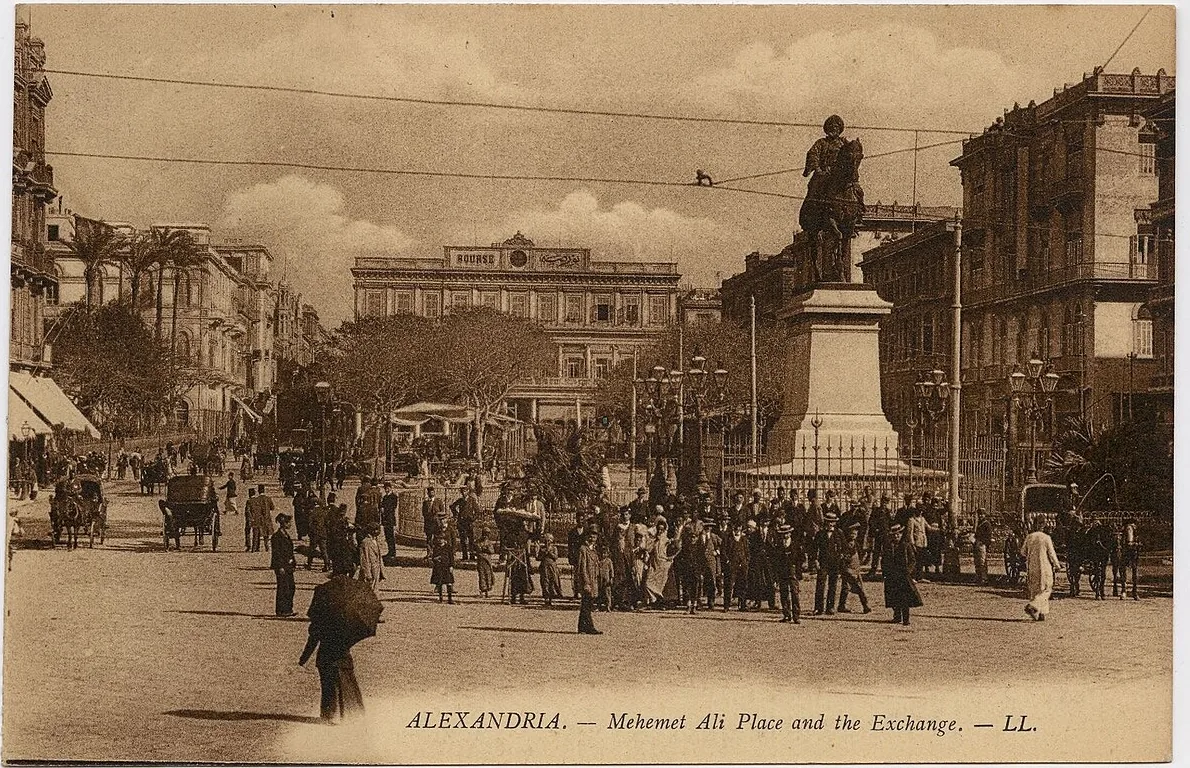
Stavro Skendi, in his history of the national awakening, noted that the Albanians of Egypt came predominantly from southern Albania and lived in Cairo, Alexandria and the cities of the Nile Delta. The historian Muhamed Mufaku, who has studied the colony since the 1970s, gives a longer list of towns: Alexandria, Rosetta, Damietta, Mansoura, Shibin el-Kom, Zagazig, Cairo, Fayoum, Beni Suef and Maghagha. The colony was densest, he writes, in Alexandria, Rosetta and Cairo. Drawing on Spiro Dine, Mufaku describes what its members built there, with their newspapers, their books and their care for their identity, as a "little Albania".

How large was this colony? Nobody knows. Blumi cautions that political societies of this kind, whether in Romania, Bulgaria or Egypt, "never enjoyed a membership of more than a few hundred people". The few figures that exist are collected further down.
Books for a nation: the awakening on the Nile
In the last decades of Ottoman rule, when Albanian books could not be printed freely at home, Albanians in Egypt collected folklore, founded societies and published books and newspapers. Egypt was one of several such centres abroad, beside Bucharest, Sofia, Italy and Brussels.
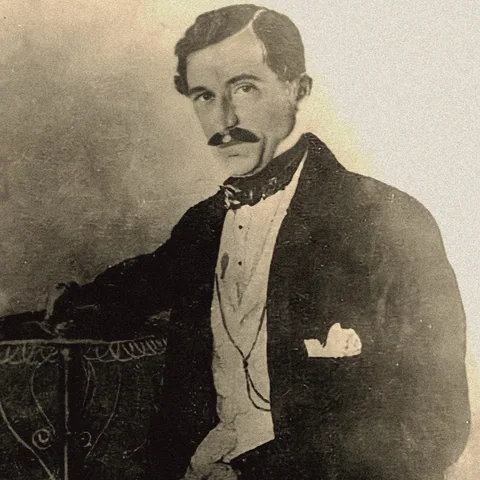
Folklorist, in Egypt from 1865
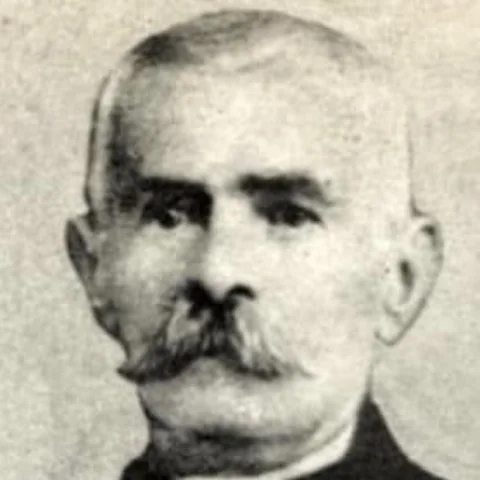
Folklorist, in Egypt from 1866
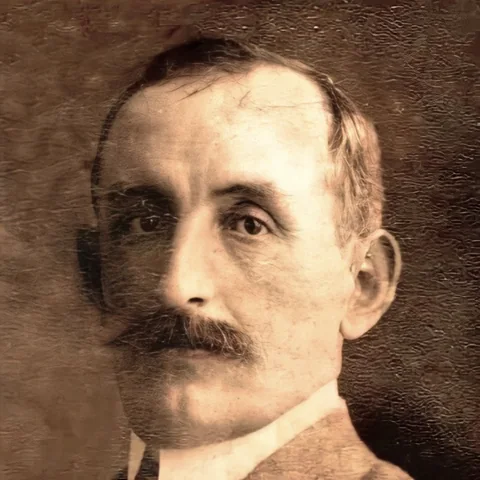
Poet, died in Heliopolis in 1930
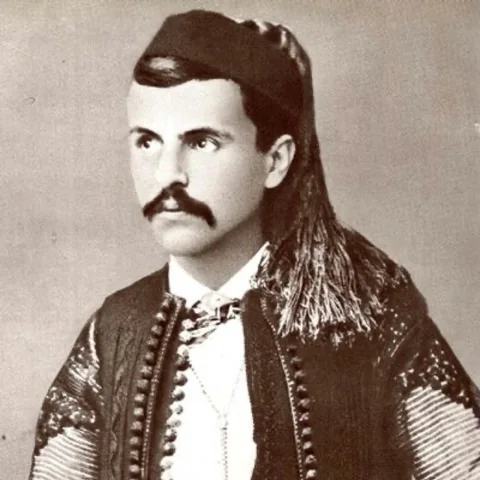
Poet and railway engineer
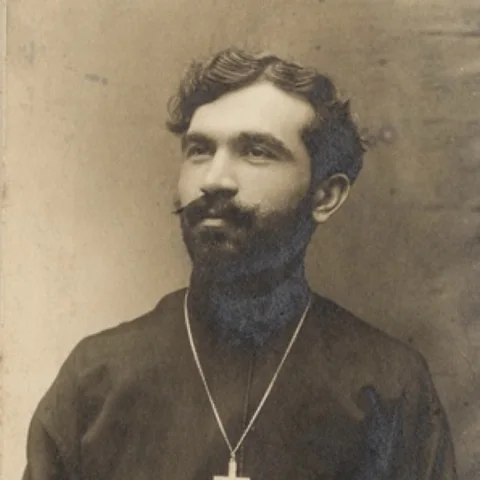
In Egypt from 1903 to 1906
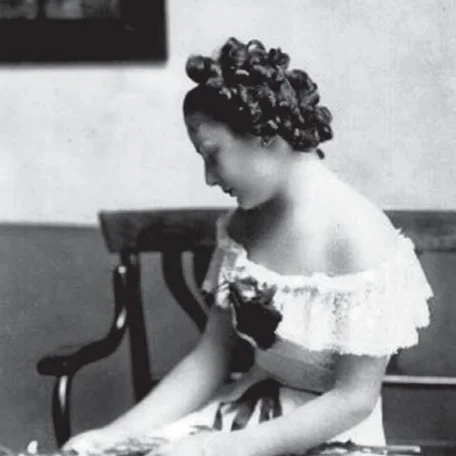
Soprano, born in Fayoum in 1910
Portraits from Wikimedia Commons, all in the public domain: Mitko (Kristo Frashëri collection), Dine, Çajupi, Shiroka (photograph by Kel Marubi, Marubi National Museum of Photography), Noli (photographed in 1909), Tashko-Koço (1930s, Directorate of Archives of Albania).
The bee and the waves
Thimi Mitko's interest in folklore began around 1859, in Vienna. By 1874 his collection was finished: 55 folk songs and 39 tales and popular sayings, mainly from southern Albania. Four years later it was printed in Alexandria, in Greek letters, under the Greek title Albaniké melissa and with an Albanian subtitle. Albanians know it as Bleta shqiptare, "The Albanian Bee". Robert Elsie judged it "the first compilation of oral literature designed for the Albanian public". A copy, it is said, was burned in public in Athens. Mitko's unpublished Albanian-Greek dictionary, some 3,000 pages in manuscript, was later discovered in Alexandria.
His friend Spiro Dine continued the work on a larger scale. Dine's Valët e detit, "The Waves of the Sea", appeared in Sofia in 1908: 856 pages of folklore and literature, at the time the longest book ever printed in Albanian.
Societies and newspapers
The first Albanian society of Egypt was founded in 1875, and many others followed. In 1881 Dine was among the founders of an Egyptian section of the Istanbul-based Society for the Publication of Albanian Writing. In 1894 came Vëllazëria Shqiptare, the Albanian Brotherhood, with Milo Duçi as its president. Where it was founded is less certain: the historian Stavro Skendi wrote that it was founded in Cairo, while other accounts, which give no source, name Beni Suef.
Newspapers followed. The historian George Gawrych counts four Albanian periodicals in Egypt by 1908, as many as in Romania, against seven each in Bulgaria and Italy. Among the colony's papers, then and a little later, were Toska, Besa-Besën, Shkopi ("The Stick") and Rrufeja ("The Lightning"). Sources disagree about several of their dates and even their towns; what is firm is this. Toska ran from 1901 to 1903. Shkopi, a satirical paper edited by Athanas Tashko and Jani Vruho, first appeared on 10 March 1907; its masthead names Cairo, it was printed in Sofia and it was handed out free of charge. In 1922 Duçi founded the Albanian Publishing Society in Cairo.
The colony was not united. In the years after Albanian independence it was organised into patriotic clubs and societies that were often at odds with one another over politics.
A poet in Heliopolis, a cantor in Fayoum
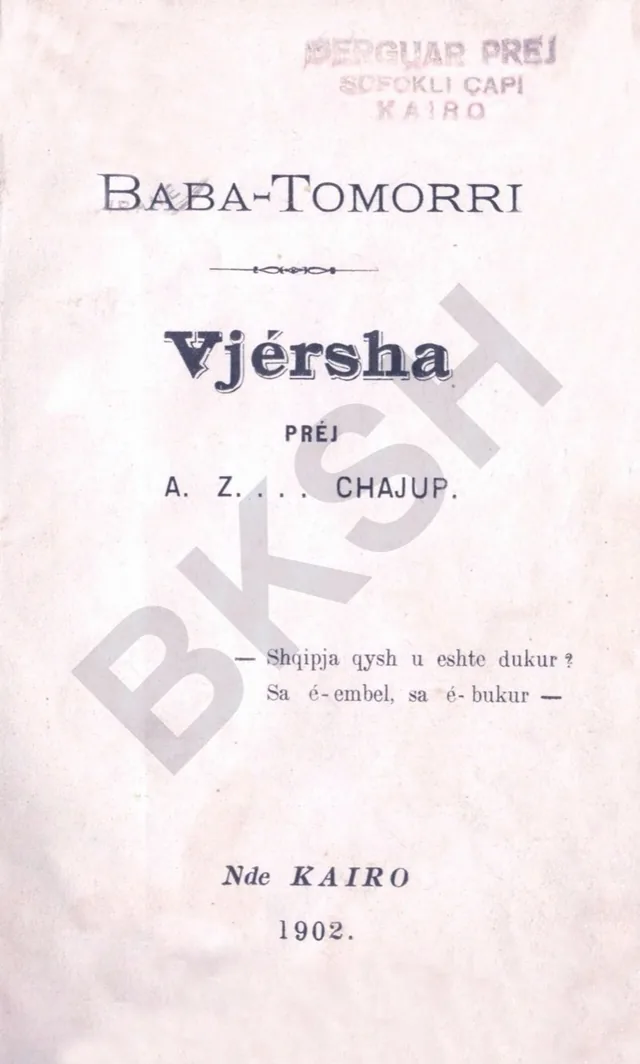
Andon Zako Çajupi, born in the village of Sheper in 1866, studied law in Geneva and returned to Egypt around 1894 to train with a law firm in Cairo. His legal career ended quickly after he defended a French company against the interests of the khedive. Financially independent, he gave his time to literature and to the Albanian movement in Egypt. Baba-Tomorri, printed in Cairo in 1902 and named after Mount Tomorr in central Albania, is the volume of poems for which he is best remembered. Among its poems is "Mëmëdheu", "Homeland", written by a man who had left his village at sixteen:
„Mëmëdhê” quhetë toka
ku më ka rënurë koka.
Ku kam dashur mëm’ e atë,
Ku më njeh dhe gur’ i thatë."Homeland" is the name of the land where I was born, where I loved my mother and father, where even the dry stone knows me.
Andon Zako Çajupi, "Mëmëdheu" (Homeland), in Baba-Tomorri, Cairo 1902; text as printed in the second edition (Tirana, 1935), translation by dua.com
He spent his later years in a villa in Heliopolis, where he died on 11 July 1930. His remains were taken to Albania in 1958.
The most consequential visitor was a young man born in Ibrik Tepe, a village south of Edirne, who arrived with a touring Greek theatre company and left it in Alexandria. Fan Noli worked from March 1903 to March 1905 as a Greek teacher and church cantor in Shibin el-Kom, and then until April 1906 in Fayoum, where "a small Albanian colony had settled". In Egypt he studied Byzantine church music with a monk named Nilos and resolved to become an Orthodox priest himself. He also came to know Dine, Vruho and Tashko, who urged him to go to America. In April 1906 Noli sailed for New York, "with a second-class steamer ticket which was paid for by Spiro Dine". Two years later he was ordained a priest and celebrated the liturgy in Albanian for the first time, a story that belongs to our guide to Albanians in the United States.
Others passed through on their way to a role at home. Aleksandër Xhuvani of Elbasan, later a leading Albanian linguist, was forced to emigrate in 1910 and worked in Egypt as a journalist; after independence he returned to head the teacher-training school in Elbasan. And Egypt gave Albania a voice in the literal sense: Tefta Tashko-Koço, the daughter of Athanas Tashko, was born in Fayoum in 1910. She studied singing in Montpellier and Paris and in 1936 went to Albania, where she became a leading concert soprano.
The colony's cultural life did not end with independence. A document of 1937, published by the archivist Nevila Nika, describes a celebration at "the Albanian school in Cairo": pupils and teachers staged a play, with music and Himni i Flamurit, the national anthem.
The lodge on the cliff: the Bektashi tekke of Cairo
For about seventy years the Bektashi tekke on the Muqattam hill above Cairo was led by Albanian babas, and it became a meeting place for the Albanians of Egypt. Cairenes knew it as the tekke of al-Maghawri, in Arabic تكية المغاوري, after the saint said to be buried in its cave; the name means "the man of the cave". Robert Elsie calls it the Magauri tekke. The site is older than the Albanian community. The lodge's own tradition identifies the saint as Kaygusuz Abdal, a dervish from Alanya on the Anatolian coast, known in Cairo as Abdullah al-Maghawri. He was not Albanian.
From 1885 the lodge was led without a break by Albanians. In that year Haydar Mehmed Baba, born in Leskovik, became its head in practice. He was followed by Mehmed Lutfi Baba, born in 1849 in the Gjirokastër region, and by Ahmed Sirri Baba, born in 1895 in the village of Glina near Leskovik. H. T. Norris calls them "the last three shaykhs of the order in Egypt, all of them Albanians". Most earlier heads had come from Anatolia, although the list of babas published by the Turkish scholar H. Dursun Gümüşoğlu, after Bedri Noyan, also names a baba from Elbasan around 1800.
Those who wrote about the place stressed its beauty. The American scholar John Kingsley Birge, in his 1937 study of the order, called it "the beautiful Kaygusuz Tekke on the Mokattam [Muqattam] at Cairo", the most famous Bektashi lodge outside Turkey and Albania. For the Albanians of Egypt it was more than a shrine. Dorian Koçi, writing in the Albanian journal Univers, describes it as "a meeting place for all the Albanians in Egypt" and credits it with bringing the colony's Muslims and Christians closer together.
After 1946 the lodge had a royal guest. King Zog's "favourite place" in Cairo, Tomes writes, "was the Bektashi monastery on the Mukattam [Muqattam] cliff, where, amid fountains and tame gazelles, he could sit and talk to Albanian-Egyptians". When the king's sister Ruhije died in 1948 she was buried in the lodge's cemetery, where Prince Kamal al-Din Husayn, a grandson of Khedive Ismail and himself a member of the order, had been laid to rest after his death in 1932. Where Ruhije's remains lie today is not recorded in the sources used here. Among the baba's friends was the poet Ahmad Rami, who wrote songs for Umm Kulthum, and later the verse carved on the baba's tomb.
On 30 January 1949 a meeting of Bektashi representatives at the Cairo lodge held that nobody appointed by Albania's communist regime could represent the order, and decided that Ahmed Sirri Baba was the most suitable candidate for its highest office, that of dedebaba. The lodge was also a station on the way west. Baba Rexheb, who had fled Albania in 1944, stayed there before he reached New York in 1952. With other dervishes from Cairo he founded the Albanian Bektashi tekke near Detroit, which opened in 1954.
The end came quickly. Early in 1957 the land on the Muqattam was expropriated and turned into a military zone. Ahmed Sirri Baba and his last five dervishes were moved to Maadi, south of Cairo, into buildings that had belonged to a prince of the old dynasty. A neighbour's son, the journalist Samir Raafat, remembered the baba arriving "accompanied by a small retinue, a tiny goat herd and some rare houseplants". Only the memoirs of the Egyptian painter Esmat Dawestashy record what followed: the bones of those buried on the Muqattam were moved to the Basatin cemetery, and the saint's cave became a store for provisions. Dawestashy also wrote that since his memory had begun to fail, imagination and fact were mixing in his recollections.
Dawestashy and his family stayed with the baba whenever they came to Cairo. In the summer of 1962 Dawestashy, then nineteen, visited the Maadi lodge with his father. The baba, gravely ill with diabetes, made him an offer:
"Sirri Baba proposed that I become a dervish of the new tekke in Maadi. His aim was to make sure that after his death I would take over the dervishes of this tekke as their sheikh."
Esmat Dawestashy, memoirs (Alexandria, 2004), translated by dua.com from the Turkish version of Salih Çift (2011, p. 140)
Dawestashy declined: he wanted to study at the fine arts faculty in Alexandria. Before he left, the baba insisted that he, his father and some guests put on dervish robes, and Dawestashy photographed them with his own camera: probably, he wrote, the last pictures of the baba and his lodge. Ahmed Sirri Baba died in January 1963 and, by special permission, was buried in the tomb he had built for himself at the old lodge. With his death, concludes Salih Çift in the Turkish Diyanet Foundation's Encyclopaedia of Islam, Bektashism in Egypt came to an end. In 1972 the Dutch scholar Frederick de Jong found the lodge's papers in a Cairo market; they are now in the library of Leiden University.
A king in Alexandria: Zog's Egyptian years
King Zog of Albania, driven out by the Italian invasion of 1939, spent more than nine years of his exile in Egypt, from February 1946 to August 1955. He came, Mansel writes, "at King Farouk's invitation". Tomes gives three reasons for the choice: Egypt "possessed a sizeable Albanian community", it "had never ceased to recognise the Kingdom of Albania", and the founder of its dynasty was said to have been Albanian.
Zog and Queen Geraldine stepped onto the quay at Port Said early on 23 February 1946. When their train reached Cairo, Tomes records, they found the station "decked with Albanian flags". In Egypt he invested in import and export schemes and set up a small arms factory, Tomes writes, and since diplomatic status exempted him from tax, he lived as grandly as any pasha. He bought a plot on the Ramleh corniche in Alexandria, and the family moved into the new house in the summer of 1948. Crown Prince Leka, nine years old, went to the nearby Victoria College, "always with two bodyguards".
Around the king, the Albanians of Egypt briefly had a centre again. Cairo, Tomes notes, "had the last Royal Albanian Legation", and each 28 November the national day "brought together compatriots and friendly diplomats". Yet the king's biographer adds a sober observation about the Albanian-Egyptians whom Zog met at the tekke: "Most viewed him sympathetically, but few identified strongly with modern Albania."
It did not last. A year after buying the house, Zog told Geraldine: "I do not think that we will be able to live here for long." After Farouk's fall the Egyptian government closed the Albanian legation, in August 1953. On 28 September and again on 1 November police searched the villa, and Zog was charged with tax evasion. By then seriously ill, he could no longer take decisions; it fell to Geraldine to organise the departure. The family left Egypt on 1 August 1955, and Zog died in France in 1961.
Less than a year after his departure, on 19 April 1956, Egypt and the People's Republic of Albania established diplomatic relations.
How the colony ended
The Albanian colony of Egypt lost its protectors in 1952, its institutions in the years that followed, and in time most of its distinct identity.
Elsie gives the starkest version. "With the advent of Gamal Abdel Nasser and the Arab nationalization of Egypt," he writes, "not only the royal family but also the entire Albanian community, some 4,000 families, were forced to leave the country." He names no source for the figure, and other evidence suggests that "entire" goes too far.
The departures were real. Salih Çift writes that from July 1952 the Turks, Circassians and Albanians living in Egypt came under open or indirect pressure. The last two dervishes of the tekke left to join relatives in America.
But some stayed. When Mufaku spent a month in Egypt in the summer of 1979, he met, as he recalls, distinguished activists of the Albanian colony, among them Qerim Haxhiu and Musa Shehu, who gave him original publications and rare photographs.
What happened to those who stayed is, in our reading, the quieter half of the story: they became Egyptians. Tomes, describing the late 1940s, notes that even then few Albanian-Egyptians identified strongly with modern Albania. By 2010 Elsie could write, in a single line: "The Albanian minority in Egypt has now dissipated."
Turning points in dates
- 1811: a massacreMuhammad Ali has the Mamluk leaders killed at the Cairo Citadel; one account names his Albanian soldiers as the men who fired.
- 1878: a bookMitko's collection of Albanian folk songs and tales is printed in Alexandria.
- 1894: a societyThe Albanian Brotherhood, Vëllazëria, is founded, with Milo Duçi as its president.
- 1902: a poetAndon Zako Çajupi publishes "Baba-Tomorri" in Cairo.
- 1906: a ticketFan Noli sails for New York on a ticket paid for by Spiro Dine.
- 1936: a countA report in Albania's state archive puts the Albanians of Egypt at about 8,000.
- 1952: a king departsKing Farouk is deposed and leaves Egypt by sea.
- 1963: the last babaAhmed Sirri Baba dies, and Bektashi life in Egypt ends with him.
- 1972: the papersThe lodge's papers turn up in a Cairo market; they are now in Leiden.
- 2013: KosovoEgypt recognises the Republic of Kosovo.
- 2025: schoolbooksThe embassy in Cairo offers Albanian textbooks to Egyptian citizens of Albanian origin.
How many Albanians were there? The numbers that exist
There is no defensible count of the Albanians of Egypt at any date. No Egyptian census table that counts them separately is known. One likely reason is that until 1912 Albanians were Ottoman subjects and would not have been listed as a nationality of their own. What exists are a handful of figures of very different quality.
| Date | Figure | What it counts, and how solid it is |
|---|---|---|
| 1801 | about 4,000 | The Albanian irregular force of the Ottoman army, as "reported" in Khaled Fahmy's biography of Muhammad Ali. The figure of 300 often quoted with it is the troop from Kavala that Muhammad Ali served in. Soldiers, not settlers. |
| 1936 | about 8,000 | Albanians in Egypt according to a report in Albania's Central State Archive, cited by the historian Muhamed Mufaku, who adds that this made them the fifth-largest foreign community in Egypt, after the Greeks, Italians, French and British. The report itself could not be consulted. |
| 1950s | "some 4,000 families" | The community said by Robert Elsie to have been forced out under Nasser. No source or definition is given, and the figure sits uneasily beside the 8,000 people of 1936. |
| 2011 | "some 18,000" | Albanians in Egypt, "supposedly lingering remnants of Mohammad Ali's army", in a book on nationalism and the internet by the political scientist Robert A. Saunders (p. 98). His "supposedly" qualifies their origin, not the number; the footnote that may give the figure's source could not be read. The English Wikipedia gives it, with this book as its source, as the total for Albanians in Egypt. |
| undated | "about 50,000" | Albanians in Egypt "since the time" of Muhammad Ali, in a 2010 article by Dorian Koçi. No source is given, and it is unclear whether one date or a whole period is meant. |
| 2024 | no figure | The United Nations migrant-stock tables list no separate figure for people born in Albania and living in Egypt. |
These numbers cannot be added up or drawn as a trend, which is why there is no population chart here. The 1936 report, if it is accurate, describes the colony at its peak: Mufaku writes that a new wave of arrivals between the world wars brought the number of Albanians in Egypt to its highest point.
Albanians in Egypt today
What exists today is an embassy, descendants who are Egyptian citizens, and Albanians who have come more recently. No association, club or school of Albanians in Egypt with current activity is known.
The embassy itself uses two terms: the "old diaspora" and the "new". Both were invited when President Bajram Begaj of Albania visited Cairo for the opening of the Grand Egyptian Museum in early November 2025. According to the embassy's account, the president spoke about keeping the Albanian language and culture and suggested classes for children who wish to learn Albanian. Some participants from the old diaspora, the report continues, expressed a strong wish to obtain Albanian passports, and were promised support.
The reports give no numbers and few names. One name stands out. In March 2026 the ambassador received Erik Adam, whom the embassy describes as a successful businessman in Egypt, the best-known representative of the old Albanian diaspora and a descendant of Thimi Mitko. The same note thanks him for supporting the activities the embassy has held with the Albanian community in Cairo, Alexandria and elsewhere. The line of descent is the embassy's statement and has not been checked independently.
For anyone in Egypt who wants to make contact, the embassy is the only address. At a meeting with Albanians in Egypt in June 2025 it introduced its consul, Harilla Goga, as the person who would stay in touch with the community, and it offered schoolbooks to those who wish to learn Albanian. Its news pages, checked in November 2026, announce no class, club or regular meeting. The most recent items for the community, from March 2026, invite Albanians abroad to the fourth Albanian Diaspora Summit, Diaspora Shqiptare 2030, in mid-April 2026.
The best-documented link today is religious education. Al-Azhar University in Cairo is where some Albanian and Kosovar theologians train: the head of the Muslim Community of Albania, Bujar Spahiu, completed his theological studies there in 2003, according to the community's own profile. In September 2024 the Islamic Community of Kosovo received a group of its scholarship students who study at Al-Azhar. Neither body publishes how many students are in Egypt, and no association of Albanian students there is known.
Official contact between the two states has grown in the 2020s. In mid-December 2025 the two countries' joint economic committee met in Tirana, for the first time since 1993; the Albanian embassy called the occasion the first high-level Egyptian ministerial visit in almost twenty years. In 2025 Tirana and Alexandria shared a title: the Union for the Mediterranean named them the first Mediterranean Capitals of Culture and Dialogue.
Scholarship has moved as well. In 2018 the Cairo publisher Dar al-Shorouk brought out Mufaku's history in Arabic, under his Arabic name Muhammad al-Arna'ut, as al-Jaliya al-makhfiya (الجالية المخفية), "The Hidden Community: Chapters from the History of the Albanians in Egypt". It was meant for Egyptian readers, Mufaku explains, to whom a colony that had once played so large a part had remained hidden.
What you can still see
The most visible traces are the monuments of Muhammad Ali's dynasty, which Egypt presents as part of its national heritage. The community's own places, the lodge on the cliff and the homes of the poets, are harder to find.
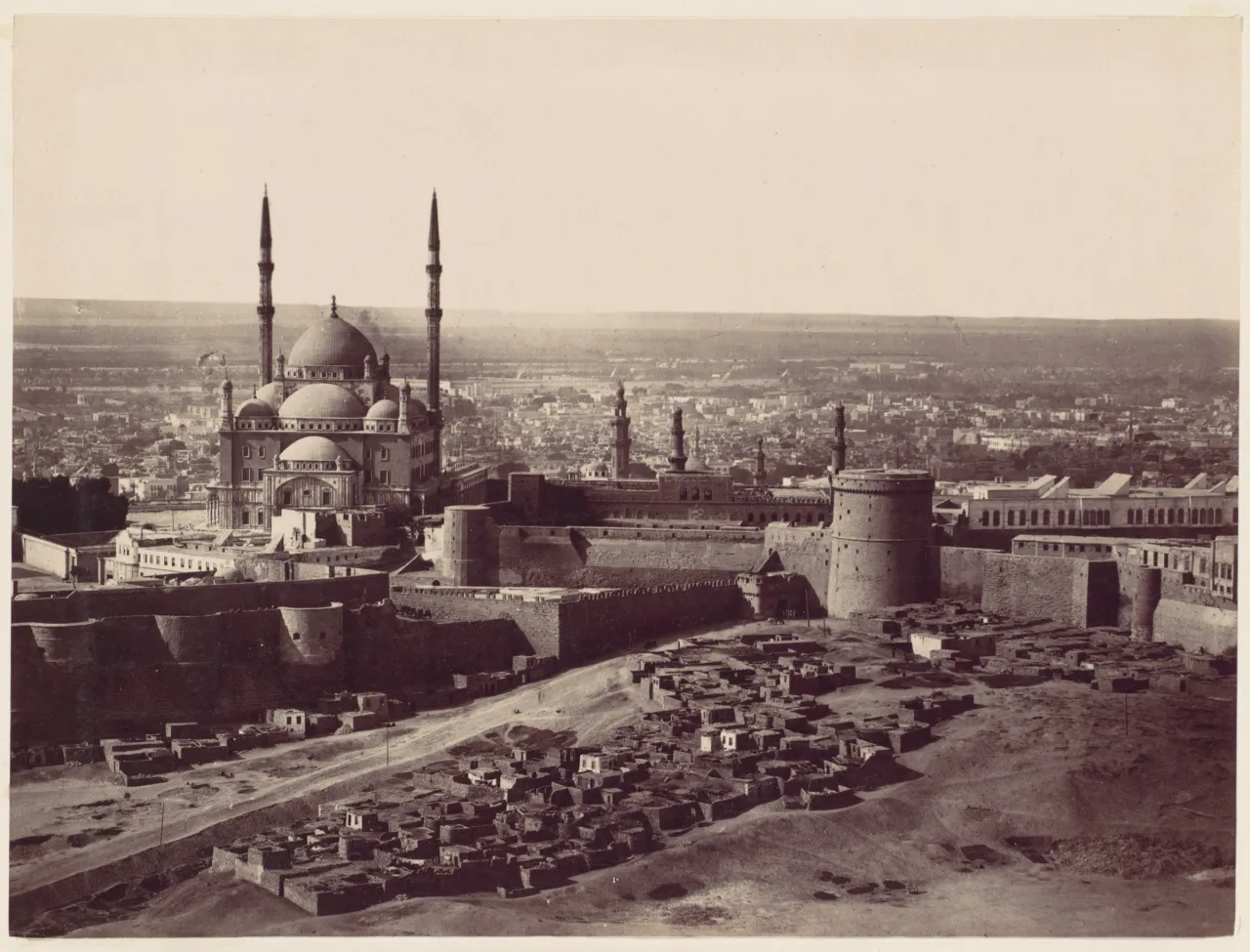
- Cairo, the Citadel. The Mosque of Muhammad Ali stands inside the Citadel, on the site of Mamluk palaces. This is also where the Mamluks were killed in 1811. In the square at the foot of the Citadel the pasha tried to drill his Albanian troops in 1815.
- Cairo, al-Rifa'i Mosque. Khedive Ismail and the kings Fuad I and Farouk are buried here.
- Cairo, Manial Palace. The palace of Prince Muhammad Ali Tawfik, a member of the dynasty, is now a museum.
- Alexandria. The bronze equestrian statue of Muhammad Ali by the French sculptor Henri-Alfred Jacquemart arrived in Egypt in 1872 and was unveiled, according to the art historian Alia Nour, on 16 August 1873. Five years later Mitko's book was printed in the same city.
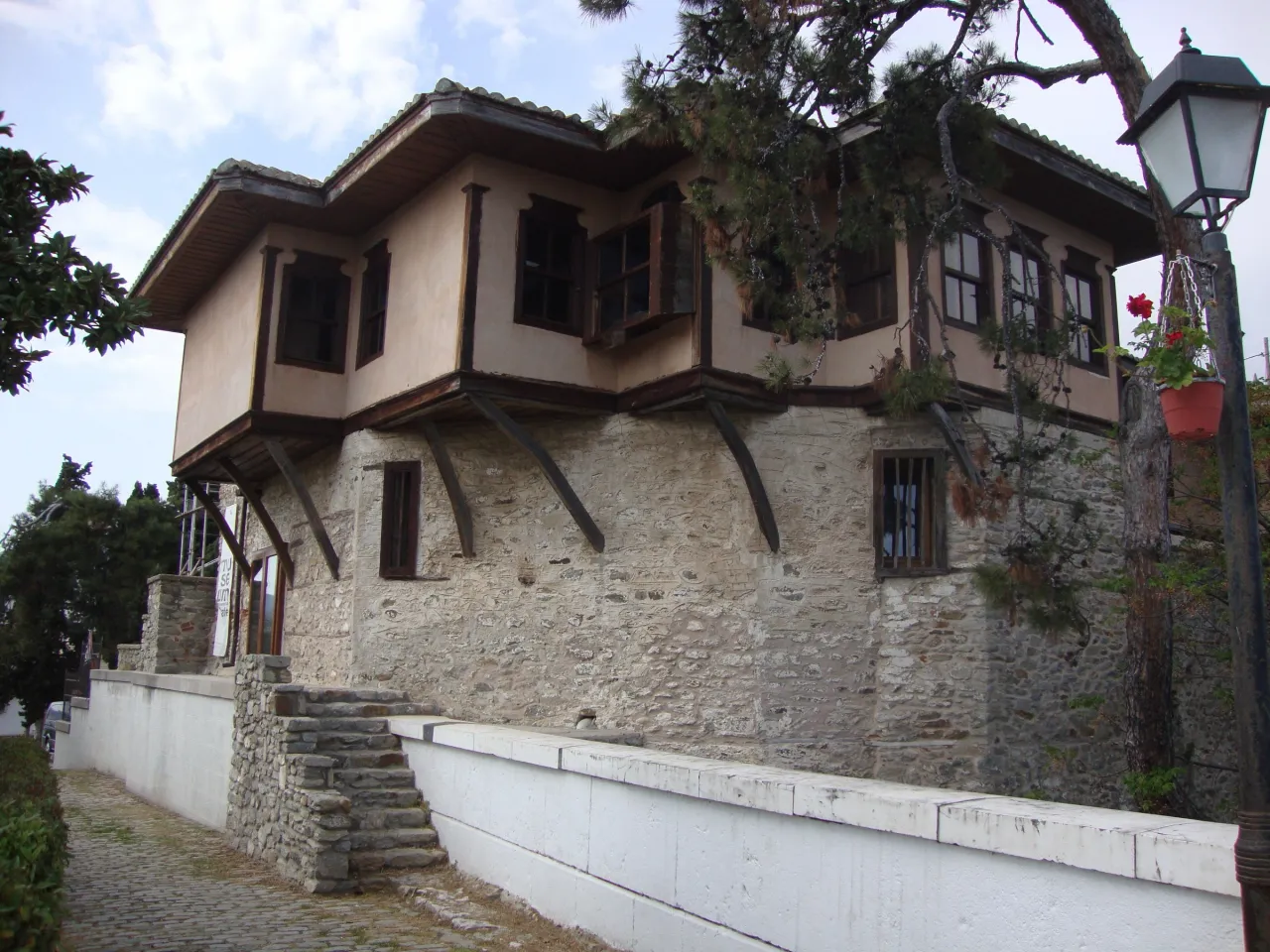
- Kavala, Greece. The house known as Muhammad Ali's and the Imaret, the charitable complex he began to build in 1813, still stand in the old town. A second equestrian statue, by the Greek sculptor Konstantinos Dimitriadis, was unveiled on 6 December 1949.
The Bektashi site on the Muqattam has been closed since 1957. Its present condition is not documented, and it lies in what became a military area, so do not go looking for it. Çajupi no longer lies in Egypt; his remains were taken to Albania in 1958.
Directory: verified contacts and resources
Checked in November 2026. The list is short on purpose: it contains only what verifiably exists today. Opening hours, fees and entry rules change; confirm them before you travel. Arabic names are given for searching on the spot.
- Embassy of Albania in Cairo: 27 El-Gezera Al-Wossta, ground floor no. 4, Zamalek, Cairo. Telephone +202 27361815/4321. Email [email protected]. The ambassador, Sami Shiba, presented his credentials on 14 July 2024. Source: the embassy's website.
- Consular services: the embassy states that it offers all consular services except the production of biometric passports and identity cards, and that they are provided online through the e-Albania portal. Its pages show two different emergency mobile numbers, so ask the embassy which one is current.
- For citizens of Kosovo: Egypt recognised the Republic of Kosovo on 26 June 2013, according to the Egyptian foreign ministry's announcement of that day and Kosovo's own list of recognitions. In November 2018 Egypt's foreign minister, Sameh Shoukry, told Serbian television during a visit to Belgrade that the decision would not be implemented until Kosovo's status was settled through negotiations; the Kosovo news site Periskopi, reporting the interview on 28 November 2018, called this a "frozen" recognition. Kosovo's list of its embassies includes none in Egypt, so ask the Ministry of Foreign Affairs and Diaspora in Prishtina which mission serves its citizens there.
- Visas for Egypt: Egypt's official e-Visa portal lists both Albania and the Republic of Kosovo among the nationalities that can apply online. In November 2026 it gave the fee for a single-entry tourist visa as US$30 and for a multiple-entry one as US$65, and asked for applications at least seven days before departure.
- Embassy of Egypt in Tirana: Str. Kuvajt no. 1, Tirana; telephone +355 4 223 3022, as listed by Egypt's foreign ministry.
- Reading in Albanian and English: Robert Elsie's pages on Çajupi and Fan Noli, and Muhamed Mufaku's essay "Nga historia e shqiptarëve në Egjipt" in the newspaper Dielli.
How this guide was put together
This guide rests on sources we opened ourselves between 16 and 17 November 2026: academic histories and reference works, the Albanian embassy's own reports, official Egyptian and Greek heritage pages, and museum records. A source log with the exact passage behind each statement is kept with the article's working files.
A few rules shaped the text. Where historians disagree, as on Muhammad Ali's origin, we give both sides and say who holds which view. Statements taken from Albanian and Turkish sources are given in our own translation or paraphrase. Where a number has no traceable source, we either say so or leave it out. And where we draw a conclusion of our own, as on the fate of the soldiers' descendants and on how the colony dissolved, we mark it as an inference.
Much remains unknown. We could not consult Mufaku's books, the Egyptian censuses of 1927 to 1947, the 1936 report he cites or the archive of Albanian societies in Tirana, nor several studies that would deepen this account: Frederick de Jong's article on the Maghawri tekke (1981), Frances Trix's life of Baba Rexheb (2009), Nathalie Clayer's work on the Albanian Bektashi (1990), the 1993 travel account by Shkëlzen Halimi and Emin Azemi, and the former ambassador Faruk Borova's history of the dynasty (2012). We found no reliable count of the Albanians of Egypt at any date, no published interview with a descendant in Egypt today, and no association with current activity. If you belong to one of these families, or hold papers and photographs from the colony, the story told here is incomplete without you.
Frequently asked questions about Albanians in Egypt
How many Albanians live in Egypt today?
Nobody knows. No published Egyptian figure for residents of Albanian origin is known, and the United Nations migrant tables list no separate number for people born in Albania. The Albanian embassy in Cairo speaks of an old diaspora, meaning Egyptian citizens of Albanian descent, and a new one, without giving numbers. The only archival figure known is historical: about 8,000 Albanians in a report of 1936.
Was Muhammad Ali of Egypt Albanian?
It is not documented. He was born around 1769 or 1770 in Kavala, in what is now Greece, and rose to power in Egypt as commander of Albanian troops. The Encyclopaedia Britannica says his ethnic background is unknown, though he may have been Albanian. His biographer Khaled Fahmy writes that his mother tongue was Turkish and calls the idea that he was an ethnic Albanian erroneous. Other works, such as Robert Elsie's dictionary, describe his dynasty as Albanian.
Why did Albanians go to Egypt?
For two different reasons in two different periods. Albanian soldiers served in Egypt from the eighteenth century, and those who came with the Ottoman army in 1801 became the force behind Muhammad Ali's rise. From the 1860s, merchants, professionals and workers from southern Albania, especially the Korçë region, came for work and trade in a fast-growing economy. A ruling family that many regarded as Albanian made Egypt a welcoming place for them.
Which Albanian books were written or printed in Egypt?
The best known are Thimi Mitko's collection of folk songs and tales, The Albanian Bee, printed in Alexandria in 1878, and Andon Zako Çajupi's poems Baba-Tomorri, printed in Cairo in 1902. Spiro Dine, who lived in Egypt, published his 856-page Waves of the Sea in Sofia in 1908. Albanian newspapers such as Toska and Shkopi were also edited in Egypt in the 1900s.
What did Fan Noli do in Egypt?
Fan Noli lived in Egypt from 1903 to 1906. He worked as a Greek teacher and church cantor, first in Shibin el-Kom and then in Fayoum, and came to know the Albanian patriots of the colony. They encouraged him to emigrate to the United States, and Spiro Dine paid for his steamer ticket. Noli sailed in April 1906. Two years later, in Boston, he celebrated the liturgy in Albanian for the first time, the first step towards an Albanian Orthodox Church.
What happened to the Bektashi tekke in Cairo?
The Bektashi lodge on the Muqattam hill was led by Albanian babas without a break from 1885. Early in 1957 its land was expropriated and became a military zone, and the last baba, Ahmed Sirri, moved with five dervishes to a villa in Maadi. He died in January 1963, and Bektashi life in Egypt ended with him. The lodge's papers were found in a Cairo market in 1972 and are now kept at Leiden University.
Why did King Zog live in Egypt?
King Zog came to Egypt in February 1946 at the invitation of King Farouk. Egypt had a sizeable Albanian community and had never stopped recognising the Kingdom of Albania, and its royal house was said to be of Albanian origin. Zog lived mainly in Alexandria. After King Farouk was deposed in 1952, the Albanian legation was closed and Zog's villa was searched by police. He left for France on 1 August 1955.
Is there an Albanian embassy in Egypt?
Yes. The Embassy of Albania is at 27 El-Gezera Al-Wossta in the Zamalek district of Cairo, telephone +202 27361815, email [email protected]. It offers consular services through the e-Albania portal, except the production of biometric passports and identity cards. The two states established their present diplomatic relations on 19 April 1956; before that, Egypt had recognised the Kingdom of Albania. Egypt has an embassy in Tirana. Kosovo lists no embassy in Egypt; Egypt recognised Kosovo in 2013, but in 2018 its foreign minister said the decision would not be implemented until Kosovo's status was settled through negotiations.
In June 2025 the embassy in Cairo promised schoolbooks to Egyptians who wanted to learn Albanian. More than 120 years earlier, the title page of Çajupi's Baba-Tomorri, printed in the same city, had put a question to its readers in two lines of verse: "Shqipja qysh u eshte dukur? Sa é-embel, sa é-bukur." How has Albanian seemed to you? How sweet it is, how beautiful.
The Albanians of Egypt belonged to a wider world. Read how the same Ottoman centuries shaped the far larger community of Albanians in Turkey, follow Fan Noli across the ocean to the Albanians of the United States, meet the correspondents of Mitko and Dine among the Arbëreshë, the Italo-Albanians of Italy, or browse every country in the Albanian community hub. And if you would rather write the next chapter than read the last one, meet Albanians on dua.com.