
Albanians in America
Wherever you landed, some of us are close by.
Between 750,000 and a million of us live here, spread across a continent — and the parts of Albanian America are further from each other than any of them is from Albania. This is where the community actually is, and how it finds itself.



1.1 million+ Albanians already on dua.comPhoto-verified profiles
Where are you?
Pick a place and we'll show you what the data says — and who's already there.
In and around New York
68,240
people of Albanian ancestry in the metro
Three in every ten Albanian Americans. Staten Island is 1.75% Albanian — the highest share of any county in the country — and the most Albanian census tract in America is in Allerton, in the Bronx, at 16.8%.
Free to join · 3,245 members here
750,000–1M
The community's own estimate
Albanian American Civic League · National Albanian Registry
228,504
Counted by ancestry
± 8,279 · ACS 2020–2024, table B04006
13,437
Already on dua.com in the US
3,245 of them in New York · July 2026
The Albanian nation had a newspaper in Boston before it had a country. Dielli — “The Sun” — first appeared on 15 February 1909, printed by Albanian immigrants, many of them from villages around Korçë. Albania would not declare independence for another three years.
It is a remarkable detail, but it also tells us something about Albanians in America. This is an old diaspora — old enough that counting it by birthplace alone was never going to work.
Ask within the community and you may hear 750,000 to 1 million. Turn to US government data and the picture looks very different. 252,106 people wrote Albanian in the detailed race question, 228,504 reported Albanian ancestry, 184,704 speak Albanian at home, and 110,504 US residents were born in Albania.
Someone born in the Bronx to Albanian parents may have never lived in Albania. A family from Kosovo can be Albanian without Albania appearing anywhere in its birthplace data. A third-generation family may still think of itself as Albanian long after English has replaced Albanian around the dinner table.
The first communities took root around Boston. Then communist Albania effectively closed one migration route for four decades. After the regime fell, Albanians began arriving again in much larger numbers, including thousands through the Diversity Visa lottery. New York became the obvious centre, but Albanian America never belonged to one city. Communities grew in Michigan, Massachusetts, Connecticut and elsewhere, while families from Kosovo, North Macedonia, Montenegro and other Albanian-speaking regions added their own histories to the diaspora.
That history is still visible in everyday life. In the churches and mosques built by earlier generations. In restaurants that once hid their Albanian ownership behind Italian names and newer ones that put Albanian words proudly above the door. In households where grandparents speak Albanian, parents move between two languages, and children understand more Albanian than they are willing to speak.
It is also visible in a question Albanians ask each other almost automatically: Nga je? — Where are you from?
In America, the answer is rarely as simple as the question.
This guide follows that community from the first arrivals in Boston to the Albanian America that exists today: where people settled, how migration changed after communism, what the Census can and cannot tell us, how religion and language have changed across generations, and how a community spread across an entire continent continues to find one another.
Throughout the guide, we keep one distinction clear. The 750,000–1 million figure is a community estimate, not a Census count. Official US datasets produce smaller numbers because they measure specific things — ancestry, birthplace, language or self-identification — rather than every person who considers themselves Albanian.
For comparison with other Albanian communities abroad, see Albanians in Massachusetts, Albanians in London: A Community of About 80,000, Albanians in the UK: A Community of More Than 150,000, Greece, Italy, Germany and Austria.
Live community hub
Start nationally. Find the right local door.
Use verified official statistics for scale, then move to community-maintained directories and regional pages for practical, current connections.
The National Albanian Registry is a third-party, community-led nonprofit. Its live entries are self-submitted and reviewed by its team; they are not a Census count or a representative population estimate. We link to the live tables instead of copying volatile totals.
Live community resources
These Registry pages change as community members add or update entries. Check the linked page for the current record.
- Registry by stateBrowse the Registry’s live by-state table and its published explanation of what each column measures.Open live resource
- Business directoryFind community-submitted Albanian-owned and Albanian-serving businesses; verify details with the business before visiting.Open live resource
- Organization directoryFind cultural, faith, professional and civic groups and follow their official contact channels.Open live resource
- Events calendarReview community-submitted events, then confirm the date, venue and access requirements with the organizer.Open live resource
Regional starting points
The figures below are ancestry estimates, not total community counts. Metro and state geographies are labeled separately and must not be compared as if they were the same boundary.
- New YorkNew York–Newark–Jersey City metro68,240 ±4,2752020–2024 ACS 5-year B04006, estimate ± 90% MOEThe largest measured metro concentration, with a guide to its neighborhoods and local networks.Read regional guide
- DetroitDetroit–Warren–Dearborn metro24,575 ±2,3542020–2024 ACS 5-year B04006, estimate ± 90% MOEA long-established Michigan community anchored by faith, cultural and business institutions.Read regional guide
- MassachusettsMassachusetts state21,625 ±1,9722020–2024 ACS 5-year B04006, estimate ± 90% MOEA statewide view that includes Boston, Worcester and communities beyond the metro core.Read regional guide
- ChicagoChicago–Naperville–Elgin metro14,515 ±1,9822020–2024 ACS 5-year B04006, estimate ± 90% MOEA cross-state metro community whose institutions extend beyond Chicago city limits.Read regional guide
- New JerseyNew Jersey state18,304 ±2,2212020–2024 ACS 5-year B04006, estimate ± 90% MOEA statewide community closely connected with, but not reducible to, the New York metro.Read regional guide
- FloridaFlorida state17,470 ±3,5132020–2024 ACS 5-year B04006, estimate ± 90% MOEA dispersed statewide community; Jacksonville and Tampa are useful local starting points.Read regional guide
Other regional centers
The six hubs are not the whole map. These established or growing centers belong in the national picture, but unreliable commercial city rankings are not copied here.
- Philadelphia
A long-running East Coast community connected to the wider Pennsylvania and Delaware Valley network.
- Waterbury & Connecticut
A historic factory-era center with Albanian institutions and settlement patterns that have endured for generations.
- Cleveland
Successive Arbëreshë, labor, displaced-person and post-1990 arrivals created a visible civic community and Cultural Garden.
- Dallas–Fort Worth
A smaller, dispersed Sun Belt network best explored through current organizations and live community directories rather than commercial city counts.
Upcoming community dates
Future dates were checked on the organizers’ own pages on 12 September 2026. Past dates leave this list automatically.
Festa e Flamurit 2026
St Paul Albanian Catholic Church, Rochester Hills, Michigan
The Rochester Hills church’s annual Albanian Flag Day celebration, listed for 7:00 p.m.
Check organizer
Schedules, permits and admission can change. Confirm on the organizer’s page before travelling.
Verified institutions
These links go to the institutions’ own sites. Inclusion is informational, not an endorsement, and local programs should be confirmed directly.
Albanian American National Organization
A national fraternal and cultural organization with chapters and an annual convention.
Visit official siteAlbanian American Civic League
A US advocacy organization; its population figure is an organizational estimate, not a Census total.
Visit official siteAlbanian Orthodox Archdiocese in America
The Orthodox Church in America’s Albanian archdiocese and its parish network.
Visit official siteFirst Albanian American Bektashi Monastery
The Bektashi monastery established in Michigan as a religious and cultural center.
Visit official siteSt Paul Albanian Catholic Church
A Detroit-area Albanian Catholic parish with a current public events calendar.
Visit official siteAlbanian-American Chamber of Commerce of Michigan
A Michigan regional business chamber publishing member and community programs.
Visit official site
What each number can—and cannot—say
No single measure captures every Albanian American. This page keeps the main evidence families separate.
Ancestry
ACS B04006 counts people reporting Albanian first or second ancestry. The 2020–2024 five-year estimate is 228,504 ±8,279 nationwide.
Birthplace and language
Birthplace measures where a person was born; language measures Albanian spoken at home. Neither is interchangeable with ancestry.
Refugee, immigration and community records
Administrative programs and Registry entries describe specific flows or voluntary participation, not the whole population.
dua aggregates
Approved dua figures are anonymous account aggregates for the stated geography and date. They are not population estimates, and no individual-level data is published.
Review and corrections
We log material claims in the claim-to-source ledger, date each review, and correct factual errors after checking the primary source. ACS and PUMS measures are refreshed when a new comparable release is available; event links require a fresh organizer check before attendance.
Evidence and links reviewed 28 August 2026
The counts
How many Albanians live in the United States?
The community answer is 750,000 to 1 million. That range is used by Albanian-American organisations to include the full community across countries of origin, generations and citizenship statuses. The official figures are lower because each federal table measures one narrower characteristic rather than ethnic community membership.
| Measure | Figure | What it represents |
|---|---|---|
| Community estimate | 750,000–1 million | The range used by Albanian-American organisations for the wider ethnic and descendant community. |
| Largest current published Census figure | 252,106 | People reporting Albanian in the detailed race question, alone or in combination. |
| Albanian ancestry | 228,504 ± 8,279 | People reporting Albanian as one of up to two ancestries in the 2020–2024 ACS. |
| 2020 Census full count | 236,635 | A complete enumeration rather than a sample, with a documented margin of error of three people. |
| Albanian spoken at home | 184,704 | Residents aged five and over identified in the 2024 ACS microdata. |
| Born in Albania | 110,504 ± 5,099 | Place of birth, regardless of current citizenship. |
| Evidence-led living signal | ≈ 315,000 | A de-duplicated model combining ancestry, language, birthplace and measured relatives; not an official count. |
Start with 228,504. That is how many people told the American Community Survey they had Albanian ancestry. Ask a slightly different question, however, and the number changes. In the same survey and over the same period, 252,106 people wrote “Albanian” in the detailed race question — the largest Albanian figure in any published US Census table.
Then there is 236,635. Unlike the other figures, this one does not come from a survey sample. It is the full 2020 Census count, published on 21 September 2023, with a documented margin of error of just three people.
That last number is the easiest to misunderstand. It tells us where someone was born, not who they are. It cannot capture an Albanian born in Kosovo, a second-generation Albanian born in New York, or a grandchild in Michigan whose family has considered itself Albanian for decades.
The ancestry estimate is 228,504 ± 8,279. The race write-in is 252,106 ± 8,977. The Albania-born population is 110,504 ± 5,099. Each comes from an official US dataset, but each asks a different question and therefore sees a different part of Albanian America.
Even official measures do not line up neatly. In the same survey period, 10.3 percent more people identified as Albanian in the race question than in the ancestry question. And the full 2020 Census count came in 17 percent above the survey estimate from around the same time.
A government dataset can count birthplace, ancestry or the identity someone writes on a form. What it cannot do perfectly is draw a line around a diaspora — especially one that includes families from Albania, Kosovo and other Albanian-speaking regions, alongside children and grandchildren born in the United States.
That is why the official figures and the 750,000–1 million community estimate should not be treated as competing answers. They are attempts to describe the community from different starting points.
Fivefold since 1990, and a plateau in the middle
In 1990 the census recorded 47,710 Albanian ancestries. In 2000 it was 113,661 — a rise so sharp that the Census Bureau flagged it in its own report, noting that a handful of small ancestry groups, Albanian among them, “at least doubled.”
Between the 2014 and 2018 survey estimates the count did not move at all — 191,021 to 191,264, a change of 0.1 percent over four years, well inside the margin of error. Albanian America went flat for the better part of six years, and only started climbing again in the 2020s.
Why no official ethnic-Albanian total exists
One reason Albanians are so difficult to count in America is simple: not all Albanians come from Albania.
They arrive from Kosovo, North Macedonia, Montenegro and southern Serbia, as well as from older Albanian communities in Greece, Turkey and Italy. Yet in US birthplace statistics, only those born in Albania are easy to identify.
Kosovo shows just how much can disappear between the community and the official tables.
Despite declaring independence in 2008, Kosovo has never appeared as its own line in the Census Bureau's published place-of-birth tables — not once between 2009 and 2024. It only received a separate code in the public microdata in 2017. Montenegro has never had its own published line either.
On the surface, these people are almost invisible. Go beneath the published tables and into the individual Census records, and they begin to appear.
In 2024, the United States had an estimated 23,069 residents born in Kosovo, 12,945 born in Montenegro and 29,937 born in North Macedonia. Another 29,131 still reported their birthplace as Yugoslavia — a country that had ceased to exist more than two decades earlier.
And this is where birthplace becomes particularly misleading for Albanians.
About seven in ten Kosovo-born residents report Albanian ancestry. Among people born in Montenegro, more than a third do. That might seem surprising when Albanians make up only about five percent of Montenegro's population, but migration to America has never been a miniature copy of the country left behind. Much of the Montenegrin migration came from places with long-established Albanian communities — Ulcinj, Tuzi, Plav and Gusinje.
North Macedonia tells a different story.
In Germany and Austria, roughly two-thirds of emigrants from North Macedonia are Albanian. In the United States, the pattern flips. Of the 29,937 US residents born in North Macedonia, only 22.4 percent report Albanian ancestry, while 59.9 percent report Macedonian ancestry.
That difference matters because it shows why birthplace cannot simply be converted into ethnicity. A Kosovo-born resident may be Albanian. A Montenegro-born resident may be Albanian. A North Macedonia-born resident may be Albanian — but is more likely, in the American data, not to be.
Older records make the picture messier still. Some immigrants remain buried inside broad categories such as “Other Eastern Europe,” while Department of Homeland Security records preserve the wonderfully bureaucratic label “Yugoslavia (unknown republic) prior to February 7, 2003.”
Put all of this together and the problem becomes clearer. The Census can tell us where people were born. Geography alone cannot tell us who is Albanian.
For a diaspora whose ethnic boundaries have never matched neatly with state borders, there was never going to be a single birthplace statistic that captured the whole community.
Albanian America in eight numbers that tell the story
Before getting into the history, there are eight numbers worth knowing. Some confirm what the community already knows. Others complicate it.
Albanian-American organisations put the community at somewhere between 750,000 and 1 million people.
The Albanian American Civic League uses 750,000; the National Albanian Registry puts the figure closer to one million. Neither is a Census count. That distinction matters, because the official numbers tell a very different story.
The largest current Albanian figure in a published Census table is 252,106.
Another table records 228,504 people with Albanian ancestry, while ACS microdata identifies 184,704 people aged five and over who speak Albanian at home. The gap between those numbers is not an error. Each one is looking for something different.
The most precise Albanian count the US has ever produced is 236,635 — with a margin of error of just three people.
It comes from the 2020 Census and was published on 21 September 2023. Yet, as far as we can find, the number has barely entered the conversation among the people it counts.
In fiscal year 2000, four out of every five Albanians who became US permanent residents had won the Diversity Visa lottery.
The scale of interest back home was extraordinary: in a single autumn, Albania submitted 367,231 entries, equivalent to 12.8 percent of the country's population. For thousands of families, the lottery was not a side story in Albanian migration to America. It was the route in.
Kosovo has been independent since 2008, but Kosovo-born Albanians remain unusually difficult to see in published US statistics.
The Census Bureau introduced a “born in Kosovo” code in 2017 but has never published Kosovo as its own line in a birthplace table. To find the 23,069 Kosovo-born US residents counted in 2024, you have to go into the microdata.
New York may be the centre of Albanian America, but one of the strongest concentrations is in Michigan.
Among sizeable US cities, Sterling Heights has the highest Albanian share, at 2.85 percent. Staten Island leads at county level, at 1.75 percent. Zoom all the way down to census-tract level, though, and the map returns to New York: one tract in Allerton, in the Bronx, is 16.8 percent Albanian.
More Albanians arrived in the United States during the 2010s than in any previous decade.
Not the great migration of the 1990s. Not the years surrounding the Kosovo war. The largest decade of Albanian arrival was the one that ended only recently.
And then there are 35,546 children and grandchildren living in Albanian households who disappear from Albanian statistics altogether.
They live in families where an Albanian connection is still visible, but they are not counted as Albanian by the usual ancestry, birthplace or language measures. About 19,500 did not report an ancestry at all. This is one of the clearest examples of how a community can remain visible around the dinner table while slowly disappearing from the dataset.
The map
Where Albanian America lives, dot by dot
One dot per county with at least 30 people reporting Albanian ancestry — 407 counties holding 98% of the national total. Hover any dot for the county and its figure, or click a state to see its own total and top counties.
Source: US Census Bureau, ACS 2020–2024 5-year estimates, table B04006, county and tract level.
dua.com is part of that change. More than 13,400 members were registered in the United States as of July 2026, connecting with Albanians nearby, across the country, and back in Kosovo, Albania, and North Macedonia. It’s not here to replace the churches, associations, or family networks that have kept Albanian communities close for generations. It simply adds something new: an easier way to find each other, even when “your people” happen to live hundreds — or thousands — of miles away.
Dot size
people per county
Counties with the largest Albanian population
What the map means in practice
The dots are the problem, and the reason dua.com exists
Four hundred and seven counties, and five of them hold a fifth of the community. For a century Albanians in America met through the village association, the parish hall and the cousin with a spare room — networks that work beautifully inside a dot and stop at its edge. A family in Phoenix is four flying hours from the nearest street where the language is spoken.
dua.com is that circle at the scale of the country — and across the Atlantic. More than 13,400 members in the United States, 3,245 of them in New York, and 5,671 matches back to Kosovo, Albania and North Macedonia between April and July 2026.
Places
Where Albanian America lives
Albanian America is spread across the country, but its geography is far from random.
More than half of all people reporting Albanian ancestry live in just four states: New York, Michigan, Massachusetts and New Jersey. New York is comfortably the largest, with 56,959, followed by Michigan with 26,598, Massachusetts with 21,625 and New Jersey with 18,304.
But raw numbers hide something more interesting.
Look at concentration rather than headcount and the map changes. Massachusetts and Connecticut are proportionally more Albanian than New York. Detroit, at 0.56 percent, is more Albanian than the New York metropolitan area. And the highest concentration of any US metropolitan area is around Waterbury, Connecticut, where almost one person in every hundred reports Albanian ancestry.
So there isn't really one Albanian America. There are several — and they grew for different reasons.
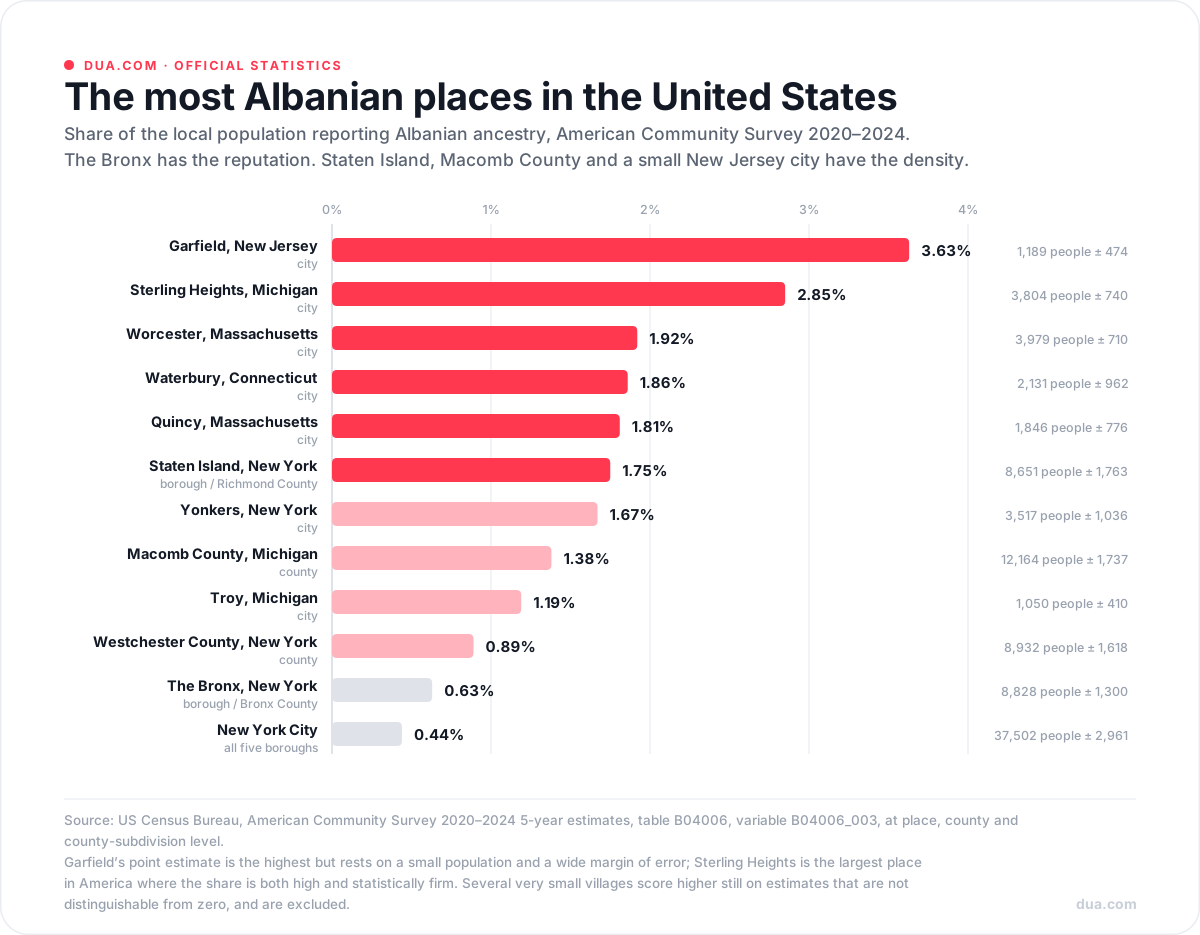
- 3.63%
Garfield, New Jersey
most Albanian city in America by point estimate
- 3.03%
Rocky River, Ohio
a colony outside Cleveland
- 2.85%
Sterling Heights, Michigan
3,804 people — the largest firm count
- 1.92%
Worcester, Massachusetts
oldest Albanian congregation in the United States
- 1.75%
Staten Island, New York
most Albanian county in America
- 1.38%
Macomb County, Michigan
most Albanian sizeable county outside New York City
Share of the local population reporting Albanian ancestry. ACS 2020–2024, table B04006.
New York: the Bronx has the reputation, Staten Island has the numbers
If Albanian America has a capital, though, it is still New York. The metropolitan area is home to 68,240 people reporting Albanian ancestry — roughly three in every ten Albanian Americans.
The Bronx has the history and the reputation. Queens actually has the largest number, with 9,655. And Staten Island has quietly become the most Albanian county in the country: 8,651 residents, or 1.75 percent of the borough's population, report Albanian ancestry.
But to see Albanian New York at its most concentrated, you have to zoom in much further.
Around Pelham Parkway, Allerton and Morris Park, the percentages suddenly jump.
Morris Park is 5.85 percent Albanian. In one part of Allerton, just north of Pelham Parkway, 16.8 percent of residents report Albanian ancestry — the highest share of any census tract we found in the United States.
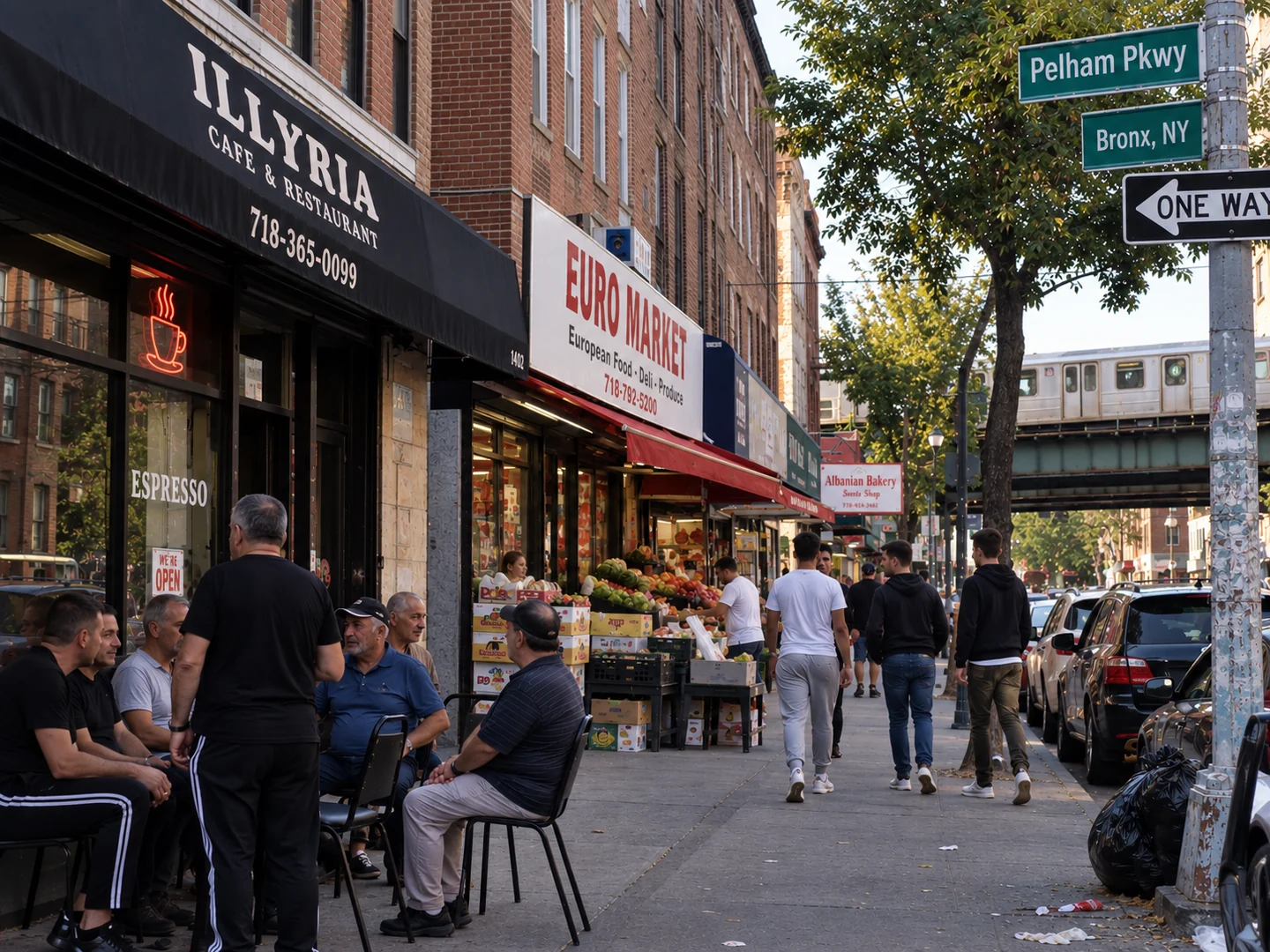
At that scale, the statistics begin to resemble an actual neighbourhood. New Yorkers sometimes talk about the Bronx's Little Albania as if it were a single district. On the ground, it is harder to draw the border.
The residential heart runs through the Pelham Parkway area, particularly around Lydig Avenue. Albanian bakeries, pizzerias, and markets sit among businesses belonging to the Russian, Jewish, and other communities that have also made this part of the Bronx home.
You can see that same pattern online. New York is dua.com’s largest community in the US, with 3,245 registered members as of July 2026. That number isn’t meant to represent the Albanian population of New York — it simply shows where one part of the community is connecting digitally.
For younger Albanians especially, community life no longer happens only in neighborhoods, cafés, churches, or cultural events. It happens on the screen too.
Then there is Arthur Avenue and Belmont, traditionally known as the Bronx's Little Italy. That is where another part of the Albanian story becomes visible.
For decades, Albanians worked in Italian restaurants across New York. Many learned the business from the inside — cooking, waiting tables, washing dishes and eventually managing restaurants of their own. Some kept the Italian names and menus. Others no longer saw a reason to.
Today, Çka ka Qëllu serves Albanian food in the middle of the Bronx's old Italian restaurant district and appears in the Michelin Guide.
The sign above the door says something the statistics cannot: a community that once found work inside somebody else's ethnic economy is increasingly comfortable putting its own name on the business.
Mujo Rugova watched that transition happen. He came from Plav, Montenegro, in the 1980s and eventually built a business of European food markets and distribution. Looking back at the Bronx restaurant trade, he described the cycle plainly: Albanians had once worked for Italian owners; later, they became the owners themselves. Newer immigrant groups were now doing many of the jobs Albanians once did.
It is an old New York story, just with different names on the storefronts.
A taste of Albanian New York
And then there is the food. Burek has travelled with Albanians everywhere, and New York is no exception. In Albanian bakeries across the city, dough is still stretched by hand, filled, and baked much the way generations grew up eating it back home.
Seven kinds of burek in one New York kitchen. Some traditions don't need much explaining.
The Bronx remains the symbolic centre of Albanian New York. But the community is already shifting north.
Across three consecutive survey periods, the Albanian-ancestry population of the Bronx fell from 10,317 to 9,546 to 8,828.
Westchester moved the other way: 7,878 to 7,917 to 8,932.
The numbers suggest what many immigrant communities eventually do as families become more established: move outward while keeping the institutions and relationships that hold the community together.
In this case, one of those institutions moved before the statistics did.
The Albanian Catholic parish once stood on Park Avenue in the Bronx. In 1999, Our Lady of Shkodra opened its new church in Hartsdale, Westchester.
The Bronx did not stop being Albanian when families began moving north. The boundaries of Albanian New York simply got larger.
Michigan: follow Van Dyke north
New York has more Albanians. Metro Detroit is more Albanian.
About 24,575 people of Albanian ancestry live across metropolitan Detroit, and nowhere is the concentration clearer than Macomb County. In Sterling Heights, 3,804 residents — 2.85 percent of the city — report Albanian ancestry, making it the most Albanian sizeable city in America by a statistically firm measure.
But the more interesting story is how they got there.
Compare the map in 2000 with the map today and you can almost watch Albanian Detroit move northeast along the Van Dyke corridor.
Hamtramck fell from 635 Albanians to just 26. Warren dropped from 1,053 to 202. The city of Detroit itself declined too.
At the same time, Sterling Heights grew by 66 percent. Troy more than doubled. Westland more than tripled.
The community did not disappear. It moved.
That movement says something about how established Albanian America has become. Earlier immigrants settled near factories, affordable housing and relatives. As families bought homes and moved outward, the centre of gravity followed them into the suburbs.
Michigan is unusual in another way. Its Albanian population comes from across the Albanian-speaking Balkans: roughly half from Albania itself, alongside substantial communities with roots in North Macedonia, Kosovo and Montenegro.
And if the Bronx has its Albanian-run pizzerias, Detroit has Coney Islands.
The city's hot-dog restaurants became one of those immigrant businesses where relatives brought in relatives, employees became owners, and a job turned into a foothold in America. Different menu, familiar story.
One claim about Detroit is worth correcting. It is sometimes called the largest Albanian community outside Europe. It isn't: metropolitan New York has roughly 68,240 people reporting Albanian ancestry, compared with Detroit's 24,575.
What Detroit can claim is more interesting anyway. Among America's large metropolitan areas, nowhere is Albanian identity as concentrated.
Read the complete Albanians in Detroit guide for ACS margins of error, migration sources, institutions, schools, businesses, football and the current directory.
Worcester and Waterbury: the old map survives
If Detroit shows where Albanian America moved, Worcester shows what survived.
Albanians have been building institutions there for more than a century. The city's Albanian Orthodox congregation was organised in 1911, and its church on Wellington Street was designed as a replica of St George in Korçë.
Today, about two-thirds of its liturgy is in English.
That small detail may say as much about a century of Albanian-American life as the population numbers do. The church remained. The language around it changed.
Worcester itself is still 1.92 percent Albanian, but Massachusetts no longer follows the old industrial map. Places such as Southbridge have faded while newer communities have grown around Boston and along the North and South Shores. Quincy, for example, has seen its Albanian population rise sharply since 2000.
Connecticut offers a different kind of continuity.
Albanians were arriving in Waterbury for factory work before the First World War. A century later, the city still has 2,131 residents reporting Albanian ancestry — remarkably close to the 2,174 counted in 2000.
And yet ask locally how many Albanians live there and you may hear a very different number.
In 2008, Waterbury's mayor put the community at “around 15,000.” The Census count was nowhere close.
That sevenfold gap is another reminder of the problem running through this entire story: the community people believe they belong to is often much larger than the community an official form can see.
New Jersey: the newer centre
Then there is New Jersey.
Since 2000, its Albanian-ancestry population has grown by roughly 150 percent, faster than any other large Albanian state.
One of the clearest concentrations is Garfield, where an estimated 3.63 percent of residents report Albanian ancestry. Its origins also look different from those of Massachusetts: people born in North Macedonia form a particularly visible part of the local community.
That matters because there is no single Albanian-American migration story. Worcester grew out of the early Albania-to-America migration. Detroit drew heavily from several parts of the Balkans. New Jersey reflects later movements from both Albania and the former Yugoslavia.
Sometimes reputation lags behind the numbers too.
Paterson appears regularly on lists of Albanian-American centres. The current ancestry estimate finds just 94 people there.
Communities move faster than stereotypes do.
The map is still moving
Beyond the major centres, Albanian America becomes more scattered.
The Chicago metropolitan area has about 14,515 people of Albanian ancestry, with particularly strong roots in communities from North Macedonia. Florida, now home to 17,470, has become one of the country's largest Albanian states. And in Rocky River, Ohio, Albanians make up about 3 percent of the population.
At the same time, some places that once had recognizable Albanian communities have nearly emptied out.
Bridgeport fell from 386 to 79. Ansonia from 208 to 32. Boise from 275 to 51. El Cajon, California, from 208 to just 5.
Taken one by one, those numbers look like decline.
They aren't.
Albanian America has roughly doubled since 2000 while disappearing from many of the places where an earlier generation lived. Families moved from cities to suburbs, from old industrial towns to newer economic centres, and from first apartments to neighborhoods their grandparents would never have associated with Albanians.
The population grew. The map changed underneath it.
History
Boston, 1886: the country that started in America
Albanian America is older than Albania. The first Albanian newspaper printed in the United States, Kombi, came off a press in a Boston cellar in June 1906. Dielli followed on 15 February 1909. The Pan-Albanian Federation of America, Vatra, was founded in Boston in 1912. Albania declared its independence at Vlora on 28 November of that same year. For a few years in the middle of all this, the most consequential Albanian institutions on earth were in Massachusetts.
The community remembers its own beginning in a blessing, recorded by fieldworkers in 1939: “Who opened America may his soul shine and shine; a fellow from Korcha and one from Katundi may their souls shine and shine.” The fellow from Korçë came in 1876 and left almost at once for Argentina. The one from Katundi stayed.
His name was Kolë Kristofori, and in America he became Nicholas Christopher — less a renaming than a translation, since Kolë is Nicholas and Kristofori is Christopher. Dielli, the paper his own generation founded in Boston, once made the coincidence do some work in a headline: the Albanian “Columbus” who discovered America for the Albanians. It is one writer's phrase — Dalip Greca's, in 2017 — and it is about the right size for what the man did.
He was born around 1859 in Katundi, a village in the hills of Vithkuq above Korçë, crossed on a Greek steamer and landed at Boston in the mid-1880s, and spent his first night in America asleep in the open beside a railway depot, among the Greeks he had crossed with, because he knew nobody in the city. He is the first Albanian who came to America for work and stayed. Then he went home and came back in 1892 leading a party of sixteen or seventeen men from his own village, and kept going back for more, until, as the 1939 study puts it, the first ten Albanians in the United States all came from the same village. What the village remembers is not an argument but a picture: the man who walked back in wearing European clothes and a starched collar, with money in his pockets, saying that in America you could make ten dollars a day selling flowers and fruit in the street. It did not need to be true to empty a village.
What he built afterwards outlasted him. In Boston in 1908 he gathered the men of Katundi into Fatbardhësia — “Good Fortune” — a village society that sent money home to school Albanian children, and that half a century later printed the first history of Albanian America. A free school for girls was opened in his family's house back in Katundi while the Ottoman state still banned printing in Albanian, with his sister Sofi teaching in it. He was ordained a priest in 1917, into Fan Noli's own cathedral of St George. Albanian-American writers count him among the founders of the diaspora's national movement. He died in Boston on 26 July 1940, aged eighty.
By 1900 there were perhaps forty-two Albanians in the whole of Massachusetts. Within twenty years there were tens of thousands across New England — and the reason was the same one that shaped every other detail of their lives: mill work paid, and it did not ask for English.
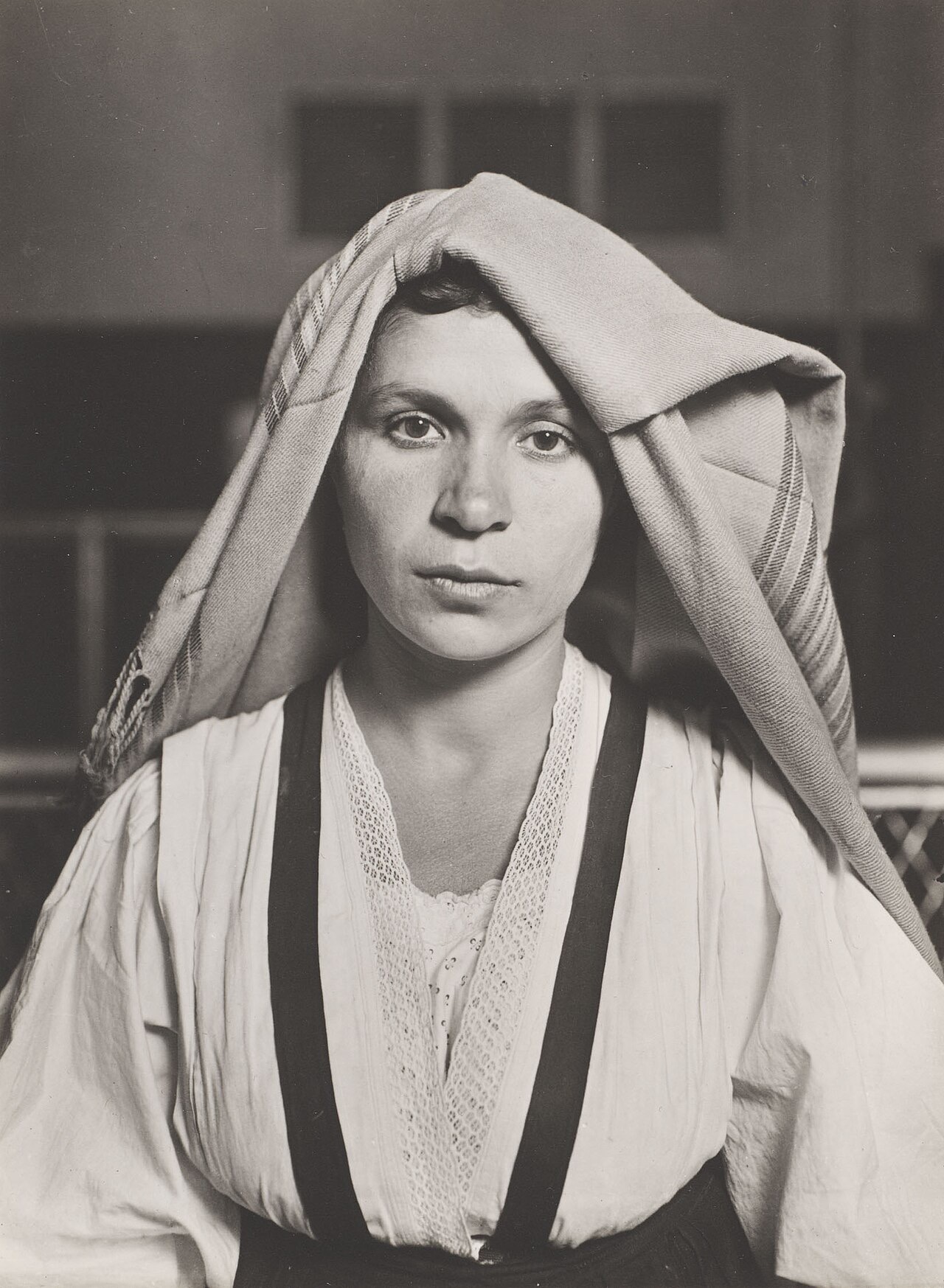
One man from Katundi
Kolë Kristofori settles in Massachusetts, peddles bananas, and goes home again and again — until the first ten Albanians in the United States all come from his village.
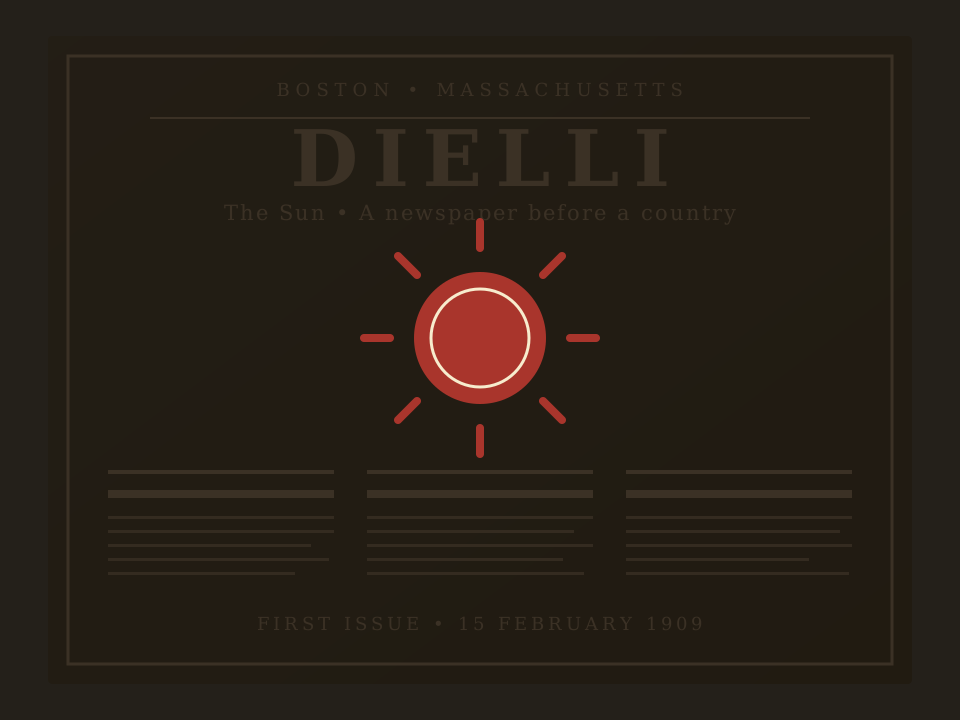
A newspaper before a country
Dielli — “The Sun” — first appears on 15 February, printed by mill hands from the villages around Korçë. Albania declares its independence three years later.
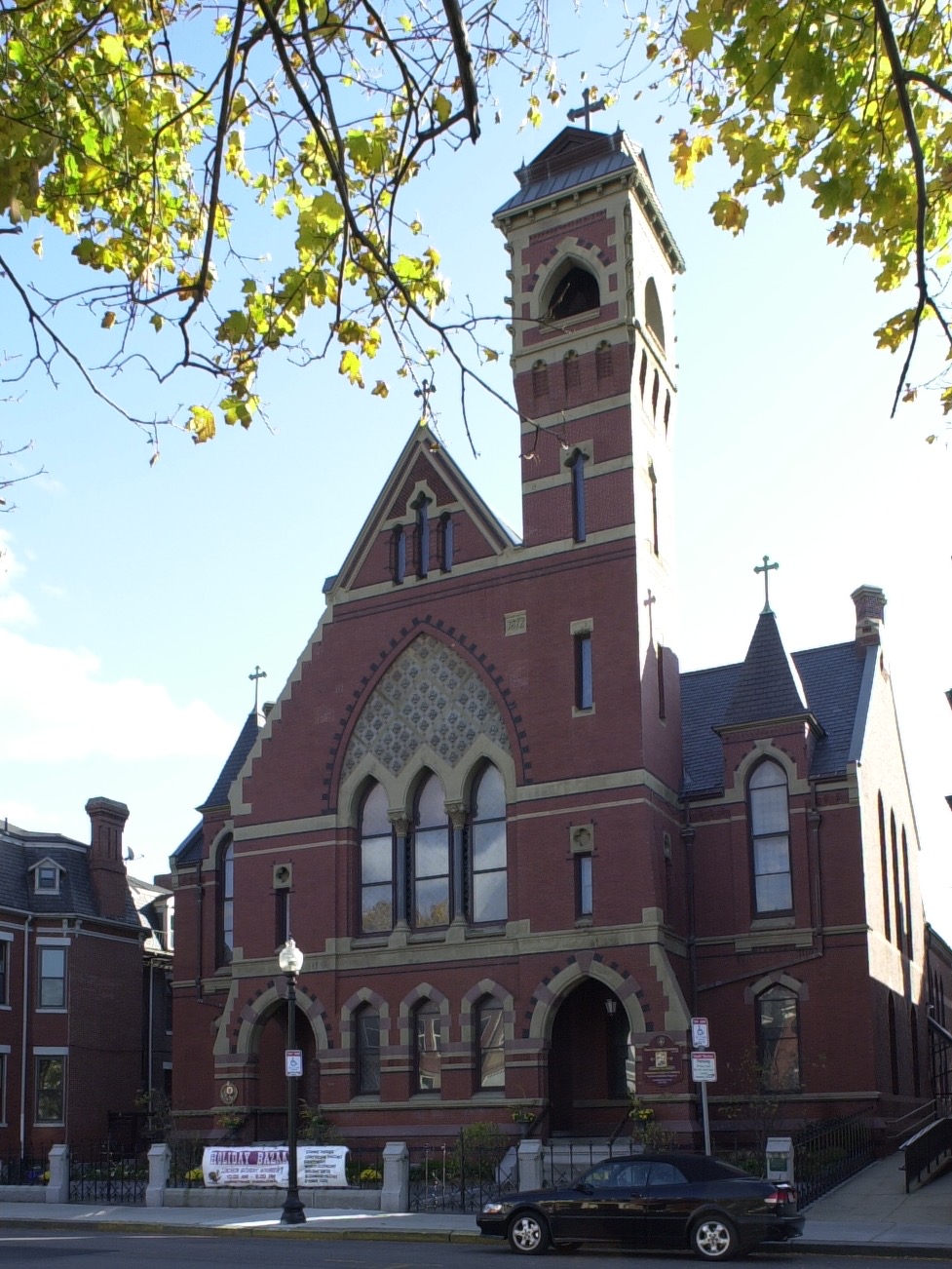
A refused burial founds a church
Vatra is founded in Boston. The Albanian Orthodox Church in America begins with a priest's refusal to bury an immigrant, and ends up a cathedral in South Boston.
The lottery that built a community
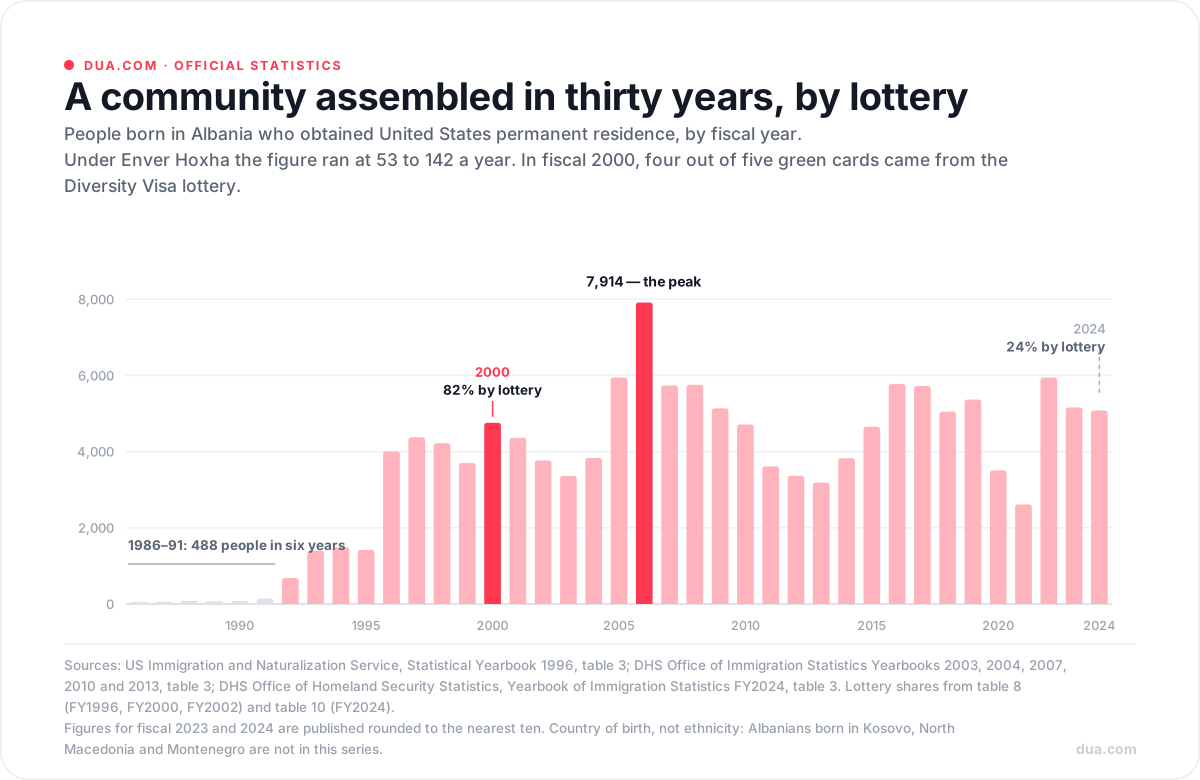
367,231 Diversity Visa entries from Albania in a single autumn. By fiscal 2000, four in five Albanian green cards came from winning it.
A community spread across a continent
228,504 counted by ancestry; 750,000 to 1 million by the community's own reckoning. The parts of it are further from each other than any of them is from Albania.
1886–1920
Ten men to a flat
Most of the first Albanian migrants did not come to build a life in America. They came alone, expecting to work, save money and go home.
Even getting there could require a small deception. The passage cost more than fifty dollars, money many borrowed from village lenders. But a 1907 US law could exclude labourers who arrived on borrowed money, so migrants learned what to say at Ellis Island. Boys might claim the money came from their fathers; sometimes strangers were recruited to play the part. If the story fell apart under questioning, the journey ended in deportation.
Those who made it through found work in the textile mills, shoe factories and metalworks of Massachusetts and nearby industrial towns. They crowded ten or fifteen to a flat, in communal houses they called konaks.
There was little romance in it. One immigrant later remembered the konaks as “often no better than kolnets” — dog kennels.
And yet, inside those rooms, something unexpected happened.
The konak became a school
Many of the men had grown up under Ottoman rule and had never learned to read Albanian. In America, the one man in the flat who could read would sit down with a newspaper and read it aloud. Not just the politics, but everything — sometimes even the advertisements. Then everyone argued about what they had heard.
Books began arriving from Albanian publishers abroad. So did newspapers.
Sotir Peçi produced Kombi from a cellar on Hudson Street in Boston. Then, on 15 February 1909, came Dielli — “The Sun.”
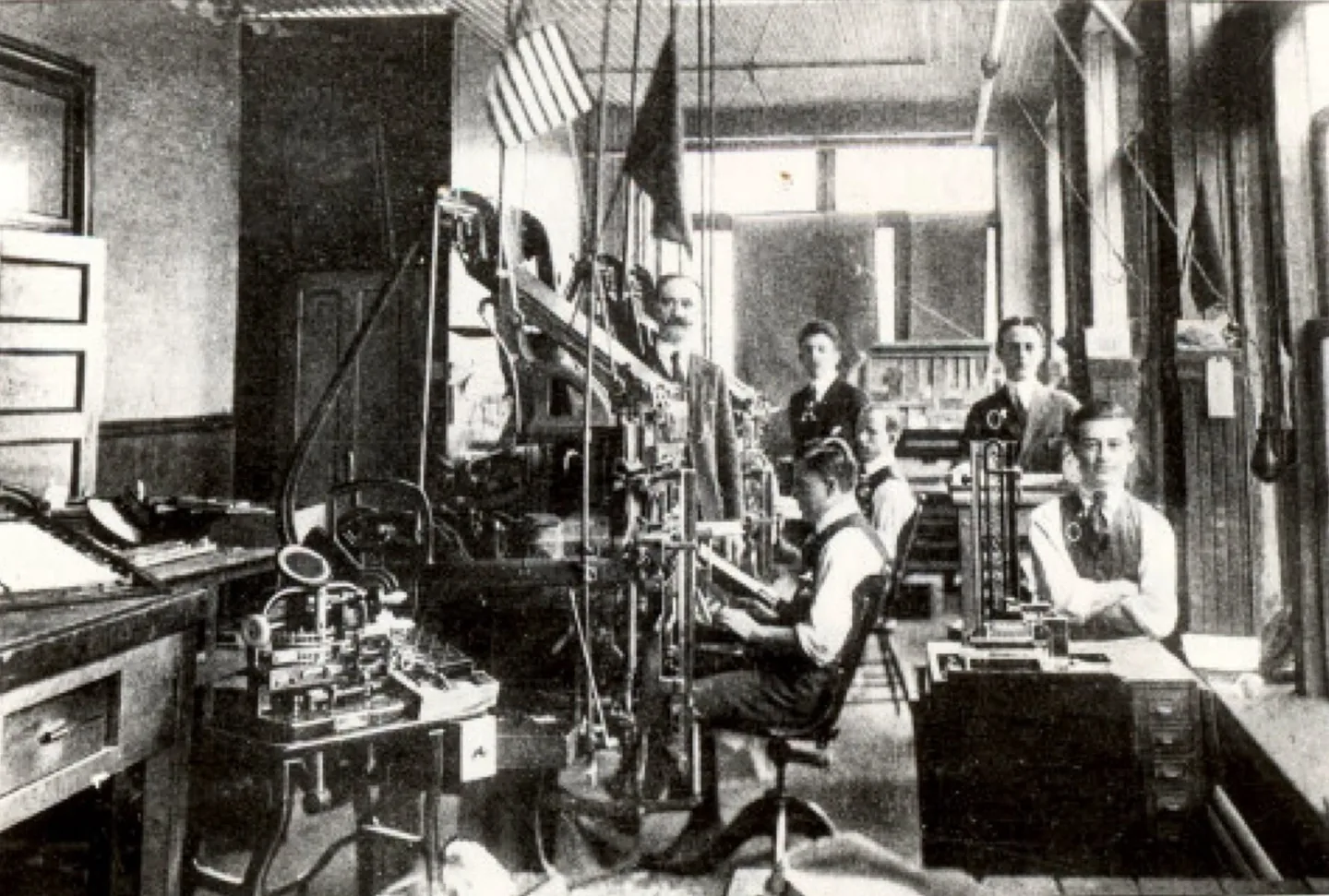
Three years later, Albania declared independence.
That sequence is worth dwelling on. Before Albania had a state of its own, Albanian immigrants in Boston were already printing newspapers, debating politics and imagining what that state might look like.
Dielli still publishes today, making it the oldest surviving Albanian-language newspaper in the world.
A burial, then a church
Religion created another problem.
Orthodox Albanians in New England generally worshipped in Greek churches, where Albanian had no place in the liturgy. The conflict became impossible to ignore in 1907, when a young Albanian nationalist died in Massachusetts and a Greek priest refused to bury him. He went into the ground without a religious service.
The response was not to find another Greek priest. Albanians built their own church.
At the centre of it was Fan Noli, one of the most remarkable figures in the early diaspora. On 22 March 1908, in a hall on Washington Street in Boston, Noli celebrated the first Orthodox liturgy in Albanian before a congregation of more than five hundred.
For many of the people in that room, hearing Albanian at the altar must have meant more than a change of language. The church was becoming Albanian too.
The first purpose-built Albanian church in America, St Nicholas in Southbridge, followed in 1912. By 1939, Massachusetts had six Albanian Orthodox churches.
Boston became more than a destination
The same year St Nicholas opened, Noli and Faik Konica helped found Vatra — “The Hearth.”
By 1918, that politics was visible in public as well as on the pages of Dielli. At a Flag Day gathering in New York, Albanians marched carrying the American flag beside the Albanian double-headed eagle. It is a revealing image of the first diaspora generation: they were building lives in the United States while campaigning for the survival of a country most of them still imagined as home.
Calling it an immigrant association almost understates what it became. Vatra published Dielli, organised the diaspora, raised money and lobbied for an Albanian state whose survival was still far from certain.
And the money came from people who did not have much of it.
During one fundraising campaign, a small Boston shopkeeper gave $500. Two shipyard workers in Quincy gave $360 each. In 1920, when Albania needed to raise a national loan, its finance minister came to Boston and went through Vatra. Albanian-Americans subscribed $222,900.
The distance between the konak and national politics turned out to be surprisingly short.
When the victorious Allied powers considered plans that would divide Albania after the First World War, Vatra spent years lobbying Washington against partition.
One photograph from July 4, 1918 captures just how far that lobbying had reached.
On Independence Day, Fan Noli joined representatives of other national movements at a gathering with President Woodrow Wilson at Mount Vernon, near Washington, representing Vatra at a moment when Albania's borders and political future remained uncertain.
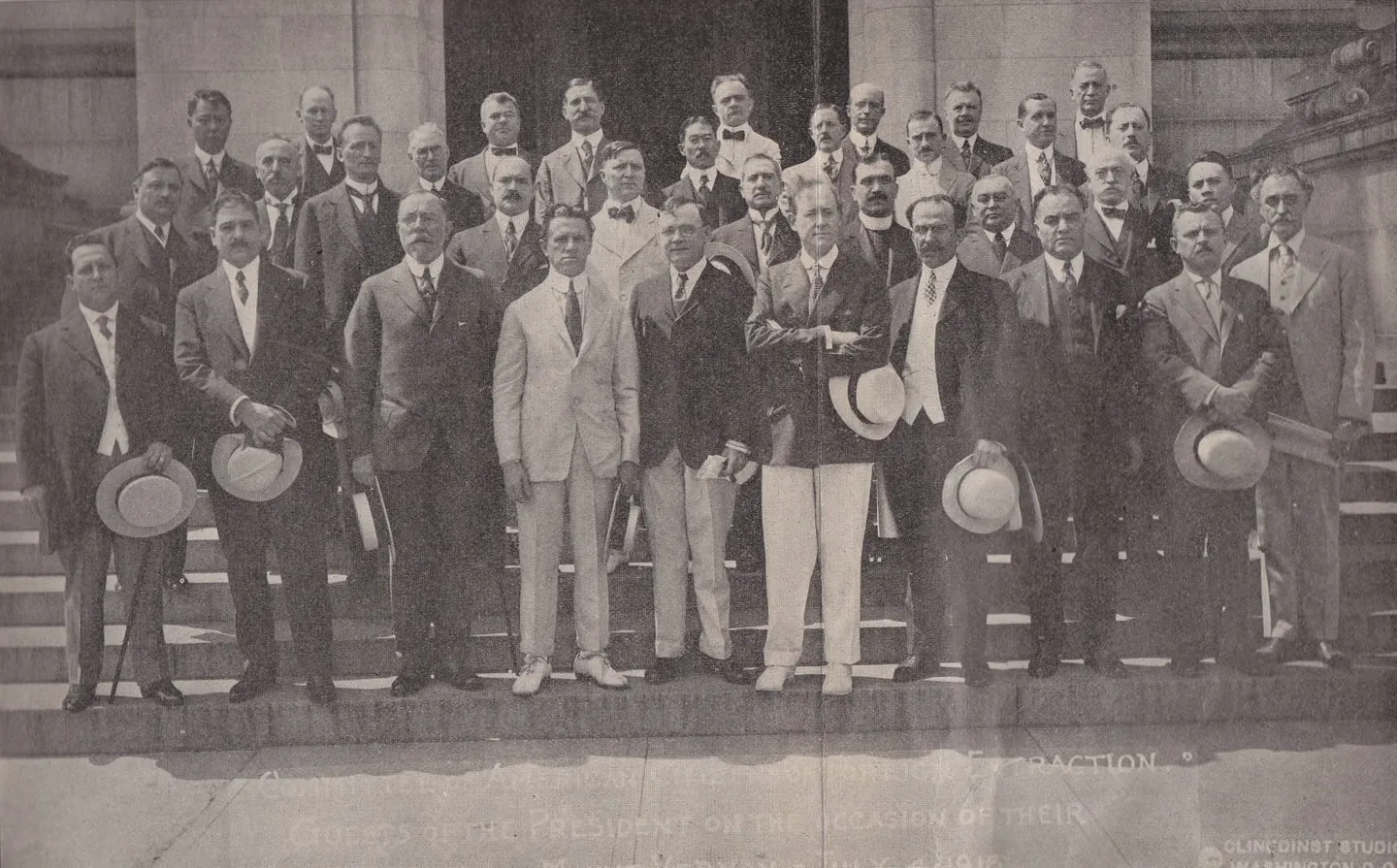
In the photograph, Wilson stands at the centre in white trousers and a dark jacket. Just behind him, slightly to his left, is Noli — an Albanian immigrant, priest and community organiser who had arrived in America barely a decade earlier.
Dielli later reported that Noli spoke with Wilson twice and with First Lady Edith Wilson once. The newspaper credited those brief conversations with helping Albania's campaign against further partition.
That was Vatra's own contemporary account, and the influence of a single conversation should not be overstated. But the photograph captures something remarkable on its own: within a few years of organising in Boston, Albanian immigrants had carried their national cause all the way to Washington.
Albanian-American pressure was not solely responsible for Albania's survival, and Woodrow Wilson was never the uncomplicated champion later memory sometimes made him. But the diaspora had made itself politically impossible to ignore.
That is the extraordinary part of this first chapter of Albanian America: men who had crossed the Atlantic to work in mills and factories found themselves helping to argue for the survival of a country thousands of miles away.
Noli eventually went back and, briefly, became Albania's prime minister in 1924. His government lasted only months. He returned to the United States, translated Shakespeare and Cervantes into Albanian, earned a doctorate from Boston University in 1945 and died in 1965.
By then, the migration that had created his Boston world had largely stopped.
US immigration restrictions reduced Albania's quota to just 100 people a year in 1924. For the next four decades, communist rule at home would close the other side of the door.
The first Albanian America had been built. A second one would have to wait.
1945–1990
The forty sealed years
For four decades, one of the oldest Albanian communities abroad was almost cut off from Albania itself.
US immigration quotas had already narrowed the door. Then Enver Hoxha's regime effectively closed it from the other side. By the 1980s, the number of people arriving from Albania could be counted in dozens: 22 in 1983, 32 in 1984, 45 in 1985.
Even the great anti-communist exile sounds surprisingly small when reduced to numbers. Around 1,400 Albanians were admitted in the 1950s and 1,950 in the 1960s. Among them were nationalists, monarchists, religious leaders and political exiles who would build institutions, organise against Hoxha and spend decades imagining a return home.
They would not have filled a mid-sized theatre.
For a time, some believed they might actually bring Hoxha down.
In 1949, with American backing, Albanian exiles formed the Free Albania National Committee. Behind it was an even more ambitious operation: British and American intelligence trained armed émigrés and sent them back into Albania to organise resistance.
It ended badly. Many of the men were captured.
For years, the familiar explanation was that Soviet spy Kim Philby had betrayed the operation. More recent archival research complicates that story: Philby's role appears to have been overstated, while Washington and London had quietly abandoned the goal of overthrowing Hoxha much earlier than the Albanians themselves were told.
Families in exile kept sending sons into a fight their sponsors no longer expected them to win.
The Cold War was not fought only through committees and covert operations. In Chicago in 1951, Albanian anti-communist demonstrators gathered publicly against Yugoslav rule and the persecution of Albanians in Kosovo. Many wore the traditional white plis — carrying an unmistakably Albanian symbol onto an American street. The photograph matters because it pushes one part of the story further back than we usually tell it: Kosovo was already an Albanian-American political cause decades before it became one in Washington.
Albanian America was changing anyway
While migration from Albania had almost stopped, another Albanian migration was already underway.
In 1990, only 5,627 people living in the United States had been born in Albania. Yet 13,608 foreign-born residents spoke Albanian at home.
That gap tells the story better than almost anything else from the period. Albanian America was growing beyond Albania.
The newcomers came from Kosovo, western Macedonia and Albanian communities in Montenegro — from places such as Debar, Struga, Tetovo, Gostivar, Ulcinj, Plav and Gusinje. Many arrived carrying Yugoslav passports.
And unlike later refugee populations, they generally arrived without a resettlement system waiting for them. There was no agency arranging the apartment and the first job.
There was usually something more informal: a cousin, a spare room and someone who knew who was hiring.
Michigan, 1954: the border reached all the way to America
In 1953, seventeen Albanian men in Detroit agreed to help Baba Rexheb, a Bektashi cleric who had reached Michigan through displaced-persons camps and Egypt, build the first Bektashi teqe in the Western Hemisphere.
Then letters began arriving from Albania.
The message was clear: if the men continued, relatives back home could pay the price.
Ten of the seventeen pulled out.
The remaining seven went ahead. They bought an eighteen-acre farm from a German-American family in Taylor, Michigan, and in the spring of 1954, the teqe opened its doors.
It was a small religious community thousands of miles from Albania. But distance offered less protection than it seemed. Hoxha's government could not easily control Albanians in America; it could still reach the families they had left behind.
That pressure entered Orthodox life as well. After Fan Noli died in 1965, a dispute over his successor divided Albanian-American parishes between those who remained tied to the church hierarchy in communist Albania and those who wanted an independent path. By 1971, most had broken away and joined the Orthodox Church in America.
But institutional disputes only hint at what four decades of separation meant inside families.
Halil Bushka arrived in Waterbury, Connecticut, in 1954 with seven children. His wife, Haxhire, and their youngest son remained behind in an Albanian internment camp.
Haxhire was released in 1990.
Thirty-six years is a long time to explain with immigration statistics.
Supers, pizzerias and the Bronx
In New York, one unlikely route into the middle class ran through the basements of apartment buildings.
Many Albanian immigrants had spent time in Italy or Italian refugee camps before reaching America. That gave them an advantage in the heavily Italian Bronx: they could work as building superintendents and speak to Italian landlords in their own language.
One of them was Sali Nezaj. He arrived in 1970 and moved in with cousins. He worked construction while his wife cleaned Manhattan offices at night. In 1984, they bought a nineteen-family building on Bainbridge Avenue. By 1992, Nezaj owned four buildings.
The progression became familiar: find work through someone you knew, save, buy something, then help the next person do the same.
Sometimes the help was remarkably literal. Bronx realtor Rexh Xhakli lent Albanians he barely knew as much as $80,000, without interest and sometimes on little more than a handshake.
His explanation needed no economic theory:
“You don't charge a brother interest.”
Another superintendent, Peter Mrnaci, used to joke with his landlord: “One day, I'll own this building.”
Eventually, he did.
The landlord became his tenant.
This was the Albanian America that grew while Albania itself was sealed shut: built less through formal institutions than through relatives, introductions, borrowed rooms, shared jobs and trust.
A Bronx newspaper manager later summed up the migration more simply:
“After each war, the side that doesn't win comes to America.”
For Albanians, another war was coming.
1981: Kosovo changes Albanian America
By the early 1980s, another political struggle was beginning to reshape the diaspora.
Student protests erupted in Pristina in 1981. They had begun with complaints about conditions at the university, but Yugoslav authorities responded with repression, and Albanians increasingly came to be treated as a security problem.
The change can be seen in the archives. One researcher who later examined Croatian secret-police records found only about eight Albanians in the files before 1981. Within a few years, there were thousands.
What happened in Kosovo did not stay in Kosovo.
In the United States, it pushed Albanian communities toward a kind of cooperation that had once been difficult to imagine. In Detroit, a Catholic priest, a Sunni imam and a Bektashi baba mobilised their congregations together for demonstrations in Washington and New York.
For a diaspora divided by region, religion and different waves of migration, that image matters. Kosovo was beginning to give Albanian America a common political cause.
And sometimes the connection worked in the other direction: ideas born in Kosovo crossed the Atlantic and entered Albanian-American life.
In July 1990, Anton Çetta, a folklore professor from the University of Pristina, arrived in the Bronx carrying the blood-feud reconciliation movement that had already drawn huge gatherings in Kosovo.
“The time has come for us to all shake hands,” he told families gathered around Pelham Parkway.
Within a week, ten oaths of revenge had been withdrawn and twelve feuds reconciled. Then Çetta continued to Detroit.
One Bronx printer compared him to Gandhi.
The comparison may have been grand, but the moment says something important about how the diaspora had changed. The first Albanian immigrants had sent newspapers, money and political ideas back across the Atlantic. By 1990, influence was moving in both directions.
And Albanian America was no longer simply a collection of communities from the same part of the world. It was beginning to behave like one diaspora.
The voice that got through
People could barely get out of Albania. Information, however, could still get in.
For generations of Albanians under communism, Zëri i Amerikës — Voice of America — was one of the few outside voices that could cross the border every day.
There is a fitting end to that story.
On 22 June 1991, as communist rule was collapsing, some 300,000 people filled Skanderbeg Square to hear US Secretary of State James Baker. But the voice many Albanians heard over the loudspeakers was that of his interpreter, Elez Biberaj — an Albanian from Montenegro who had arrived in America at fifteen and spent years broadcasting back across the Atlantic.
One future Albanian ambassador remembered it simply as “the sound of history.”
1995–today
The lottery that built a community
In the summer of 1990, thousands of Albanians climbed the walls of the foreign embassies in Tirana, and the regime that had sealed the country for forty-five years began to come apart. The exodus that followed did not go to America. In fiscal year 1990, seventy-eight people born in Albania obtained United States permanent residence. In 1991, 142.
America opened four years later, and it opened by lottery.
For more than forty years, Enver Hoxha's regime had made leaving Albania almost impossible. Then, in 1990, the United States created an immigration programme that rewarded countries for exactly that: having sent very few immigrants to America.
The Diversity Visa programme offered green cards by lottery to people from countries with historically low levels of immigration to the United States. When Albania emerged from communism, it was almost perfectly placed to benefit.
Years later, during registration for the DV-2018 lottery, 367,231 entries came from Albania. In a country of fewer than three million people, that was equivalent to 12.8 percent of the entire population putting its name into the draw in a single autumn.
For many Albanian families, America represented something that had been inaccessible for most of their lives: the chance to leave, work, earn, and start again somewhere else. The lottery reduced that enormous decision to something almost ordinary. Fill in the application. Send it. Wait.
Albania was not literally the country with the world's highest participation rate. A few smaller countries occasionally entered at even higher rates. But within the Albanian world, the difference was striking. In the DV-2019 cycle, entries were equivalent to 11.6 percent of Albania's population, compared with 3.1 percent in Kosovo, 1.7 percent in North Macedonia and 0.5 percent in Montenegro.
The same people, broadly the same language and culture — but very different migration histories. Albanians outside Albania had other routes abroad, particularly into Europe. For people inside Albania, the American lottery carried a different weight.
Between fiscal 1995 and 2016, 44,806 people born in Albania received Diversity Visas. Only Ethiopia, Nigeria, Egypt and Ukraine produced more winners, despite all four having vastly larger populations.
By the late 1990s, the lottery was no longer a curious feature of Albanian migration. It was one of the main ways Albanian America was being built.
In 1996, Diversity Visas accounted for 60 percent of green cards issued to Albania-born immigrants. In 1998, the share reached 80.6 percent.
That year, 4,756 Albania-born people became US permanent residents. Of them, 3,909 — more than four out of every five — had won the lottery.
Think about what followed each winning envelope. A person left. Often a spouse and children came too. Someone found an apartment and a first job. Relatives visited. Some eventually followed. Children were born in America.
A random draw was quietly turning into a migration network.
By 2024, only 24 percent of the year's Albania-born permanent residents had arrived through the Diversity Visa programme. Fifty-seven percent came as immediate relatives of US citizens.
The lottery had become less important not because Albanians had stopped coming, but because the people who won decades earlier had put down roots. They became citizens. They married, had children and brought family members over through the ordinary machinery of American immigration.
It helped turn a migration wave into a community.
The other doors
Not everyone waited for a draw. Albania was briefly a refugee-sending country in its own right in the early 1990s, and the collapse of the pyramid schemes in 1997 produced a wave of asylum claims rather than a wave of boats. Students came, and stayed: the Department of Homeland Security's overstay report puts the fiscal 2023 overstay rate for Albanian students and exchange visitors at 8.07 percent, against 1.15 percent for all in-scope travellers worldwide.
Albania, Kosovo and North Macedonia are not in the Visa Waiver Program: every tourist and business visitor sits a consular interview. That has not stopped the traffic. In fiscal 2024 Albanian nationals were admitted to the United States 31,580 times — an all-time record, more than triple the 9,990 of fiscal 2015.
And the migration did not end with the Kosovo war, whatever the received story says. Of the foreign-born Albanian Americans alive in the United States today, more arrived in the 2010s than in any other decade — 38,831, against 33,955 in the 2000s and 32,113 in the 1990s.
Becoming American
The lottery brought tens of thousands of Albanians to America. Most did not remain newcomers for long.
Between 1987 and 2024, 81,064 people born in Albania became US citizens. Almost all of those naturalisations — 96.7 percent — happened after 2000, as the migration wave that began in the 1990s reached the point where people could apply for citizenship.
The peak came in 2010, when 5,088 Albania-born immigrants became Americans. Another 4,607 did so in 2022.
Today, 70.5 percent of foreign-born Albanian Americans are US citizens, compared with roughly 53 percent of the foreign-born population overall.
That difference tells us something about the community the Diversity Visa helped create. The people who arrived in the 1990s and 2000s did not simply settle. They naturalised, bought homes, raised American-born children and gained the ability to sponsor close relatives.
The migration route changed with them.
A generation earlier, an Albanian family might have waited for a lottery result. Today, many arrive because someone from an earlier wave is already an American citizen.
There is another change worth watching. Since 10 April 2026, most Diversity Visa entrants have been required to hold a valid passport and upload a copy, with limited exemptions. The State Department introduced the rule after reporting 2.5 million fraudulent entries in the DV-2025 programme.
For Albania, that requirement may matter more than it sounds. The last time a passport rule was in force, Albanian entries fell by about 30 percent in a single year.
Whether the new rule produces the same effect remains to be seen. But the larger shift has already happened: Albanian America no longer depends on the lottery the way it once did.
The lottery helped people get there. Citizenship helped them stay — and bring the next generation with them.
Kosovo
Kosovo, and what Albanian America did about it
By the time war reached Kosovo, Albanian America had spent more than a decade trying to make Washington pay attention.
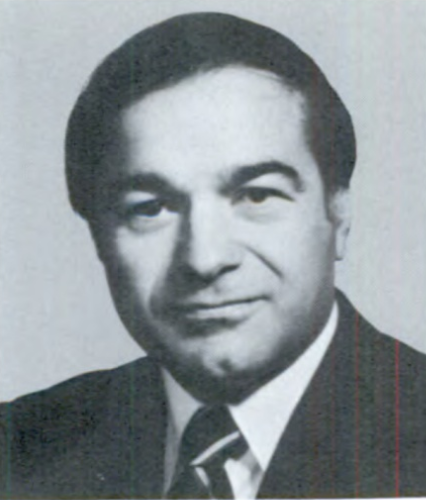
One of the people pushing hardest was Joseph DioGuardi, a Republican congressman from New York and the first Albanian-American elected to Congress. He convened the first congressional hearing on Kosovo in 1987 and, after leaving the House in 1989, founded the Albanian American Civic League.
There was an unusual history behind his Albanian identity. DioGuardi's father came from Greci, an Arbëresh village in southern Italy settled by Albanians whose ancestors had crossed the Adriatic centuries earlier.
So when DioGuardi took Kosovo's cause to Congress, one of the most visible Albanian voices in Washington came from a branch of the diaspora that had left the Balkans roughly five hundred years before.
Then, in 1998, lobbying was no longer enough.
When the war came, the diaspora responded
Albanian Americans raised money, supplied weapons and went back to fight.
Money was collected through Vendlindja Thërret — “Homeland Calling.” The fund moved through the places where Albanian-American life already happened: restaurants, clubs, community organisations and parish halls from the Bronx to Michigan.
Some of that support went to the Kosovo Liberation Army.
Florin Krasniqi, a Kosovar roofing contractor living in Brooklyn, became one of the best-known organisers. He established legally affiliated gun clubs in the United States and Albania, bought rifles legally in America and exported them legally to Albania. From there, the weapons made their way across the mountains into Kosovo.
But money and weapons were not the end of it.
People went too.
Several hundred Albanian Americans — most accounts put the number at around 400 — boarded a charter flight from the United States, travelled through Ireland and Italy, and eventually reached a KLA training camp near Burrel in northern Albania.
They were not professional soldiers.
There was a taxi driver from Stamford. A student at John Jay College in Manhattan. A pizzeria owner from Yonkers with three children at home.
That detail is worth remembering. A war in Kosovo had reached deeply enough into American life that people were leaving jobs, universities and families in New York and Connecticut to go back and fight in a country many of them had already escaped.
Not everyone who volunteered was allowed to go.
Recruiters turned away men whose immigration status in America was unresolved. Some lacked the right documents; others were undocumented or still waiting for their cases to be decided.
It produced one of the stranger contradictions of the war: to risk your American life fighting for Kosovo, you first needed to know that America would let you come back.
And then came the legal paradox
America's relationship with the KLA was never simple.
The State Department did not place the KLA on its official list of foreign terrorist organisations. But in February 1998, a US envoy publicly described it as a terrorist group before retreating from that language shortly afterward.
Then NATO intervened against Yugoslav forces in 1999, fighting a war whose outcome helped make possible the Kosovo that exists today.
You might expect the legal story to end there.
It didn't.
US immigration law contained broad provisions covering support for armed organisations. That meant Albanians who had raised money or provided other assistance to the KLA could still encounter terrorism-related immigration restrictions years after the war.
The contradiction survived until 2012.
Think about the distance between those two moments.
In the late 1990s, someone could walk into an Albanian restaurant in the Bronx, put money into a collection for Kosovo and believe they were helping their homeland. The United States would soon lead a NATO intervention against Serbian forces.
Yet years later, that same act of support could still create a problem under American immigration law.
Albanian America had spent years trying to bring Kosovo into American foreign policy. When Washington finally acted, the law took much longer to catch up.
Fort Dix, 1999
In the spring of 1999, thousands of Kosovars were being driven from their homes. Some ended up more than 4,000 miles away, on a military base in New Jersey.
Beginning in May, the United States airlifted 4,045 refugees from Macedonia to Fort Dix as part of Operation Provide Refuge. They arrived carrying whatever they had managed to take with them and, in many cases, with no idea where in America they would eventually live.
The government called it an emergency refugee operation. For the people arriving, it was the end of one journey and the beginning of another.
One of the first stories to come out of Fort Dix was about a baby.
He was the first child born there to Kosovar refugees. His family named him Amerikan.
A week later, he flew to Dallas with twenty-four relatives after a family member agreed to sponsor the entire group.
Another refugee arrived after his mother died during the flight to America. Speaking to the commander at Fort Dix, he said he wished she had lived just three days longer, long enough to experience “the kindness of America.”
Those stories help explain something statistics alone cannot: why the United States came to occupy such an unusual place in Kosovo's memory of the war.
The numbers still matter. In fiscal 1999, roughly one in six refugees admitted by the United States was charged to Serbia and Montenegro, with about 13,000 people arriving through the Kosovo emergency allocation.
But even the statistics struggle to show who these people were.
Three years later, 10,401 people born in “Yugoslavia” became permanent residents. More than 8,500 were refugees or asylees adjusting their status. Kosovars were there in the data — just not yet under the name Kosovo.
The country they had fled from would disappear before the Census vocabulary caught up.
From Bill Clinton Boulevard to a more complicated relationship
When Kosovo declared independence on 17 February 2008, the United States recognised it the following day.
By then, gratitude toward America had become part of the landscape.
Pristina has Bill Clinton Boulevard, where a three-and-a-half-metre statue of the former president was unveiled in 2009.
There is a street named after George W. Bush. For years, visitors could even find a women's clothing boutique called Hillary.
It is difficult to think of another European capital where affection for American political figures has been made quite so literal.
But statues are easier to preserve than political relationships.
The relationship between Washington and Pristina has become more complicated as Kosovo has moved from liberation and independence into the ordinary disputes of statehood. In September 2025, the US Embassy announced that its planned Strategic Dialogue with Kosovo had been suspended indefinitely.
That does not erase the history that came before it. It does show that the relationship has changed.
For Albanian Americans, that creates a different political world from the one DioGuardi and the activists of the 1980s entered. Back then, much of the work was about persuading Washington that Kosovo mattered at all.
What political influence looks like now
One way to see the change is through the Congressional Albanian Issues Caucus.
Its four co-chairs — Ritchie Torres, Robert Aderholt, Jim Himes and Lisa McClain — are not Albanian. But three represent places closely connected to major Albanian-American communities: New York, Connecticut and Michigan.
The geography is not accidental.
In NY-11, covering Staten Island and parts of south Brooklyn, people reporting Albanian ancestry make up about 1.68 percent of the population. In MI-10, centred on Macomb County, the figure is about 1.35 percent.
Those percentages are small. In American politics, concentrated communities do not always need to be large to be noticed.
And political participation is no longer limited to lobbying Congress about Albania or Kosovo.
Ardian Zika, born in Kosovo in 1980, arrived in the United States as a teenager in 1997. Twenty-one years later, he was elected to the Florida House of Representatives with 60 percent of the vote and went on to serve two terms.
His story is almost the reverse of the generation that came before him. Earlier Albanian activists used American politics to influence events back home. Zika entered American politics as an American politician.
That distinction matters.
The diaspora is still looking across the Atlantic, though.
When Albania allowed its citizens abroad to vote by post for the first time in 2025, the United States produced 20,648 registered voters — the fourth-largest diaspora electorate after Italy, Greece and Germany.
And Albanians abroad actually turned out.
Overseas turnout reached 82.2 percent, compared with 42.2 percent inside Albania. Diaspora voters backed the governing Socialists by 61.1 percent to 23.5 percent, even more strongly than voters living in Albania.
That result complicates an old assumption about emigration: that the people who leave will naturally become the fiercest opponents of whoever governs the country they left.
Albanian voters abroad did not behave that way.
Perhaps that is the more interesting story of Albanian-American politics today. The community can lobby Washington over Kosovo, vote in Albania, elect Albanian-born politicians in America and protest governments on either side of the Atlantic.
The first Albanian Americans had to build a political voice. Their descendants inherited one — and now have to decide what to use it for.
The passport that went the other way
For a hundred and forty years the paperwork ran in one direction. On 10 April 2026 it ran the other way. President Bajram Begaj signed a decree granting Albanian citizenship to Eric Adams, mayor of New York City from 2022 to the end of 2025, at Adams's own request. Four days later Adams registered as a resident of Administrative Unit No. 2 in Tirana, and that evening, at the fourth Diaspora Summit, wearing a white woollen plis, he was handed an Albanian passport and identity card by Edi Rama.
“I love being American,” Adams told the hall, “but today, thanks to your prime minister, I'm Albanian.” Albanian-language accounts render the same sentence “I am also Albanian.” Set against the rest of this page it is a small and cheerful reversal. The first generation here was coached to lie to inspectors at Ellis Island to get in, and Albania once submitted 367,231 entries to a single American visa lottery for the chance to come legally. A century later a mayor of New York asked Tirana for a passport, and got one.
Faith
Four faiths, one community
Nobody knows the religious composition of Albanian America, and nobody can: the United States census has been forbidden to ask about religion on a mandatory basis since 1976. What can be documented is the institutions.
Orthodox: the church that a refused burial built
The oldest institution in Albanian America began, as the founding chapter describes, with a body nobody would bury. Fan Noli's liturgy of 22 March 1908 produced the Albanian Orthodox Church in America, and its cathedral is St George, at 517 East Broadway in South Boston. Its archdiocese, now part of the Orthodox Church in America, has eleven parishes, in Connecticut, Massachusetts, Michigan, New York, Ohio and Pennsylvania, and nowhere else.
Half a mile away, at 245 D Street, stands a second Albanian Orthodox headquarters, and the reason it exists is on the record in a declassified State Department report from 1950. The purpose of consecrating a rival Albanian bishop was, in the department's own words, “to offset the harmful influence among the Albanian community of Bishop Fan Noli, who is of communist leanings.” In 2020 it reported two parishes, 800 adherents and about 160 people in church on an ordinary Sunday — the smallest active Eastern Orthodox jurisdiction in the United States.
Sunni: from a Detroit church to a Brooklyn bowling alley
For the first generation of Albanian Muslims in America, Islam was mostly practiced without a mosque.
There had been small attempts to organise — including a short-lived mosque in Waterbury around 1919 — but they left little behind. A major 1939 study of Albanian America put it bluntly: “Moslem Albanians in America neither built nor attended any mosques.”
Detroit changed that.
In November 1945, local Albanians organised the Albanian-American Moslem Society. Four years later they brought Imam Vehbi Ismail from Egypt to lead the community.
They did not begin with a dome or a minaret.
In 1951, the congregation bought an old church on Hamilton Avenue and turned it into a mosque. It was modest, but it gave Albanian Muslims in Detroit something the earlier generation had never managed to sustain: a religious home of their own.
A more ambitious building followed. On 3 November 1963, the Albanian Islamic Center opened in Harper Woods, its dome and minaret drawing deliberately on Balkan-Ottoman architecture.
Harper Woods is often described as America's first Albanian mosque. The history is slightly messier — and more interesting. The Hamilton Avenue congregation had opened twelve years earlier. Harper Woods was the first purpose-built Albanian mosque to survive, not the first place Albanian Muslims had gathered to worship.
New York took a different route.
When Albanian Muslims from New York and New Jersey opened their mosque in Flatbush in 1972, they did not move into anything resembling a traditional mosque. They bought a converted mansion in a largely Jewish and Italian neighborhood.
There was no minaret.
There was, however, a bowling alley in the basement.
The New York Times, reporting on the opening, noted that the congregation still planned to turn it into a dining room.
It is a wonderfully ordinary detail. Albanian Islam in America was not transplanted intact from the Balkans. Communities took whatever America offered them — an old church in Detroit, a mansion with a bowling alley in Brooklyn — and made something of their own inside it.
More institutions followed, including the Albanian Islamic Cultural Center on Victory Boulevard in Staten Island.
By then, the story had changed considerably from the one recorded in 1939. Albanian Muslims were no longer simply practicing their faith inside immigrant homes and informal circles.
They had begun building places meant to last.
Bektashi: a Michigan farm with a much longer reach
The Bektashi story in America began with Baba Rexheb, seven supporters and a farm outside Detroit.
When communist Albania refused to recognise the new teqe, Rexheb turned instead to the Kaygusuz teqe in Cairo for spiritual authority. Even the building itself crossed religious lines. The Bektashi order's history remembers Bektashis, Sunni Muslims and Christians working together to establish it.
That feels particularly Albanian: a religious institution built not only by the people who worshipped there, but by a community that understood why having it mattered.
What opened in Michigan in 1954 was the first Bektashi teqe in the Western Hemisphere. For decades, while religion was being suppressed in communist Albania, a farmhouse in suburban Detroit helped preserve a tradition that had lost much of its institutional life at home.
Seventy years later, Bektashism was back in an altogether different conversation.
On 22 September 2024, Albania's prime minister used the stage of the United Nations in New York to announce a proposal for a sovereign Bektashi state within Tirana.
Whether that project ultimately becomes what its supporters imagine is another question. But the historical arc is a remarkable one: a religious order once kept alive in part by exiles on a Michigan farm was now being discussed as the possible sovereign occupant of a piece of Albania's capital.
Catholic: from the Bronx back to Tirana
Albanian Catholic America came later.
Many of its families arrived from Kosovo, Montenegro and the northern Albanian lands, part of the migration from Yugoslavia that reshaped New York's Albanian community after the Second World War.
By 1970, there were enough of them for the New York Times to announce the opening of what it called the “Hemisphere's First Albanian Catholic Church” in the Bronx.
The church stood at 4221 Park Avenue. In 1989, Cardinal John O'Connor formally established the first Albanian Catholic parish in the United States there.
Then the congregation began doing what so many Albanian families in New York were doing: moving north.
In 1999, the parish followed its community out of the Bronx to Hartsdale in Westchester. Our Lady of Shkodra still stands there today.
But the most interesting journey went in the opposite direction.
The parish's first pastor, Rrok Mirdita, had spent years serving Albanian Catholics in the Bronx and Westchester. Then communism collapsed in Albania, leaving a country where religious institutions had been systematically destroyed.
In December 1992, Mirdita was named Archbishop of Tiranë–Durrës. Pope John Paul II consecrated him the following April.
A priest who had helped Albanians build a religious home in New York was now being asked to help rebuild the Catholic Church in Albania.
It is another reversal that appears throughout the history of this diaspora. At first, Albanians built institutions in America because they could not build or sustain them at home. When Albania reopened, some of the people and institutions formed abroad began travelling back.
The traffic across the Atlantic no longer moved in only one direction.
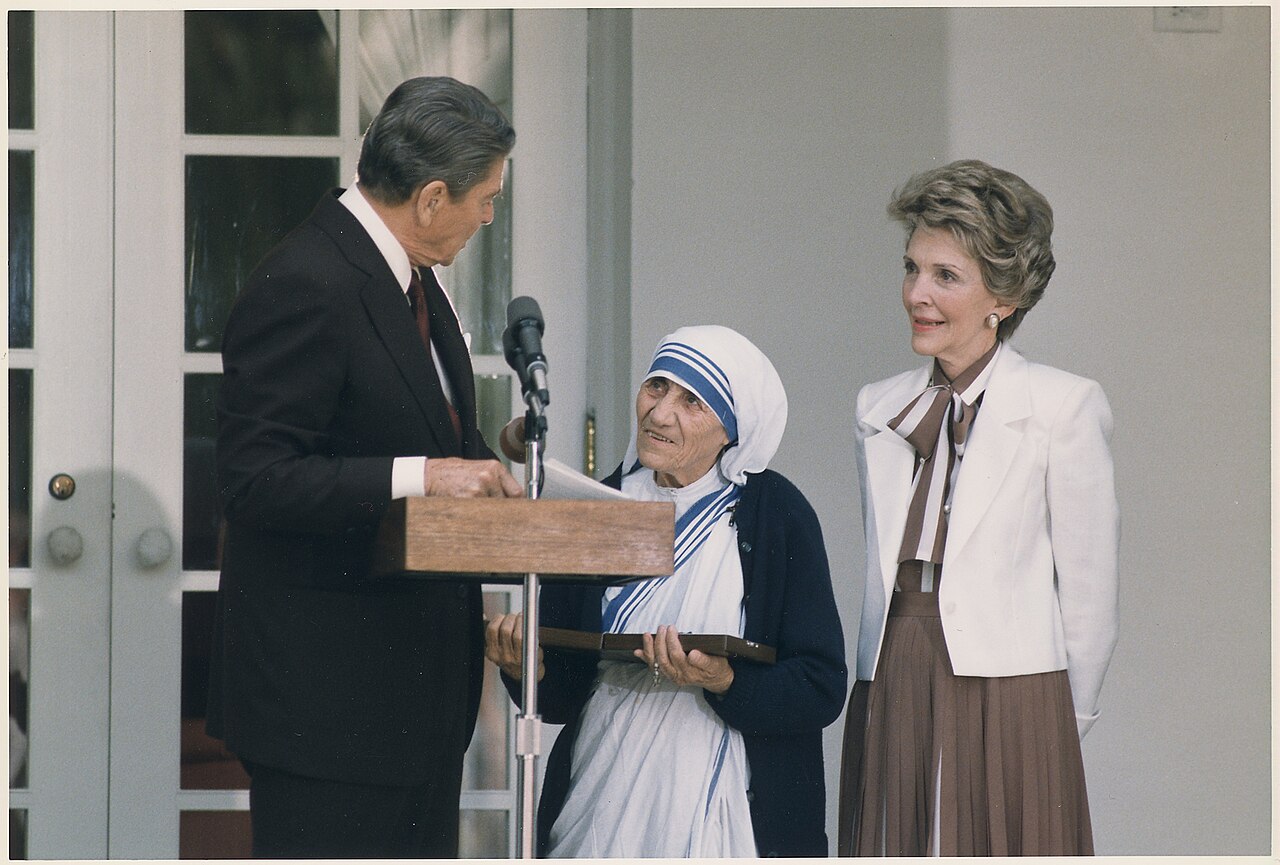
What the coexistence actually looks like
Albanians say of themselves that the religion of the Albanian is Albanianism — a line written around 1878 by Pashko Vasa, a Catholic in Ottoman service. So here is the evidence.
- When Detroit's Albanian Christians founded St Thomas Orthodox Church in 1929, the city's Albanian Muslims helped them with the mortgage.
- Imam Vehbi Ismail, interviewed in 1995, on how his mosque got built: “the Albanian Islamic Center was constructed with the support of both the Muslims and the Orthodox … Bishop Noli himself donated $500, and we have also contributed for the constructions of Albanian Orthodox churches … We are all Albanians and children of the same God.”
- In 1981, a Catholic priest, a Sunni imam and a Bektashi baba jointly mobilised their Detroit congregations for the Kosovo rallies in Washington and New York.
- In 2013 the President of Albania decorated all four Detroit Albanian houses of worship — two Catholic churches, a Sunni mosque and a Bektashi teqe — on the same day.
A member of St Thomas, interviewed in 1995, described how the joint Flag Day events run by a mixed Orthodox-Muslim benevolent society came to an end: the society dissolved amid political factions, and Michigan's Albanians stopped commemorating their national day as one community. The coexistence was real. So was the Cold War.
Work & money
Work, money and the road home
Albanian-American households earn a median of $102,000 a year against an American median of $81,604 — and individual Albanian Americans earn less than the national median. Both are true, and the explanation is the whole economic story in one line: the households are bigger (3.05 people against about 2.5) and they have more earners in them. Poverty runs at 7.5 percent against the American 12.1. Forty percent of Albanian Americans over twenty-five hold a bachelor's degree, against 36.8 percent nationally. There is one glaring exception, and it should be said before the success story. Elderly poverty among Albanian Americans is 13.4 percent — well above the community's own rate and above the American figure. The grandparents came late, on family visas, without American work histories, and they are by a wide margin the poorest slice of the community.
poverty rate, against the American 12.1%
hold a bachelor's degree, against 36.8% nationally
elderly poverty — above the community's own rate and above the American figure
work in truck transportation — nearly twice the rate of all employed Americans
The grandparents came late, on family visas, without American work histories, and they are by a wide margin the poorest slice of the community. That exception belongs before the success story, not after it.
The buildings
The most striking economic fact about Albanian New York has a date on it. When Co-op City opened in 1973 and the Bronx economy fell apart, property values collapsed so far that landlords began handing buildings to their own superintendents for five to twenty thousand dollars over the outstanding mortgage. The Albanians were the superintendents.
In August 1979 the New York Times found Nikoll Vataj, thirty-six, who had gone from porter on the Upper East Side to superintendent to the owner of six buildings and 550 apartments in seven years. He explained why he started: “If I work as a porter always, I will be poor my whole life.” His account of what he was buying was blunter — “Every Albanian who bought a building bought it when it was completely destroyed.”
The trucks
The 2020–2024 ACS Michigan PUMS sample supports a trucking signal, but a smaller one than older extracts suggested. About 5.42 percent ±2.35 percentage points of employed Michigan residents reporting Albanian ancestry worked in truck transportation, compared with 1.30 percent statewide — about 4.18 times, based on 21 unweighted Albanian-ancestry records. This is a Michigan estimate, not a Detroit workforce census.
Self-employment is also elevated without reaching ‘one in four’: 18.00 percent ±3.58 points, compared with 8.69 percent across Michigan. Motor-vehicle manufacturing is 6.38 percent ±2.18 points, close to Michigan's 7.47 percent. The evidence supports entrepreneurship, food, construction and trucking; it does not support saying Detroit's Albanians rejected auto work or all followed one occupational path.
The pizzerias, and the name on the awning
The other New York niche was Italian food, and the succession is documented from both sides. In 2001 a supplier to seven hundred New York pizzerias told the Times: “The Italians can't do the work anymore, they've gotten fat in America. You go into an Italian restaurant now, you see Albanians. You think they're Italian. They speak Italian, they look like us, the food is great.”
The Albanians agreed, and hid. Gjergj Dedvukaj bought Giovanni's on Arthur Avenue and changed neither the name nor the menu, because “customers don't know Albanian food.” One family put their mother Roze on a jar of marinara sauce as “Mamma Rosa” and wrote in the company brochure that the family had made the pilgrimage from Italy to America, with Albania unmentioned. One of the brothers said why: “I'm not sure I like the idea of advertising the fact that we're Albanian. It's a touchy situation.”
Twenty-five years later, Ramiz Kukaj runs four restaurants called Çka Ka Qëllu — the name is Albanian, the food is Albanian, one of them is in the Michelin Guide, and one was on the New York Times' list of the hundred best restaurants in the city. That arc, from “Mamma Rosa” to an Albanian phrase on the awning in Belmont, is the clearest measure of what changed in a generation.
One generation out of the kitchen
The first generation often entered the American economy through the jobs that were available: restaurants, construction, building maintenance and small family businesses.
| Occupation | Arrived after 2010 | US-born, under 40 |
|---|---|---|
| Construction | 14.7% | — |
| Food preparation and kitchens | 13.0% | 4.2% |
| Truck transportation | 10.6% | — |
| Management | — | 16.7% |
| Healthcare practitioners | — | 8.2% |
| Software and mathematics | — | 7.3% |
| Self-employed | 16.1% | 8.6% |
The software that runs the pizzerias
By the second generation, the picture changes.
The clearest example is the restaurant business. Among newer Albanian immigrants, kitchen work remains unusually common. Among American-born Albanian Americans, the share working in kitchens has already fallen below the US average.
That is what upward mobility can look like in a single generation. The family business may survive, but the children do not necessarily inherit the job.
Ilir Sela offers an almost too-perfect example.
His family comes from Debar, and he grew up around the independent pizzerias that became such a familiar route into business for Albanian families in New York. He later founded Slice, a technology company built around online ordering and payments for independent pizza shops.
There is something fitting about that progression.
One generation of Albanians learned how to run America's pizzerias. Another built software for them.
The money still goes home
Economic success in America did not stay entirely in America.
In 2021, Albanian Americans sent an estimated $129.96 million back to Albania. That same year, total US goods exports to Albania were worth $97.9 million.
In other words, Albanian households in America sent more money to Albania than American companies sent there in goods.
Kosovo shows the same pattern on an even larger scale. The United States exported $46.1 million in goods to Kosovo in 2024, while remittances from America were roughly €100 million.
For both Albania and Kosovo, the United States is now the third-largest source of remittances.
But what happens to diaspora money is changing.
It still helps parents, siblings and extended families. Increasingly, though, it also buys apartments, houses and land. In the second quarter of 2025, foreign direct investment in Kosovo reached €231.5 million. More than 80 percent went into real estate, with diaspora demand playing an important role.
Anyone familiar with the summer rhythm of Kosovo or Albania will recognise part of the story: families who built their lives in New York, Detroit or Chicago still want something tangible back home.
The money crosses the Atlantic even when the family no longer does permanently.
The $30 million experiment
There is another kind of Albanian-American investment, and it began not with the diaspora but with the US government.
In 1995, USAID provided $30 million to establish the Albanian-American Enterprise Fund. Albania was only a few years removed from communism, and the idea was to use American capital and business experience to help build a private economy almost from scratch.
The fund invested in companies and helped establish what became Albania's first Western-style bank.
Then something unusual happened.
It made money.
In January 2011, the fund returned $15 million to the US Treasury. Its profits also helped endow the Albanian-American Development Foundation, which has since committed at least $109 million to 28 projects in Albania.
So one of the largest institutions carrying the Albanian-American name began as American foreign aid and gradually became something closer to a permanent investment in Albania's development.
That distinction matters. Remittances connect families. The Enterprise Fund tried to change institutions.
Both are part of the economic relationship the diaspora helped build.
Business footprint
The businesses Albanians built across America
ALB Connection's July 2026 directory snapshot documents 1,459 verified Albanian-owned businesses across 43 states and Washington, DC. It turns the family stories above into a national picture: enterprise is concentrated in a few historic hubs, but reaches 491 cities and towns.
verified US businesses
states and the capital represented
cities and towns
of listings work in food
Where the directory is most concentrated
New York remains the largest hub by a wide margin, followed by metro Detroit's Michigan cluster and long-established communities across the Northeast and Midwest.
- New York550
- Michigan193
- Illinois129
- Pennsylvania120
- New Jersey114
- Connecticut70
The sectors shaping the economy
Food is the defining industry, while the building trades and professional services form the next visible layer of Albanian-American enterprise.
- Restaurants449
- Construction & home improvement127
- Beauty & wellness83
- Real estate67
- Legal services51
A highly digital business community
Most businesses in the directory can be found and contacted online—useful for a community spread across an entire continent.
Source: ALB Connection business directory, July 2026. Figures cover publicly visible businesses meeting its two-signal verification standard and should be read as a documented minimum, not a complete business census. Coverage is strongest in the Northeast and Midwest, and the method favors businesses with a public digital presence.
Read ALB Connection's full reportInstitutions
The organisations that hold it together
Money is one way a diaspora remains connected. Institutions are another.
The institutions that survived
And some of Albanian America's institutions are remarkably old.
Vatra — the Pan-Albanian Federation of America — was founded in Boston in 1912 by Fan Noli, Faik Konica and their contemporaries. In its early years, calling it an immigrant association hardly does it justice. Vatra lobbied Washington, argued for Albania's survival and helped raise a national loan among workers who often had very little money themselves.
More than a century later, Vatra still exists.
But longevity should not be confused with size.
Its modern chapters can be tiny. A federal return from its Queens chapter reported just $2,960 in annual revenue, all from membership dues, and $814 in assets. Its Boston chapter — in the city where Vatra began — had to be re-established in 2024.
That contrast is revealing.
The institutions that once spoke for nearly the whole organised community now share the field with churches, mosques, cultural groups, professional networks, businesses, social media and organisations built by much newer waves of immigrants.
The institution survived. The community around it changed.
The same is true, in its own way, of Dielli.
First published on 15 February 1909, it is still being produced today, making it the oldest surviving Albanian-language newspaper in the world, though its publication history has not been completely uninterrupted.
Then came Illyria, founded in New York in 1991 and shaped by a different Albanian America — one increasingly concerned with Kosovo and the upheavals taking place across the former Yugoslavia.
Put the two newspapers beside each other and you can almost see the diaspora changing generations.
Dielli belonged to the community that was trying to create and preserve Albania.
Illyria emerged from a community fighting to make America understand Kosovo.
The next Albanian-American institution may not look much like either of them.
The voice that stopped
For forty years under communism, the most trusted sound in the Albanian language was Zëri i Amerikës, the Voice of America's Albanian service — listened to illegally, at low volume, by people who could be jailed for it. It has been silent since 15 March 2025, when all Voice of America programming was suspended under executive order. Albanian was one of forty-nine languages; only a handful have been restored, and Albanian is not among them. The website is still up, and every story in it is from March 2025.
A funding bill signed on 3 February 2026 provides $199.5 million for the Voice of America in the 2026 fiscal year. The money came back. The Albanian did not.
The lobby, and where the money actually is
The Albanian American Civic League, founded by Joseph DioGuardi in January 1989, is credited across the Balkans with shaping American policy on Kosovo, and it says on its website that it speaks for 750,000 Albanian Americans. Its most recent federal return reports total revenue of $52,230, expenses of $45,417 and year-end assets of $14,807. It has twenty-nine board members, a volunteer president and a PO box in Ossining, New York: the influence on Kosovo it is credited with was won on those sums, by volunteers. That is how the community's institutions are financed, and the League is the rule rather than the exception.
Meanwhile the two richest institutions with “Albanian-American” in their names were created by act of Congress and spend their money in Albania. The Albanian-American Enterprise Fund, established under the SEED Act of 1989, holds about $82.8 million; its legacy body, the Albanian-American Development Foundation, reported $216 million in assets in 2018. Together, roughly $300 million — against community organisations running on four and five figures. Both are chaired by an American appointed to the Fund's board by President Clinton.
Thirty-one schools, almost none of which owns a classroom
The Albanian government's own register lists 31 Albanian-language school sites in the United States, operating under 21 school names, across nine states. Thirteen of them are in New York alone — 42 percent of the sites listed in the register.
Almost none of them owns the room it teaches in; they rent American civic space at weekends. They are called Fol Shqip — Speak Albanian — and Mëso Shqip — Learn Albanian — and Udha e shkronjave, the Road of Letters.
The classrooms have changed. The reason for them has not.
The largest of today's schools opened on Staten Island in April 2022 with about fifty pupils and now reports between two hundred and two hundred and forty. It is run jointly by three associations — Kraja, Ana e Malit and Ulqini — all named for Albanian communities on the Montenegrin coast.
Nobody knows how many children attend Albanian school in America. Neither Tirana nor Pristina publishes a figure; Kosovo's education ministry has itself said publicly that it needs a database with the exact number of teachers and students abroad. What is documented is the freight: when Albania shipped 3,595 free textbooks to ten countries in September 2021, the embassy in Washington received 1,080 of them — the largest single consignment in the batch.
People
The people
Four claims get confused constantly in this territory, so this page keeps them apart: being born in Albania, being an ethnic Albanian, being Albanian-American, and being an Albanian who worked in America. Everyone below has been checked against a primary or reference source; where the evidence is thin, that is stated rather than glossed over.
Bebe Rexha
Brooklyn, from a Debar family
Ava Max
Milwaukee, parents from Sarandë
Action Bronson
Queens, by way of Gjakova
Eliza Dushku
Boston, from a Korçë family
John Belushi
1949–1982 · Chicago, from Qytezë
Ferid Murad
Nobel laureate in Medicine, 1998
The strongest single figure nobody counts
Gjon Mili was born in Korçë in 1904, raised in Romania, and came to America to study electrical engineering at MIT. In 1937 he met Harold Edgerton, who had built the stroboscopic light, and began photographing motion at a hundred-thousandth of a second for LIFE. He photographed Picasso drawing in the air with a penlight. He photographed Billie Holiday at the late-night jazz sessions he hosted himself. The plaque in his New York studio read: ALL THE WORLD'S A CAMERA. LOOK PLEASANT, PLEASE. His own summary of what the strobe gave him is the best sentence any Albanian-American has said about their own work: “Time could truly be made to stand still. Texture could be retained despite sudden violent movement.”
He also directed Jammin' the Blues for Warner Bros. in 1944, a nine-minute jazz short with Lester Young — nominated for an Academy Award and, in 1995, selected for preservation in the United States National Film Registry. A boy from Korçë made a film the Library of Congress protects. There is no free photograph of him anywhere; the only way to picture him is the stamp Albania issued in 2008, in a series honouring Albanian-Americans, alongside John Belushi.
Public service
The community's political history has a correction in it that nobody has made. Mark Gjonaj was the first Albanian-American elected in New York State, and the first on the New York City Council. He was not the first in America. Louis V. Mato, born in Pogradec in 1903, a chef-supply salesman and restaurant owner living in Fairchild, Wisconsin, sat in the Wisconsin State Assembly from 1963 to 1971 — four terms, half a century before Albany, and nobody remembers him.
And the best arc of them all belongs to a judge. Emin Toro was born in Tirana in 1974. A Florida minister doing mission work at an Albanian orphanage needed an interpreter; Toro was chosen, and the minister brought him back to America for college. He went to Palm Beach Atlantic, then law school at North Carolina, then clerked for a judge on the DC Circuit and then for Justice Clarence Thomas of the Supreme Court of the United States. On 1 August 2019 the Senate confirmed him to the United States Tax Court by voice vote, for a fifteen-year term.
The other clock
Albanian America runs on two clocks.
One begins in the 1890s, with migrants leaving Korçë and other parts of the Balkans for the mills and factories of New England.
The other starts almost five centuries earlier.
The Arbëreshë are descendants of Albanians who crossed into southern Italy during and after the Ottoman expansion into the Balkans. They built villages there, preserved forms of the Albanian language, and remained distinct communities for centuries.
Then some of their descendants crossed the Atlantic again.
When Arbëreshë immigrants arrived in the United States from Italy, however, America mostly saw Italians. They carried Italian passports and surnames, came from Italian towns and usually entered Catholic parishes alongside other Italian immigrants.
Their Albanian story was much easier to miss.
Joseph DioGuardi is perhaps the clearest example.
His father came from Greci, a small Arbëreshë village in the hills of Campania where an Albanian language survived for centuries after the original migration.
DioGuardi was born in the United States, entered Congress as a Republican from New York and eventually became one of the most persistent advocates for Kosovo and Albanian causes in Washington.
There is something remarkable about the route that identity travelled.
His ancestors left the Albanian world for Italy centuries before Albania existed as a modern state. Their descendant eventually walked into the United States Congress and argued for Albanians in the Balkans.
The connection continued into another generation. DioGuardi's daughter, songwriter and television personality Kara DioGuardi, also traces her family to the Arbëreshë community.
And the DioGuardis are not an isolated case.
Novelist Tom Perrotta grew up with an Arbëreshë mother, whom he once described as Albanian-Italian. He remembered that distinction mattering even among Italians: it made her, in his words, “a second-class Italian.”
Writer and music critic Nick Tosches traced his family to the Arbëreshë community of Casalvecchio di Puglia.
Their stories reveal a part of Albanian America that Census tables are particularly unlikely to find.
An Arbëreshë American may have an Italian surname, an Italian-born grandparent and generations of Catholic family history in southern Italy. Ask only for birthplace or recent ancestry and the Albanian connection can disappear completely.
Yet it survived for centuries before reaching America.
That changes the timeline.
The familiar story of Albanian America begins with men from Korçë arriving in Boston at the end of the nineteenth century. But another Albanian migration had already travelled from the Balkans to Italy, waited there for hundreds of years, and then crossed the Atlantic under an Italian name.
Albanian America is older than its immigration records make it look.
A Nobel Prize
Ferid Murad's Albanian-American story begins with a name that was not originally his family's.
His father arrived at Ellis Island in August 1913. He was an ethnic Albanian with less than a year of formal schooling who had worked as a shepherd, travelled the Balkans selling sweets and somehow learned seven languages along the way.
At immigration, Murad later recalled, an officer asked his father's name and then simply decided what America would call him:
“The officer declared him to be John Murad and stamped his papers.”
The name stuck.
Ferid grew up in Whiting, Indiana, in four rooms behind the 28-seat restaurant his parents ran. As a boy, he would add up customers' bills in his head before they reached the register.
In 1998, he shared the Nobel Prize in Physiology or Medicine for work that established nitric oxide as a signalling molecule in the cardiovascular system.
There is an almost too-neat immigrant story hiding in those eighty-five years: a clerk at Ellis Island gives an Albanian immigrant an American name, and his son eventually carries that name to Stockholm.
A Space Shuttle
But Albanian-American achievement did not always begin with someone stepping off a ship from Albania.
William G. Gregory was born in Lockport, New York, in 1957. He became an Air Force pilot, then a test pilot, then an astronaut.
In March 1995, he sat in the pilot's seat of Space Shuttle Endeavour for STS-67. The mission lasted sixteen days and fifteen hours — the longest flight Endeavour ever made.
His Albanian connection is easy to miss. Gregory was baptised at St Elia, the first Albanian Orthodox church in New York State.
Not in the Bronx or Manhattan, but in a small Albanian parish in upstate New York.
That is one reason famous-Albanian lists can be misleading. By the second or third generation, the connection may no longer be visible in a surname, birthplace or biography. Sometimes you have to follow the family back to a church.
A $2 billion bet
Mira Murati's route to America belongs to a much newer Albania.
Born in Vlorë in 1988, she left Albania at sixteen on a scholarship and later studied engineering at Dartmouth. She worked on Tesla's Model X before joining OpenAI, where she eventually became Chief Technology Officer and, briefly in November 2023, interim chief executive.
Then she left to build something of her own.
In 2025, Murati founded Thinking Machines Lab. Its first funding round raised $2 billion at a $12 billion valuation — an extraordinary amount for a company at the beginning of its life.
One of the investors was Albania itself.
The Albanian government committed $10 million, even amending the state budget to make the investment.
That detail brings the story almost full circle. Earlier generations of Albanian Americans sent wages and remittances back home. Vatra's factory workers helped finance Albania. A century later, Albania was investing public money in a company founded by an Albanian who had left the country as a teenager.
The relationship between diaspora and homeland no longer runs in only one direction.
The Belushis: Albanian on both sides
Then there are the names almost everyone knows. John and Jim Belushi are sometimes described vaguely as having Albanian roots. The connection was much closer than that. Their father came from Qytezë, in the Korçë region, and settled in Chicago, where he ran a restaurant on North Avenue. Their mother was born in Ohio to Albanian immigrants, also from the Korçë region.
The brothers grew up American and Albanian at the same time. When Albania's president decorated Jim Belushi in Tirana in 2008, Belushi described that identity in one sentence: “I was born and raised in America, but my genes are Albanian.” It is not a scholarly definition of diaspora identity. It may be a more recognizable one.
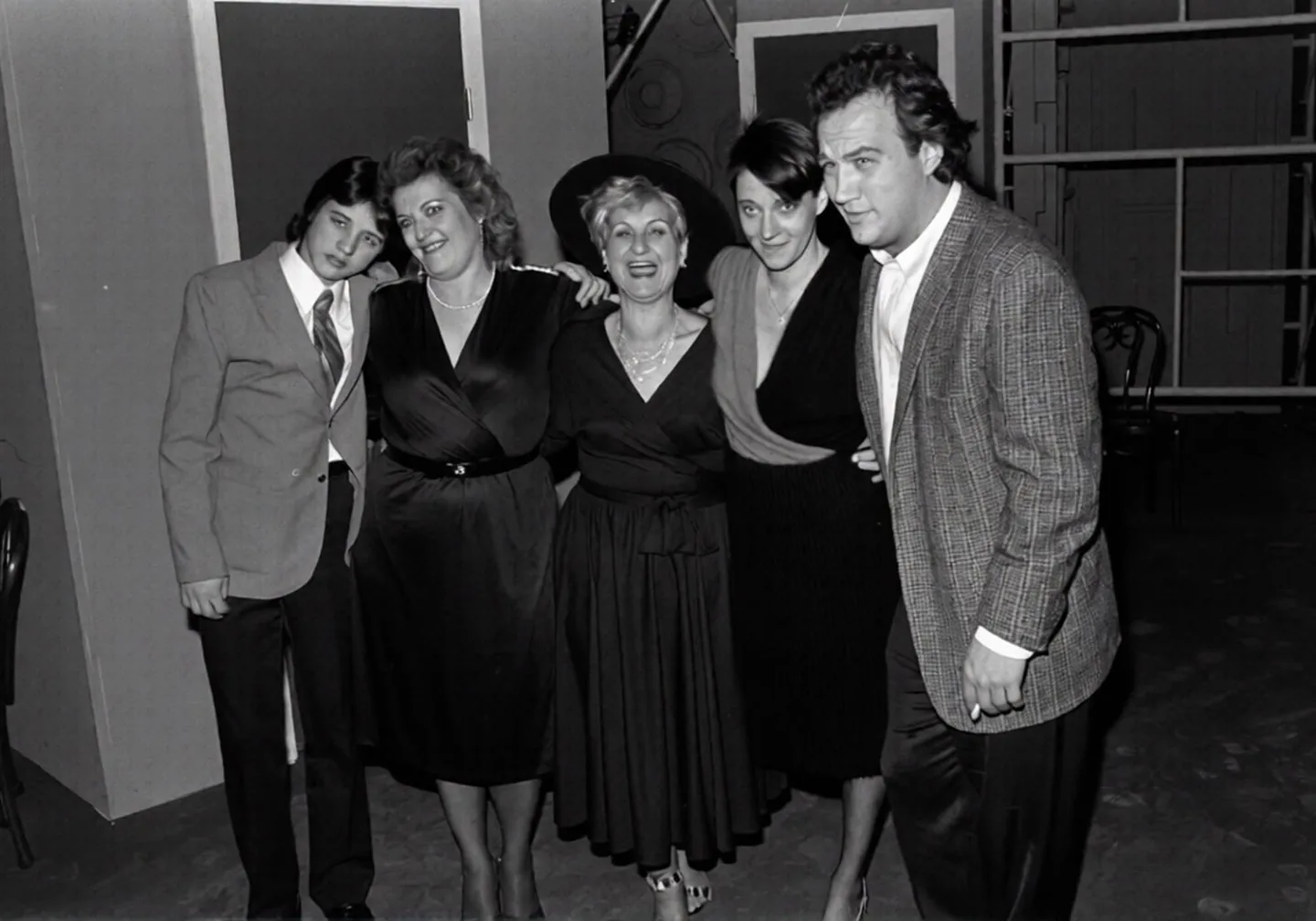
Fadil Berisha: Albania through a different lens
Fadil Berisha arrived in New York from Kosovo as a child. He studied fashion and photography at the Fashion Institute of Technology, spent time working as a stylist in Italy, and eventually found his place behind the camera.
Over the decades that followed, Berisha became a major name in fashion and beauty photography. His work appeared in publications including Vogue, Elle, Harper's Bazaar and Cosmopolitan, while his portraits brought some of the world's most recognisable models, actors and public figures in front of his lens.
But Berisha also used that career to make Albanian faces more visible. He helped introduce Albanian and Kosovar models to international audiences and became closely involved with Miss Universe Kosovo, including its first competition after independence.
That connection to home went beyond fashion. Berisha was also an executive producer of Dear Albania, the 2015 documentary featuring fellow Albanian-American Eliza Dushku and her brother Nate as they travelled through Albania and explored the culture, history and roots connecting the diaspora to the country.
The woman Albanian America largely forgot
And then there is Nexhmie Zaimi.
She does not fit neatly beside Nobel laureates, astronauts or Hollywood stars — which may be why her story is more interesting.
Born in Libohovë in 1917, Zaimi was among the first six girls in Albania to attend a secondary school run by American Presbyterian missionaries.
She eventually came to the United States and became a writer and foreign correspondent, entering a profession in which both her nationality and her gender made her unusual.
Her journey also connects two worlds that appear repeatedly in this history: Americans arriving in Albania as teachers and missionaries, and Albanians later carrying those connections back to America.
Zaimi's name is far less familiar today than Mili's, Murad's or Belushi's.
That does not make her marginal to the story.
It shows how much of Albanian-American history is still waiting to be remembered.
Sport
In September 1991 the United States beat Jamaica 1–0, and the only goal was scored by a man born in Vusanje, a village above Gusinje in the Montenegrin mountains. Sadri Gjonbalaj moved to Brooklyn as a child, played at North Carolina State, and won five caps for the US national team.
Andy Varipapa, born in an Arbëresh village in Calabria in 1891 and brought to Brooklyn at twelve, became the most famous trick bowler in the world; a two-game finish that totals exactly 300 is still called a Varipapa 300.
The trope, and the record
No page about Albanians in America is honest without this paragraph. Taken (2008) cost $25 million, took $226.8 million worldwide, and did more to fix Albanians in the American imagination than a century of migration. Liam Neeson was menaced by Albanians again in Run All Night in 2015. In 2019 the Albanian government made a tourism advertisement called “Be Taken by Albania” and invited him to come and see the country.
Behind the trope sits one real case. United States v. Ivezaj, decided by the Second Circuit in 2009, describes the Rudaj Organization as “a violent Albanian racketeering organization based in New York City and Westchester County” which took gambling clubs in Astoria from the Lucchese family. Six men appealed; the convictions were affirmed. Two of the six appellants were Italian-American, the victims were Greek, and the property at issue was illegal gambling.
That is the documented core of “the Albanian mafia in America.” There is no American crime statistic for Albanian-Americans, because no American dataset has ever had a field for it — the same absence that runs through every other number here, arriving here in a form that happens to work in the community's favour.
The music
Albanian-American music reaches listeners in more than one language. Bebe Rexha and Ava Max have built international pop careers; Njomza works as a singer and songwriter. Unikkatil represents another connection: Albanian-language rap made in the diaspora and heard on both sides of the Atlantic.
Unikkatil
Unikkatil is Viktor Palokaj, a Kosovo-born rapper associated with the Bronx and The Bloody Alboz. His Albanian-language recordings connect life in the United States with audiences in Kosovo and the wider diaspora.
Next generation
Language, marriage and the next generation
Albanian America is still a young community. Its median age in the 2020 Census was 34.7, compared with 38.8 nationally. Almost a quarter of the population was under eighteen, while only 10.8 percent was over sixty-five. You can see the migration history in those numbers. This is not yet a diaspora made up mostly of distant descendants. Many of the people who arrived in the great migration of the 1990s and 2000s are raising children — or watching those children raise families of their own. And that is where the story becomes harder to count.
The language is surviving — but changing
About 184,704 people speak Albanian at home in the United States.
That number has grown substantially. So has something that might seem surprising after several decades of settlement: 41.3 percent of Albanian speakers say they speak English less than “very well.” In 2013, the figure was 43.9 percent.
The obvious explanation is not that Albanians are failing to learn English. It is that the Albanian-speaking population keeps receiving new arrivals.
At the same time, Albanian is making it into the next generation.
Nearly a quarter of the people who speak it at home — 42,463 people — were born in the United States.
What “speaking Albanian” means inside those households can vary enormously. Some children grow up speaking it fluently with parents and grandparents. Others understand everything but answer in English. Some can hold a conversation but have never learned to write the language confidently.
Ava Max, whose parents are Albanian, has described herself as being able to speak Albanian but not read it.
That is a familiar second-generation experience: the language survives first in the ear and the family, not necessarily on the page.
Even the Census has trouble showing this clearly. Its standard published language table does not give Albanian a line of its own; Albanian sits inside “Other Indo-European languages.”
So one of the clearest markers of Albanian life in America is also one of the harder ones to find in the standard tables.
There isn't one Albanian America
Language connects the community, but it also carries the history of where people came from.
The first major Albanian migration to the United States came heavily from Korçë and southern Albania. It was largely Tosk-speaking and built many of the early communities in Massachusetts and New England.
The later migration that transformed New York and Detroit drew much more heavily from Kosovo, western North Macedonia and Montenegro, where Gheg varieties predominate.
Those histories are still visible on the American map.
Worcester has 3,258 ±626 residents born in Albania in the 2020–2024 ACS. Garfield, New Jersey, and Chicago have distinct Albanian-speaking histories that should be evaluated with the same geography and measure discipline.
So when two Albanian Americans say their families “came from back home,” they may be describing very different places, dialects, religions and migration stories.
America brought those communities closer together.
It did not make their differences disappear.
Who Albanians marry
There was a time when meeting another Albanian in America often came with a connection already attached.
A cousin knew someone. Your parents knew their parents. You met at a wedding, after church, through the mosque, at an Albanian event — or somebody decided the two of you really needed to meet.
The community was smaller. The network did a lot of the matchmaking. Today, Albanian America is much bigger, more spread out and more American-born. One number shows how people describe their ancestry: 82 percent of Americans who report Albanian ancestry report Albanian ancestry alone, rather than Albanian alongside another ancestry.
That does not tell us whom people date or marry. But compared with older European-American communities, where mixed ancestries are much more common after generations of intermarriage, it does tell us something about how recently much of Albanian America was formed.
And the dating map is no longer just America.
In fiscal 2024, the United States issued 145 K-1 fiancé visas to citizens of Albania and another 114 to citizens of Kosovo, according to the State Department’s nationality table.
Those 259 visa issuances point to relationships that crossed borders. They do not establish how many people later entered the United States or completed a marriage, but they show another way the diaspora’s personal connections reach across the Atlantic.
Your person might not live in your ZIP code
That has always been part of diaspora life. What has changed is how people find each other. If you're Albanian in New York, your circle does not necessarily end in New York. Someone who gets you might be in Detroit, Boston, Florida, Pristina, Tirana or Zürich.
That's where technology has quietly changed the old community network.
dua.com takes something Albanians have always done — finding one another through a shared culture — and removes the geographical limits. Instead of relying on who your cousin knows or hoping to meet someone at the next wedding, you can discover Albanians across America and the wider diaspora yourself. Same idea. Much bigger neighbourhood.
There is another immigration category that captures the connection from a completely different angle.
P-3 visas are used for artists and entertainers participating in culturally distinctive programmes.
On a spreadsheet, that's an immigration category.
In real life, it can mean musicians, singers, folk performers and valle groups arriving for cultural events — and the celebrations where Albanian America comes together.
Because not every connection across the Atlantic ends with somebody moving permanently. Sometimes it just arrives in time for wedding season.
The Albanians disappearing from the Albanian statistics
Then we reach the group that may tell us the most about where the community is going.
We identified 35,546 children and grandchildren living in households with a visible Albanian connection who do not themselves appear in the usual Albanian measures.
Most were born in the United States. 23,889 are under eighteen.
They are not counted as Albanian through the ancestry, birthplace or home-language measures used elsewhere on this page. More than 19,000 did not report an ancestry at all; others reported identities such as American, Irish, Italian or German.
It would be easy to look at those numbers and say that Albanian identity is disappearing.
The reality is probably more complicated.
A child can answer the Census in English, report no Albanian ancestry, and still spend Sundays with Albanian grandparents. Someone can stop speaking Albanian and still turn up at an Albanian wedding, follow Kosovo's national team, know exactly where their family village is, or feel Albanian when somebody asks Nga je?
And the opposite is possible too. For some families, the connection really does weaken with every generation.
The Census cannot tell us which is happening inside each household.
What it can show is the distance opening between measurable Albanian identity and family connection.
That distance is where the next chapter of Albanian America will be decided.
The first generation had to build churches, mosques, newspapers and organisations because they were far from home. The next generation faces a different problem: how to inherit an identity when home is no longer somewhere you left, but somewhere your parents or grandparents remember.
That is why the Saturday schools, churches, mosques, football clubs, June parade — and increasingly the digital spaces connecting Albanians across the country — matter.
They are no longer only helping immigrants find one another.
They are helping their children decide what being Albanian in America will mean.
Albanian stays alive when there are reasons to actually use it. For earlier generations, that happened naturally — at home, at church or the mosque, at the club, or over coffee with other Albanians. For younger Albanian Americans, some of those everyday moments now happen online too.
On dua.com, you don’t need perfect Albanian to feel Albanian. A conversation can start in English, slip into Albanian, mix the two completely — or begin with the most Albanian question of all: Prej kahit je?
No app is going to solve language loss. But every message, joke, and slightly broken Albanian sentence gives the language one more place to live — outside of conversations with your parents and grandparents.
The generation that is becoming harder to count on paper may also be the one figuring out, in real time, what being Albanian means to them.
They might have been born in New York, Detroit or Boston. English might be their first language. Albania or Kosovo might feel less like a place they left and more like somewhere they know through summer trips, grandparents, weddings, music, food and the stories they grew up hearing.
And still, many want Albanian people in their lives — as friends, as partners, as community.
That’s where dua.com has a slightly different role in America. In Albania or Kosovo, meeting another Albanian is part of everyday life. In the US, the person who shares your culture, your family dynamics, and your “you just get it” moments might live three states away.
For second- and third-generation Albanian Americans, finding each other online isn’t necessarily about holding on to the past. Sometimes it’s simply about making sure being Albanian still has a place in whatever comes next — friendships, love, family, and the life they choose to build.
Meeting today
How do Albanians in America connect today?
The cousin network
First, there was the cousin network. For most of Albanian-American history, finding your people was surprisingly simple.
You knew someone who knew someone. A cousin met you at the airport. Someone from the village found you a room. An uncle knew who was hiring. Families introduced their children. You met people at church, at the mosque, at weddings, football games, cafés, and community events.
And once you found one Albanian, you usually found twenty more. That network helped build Albanian America. Earlier in this story, we saw it find jobs for new arrivals, finance churches and mosques, raise money for Kosovo and keep families connected across an ocean. In places like the Bronx, Detroit or Worcester, it worked because the community was physically close.
But America is enormous. Families moved from the Bronx into Westchester. Detroit's Albanian community spread into Macomb County. Older centres changed, while new Albanian communities appeared in Florida, Texas, Arizona and the Carolinas. The community got bigger. The distance between us did too.
So what happens when your people aren't down the street?
If you grow up Albanian in New York, you might have cousins, family friends, and Albanian businesses all around you.
Grow up in Phoenix, and your experience can look completely different. You can speak Albanian at home, spend summers in Kosovo, know every song at a wedding, and still have very few Albanians your age anywhere nearby.
That's the strange thing about growing up diaspora: you can feel deeply connected to a community you don't physically live inside. And nowhere is that more obvious than dating.
Wanting someone who understands the culture is one thing. Actually finding them is another. Someone who gets why you disappear to Europe for three weeks every summer. Why your family is going to have opinions. Why one Albanian wedding somehow contains 400 relatives you've never met. Someone you don't have to explain that part of yourself to.
From introductions to algorithms
Albanian Americans still want culturally familiar connections, but geography makes them harder to find.
For many Albanian Americans, dating comes with a few extra questions. It’s not just Do I like this person? It can also be: Will they get my family? Will I have to explain why we’re spending half the summer in Kosovo? Why the wedding has 300 guests? Why somehow, everyone knows everyone?
For older generations, family and the local Albanian community often helped make those introductions. But Albanian America is more spread out now, and younger generations don’t always grow up surrounded by a big Albanian circle.
dua.com brings a little of that old-school “I know someone you should meet” energy into a very different world. There’s no auntie choosing for you — you decide who you like and what you’re looking for. But culture, language and that feeling of they already get it can still be part of the connection.
The cousin network was pretty good at this. The problem is that your cousin's network has a limit. This is where dua.com changes the map! The app takes the Albanian network we've always had and makes it searchable.
That's the important part. Instead of your Albanian world ending with the people your family knows, your neighbourhood, or the city you happen to live in, dua.com opens that circle to Albanians across America and the diaspora.
✈️ New York to Michigan.
✈️ California to Massachusetts.
✈️ Florida to Kosovo.
✈️ Chicago to Tirana.
And with Fly, even your current location doesn't have to decide who you can discover. You can explore another city or country and meet Albanians there — useful when “home” might mean more than one place.
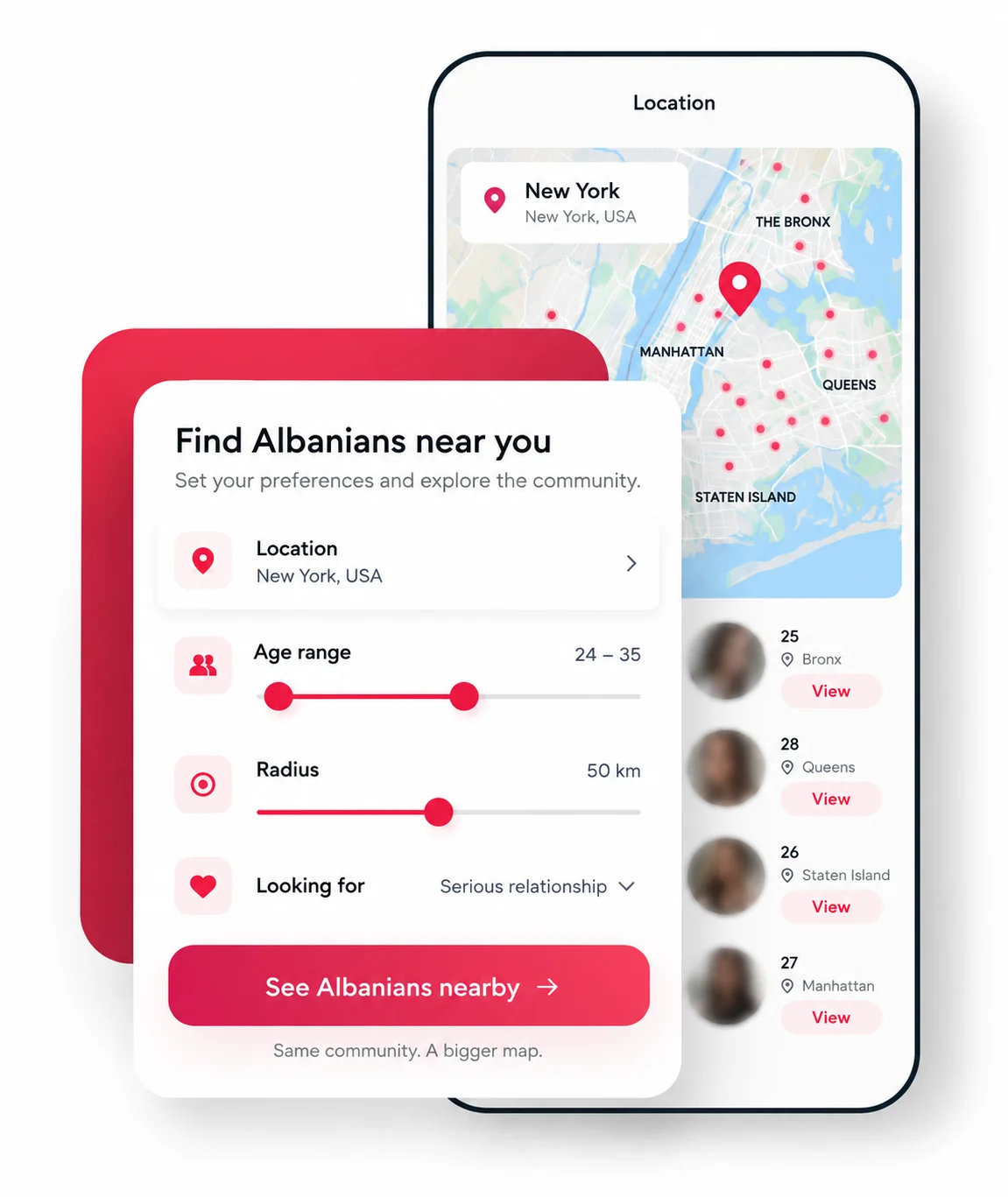
The app doesn't replace weddings, introductions or that cousin who is absolutely certain they know the perfect person for you. It gives you another way in. And this time, you choose where to look.
Sometimes two people just need a bigger map
One story shared with dua.com makes the point better than any feature list could. An Albanian woman who had moved to the United States at ten had built most of her life here: university, law school, career.
Then, in 2020, she met an Albanian man on dua.com. He had a doctorate in mathematics. She was a lawyer. They had the cultural connection she was looking for and plenty else in common. There was just one problem.
They lived in different states. Without a way to look beyond their immediate circles, there is a good chance their paths would simply never have crossed.
On dua.com, they did. They met that summer. By October, they were engaged.
It's a small story inside a very large diaspora, but it captures why digital connection matters particularly in America.
Sometimes your person isn't far from your culture. They're just far from your ZIP code.
dua.com doesn't create the desire to stay connected. Albanians have been solving that problem in America for more than a century.
Dielli connected immigrants through a newspaper. Vatra organised people across cities. Churches, mosques and associations created places to gather. Weddings and family networks introduced one generation to the next.
Digital connection is simply the newest layer of that story.
Today, dua.com can put an Albanian in Florida in the same digital room as someone in Michigan, New York, Pristina, Zürich or Tirana.
That matters because the challenge facing the next generation is different from the one their grandparents faced. Their grandparents had to figure out how to reach America. Their parents had to figure out how to build a life here.
For many of their children, the question is:
How do I stay close to my community when my community is everywhere?
For more than a century, Albanian Americans have kept finding new answers. dua.com is one of them.
dua.com community data
A network the size of the country
Everything else on this page comes from the Census Bureau, the Department of Homeland Security and the scholarship. This counts our own members instead.
Between April and late July 2026, more than 5,600 matches connected members in the United States with Albanians in Kosovo, Albania and North Macedonia — more matches back across the Atlantic in four months than there were Albanian green cards in a good year. New York, Pristina and Tirana lead the Fly destinations, in that order: people search toward New York as much as away from it.


dua.com internal data (dua_city_country_insights, July 2026). Percentages are shares of the members who answered the relevant profile question, not of all members. Matches with the countries of origin cover April to 27 July 2026. Fly shows in-app destination selections, not confirmed travel.
The ledger
How the community estimate and official measures fit together
The United States measures birthplace, ancestry, the detailed race write-in and language at home. Albanian-American organisations measure belonging more broadly, across origin countries and generations. This section places the 750,000–1 million community estimate beside the official measures and dua.com's narrower analytical model without pretending that they answer the same question.
| Block | What it is, and how it is treated | People |
|---|---|---|
| Visible baseline | ACS 2020–2024, table B02024 — Albanian, alone or in any combination. Published table, no adjustment. | 252,106 |
| Direct Albanian signal | 2024 microdata: Albanian ancestry, or Albanian spoken at home, or born in Albania or Kosovo. A union of three measured sets, de-duplicated. | 278,414 |
| Children and grandchildren | Same households, no Albanian signal of their own; 34,636 US-born, 23,889 under 18. Counted. | +35,546 |
| Siblings, parents, other blood relatives | Same households. Counted. | +3,599 |
| Albanians the census files elsewhere | Born in North Macedonia, Montenegro, Serbia or “Yugoslavia”. Estimated from the origin-country censuses and from what they report in America; assumptions published. | +4,000 |
| Non-Albanians born in Albania and Kosovo | Greeks of Albania, Kosovo Serbs, Bosniaks, Roma and others — Albania 2–4%, Kosovo 8–12%. Subtracted. | −6,500 |
| Spouses, partners, in-laws, housemates | 49,261 people who married in, plus 8,127 unrelated housemates. Excluded entirely. | 0 |
| Living Albanian signal | The blocks above, summed. No uplift factor, no invented values. | ≈ 315,000 |
| Descendants of the founding migration | The 40,000–60,000-strong community of 1945, grown at the national rate, less those still reporting Albanian ancestry. A projection, not a measurement. | +110,000 |
| The Arbëreshë | Americans descended from the Albanians who left for Italy in the fifteenth century. Unbounded and unmeasurable. Not counted. | — |
| Model total, by descent | After the survey's own sampling error of ±6.7% on the measured blocks. | ≈ 425,000 |
The arithmetic in full view
Two features of that table matter more than the total. The first is that the two big blocks are measured, not modelled: they come from the 2024 American Community Survey microdata, on one frame, linked at household level. The second is that more people are thrown out of this model than are estimated into it. Fifty-seven thousand spouses, partners, in-laws and housemates are excluded; four thousand are added.
The generation the Census cannot see
There is another group hiding in the data.
We found 35,546 children and grandchildren living in households with an Albanian connection who do not themselves appear in the usual Albanian measures. Almost all were born in the United States, and 23,889 are under eighteen.
Most strikingly, 19,498 reported no ancestry at all. Others identified as American, Irish, Italian, German, Macedonian or Montenegrin.
That does not necessarily mean they stopped being Albanian.
A child can speak English at home, leave the ancestry question blank and still grow up with Albanian grandparents, weddings, food and family ties. What disappears first may not be the identity itself, but the Census trail that allows us to find it.
And the further back we go, the larger that blind spot becomes.
Scholars estimated 40,000 to 60,000 Albanian Americans in 1945, including children already born here. Most of their grandchildren and great-grandchildren are now difficult to identify in modern Census data.
A rough demographic projection suggests that early community could have 110,000 to 160,000 living descendants today. Adding descendants no longer visible in the standard ancestry, birthplace and language measures could push a broader descent-based estimate toward 425,000.
That number should be treated cautiously. It is a projection, not a Census count, and it is far less certain than the official figures elsewhere on this page.
But the uncertainty is itself part of the story.
The longer Albanians have been in America, the harder they become to count as Albanian.
What the records can tell us
There are other ways to look for Albanian America in official records. None gives us the whole community.
Take Albania's first diaspora postal vote in 2025. 20,648 people in the United States registered, and 17,244 returned ballots. That tells us something useful about politically engaged Albanian citizens in America.
It tells us almost nothing about the Albanian from Kosovo, the family from Montenegro, or the third-generation American whose grandparents came from Korçë.
Naturalisation records have the same problem from another direction. Since 1987, 81,064 people born in Albania have become US citizens. Again, a solid number — but only for people born in one country who followed one immigration path.
Even the Census disagrees with itself depending on how the question is asked. In the same survey period, 10.3 percent more people identified as Albanian in the detailed race question than in the ancestry question. The full 2020 Census count was also 17 percent higher than the comparable survey estimate.
That is why we do not treat any one official number as the Albanian-American population.
The records are good at counting what they were designed to measure. The Albanian diaspora is larger and messier than any one of those definitions.
Where we draw the line
Being cautious also means knowing who not to add.
We exclude 49,261 non-Albanian spouses, partners, in-laws and other members of mixed households. They are part of Albanian family life, but counting everyone who married into an Albanian household would turn a measure of Albanian descent into something else.
We also do not add a speculative number for Arbëreshë Americans or descendants of Albanians who migrated through Turkey. Both belong in the history of Albanian America, but there is no defensible way to identify their full populations in current US data.
That leaves an imperfect boundary.
But an imperfect boundary we can explain is better than a larger number we cannot defend.
The community estimate: 750,000 to 1 million
So how many Albanian Americans are there?
The honest answer depends on what we mean by Albanian American.
The Albanian American Civic League uses a figure of about 750,000. The National Albanian Registry puts the community closer to one million.
Those are community estimates, not Census counts. No public US dataset currently produces anything close to one million people individually identifiable as Albanian.
But that does not make the estimates meaningless.
Official statistics are answering narrower questions. They can tell us that 252,106 people identified as Albanian in the largest current published Census measure, that 228,504 reported Albanian ancestry, and that 184,704 speak Albanian at home.
None of those questions asks simply: Are you Albanian?
And that is the difficulty running through this entire page.
Five numbers, five different questions
When someone gives you “the number of Albanians in America,” it is worth asking what they actually counted.
228,504 reported Albanian ancestry.
252,106 identified as Albanian in the detailed race question.
110,504 were born in Albania.
184,704 speak Albanian at home.
And the number of Americans who have any Albanian descent at all is unknown.
These figures overlap heavily, but they are not interchangeable. Someone born in Kosovo can be Albanian without being Albania-born. A third-generation American can have Albanian ancestry without speaking the language. A child can speak Albanian at home without appearing in the ancestry count.
And, as we have seen, some descendants eventually disappear from all of those measures.
That makes the United States different from several of the European countries in this series. There is no published American category that neatly gathers together Albanians from Albania, Kosovo, North Macedonia, Montenegro and the generations born here.
That missing category is not a flaw in the research. It is part of the answer.
So this page uses 750,000 to 1 million when referring to the broad community estimate, and labels it as such.
Alongside it, we give the numbers the US government can actually measure: 252,106 in the largest current published Census measure, 228,504 reporting Albanian ancestry, and 184,704 speaking Albanian at home.
There is also a narrower model of roughly 315,000 people whose Albanian connection can still be identified across several signals in the data. It is useful for analysis, but it is not an official population count either.
There is no single correct number hiding somewhere in a Census spreadsheet.
There are different answers because America is counting different things — birthplace, ancestry, language and identity — while Albanian America contains all of them.
Directory
A practical directory
Everything below was checked against the organisation's own published record in August 2026. Where an entry rests on a community directory rather than an institutional source, it says so.
Consulates and embassies
| Mission | Address | Telephone |
|---|---|---|
| Embassy of Albania | 2100 S Street NW, Washington, DC 20008 | +1 202 223 4942 |
| Consulate of Albania, New York | 320 East 79th Street, New York, NY 10075 | +1 212 255 7381 |
| Embassy of Kosovo | 3612 Massachusetts Avenue NW, Washington, DC 20007 | +1 202 450 2130 |
| Consulate General of Kosovo, New York | 801 Second Avenue, Suite 301, New York, NY 10017 | +1 212 949 1400 |
| Consulate of Kosovo, Des Moines | 309 Court Avenue, Suite 223, Des Moines, IA 50309 | +1 515 875 4944 |
These five are the complete list of Albanian and Kosovar state representation in the United States. Several commercial visa sites also advertise Albanian honorary consulates in Detroit, Boston, New Orleans and Stamford; none of them appears in the Albanian foreign ministry's own mission directory, and at least one names a consul who has died. Do not rely on them.
Churches, mosques and the teqe
- Cathedral of St George517 East Broadway, South Boston, MASeat of the Albanian Orthodox Archdiocese in America (OCA), which has eleven parishes across six states.Map
- Albanian Orthodox Diocese of America245 D Street, South Boston, MAThe other Albanian Orthodox jurisdiction (Ecumenical Patriarchate), four blocks away.Map
- Church of the Assumption of the Virgin Mary535 Salisbury Street, Worcester, MAThe oldest Albanian congregation in the United States, organised 1911.Map
- St Thomas Albanian Orthodox Church29150 Ten Mile Road, Farmington Hills, MIEstablished in Detroit in 1929.Map
- Our Lady of Shkodra361 West Hartsdale Avenue, Hartsdale, NYThe first Albanian Catholic parish in the US, erected in the Bronx in 1989 and consecrated in Westchester in 1999.Map
- Albanian Islamic Center19775 Harper Avenue, Harper Woods, MIOpened 3 November 1963, successor to the converted-church mosque of 1951 on Hamilton Avenue.Map
- Albanian Islamic Cultural Center307 Victory Boulevard, Staten Island, NYNew York's Albanian Sunni centre.Map
- Albanian American Muslim Community38 Raymond Street, Waterbury, CTThe Brass City congregation.Map
- First Albanian Bektashi Teqe in America21749 Northline Rd, Taylor, MIThe first Bektashi house in the Western hemisphere, founded 1954. The türbe is open daily.Map
Albanian schools
The Albanian government's register lists 31 sites under 21 school names, in New York (13), Michigan, Massachusetts, Connecticut, Pennsylvania, Texas, Illinois, New Jersey and Florida. A representative sample:
- Shkolla shqipe “Mëso Shqip” — the largest, 200–240 pupilsI.S. R002 George L. Egbert, 333 Midland Avenue, Staten Island, NYMap
- Shkolla shqipe në BronxChristopher Columbus High School, 925 Astor Avenue, and MS 80, Mosholu Parkway EastMap
- “Hasan Prishtina” and “Shqiponjat”106 Columbia Boulevard and 233 South Elm Street, Waterbury, CTMap
- Shkolla shqipe në Michigan and “Nënë Tereza”1451 East Big Beaver Road, Troy, MI; 29350 Lahser Road, Southfield, MIMap
- “Besa” and “Iliria”100 William T. Morrissey Boulevard, Boston, MA; Arlington and Beverly, MAMap
- Shkolla shqipe Naples16165 Learning Lane, Naples, FLMap
Organisations, media and events
- Vatra — Pan-Albanian Federation of AmericaFounded Boston, 1912. Publishes Dielli (1909), the oldest Albanian-language newspaper in the world.Search
- Albanian American Civic LeagueFounded 1989, Ossining, NY — the Kosovo lobby. Revenue $52,230; assets $14,807.Search
- Albanian American National OrganizationFounded in Worcester, Massachusetts in 1946.Search
- IllyriaThe Albanian-American newspaper founded in the Bronx in 1991, which carried the Kosovo generation.Search
- Albanian TV of AmericaTroy, Michigan — the community's television station.Search
- Zëri i AmerikësThe Voice of America's Albanian service — silent since 15 March 2025. The site is still up; every story is from March 2025.Search
- The Albanian Roots ParadeManhattan, in June — assembling at 81st Street and Central Park West.Map
- Independence Day flag-raising, 28 NovemberBowling Green, Manhattan; the Michaelian Office Building, White Plains; and across metro Detroit.Map
Where to eat, in the Bronx
Addresses below are as published in the community's own business directory.
FAQ
Frequently asked questions about Albanians in America
Each answer points back to the section of this page where the evidence sits.
How many Albanians live in the United States?
Why is the community estimate higher than the Census figures?
Why does the US census not count Kosovar Albanians?
Where do most Albanian Americans live?
What is the most Albanian city in America?
Is the Bronx really the centre of Albanian New York?
When did Albanians first come to America?
What was the Diversity Visa lottery's role?
What happened at Fort Dix in 1999?
Which faiths do Albanian Americans belong to?
Which famous Americans are of Albanian descent?
Do Albanian Americans still speak Albanian?
How connected is the community to Albania and Kosovo?
How do Albanians in America meet other Albanians?
Eduard Luta
CMO at dua.com · Updated 12.09.2026
Last full evidence review: 28 August 2026
Sources
US Census Bureau, American Community Survey 2020–2024 5-year estimates, tables B04006, B02024 and B05006 · 2020 Census Detailed Demographic and Housing Characteristics File A, table T01001, iteration 1114, released 21 September 2023 · ACS 2024 1-year Public Use Microdata Sample, person and household files · Department of Homeland Security, Yearbook of Immigration Statistics · dua.com internal data, July 2026.
Methodology
This page leads with the Albanian-American community estimate of 750,000 to 1 million and identifies it as such. It is then compared with separate official measures for birthplace, self-reported ancestry, the detailed race write-in and Albanian spoken at home. Those measures cover the US resident population regardless of citizenship, but none is a complete ethnic-community count. Community estimates, official statistics, historical record and editorial interpretation are labelled separately throughout.