
Albanians in the UK
Britain counted us. Then it filed the answer where nobody would look.
More than 150,000 of us live here, built almost entirely out of two migrations a generation apart that share a language and almost nothing else. This is the number rebuilt from the census upwards — and the community the number cannot describe.



1.1 million+ Albanians already on dua.comPhoto-verified profiles
Where are you?
Pick a place and we'll show you what the census says — and who's already there.
Greater London
56,463
born in Albania or Kosovo
Half of Albanian Britain lives inside the M25 — 50.6 percent of everyone born in Albania and 71.1 percent of everyone born in Kosovo. One of the most extreme concentrations of any birthplace group in the census.
Free to join · 16,301 members in London
150,000+
Albanians in the UK
Best available evidence; 200,000 a plausible unmeasured ceiling
99,389
Counted at the 2021 census
Born in Albania or Kosovo, England, Wales and Northern Ireland
52,328
Speak Albanian as a main language
The most-spoken non-EU European language in England and Wales
Britain counted them, and then filed the answer where nobody would look. The 2021 census asked everyone in England and Wales where they were born, and its detailed classification has a code for Albania and a separate code for Kosovo. Run them and you get 68,672 and 30,515. But neither number appears in a single published census table — both are folded into a bucket labelled “Rest of Europe: Other Europe”, alongside Norway, Russia and Switzerland. To see them you have to build a custom table from a 190-category classification most people do not know exists.
So the most-quoted figure for the Albanian population of Britain is not a census figure at all. It is “47,000 (ONS, 2019)” — a survey estimate with a margin of error of ±11,000, from a series the Office for National Statistics discontinued in October 2022. The edition of that survey covering census month put the whole UK at 29,000. The census, taken in the middle of that same twelve months, found 68,672 in England and Wales alone.
This page rebuilds the number from the ground up, and then tells the story the number cannot: that there are two Albanian migrations to Britain, a generation apart, which share a language and almost nothing else — and a third that Britain has no way of counting at all, because it arrived on Italian and Greek passports. The evidence rules are the ones used on Greece, Italy, Germany and Austria: every figure traced to a named table on a named date, every measurement universe kept apart from the others, and everything contested labelled as contested.
And there is another part of the story that a census cannot capture: how a community finds and connects with itself once it is spread across a country. That is the space dua.com was built for — connecting Albanians across borders and generations, and helping people find relationships rooted in a shared language, culture and background.
Albanian Britain in seven evidence-led facts
- More than 150,000 Albanians live in the UK, with 200,000 a plausible but unmeasured upper possibility. The counted floor — census plus post-census birth registrations, with nothing modelled — is 117,189.
- Two migrations, thirty years apart. 75.6 percent of Kosovo-born residents arrived in the decade 1991–2000. 66.4 percent of Albania-born residents arrived in the seven years 2014–2021.
- Nine in ten Kosovo-born residents hold a British passport (89.9 percent) and 80.7 percent describe themselves as “British only”. Among Albania-born residents the figures are 23.1 and 22.6 percent.
- Almost three in ten Albania-born residents hold an EU passport — 3,602 of them Italian. Italy and Greece had naturalised roughly 480,000 Albanians by the end of 2020, and every one of them gained the right to move to Britain on the same day.
- Albania is the fifth-largest non-EEA nationality in the entire EU Settlement Scheme, with 54,750 applications — ahead of Nigeria, Bangladesh and Ukraine.
- 30.7 percent of Albania-born people in work are in construction, against 8.7 percent of everyone in work in England and Wales.
- Albanian is the most-spoken non-EU European language in England and Wales — 52,328 speakers, up 61 percent in a decade.
Last evidence review: 9 August 2026. Official statistics, historical record and editorial interpretation are labelled separately throughout. On the contested ground this page has to cross — the 2022 arrivals, the asylum arguments, the crime figures — it reports what the primary documents say, gives the denominators, and names what nobody knows.
The count
How many Albanians live in the UK?
More than 150,000, on the best available evidence — of whom 99,389 were counted at the 2021 census as having been born in Albania or Kosovo. The gap between those two numbers is almost entirely the generation born here, which no British dataset counts directly. For a community whose identity increasingly spans generations, borders and places of birth, the census can only tell part of the story.
Getting from one number to the other is the work of the sections that follow, and every step is shown in the ledger at the end.
Start with what was actually counted. On census night, 21 March 2021, there were 68,672 people born in Albania living in England and Wales — 67,957 in England and 715 in Wales — and 30,515 born in Kosovo. Northern Ireland, which held its census on the same day, added 142 and 60. That is 99,389 people, in a population of 61.5 million — Scotland is in neither number.
Set that against the two censuses before it and the shape of the thing appears. In 2001 there were 2,238 Albania-born people in England and Wales. In 2011 there were 13,415. In 2021 there were 68,672 — more than thirty times the 2001 figure, over twenty years in which the population of England and Wales as a whole grew by 14.5 percent. Kosovo-born residents barely moved: 28,446 in 2011, 30,515 in 2021, a rise of 7.3 percent in a decade. In 2011 there were twice as many Kosovo-born people in England and Wales as Albania-born. By 2021 Albania-born outnumbered them 2.25 to one.
Why “47,000” is wrong, and why it is everywhere
Almost every article, infobox and briefing about Albanians in Britain quotes a figure of 47,000, attributed to the ONS in 2019. It is a real number and it comes from a real source — the Annual Population Survey, a household survey of about 300,000 people. Its published margin of error was ±11,000.
The survey’s last edition covered July 2020 to June 2021 — the twelve months containing census day. It put the Albania-born population of the entire United Kingdom at 29,000. The census found 68,672 in England and Wales alone. The survey was low by roughly 40,000 people, or 58 percent; that estimate carried its own interval of ±9,000, so even its ceiling of 38,000 was barely half the true figure. In London, where most of the community lives, the survey said 8,000 and the census said 34,773 — out by a factor of 4.3.
The reason is not mysterious. A household survey under-covers houses in multiple occupation, recent arrivals, and young men in shared private-rented accommodation — which is a precise description of the cohort that arrived between 2014 and 2019. The ONS discontinued the series in October 2022, citing data problems, and its replacement publishes only grouped regions with no country detail. There is currently no official annual estimate of the Albanian population of the United Kingdom at all. The March 2021 census is the most recent authoritative count, and it is now five years old.
The five universes, and why they never add up
UK statistics count this community in at least five incompatible ways. Most of the wrong numbers in circulation come from adding two of them together.
| Measure | Figure | What it counts |
|---|---|---|
| Country of birth: Albania | 68,672 | People born in Albania, whatever passport they now hold. Includes 15,860 who hold a UK passport. |
| Country of birth: Kosovo | 30,515 | Same, for Kosovo. Includes 27,453 who hold a UK passport, from a cross-tab totalling 30,519. |
| Ethnic group write-in | 58,746 | People who wrote “Albanian” (45,601) or “Kosovan” (13,145) in the free-text box. A floor, not a total. |
| Main language: Albanian | 52,328 | Residents aged 3+ whose main language is Albanian. Catches Kosovo and North Macedonia origins; misses anyone whose main language is now English. |
| Home Office nationality: Albania | varies by year | Albanian passport-holders in the immigration system. Albanians from Kosovo appear as Kosovo; from Italy, as Italy. |
The trap most people fall into is the third row. The intuition is that an ethnicity question will catch the second generation and therefore run higher than country of birth. It runs lower: 58,746 against 99,187 born in the two countries. The census ethnicity question is a tick-box with a write-in field, and large numbers of Albanians ticked “Other White” and wrote nothing — 211,287 such responses were recorded across England and Wales. So the write-in figure measures who chose to name themselves on a form, which is interesting but is not a population.
One more structural point, and it matters for every local figure that follows. ONS applies cell-key perturbation independently at each geography — small random adjustments that protect individual confidentiality. The 331 local-authority cells for Albania sum to 68,677 against a national 68,672. Census numbers here are exact as published and are not exactly additive.
And Scotland?
No UK statistical agency publishes how many Albanians live in Scotland. Scotland ran its census a year later, in March 2022, and National Records of Scotland grouped Albania into a single cell labelled “accession countries March 2022” — 3,684 people covering Albania, Bosnia and Herzegovina, Montenegro, North Macedonia, Serbia and Ukraine, counted a month after the invasion. Kosovo is not in that group at all; it sits inside a 7,709-person “other non-EU European countries” cell alongside Norway, Iceland, Belarus, Moldova, Georgia and Armenia. Scotland’s census publishes no Albanian ethnic write-in and no Albanian language figure. Answering the question would take a commissioned table.
Two migrations
Two migrations that share a language
The single most useful thing to understand about Albanians in Britain is that there are two very different migration stories sitting inside the same statistics.
One arrived as refugees from a war, in one decade, and is now overwhelmingly British. The other arrived for work, thirty years later, and is still largely made up of people who were born abroad. They speak the same language and appear in the same census, but their ages, experiences and relationship with Britain are very different.
Look at when they arrived. 23,073 of the 30,515 Kosovo-born residents of England and Wales — 75.6 percent — arrived between 1991 and 2000. Since 2011, only 2,571 have arrived in total — fewer in eleven years than arrived in a single year at the peak. It is now a largely settled generation: only 223 Kosovo-born residents were under sixteen at the 2021 census, because children of the community are increasingly being born in Britain. The largest five-year age group among Kosovo-born residents was 45 to 49.
Now look at the other line. 45,571 of the 68,672 Albania-born residents — 66.4 percent — arrived in the seven years from 2014 to 2021, with 23,084 arriving in the three years from 2017 to 2019 alone. The largest five-year age group among Albania-born residents was 25 to 29. Nearly half of them, 48.2 percent, arrived between the ages of 20 and 29; barely one in ten arrived as a child.
Every other statistical difference between the two follows from those two dates.
| Census 2021, England and Wales | Kosovo-born | Albania-born |
|---|---|---|
| Total | 30,515 | 68,672 |
| Arrived 1991–2000 | 75.6% | 9.9% |
| Modal age band | 45–49 | 25–29 |
| Holds a British passport | 89.9% | 23.1% |
| Holds an EU or Irish passport | 1.7% | 29.7% |
| National identity “British only” | 80.7% | 22.6% |
| Main language is English | 54.0% | 30.5% |
| Cannot speak English well or at all | 7.9% | 18.2% |
| Records a Muslim religion | 48.4% | 29.8% |
| Records a Christian religion | 10.4% | 34.2% |
| Works in construction | 23.1% | 30.7% |
| Aged under 16 | 223 people | 2,960 people |
Two of those rows are worth stopping on, because most British readers will guess them wrong. Albania-born residents of England and Wales are more likely to record a Christian religion (34.2 percent) than a Muslim one (29.8 percent), with 26.1 percent recording no religion — a distribution that reflects both Albania’s own mixed confessional map and the over-representation of Catholic northerners and Orthodox southerners in emigration. Kosovo-born residents are 48.4 percent Muslim and 10.4 percent Christian. Any statement about “the religion of Albanians in Britain” that does not say which of those two populations it means is meaningless.
And it matters beyond the statistics. Two generations of Albanians can share a language and cultural background while growing up in very different Britain. Finding one another is therefore not simply about being Albanian — it is also about finding people who share the kind of life, values and future you are looking for.
The map
One geography, three different questions
Where people born in Albania live, where people born in Kosovo live, and where Albanian is spoken at home are not the same map. Switch between them below and watch the community hand over from the north London arc to the inner-west London estates.
Where Albanian Britain lives
The same census, asked three ways. Every local authority in England and Wales is shaded by its share of residents; the second panel drops to neighbourhood level across London and the M25 rim.
68,677 residents of England and Wales were born in Albania. 55.5% of them live inside the London-and-M25 window below.
Hover or tap any area for its name and figures. Switch the measure above.
England and Wales
331 local authorities. Scotland ran its own census in 2022 and is not in this classification; Northern Ireland's 202 Albania- and Kosovo-born residents are counted by NISRA separately.
London and the M25 rim
1,276 neighbourhoods (MSOAs), each about 8,000 people. Borough outlines in grey; the Thames and the reservoirs are unshaded because census areas stop at the water.
Share of residents
% of all residents born in Albania
Local authorities
- Enfield4,9211.49%
- Barnet3,6800.95%
- Haringey2,8671.09%
- Waltham Forest1,6930.61%
- Birmingham1,6270.14%
- Barking and Dagenham1,3940.64%
- Ealing1,3430.37%
- Redbridge1,2250.39%
Neighbourhoods
- Broomfield ParkEnfield4864.30%
- SouthgateEnfield4444.29%
- New Barnet Town & East BarnetBarnet3974.10%
- BowesEnfield3473.29%
- Harringay Ladder NorthHaringey3173.63%
- Enfield Town South & Bush Hill ParkEnfield3133.08%
Places
Where do Albanians live in the UK?
In about forty postcodes. London holds 50.6 percent of everyone born in Albania and 71.1 percent of everyone born in Kosovo — one of the most extreme concentrations of any birthplace group in the census. And 42 of England and Wales’s 331 local authorities have fewer than ten Albania-born residents.
The centre of gravity is a single arc of north London: Enfield (4,921 Albania-born and 1,465 Kosovo-born), Barnet (3,680 and 2,003) and Haringey (2,867 and 903). Enfield alone holds 7.2 percent of every Albania-born person in England and Wales. Roughly one resident in fifty-two of the whole London Borough of Enfield was born in Albania or Kosovo, and Enfield has more Albanian main-language speakers — 3,508 — than any other local authority in the country.
Go down to neighbourhood level and it sharpens further. In Broomfield Park, Enfield, 486 of 11,311 residents were born in Albania. In Southgate, 523 of 10,343 people were born in Albania, Kosovo, North Macedonia or Montenegro — one resident in twenty. The same pattern runs through Bowes Park, the Harringay Ladder, Palmers Green, Wood Green, New Barnet and Bush Hill Park.
The Kosovar map is a different map
Overlay the Kosovo-born figures and the picture inverts. Camden has 1,919 Kosovo-born residents and 440 Albania-born — a ratio of 4.4 to one. Westminster has 1,471 to 451. Kensington and Chelsea has 824 to 257. Down at neighbourhood level: Church Street in Westminster, 243 Kosovo-born to 36 Albania-born; Grahame Park in Barnet, 144 to 37; Adelaide Road in Camden, 96 to 8.
Those are estate addresses. The pattern is what you would expect if one population had been housed by the state and the other had settled itself: inner-London council and Home Office accommodation against outer-suburban private renting and owner-occupation fifteen years later. But the 1999 airlift dispersed its 4,346 arrivals to thirty-three towns and not one of them was in London. This map belongs to the separate, larger flow of Kosovar asylum seekers who concentrated in London through the 1990s. No UK dataset traces individuals from placement to address, so the mechanism is a reading of the map rather than a finding.
Outside London
The largest Albania-born population outside London is Birmingham (1,627), but in a city of 1.14 million it is 0.14 percent — present and invisible at once. Add Sandwell (694), Coventry (598) and Wolverhampton (183) and the West Midlands conurbation holds over 3,100.
By share, the answer is a surprise: Oxford is the most Albanian city in Britain outside London, at 0.75 percent of its population born in the four countries (1,216 people, 859 of them Albania-born). Luton has 1,161 Albania-born, concentrated in High Town and New Town either side of the station. West Northamptonshire has 1,204.
Then there is the M25 rim. Hertsmere — Borehamwood and Potters Bar, directly north of Barnet — is 0.64 percent. Watford 0.58 percent, Broxbourne (Cheshunt and Waltham Cross, directly north of Enfield up the Lea Valley) 0.45 percent, Thurrock 0.47 percent, Epping Forest 0.28 percent. These are the places people move to out of Enfield, Barnet and Barking. The suburbanisation of Albanian London is visible in the numbers before anyone has written a word about it.
The map the census cannot draw
There is one dataset that shows the community where the census barely sees it: the Albanian government’s own register of shkolla shqipe, the Saturday supplementary schools, maintained by the Qendra e Botimeve për Diasporën. It lists Albanian schools in Sheffield, Liverpool, Bristol, Cardiff, Bracknell, Brighton, Northampton, Luton, Oxford, Reading, Manchester and Birmingham, as well as across London. Cross-check it against the census and the schools track the population almost exactly — West Northamptonshire (Northampton) 1,204, Oxford 859, Sheffield 652, Reading 500, Bristol 401, Liverpool 364. Where there are two hundred families, there is a Saturday school.
What no dataset shows is the high street. Green Lanes, running from Newington Green up through Harringay and Wood Green into Palmers Green, is the closest thing to an Albanian commercial spine in Britain — but it is emphatically a Turkish and Greek-Cypriot street with an Albanian layer, not an Albanian takeover, and it should be described that way. The specifics that are checkable are small and telling: a café-bar at 12 Green Lanes traded as “Scutari” — the Venetian name for Shkodër — before becoming B7 Café Bar and Lounge in June 2024, after Enfield’s licensing sub-committee cut its proposed hours and the Metropolitan Police withdrew their objection.
History
When did Albanians first come to Britain?
As a community, in the 1990s. As a relationship, in 1809, when a 21-year-old on his Grand Tour rode inland from the Ionian coast to the court of Ali Pasha at Tepelena and came home with a costume.
Lord Byron reached Albanian lands in October 1809 and wrote the Albanians into Canto II of Childe Harold’s Pilgrimage; the clothes he bought there were painted by Thomas Phillips in 1813, and the portrait now belongs to the Government Art Collection. It is probably the most-reproduced image of an Englishman in Albanian dress ever made, and for most of the nineteenth century it was as close as Britain got to Albania.
Edith Durham and the committee that would not become a monarchy
Mary Edith Durham (1863–1944) went to the Balkans at thirty-seven on her doctor’s advice, after a breakdown while nursing her mother, and spent the next two decades walking the northern Albanian mountains, drawing, photographing and writing. High Albania (1909) remains in print. Her papers are held by the Royal Anthropological Institute in London; her great-nephew, Dr James Hickson, is today a vice-president of the Anglo-Albanian Association — a family thread running unbroken from 1909 to 2026.
Her contemporary Aubrey Herbert (1880–1923), Conservative MP and traveller, advised the Albanian delegates at the London Balkan peace conference of 1912–13 and was twice offered the Albanian throne — first in 1914, before the outbreak of war, when he was interested and was dissuaded by the Prime Minister, H. H. Asquith; and again in September 1920, unofficially, on behalf of the Albanian government. “Offered the throne” is how the story is always told; what the archives hold is a series of private soundings. He founded the Albanian Committee in London, which became the Anglo-Albanian Society in 1918 and then the Anglo-Albanian Association, still running today. John Buchan used him as the model for Sandy Arbuthnot in Greenmantle.
A king at the Ritz, a minefield in the Corfu Channel
When Italy invaded Albania in April 1939, King Zog I and his household made their way west, and from 1940 the Albanian royal family lived in Britain — first at the Ritz in London for about nine months, then briefly at Forest Ridge in South Ascot, and from 1941 to 1946 at Parmoor House in Buckinghamshire. Among the exiles who reached England with that party was Tajar Zavalani, who in November 1940 took a job at the BBC’s new Albanian-language service and went on to write a two-volume history of Albania in London while Enver Hoxha was writing a different one in Tirana.
Then it went wrong. On 22 October 1946 two Royal Navy destroyers struck mines in the Corfu Channel; forty-four sailors were killed. The United Kingdom took Albania to the new International Court of Justice, and in 1949 Corfu Channel (United Kingdom v. Albania) became the Court’s first contentious judgment. Britain held Albanian gold in London as security, and the dispute was not finally settled until 1992. Between 1949 and 1954, MI6 and the CIA ran Operation Valuable, infiltrating Albanian émigrés trained in Malta and Britain back into the country; the orthodox account, Nicholas Bethell’s of 1984, holds that Kim Philby betrayed it and that around 300 agents died; a 2024 reassessment by Stephen Long in the Journal of Intelligence History argues that both the casualty figures and Philby’s role have been overstated. Both readings are in the literature. For four decades afterwards, formal Anglo-Albanian relations were close to nil.
Two Albanias in one country, and a comedian
Through the Cold War, Britain’s Albanian life was carried by a handful of people. The exile Anglo-Albanian Association continued in London. Against it, and utterly unlike it, stood the Albanian Society, re-established by Bill Bland, a Marxist-Leninist optician from Ilford, Essex, who edited the quarterly Albanian Life from his home for roughly thirty years until July 1990. Issue 32, in 1985, was a fifty-two-page memorial to Enver Hoxha; issue 35 cost 50p. Britain’s longest-running Albanian periodical of the Cold War was produced in an Essex suburb by an admirer of the regime the exiles had fled.
And there was Norman Wisdom. His films were among the very few Western films Hoxha allowed into Albanian cinemas, on the reading that Pitkin was a downtrodden worker mocking his bosses, and generations grew up on them. He was made an honorary citizen of Tirana in 1995, though some accounts date the honour to 2001. In March 2001, when England played a World Cup qualifier in Tirana, the 86-year-old comedian walked out to the centre circle in a half-Albanian, half-English shirt, performed one of his trademark trips, to a huge reception; accounts of the visit agree that his arrival at the England training ground drew more attention than David Beckham’s.
The BBC Albanian Service, which had begun in 1940, closed in 1967, returned in 1993 and shut for good on 28 February 2011, in a round of World Service cuts that also ended the Macedonian and Serbian services. Britain stopped broadcasting in Albanian in exactly the decade its Albania-born population quintupled, from 13,295 to 67,957 in England.
1999
The airlift and the community it made
Between 25 April and 25 June 1999, 4,346 refugees from Kosovo were flown to the United Kingdom under the UNHCR Humanitarian Evacuation Programme, with a further 68 arriving later on medical evacuation flights.
They are the founding cohort of Kosovar Britain, and they are not in the asylum statistics — a distinction that trips up almost everyone who writes about this. They arrived by government aircraft, not by application, and were granted either leave in line with settled relatives or twelve months’ Exceptional Leave to Remain.
Around them, separately, ran the asylum flow. Home Office management information records Kosovo asylum applications, excluding dependants, of 140 in 1996, 600 in 1997, 4,580 in 1998 and 9,850 in 1999. The grant rates of those years read like nothing in the modern record: of 1,400 decisions in 1997, 1,340 were grants of asylum — about 96 percent. In 1998, 930 of 1,060.
Britain’s part in the war itself was substantial, and it is the reason the Kosovar relationship with the UK is different in kind from the Albanian one. On 12 June 1999, British troops led the NATO entry into Kosovo.
Tony Blair’s association with that intervention produced something no other British politician has: a Kosovar given name. Kosovo’s statistics agency records more than ten people carrying the names Tonibler, Toni or Bler in exactly those forms; the wider variant count is unquantified, and the recorded number is considerably smaller than the folklore suggests, and still more than any other foreign leader has managed. A bronze statue of Blair stands on Blair Boulevard in Ferizaj.
What happened to the 4,346
Policy turned quickly. On 13 September 1999, with the war over, the Home Secretary announced that Kosovan Albanian claims would be considered individually and that in most cases they would be refused. Of the evacuees, 2,439 went home. Of the 514 who later claimed asylum in Britain, two were granted it.
The ones who stayed converted, slowly, through Exceptional Leave to Remain into indefinite leave and then into citizenship — and the citizenship statistics record the moment precisely. British citizenship grants to former Kosovo nationals: 1,127 in 2009, 1,364 in 2010, 1,248 in 2011, 1,067 in 2012 — 4,806 in four years, then a fall away to a few hundred a year. Before 2007 there was no “Kosovo” category at all in Home Office data; Kosovar Albanians naturalising in 2005 and 2006 appear under “Serbia and Montenegro”, which recorded 9,809 and 7,547 grants in those two years. How much of that 17,356 was Kosovar Albanian is not published, and should not be guessed.
That pipeline is why 89.9 percent of Kosovo-born residents held a British passport in 2021, and why the Kosovan story in Britain is now a story about the second generation rather than about migration.
Two families. A story nobody could have predicted.
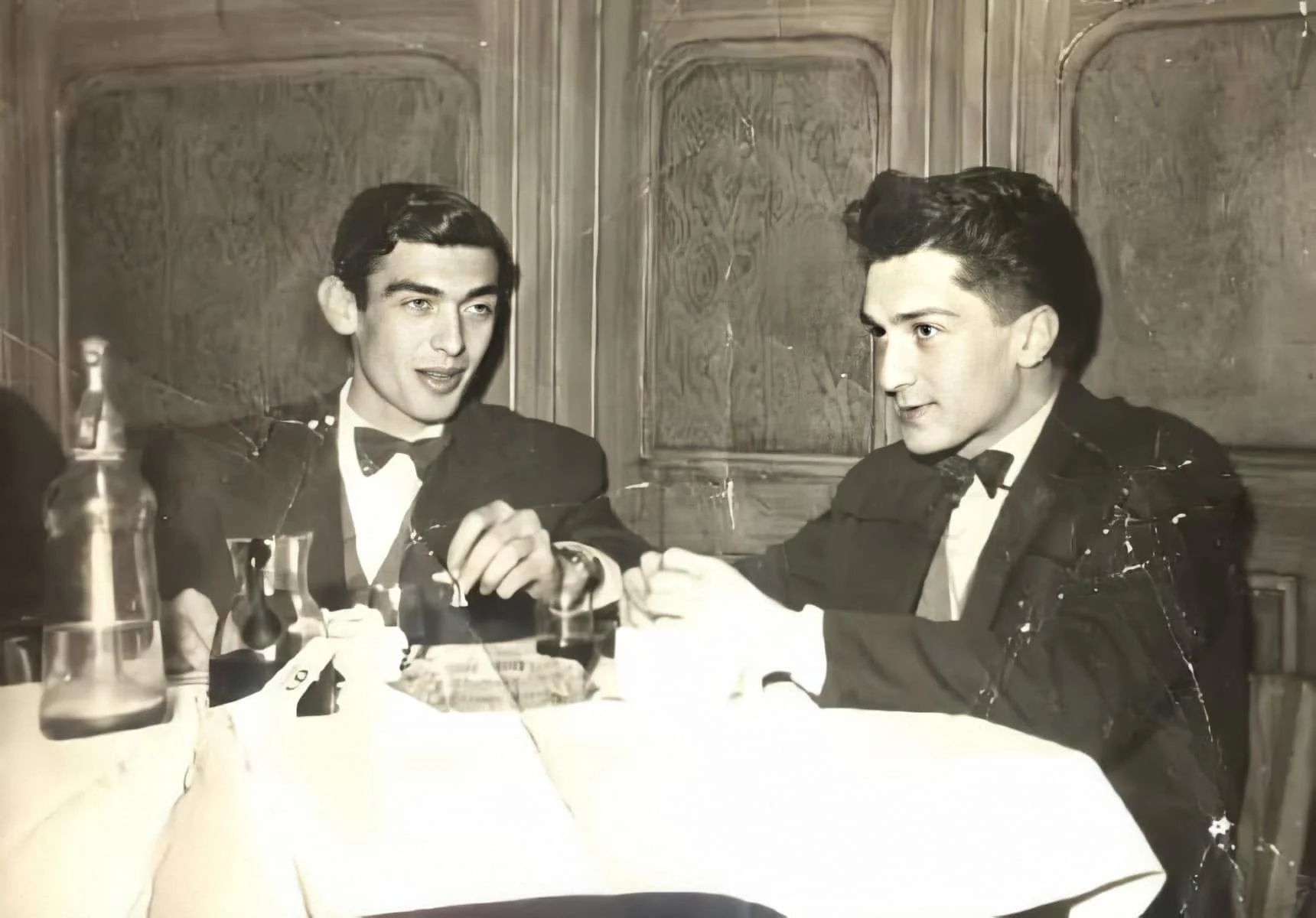
Peja, 1960s. Besim Sahatçiu and Seit Lipa sit together at a table. Two educated men from the same Kosovan city, one a filmmaker, the other a historian.
They couldn't have known where their families' stories would go next.
Decades later, as life in Kosovo became increasingly difficult, both families would build new lives in Britain. And another generation later, their granddaughters, Rita Ora and Dua Lipa, would become two of the world's most recognisable Albanian-British pop stars.
From Peja to London. From one generation to another.
Sometimes diaspora history fits inside a single photograph.
Work & money
Work, money and the trade that built the map
Nearly a third of Albania-born people in work in England and Wales work in construction. Of the 40,212 with an industry recorded at the 2021 census, 12,363 — 30.7 percent — were in construction, against 8.7 percent of everyone in work. It is the single most explanatory fact about this community’s geography, income and shape.
Everything else follows. 35.4 percent of Albania-born people in work are self-employed, against 16.6 percent of everyone in work — the sole-trader economy of the building trades. Just 1.68 percent are retired, against 21.65 percent of England and Wales aged 16 and over, because almost nobody in this population has been here long enough to be old here. Unemployment was 11.3 percent.
After construction, the next largest industries are food and beverage service (4,830), retail (3,204), health (1,822), education (1,787), cleaning and services to buildings (1,635), the motor trade (1,106) and personal services including barbering (705). Construction plus restaurants plus cleaning plus the car trade plus barbering is over half of all recorded Albanian employment — and it is also, precisely, the visible Albanian high street.
The money that goes home
Britain is a modest link in the remittance economy compared with Greece and Italy, and the page should not inflate it. The Bank of Albania’s remittances leaflet puts the UK at around 8 percent of remittances to Albania — an undated, 2018-vintage share and the weakest number here; applied to that year’s total it gives roughly €99 million.
For Kosovo the arithmetic can be done exactly: multiplying the Central Bank of Kosovo’s monthly remittance totals by its monthly country shares gives the UK €37.3 million in 2025, 2.64 percent of the total and tenth place — a derivation from two published tables rather than a published figure — a long way behind Germany and Switzerland, which is exactly what you would expect from a community that mostly took British citizenship and stayed.
The air bridge
The clearest measure of the connection is not money but seats. In 2015, 76,325 passengers flew between UK airports and Tirana. In 2025, 1,012,307 did — thirteen times as many in a decade, and past a million for the first time. Some of that is the British discovery of the Albanian riviera; the UK now imports £106 million of travel services from Albania a year, against total two-way trade of £373 million. But a large share of it is a diaspora that can now fly home for a long weekend, on a route that barely existed when most of them arrived.
Kosovo’s equivalent is smaller and stranger: 126,537 UK–Pristina passengers in 2025, 100 percent of them through London Luton — a whole country’s British air link running through one airport.
Italians & Greeks
The Albanians who arrived as Italians and Greeks
This is the part of the story that no British source tells, and it is the part that ties this story to Italy and Greece.
Between them, Italy and Greece naturalised roughly 480,000 Albanian citizens by the end of 2020 — 251,588 in Italy and 228,951 in Greece, on Eurostat’s count. Every one of those people became, at that moment, an EU citizen with the right to live and work in the United Kingdom. A decade of Albanians did exactly that, and Britain filed them as Italians and Greeks.
The census caught the tail of it. Of 68,673 Albania-born residents of England and Wales, 3,602 held an Italian passport and a further 15,434 held a passport recorded only as “other EU countries”. ONS itemises France, Germany, Italy, Portugal, Spain, Lithuania, Poland, Romania and Ireland separately — and does not itemise Greece. The individually named EU passports account for fewer than 1,400 of the remainder between them. The overwhelmingly probable source of those 15,434 documents is Greece, one of the countries that naturalised the most Albanians. That inference is an inference, and is labelled as one here; ONS has already told a member of the public, in a freedom-of-information response of 9 February 2023, that it cannot produce the table that would settle it.
Either way the arithmetic stands: 20,425 Albania-born residents of England and Wales — 29.7 percent — held an EU or Irish passport rather than a British or Albanian one. Add the 15,860 with British passports and more than half of all Albania-born residents of England and Wales were travelling on a document issued by somewhere other than Albania.
The control case proves it is real. Among Kosovo-born residents, EU passports of every kind total 521 people — 1.7 percent. Kosovars naturalised in Germany, Switzerland and Austria, and stayed there; the ones who came to Britain came in 1999 and became British. The diaspora-of-a-diaspora is an Albanian phenomenon, not an Albanian-and-Kosovar one, and a single census table demonstrates it.
The statistic that proves it, hiding in the EU Settlement Scheme
Then there is the number in the EU Settlement Scheme. Albanian nationals lodged 54,750 applications to the EU Settlement Scheme between August 2018 and March 2026 — as family members of EEA citizens, which in practice means the spouses, partners, parents and children of Albanians who had already become Italian or Greek. That makes Albania the fifth-largest non-EEA nationality in the entire scheme, behind only India, Pakistan, Brazil and Ghana, and ahead of Nigeria, Bangladesh and Ukraine.
A country of 2.8 million people, with no colonial or Commonwealth tie to Britain and no EEA membership, placed fifth in a scheme designed for the families of EU citizens. In 2021 alone, 5,177 Albanian nationals were issued a UK entry visa as the family member of an EEA citizen. The Albanian refusal rate in the scheme — 8,247 of 51,882 concluded applications, 15.9 percent — is four times the Italian rate, because proving a family relationship to an EEA sponsor is documentarily hard.
And 24,510 Albanian applications have been lodged since the start of 2022, six months after the scheme’s main deadline passed on 30 June 2021, as joining family members. Roughly 5,000 to 6,000 a year still come through that door.
What cannot be counted is the reverse case. The Home Office records nationality, not country of birth, in every one of these datasets; an Albania-born Italian citizen appears as “Italy”, inside a total of 775,343 Italian applications. There is no published route to counting them, and there never has been. Britain’s statistical system has a category for where you were born and a category for what passport you hold, and it has never crossed them anywhere except in the census — which is why the passport table above is the load-bearing evidence for this entire section.
Brexit closed the route. Nobody noticed, because the people using it were not on the statistics as Albanians. Anyone here as an EU citizen by 31 December 2020 could stay. Anyone who was not, could not. A migration channel that had run for a decade was ended by a date rather than by a policy about Albania — and the year after it closed, Albanian asylum claims went from 5,479 to 16,800.
Whether one caused the other is a hypothesis, not a finding, and this page will not assert it. But the sequence is exact.
2022
The year Albania became a British argument
For eight months in 2022 the word “Albanian” did more work in British politics than it had in the previous eighty years. This section sets out what happened, what was said, what the data actually shows, and what the independent bodies that examined it afterwards concluded. It does not adjudicate the politics. It does give every denominator.
What happened
Detected small-boat arrivals by Albanian nationals ran at 16 in 2018, 13 in 2019, 54 in 2020 and 815 in 2021. In 2022 the figure was 12,658 — the largest single nationality that year, ahead of Afghanistan, Iran and Iraq. Then it collapsed: 927 in 2023, 635 in 2024, 255 in 2025, and 9 in the first quarter of 2026.
Two corrections to the received version, both checkable. First, Albanians were 27.7 percent of small-boat arrivals in calendar 2022, not a third. The Prime Minister told the Commons on 13 December 2022 that “a third of all those arriving in small boats this year” were Albanian; the BBC pointed out at the time that the correct share was 28 percent on the figures then published. The “third” figure is a January-to-September number (34.7 percent). The true peak is narrower and higher than either: in the third quarter of 2022 alone, Albanians were 9,044 of 20,301 arrivals — 44.5 percent. Seventy-one percent of the whole year’s Albanian arrivals landed in those three months.
Second, small boats were never the whole Albanian route, and by 2025 they were not even the main one. Even at the 2022 peak, 4,010 Albanian asylum claimants — roughly a quarter — had entered clandestinely, in lorries, rather than by boat. In every year from 2018 to 2020, Albanians arriving as inadequately documented air passengers outnumbered Albanian boat arrivals by an order of magnitude — 515 to 54 in 2020. Boats first overtook air in 2021. By 2025 clandestine entry (930) exceeded small-boat entry (311) three to one. Those are asylum-claim records; the 255 above is the separate count of detected boat arrivals, and the two datasets never match exactly.
Who came: 11,020 men, 1,537 women and 101 unrecorded in 2022, and 1,756 children — 13.9 percent, one in seven. The Home Office’s own contemporaneous framing was that 77 percent were adult males. Both figures are true and they are different universes.
What was said
On 31 October 2022, in a Commons statement on the Manston processing centre, the Home Secretary Suella Braverman said the British people deserved to know which party was serious about stopping “the invasion on our southern coast”. (The remark is almost universally misquoted as “invasion of our southern coast”; Hansard says “on”.) In the same sitting, asked specifically about Albanians, she said that young single Albanian men were “either part of organised criminal gangs” or were coming to Britain and “partaking in criminal activity, particularly related to drugs”. She also told MPs that Albania was “not a war-torn country”, and that it was difficult to see how asylum claims from it could be legitimate.
Three weeks later, giving evidence to the Home Affairs Committee, she drew a line the coverage largely lost: the government valued its relationship with “the Albanian community in the United Kingdom” and continued to welcome Albanians who came legally and contributed to British society.
On 13 December 2022, Rishi Sunak devoted a Commons statement to the subject and signed two joint communiqués with Tirana the same afternoon. He announced Border Force officers embedded at Tirana airport for the first time, new caseworker guidance stating Albania was safe, a higher evidential threshold for modern-slavery claims, formal assurances from Albania on returning victims, and a 400-strong unit to clear the Albanian caseload. He promised that “thousands of Albanians will be returned home”, with weekly flights until the backlog was cleared. Theresa May, the author of the Modern Slavery Act 2015, intervened in the same statement to warn that people smuggling and human trafficking are separate crimes and should not be spoken of as one.
Here is a correction worth making, because it is repeated everywhere: Albania was not “declared a safe country” in December 2022. It has been a designated state under section 94(4) of the Nationality, Immigration and Asylum Act 2002 since 1 April 2003. Nineteen years of safe-country designation preceded the crisis. What was new in December 2022 was the operational push; what was new in September 2023 was section 80AA, inserted by the Illegal Migration Act, which lists the states whose protection claims are inadmissible — on the statute book, though the inadmissibility provisions were never fully brought into force. Albania is the first name on that list and the only state on it outside the EU, the EEA and Switzerland. In British statute, Albania sits inside a club of which it is not yet a member.
The government’s case was not only rhetorical. Dan O’Mahoney, then Clandestine Channel Threat Commander, told the Home Affairs Committee on 26 October 2022 that the rise was “in the main due to the fact that Albanian criminal gangs have gained a foothold in the north of France”, and that intelligence showed flights leaving Albania for Belgium whose passengers went straight to the French coast. In the same session he described a quite different pattern in the same population: “They work illegally in the UK for maybe six months or a year, they send the money home, and then they go back.”
The response
Albania’s Prime Minister Edi Rama replied on 2 November 2022 that Albanians in the UK “work hard and pay tax” and that Britain should fight criminal gangs of every nationality rather than discriminate against Albanians to excuse policy failures. Albanians demonstrated in London that month carrying placards reading “Braverman, you can be a criminal, we can’t”. On 17 January 2023 the Albanian government summoned the British ambassador, Alastair King-Smith, over a Home Office promotional video about detaining Albanian criminals; Reuters reported the protest note in terms of the “language of hatred”.
The Albanian ambassador in London, Qirjako Qirko, told the Home Affairs Committee on 7 December 2022 that he detected a “campaign of discrimination” and that “there are youngsters especially who are bullied at school just because they are Albanian.” Asked who Albanians in Britain were, he answered that they included “doctors, lawyers, engineers and labourers of all sorts, paying taxes”. Esme Madill, a solicitor working with young Albanian trafficking victims, told the same Committee in written evidence that the rhetoric caused the children she represented to experience discrimination and racism daily at college and when applying for jobs.
None of that is measured. Hate-crime statistics for England and Wales monitor race, religion, sexual orientation, disability and transgender identity; there is no Albanian category, and Albanians are not separately identifiable in the series. Any claim of a measured rise in anti-Albanian hate crime in 2022 is unsupportable from official statistics — in either direction.
What the independent bodies found
The Home Affairs Committee reported on 12 June 2023, having visited Albania in March. Its central conclusion is worth quoting in both halves, because it is regularly quoted in one. On the one hand: Albania is not the cause of the UK’s migration problems and “should not be singled out as such or scapegoated for home-grown failure” to process claims and remove people quickly. On the other, in the same paragraph: the number of Albanians crossing the Channel “unquestionably contributed to the overwhelming of the asylum system”, and particularly to the overcrowding at Manston. The Committee also found that Albania was safe and that it saw no reason for the UK routinely to accept Albanian asylum claims — while insisting there were unquestionably real trafficking cases requiring safeguards.
On why it happened, the Committee opened by saying it was not clear, and listed five candidate explanations without choosing. Its most striking piece of evidence came from Kukës, Albania’s poorest county and the one with the deepest UK family chains: a Swiss Contact survey of 1,800 households found that 35 percent of respondents wanted to migrate, and of those 59 percent wanted to go to Britain; separately, 42 percent of all respondents strongly agreed that young people in their community had no option but to leave by any means possible. The geography of Albanian emigration is a map of where earlier generations went — the north to Britain and northern Europe, the south to Greece and Italy. It is why these pages describe different countries and the same family.
Then there is the document almost nobody has read. In February 2024 the Independent Chief Inspector of Borders and Immigration, David Neal, published an inspection of asylum casework covering June to October 2023. It revealed Operation BRIDORA — the Home Office operation set up in December 2022 to clear a starting caseload of 12,543 Albanian claims. The legacy backlog had been split into three named operations: AMESA for the high-grant nationalities (14,563 claims), MAKHU for everyone else (58,252), and BRIDORA for Albanians alone. Albanians were the only single nationality given an operation of their own. Between February and May 2023, all but two decision-making units were assigned to it, and most managers told inspectors it was a bad decision that cost quality and productivity elsewhere.
The inspection found that decision-makers were told they were “no longer authorised to implement any grants for Albanians”, even where the decision had already been written. When inspectors asked managers why, they were told that a decision had been taken at ministerial level that “no more than 2% of Albanian claims should be successful.” One caseworker described the rewriting of the country guidance in a single sentence: “suddenly we are sending trafficked women back.” The country information team said it had not been directly told to amend the guidance but had found the indirect pressure hard to avoid.
The government’s published response to the Committee, in September 2023, made its counter-argument in statistical form: 84 percent of outcomes on Albanian claims in the year to March 2023 were withdrawals, against 18 percent for all other nationalities combined, and counting withdrawals in the denominator drops the Albanian grant rate for that year from 34 percent to 5 percent — against a fall from 76 to 63 percent for everyone else. There is no single Albanian grant rate. There are at least five, and which one you quote is an argument rather than a fact.
The operation’s own outcomes, between 9 January and 12 November 2023: 15,955 decisions — 9,863 withdrawals (61.8 percent), 4,549 refusals, 498 grants (3.1 percent). Nine in ten of those withdrawals were implicit: the claimant had stopped reporting or absconded. Ministers read that as claims abandoned because they were false. Dr Peter Walsh of the Migration Observatory told the Committee that the Albanian withdrawal rate was about twice the average, and that “it does not say why they are absconding” — trafficking being one of the reasons thought to be involved. The data cannot distinguish the two. And against the promise of weekly flights until the backlog was gone, 245 people from that cohort had been removed by 13 November 2023. The Home Office’s answer is a wider universe: 6,458 Albanian nationals were returned from the UK in 2023 by all routes, second only to Romania. Both numbers are correct; they count different things. Neal was dismissed as Chief Inspector on 20 February 2024, nine days before the report was published and a month before his term was due to expire.
And the same people, in the other column
Here is the fact that has to sit in the same section. In 2022 — the year ministers described Albanians as criminals — Albanians were the largest single group of identified potential victims of modern slavery in the United Kingdom. There were 4,613 referrals to the National Referral Mechanism, 27.2 percent of the national total, ahead of UK nationals. Albania was the most-referred non-UK nationality every year from 2018 to 2024.
Among the 2022 small-boat cohort specifically, 3,188 of 12,652 Albanian arrivals were referred to the NRM — 25.2 percent, against 12.9 percent for all nationalities (12,652 is the NRM-linked extract of the same dataset that gives 12,658 above). Albanians alone were 54.3 percent of every modern-slavery referral arising from that year’s crossings. Of those referrals that reached a conclusive-grounds decision, 516 people were found, after full investigation by the British state, to be victims of modern slavery — more than the 498 grants of leave made in the ten months the inspector examined. Only 516 of the 1,548 conclusive-grounds decisions in that cohort were positive — 33.3 percent, against an all-nationality positive rate near 89 percent in the same year — and they were taken in the months when a ministerial grant ceiling was being described to inspectors and the Albania trafficking guidance was rewritten. Whether those things are connected is not something the data can settle. Both are true.
Ministers argued that late referrals into the modern-slavery system were abuse. Dame Sara Thornton, the former Independent Anti-Slavery Commissioner, told the Committee that “the fact that disclosure is late does not in my view mean that it is unreliable” — while conceding, in the same session, that a slow asylum system gives people the opportunity to come and then disappear.
The referral pattern also breaks the familiar framing. Albanian men were referred into the modern-slavery system at essentially the same rate as Albanian women (25.5 percent against 23.8 percent among the 2022 boat cohort), and the Albanian NRM profile is not primarily sexual exploitation: 64.5 percent of 2022 referrals involved labour exploitation and 44.8 percent criminal exploitation. Dr Andi Hoxhaj, then of UCL and now chair of the Anglo-Albanian Association, described the mechanism to the Committee: young men from areas of extreme rural poverty offered “a free ride to the UK in exchange for employment in cannabis farming or other illegal and criminal activities” for twelve to eighteen months. The crossing is the loan; the cannabis farm is the repayment. As Esme Madill put it, someone can leave for economic reasons, fall into debt bondage, and become a trafficking victim on arrival.
The courts have had to hold both things at once. In R v BEP [2022] EWCA Crim 1881, decided four days after Braverman’s Commons statement, the Court of Appeal considered an Albanian man convicted of producing cannabis whom the Single Competent Authority had already conclusively found to be a victim of modern slavery. The Court accepted he would have had a real prospect of the statutory defence — and refused to quash the conviction, because the defence does not arise automatically from being trafficked and he had pleaded guilty on advice. An Albanian man officially recognised by the British state as a slavery victim, and lawfully a convicted cannabis producer. The case resists both of the simple stories.
Where it ended
By 2025 Albanians were 0.6 percent of small-boat arrivals and seventeenth among asylum-claiming nationalities, down from first in 2022 — the most dramatic ranking movement of any nationality in the series. Sunak and Rama repaired the relationship at a bilateral in March 2023.
The argument has not gone away. In April 2026 the current Albanian ambassador, Uran Ferizi, told the Guardian that Albanians in the UK were being scapegoated by parts of the media and by politicians; two weeks earlier the Telegraph had run the conviction figures under the headline “One Albanian migrant jailed every two days”. On the causal question at the centre of it all, the Migration Observatory’s reading is that arrivals had already fallen sharply before the December 2022 agreement, which therefore “likely maintains low numbers rather than causing the initial collapse.” The quarterly data supports the timing: 9,044 in the third quarter of 2022, 1,185 in the fourth, and the deal signed on 13 December.
Visas
Why Albanians still need a visa for Britain
Here is an asymmetry that shapes daily life for every family in this story and is almost never stated. Albanians have travelled visa-free to the Schengen area since December 2010. Kosovans have since 1 January 2024. Both still need a visa to visit the United Kingdom — for a wedding, a funeral, a graduation or a fortnight with a grandchild.
The Home Office data shows what that costs. In 2025 the UK issued 23,338 visitor visas to Albanian nationals and refused 9,012 — a refusal rate of 27.9 percent, against a world average of 20.8 percent. In 2023, in the direct policy echo of the small-boat year, 47.9 percent of Albanian visitor-visa applications were refused: 18,233 refusals against 19,869 issues, the highest rate in the twenty-one-year series. Kosovo’s rate is consistently lower than Albania’s and still well above average: 24.7 percent in 2025.
The Committee heard the practical consequence more than once: a UK visit visa cost roughly $280 for up to 180 days, and Albanians told MPs repeatedly that it was off-putting — while a Channel crossing was routinely priced at £3,000 to £5,000. It is not a comfortable juxtaposition, and it belongs in any honest account of the routes into Britain.
The work channel opened briefly and shut again. Albanian work visas rose from 112 in 2019 to 873 in 2023, almost all of them skilled-worker and health-and-care routes after Brexit, then fell to 224 in 2025 as the rules tightened — with a refusal rate that has climbed to 39.8 percent, the highest in the series. Study visas peaked at 755 in 2022 and were 269 in 2025.
Meanwhile the settled community keeps settling. British citizenship grants to Albanian nationals reached 2,609 in 2024 and 2,931 in 2025, the highest ever recorded, and applications hit 4,079 in 2025 — 55 percent above the previous year, and a number that will feed the grant figures for years. Registration, the route used mostly for children born in the UK to Albanian parents, has grown from 12 percent of grants in 2013 to 42 percent in 2025. Settlement grants reached 2,301 in 2025, nearly six in ten of them (1,350) through the refugee and protection route — the 2016–2020 cohort reaching its five years.
That is the quiet counter-story to 2022, and it is bigger: while the argument was going on, the community was naturalising faster than it ever had.
Language & faith
What language and religion do Albanians in the UK have?
52,328 people in England and Wales gave Albanian as their main language at the 2021 census — up 61 percent from 32,425 in 2011. That makes Albanian the most-spoken non-EU European language in England and Wales by a wide margin.
It is 70 percent of that entire category, more than Ukrainian and every other non-EU European language put together, and nearly three times the combined total for Bosnian, Croatian, Serbian and Montenegrin. Enfield has more Albanian speakers than any other local authority: 3,508. Northern Ireland has 86.
The language figure is arguably the best single proxy for the ethnic community, because unlike country of birth it catches Albanians from Kosovo and North Macedonia in one number. It also has a floor built into it: anyone whose main language is now English drops out, which is why 30.5 percent of Albania-born and 54.0 percent of Kosovo-born residents are not in it.
Saturday schools, and no GCSE
Nobody teaches Albanian in a British state school as a curriculum subject, and Albanian is not available as a GCSE or an A-level anywhere in the United Kingdom. It was never withdrawn; it was never offered. The government’s position, given verbatim in a petition rejection of 16 January 2023, is that it is for schools to decide what languages to teach and for exam boards to judge whether demand is sufficient.
There was a real push. Petition 615921, “Introduce Albanian language as a GCSE and A Level”, ran from May to November 2022 and collected 1,916 signatures — short of the 10,000 needed for a government response. Two later attempts collected seven signatures each. But the 2022 petition left behind something more useful than a result: a signature map. Signatures were recorded in 330 of 650 constituencies, led by Chipping Barnet (68), Enfield Southgate (61), Hampstead & Kilburn (55), Edmonton (42) and Hendon (42) — independently reproducing the census geography, from a completely different dataset.
What exists instead is a volunteer network. The oldest is Shkolla Shqipe “Kosova”, founded on 3 October 1993 by Talat Pllana and a group of parents, which began in Westminster and Camden and now runs at Haverstock School near Chalk Farm — thirty-plus years, more than thirty teachers, no state funding, and a curriculum taken from Kosovo’s education ministry. Around it: Shpresa’s schools across five east and north London boroughs; Ardhmëria, which runs five schools in Greater London; Nënë Tereza in Edmonton; Gjurmë Iliriane in Richmond; Arbëria in Edmonton; and the Faik Konica association’s mother-tongue classes in Chelsea. A new school opened in Bexleyheath on 6 October 2024. At its opening, Albania’s Minister of State Taulant Balla claimed that “over 7,000 pupils learn Albanian in Great Britain” — a government figure with no published school list or method behind it, and the only national estimate in existence. Treat it as a claim, not a count.
Since 2018, Albania and Kosovo have run a joint diaspora curriculum and supply the textbooks. Britain’s contribution is UCL SSEES, which has offered Albanian evening courses including one aimed specifically at heritage speakers — people who grew up speaking the language at home with little formal schooling in it. The institutional history there is deep: Stuart Mann was Reader in Czech and Albanian at SSEES from 1947 to 1972 and wrote the Historical Albanian–English Dictionary (London, 1948); the Mann Collection sits in the SSEES library in Bloomsbury.
Three faiths and no single institution
Albanian religious pluralism is proverbial, and Britain shows it in an unusual form: there is no Albanian church, and the mosques are the only substantial buildings.
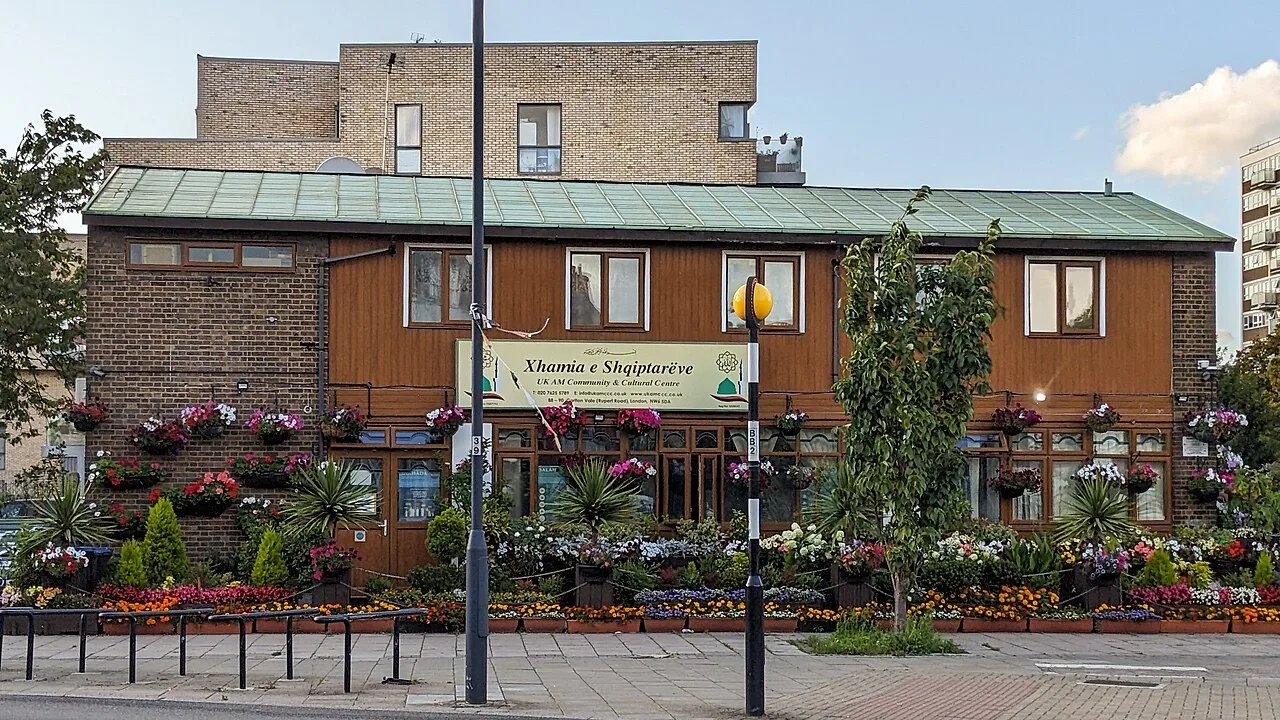
The UK Albanian Muslim Community and Cultural Centre — Xhamia e Shqiptarëve, the Albanians’ mosque — was founded in 1994 as the Kosova Islamic Centre and registered as a charity in 1996. It stands on the corner of Carlton Vale and Canterbury Road, on the Brent side of the Brent–Camden–Westminster boundary, and it is by a distance the largest Albanian religious institution in Britain, with an income of £246,729 in the year to July 2025. It runs the five daily prayers, classes, marriages, funerals, and distributes Qur’ans and prayer timetables in Albanian. A thirteen-storey purpose-built replacement is proposed for the site. The current building is the former Shamrock pub — which is, if you want one image for how immigrant London works, probably the image.
Three more Albanian Muslim charities operate in London and one in Leicester — five on the register in all — including a new one registered in Walthamstow in April 2025. The institutional build-out is still going. The British Albanian Muslim Community in West Hampstead writes participation in the Camden Faith Leaders’ Forum and “moderation in religion” into its own charity objects.
Catholics have a chaplaincy rather than a church: the Albanian and Kosovan Catholic chaplaincy under Fr Gary Walsh, based at St Charles Borromeo, 8 Ogle Street, W1. There is no Albanian Catholic parish building in the UK — a contrast with the United States, which has purpose-built ones. No Albanian Orthodox parish and no Bektashi tekke were identified anywhere in Britain. Where Albanian Orthodox families in Britain worship is not documented; the likeliest answer is the Greek Orthodox parishes of the Archdiocese of Thyateira, but nobody has established it. That absence distinguishes the UK from the US, Germany and Austria, and it is worth stating plainly rather than glossing.
The generation being born here
The second generation is measured sideways, through birth registrations, and it is now large. Albania entered the top ten countries of birth of non-UK-born mothers in England and Wales in 2021 and has stayed there, peaking at seventh in 2023 with 3,891 births. Across 2021 to 2025 there were 17,800 babies born to Albania-born mothers and 20,011 to Albania-born fathers. In 2023, roughly one baby in every 152 born in England and Wales had an Albania-born mother.
Put that next to the past and the scale lands: more children were born to Albanian mothers in England and Wales in five years than the entire Albania-born population of Britain in 2011. Albania alone accounts for 29 percent of every birth ONS files under “Rest of Europe” — a grouping that also contains Turkey, Ukraine, Russia and the whole of the former Yugoslavia. The ONS’s own categories conceal the story its own data contains.
There is one measured school count, and it is the strongest evidence on this page that the community is settled rather than newly arrived. In the spring of 2018 the Department for Education recorded 16,255 pupils in England’s state schools whose first language was Albanian — and only 10 percent of them had arrived after reception. That is the lowest late-arrival rate of any European language in the table: 52 percent of Romanian speakers, 47 percent of Bulgarian and 58 percent of Italian had joined an English school later. Nine in ten Albanian-speaking pupils had entered the English school system by reception age. On English proficiency the same table puts them at 38 percent fluent, ahead of Polish, Romanian, Turkish, Arabic, Portuguese and Urdu speakers.
The school figure is corroborating evidence, not an extra 16,255 people to add to the census. It includes both UK-born and foreign-born pupils, and the published table does not separate them; “arrived after reception” records when a child entered the English school system, not where that child was born. The count proves that a large Albanian-speaking generation was already in English classrooms in 2018. It cannot, by itself, say how many of them sit outside the country-of-birth total.
The DfE has not published the figure since. Its regular statistics record only whether a pupil’s first language is English, not English, or unknown — so there is no current, local-authority-level count of Albanian-speaking pupils anywhere in the public domain, and getting one would take a freedom-of-information request against the National Pupil Database.
Nobody has measured Albanian language retention in Britain either. There is a good study of it in Athens and none here; any claim about how well British-born Albanians keep the language is currently unevidenced, and this page is not going to invent one.
Institutions
The organisations that hold Albanian Britain together
The registered UK-Albanian community charity sector in England and Wales comprises twenty-one bodies; the seventeen that have filed accounts have a combined annual income of about £1.2 million. One organisation is 44 percent of it.
Shpresa Programme
Shpresa means hope. The charity was founded in 2002–03 by Luljeta “Luli” Nuzi, who had arrived in London from Albania in 1999 and claimed asylum with her family; a community consultation was held on 28 November 2002 — Albanian Flag Day — the company was incorporated on 11 March 2003, and charity registration followed in August 2005. It started in a converted storage room at the Froud Centre in Newham and now works from Mansfield House in Plaistow, across Newham, Barking and Dagenham, Redbridge, Enfield and Haringey, and since March 2020 describes itself as working UK-wide. Income in the year to March 2025 was £531,884; it reports serving between 2,000 and 5,000 people a year.
Its programme list is a fair description of what a diaspora actually needs: advice and advocacy, Albanian schools, Breaking the Chains (an anti-trafficking legal project run jointly with the Migrant & Refugee Children’s Legal Unit at Islington Law Centre, which also trains young Albanians as “Immigration Champions”), Empower Women, a befriending project, parenting programmes and a leadership programme. It joined Citizens UK around 2004 through an investigation into conditions at the Lunar House immigration centre, and Nuzi went on to co-chair East London Citizens.
She died of cancer on 12 February 2025. Officials of both the Albanian and the Kosovan embassies spoke at her memorial. There is a postscript that has to be recorded carefully, because every secondary source has it wrong: an MBE for services to the Albanian community was gazetted in her name in the King’s Birthday Honours of June 2025, four months after her death, and the Central Chancery struck the entry as printed in error in May 2026 — British honours are not conferred posthumously. She was not awarded an MBE, and she was not denied one; a notice was published and then withdrawn.
The rest of the register
Below Shpresa, the sector is small, local and mostly educational. Ardhmëria in Charlton (five London schools; income up 6.5-fold in five years to £106,952); Nënë Tereza in Edmonton (£108,690); Firdeus UK in Chingford, a humanitarian charity founded in 2020 — the clearest sign of a community that has moved from receiving aid to sending it; Gjurmë Iliriane in Richmond, the only charity on the register whose objects are solely an Albanian supplementary school; the Albanian Community “Faik Konica” in Chelsea, registered in 1999 and still running on almost nothing; the British Albanian Kosovar Council, registered in December 1998, in the middle of the Kosovo crisis, and now effectively volunteer-run; the Centre for Albanian Studies in SW10, the small imprint that has published much of the English-language Albanian documentary record; and, newest, the UKAP Foundation (2025), a professionals’ body running mentoring and scholarships.
Outside London: the Albania UK Charity in Manchester, Manchester Aid to Kosovo (registered 2001), an Albanian Cultural Association in Northampton (2025), an Albanian Midlands Muslim Community in Leicester (2023) — and, in Scotland, AlbScott, registered with the Scottish charity regulator in 2012 and based at the Garnethill Multicultural Centre in Glasgow, currently overdue on its filings. The Midlands Ethnic Albanian Foundation, registered in Birmingham in 2000, has filed nil income and appears dormant, which leaves the West Midlands conurbation — 3,100 people — with no funded Albanian community organisation at all.
There is also a graveyard. Twenty-seven Albania- and Kosovo-named charities have been removed from the England and Wales register since 1995, almost all of them registered in the emergency wave of 1992–2001 and wound up in the 2000s and 2010s: Kosova Aid, Task Force Albania, the Albanian Medical Trust, 999 to Albania (East Anglia), the Westmorland Albanian Appeal, Devon Aid to Albania and Macedonia. The 1990s produced British charities pointed at the Balkans. The 2000s onwards produced Albanian charities pointed at Britain. That inversion is the whole story of the community’s first thirty years, written in the charity register.
And the oldest body of all
The Anglo-Albanian Association traces itself to the Albanian Committee founded by Aubrey Herbert in 1912 or 1913 (its own site says 1912; Wikipedia says 1913 — both are in circulation). Edith Durham was an early secretary. It became the Anglo-Albanian Society in 1918. It is still running in 2026, publishes the Gazette three times a year, runs talks, book launches and film screenings, and held a Scanderbeg symposium with Pembroke College, Cambridge.
Its current officers make the point better than any paragraph could. The President is Sir Noel Malcolm, the All Souls historian who wrote Kosovo: A Short History — a book that remains contested in the field and should be described that way. One Vice-President is Dr James Hickson, Edith Durham’s great-nephew; the other is Stephen Nash CMG, a former British ambassador to Albania. The Chair is Dr Andi Hoxhaj OBE, an Albanian-born legal academic at King’s College London who was appointed OBE in the 2024 New Year Honours for services to UK–Albania relations, contributed to the 2022 joint communiqué and gave the Home Affairs Committee the evidence quoted earlier.
Two national days, two different countries
28 November, Albanian Flag Day, is a street festival. Trafalgar Square is the gathering point, and it has been large enough for the Metropolitan Police to issue a dispersal order after cars blocked the roads and fireworks went up. The institutional version runs in parallel and looks nothing like it: Shpresa stages a two-week programme across London libraries, town halls and school halls — Gascoigne School, Barking Town Hall, Stratford Library, Forest Gate Library — with children’s poetry, dance and speeches on domestic violence, employment and immigration law, attended by officials of both embassies and the local mayor. Barking and Dagenham council marked the 107th anniversary officially in 2019.
17 February, Kosovo Independence Day, is an embassy occasion: receptions at the Royal Horseguards, the diplomatic corps, speeches by the Kosovan ambassador Ilir Kapiti. Mass on one day, elite on the other; Trafalgar Square and a Whitehall hotel. The two national identities are performed in Britain in visibly different registers, and that difference maps exactly onto the two migrations.
The Albanian embassy is at 33 St George’s Drive, Pimlico, under Ambassador Uran Ferizi, accredited to the UK and Ireland; Kosovo’s is at 8 John Street, Bloomsbury. Neither publishes an estimate of the community’s size. An Albanian government figure of “about 50,000” circulates — lower than the census count of Albania-born residents of England alone, and it cannot be right.
And once every couple of years there is the other national gathering. England have played Albania at Wembley twice recently — 12 November 2021 and 21 March 2025, the latter with an official attendance of 82,378 — and Kosovo at St Mary’s, Southampton, on 10 September 2019 in front of 30,155. Albanian outlets reported the away allocation for the 2025 Wembley match sold out and that Albanian fans were in every corner of the ground. That is a partisan pre-match claim rather than a measurement, and the official away allocation was never published; but anyone who was there will tell you the same thing.
People
From Faik Konica’s Islington to Dua Lipa
A warning before the list. Almost every “famous Albanians” page a British reader will meet is contaminated by Albanian-Americans: Bebe Rexha, Ava Max, Eliza Dushku, the Belushi brothers, Action Bronson. None of them has anything to do with Britain. Everyone below has a documented Albanian origin and a substantive UK connection, and where a claim is thin it says so.
_(53836769052)_(cropped).jpg)
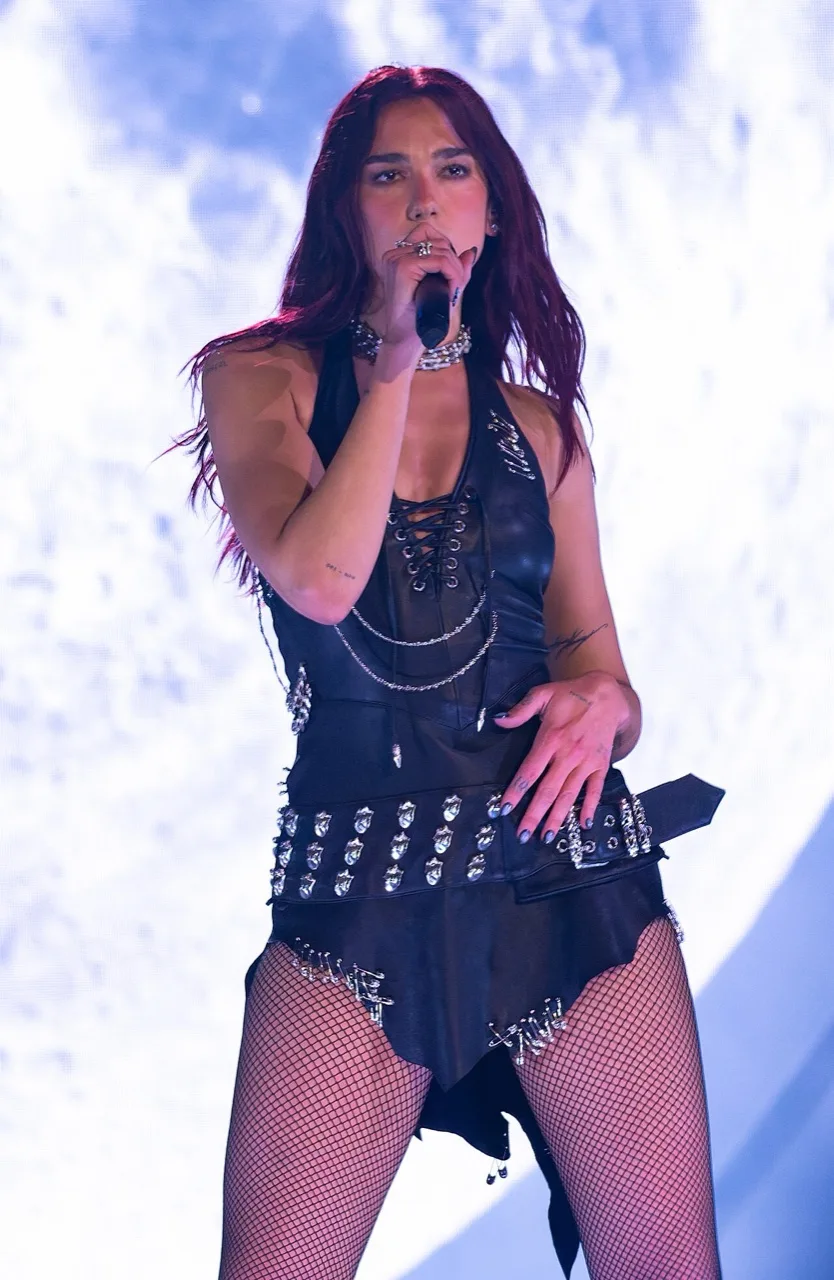
Dua Lipa
Singer · born London, 1995
Dua Lipa was born in London on 22 August 1995, the eldest child of Anesa and Dukagjin Lipa, Kosovo Albanians from Pristina. The family moved back to Pristina in 2008, the year Kosovo declared independence; she returned to London alone at fifteen. She was made an Honorary Ambassador of Kosovo in August 2022, granted Albanian citizenship that November and Kosovan citizenship by presidential decree in 2025 — three passports, in the order London, Tirana, Pristina. Since 2018 she and her father have run the Sunny Hill Festival in Pristina, which funds the Sunny Hill Foundation. Her father fronted the Kosovar rock band ODA before he managed her: a Pristina rock singer whose daughter headlines Glastonbury.
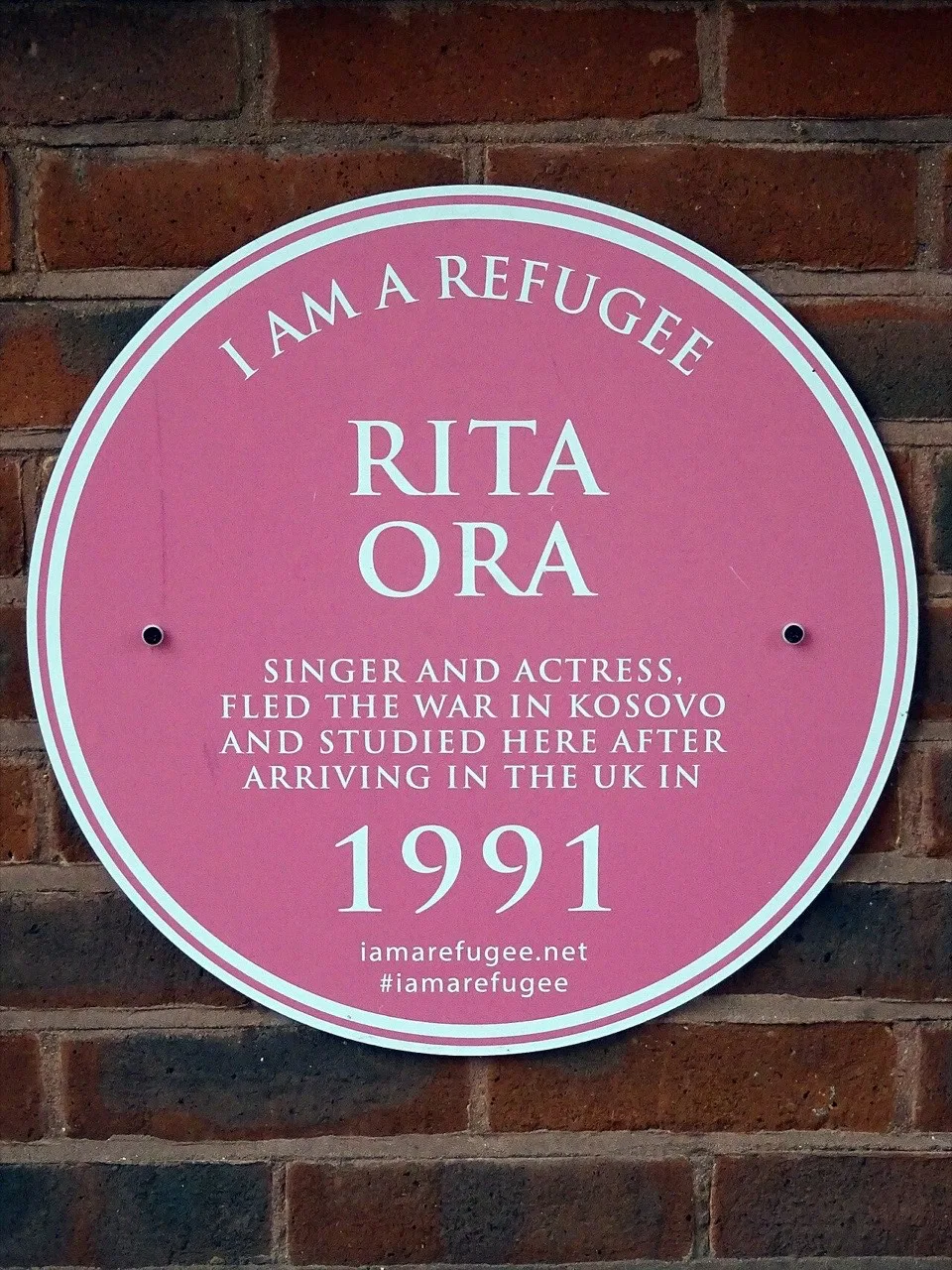

Rita Ora
Singer · born Pristina, 1990
Rita Ora was born Rita Sahatçiu in Pristina on 26 November 1990. Her family fled to London in 1991, when she was one — her mother Vera a psychiatrist, her father Besnik a pub owner who had studied economics. Her paternal grandfather, Besim Sahatçiu, was a Kosovar film and theatre director. She was named an Honorary Ambassador of Kosovo in July 2015. And on the wall of her old primary school in Earls Court there is a red plaque, unveiled in 2016, which reads that she fled the war in Kosovo and studied here after arriving in the UK in 1991. It compresses two things seven years apart: the family left Pristina in 1991, in the grinding decade of dismissals and revoked autonomy that preceded the war, not during it. The plaque has the feeling right and the chronology wrong, which is its own kind of summary of this subject.
The footballers Britain trained and Albania picked
This is the most under-reported storyline in the community. Albania’s squads now routinely contain players born in English hospitals and made in English academies.
Armando Broja was born in Slough on 10 September 2001 to parents from Koplik in the far north of Albania, joined Tottenham’s academy at six and Chelsea’s at eight, was eligible for England — and chose Albania. Anis Mehmeti was born in London in 2001 and plays for Albania and Ipswich Town. Maldini Kacurri was born in Lewisham in 2005, came through Arsenal’s academy, and made his senior Albania debut away to Gibraltar. Adrion Pajaziti, London-born in 2002, joined Fulham’s academy at twelve, played twice for Kosovo’s under-21s and then switched to Albania. A dozen or so more English-born professionals of Albanian origin now play across the EFL and non-League, and several are capped by Kosovo instead.
The most instructive career belongs to a woman. Elizabeta Ejupi was born in Kosovo and raised in England, played for England at youth level, was capped by Albania as a full international while still a teenager, and, on the account carried in her Wikipedia entry and repeated in match reporting, sought to switch to Kosovo in 2021 in a move that stalled on documentation. That last step is thinly sourced, and no federation statement confirms it. One player, three federations, and the paperwork of a country that has only existed since 2008.
Before all of them there was Rudi Vata, the first Albanian to play for a British club. Celtic signed him in the summer of 1992 and he made his debut at Dundee on 3 October, going on to win the 1995 Scottish Cup. His route out of Albania he has told himself many times: playing for the national team at the Parc des Princes in March 1991, he feigned injury, changed, walked to a Paris police station and claimed political asylum. His son Rocco Vata, born in Glasgow in 2005, was eligible for Albania, Scotland, Montenegro and Ireland — and plays for the Republic of Ireland. Lorik Cana, born in Pristina, joined Sunderland in 2009 as by most accounts the first Albanian in the Premier League, and was made captain. And Elvisi Dusha, born in London in 1994, plays basketball for Albania and was named a British Basketball League player of the month in the 2022–23 season.
The ones who work in libraries
Lea Ypi holds the Ralph Miliband Chair in Politics and Philosophy at the LSE. Her memoir of growing up at the end of Albanian communism, Free (2021), has been translated into nineteen languages and won the RSL Ondaatje Prize. She is, by a distance, the most decorated Albanian intellectual in Britain.
Dr Gëzim Alpion has taught sociology at the University of Birmingham since 2002 and is the leading scholarly authority on Mother Teresa’s Albanian identity; the Albanian Prime Minister conferred the Nation’s Ambassador Award on him in 2019, which his own university announced. Dr Andi Hoxhaj OBE teaches law at King’s College London and chairs the Anglo-Albanian Association. Arsime Demjaha, born in Kosovo, is an honorary clinical lecturer at the Institute of Psychiatry, Psychology and Neuroscience at King’s and treats patients with severe psychotic disorders at the South London and Maudsley. Bejtullah Destani, working from London, has assembled and edited more of the documentary record of Britain’s engagement with Albania than anyone — Edith Durham’s collected articles and letters, Tajar Zavalani’s history, and Aubrey Herbert’s diaries and papers.
Thomas Simaku, born in Kavajë in 1958, came to York for a doctorate in 1991 and is now Professor of Composition at the University of York. He won a British Composer Award in 2009 and first prize in the international competition for Lutosławski’s centenary in 2013, chosen from 160 entries from 37 countries. He is the most decorated Albanian-origin figure in British art music.
Two people belong here with a label attached, because they are not Albanian and it would be a category error to imply otherwise. John Hodgson, British, taught at the universities of Pristina and Tirana and translates Ismail Kadare from the Albanian — five novels, one of them shortlisted for the Man Booker International in 2017 — from London. And Sir Noel Malcolm writes the Albanian history from All Souls.
Screen, stage and the picture that travelled
Orli Shuka, a British-Albanian actor, plays Luan Dushaj, head of the Albanian family, in Sky Atlantic’s Gangs of London — which is, awkwardly, the largest mass-audience portrayal of Albanians ever made in Britain, and a crime drama.
The counterweight is a Kosovar artist working in London. Alketa Xhafa-Mripa’s installation Thinking of You hung 5,000 donated dresses across the pitch and terraces of Pristina’s main football stadium in June 2015, in solidarity with survivors of wartime sexual violence. Donors included Kosovo’s president Atifete Jahjaga, Rita Ora and Cherie Blair. The work formed part of the campaign that led Kosovo to amend its law on civilian victims of war to include survivors of sexual violence, and in 2024 the Mukwege Foundation recreated it in The Hague with garments from survivors in more than twenty countries. A London-based Kosovar’s artwork became an international protocol for commemorating wartime rape.
The oldest London Albanian, and the ceiling
In 1903–04, Faik Konica — the man who effectively invented modern Albanian prose — lived in Islington, at an address recorded as Oakley Crescent, and edited his review Albania from London, under the pen-name Trank Spiro Beg. It ran from London from 1902 until 1909 or 1910 — sources differ — and was the focal publication of Albanian writers abroad; Guillaume Apollinaire wrote a memoir of their London lunches, complaining that he never managed to see a single museum because the meals ran so long. A hundred and twenty years later there is a small Albanian community charity in Chelsea named after him, running mother-tongue classes on Saturdays.
And then the honest note to end on. This research found no Albanian-origin MP, peer, Member of the Scottish Parliament or Member of the Senedd — an absence rather than a verified nil, but a striking one. The political ceiling for British Albanians is currently the London borough council: Kastriot Berberi, an immigration lawyer, has been a Labour councillor for Forest ward in Waltham Forest for over a decade, joined in 2022 by Marsela Berberi. For a community of this size, thirty-five years in, that is a striking absence — and the second generation now reaching thirty is the cohort that will change it or not.
Meeting today
How Albanians in the UK connect today
So, where do Albanians in Britain actually meet each other?
For a long time, the answer was simple: through family, friends and the community around them. You met someone at a wedding. Your parents knew their parents. You went to the same mosque, the same Saturday school or the same Albanian event. Maybe you lived in the same neighbourhood. In many cases, you didn't need to look very far.
That is still true. But Britain’s Albanian community has grown far beyond a handful of neighbourhoods.
Today, about half of the community lives in London, with large numbers around Enfield, Barnet and Haringey. Others are spread across Oxford, Luton, Northampton, Sheffield, Bristol, Cardiff and cities in between. So what happens when the person you might actually connect with lives two hours away? Or in another city? Or even in another country?
This is where things have changed.
A younger Albanian growing up in Britain might speak English every day, have Albanian parents or grandparents, spend summers in Kosovo or Albania, and still feel very much part of the wider Albanian community. They might know the traditions, understand the jokes, speak the language at home and still have a life that looks completely different from their parents'.
And when it comes to relationships, that can make finding someone who gets it a little harder.
You are not necessarily looking for someone who simply lives nearby. You might want someone who understands your family, your culture, the language, the expectations — and maybe why your mum still wants to know where you are going even when you're 30.
That is part of the reason dua.com exists.
Albanians have always found one another through their networks. dua.com simply gives that network another place to live.
Instead of waiting for a cousin to make an introduction or hoping you meet someone at the next community event, you can meet Albanians who share your background wherever they are — across London and the rest of the UK, or back in Kosovo, Albania and elsewhere in the diaspora.
And there is something quite familiar about that.
The technology is new. The reason for looking for someone who understands where you come from is not.
For an Albanian community that has spent generations building connections far from home, dua.com is one more way those connections can happen.
dua.com for Albanians in Britain
Meet someone who understands your roots
Connect with Albanians across the UK and beyond.
Find someone who says «të dua»dua.com community data
Albanians in the UK on dua.com — by the numbers
The rest of this page relies on the ONS, the Home Office and academic research. The numbers below come from somewhere different: dua.com itself. They offer a glimpse of the Albanian community from the inside — who is connecting, where they live and how those connections cross borders.
There are more than 37,000 dua.com members in the UK, with more than 16,000 in London. That is strikingly close to the picture we see in the census: London is where the largest part of the Albanian community has settled.
But the numbers tell us more than where people live.
Of the members who have told us what they are looking for, 65 percent say they want a serious relationship, a partner or marriage. And among those who have answered about family plans, 75 percent say they want children.
In other words, for many people on the platform, this is not simply about meeting someone new. It is about finding someone to build something with.
The connections also don't stop at the UK border. Roughly 87 percent of recent matches have gone on to a conversation. Between April and late July 2026, more than 6,200 matches connected members in Britain with Albanians in Kosovo, Albania and North Macedonia.
And then there is Fly. London is the most-chosen destination, followed by Tirana and Pristina. It is a small detail, but an interesting one: even when people are living in Britain, their connections still stretch back to the places they or their families came from.
Put all of that together and a familiar picture emerges. The Albanian community in Britain may be rooted in British cities, but its relationships are still very much cross-border. dua.com is simply one place where those connections are happening today.
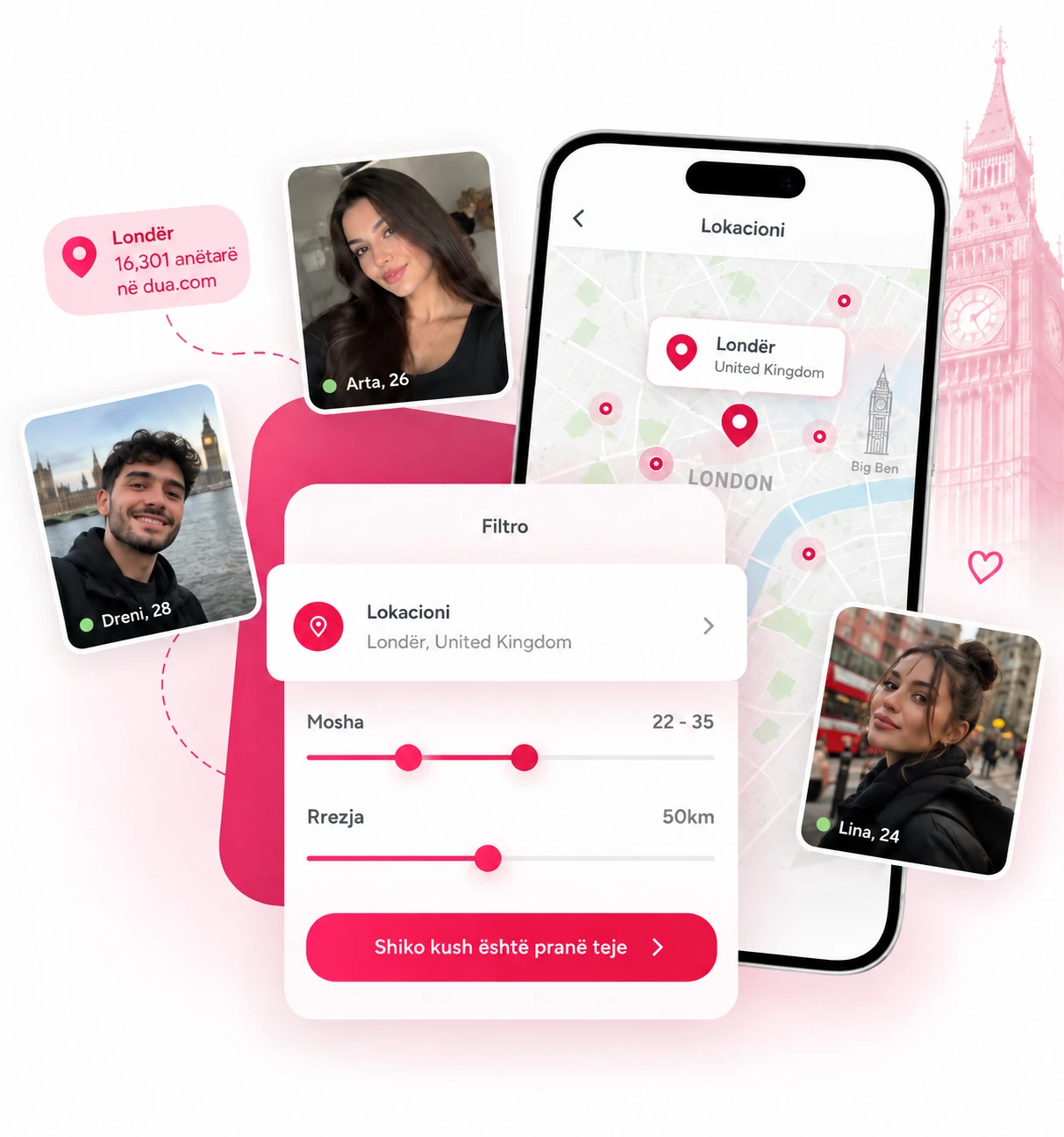
- Registered members in the UK
- 37,290
- Members in London
- 16,301
- Matches that go on to a conversation
- 87%
- Looking for a serious relationship, partner or marriage
- 65%
- Want children
- 75%
- Matches with Kosovo, Albania and North Macedonia
- 6,276
- Most-chosen Fly destinations
- London, Tirana, Pristina
dua.com internal data (dua_city_country_insights, July 2026). Percentages are shares of the members who answered the relevant profile question, not of all members. Matches with the countries of origin cover April to 27 July 2026.
The ledger
The full ledger: how the total is built
This section shows the arithmetic behind “more than 150,000”, including everything that could not be counted. Anyone who disagrees with the headline should be able to see exactly where to disagree.
What was counted
| Component | Figure | Source |
|---|---|---|
| Albania-born, England and Wales | 68,672 | Census 2021, country of birth (extended), category 39 |
| Albania-born, Northern Ireland | 142 | NISRA commissioned table CT0124 |
| Kosovo-born, England and Wales | 30,515 | Census 2021, category 47 |
| Kosovo-born, Northern Ireland | 60 | NISRA CT0124 |
| Sub-total, census night 21 March 2021 | 99,389 | — |
| Babies born to Albania-born mothers, England and Wales, 2021–2025 | 17,800 | ONS, Parents’ country of birth |
| Counted floor | 117,189 | Nothing modelled |
Alongside the floor sits a separate count that cannot safely be added to it. The Department for Education counted 16,255 pupils in England’s state schools whose first language was Albanian in spring 2018, and only 10 percent had entered the English school system after reception. The table does not cross first language with country of birth, however, and the 2021 census does not identify which of those pupils were still present three years later. Some were UK-born and missing from the country-of-birth total; others were foreign-born and already inside it. The count is powerful evidence for the size and rootedness of the second generation, but its non-overlapping share is unknown.
What could not be counted — and which way each one pushes
Six of the seven can only add. The seventh — net movement since March 2021 — could go either way, and nobody knows which.
- Scotland. No published figure. National Records of Scotland folds Albania into a six-country cell of 3,684 that also contains Ukraine, counted a month after the invasion; Kosovo sits in a different 7,709-person bucket. The only Albania number for Scotland in existence is a survey estimate of 1,000 with a confidence interval of ±2,000.
- Births to Albania-born mothers between 2015 and 2020. Never published, because Albania sat outside the top ten countries of birth of mothers until 2021 and ONS prints only the top ten. Over exactly that window the Albania-born population of England and Wales roughly trebled. At even half the 2021 birth rate the six missing years are worth something in the region of ten to fourteen thousand children, and this ledger counts none of them.
- The Kosovar second generation who had left school before 2018. Born before about 2002, so outside the school figure; born here, so outside the census. The clearest evidence they exist is negative: only 223 Kosovo-born residents were under sixteen in 2021, while the Kosovo-born cohort’s modal age was 45–49. A population of 30,515 that arrived overwhelmingly in the 1990s and is now in its late forties has adult British-born children, and not one of them appears in any figure on this page.
- Albanian-heritage children whose first language was recorded as English. The school figure counts only pupils with English as an additional language. A child of a mixed household, or of a family settled here since 1999, is not in it.
- Ethnic Albanians born in North Macedonia, Serbia and Montenegro. Readers often expect this component to be large, but the British evidence does not justify adding these entire birthplace groups to an ethnic Albanian total. Ethnic Albanians are roughly a quarter of North Macedonia’s population, so a UK figure of several thousand would be a reasonable prior. But there are only 7,547 North Macedonia-born residents of England and Wales in total, and of those 5,876 recorded a Christian religion and just 479 recorded Islam. Their geography also differs: the North Macedonia-born cluster in Reading, Cherwell, Swindon and Arun, away from the Albanian arc of Enfield, Barnet and Haringey. This is consistent with predominantly Slav-Macedonian labour migration, but birthplace, religion and geography do not establish ethnicity. Counting every Muslim, every “no religion” and every non-response as Albanian, while excluding everyone recorded as Christian, gives an illustrative scenario of about 1,600. It is not an ethnic ceiling: some Albanians are Christian, and those included need not all be Albanian. Serbia-born: 471 Muslims of 11,713; Montenegro-born: 1,075 in total. Adding 7,547 and 11,713 wholesale to an “Albanians in the UK” total, as some sources do, would be simply wrong — and it would be the kind of error this page exists to avoid. Major destinations for North Macedonia’s Albanians included Switzerland, Germany and Italy; the published British figures do not establish how many came here.
- The diaspora-of-a-diaspora. Albania-born people holding EU or Irish passports are in the census — 20,425 of them, including Italian passport holders and the likely Greek-passport group discussed above. Their children, born in Italy or Greece, are not: they appear as Italy-born and Greece-born, and no UK dataset crosses country of birth with ethnicity. This is the largest genuinely unknown quantity on the page.
- Net change since March 2021. Unknown, and possibly small. 16,800 asylum claims in 2022 were followed by 17,331 returns across 2023–25; naturalisations and settlements rose sharply; EUSS family applications continue at 5,000–6,000 a year.
Why more than 150,000
Start with the two independent estimates already in circulation. The House of Commons Home Affairs Committee, in Asylum and migration: Albania (HC 197, 12 June 2023), records “an estimated 140,000 Albanians” resident in the UK, citing written evidence from Dr Andi Hoxhaj of UCL. The Shpresa Programme, the community’s largest charity, told Citizens UK in November 2022 that the population exceeds 140,000. Neither published a method. Both were speaking before the 2021 census figures were extractable, and both were describing a community that has since had five more years of births, settlement and naturalisation.
The counted floor assembled above is 117,189: 99,389 people born in Albania or Kosovo at the 2021 census, plus 17,800 UK-born babies registered to Albania-born mothers from 2021 to 2025. It is a floor, not an estimate of the whole community. Add the six unpublished years of births — plausibly ten to fourteen thousand children — and the British-born share of the 16,255-pupil school cohort. Then add the pre-2002 Kosovar second generation, Scotland, Albanian-heritage children recorded with English as their first language, and the families whose country of birth is Italy or Greece. More than 150,000 remains the best-supported reading. A range around 150,000 to 175,000 requires fewer assumptions than any higher figure, but it is still a reasoned range rather than an official count.
Could it be 200,000? Yes — as a possibility, not as a measured total. Reaching it would require the uncounted categories together to add roughly 83,000 people above the counted floor: the British-born part of the 2018 school cohort, the older Kosovar second generation, the missing 2015–2020 births, Scotland, and families born in Italy, Greece and elsewhere. Every one of those groups exists; no UK dataset can size their combined non-overlapping total. That leaves 200,000 plausible enough to retain as the upper possibility, but not evidenced strongly enough to use as the headline.
For completeness, the other figures in circulation, with their universes: an Albanian government figure of about 50,000, which is lower than the census count of Albania-born residents of England alone and cannot be right; an IOM estimate of 70,000–100,000 from a 2008 London mapping exercise, unverified at source; and “47,000 (ONS 2019)”, dealt with at the top. Do not average them. They are measuring different things badly.
What would settle it
One commissioned ONS table: country of birth crossed with ethnic group and passports held, naming Greece. ONS has already told a member of the public in a freedom-of-information response that the multivariate data to answer the Greek-passport question did not exist, and its flexible table builder does not carry Albanian as a separate language or national identity. Two further FOI requests in 2025, five weeks apart, both asked for UK births to Albanian parents and both were refused as reasonably accessible elsewhere. Somebody keeps trying to ask Britain how many Albanians it has, and Britain keeps not being able to say.
Directory
A practical directory for Albanians in the UK
Everything below was checked in August 2026. Community organisations move and small charities close; check before travelling.
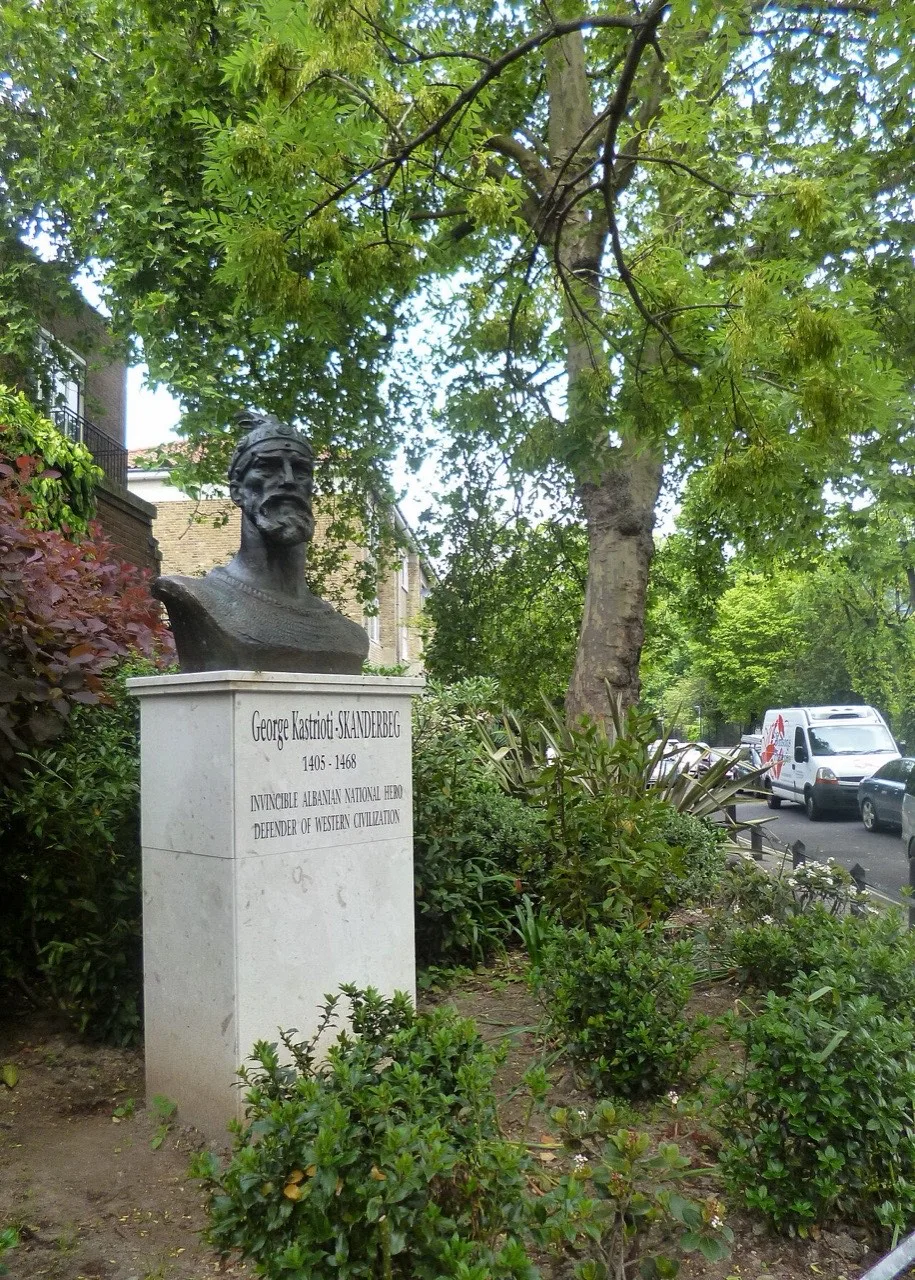

Consular
Embassy of the Republic of Albania
33 St George’s Drive, London SW1V 4DG
Ambassador Uran Ferizi, accredited to the UK and Ireland. Consular services run through the Albanian foreign ministry’s online portal.
Embassy of the Republic of Kosovo
8 John Street, London WC1N 2EB
Ambassador Ilir Kapiti. Also accredited to Ireland.
Community and advice
Shpresa Programme
Mansfield House, 30 Avenons Road, Plaistow, London E13
Registered charity 1110688. Advice, advocacy, Albanian schools, anti-trafficking legal support through Breaking the Chains, women’s and parenting programmes. Works across Newham, Barking and Dagenham, Redbridge, Enfield and Haringey, and nationally since 2020.
Ardhmëria
Standard House, 107–115 Eastmoor Street, Charlton, London SE7 8LX
Charity 1118989. Five supplementary schools in Greater London.
Nënë Tereza
Community House, 311 Fore Street, Edmonton, London N9 0PZ
Charity 1137791. Saturday school, advice, advocacy, prison work.
British Albanian Kosovar Council
Resource for London, 356 Holloway Road, London N7 6PA
Charity 1072694. Youth clubs and the Kosovo Independence Day programme.
Albanian Community “Faik Konica”
SW10, Chelsea
Charity 1076004. Mother-tongue classes and drop-in advice.
UKAP Foundation
London N1
Charity 1215303. Mentoring, speaker events and a scholarship programme for young people of Albanian heritage.
Albania UK Charity
Whitefield, Manchester M45
Charity 1196710.
AlbScott (Albanian Scottish Association)
Garnethill Multicultural Centre, 21 Rose Street, Glasgow G3 6RE
Scottish charity SC043062.
Faith
UK Albanian Muslim Community and Cultural Centre
Carlton Vale / Canterbury Road, London NW6 5DA
Xhamia e Shqiptarëve. Charity 1057193. Five daily prayers, classes, marriages, funerals, Albanian-language materials.
British Albanian Muslim Community
41A Mill Lane, West Hampstead, London NW6 1NB
Charity 1159724.
Albanian Muslim Community London
Blackhorse Lane, Walthamstow, London E17 6SH
Charity 1212790. Friday prayers and teaching in Albanian.
Albanian and Kosovan Catholic chaplaincy
St Charles Borromeo, 8 Ogle Street, London W1W 6HS
Fr Gary Walsh. Check Mass times with the parish.
Language and culture
Shkolla Shqipe “Kosova”
Haverstock School, Chalk Farm, London NW3
Running since 3 October 1993; the oldest Albanian school in Britain.
Albanian supplementary schools
Twelve cities plus around twenty London locations
Birmingham, Manchester, Sheffield, Liverpool, Bristol, Cardiff, Northampton, Luton, Oxford, Reading, Bracknell and Brighton. The Albanian government’s Qendra e Botimeve për Diasporën publishes the register.
Anglo-Albanian Association
London
Talks, book launches, film screenings and the Gazette, three times a year. Founded 1912–13.
UCL SSEES
Bloomsbury, London
Has run Albanian evening courses, including a strand for heritage speakers — check current availability; home of the Mann Collection.
Bust of Skanderbeg
Bayswater, London W2
The community’s one public monument identified in central London.
Elsewhere in this series
- Albanians in Manchester — community stories, schools and local contacts
- Albanians in Greece — where most of Albania’s emigrants went first, and where a fifth of Britain’s Albania-born residents may have acquired their passport.
- Albanians in Italy — the other side of the same door.
- Albanians in Germany and Albanians in Austria — where the Kosovar diaspora mostly went instead of Britain.
- Albanians in Switzerland — Europe’s densest Albanian community.
- Albanians in Sweden — the newest page in the series.
FAQ
Frequently asked questions about Albanians in the UK
How many Albanians live in the UK?
Why is there no official figure for how many Albanians live in Britain?
Why are there so many Albanians in the UK?
Where do Albanians live in London?
Where do Albanians live in the UK outside London?
Are Kosovans Albanians?
How many Kosovans live in the UK?
When did Albanians first come to Britain?
What religion are Albanians in the UK?
What language do Albanians in the UK speak?
Do Albanians need a visa to visit the UK, and can they work here?
How many Albanians claim asylum in the UK, and how many are granted?
How many Albanians are in UK prisons?
Who are the most famous Albanians in Britain?
Where can you meet other Albanians in the UK?
CMO at dua.com · Updated 10 September 2026 · Last evidence review: 9 August 2026
About this guide
Editorial methodology: the UK publishes no official count of its Albanian population, so this page builds one and shows the arithmetic. The counted floor is 117,189 — 68,672 Albania-born and 30,515 Kosovo-born residents of England and Wales plus 142 and 60 in Northern Ireland at the 2021 census, followed by 17,800 UK-born babies registered to Albania-born mothers between 2021 and 2025. Every figure is traced to a named table on a named date; measurement universes are kept apart; contested ground is labelled as contested.
Sources
- Office for National Statistics — Census 2021, country of birth (extended, 190 categories) — the classification that carries Albania (39) and Kosovo (47), available only through the census-observations API (2023)
- Office for National Statistics / Nomis — Census 2021 tables TS022 (ethnic group, detailed) and TS024 (main language, detailed), and the 2001 and 2011 country-of-birth tables UV008 and QS213EW (2023)
- NISRA — Census 2021 commissioned table CT0124, country of birth (full detail) by sex, Northern Ireland (2024)
- National Records of Scotland — Scotland's Census 2022, table UV204 country of birth — the six-country grouping that makes an Albanian figure for Scotland impossible (2024)
- Department for Education — English proficiency of pupils with English as an additional language, February 2020, Table 12 — 16,255 Albanian-first-language pupils in England, and the 10 per cent late-arrival rate (2020)
- Office for National Statistics — Parents' country of birth, 2025 edition, Tables 2a and 2b — births to Albania-born mothers and fathers in England and Wales (2026)
- Office for National Statistics — Population of the UK by country of birth and nationality (discontinued after June 2021) — the source of the widely quoted 47,000 figure (2021)
- Office for National Statistics — Freedom of information response: Albanian residents in the UK — ONS's own account of why no clean figure exists (2025)
- Home Office — Immigration system statistics, year ending March 2026 — datasets Asy_D01/D02, IER_D01–D05, Ret_D01–D03, Cit_D01/D02, Se_D02, Vis_D02, EUSS_D01/D02, Det_D01–D03 (2026)
- Home Office — Modern Slavery: National Referral Mechanism and Duty to Notify statistics, end-of-year summaries 2018 to 2025 (2026)
- Home Office — Asylum applications from Kosovo 1996–1999 and the Humanitarian Evacuation Programme — the only published record of the 4,346 airlifted in 1999 (2000)
- Home Office — Joint UK–Albania communiqué in relation to trafficking, 13 December 2022 (2022)
- House of Commons Home Affairs Committee — Asylum and migration: Albania, HC 197, Second Report of Session 2022–23 — the source of the 140,000 estimate and of the Kukës survey evidence (2023)
- Independent Chief Inspector of Borders and Immigration — An inspection of asylum casework, June to October 2023 — the report that documented Operation BRIDORA and the 2 per cent grant ceiling (2024)
- Hansard — House of Commons debates, 31 October 2022 (Western Jet Foil and Manston) and 13 December 2022 (Illegal Immigration) (2022)
- legislation.gov.uk — Nationality, Immigration and Asylum Act 2002, sections 94 and 80AA — Albania designated safe since 1 April 2003 (2026)
- Ministry of Justice — Offender management statistics quarterly — prison population by nationality, England and Wales (2026)
- Court of Appeal (Criminal Division) — R v BEP [2022] EWCA Crim 1881 — an Albanian cannabis conviction alongside a conclusive finding of modern slavery (2022)
- Migration Observatory, University of Oxford — Albanian asylum seekers in the UK and EU: a look at recent data (2025)
- Eurostat — migr_acq — acquisitions of citizenship by former citizenship: roughly 480,000 Albanians naturalised in Italy and Greece by the end of 2020 (2025)
- Charity Commission for England and Wales — Register of Charities, full monthly extract, 7 August 2026 — the twenty-one UK Albanian community charities and the twenty-seven removed since 1995 (2026)
- UK Civil Aviation Authority — Airport data, Table 12.1 — international air passenger traffic between UK airports and Tirana and Pristina (2026)
- Central Bank of the Republic of Kosovo — Remittances by country of origin, Tables 31 and 32 — the UK's €37.3 million and tenth place in 2025 (2026)
- Qendra e Botimeve për Diasporan (Republic of Albania) — Register of Albanian supplementary schools in England — the geography no census produces (2026)
- UK Government and Parliament Petitions — Petition 615921, Introduce Albanian language as a GCSE and A Level — 1,916 signatures and their constituency map (2022)
- King, R. & Karamoschou, C. — Fragmented and Fluid Mobilities: onward migration of Albanians from Greece to the UK, Migracijske i etničke teme 35(2) (2019)
- Vathi, Z. & King, R. — Narratives of migration and settlement among Albanian-origin immigrants in London, Ethnic and Racial Studies 36(11) (2013)
- Shpresa Programme — The UK's largest Albanian-speaking community charity (registered charity 1110688) (2026)
- Anglo-Albanian Association — Founded by Aubrey Herbert in 1912–13 and still publishing the Gazette (2026)
- ONS Open Geography Portal — Local Authority Districts (December 2021) UK BUC and Middle layer Super Output Areas (December 2021) EW BSC — the boundaries behind the map on this page. Contains OS data © Crown copyright and database right 2021 (2021)
- House of Commons Library — MSOA Names — the everyday neighbourhood names used on the London panel of the map, in place of ONS codes such as “Enfield 036” (2024)