There is no exact official figure for Albanians in Hamburg because the city does not record ethnicity. As of December 31, 2025, a transparent three-country model gives around 13,827 people with Albanian ties: it combines 7,801 citizens of Albania or Kosovo with a modeled share of the North Macedonian citizenship row. This is an editorial estimate, not an official count of ethnic Albanians.
Our dua.com team in Hamburg
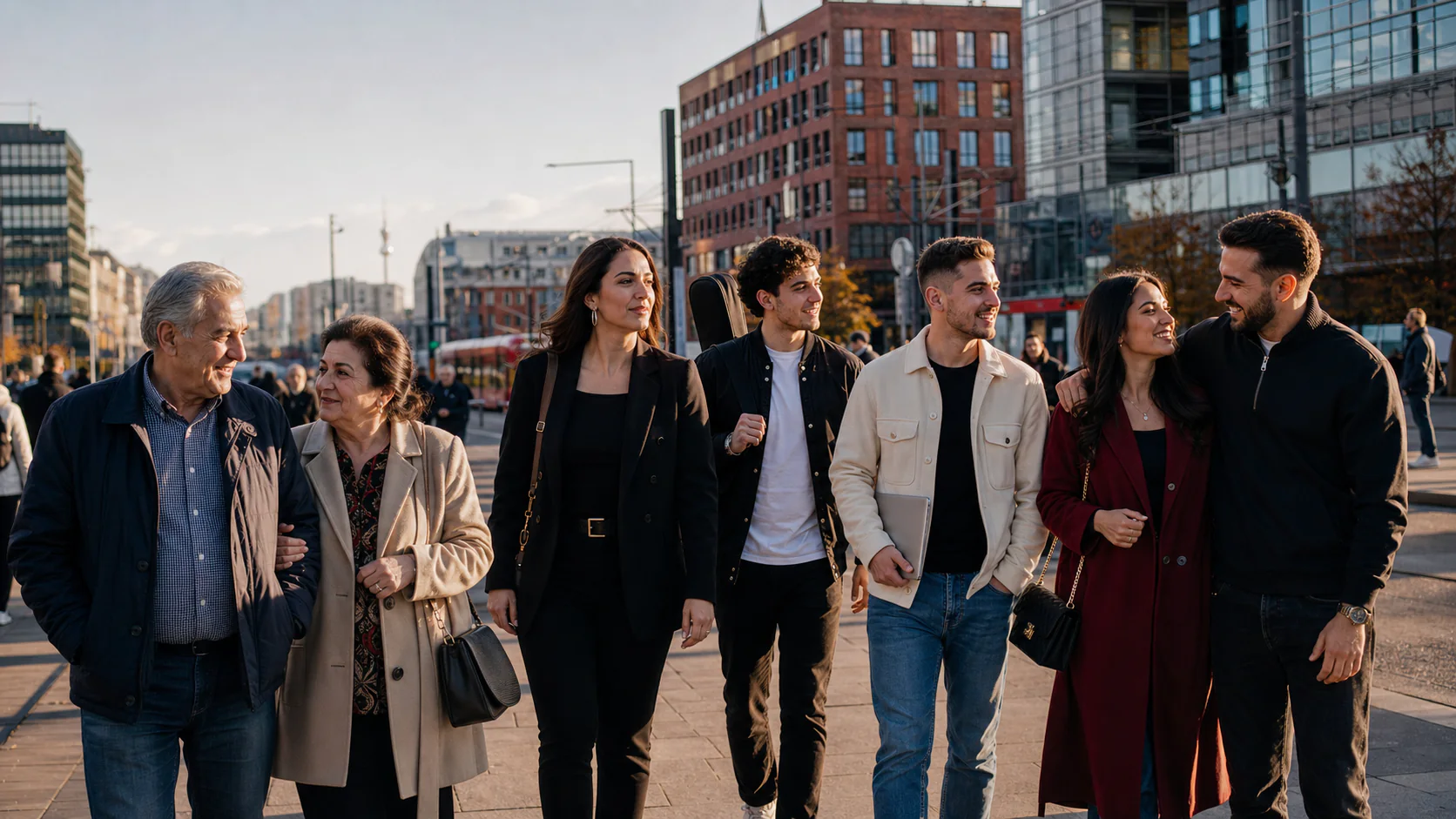
Our dua.com team visited Hamburg to spend time with Albanians in the city. We had a great time meeting both dua.com users and other members of the community. One of the highlights was meeting Albanians from Kosovo, North Macedonia and Albania.
More than 5,000 users in Hamburg are registered on dua.com. Meet Albanian singles in Hamburg on dua.com.
Looking back on our community visit in Hamburg
Our dua team visited Hamburg in September 2026 and filmed our encounters with the Albanian community. Revisit those meetings through the Albanian-language recap, our thank-you to the people we met and an introduction to dua in Hamburg.
Thank you to the community in Hamburg
Connecting through dua in Hamburg
The story behind Hamburg’s Albanian community
In July 1990, singer Niko Besnik Isufi came from Durrës to Germany through the occupied German Embassy in Tirana. His train continued north. He later told Hinz&Kunzt: “The carriage I was in was uncoupled in Hamburg.” He stayed and, years later, rehearsed in Ottensen with his band Balkan Caravan, giving a voice to a much older Hamburg story.
This story didn't start in 1990 and it didn't come in a single wave. Albanian-speaking workers from what was then Yugoslavia, family reunification, protection from the Kosovo war, students and more recent labor migration have created different Hamburg biographies. The official categories almost always lagged behind their reality.
Last editorial evidence check: September 7, 2026. This page explicitly distinguishes official counts, official estimates, journalistic biographies and editorial interpretation.
How many Albanians live in Hamburg?
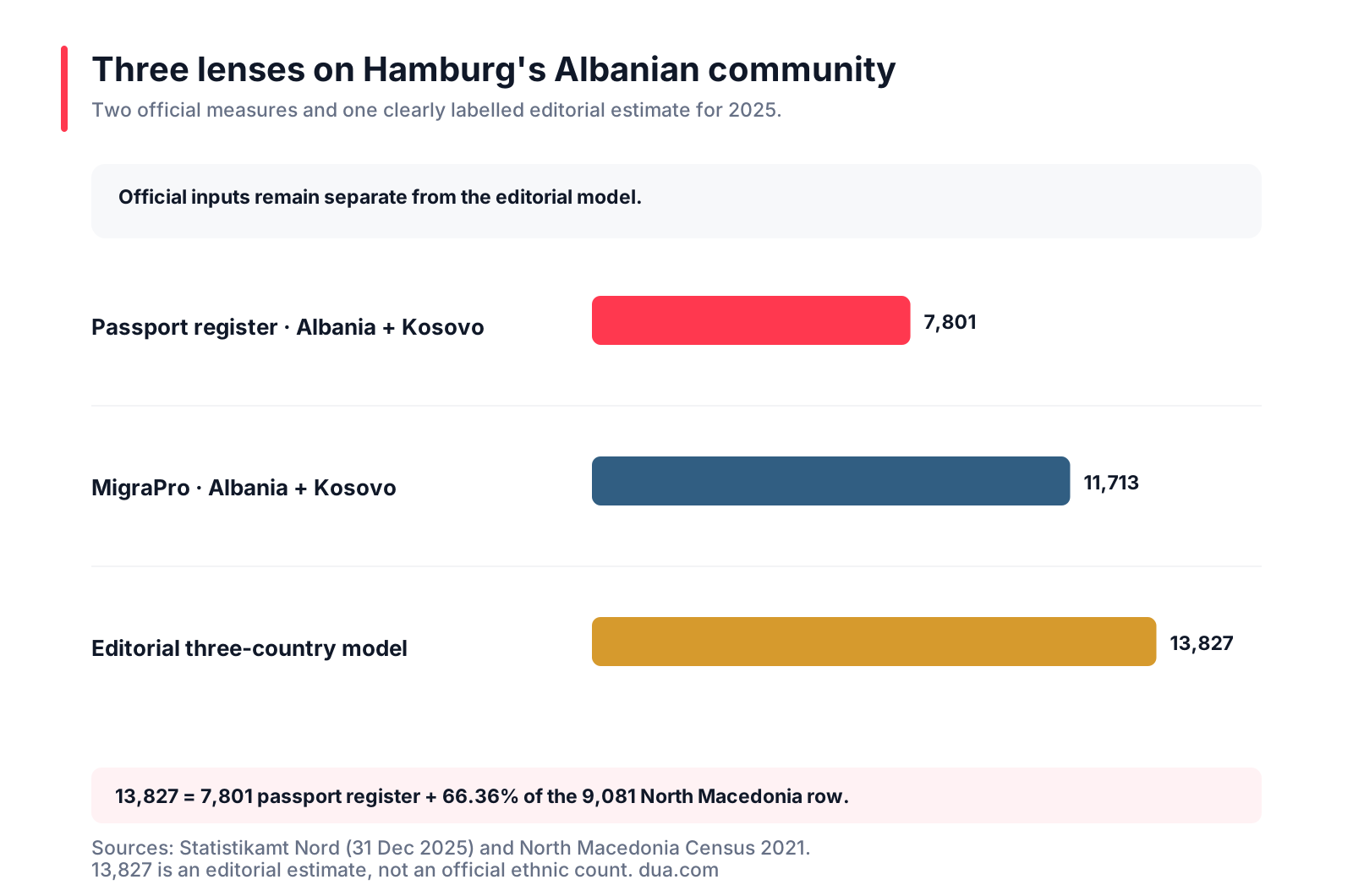
The selected editorial model estimate is around 13,827 people with Albanian ties. It starts with the foreign population by citizenship: 4,770 people with Albanian citizenship and 3,031 with Kosovan citizenship, or 7,801 in total. The model adds around 6,026 people – 66.36 percent of the 9,081 residents with North Macedonian citizenship.
The coefficient comes from the 2021 North Macedonia census: 66.36 percent of the registered non-resident population identified as Albanian. Applying it to Hamburg is not a local measurement but a transparent, reproducible assumption. The result is therefore always described as “around”, “modeled” or “estimated”.
MigraPro provides a second official lens. Statistics Office North estimates 5,707 people with Albania as their reference country and 6,006 with Kosovo, for a total of 11,713, including German citizens. This is not simply a lower version of the same figure: it includes German citizens but leaves the Albanian share within the North Macedonia and other origin rows unresolved. The two methods answer different questions.
What the estimate of 13,827 can show – and what it cannot
The calculation avoids treating all 9,081 people with a North Macedonian passport as Albanian. At the same time, its coefficient must not be confused with a Hamburg ethnicity survey: migration can be selective, naturalized citizens are absent from the foreign-resident statistics, and Albanian family ties from Montenegro, Serbia, Greece and other countries remain invisible. The figure of 13,827 is therefore a consistent editorial scenario for comparison with Germany, Berlin and Munich – not an official lower bound or the exact size of the community.
| Level | Calculation path | Result | Classification |
|---|---|---|---|
| Passport register base | 4,770 Albania + 3,031 Kosovo | 7,801 | official nationality lines |
| Separate MigraPro lens | 5,707 reference country Albania + 6,006 Kosovo | 11,713 | official register-based estimate including German citizens |
| North Macedonian model share | 9,081 × 66.36 % | ≈ 6,026 | transferred diaspora coefficient, not locally measured |
| Selected model estimate | 7,801 + 6,026 | ≈ 13,827 | editorial scenario, not an ethnic count |
The model estimate follows the same transparent three-country logic as the Germany and Munich pages. The official raw values and the single transferred assumption can be checked separately.
Where do Albanians live in Hamburg?
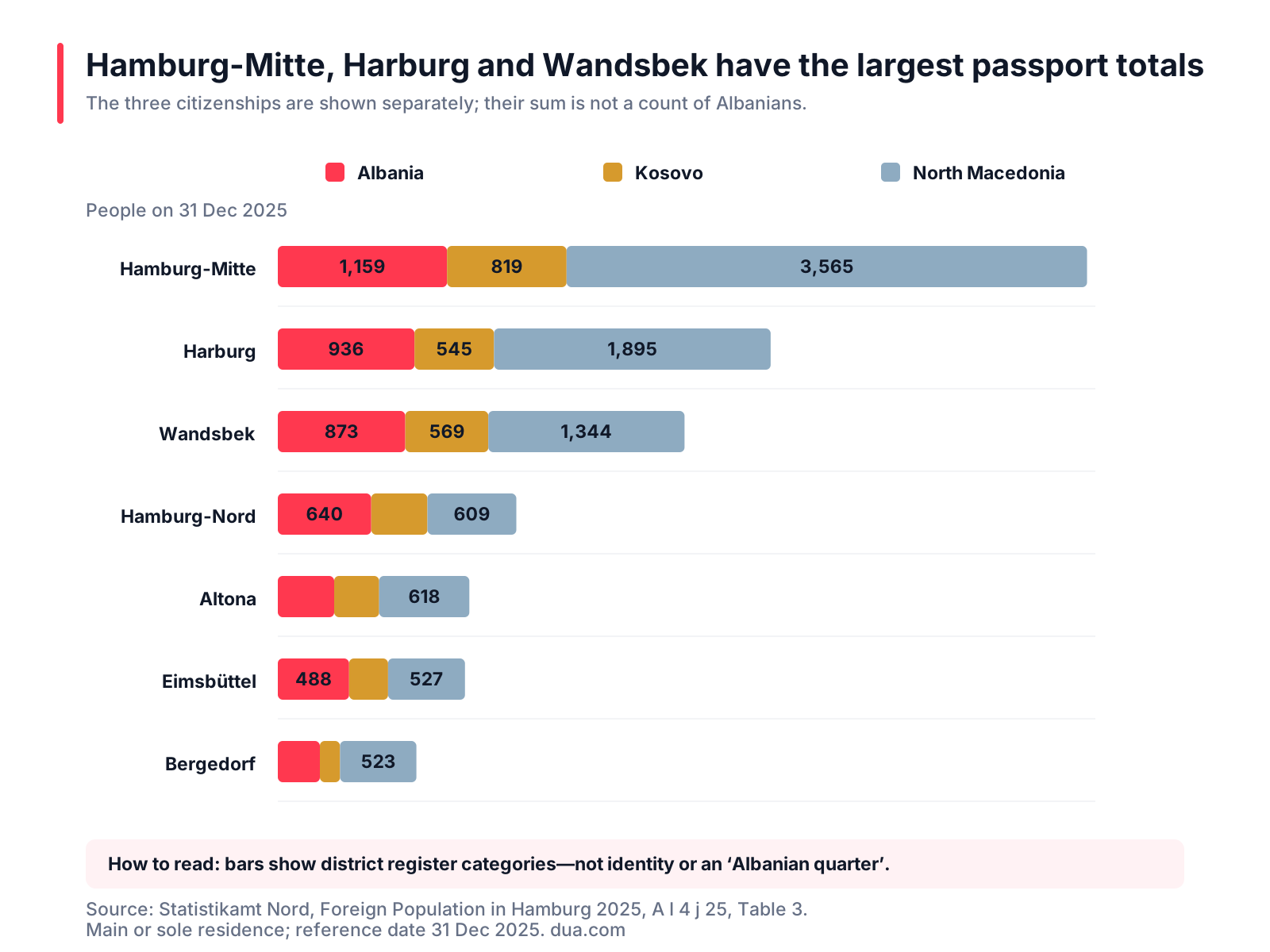
There is no officially defined “Albanian quarter”. Hamburg’s seven boroughs are large, and the statistics publish citizenship rather than ethnicity at this level. They nevertheless show clearly that Hamburg-Mitte, Harburg and Wandsbek have the largest registered populations across all three citizenships examined.
| District | Albania | Kosovo | North Macedonia |
|---|---|---|---|
| Hamburg-Mitte | 1,159 | 819 | 3,565 |
| Harburg | 936 | 545 | 1,895 |
| Wandsbek | 873 | 569 | 1,344 |
| Hamburg-Nord | 640 | 385 | 609 |
| Altona | 386 | 308 | 618 |
| Eimsbüttel | 488 | 267 | 527 |
| Bergedorf | 288 | 138 | 523 |
A network rather than a quarter
The community’s public presence is distributed differently from a classic enclave: the Islamic-Albanian Cultural Center is in St. Georg, Klub Kosova plays southeast of the city center on Müggenburger Straße, current heritage-language classes take place in Harburg and elsewhere, and the Consulate General of Kosovo is in Rotherbaum. These places do not prove residential concentration. They show how a citywide network operates.
Growth, age and work: what the figures really show
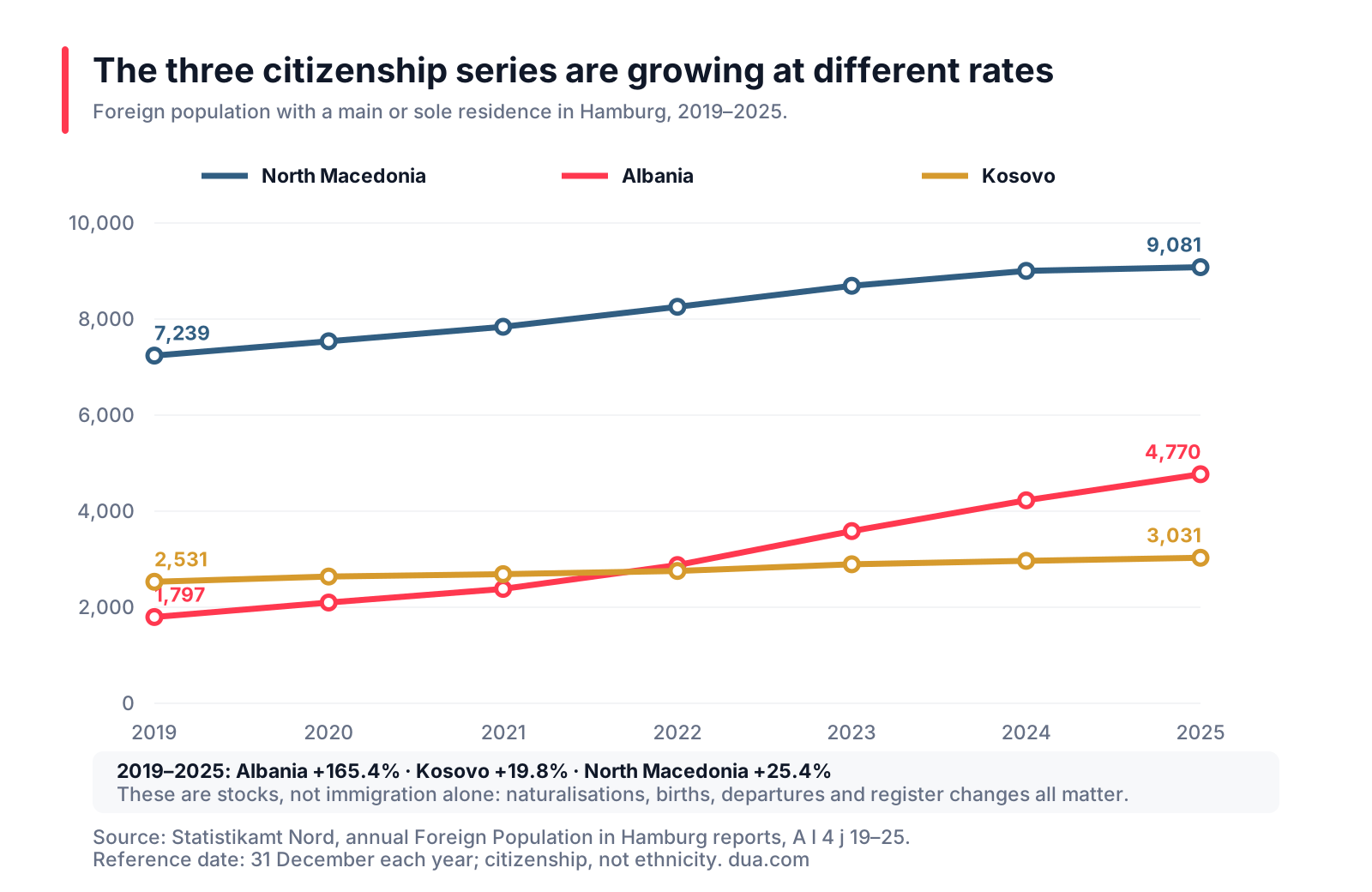
Between the end of 2019 and the end of 2025, the number of foreign residents with Albanian citizenship rose from 1,797 to 4,770 – an increase of 165.4 percent. The Kosovo row grew from 2,531 to 3,031, and the North Macedonia row from 7,239 to 9,081. This is a substantial change, but not a pure immigration curve: births, departures, naturalizations and register corrections also alter these population stocks.
The Albanian row has the youngest profile
Of the 4,770 people with Albanian citizenship at the end of 2025, exactly 3,825 were aged 18 to 64, or 80.2 percent; the 25-to-49 age group alone contained 3,191 people. Only 37 were 65 or older. The combination of a young age profile and rapid growth is consistent with recent labor migration and family reunification. It does not, however, prove any individual reason for arrival or a particular employment sector.
The Western Balkans Regulation explains one route, not every biography
Since 2016, the Western Balkans Regulation has provided citizens of Albania, Kosovo, North Macedonia and three other countries with a regular route into employment. The current nationwide annual quota is 50,000 approvals. It is plausible that this route accounts for part of Hamburg’s growth. However, there are no reliable Hamburg statistics showing which sectors Albanian residents work in or how many businesses they run. This page therefore does not present stereotypes about hospitality, construction or entrepreneurship as facts.
How Albanian Hamburg came to be
Hamburg’s community is the result of several overlapping arrivals. Earlier migration from what was then Yugoslavia remained grouped under “Yugoslavia” in citizenship-based statistics. Later, family, political upheaval, war and displacement shaped other biographies; more recent migrants may also use study, vocational-training and regular employment routes.
- 1968: The Federal Republic of Germany signs its recruitment agreement with Yugoslavia. Workers from Kosovo and Macedonia are recorded under Yugoslavia in citizenship-based statistics; Albanian language or identity remains invisible.
- 1973: The recruitment freeze ends recruitment, not migration. Family reunification and networks that have already been created turn temporary work into permanent life.
- 1977: Klub Kosova is founded. The club remains registered in Hamburg football and connects sport, youth and belonging.
- 1985: According to the St. Georg neighborhood magazine, the Albanian mosque community buys premises at Kleiner Pulverteich. A still-visible institution grows from a prayer room.
- 1990: Niko Besnik Isufi's wagon is uncoupled in Hamburg. His personal arrival represents people who left via the embassies at the end of the Albanian dictatorship.
- 1998/99: “Hamburg helps Kosovo” sends aid to the Balkans while people seeking protection arrive in the city. The war becomes tangible in both directions of travel.
- 2012/13: Hamburg signs agreements with Islamic religious communities, and the Hamburg Parliament approves them. The Albanian community is part of a city-recognized infrastructure.
- 2016: The Western Balkans Regulation creates a new legal employment route, distinct from guest-worker migration and wartime displacement.
- 2020: Hamburg-born Sami Musa wins election to the Hamburg Parliament with 3,679 personal votes – one generation after his father’s arrival in Harburg.
- 2024: According to police, around 6,000 Albanian supporters march from the port toward the stadium. Hamburg experiences a moment of Albanian visibility in public space.
1990: an uncoupled wagon
Niko Isufi was a musician when thousands of people in Tirana sought protection in foreign embassies in July 1990. His story does not end with a spectacular escape, but with something everyday: an unknown train station, work, rehearsals, homesickness and a new audience. This is exactly how a historical event becomes a city biography.
“The wagon I was sitting in was uncoupled in Hamburg.”
Niko Besnik Isufi in an interview with Hinz&Kunzt, 2010
1998/99: aid goes out, people come in
ASB Hamburg documents how the “Hamburg helps Kosovo” campaign organized aid shipments from August 1998. In April 1999, taz reported the arrival in Hamburg of a plane carrying around 200 Albanian refugees. Such individual records do not provide a complete admissions total. They do show that the Kosovo War was more than news here.
Klub Kosova had already existed for more than two decades. Its founding in 1977 and the teams still registered today show how one institution can survive several very different phases of migration.
Language, sport and faith: the infrastructure of the community
A community does not only become visible when it fills a festival. It becomes visible when children have lessons on Tuesdays, when a club has published fixtures for decades and when religious and secular organizations create spaces for very different families.
Albanian is taught through cross-school courses
Hamburg’s school authority lists Albanian as one of twelve heritage languages offered through cross-school instruction. For the 2026/27 school year, the official secondary-school directory lists courses at Schule Maretstraße for grades 5–6 and 7–10, and at Schule Mendelssohnstraße for grades 5–7. One course at Maretstraße may also be chosen as an elective. Places are limited, pupils at the host school have priority, and admission is not guaranteed. Before registering, parents should check the authority’s current directory.
This is more than weekend folklore. Heritage-language instruction treats reading, writing and cultural knowledge as education – taking Albanian from the private kitchen table into the public school system.
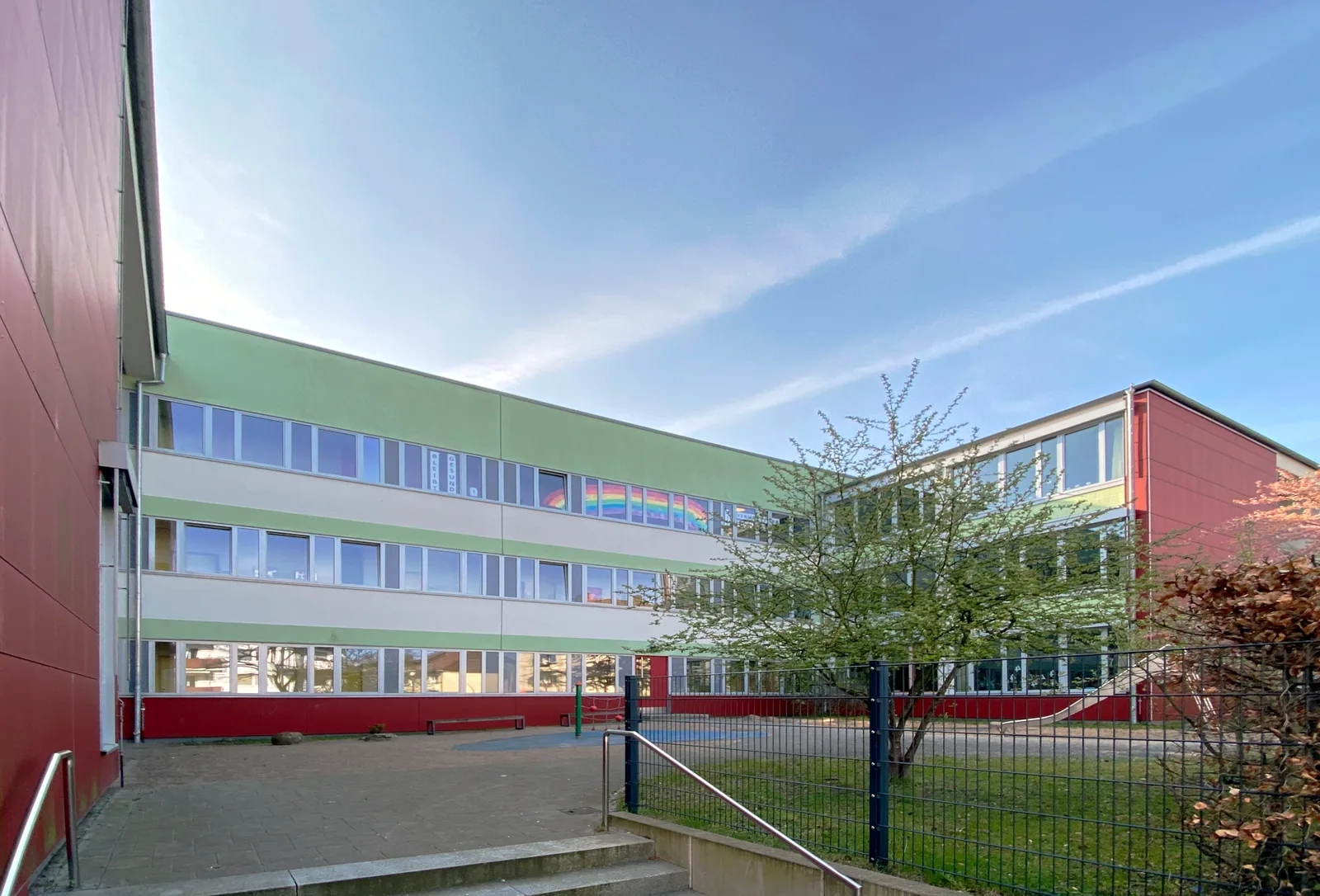
Klub Kosova: on the pitch since 1977
The DFB lists Klub Kosova as founded in 1977, with red and black colors and three teams, including a C-youth side. Its ground on Müggenburger Straße lies between Rothenburgsort and Veddel. Leagues and kick-off times change, so the current DFB page is more reliable than old club profiles.
Religious life is plural
The Islamic-Albanian Cultural Center at Kleiner Pulverteich combines a mosque, cultural work and language classes. According to local sources, its history dates to the 1980s. Since 2026, the new Albanian Christian Association in Finkenwerder has also presented youth, cultural and community activities. None of these institutions speaks for the entire community.
New culture takes place in old Hamburg spaces
In January 2026, Goethe-Schule Harburg hosted a German-Albanian reading with the Kosovar author Shpëtim Selmani. Since 2019, ODA Hamburg has connected German-Albanian academics around education, youth and culture. Albanian Hamburg is not only preserving heritage; it is also creating the present.
June 19, 2024: when Hamburg turned red for a day
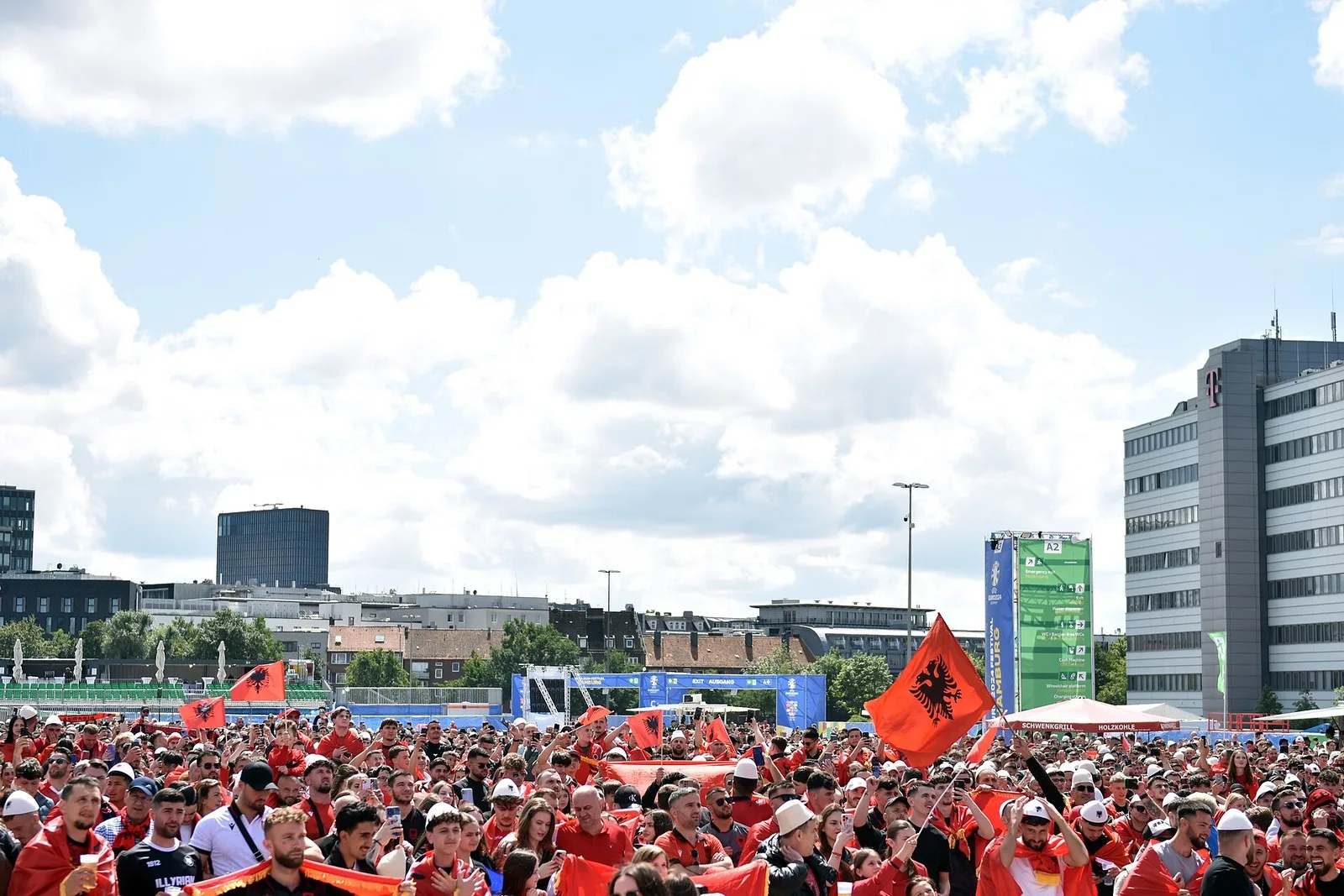
Ahead of the European Championship game between Croatia and Albania, according to police information, around 6,000 Albanian fans marched from the Jan Fedder Promenade towards the Volksparkstadion. There, 46,784 spectators saw a 2-2 draw. The crowd consisted of locals and visiting fans; it is expressly not a population statistic. As a moment of public visibility, it was nevertheless exceptional.
The photo above this article was taken on the same day in the Hamburg Fan Zone. It shows flags, jerseys, families and friend groups – not a statistical average. This is precisely where its value lies: it documents a real moment in Hamburg without forcing a single face on a diverse community. Photo: Frank Schwichtenberg / Wikimedia Commons, CC BY-SA 4.0; resized as WebP for this page.
Three biographies, three ways of becoming part of Hamburg
Niko Besnik Isufi: Arrival
Isufi’s journey from Durrës through the German Embassy to Hamburg is a story of political upheaval told as personal memory. His homesickness and music belong both to Albania and to the city where his carriage ended its journey.
Etnik Zarari: a second generation produces its own sound
The producer Etnik was born in Hamburg as the son of Albanian immigrants and grew up here. An early discovery in a Hamburg club led him to international electronic music. His biography shifts the perspective: Hamburg is not just a place of arrival, but a place of production for a generation that does not have to divide its aesthetics between two countries.
Xhelil and Sami Musa: from Harburg to the Hamburg Parliament
According to the family account, Xhelil Musa came from Pozheran to Harburg as a guest worker in 1970. His Hamburg-born son Sami worked in hotels and hospitality and was elected to the Hamburg Parliament in 2020 with 3,679 personal votes. This story does not represent all Albanians in Hamburg. It is one verifiable, multigenerational Hamburg biography.
Directory: Albanian contact points in Hamburg
These entries were checked on government or first-party websites on September 7, 2026. Match schedules, class times, services and opening hours may change; always check the linked primary source before visiting.
Consulate and public services
- Consulate General of the Republic of Kosovo – Rothenbaumchaussee 133, 20149 Hamburg. The responsible official mission; check the Federal Foreign Office for current contact details and office hours.
- Heritage-language instruction in Albanian – the authority’s page for cross-school courses, registration and current school-year lists.
Clubs, education and culture
- Klub Kosova e.V. – Müggenburger Straße 26, 20539 Hamburg. A football club founded in 1977; current fixtures are available through the HFV or DFB.
- ODA Hamburg e.V. – an organization of German-Albanian academics focused on education, youth, art and culture since 2019. Its public events page is older; contact the organization directly.
Faith and community
- Islamic-Albanian Cultural Center Hamburg e.V. – Kleiner Pulverteich 17–21, 20099 Hamburg. Mosque, language, educational and cultural offerings.
- Albanian Christian Association Hamburg e.V. – Rüschweg 25, 21129 Hamburg. New initiative since 2026 with youth, cultural, language and community work.
How Albanians in Hamburg get together today
Someone new to the city needs different entry points from a family with school-age children. Football leads to Klub Kosova, language to heritage-language classes, culture to ODA or a reading, and faith to the respective communities. For consular questions, the official mission is the right first stop.
If you want to meet people beyond your own club, borough or family circle, you can find Albanians in Hamburg and across the global diaspora on dua.com. The app complements real-world institutions; it does not replace them.
The national picture and the detailed migration history are on Albanians in Germany. You can find more city portraits at Albanians in Berlin and Albanians in Munich.
Frequently asked questions about Albanians in Hamburg
How many Albanians live in Hamburg?
The transparent three-country model gives around 13,827 people with Albanian ties at the end of 2025: 4,770 Albanian citizens, 3,031 Kosovan citizens and a modeled 66.36 percent of the 9,081 people in the North Macedonian citizenship row. It is an editorial estimate, not an official ethnic count. Separately, the MigraPro rows for the reference countries Albania and Kosovo total 11,713 people, including German citizens.
Why is there no exact number?
Hamburg does not record ethnicity. The foreign-resident statistics exclude German citizens; MigraPro estimates reference countries, but not self-identification or language. No Hamburg table can clearly separate Albanian families from North Macedonia, Montenegro, Serbia and other countries.
In which districts do most people live?
According to the separate register lines for Albania, Kosovo and North Macedonia, the largest holdings are in Hamburg-Mitte, Harburg and Wandsbek. The districts are large, and these numbers do not indicate ethnicity or a specific neighborhood.
Is there an Albanian quarter in Hamburg?
No, at least not something that can be clearly defined officially or institutionally. The community functions as a network: cultural center in St. Georg, football on Müggenburger Straße, schools in Harburg and a consulate in Rotherbaum. These places are contact points, not residential statistics.
When did the first Albanians come to Hamburg?
The modern community grew after the German-Yugoslav recruitment agreement of 1968; people from Kosovo and Macedonia were included in citizenship-based statistics under Yugoslavia. Klub Kosova has existed since 1977, the Albanian mosque community has roots in the 1980s. Later waves came through family, upheaval in Albania, the Kosovo war, studies and work.
Where can children learn Albanian?
Albanian is part of the regular Hamburg heritage language lessons. For the 2026/27 school year, the authority names, among others, the Maretstrasse school and the Mendelssohnstrasse school. Offers change annually; the current school authority directory is relevant.
Which Albanian clubs and institutions are there?
Verified examples include Klub Kosova, the Islamic-Albanian Cultural Center, ODA Hamburg, the Consulate General of Kosovo and the new Albanian Christian Association. Check contact details and dates on their primary pages before visiting.
Where can you meet Albanians in Hamburg?
Through clubs, heritage-language classes, cultural events, religious communities and football. dua.com also connects people in Hamburg with the Albanian diaspora worldwide.
Niko’s carriage was uncoupled in Hamburg in 1990. Xhelil Musa’s son entered parliament fifty years after his father’s arrival. And on a June day in 2024, thousands carried red and black through the port. None of these scenes is “the” community. Together, however, they tell what statistics alone cannot: how people from very different journeys build a present in Hamburg.