Albanian New York is larger than the Bronx and more complicated than any one population number. The latest American Community Survey estimates 37,502 ± 2,961 people reporting Albanian ancestry in New York City, 56,959 ± 3,701 in New York State, and 68,240 ± 4,275 across the New York–Newark–Jersey City metropolitan area. Queens has the largest borough point estimate. Staten Island has the highest borough share. The east Bronx remains the community’s best-known cultural centre, while overlapping survey vintages suggest the centre of gravity may be extending north into Yonkers and Westchester.
These are official ancestry estimates, not a census of everyone who is ethnically Albanian. People from Kosovo, North Macedonia and Montenegro may write “Albanian”, another identity, or nothing at all; mixed families can report two ancestries. This page keeps Census data, community estimates and first-party dua.com figures separate.
This guide is for residents, descendants, researchers and visitors who need population evidence or a practical route into the community; it does not estimate religious affiliation or decide who counts as Albanian. The story runs from Jamestown in 1906 through the post-1965 Bronx migration, restaurant and property ownership, Kosovo mobilisation, religious centres, schools and today’s public events. This New York chapter of dua.com’s guide to Albanians in America combines defensible numbers with neighborhood maps, current photography, video and practical routes into the community. Census figures use the 2020–2024 five-year survey and show the 90% margin of error where it matters.
For more on this topic, read Albanians in America: A Community Estimated at 750,000 to 1 Million and Albanians in Copenhagen: A Community Beyond the Numbers.
Last evidence review: 10 August 2026. Official statistics, institutional claims, first-party dua.com data and editorial interpretation are labelled separately throughout.
How many Albanians live in New York?
The best current published answer for New York City is 37,502 people reporting Albanian ancestry, with a margin of error of ±2,961. For New York State the estimate is 56,959 ± 3,701. For the New York–Newark–Jersey City metropolitan area it is 68,240 ± 4,275.
Swipe horizontally to explore the full chart.
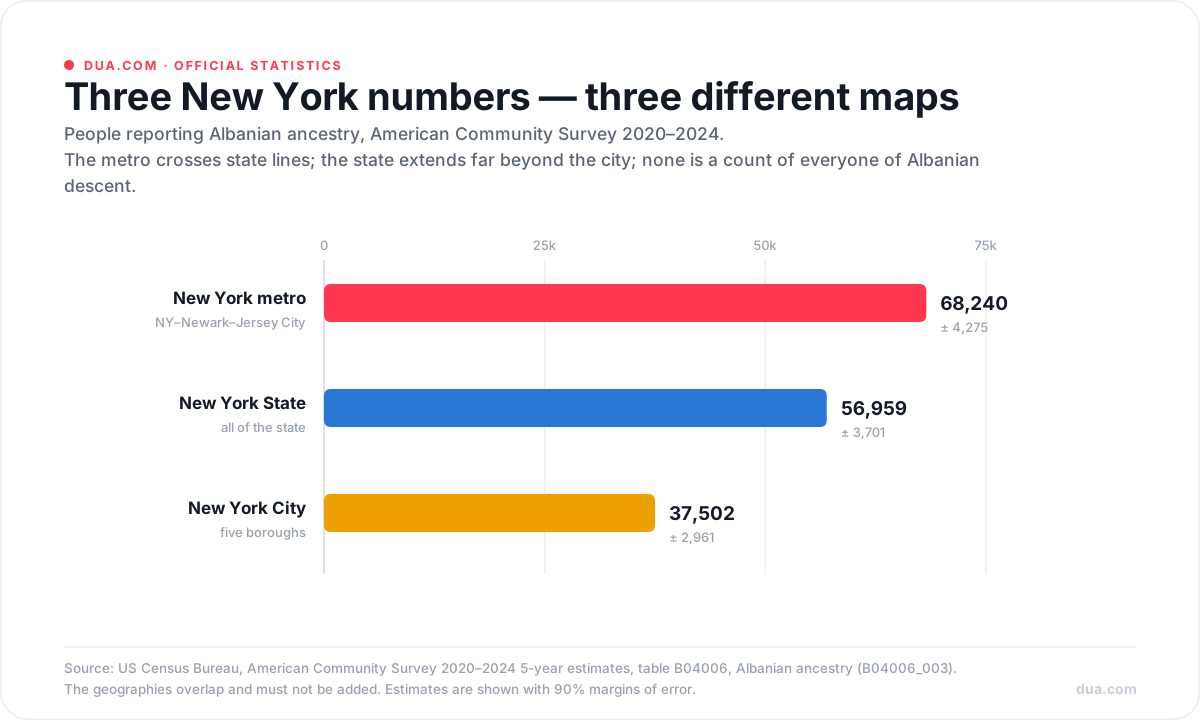
The city figure covers the five boroughs and nothing outside them. The state figure includes the city, Long Island, Westchester, the Hudson Valley and upstate New York, but excludes New Jersey and Connecticut. In the 2024 ACS geography, the metro is the New York–Newark–Jersey City, NY–NJ Metropolitan Statistical Area; it includes northern New Jersey but not Connecticut. The broader New York combined statistical area is a different geography. The metro is not “New York State plus something”, and the three figures are not additive.
What the Census number actually measures
Table B04006 is called “People Reporting Ancestry”. The survey lets a person report up to two ancestries. “Albanian” is one line in that table, and the universe is the full population. The number therefore includes Albanian-born newcomers, US-born children and people with one Albanian parent — if Albanian is one of the answers recorded. It excludes an Albanian who reports only “American”, “Kosovar”, “Montenegrin”, “Italian” or no ancestry.
That makes 37,502 a visible baseline, not a ceiling on descent. It is also why the city government and community organisations sometimes publish figures above 100,000. Those are attributed constituency estimates, usually intended to include the wider Albanian-speaking and Albanian-descended population. They are not interchangeable with B04006, and no public dataset supplies a defensible multiplier that turns one into the other.
How much of Albanian America is here?
The same survey estimates 228,504 Albanian-ancestry residents nationwide. On that consistent denominator, New York State holds 24.9% of the national total, New York City 16.4%, and the New York metro 29.9%. Nearly three in ten Americans who write Albanian in the ancestry question live in the metropolitan region.
That explains the city’s national role. New York is where Albania and Kosovo maintain consular missions, where the major parade happens, where lobbying for Kosovo built an audience, and where artists and politicians can speak to a community large enough to matter but geographically compact enough to gather.
The map: Queens has the count, Staten Island the density
The Bronx is the symbolic capital of Albanian New York, but the latest borough arithmetic is almost a three-way tie. Queens is first by headcount with 9,655 ± 1,586. The Bronx has 8,828 ± 1,300. Staten Island has 8,651 ± 1,763. Given the margins of error, the survey cannot establish a precise winner among those three with the confidence a league table implies.
Swipe horizontally to explore the full chart.
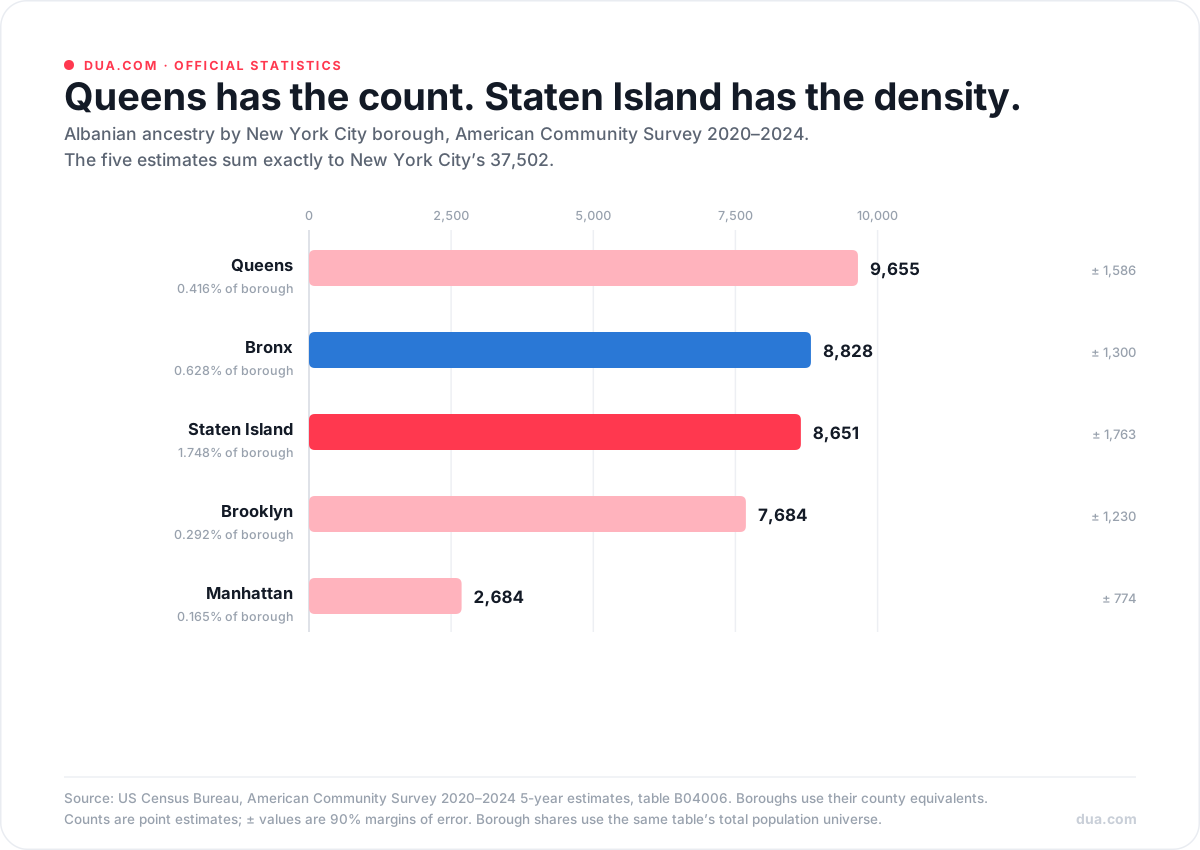
Density tells a different story. Albanian ancestry accounts for 1.748% of Staten Island, 0.628% of the Bronx, 0.416% of Queens, 0.292% of Brooklyn and 0.165% of Manhattan. Staten Island’s share is nearly four times the citywide 0.442%.
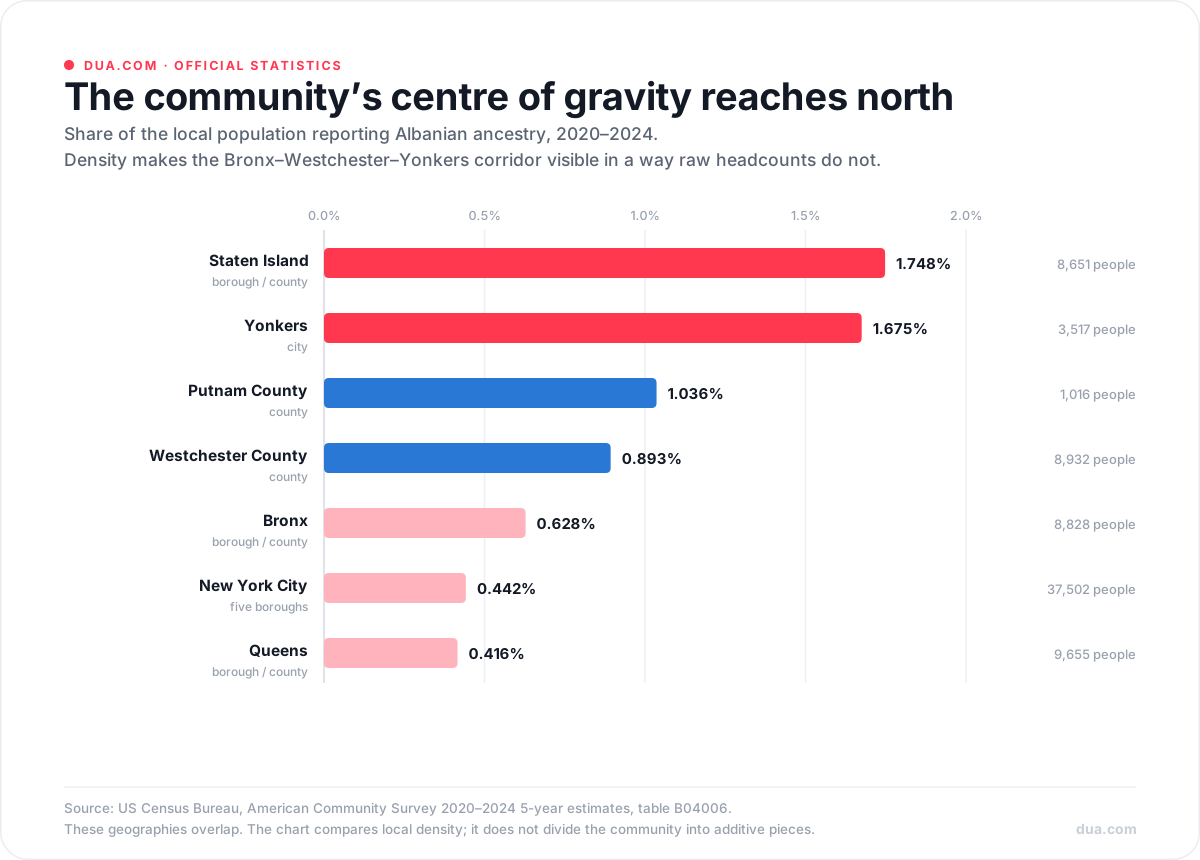
There is no single, clean “Little Albania”. The residential and social map is a chain: Pelham Parkway, Allerton, Morris Park and Belmont in the Bronx; Ridgewood and Glendale in Queens; Bensonhurst and Bath Beach in Brooklyn; New Dorp and the east and south shores of Staten Island; then north through Mount Vernon and Yonkers to Hartsdale and the wider Westchester suburbs.
Swipe horizontally to explore the full chart.
Before the Bronx: New York’s first Albanian institutions
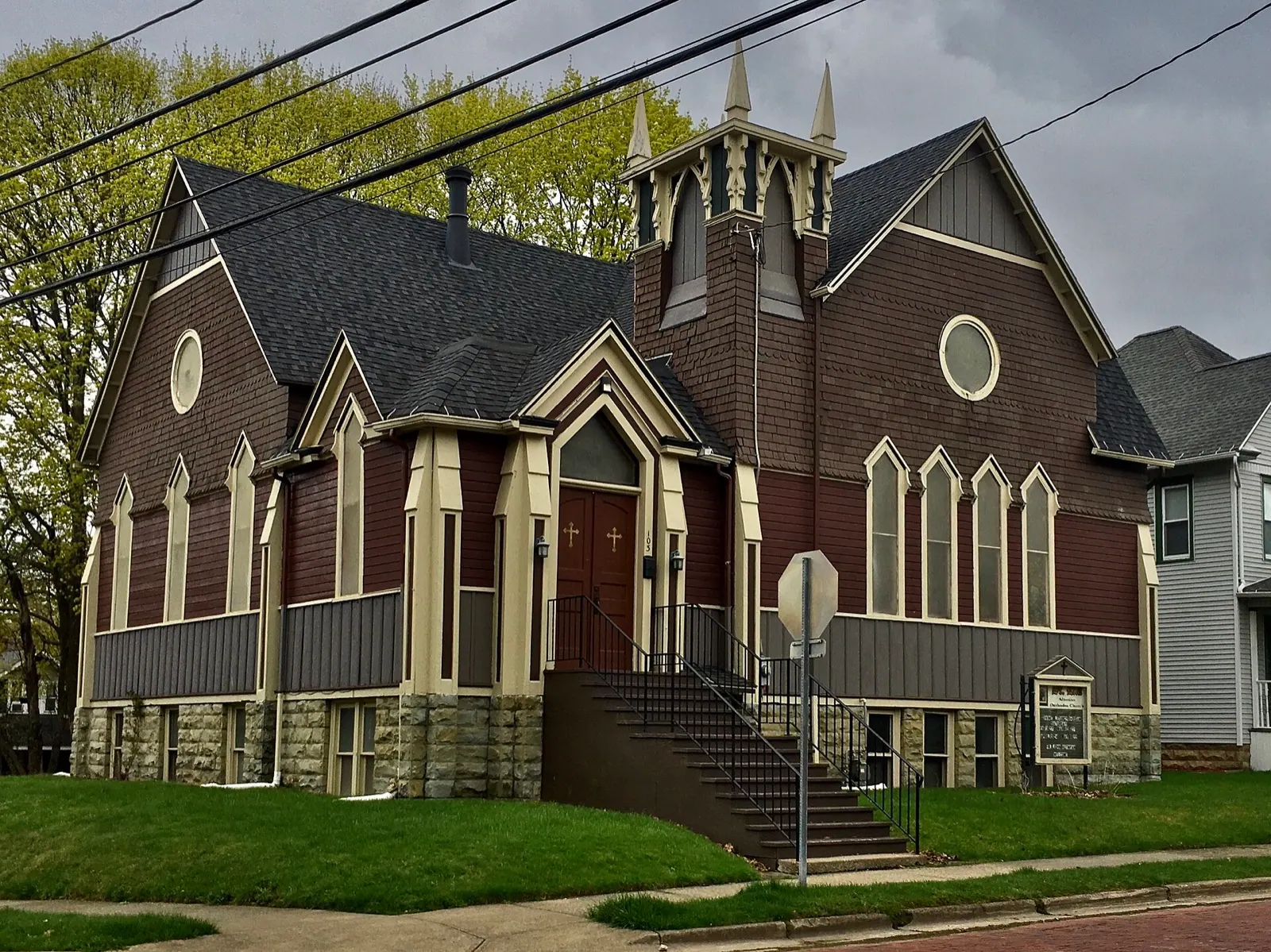
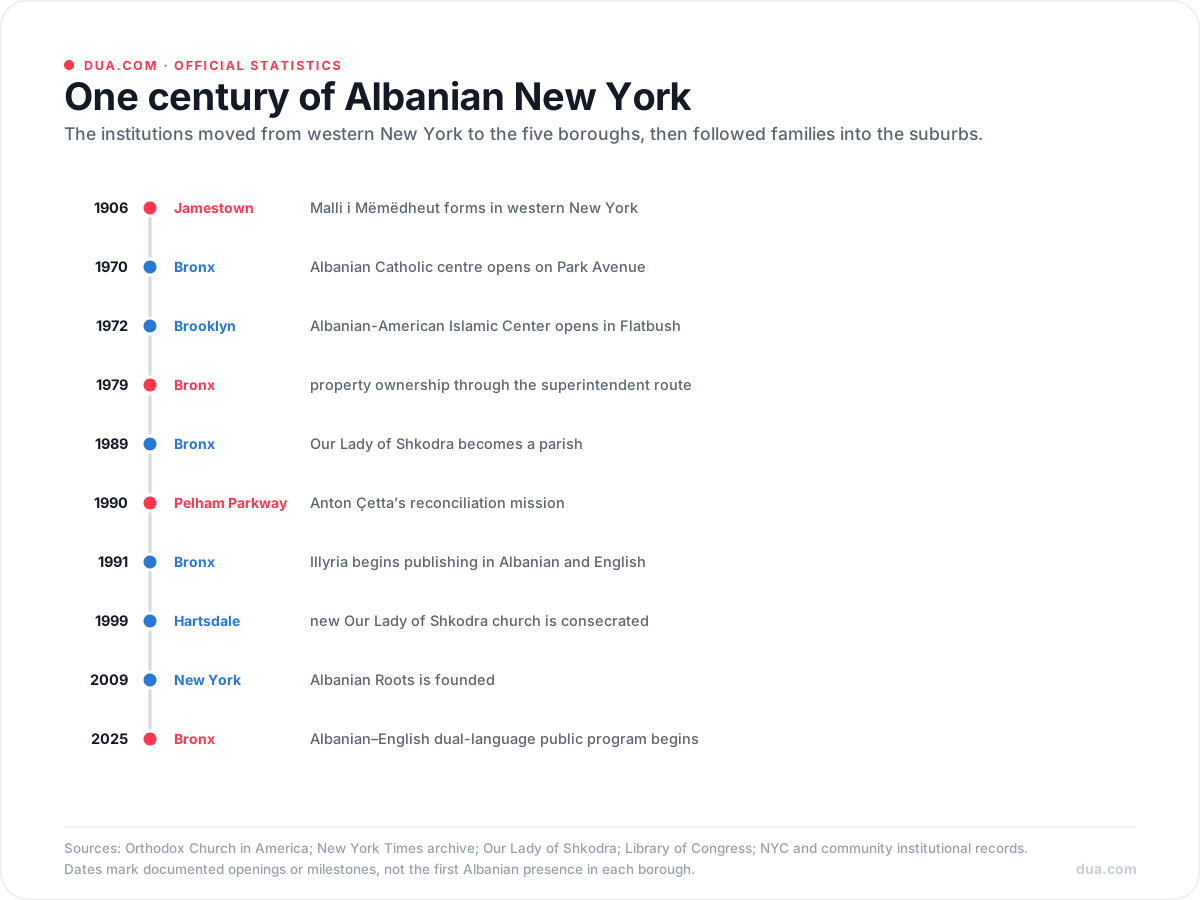
The first organised Albanian New York was not in New York City. It was in the industrial towns of western New York, among Orthodox men from the Korçë region who found work around Buffalo and Jamestown. At the turn of 1905–1906 they formed Malli i Mëmëdheut — “Longing for the Homeland” — in Jamestown, an early mutual-aid and national organisation.
Fan Noli visited western New York and conducted services for the small Jamestown colony. St Elia Albanian Orthodox Church, whose parish history is preserved by the Orthodox Church in America, grew out of that presence. It is easy to miss this beginning because the modern community is downstate and largely descended from a different migration. But New York State’s Albanian institutional history starts with southern Orthodox workers, not with the later Gheg-speaking Bronx.
Swipe horizontally to explore the full chart.
Two migrations, two maps
The founding migration to the United States came mainly from southern Albania and built its strongest institutions in Massachusetts. New York’s modern mass community came later and from a wider Albanian geography: Kosovo, the Ulcinj–Kraja–Ana e Malit area of Montenegro, Plav and Gusinje, and the Albanian regions of North Macedonia around Debar, Struga, Tetovo and Gostivar. Refugees from communist Albania formed another, smaller postwar layer; migration directly from Albania increased sharply after 1990.
This matters because “Albanian” in New York is not a single village network enlarged. It includes Muslim, Catholic, Orthodox and secular families; Gheg and Tosk speech; people whose passports said Yugoslavia, Albania, North Macedonia or Montenegro; and US-born descendants who may know the flag, food and family origin more fluently than the language.
The Immigration and Nationality Act of 1965 removed the national-origins quota system. That legal opening met political repression and limited opportunity in Yugoslavia, and it allowed kinship chains to gather in New York. By the 1970s and 1980s, the east Bronx offered three things newcomers needed at once: affordable apartments, jobs linked to housing, and established Italian neighborhoods where Italian-speaking Albanians could operate before their English caught up.
How the Bronx became Little Albania
The name “Little Albania” usually points to two connected but different corridors. Pelham Parkway, Allerton and Morris Park are the residential spine, with Lydig Avenue as a visible shopping street. Belmont and Arthur Avenue are the restaurant and market spine, nested inside the Bronx’s better-known Little Italy.
The 2020–2024 tract data still finds the strongest point estimate in Census Tract 330 in Allerton: 846 ± 524 residents reporting Albanian ancestry out of 5,197, or 16.28%. Nearby Bronx tracts also rank high. But a tract is not a neighborhood, and ±524 around an estimate of 846 is enormous. The responsible conclusion is that the Allerton–Pelham belt contains a real concentration — not that exactly one person in six on a given block is Albanian.
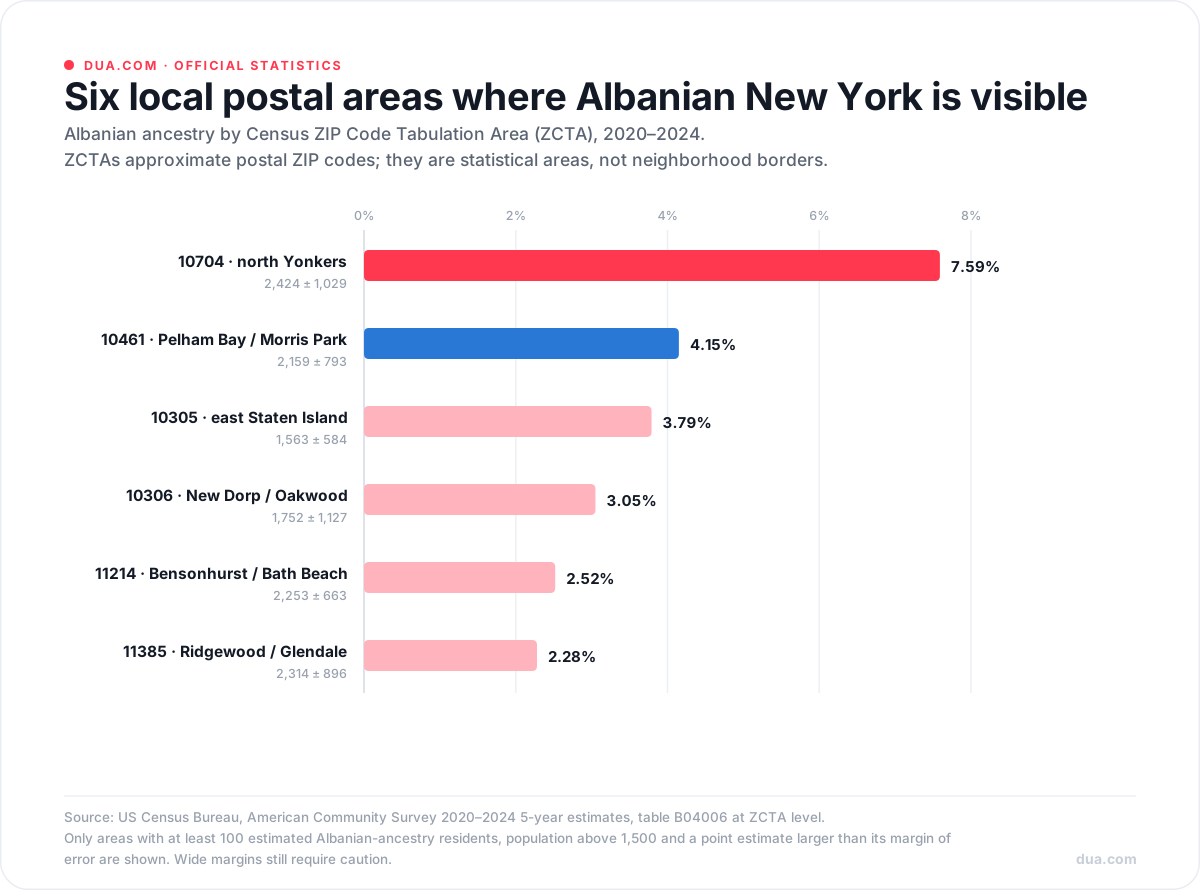
At postal-area scale, where the samples are larger, ZCTA 10461 — covering parts of Pelham Bay, Morris Park and nearby east Bronx neighborhoods — records 2,159 ± 793 Albanian-ancestry residents, or 4.15%. ZCTA 10462 is larger by total population but has a lower point estimate of 1,124 ± 370, or 1.47%.
A neighborhood built through work
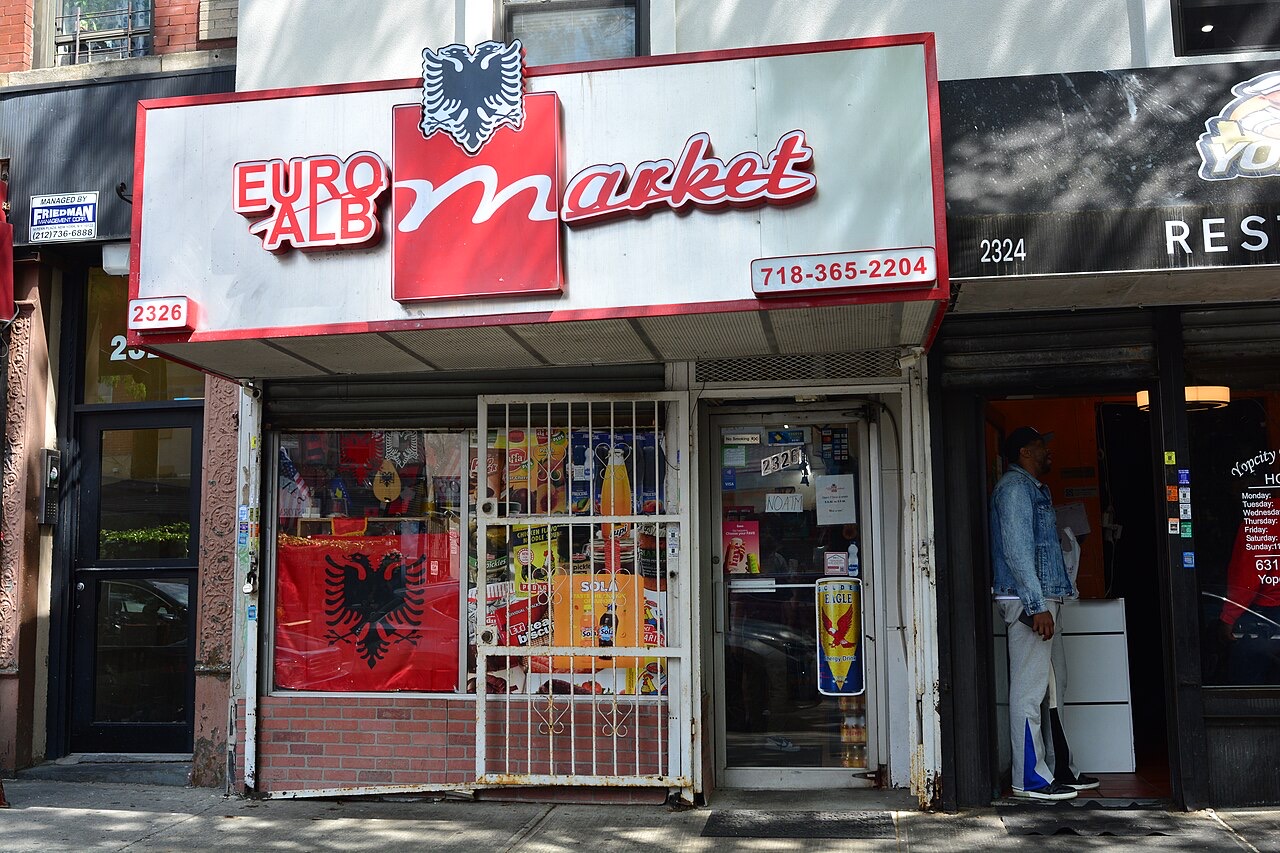
Many migrants from Yugoslavia had passed through Italy or spoke Italian. In an Italian and Italian-American Bronx, that became labor-market capital. A newcomer could work as a building superintendent, porter, construction worker, dishwasher or pizza maker before he could manage an English-language office job. Housing work often came with an apartment. One relative could therefore offer the next relative both a job and a place to sleep.
A 1992 account of Pelham Parkway followed Sali Nezaj, who arrived in 1970, lived with cousins, worked in construction and bought a nineteen-family building in 1984. By the time of the report he owned four buildings. The same account describes a community credit system based on reputation, labor exchanged across families and loans made with little paperwork. It is a case study, not proof that every Albanian followed one route, but it explains why property management became so visible.
The neighborhood changed as success accumulated. Stores selling imported peppers, cheese, coffee and cured meat made Albanian life legible on the street. Village and regional associations used halls and restaurants for meetings. The Catholic centre, the mosque, weekend schools and the offices of Albanian-language newspapers gave the network institutional addresses. A cousin chain became a community.
Supers, buildings, pizza and the economic ladder
The signature occupation of Albanian New York was not one trade but a sequence: porter → superintendent → contractor or owner. A superintendent learned plumbing, boilers, roofs, tenants and the economics of a rent roll. The job supplied housing and a relationship with the owner. In the distressed Bronx property market of the 1970s, some owners were willing to sell weak buildings close to the value of their mortgages.
In 1979 the New York Times profiled Nikoll Vataj, who had moved from porter to superintendent and then acquired six buildings with about 550 apartments in seven years. The buildings were not easy wealth: contemporary reporting describes damaged properties that required family labor, technical skill and risk. The durable lesson is not a romantic story about handshakes. It is that a low-status occupation contained information and an ownership route that outsiders could not see.
The Italian restaurant succession
Restaurants produced a parallel ladder. Albanian workers entered Italian kitchens as dishwashers, cooks and counter staff. Some had learned Italian in refugee camps; others learned the menu and the customer expectations on the job. When an older Italian-American owner retired, the employee who knew the operation could become the buyer.
A 2001 New York Times report documented the pattern across the metropolitan region. Restaurateurs interviewed for it estimated that ethnic Albanians owned or operated more than one hundred Italian restaurants and pizzerias. The exact total was not measured, and many owners marketed the restaurant as Italian rather than Albanian. That invisibility was part of the business model.
A generation later the Albanian name is on the awning. Çka Ka Qëllu beside the Arthur Avenue Retail Market serves fli, sarma, qofte and mixed grills in a room designed around Albanian material culture; it is listed by the Michelin Guide. The change from an Albanian-owned “Italian” restaurant to a successful restaurant openly named in Albanian is a measure of cultural confidence.
The same occupational inheritance also produced technology. Staten Island-raised entrepreneur Ilir Sela founded Slice to provide ordering and payments infrastructure to independent pizzerias. The community moved from working in shops, to owning shops, to building the software layer that supports them.
Do not turn a pattern into a stereotype
Albanian New Yorkers work across medicine, law, finance, construction, hospitality, public service, media and technology. The superintendent and pizzeria histories matter because they explain how a specific migration gained a foothold, not because they define the employment of a 37,000-person population today. The most useful migration history identifies a mechanism and then knows when the mechanism stopped being the whole story.
Kosovo, lobbying and the Atlantic Brigade
New York was not only where the Kosovo diaspora lived. It was where the diaspora learned to act as an American political constituency.
Joseph J. DioGuardi, a Republican representing a New York district from 1985 to 1989, was the first Albanian-American voting member of Congress. He convened a congressional hearing on Kosovo in 1987 and founded the Albanian American Civic League in January 1989. DioGuardi’s ancestry is Arbëreshë — descended from Albanians who settled in Italy centuries earlier — but the cause around which the organisation built its modern network was Kosovo.
In July 1990 the folklorist Anton Çetta brought Kosovo’s blood-feud reconciliation movement to Pelham Parkway. A contemporary account records ten revenge oaths withdrawn and twelve feuds settled during his week in the Bronx. The event joined an old customary problem to a new national argument: with political repression increasing in Kosovo, private feuds had to give way to collective survival.
Illyria, founded in the Bronx in June 1991 by Harry Bajraktari, supplied the information network. It appeared twice weekly in Albanian and English. The Library of Congress records it as a New York newspaper beginning in 1991; its bilingual format connected families, American officials and readers in the Balkans.
1999: relief, recruitment and a city watching a war
When Serbian forces drove hundreds of thousands of Kosovo Albanians from their homes in 1999, New York’s Albanian institutions raised money and relief goods. Mayor Rudolph Giuliani joined community leaders in April to announce a city relief effort. Flights bringing Kosovar refugees to the United States landed at JFK, including a group of 364 on 20 May who were placed directly with relatives around the country.
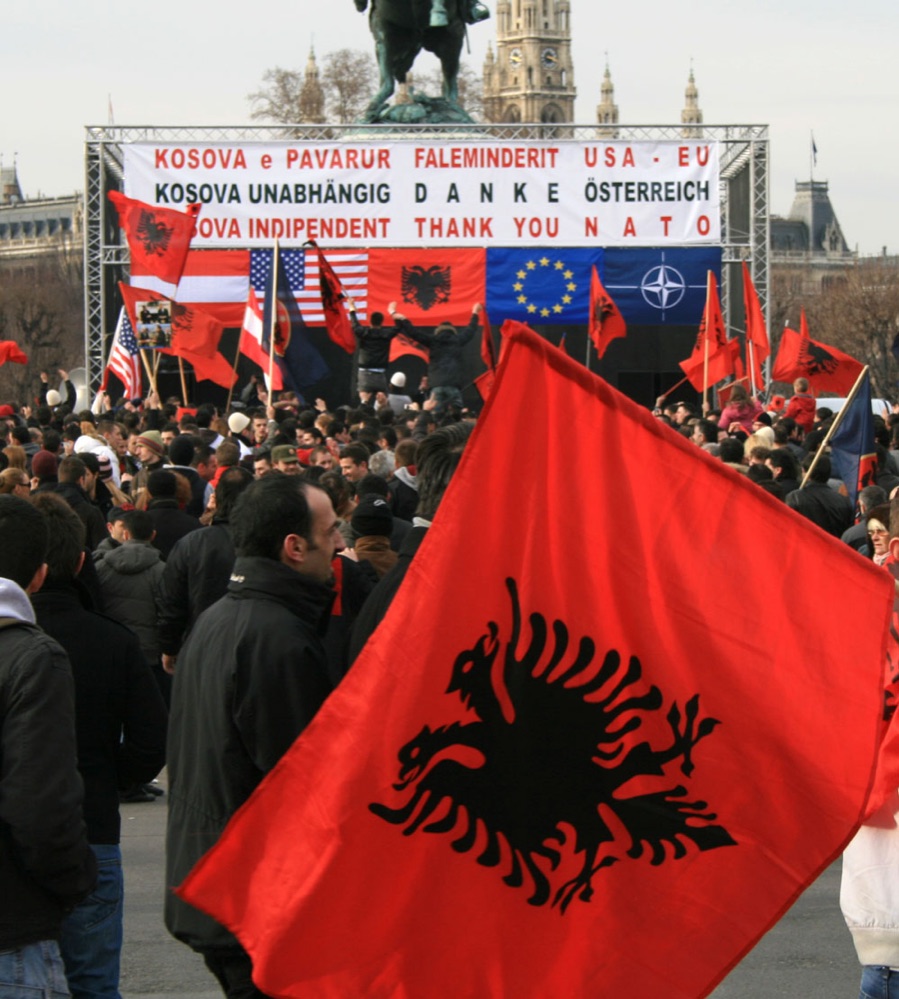
The mobilisation also had an armed edge. In April, roughly three hundred Albanian Americans assembled in a Yonkers parking lot for a swearing-in connected to the Kosovo Liberation Army. On 17 April, about ninety left the New York area on a charter to Tirana and joined the Atlantic Brigade. The participants ranged from US-born teenagers to older immigrants. Three New York residents in the unit — the Bytyqi brothers — were later detained and killed in Serbia after the war; their case remains a continuing subject of congressional resolutions.
This history should not be flattened into either triumph or scandal. American Albanians used lawful lobbying, humanitarian relief, family sponsorship, fundraising and — in a smaller number — overseas military service. Those actions belonged to different legal and moral categories. Together they show how intensely the New York community understood Kosovo as a family emergency rather than distant foreign policy.
From a lobby to representation
In 2012 Bronx Democrat Mark Gjonaj became the first Albanian-American elected to office in New York State, and in 2017 the first elected to the New York City Council. His district included Allerton, Morris Park, Pelham Parkway and other east Bronx neighborhoods at the centre of the community. Albanian political visibility had moved from lobbying people in office to electing one of its own.
The five boroughs, one by one
A borough count is useful for scale. It is not enough for finding the community. The local picture below uses Census ZCTAs — statistical approximations of ZIP codes — because they have larger samples than tracts and are recognisable to residents. Even so, the margins of error remain wide.
Swipe horizontally to explore the full chart.
Bronx — 8,828 ± 1,300
The Bronx has the strongest institutional visibility. Lydig Avenue, Pelham Parkway and Allerton form the residential belt; Arthur Avenue and Belmont carry the restaurant and market identity. ZCTA 10461’s 4.15% share is the clearest postal-area signal. The borough is also home to Vatra’s headquarters, Albanian-language schools, community charities and long-running public celebrations.
Its strength is not only density. The Bronx community built an ecosystem in which a new arrival could find food, work, religious services, translation help and relatives within a few subway stops. That is what turns a cluster into an enclave.
Queens — 9,655 ± 1,586
Queens has the largest borough point estimate but a less concentrated public identity. Ridgewood and Glendale form one visible cluster; Astoria and other northwest Queens neighborhoods hold another; Jamaica Estates is home to St Nicholas Albanian Orthodox Church. ZCTA 11385, covering Ridgewood and Glendale, records 2,314 ± 896 Albanian-ancestry residents, or 2.28%.
The Albanian-American Islamic Center of Queens was established in 1997, completed its facility in 2000 and held its inauguration in 2002. Its services include religious and Albanian-language education, illustrating how a faith institution also works as a cultural and youth centre.
Staten Island — 8,651 ± 1,763
Staten Island is the statistical surprise: almost as many Albanian-ancestry residents as the Bronx in a borough with roughly one third of the population. Its 1.748% share is the city’s highest by far. ZCTA 10305 records 1,563 ± 584, or 3.79%; neighboring 10306 records 1,752 ± 1,127, or 3.05%.
The island’s community includes families from Kosovo, northern Albania and the Albanian areas of Montenegro and North Macedonia. Regional associations such as Ana e Malit maintain schools, dance and cultural events. The Albanian Islamic Cultural Center on Victory Boulevard is both a religious institution and a community address.
Brooklyn — 7,684 ± 1,230
Brooklyn’s Albanian map is split. Bensonhurst and Bath Beach show a large ZCTA-level count — 2,253 ± 663 in 11214 — while Flatbush holds the historic 1972 Albanian-American Islamic Center at 1325 Albemarle Road. Brooklyn also supplied restaurant work and ownership across the city’s Italian commercial landscape.
The borough’s 7,684 estimate is larger than many readers expect because it lacks a single branded Albanian street. Dispersal can hide population without reducing it.
Manhattan — 2,684 ± 774
Manhattan has the smallest residential estimate and the greatest diplomatic and symbolic role. Albania’s consulate and UN mission are on East 79th Street; Kosovo’s consulate is near the United Nations; the Albanian Roots Parade runs through Manhattan; and Bowling Green hosts flag-raising ceremonies around 28 November.
Manhattan is therefore where Albanian New York becomes public, even when most participants travel in from another borough or the suburbs.
The move north: Yonkers, Westchester and Putnam
The most important geographic change in Albanian New York is not a move from one city borough to another. It is the northward extension of the Bronx network.
Westchester County now records 8,932 ± 1,618 Albanian-ancestry residents, 0.893% of its population. Yonkers alone records 3,517 ± 1,036, or 1.675%. Putnam County is smaller at 1,016 ± 548, but its point share is 1.036%. The strongest postal-area figure is ZCTA 10704 in north Yonkers: 2,424 ± 1,029, or 7.59%.
Swipe horizontally to explore the full chart.
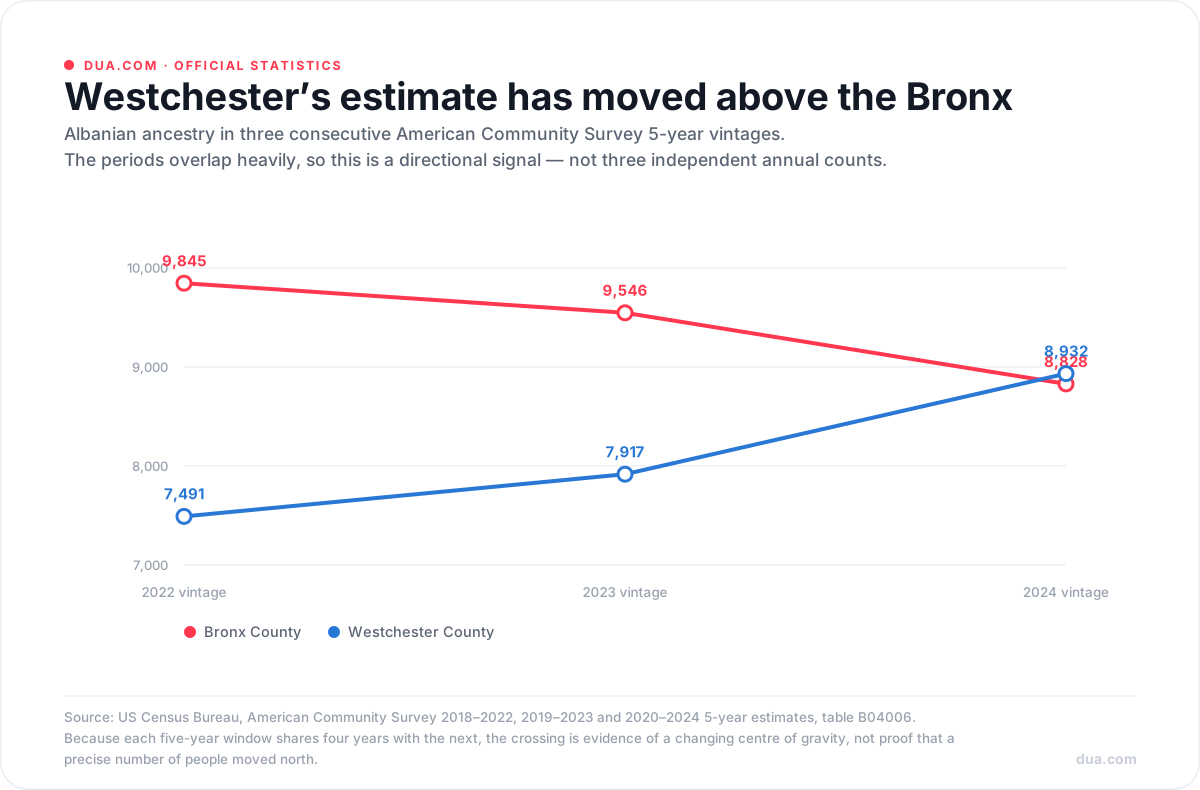
The survey sequence is striking: the Bronx moves from 9,845 in the 2018–2022 vintage, to 9,546 in 2019–2023, to 8,828 in 2020–2024. Westchester moves from 7,491, to 7,917, to 8,932. The lines cross in the latest release.
It would be wrong to subtract the two lines and announce a migration count. The windows overlap, margins of error are wide and births, deaths, immigration and survey variation all contribute. It is reasonable, however, to read the consistent direction alongside institutional evidence: families have extended the east Bronx corridor into Westchester.
The church moved before the statistic did
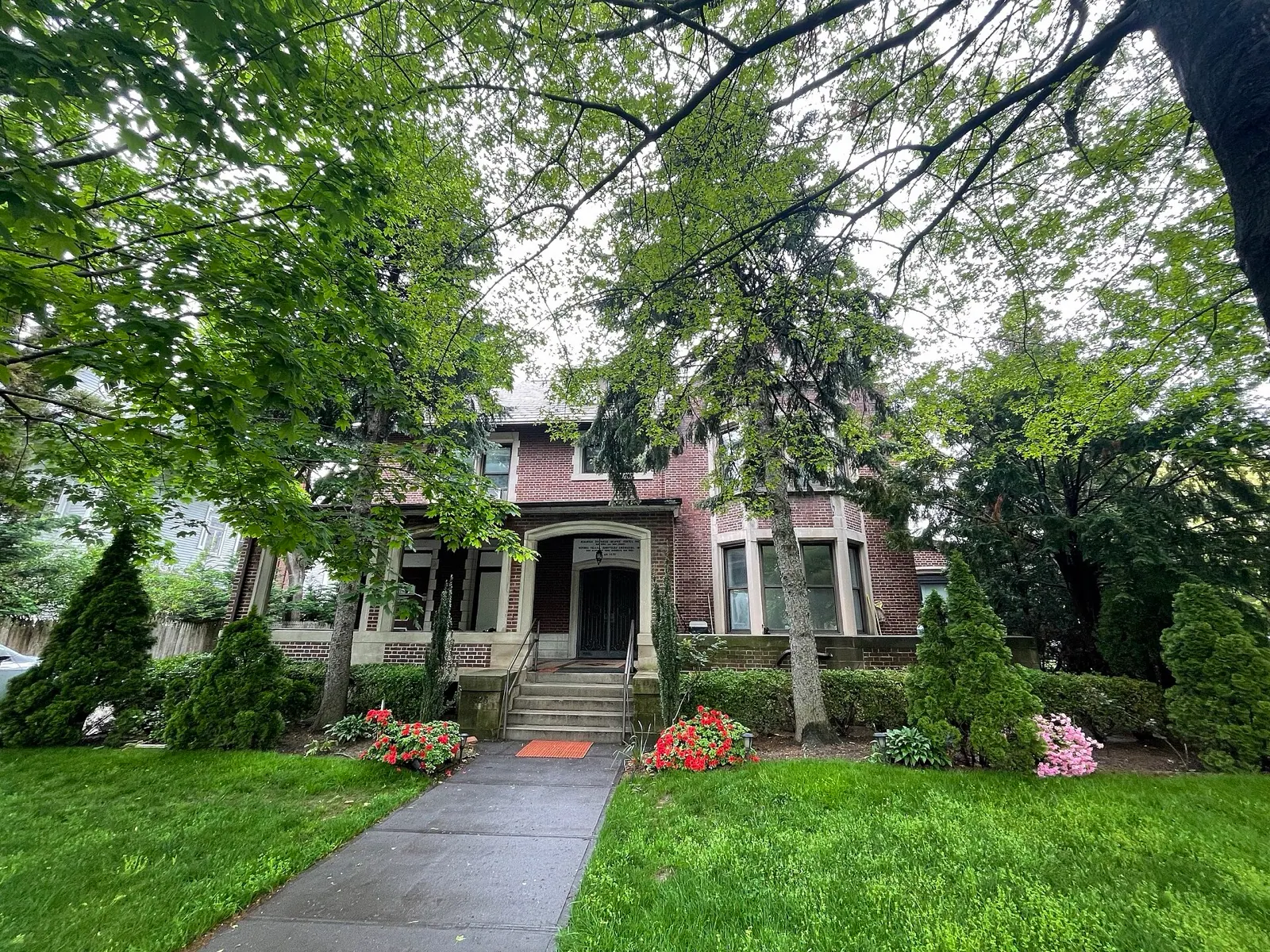
The Albanian Catholic centre opened at 4221 Park Avenue in the Bronx in 1970. Cardinal John O’Connor established Our Lady of Shkodra as the first Albanian Catholic parish in the United States in 1989. On 25 April 1999 he consecrated its new church at 361 West Hartsdale Avenue.
That move was more than a building project. A parish follows the families who baptise children, hold weddings and bury parents. Two decades before the Census series put Westchester above the Bronx, the institution had already traced the same suburban path.
Four traditions and the institutions they built
No American census asks religion, so there is no defensible percentage of Albanian New Yorkers who are Muslim, Catholic, Orthodox, Bektashi or secular. The institution map is a better guide than invented shares.
Orthodox: Jamestown to Jamaica Estates
St Elia in Jamestown preserves the oldest New York strand. In New York City, St Nicholas Albanian Orthodox Church was founded in 1941, first worshipped in borrowed Manhattan space and has been based in Jamaica Estates, Queens, since 1970. It belongs to the Albanian Archdiocese of the Orthodox Church in America.
The Orthodox story is tied to language and nation as much as to denomination. Fan Noli’s early mission was to make worship possible in Albanian rather than Greek. The New York parishes helped carry that project into a generation born in English.
Muslim: Flatbush, Queens and Staten Island
On 12 November 1972 Albanian Muslims from New York and New Jersey opened their first dedicated centre in a converted mansion at 1325 Albemarle Road in Flatbush. They had previously worshipped in Arab mosques and taught children in borrowed rooms on the Lower East Side. The building had no minaret and still contained a basement bowling alley awaiting conversion — an unusually New York beginning for a religious institution.
Later institutions followed where the community grew: the Albanian-American Islamic Center of Queens on Myrtle Avenue and the Albanian Islamic Cultural Center on Victory Boulevard in Staten Island. Their programs extend beyond prayer into language classes, youth work, funerals, marriage services and community aid.
Catholic: the Bronx and Hartsdale
The Albanian-American Catholic League was organised in 1962. The Park Avenue centre officially opened in April 1970 before a congregation reported at more than six hundred, including Muslim and Orthodox Albanian guests. Two Bronx centres later merged into Our Lady of Shkodra; the parish was erected in 1989 and its Hartsdale church consecrated in 1999.
Its first pastor, Rrok Mirdita, was named Archbishop of Tiranë–Durrës in 1992 and consecrated by Pope John Paul II in 1993. A parish created by exiles in New York supplied a leader to the Catholic Church emerging from Albania’s ban on religion.
Bektashi and secular life
New York Albanians also include Bektashi families and a large secular population shaped by communist Albania and Yugoslav civic life. National events routinely cross faith lines. The 1970 Catholic opening welcomed all three major traditions; Kosovo mobilisation drew religious and secular organisations into the same cause; and the parade is national and cultural rather than confessional.
The distinctive feature is not the absence of difference. It is the number of institutions that learned to treat religious difference as compatible with a shared language and national life.
Language, schools and the next generation
New York’s Albanian language exists in layers. A grandparent from Korçë may speak Tosk; a family from Kosovo or Montenegro may speak a Gheg variety; schoolbooks teach the standard language codified in Albania. Children often understand the home dialect before they can read standard Albanian. The classroom is therefore not just preserving vocabulary. It is teaching a written bridge between family varieties.
Swipe horizontally to explore the full chart.
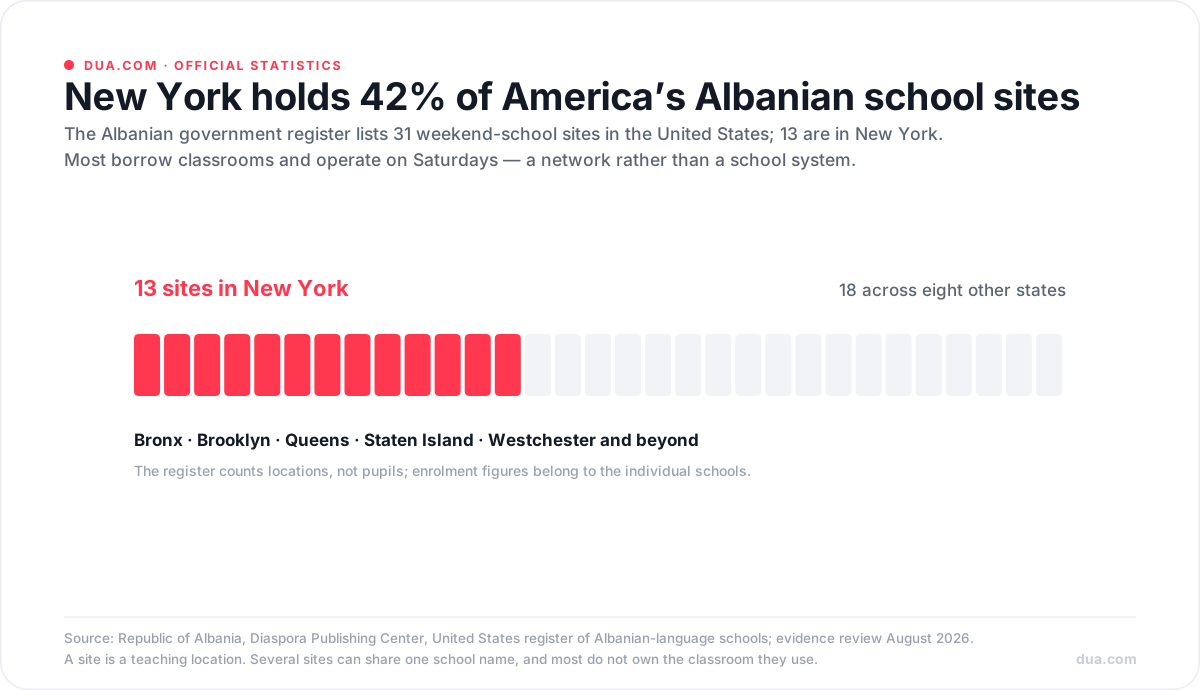
The Republic of Albania’s diaspora education register lists 13 New York sites out of 31 in the United States. They include locations in the Bronx, Brooklyn, Queens, Staten Island and the suburbs. Some are church or association programs; many rent or borrow public-school classrooms on weekends. The network is organisationally fragmented, but geographically dense.
Alba Life operates programs across New York and has received formal recognition from the State Assembly. Children of the Eagle and the Albanian-American Dual Language and Culture organisation have worked on bilingual education. Mëso Shqip on Staten Island grew through associations from Ana e Malit, Kraja and Ulqin. The Bronx school connected to Open Hand and Vatra runs Saturday classes.
Two public-school milestones: 2018 and 2025
New York City Public Schools announced its first Albanian dual-language program in the Bronx in 2018, at P.S. 105 in Morris Park. That earlier milestone matters because the 2025 launch is sometimes described too broadly as the first time Albanian entered a city public school.
In the 2025–2026 school year, P.S. 108 in the Bronx opened a new Albanian–English kindergarten program taught five days a week by certified city teachers. The useful distinction is full-time, five-day instruction, not the first appearance of Albanian in public bilingual education. Both models are structurally different from a weekend class: Albanian becomes a language of ordinary instruction rather than a heritage subject fitted around the school week.
The long-term test is not whether children can perform a poem on Independence Day. It is whether they can read a message from a grandparent, understand a news article, speak without embarrassment and carry the language into adulthood. New York has more infrastructure for that test than any other Albanian community in America.
The English-speaking Albanian
Language loss does not end identity. A New York-born Albanian may know family origin, weddings, food, religious holidays and the political memory of Kosovo while speaking little Albanian. Census ancestry can survive after language; language can also survive in a person who does not write Albanian in the ancestry box. Treating either measure as a purity test misunderstands what diaspora identity is.
The practical response is to build more entry points: beginner classes for adults, reading programs for heritage speakers, cultural events not restricted by faith, and digital spaces where people can arrive without already knowing everyone.
See Albanian New York: parades, festivals, food and community
Numbers explain the scale; public events show the community itself. The most useful way to experience Albanian New York is to combine one citywide gathering, one neighborhood visit and one institution or class whose purpose matches your own.
The Albanian Roots Parade
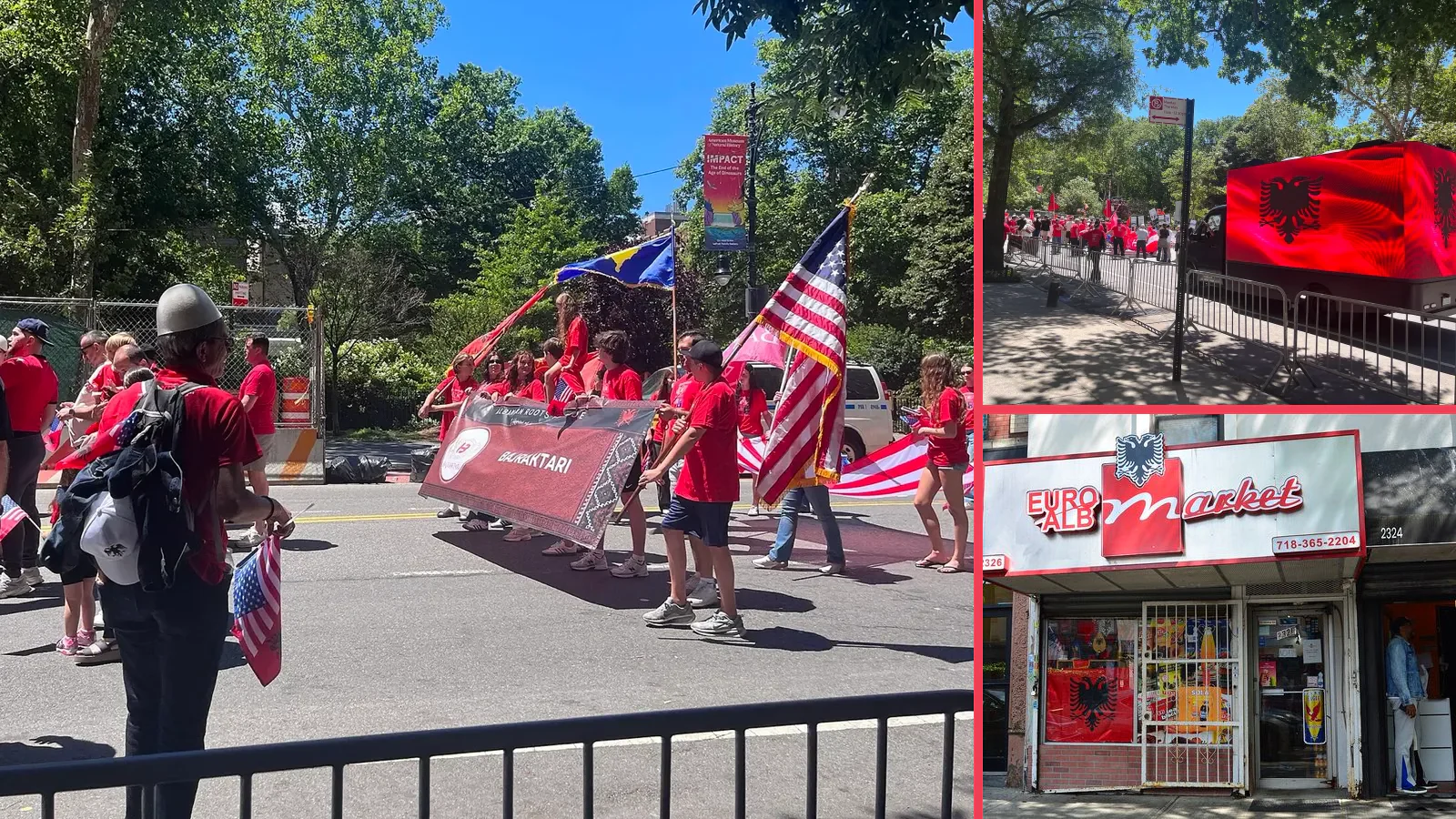
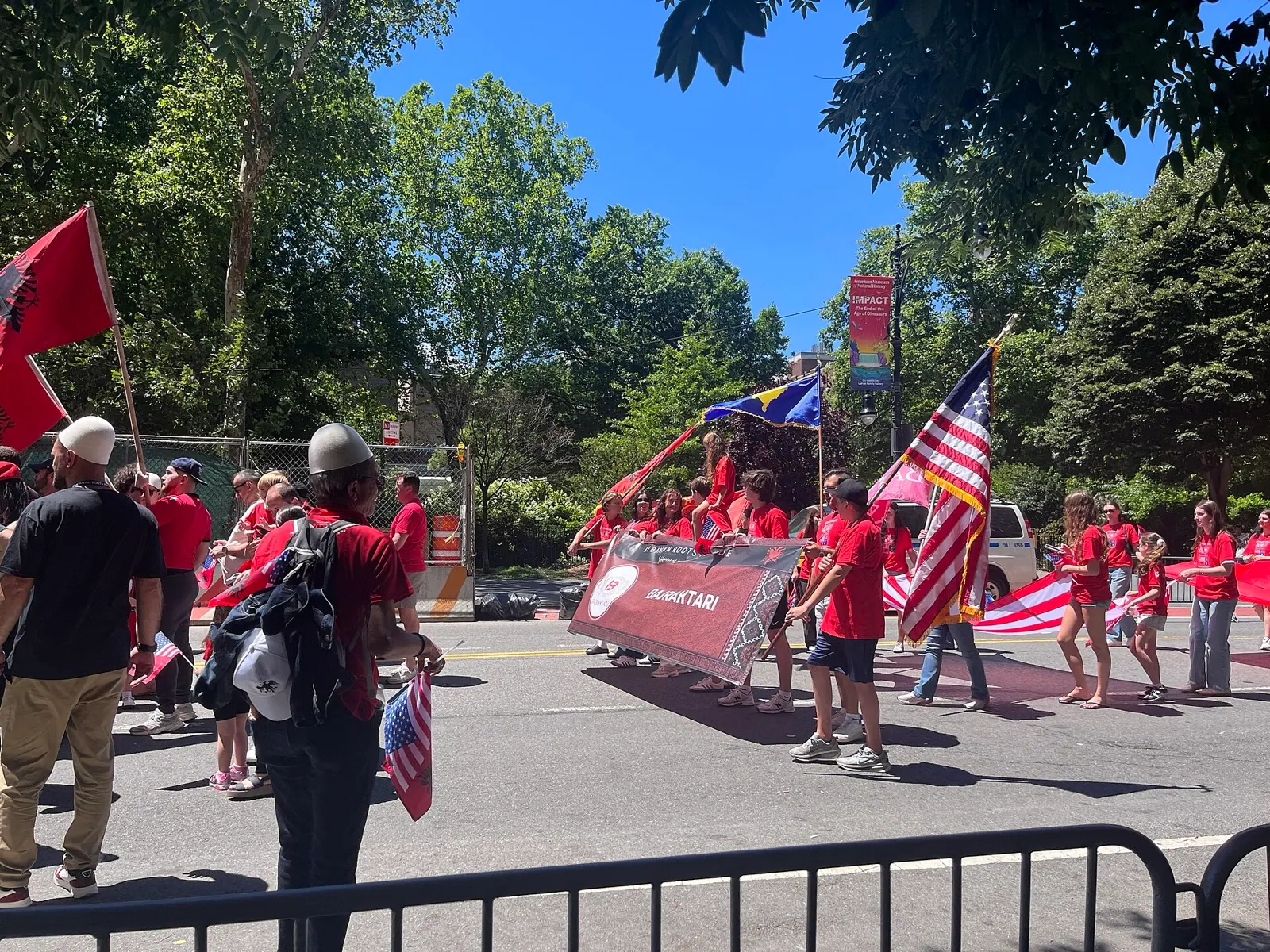
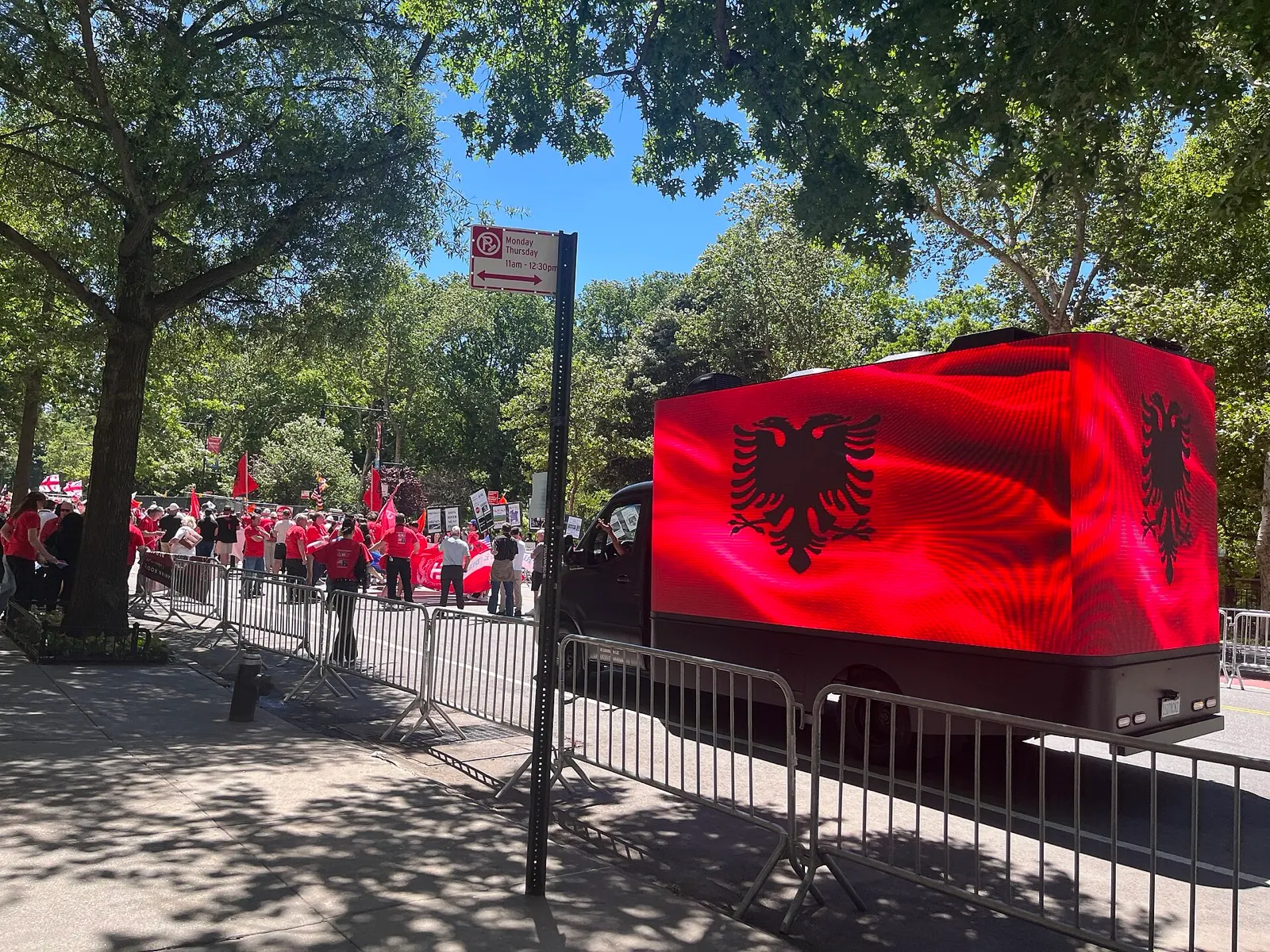
Albanian Roots, founded in 2009, organises New York’s principal Albanian parade. The 2026 edition took place near Central Park on 20 June 2026, bringing families, youth groups, regional banners, traditional dress, music and Albanian, Kosovo and American flags into the same civic space. Future dates and routes should be checked with the organiser rather than copied from a previous year.
Albanian Heritage Night at City Hall
The New York City Council’s official album records the 24 November 2025 Albanian Heritage Night as a civic gathering rather than a celebrity photo call: families, organisers, honorees, performers and elected representatives share the frame.
The Skenderbeu Street Fair on Arthur Avenue
A usable public-event calendar
Dates move, and several events are announced only weeks or months ahead. Use this as a route to the organiser, not as a permanent calendar.
Swipe horizontally to compare the full event calendar.
| Event | Latest documented edition | Where to verify the next one |
|---|---|---|
| Albanian Roots Parade | 20 June 2026, Manhattan near Central Park | Albanian Roots |
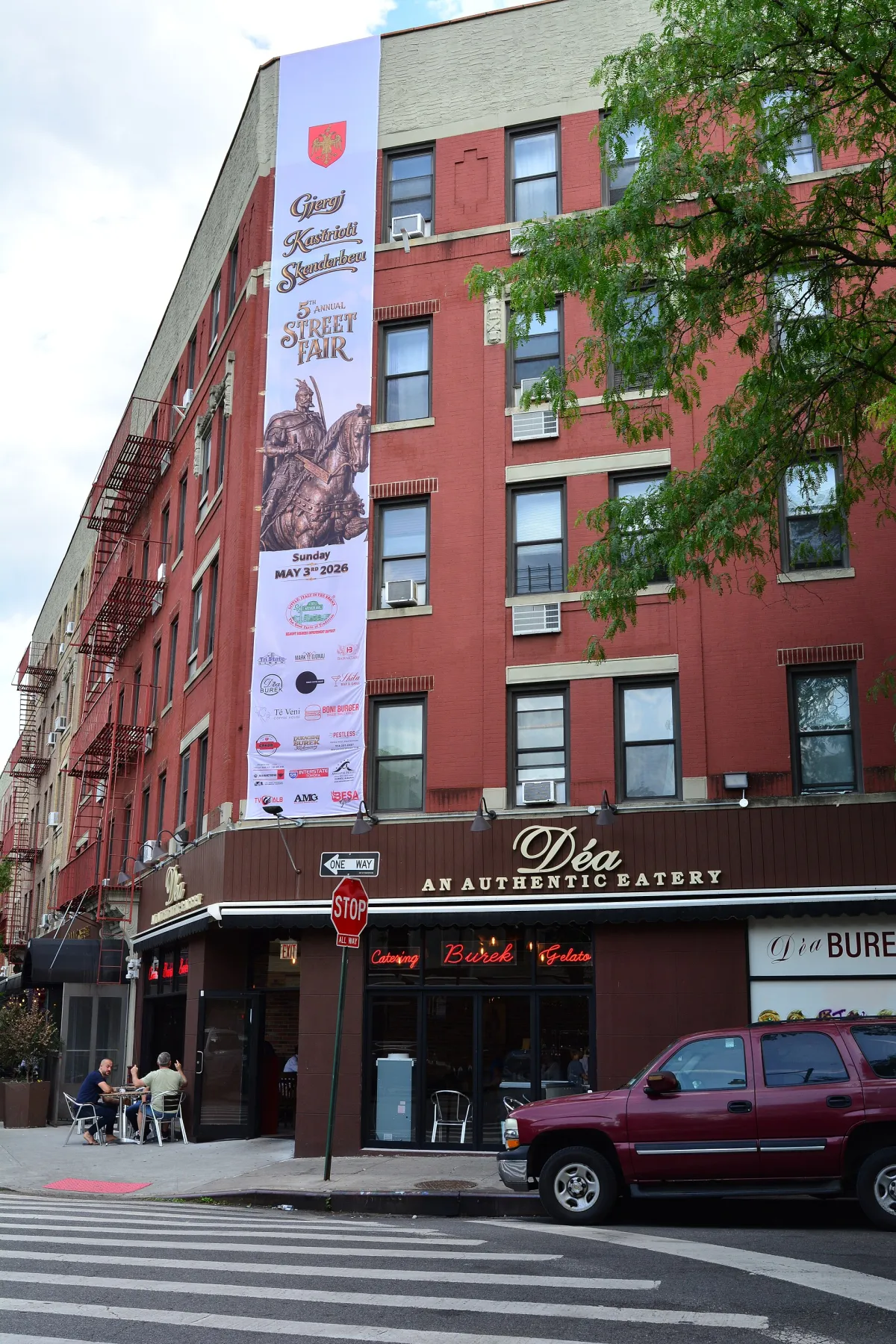
| Gjergj Kastrioti Skenderbeu Street Fair | 3 May 2026, Crescent and Arthur Avenues in the Bronx; fifth annual edition | Bronx Little Italy / Belmont BID |
| United FestivALB | 16–17 May 2026 debut, SIUH Community Park, Staten Island | Official site and 2026 gallery |
| Annual Albanian Picnic NYC | 31 May 2026, Wolfe’s Pond Park, Staten Island; fourth annual edition, reported at more than 8,000 attendees | Organizer listing and 65-photo event report |
| Albanian Heritage Night | 24 November 2025, New York City Council | Official 18-photo album |
| Albanian Independence Day | Around 28 November; civic flag raisings have included Bronx Borough Hall, Bowling Green and White Plains | Bronx Borough President and local organiser pages |
| Schools, parishes, mosques and regional associations | Weekend classes, performances, picnics, holiday programs and fundraisers throughout the year | Use the official institutions in the directory below |
The Albanian Picnic on Staten Island
From invisible ownership to an Albanian menu
Albanian workers once ran Italian restaurants without marketing them as Albanian. Today, restaurants such as Çka Ka Qëllu and Dua Kafe put Albanian food and language on the front door. Arthur Avenue captures both histories: an Italian commercial district where Albanian-owned markets, pizzerias and restaurants now form a visible second layer.
What to order first
- Byrek: flaky filled pastry; spinach, cheese and meat versions are common.
- Fli: layered batter and cream, strongly associated with Kosovo and usually made for sharing.
- Qofte and mixed grill: the easiest introduction to the northern and Balkan grill tradition.
- Tavë dheu: baked meat, cheese and pepper dish served in an earthenware pan.
- Speca me gjizë: peppers with soft cheese; useful as a side to a richer grill.
- Trileçe: milk-soaked cake found across the Albanian-speaking world.
Regional menus differ, and a restaurant described broadly as “Balkan” may still have a distinctly Albanian kitchen. Ask what is made in-house and what the kitchen considers its regional specialty.
The community room moved online
For much of the 20th century, Albanian New Yorkers found one another through institutions. Newspapers such as Dielli, organizations such as Vatra, churches, mosques, hometown associations and community events did more than share information: they created a common room for a population building a life far from home.
That room still exists, but it no longer has one address.
Today, Albanian New Yorkers move between physical and digital networks. Community news travels through websites and social media; events spread through organizer pages and messaging groups; family and hometown networks continue online long after people have moved away from the neighborhoods where those relationships began.
That matters because Albanian New York itself has changed. The community now stretches from the Bronx and Queens to Staten Island, Westchester and beyond. Children and grandchildren of immigrants may remain strongly connected to their Albanian identity without living near the relatives, institutions or neighborhoods that once made those connections automatic.
Digital networks do not replace Vatra, the local church or mosque, the football club, the Albanian school, the wedding or the cousin who knows everyone. They extend their underlying function: helping people find information, community and one another when geography or existing social circles no longer do the work on their own.
That shift—from a community organized around shared places to one that can also connect across distance—helps explain where platforms such as dua.com fit into Albanian New York today.
People who made Albanian New York visible
New York’s contribution is not a list of celebrities who happened to have an Albanian parent. The more interesting group are people whose work made the community legible in American politics, media, business and culture.
- Joseph J. DioGuardi, a New York congressman from 1985 to 1989 and the first Albanian-American voting member of Congress, founded the Albanian American Civic League.
- Mark Gjonaj became New York State’s first Albanian-American assembly member in 2012 and New York City’s first Albanian-American council member in 2017.
- Harry Bajraktari, a Kosovo-born Bronx entrepreneur, founded the bilingual newspaper Illyria in 1991.
- Gjon Mili made New York his studio, brought stroboscopic motion photography into LIFE and directed the National Film Registry jazz short Jammin’ the Blues.
- Stan Dragoti was part of the team behind the I ♥ NY campaign.
- Ilir Sela, raised in a Staten Island pizzeria family, built Slice around independent pizza shops.
How Albanians in New York connect today
Albanian New York still runs on dense networks: family introductions, weddings, religious centres, football clubs, restaurants, schools and associations based on a hometown or region. Those networks are powerful because they carry trust. They are also limited because the same people recur and because the community now lives across five boroughs, Westchester, Long Island, New Jersey and Connecticut.
The second generation faces a different problem from the immigrant generation. Their Albanian identity may matter strongly, but they are less likely to live on the same block as cousins from the same village. A person in Staten Island, Ridgewood and Yonkers can belong to one metropolitan community and still be two hours apart by public transport.
The cross-border pattern is especially revealing. New York's Albanian community has never been socially contained by New York: family, politics, migration and community life have connected it to the Balkans for generations. The 1,631 matches between New York members and members in Albania, Kosovo and North Macedonia show a contemporary version of that same transatlantic relationship.
Prishtina and Tirana appearing among the most-selected destinations reinforces the point. The technology is new; the geography of connection is not.
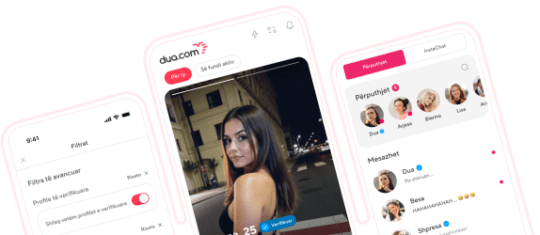
For people seeking a relationship within the culture, dua.com adds a route that does not depend on asking the same cousin circle. The important distinction is choice: cultural compatibility can matter without reducing a person to origin, faith or dialect. Profiles, intentions and safety still matter, and anyone meeting offline should follow the same precautions explained in dua.com’s safety guidance.
The wider lesson applies beyond dating. New York’s institutions work best when they help people enter the community without requiring an existing gatekeeper. That is why public events, beginner language classes, professional groups and searchable directories matter alongside the older village and parish networks.
Readers who want the national comparison can return to the full guide to Albanians in the United States; readers interested in how couples bridge geography can browse verified dua.com love stories.
A practical Albanian New York directory
Addresses and schedules change. Use the linked official page to confirm services, appointments and event times before travelling.
| Institution | Where | What it is for |
|---|---|---|
| Consulate of Albania | 320 E 79th St, Manhattan | Albanian passports, civil and consular services; appointments required for many services. |
| Consulate of Kosovo | 801 Second Ave, Suite 301, Manhattan | Kosovo consular services; verify the current appointment procedure through official government channels. |
| St Nicholas Albanian Orthodox Church | 181-14 Midland Pkwy, Jamaica Estates | Orthodox worship, Sunday school and parish life. |
| Albanian-American Islamic Center | 1325 Albemarle Rd, Brooklyn | Historic 1972 mosque and community centre serving New York and New Jersey. |
| Albanian-American Islamic Center of Queens | 72-24 Myrtle Ave, Glendale | Prayer, Albanian and religious education, youth and community services. |
| Albanian Islamic Cultural Center | 307 Victory Blvd, Staten Island | Prayer, education, events and community services. |
| Our Lady of Shkodra | 361 W Hartsdale Ave, Hartsdale | Albanian Catholic parish, Mass, catechism and cultural life. |
| Albanian & American Open Hand Association | 2141 Holland Ave, Bronx | Food aid, disability support, disaster relief, school and community programs. |
| Albanian Roots | New York metropolitan area | Annual Manhattan parade, picnics, cultural and networking events. |
| Ana e Malit Association | 489 Midland Ave, Staten Island | Mëso Shqip weekend school, dance, heritage and regional association life. |
| Illyria | New York | Albanian-American news and community coverage, founded in the Bronx in 1991. |
Where to begin by interest
- New to the city: start with a public parade, street fair, language class or cultural event rather than waiting for a private introduction.
- Learning Albanian: ask the listed school networks whether they accept adults or can refer you to a heritage-speaker class; programs and sites change by term.
- Consular documents: use only official Albania or Kosovo government channels and confirm appointment rules before paying any third party.
- Food: Arthur Avenue and the Pelham Parkway belt are the most concentrated first visit; Ridgewood, Manhattan, Brooklyn and Staten Island also have Albanian kitchens and cafés.
- Professional connections: look for Albanian-American professional associations and public networking events; verify that any group is currently active.
Methodology: what we counted, and what we refused to guess
Primary statistical source
All current population, county, place, tract and ZCTA figures come from the US Census Bureau’s American Community Survey 2020–2024 five-year estimates, table B04006, variable B04006_003 (“Albanian”). Total-population denominators come from B04006_001. Margins of error are the table’s published 90% margins.
Five-year ACS estimates pool sixty months of survey responses. “2024” is the release endpoint, not a count taken on one day in 2024. This is why the page says 2020–2024 and why the trend chart calls each release a survey vintage.
Geography rules
- New York City is the sum published for the consolidated city geography and is independently available as 37,502 ± 2,961.
- Boroughs use county equivalents: Bronx, Kings, New York, Queens and Richmond counties.
- The metro is the Census Bureau’s New York–Newark–Jersey City, NY–NJ metropolitan statistical area used by the 2024 ACS. It crosses the New York–New Jersey state line; Connecticut is outside this metro definition.
- ZCTAs are Census approximations of postal ZIP codes. They should not be described as exact ZIP or neighborhood borders.
- Census tracts are small statistical areas. The page reports Tract 330 only with its numerator, denominator and margin of error, and does not use it as a literal neighborhood headcount.
Selection rule for the local chart
The ZCTA chart includes New York areas with at least 100 estimated Albanian-ancestry residents, a total population above 1,500 and an Albanian point estimate larger than its published margin of error. This removes tiny places whose dramatic percentages are statistically indistinguishable from zero. It does not make the remaining estimates exact.
Trend rule
The Bronx–Westchester chart uses the 2018–2022, 2019–2023 and 2020–2024 ACS five-year releases. Adjacent releases share four of five survey years. We therefore describe the crossing as directional evidence and do not calculate a migration flow from the difference.
Population claims we did not merge
We did not add Albania-born residents to Albanian-ancestry residents; many are the same people. We did not invent a count for Kosovo-born New Yorkers from a table that does not publish one. We did not multiply the Census figure to force agreement with a community estimate. We report official ancestry, attributed community claims and aggregated dua.com activity as different categories.
Historical method
Institutional dates were checked against official parish, mosque, city, Library of Congress and organisation records. Contemporary journalism is used for individual economic histories and the 1999 mobilisation, with claims attributed to the report rather than generalised to the whole community. Restaurant and event listings were current at the evidence review date and should be rechecked before a visit.
Correction policy: if you have a primary record that changes a date, address or figure, contact the editorial team with the document. We will distinguish a correction to evidence from a difference in how “Albanian” is defined.
Frequently asked questions about Albanians in New York
How many Albanians live in New York City?
The latest published Census estimate is 37,502 ± 2,961 people reporting Albanian ancestry in New York City, from the American Community Survey 2020–2024 five-year table B04006. That is 0.442% of the city. It is a self-reported ancestry estimate, not a count of every person of Albanian descent.
How many Albanians live in New York State?
56,959 ± 3,701 people report Albanian ancestry in New York State. The New York–Newark–Jersey City, NY–NJ metro has a larger estimate, 68,240 ± 4,275, because it crosses into New Jersey. Connecticut belongs to the broader combined statistical area, not this 2024 ACS metro geography. State and metro are different overlapping geographies.
Which New York borough has the most Albanians?
Queens has the largest point estimate at 9,655, followed by the Bronx at 8,828 and Staten Island at 8,651. Their margins of error overlap, so the survey does not support treating the ordering as exact. Staten Island has by far the highest share of local population at 1.748%.
Where is Little Albania in New York?
“Little Albania” most often means the east Bronx: Pelham Parkway, Allerton, Morris Park and Lydig Avenue, with a commercial and restaurant extension around Arthur Avenue in Belmont. It is not an official boundary. The wider community also has major concentrations in Queens, Staten Island, Brooklyn, Yonkers and Westchester.
Why did so many Albanians settle in the Bronx?
Post-1965 migrants found affordable housing, relatives and jobs that could be entered with limited English. Italian-speaking Albanians from Yugoslavia or refugee camps could work with Italian landlords and restaurants. Building-superintendent jobs sometimes included an apartment and created a route into construction, management and ownership.
Is Staten Island more Albanian than the Bronx?
By local share, yes: 1.748% of Staten Island reports Albanian ancestry against 0.628% of the Bronx. By estimated headcount they are close — 8,651 on Staten Island and 8,828 in the Bronx — and the margins of error overlap. The Bronx remains more institutionally visible.
Where are the strongest Albanian neighborhoods outside NYC?
North Yonkers is the clearest local concentration: ZCTA 10704 estimates 2,424 ± 1,029 Albanian-ancestry residents, 7.59% of the area. Westchester County has 8,932 ± 1,618 overall, and Putnam County’s point share is 1.036%.
Are New York Albanians mainly from Albania or Kosovo?
Both, and from other Albanian regions. The modern Bronx and Staten Island communities include many families from Kosovo, Montenegro and North Macedonia, while New York also has postwar political refugees and post-1990 migrants from Albania. The US ancestry table does not publish a reliable origin breakdown within the Albanian category.
What Albanian religious centres are in New York?
Major institutions include St Nicholas Albanian Orthodox Church in Jamaica Estates; the Albanian-American Islamic Center in Flatbush; the Albanian-American Islamic Center of Queens in Glendale; the Albanian Islamic Cultural Center on Staten Island; and Our Lady of Shkodra Catholic Church in Hartsdale. Confirm service times on official sites.
Are there Albanian schools in New York?
Yes. The Albanian government register lists 13 New York teaching sites, 42% of all US sites. Programs include Alba Life, Children of the Eagle, Mëso Shqip and schools connected to community and religious organisations. New York City announced an Albanian dual-language program at P.S. 105 in 2018; P.S. 108 added a five-day kindergarten program in the 2025–2026 school year.
Where can I find Albanian food in New York?
Arthur Avenue and the Pelham Parkway belt in the Bronx are the most concentrated first stop, with Albanian restaurants, cafés and European markets. Albanian kitchens and cafés also operate in Manhattan, Ridgewood and Glendale, Brooklyn and Staten Island. Check current hours and reservations before visiting.
When is the Albanian parade in New York?
The Albanian Roots Parade is normally held in Manhattan in June; the 2026 event was on 20 June. The date and route can change, so use the organiser’s official site for the next edition. Albanian Independence Day is 28 November and is marked with flag raisings and community events.
What role did New York Albanians play in Kosovo?
New York was central to lobbying, fundraising, news and relief. Joseph DioGuardi held a Kosovo hearing in Congress in 1987 and founded the Albanian American Civic League in 1989; Illyria began publishing in the Bronx in 1991; New York organised relief in 1999; and volunteers assembled in Yonkers before some joined the Atlantic Brigade.
How can I meet other Albanians in New York?
Public routes include Albanian Roots events, street fairs, religious centres, language schools, professional groups, football and regional associations. For dating, 3,245 dua.com members live in New York; the platform lets people search beyond one borough or family circle while keeping Albanian cultural context.