Romania's last census counted 645 Albanians. The same country is where an Albanian primer was published as early as 1844, where the poet who wrote the words of Albania's anthem made his home for six decades, and where Ismail Qemali stopped to gather companions a little over three weeks before independence was declared. This guide follows that community from a report of 1595 to the people who keep it going today: who came, what they built, how few they have become, and where to find Albanian Romania now.
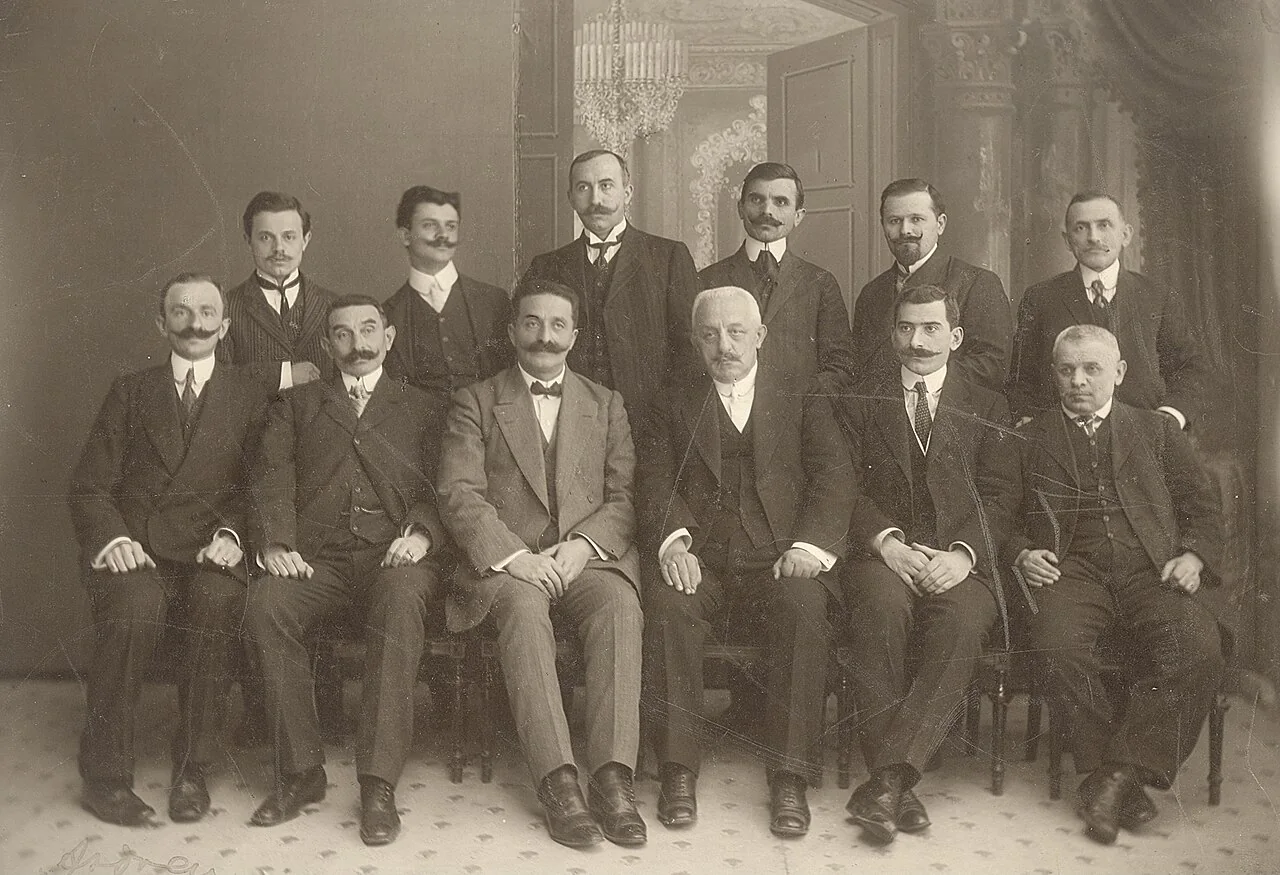
In early November 1912 Ismail Qemali was on his way from Istanbul to Vienna. He crossed the Black Sea to Constanța and went on to Bucharest; the itinerary published by the researcher Kastriot Dervishi places him there on 5 November. What happened next takes two sentences of his memoirs: "On my return journey I arrived at Bucharest, where there was a large Albanian colony. As the result of a meeting we held there, fifteen of my compatriots decided to go back with me to Albania." He telegraphed ahead to call a national congress at Vlorë.
On 28 November that congress resolved that Albania should be "free and independent". Its minutes list four delegates "from the Albanian colony of Bucharest", every one of them called Dhimitër: Zografi, Mbroja, Beratti and Ilo, the last still on the road. How a colony of merchants and craftsmen in a foreign capital came to sit in that room is a story of three centuries, and above all of one generation of printers and poets.
How many Albanians live in Romania?
A few hundred by the census, about a thousand by passport. The census of 1 December 2021 recorded 645 residents of Albanian ethnicity and 421 with Albanian as their mother tongue, in a resident population of 19,053,815: the smallest national minority in the published tables. Eurostat estimates that 958 citizens of Albania were living in Romania on 1 January 2025, a group that only partly overlaps with the first. Two larger figures are not headcounts. The League of Albanians' list won 9,177 votes at the parliamentary election of 2024, but Romanian electoral law gives every voter one vote for the Chamber and does not tie it to ethnicity. The 10,000 "of Albanian origin" quoted in the early 1990s, the community's own chronology says, "had no real basis". And the 4,670 Albanians of the 1930 census include more than a third who lived in a village that is now in Ukraine. The section on counting, after the history, takes these figures apart.

Who were the first Albanians in Romania?
The oldest document cited is a report of March 1595 by Giovanni de Marini Poli, an envoy of the Habsburg emperor, saying that Prince Michael the Brave had allowed some 15,000 Albanians to settle north of the Danube in Wallachia. Romania's minorities institute, the League of Albanians and the Council of Europe all take that report as the first attestation. The accounts that cite it disagree on its day and on whether the 15,000 included families. Lidia Cotovanu of the Nicolae Iorga Institute of History, who studies these settlers, reads the number as Michael's recruits from Ottoman lands, of whom only some were Albanians.
What can be traced on the ground is smaller. Michael, Cotovanu explains, spread his Balkan soldiers in small groups across princely villages. The best documented is Călinești, in today's Prahova county north of Bucharest, whose arbănași, the descendants of those soldiers, had their collective privileges confirmed by Prince Constantin Brâncoveanu in April 1689.
Individuals turn up in Bucharest too. The historian Constantin C. Giurescu, in his history of the city, cites a deed of 30 March 1628 in which "Gheca arbănașul", Gheca the Albanian, stands witness to the sale of a house plot. Princely charters of 1623 and 1628 list the inhabitants of Bucharest quarters with the formula "whether Romanian, or Greek, or Serb, or Albanian". In 1693 two Albanians, Dima and Leca, sell a plot in the Colțea quarter; in 1763 a pie-maker called Leca, "by his name an Albanian" in Giurescu's words, rents a shop for five thalers a year.
Arbănași and arnăuți
Romanian has two old words for these people. Arbănaș is the older ethnic name. Arnăut, borrowed through Turkish, is defined by the standard dictionary as a "mercenary soldier (of Albanian origin) hired in the princely guard", and by extension an armed servant of a boyar. The guards in gold-braided coats who stood behind the Phanariot princes were called arnăuți, and the word is still in the dictionary, where it also names a variety of spring wheat.
It is not a safe guide to origin. By the later eighteenth century, historians of the period write, the term covered any paid soldier from south of the Danube who wore the Albanian costume: Serbs, Greeks, Bulgarians and Romanians served in the corps. When arnăuți appear in the upheaval of 1821, the sources do not say who among them was Albanian.
A ruling family
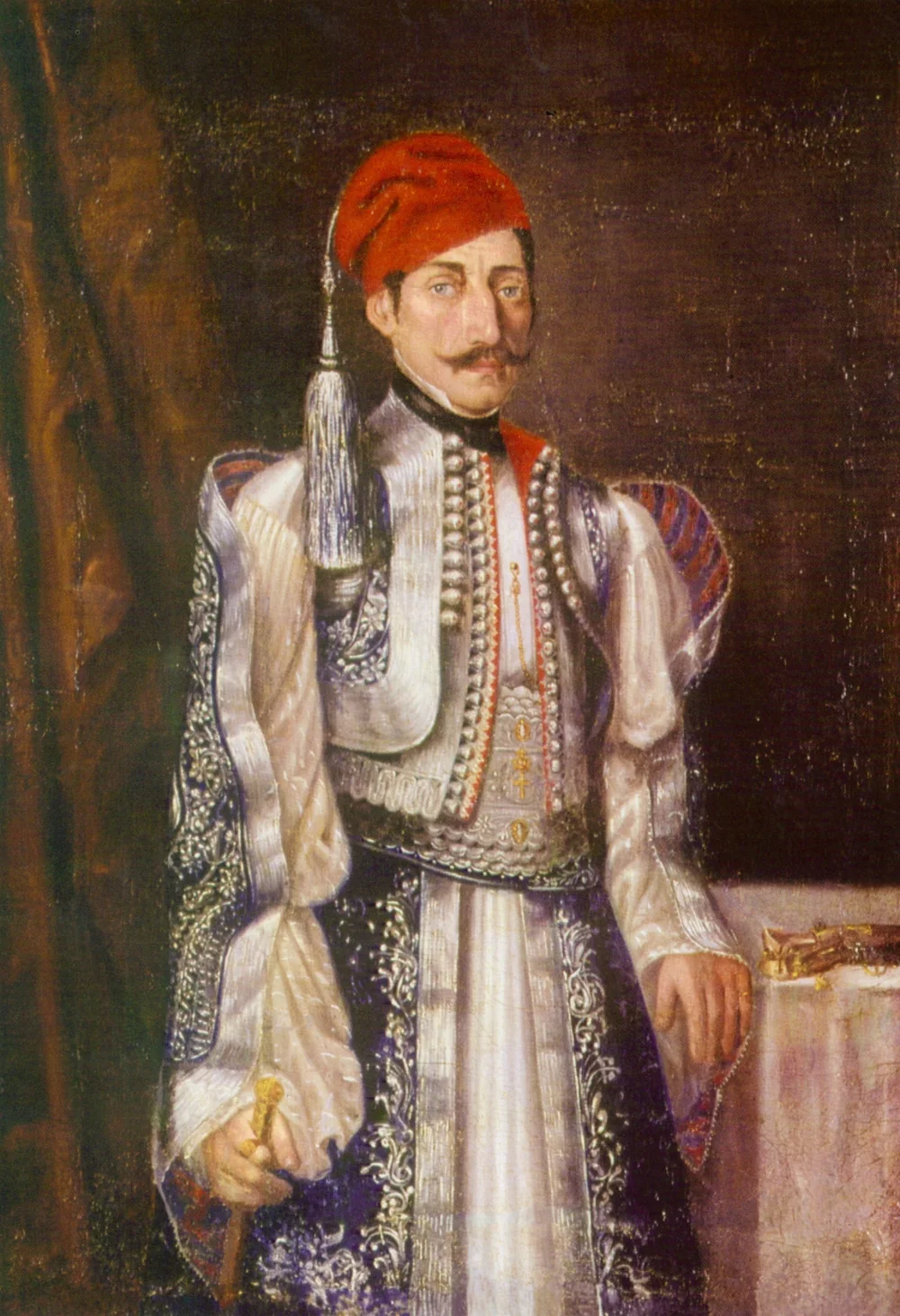
One family of Albanian origin reached the top of both principalities. Gheorghe Ghica became prince of Moldavia in 1658 and of Wallachia the following year. Dimitrie Cantemir, the Moldavian prince and scholar who wrote half a century later, calls him simply "an Albanian", and Romanian reference works describe him as Albanian by origin. His descendants ruled, on and off, until 1856; a study in the yearbook of the Bucharest city museum speaks of ten princes, though its own list names nine.
The family stayed at the top after the principalities united. Ion Ghica, once governor of the Ottoman island of Samos, was three times prime minister of Romania, in 1866, in 1866–67 and in 1870–71, and Dimitrie Ghica, a son of Prince Grigore IV, headed the government from 1868 to 1870.
The family's most famous daughter made the origin a subject. Elena Ghica, born in Bucharest in 1828, wrote in French as Dora d'Istria. Her essay on Albanian nationality in folk song, published in the Revue des deux mondes in 1866, was one of the first works to introduce a wide European readership to the Albanians, and in 1873 she gave her history of the Ghica princes the title Gli Albanesi in Rumenia. Readers of Albanian will find her life in our biography of Elena Gjika.
Other attributions are less secure. Cantemir also calls the Moldavian prince Vasile Lupu "the Albanian", and the League counts his family among its own; a Romanian biographical dictionary describes him as Aromanian from Albania, with a Greek education. His origin remains disputed.
Why was Bucharest a capital of the Albanian national awakening?
Because in the last decades of Ottoman rule Albanian books could be printed in Bucharest and could not be printed at home. The Ottoman government banned Albanian-language books and publications; Bucharest lay outside its reach and had a colony of Albanian merchants willing to pay. Between the 1880s and 1912 that colony supplied the money, the printing press and a good many of the people.
1844: a primer from a lawyer in Brăila
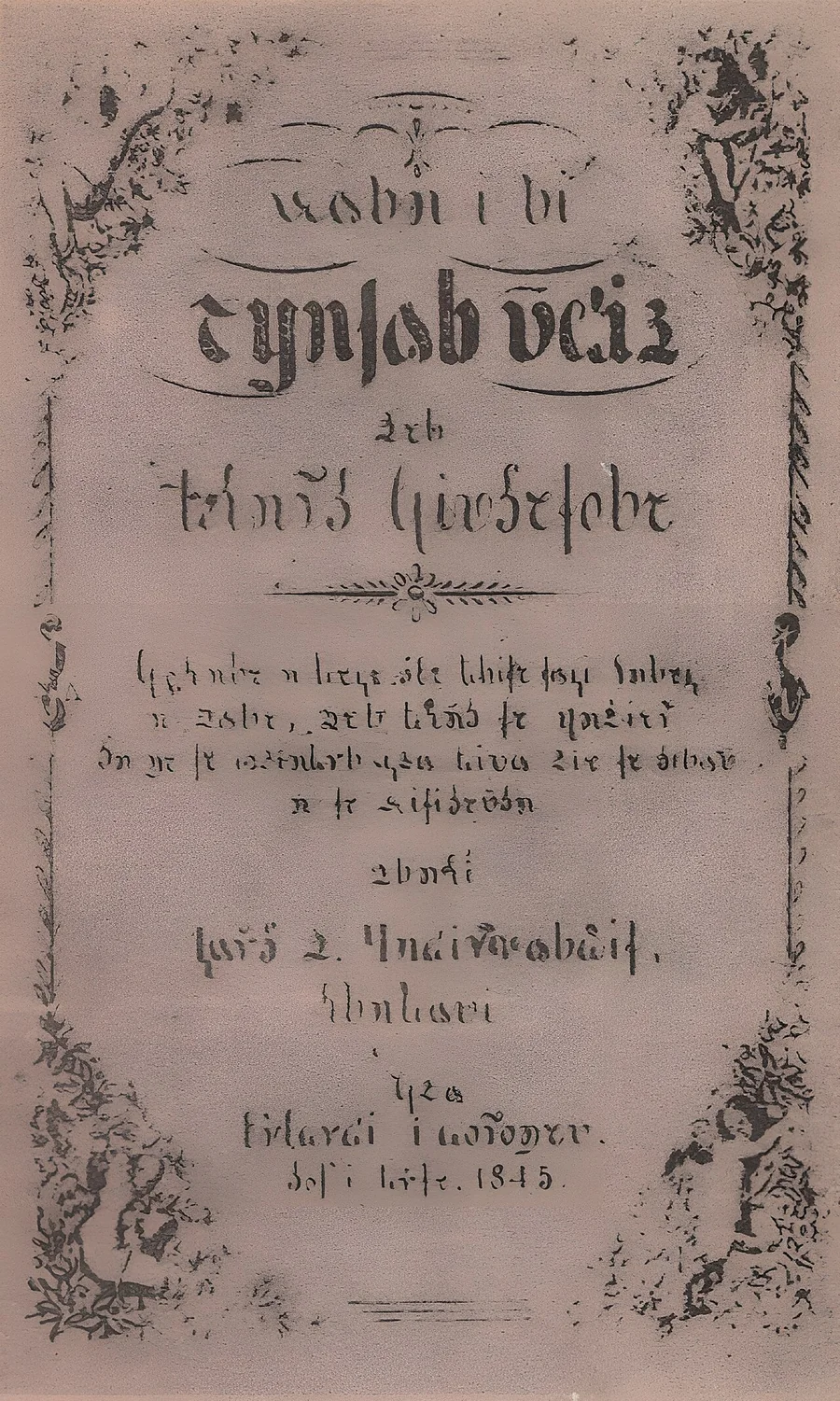
The story begins forty years earlier, on the Danube. Naum Veqilharxhi, from Vithkuq near Korçë, spent his working life, as far as is known, as a lawyer in the port of Brăila. In 1844 he printed an eight-page Albanian spelling book in an alphabet of thirty-three letters that he had designed himself, and at the end of 1845 an enlarged edition of forty-eight pages. According to the Albanologist Robert Elsie, the booklet was distributed across southern Albania from Korçë to Berat. Faik Konica, writing in 1899, remembered it as an alphabet "published in Bucharest". Veqilharxhi died in Istanbul around 1846; the story that he was poisoned is a belief of the time, not an established fact.
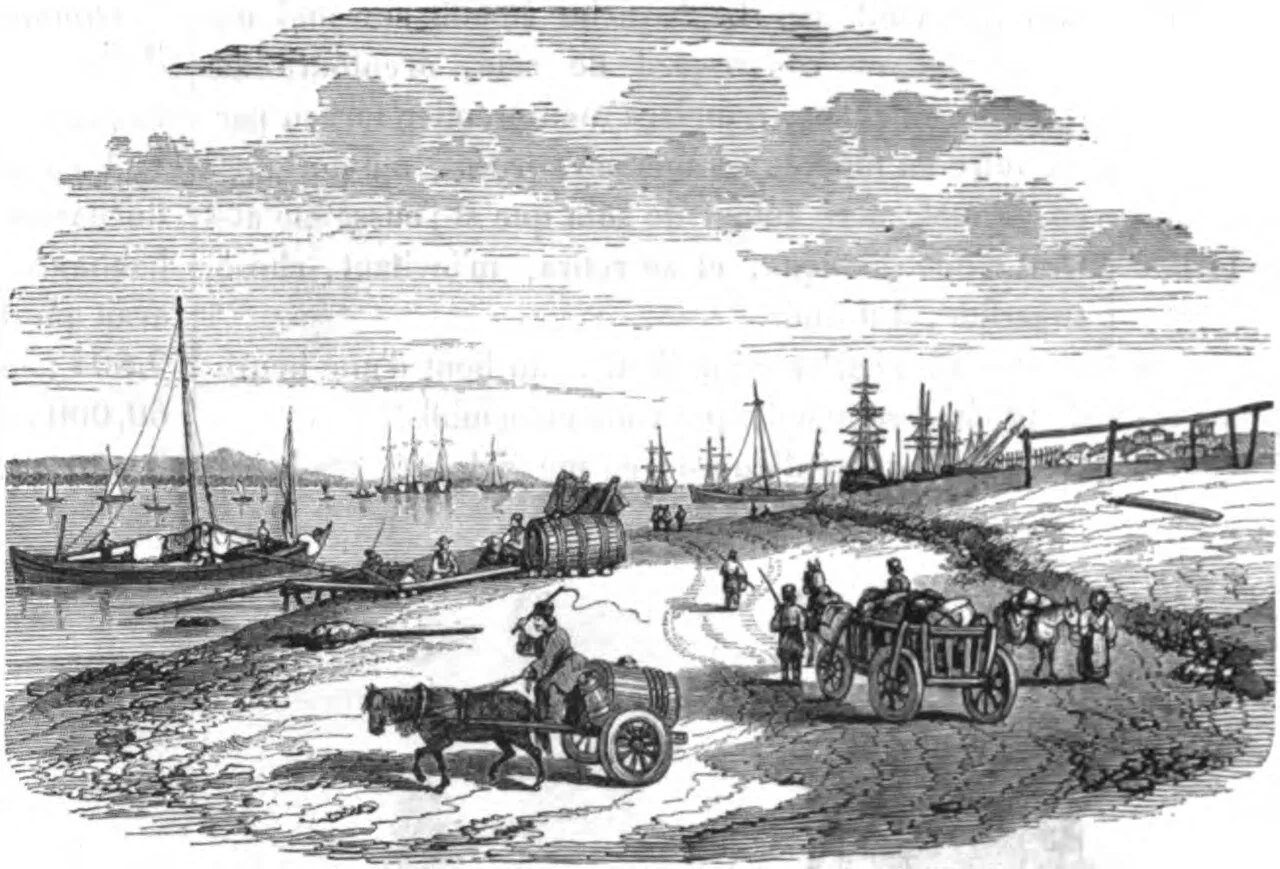
Brăila has not forgotten him. The town had an Albanian colony after 1829, and the director of its museum recalled in 2026 that the first chief magistrate after the end of Ottoman administration was an Albanian. A bust of Veqilharxhi has stood on Independence Boulevard since 2011.
The Drita society and its press
On 12 October 1879 Sami Frashëri, his brother Naim, Pashko Vasa and some twenty-five other Albanians founded in Istanbul a Society for the Printing of Albanian Writings: ten Muslims, four Catholics and fourteen Orthodox, by the count of the historian George Gawrych. When the Ottoman authorities made that work difficult, it moved abroad. "Bucharest was chosen," Konica wrote, "and one Vreto was sent there on behalf of the Albanians of Constantinople." The Bucharest branch, called Drita, "Light", took its full form on 27 December 1884, though books under its name are counted from 1881; the first article of its statute, as summarised by the scholar Jolanda Lila, set as its purpose the teaching of Albanian "both in the diaspora and in the homeland". The members bought a printing press.
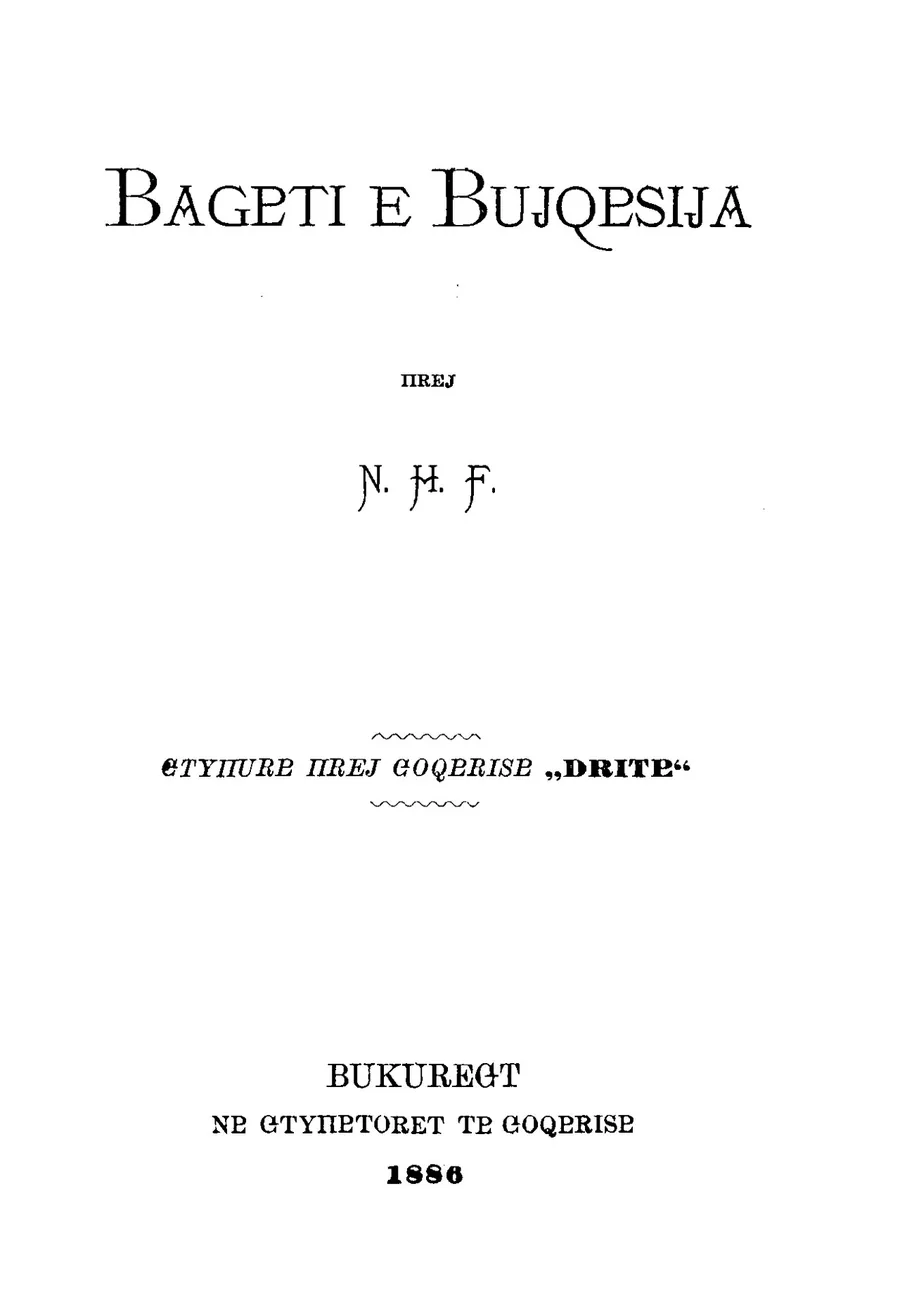
What was published in Bucharest in those years is the core of nineteenth-century Albanian literature. Naim Frashëri's pastoral poem Bagëti e bujqësija appeared in 1886. Its title page gives the author only as N. H. F. and the imprint as "printed by the Drita society", "Bucharest, at the society's press"; the poem, Elsie writes, "was smuggled into Albania in caravans". His later collections followed, many of them signed only with initials: their author was director of the censorship board at the Ottoman education ministry. In 1899 Sami Frashëri's manifesto on what Albania had been, was and would become was published in Bucharest, without the author's name on the cover. The historian George Gawrych counts some twenty-five books printed by Drita in Bucharest between 1881 and 1904.

Schools, newspapers and quarrels
The society's money travelled as well. When an Albanian school opened in Korçë in 1887, Konica records, its upkeep "was funded by Drita", and more than 150 pupils attended, "as many Christians as Muslims". In Constanța an Albanian school opened in 1905, and the League's history places a teacher-training school, taught in Albanian, in a Bucharest boarding house at the start of the twentieth century.
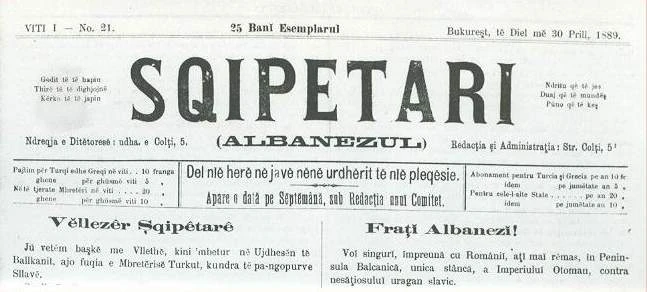
The colony also wrote for itself. The first Albanian newspaper in Romania was Drita, soon renamed Lumina, published by the society's Brăila branch from 15 May 1887 to 13 June 1888. Nikolla Naço's Shqiptari followed in Bucharest in 1888, in Albanian and Romanian. By 1908, Gawrych counts, Albanians had published more than thirty newspapers and journals around the world, four of them in Romania.
None of this was harmonious. Konica's memoir is a catalogue of factions: a pro-Slav party, a Greek party, and Naço, who, Konica writes, "showed himself as favouring Turkey", to the exasperation of the other two. The scholar Jolanda Lila, drawing on the historian Nathalie Clayer, describes a split between wealthy merchants and apprentices. A rival society, Dituria, was chaired from the mid-1890s by Pandeli Evangjeli, a property owner from Korçë who had come to Bucharest in 1878. In April 1906 the three Bucharest societies, Drita, Dituria and Shpresa, merged into one.
The colony could also be used. Prince Albert Ghica, of the same princely family, was made honorary president by one of its clubs and, wrote the British journalist H. N. Brailsford in 1906, posed in European hotels as "the chief-elect of the Albanian people", knowing "neither one word of the Albanian language nor the elements of Albanian geography". His own book of 1908 describes an Albanian national congress in Bucharest in April 1904, of two thousand delegates, that named him permanent president of its directing committee; no independent source confirms that account.
Exiles and visitors
Romania also sheltered people who could not stay in the empire. The physician Ibrahim Temo fled in November 1895 to avoid arrest and settled in Romania, where, Gawrych writes, he founded branches of the Committee of Union and Progress. According to the League he was born in Struga, worked as a doctor in Medgidia, in Dobruja, and died there in 1945; Gawrych gives Ohrid and 1939. The writer Mihal Grameno lived in Romania for twenty years. In 1911 the priest Fan Noli, on a tour of the colonies, held church services in Albanian in Bucharest.
An anthem with a Romanian melody
Aleks Stavre Drenova, who signed himself Asdreni, arrived in Bucharest in the autumn of 1885, an orphan of thirteen joining his two elder brothers. He worked as a coal-boy and an apprentice, studied when he could, taught at the Albanian school in Constanța in 1905 and published his first collection, Rézé djélli, in Bucharest in 1904.
One of his poems, a pledge to the flag, was written to an existing tune: Pe-al nostru steag e scris Unire, "On our flag is written Union", by the Romanian composer Ciprian Porumbescu. The poet Lasgush Poradeci later wrote that it was first sung by the choir of the Albanian colony of Bucharest. Sources differ on whether the poem was first printed in 1908 or 1912. It became, and remains, the national anthem of Albania: Albanian words written in Bucharest, sung to a Romanian melody.
November 1912
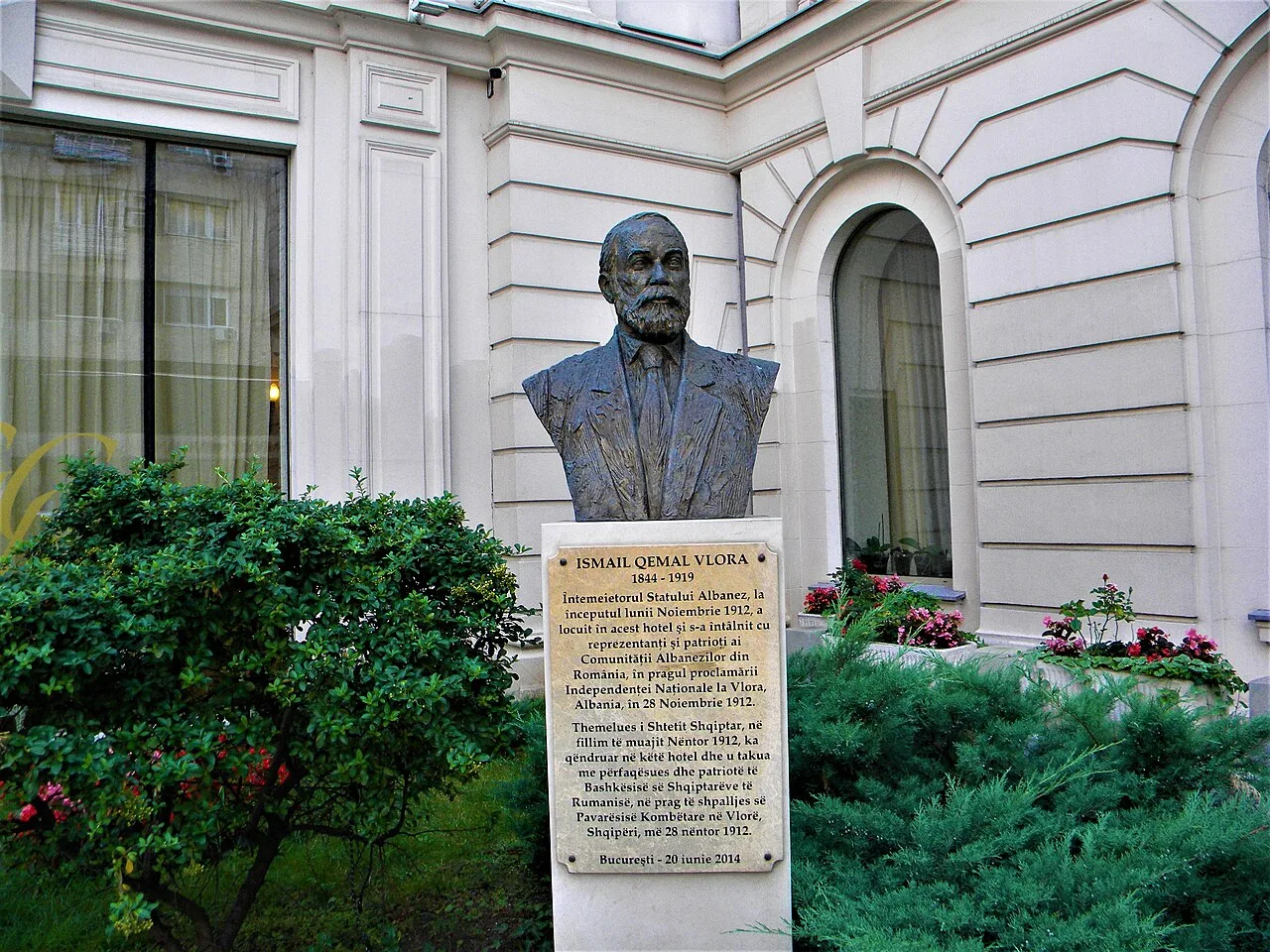
That is the colony Ismail Qemali found in November 1912. The Albanian historians Niko Koleci, writing in 1962, and Kaliopi Naska, in 1987, date his meeting with its leaders to 5 November. Naska and the League place it at the Continental Hotel, where a plaque to him was unveiled in 2003 and a bust in 2014; his memoirs name no building and no date. What the contemporary record does confirm is the outcome. The Vlorë newspaper report on the declaration says he acted after "having come to an understanding with the Albanians of Bucharest", and the congress minutes seat the colony's four delegates among those of the Albanian towns.
Romania's interest did not end there. According to the Albanian embassy, the two states established relations at legation level on 16 December 1913, and it describes Romania as "the first country to recognize the Independence of Albania". The centenary of diplomatic ties that the embassy celebrated in 2026 counts from 1926 instead, as the title of its exhibition, "Albania in Romania, 1926–2026", shows; the exhibition opens with Albania's first diplomatic representative in Bucharest, Xhemil Dino.
What happened to the colony after 1912?
It turned from a movement into a community. Its leaders first served the new state. In 1913, the League writes, the president of the Bashkimi society, Pandeli Evangjeli, sent Qemali's provisional government two chests of documents on how to organise central and local administration. In 1919 he led the colony's delegation to the peace conference in Paris, and in 1921 he went home to Albania, where he was twice prime minister. Once Albania existed, the League's historian Marius Dobrescu writes, the societies' role shrank to running the community, bringing Albanian students to Romania and charity. An Albanian consulate opened in March 1922, with Asdreni as its secretary.
For another generation Romania remained a school for Albanian writers and artists. Lasgush Poradeci arrived in 1921, studied at the Academy of Fine Arts and in 1922 took over from Asdreni as secretary of the colony, before a scholarship took him to Berlin and Graz in 1924. Mitrush Kuteli studied economics in Bucharest, graduated in 1934 and published his first book of stories, Nete shqipëtare, there in 1938; about a thousand of its 1,200 copies were lost in a fire in Constanța before they could be sold. Kristaq Antoniu, born in Bucharest in 1907 to a family from Korçë, played in eleven Romanian films from 1924 to 1931, Albanian biographies record, before settling in Albania in 1942 as one of its best-known singers.
The colony's press moved to the coast. In Constanța an illustrated Albanian weekly, Shqipëri' e re, appeared from 1919 to 1936, and in 1932–33 Gjergj Bubani edited a political paper there, Kosova, in Albanian with some pages in French and Romanian. Ploiești, which the League's history lists among the colony's towns, has its own claim. In 1921 a press there printed the first part of the first Albanian translation of the Qur'an: the opening suras, rendered from George Sale's English version by Ilo Mitkë Qafëzezi, an Orthodox Christian from Korçë. His preface gives the reason: it was time to know what the "mysterious onion skin" was that divided Muslim Albanians from their Christian brothers.
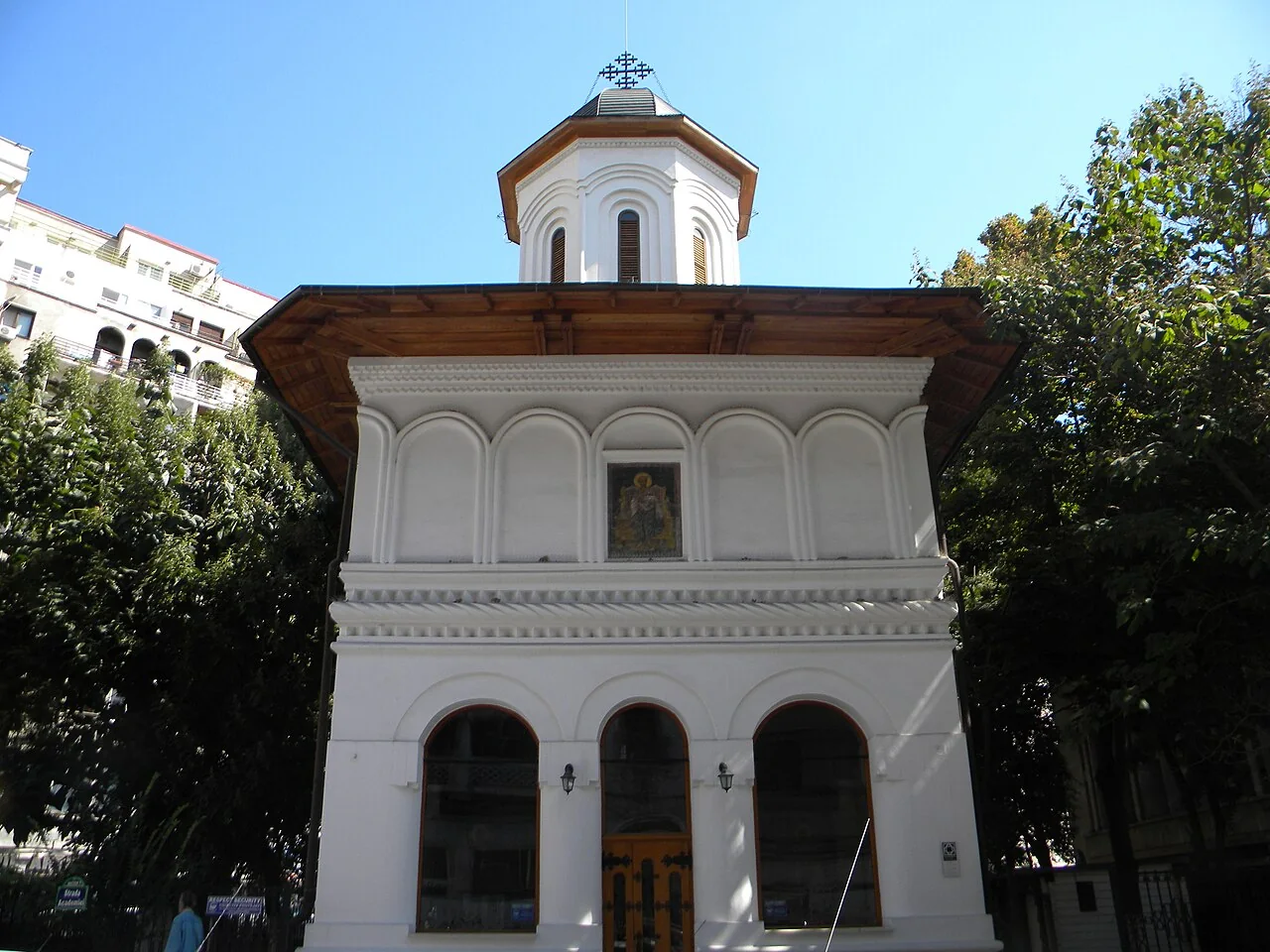
The colony also had a church: the small Orthodox church of St Nicholas "Dintr-o zi", on Academiei Street in the centre of Bucharest. A file of the Historic Monuments Commission, with correspondence from 1914 to 1951, describes it as "given for provisional use to the Albanian community". Its dates differ by source: 1911 to 1945 on a memorial plaque quoted by an Albanian priest, 1911 to 1947 in a description on a Romanian monuments website, 1912 to 1947 according to the League. The League credits Fan Noli with the first Albanian liturgy there, and the plaque says he celebrated there, which fits the plaque's dates but not the League's own: Noli's Bucharest services belong to his tour of 1911, and Elsie, who describes it, names no church.
Family memories collected by the League describe shopkeepers, wine merchants and restaurant owners in the towns of the south, and children who went to university. One unpublished memoir, by Nikolaq Zoi of Constanța, puts the outcome in a sentence: the children became lawyers, doctors and teachers "who were called Romanians of Albanian origin, this last word disappearing with time".
The case of the dramatist Victor Eftimiu, born in 1889 in Boboshticë near Korçë, needs care: a Romanian literary reference work calls his merchant family Aromanian, while Albanian institutions and the League count him as one of theirs.
Asdreni stayed. He travelled to Albania in 1937 hoping for a state pension and did not get one. He died in poverty in Bucharest on 11 December 1947.
Silence, then a seat in parliament
According to the League's historian Marius Dobrescu, after August 1944 the community's organisation took three successive names in the vocabulary of the new regime, ending as the Albanian Democratic Committee, and in 1953 it was dissolved together with the organisations of every other national minority. For thirty-six years there was no Albanian association in Romania.
What survived was private. In Slatina the Memish family, which the institute's community chronology calls one of the oldest keepers of Albanian tradition, had a confectionery, Atletul Albanez, which, the League writes, Hashim Memish kept running through the communist decades. The published census tables of those years did not show Albanians at all.
1990: starting again
On 24 May 1990, five months after the fall of the regime, the Cultural Union of Albanians of Romania was founded in Bucharest under the historian Gelcu Maksutovici, whose history of the community was launched in February 1993. Branches followed in Craiova and Constanța in 1994. In March 1995 its members laid a wreath at the statue of Michael the Brave in Bucharest to mark four hundred years since the report of 1595, and on 31 March 1999 they walked through the capital in a "March of Silence" for the people of Kosovo.
Under Article 62 of Romania's constitution, the organisation of a national minority that does not win enough votes to enter parliament in the ordinary way is entitled to one seat in the Chamber of Deputies. In 1996 the Albanian seat went to Oana Manolescu, a chemistry teacher from Craiova born in Târgu Jiu, elected on the Cultural Union's list. A dispute over the mandate followed, and on 30 June 1999 she founded the League of Albanians of Romania, known by its Romanian initials ALAR, in Craiova. The League has held the seat at every election since 2000. Manolescu sat until 2016 and died in November 2019; Bogdan-Alin Stoica has represented the minority since December 2016.
The votes behind the seat are on record. According to the Central Electoral Bureau's minutes, the League's list won 10,010 votes in 2012, 4,640 in 2016, 9,031 in 2020 and 9,177 in 2024; a compilation of the bureau's results gives 10,543 for 2000. The 2015 electoral law sets the bar at 5% of the average number of valid votes per deputy, and nothing in it ties a vote for a minority list to the voter's ethnicity: the 9,177 votes of 2024 are more than fourteen times the number of people who declared Albanian ethnicity three years earlier.
The League is financed from the state budget, as the organisations of the other minorities are. The Council of Europe gives its allocation for 2022 as 3,647,830 lei.
Counting Albanians in Romania
The census series is short and full of gaps. In 1930 Romania counted 4,670 people of Albanian nationality and 4,247 with Albanian as mother tongue. The statistics institute's own series has no ethnicity count for 1948, and those of 1956, 1966, 1977 and 1992 fold Albanians into "other". The next figure on record is for 2002, when 520 people declared Albanian ethnicity, according to the chronology published by the state's minorities institute. Romania reported 407 for 2011 to the Council of Europe, and the 2021 tables show 645, a rise of 58% in ten years for which the census gives no reason. Counts this small are fragile: in 2021 the ethnicity of 13% of all residents was recorded as unavailable.

What the 1930 figure contains
The 1930 total needs a map. The census volume on nationality, published in 1938, lists Albanians county by county and commune by commune, and its county totals add up to the national 4,670. Of these, 1,892 lived in counties that are no longer part of Romania: 83 in Southern Dobruja, now in Bulgaria, and 1,809 in Bessarabia, almost all of them in a single village. In Caracurt, in the county of Ismail, 1,754 of the 2,812 inhabitants were Albanian. Caracurt is today Karakurt, in Ukraine's Odesa region, the Bessarabian village described in our guide to Albanians in Ukraine.
Inside today's borders the census counted 2,778 Albanians, most of them in Ilfov county, which then included Bucharest, with 1,302, of whom 1,247 lived in the capital and its suburbs, and in Constanța with 471; Brăila, Ialomița and Prahova each had more than a hundred, and the census recorded none in Gorj. The decline to 645 is real, but it is a decline from about 2,800, not from 4,670. Between the two counts lie a world war, the deaths, returns to Albania and emigration to the United States and Turkey that the League's own history describes, and thirty-six years in which Albanian associations did not exist.
Ethnicity, language, passport
The census asks about ethnicity and mother tongue. Residence statistics ask about citizenship, and they give a third answer. Eurostat counts 969 valid Romanian residence permits held by citizens of Albania at the end of 2024, and estimates 958 citizens of Albania among usual residents a day later, on 1 January 2025. Citizens of North Macedonia, of every ethnicity, held 213 permits at the end of 2024; the table does not say how many of them are Albanian. A passport says nothing about ethnicity or language, and a Romanian citizen of Albanian descent appears in no permit table. The measures overlap and must never be added together.
The estimates that are not counts
Much larger numbers circulate. In the early 1990s the president of the newly founded Cultural Union spoke of 10,000 people "of Albanian origin"; the institute's chronology, whose Albanian chapter Maria Dobrescu wrote from the community's side, says the figure "had no real basis", pointing to the 520 counted in 2002. For the nineteenth century a text by the League speaks of a few thousand members, a paper by two Romanian economists gives 30,000 for 1893, citing only a website, and the historian Adrian Majuru is quoted as finding 3,698 Albanian heads of household in the Bucharest statistics of 1898–99.
Where do Albanians in Romania live?
The 2021 census found the largest groups in Gorj and Dolj in the south-west, in Bucharest, and in the western counties of Bihor, Arad and Timiș. Gorj county alone accounts for 158 of the 645 declarations, 51 of them in the town of Târgu Jiu; Dolj follows with 69, of which 43 are in Craiova; Bucharest has 56. Constanța, the Black Sea port that every history of the community names, has 28.

The Council of Europe's experts, working from the provisional results, describe the minority as "mainly concentrated in Constanța, Craiova and Bucharest". The final tables agree on Craiova and Bucharest and add detail that was not available before: 404 of the 645 live in towns and cities and 241 in rural communes, among them Stoina, Albeni and Bustuchin in Gorj.
Two communities in one table
Set the mother-tongue column beside the ethnicity column and the map splits in two. In Gorj, 158 people declared Albanian ethnicity and 7 Albanian as mother tongue; in Dolj the figures are 69 and 13. In Bucharest it is the other way round, 56 and 74, and in Bihor, Arad, Timiș and Cluj the two columns are almost level.

The census does not explain the pattern. The 1930 census recorded no Albanians in Gorj, but the League, founded in neighbouring Dolj, had a branch there by 2002 and held its Albanian Culture Days in Târgu Jiu in 2022, and its founder was born in the town. The south-west's declarations may follow the League's own reach; no source says so. The League's magazine describes two groups: in the old families, it writes, "the mother tongue is no longer spoken", while graduates who came from Albania after 1990 are "spread across the whole country" by the university towns where they studied, and speak Albanian at home.
Religion
Of the 645, the census records 402 as members of the Romanian Orthodox Church, 5 as Serbian Orthodox, 160 as Muslim, 25 as Roman Catholic and 20 with no religion. The two largest faiths sit on the same two maps. In Gorj 147 of 158 belong to the Romanian Orthodox Church, in Dolj 65 of 69 and in Constanța 23 of 28. In Arad 39 of 46 are Muslim, in Bihor 31 of 49 and in Timiș 15 of 29.

Is Albanian still spoken and taught in Romania?
In 2021, 421 people gave Albanian as their mother tongue. It is taught in no school curriculum; the League has run its own courses. The findings on teaching are those of the Council of Europe's Committee of Experts, which monitors the European Charter for Regional or Minority Languages. The Charter has applied in Romania since 1 May 2008, and Albanian is protected under its general provisions only.
The experts' third report, adopted on 15 June 2023, is frank. "Albanian is not included in the general curriculum in mainstream education," it says, because speakers "are dispersed through Romania" and there are "too few pupils of the same age group to organise Albanian teaching courses in any municipality". It also records "a reported lack of interest from persons belonging to the national minority themselves to learn the language". At university level the news was worse: Albanian was no longer taught at all, because the master's programme in Balkan cultural relations at the University of Bucharest that had included it no longer existed.
"Include Albanian in the general curriculum of mainstream education."
Council of Europe Committee of Experts, recommendation for immediate action to Romania, 2023
Against that, the report lists what exists. The League, it says, offers weekly courses with qualified teachers and summer and winter schools, some of them in Albania; it has reprinted Romanian–Albanian conversation guides and Albanian textbooks and hands them out free. The League publishes no timetable for its courses; the directory below gives its office.
There is a press. The League's magazine, founded in 2001 as Prietenul albanezului, "The Albanian's Friend", has appeared since 2017 as Drita, monthly, in 2,500 copies. Its publishing house, renamed Editura Asdreni in 2018, issues bilingual books, and a scholarly review, Albanica, has appeared since 2019. According to the Council of Europe, Radio Bucharest, Radio Oltenia Craiova and the public television channels TVR 3 and TVR Bucharest carry programmes for the minority.
What does the community look like today?
Alexandra Iancu was born in Bucharest in 1944, into one of the old families. Her grandfather Rafael Anastasiu, she told the League's magazine Drita in 2020, had come from Korçë in 1886, aged eleven, to work in a shop, and later owned one. "From childhood I remember that Albanian was spoken in our house," she said; her parents used it, she explained, so that the children would not repeat family matters at school. "Now, at 75, I regret that I did not learn Albanian as a child."
The other part of the community arrived after 1990 and speaks Albanian at home. Elsa Stavro, originally from Albania, has lived in Galați on the Danube for more than a decade and directs the Lower Danube Albanian Cultural Centre, which Albania's ambassador, Enkeleda Mërkuri, opened at the Brăila museum on 26 October 2026 with that exhibition on a hundred years of diplomacy. "In Albania, Braila is much better known than Bucharest or Iasi," she said at the opening, as reported by the news agency Agerpres, "because an important Albanian diaspora lived here." The centre plans to extend its work to Tulcea.
Three figures speak for the community in public today. Bogdan-Alin Stoica, born in Craiova in 1987, founded the student station Radio Campus Craiova before he entered parliament for the League in 2016; in 2020 he told Drita that Romania and Albania share "a bond of the heart". Luan Topciu, born in Pogradec in 1962, took his doctorate in Bucharest, translates Cioran and Blaga into Albanian and Kuteli into Romanian, and coordinates the League's Albanian Cultural Centre; in January 2022 Romania's president made him a Knight of the Order of Cultural Merit. The writer Ardian-Christian Kyçyku, also from Pogradec, publishes in both languages and heads a private university in Bucharest.
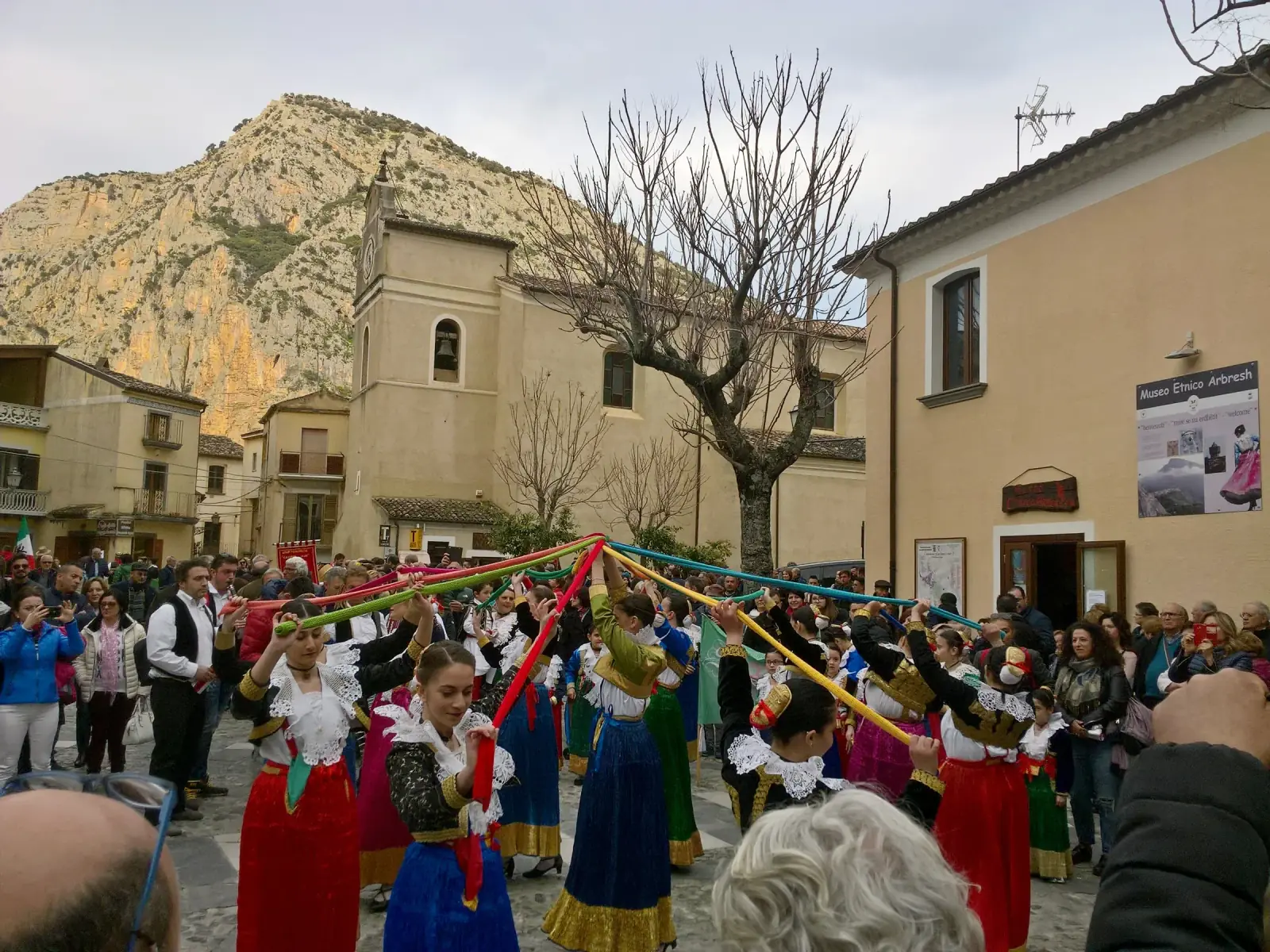
The League's calendar runs from Albanian Language Days in Brăila to Albanian Culture Days, held over the years in Craiova, Bucharest, Constanța, Târgu Jiu and Iași; the sixth edition, in October 2024, marked the League's twenty-fifth anniversary in Bucharest and Tirana. Its song and dance ensemble, Serenada, founded in 2002, mixes Albanian dances with those of Oltenia. Every 28 November the League marks Flag Day, and in 2026, Agerpres reports, the National Day events form part of an "Albanian November" programme.
Places that remember
The community has spent the past two decades putting its history back on the map, usually in bronze.
- Bucharest, Continental Hotel, Calea Victoriei. A plaque to Ismail Qemali was unveiled in 2003 and a bust by the sculptor Artan Hajdari in the hotel forecourt on 20 June 2014. Its inscription, in Romanian and Albanian, says he stayed at the hotel in early November 1912 and met representatives of the Albanian community there.
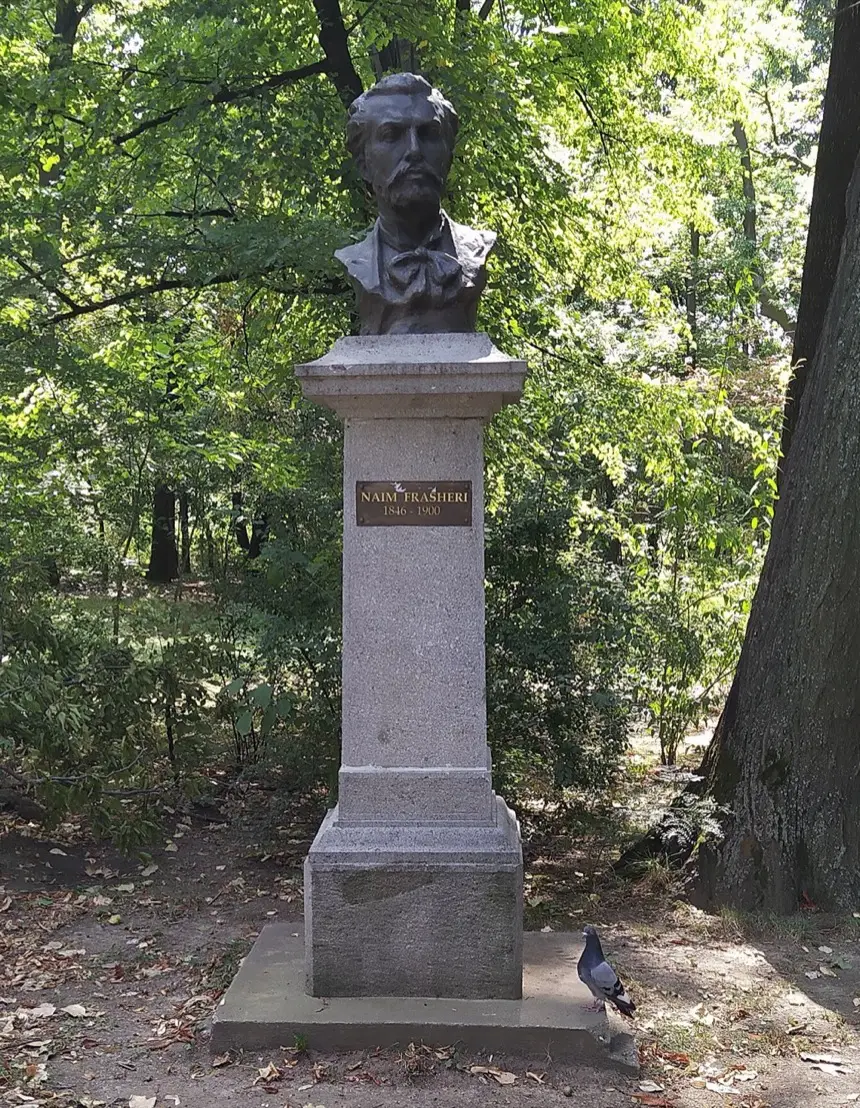
- Bucharest, King Michael I Park (Herăstrău). A bust of Naim Frashëri, whose books were printed in the city, was unveiled in September 2006.
- Brăila, Independence Boulevard. The bust of Naum Veqilharxhi dates from May 2011. The Lower Danube Albanian Cultural Centre opened at the town's "Carol I" Museum in October 2026.
- Medgidia. A bust of Dr Ibrahim Temo was placed by the League in 2015; a street bears his name.
- Craiova, Rovine Park. A bust of Skanderbeg by the Albanian sculptor Emanuel Koko was unveiled on 27 October 2018.
The newer arrivals
Beside the old families there is a second, younger group: people who, the League's magazine writes, came from Albania after 1990 to study and stayed. Some now carry the language across. Of Romania's few translators from Albanian, said Marius Dobrescu, the League's longtime editor and Ismail Kadare's Romanian translator, "three or four" are Albanians naturalised since the 1990s. The residence statistics give a partial outline of the group, since they cover only those who still hold Albanian citizenship: 579 valid permits at the end of 2008, 1,168 at the peak in 2022, 969 at the end of 2024 and 1,055 a year later.

This group probably gives most of the mother-tongue answers in the census, on the evidence of the county tables. It is also the one the old institutions were not built for: a family in Oradea or Cluj is a long way from the League's seat in Craiova, and a weekly course in one city does not reach a child in another. The Council of Europe has invited Romania to consider online teaching of such languages as a complement to face-to-face education.
Notable people
The names below are limited to people whose connection with Romania is documented and whose Albanian origin is stated by a named source, plus the minority's two deputies since 1996; where the source is the League alone, the entry says so.
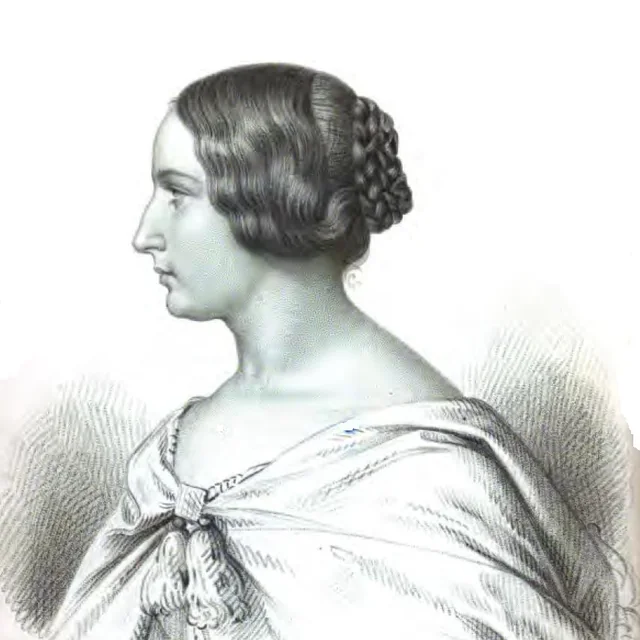
Elena Ghica · writer, born in Bucharest in 1828
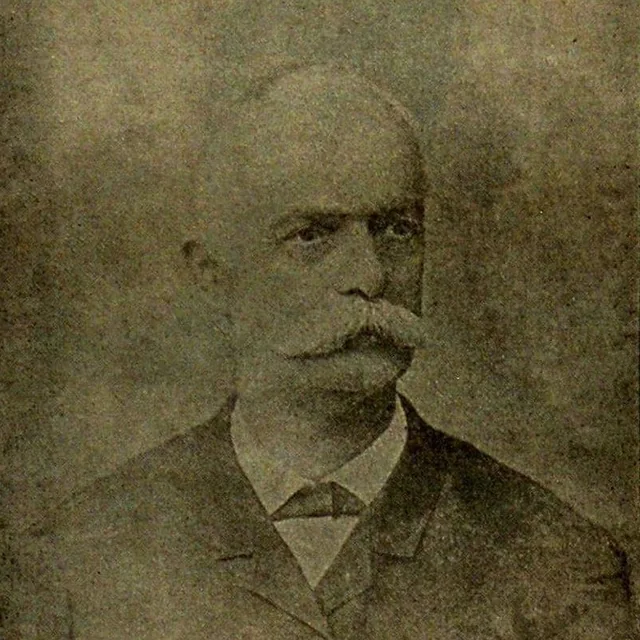
sent from Istanbul to set up the Drita branch
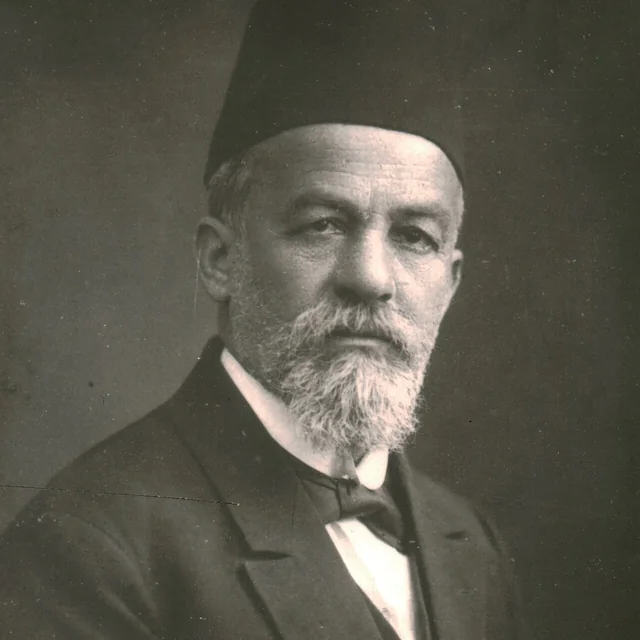
exile in Romania from 1895
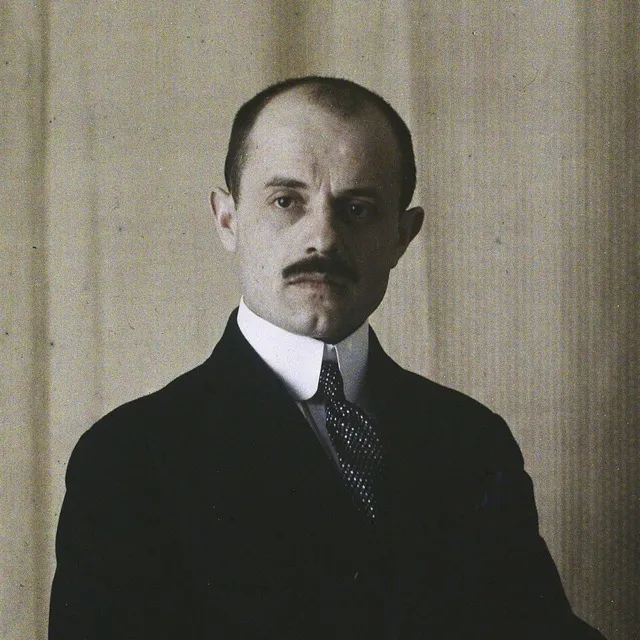
colony delegate at Vlorë, 1912 · photographed in colour, 1920
Portraits via Wikimedia Commons. Dora d'Istria: unknown artist, nineteenth-century lithograph / Wikimedia Commons (public domain); Jani Vreto: unknown photographer, 1880s / Wikimedia Commons (public domain); Ibrahim Temo: unknown photographer, 1918, General Directorate of Archives of Albania / Wikimedia Commons (public domain); Dhimitër Beratti: Auguste Léon for the Archives of the Planet, Albert Kahn Museum / Wikimedia Commons (CC0).
- Naum Veqilharxhi (died c. 1846), lawyer in Brăila, author of the 1844 primer.
- Elena Ghica, known as Dora d'Istria (1828–1888), born in Bucharest, writer, of the Ghica family of princes.
- Pandeli Evangjeli (1859–1949), in Bucharest from 1878, leader of the colony's societies, later twice prime minister of Albania.
- Ibrahim Temo (1865–1945 according to the League; Gawrych gives 1939), political exile and doctor in Medgidia.
- Asdreni (1872–1947), poet, in Bucharest from 1885; author of the words of the Albanian anthem.
- Ilo Mitkë Qafëzezi (died 1964), historian, whose partial Albanian Qur'an was printed in Ploiești in 1921.
- Lasgush Poradeci (1899–1987), poet, in Bucharest from 1921 to 1924.
- Kristaq Antoniu (1907–1979, born in Bucharest), actor and singer.
- Mitrush Kuteli (1907–1967), writer and economist, graduated in Bucharest in 1934.
- Lucia Djamo-Diaconiță (1916–1995), Slavist at the University of Bucharest, named by the League among the community's scholars.
- Oana Manolescu (1941–2019), chemist and teacher, founder of the League and deputy from 1996 to 2016.
- Luan Topciu (born 1962), writer and translator, coordinator of the League's Albanian Cultural Centre.
- Ardian-Christian Kyçyku (born 1969), writer in Albanian and Romanian.
- Bogdan-Alin Stoica (born 1987), deputy for the Albanian minority since 2016.
How Albanians in Romania find each other
For a community of a few hundred spread over a country of nineteen million, meeting is the hard part. The League's events are the obvious starting point, and so is the new cultural centre in Brăila.
For people looking for a partner who shares the language, dua.com offers another route: a way to meet Albanians beyond one's own town and circle, wherever they live. In a country where the nearest Albanian speaker may be three counties away, that matters.
Romania's colony was one of several old Albanian communities abroad. Compare it with the Arbëreshë of Italy, the Albanian villages of Ukraine and the community of Istanbul, where the society that sent its printing to Bucharest was founded, or browse the Albanian community hub. To start a conversation of your own, meet Albanians on dua.com.
Directory: where to start
Checked on 17 November 2026. Contact details change; confirm before you travel.
- League of Albanians of Romania (ALAR): registered seat Strada Nicolae Bălcescu 33, Craiova, Dolj county; telephone 0351 184 466; [email protected]; alar.ro. Its general assemblies of September and November 2026 were called to Strada Dealul Spirei 2A, Craiova. The League publishes no opening hours, branch offices or course timetable, so ask the office about courses and events.
- Other associations: Albania's National Diaspora Agency also lists, in its directory of diaspora organisations, the Bashkësia Kulturore e Shqiptarëve të Rumanisë in Bucharest and the Iliria association in Eforie Nord; no website of their own could be found.
- Embassy of Albania: Strada Duiliu Zamfirescu 7, Sector 1, Bucharest; telephone +40 21 211 9829, emergencies +40 756 127 787; [email protected]; consular contact page. The site gives no consular hours or appointment system.
- Honorary Consulate of Albania, Constanța: honorary consul Omer Susli, 125 Aurel Vlaicu, Constanța; telephone +40 241 516 158; covers Constanța county, according to the Albanian foreign ministry's list of March 2024.
- Entering Romania: holders of biometric Albanian passports need no visa for stays of up to 90 days in any 180. Romania's foreign ministry lists Kosovo, "defined in accordance with" Security Council Resolution 1244, among the visa-free entities for holders of biometric Kosovo passports from 1 January 2024. Kosovo has no embassy or consulate in Romania listed on its official missions portal. Details: eviza.mae.ro.
- Lower Danube Albanian Cultural Centre, Brăila: at the "Carol I" Brăila Museum (museum office: Piața Traian 3; telephone 0339 401 002), director Dr Elsa Stavro, opened on 26 October 2026. The centre has not yet published its own hours.
- Places of worship: the church of St Nicholas "Dintr-o zi", Strada Academiei 22, Bucharest, is today an ordinary Romanian Orthodox parish with no advertised Albanian service. No source consulted describes any mosque in Romania as Albanian; the community's graves include those in the Muslim cemeteries of Ghencea in Bucharest and of Medgidia, where Ibrahim Temo is buried.
- Census tables: the 2021 results by ethnicity, mother tongue and religion, down to commune level.
- Background reading: the League's own history of the community, published by the Romanian Cultural Institute, and the minorities institute's chronology for 1989–2009 (in Romanian).
Sources and method
We opened every source between 16 and 17 November 2026: chiefly the census tables of Romania's National Institute of Statistics, the 1930 census volume on nationality, Eurostat, the Central Electoral Bureau's minutes, three Council of Europe documents, the minorities institute's community chronology, the work of Robert Elsie, George Gawrych, Constantin C. Giurescu, Lidia Cotovanu and Jolanda Lila, and the League's publications, which the text names where it relies on them alone. Quotations from living people come from published interviews and news reports; nobody was interviewed for this guide.
Some things could not be established. We could not open the 1595 report itself, so its 15,000 is given at second hand. A charter of 1602 by Prince Simion Movilă for the Albanians of Călinești, repeated online, could not be traced to any document and is left out. We found no Albanian figure for any census between 1930 and 2002, no explanation for the rise from 407 to 645, and no source that ties the census map of Gorj and Dolj to a cause, so the reading offered there is an inference. In the 1930 county counts, Timiș-Torontal, with 10 Albanians, also covered land now in Serbia. The vote totals for 2004 and 2008 could not be checked against the electoral bureau and are omitted, and the figure for 2000 comes from a compilation of its results. An essay by Kopi Kyçyku (2017), which cites no sources, describes an interwar wave of workers from Macedonia to the towns of Transylvania; no second source confirms it, so it is left out. No licensed present-day photograph was found of the monuments in Brăila, Medgidia and Craiova or of the League's events.
Frequently asked questions about Albanians in Romania
How many Albanians live in Romania?
The 2021 census recorded 645 residents who declared Albanian ethnicity and 421 who named Albanian as their mother tongue. Separately, Eurostat estimates 958 citizens of Albania living in the country on 1 January 2025. These measures overlap and cannot be added. Nobody counts Romanians of Albanian descent, and the figure of 10,000 sometimes quoted has no statistical basis.
Were there more Albanians in Romania in the past?
Yes, but fewer than the headline figure suggests. The 1930 census counted 4,670 people of Albanian nationality in a larger Romania, yet 1,754 of them lived in one village, Caracurt, which is now Karakurt in Ukraine. Within today's borders the count was 2,778, most of them in Bucharest and in Constanța.
Is the Albanian national anthem connected to Romania?
Yes. The words are by the poet Asdreni, who lived in Bucharest from 1885 until his death in 1947. He wrote them to the melody of a Romanian patriotic song by the composer Ciprian Porumbescu. The poet Lasgush Poradeci later wrote that the song was first sung by the choir of the Albanian colony of Bucharest.
Are there Albanian churches or mosques in Romania?
Not today. Bucharest's Albanian Orthodox community used the church of St Nicholas "Dintr-o zi" from about 1911 until the 1940s; it is now an ordinary Romanian Orthodox parish. Of the 645 Albanians counted in 2021, 402 are Romanian Orthodox and 160 Muslim, and no source consulted describes a mosque as Albanian.
Where can I learn Albanian in Romania?
Not at school or university: the Council of Europe found in 2023 that Albanian is taught in no Romanian curriculum and that the last university course had closed. The League of Albanians of Romania has run weekly courses and summer schools and hands out textbooks free; it publishes no timetable, so contact its office in Craiova.
Do I need a visa for Romania with an Albanian or Kosovo passport?
Not for short stays. Romania's foreign ministry lets holders of biometric Albanian passports, and of biometric Kosovo passports since 1 January 2024, stay up to 90 days in any 180 without a visa. Romania does not recognise Kosovo's independence but accepts its travel documents.
Where can Albanian citizens get consular help in Romania?
At the Embassy of Albania, Strada Duiliu Zamfirescu 7, Bucharest, telephone +40 21 211 9829, and at the honorary consulate in Constanța, which covers Constanța county. Kosovo has no embassy or consulate in Romania listed on its official missions portal.
What does arnăut mean in Romanian?
The dictionary defines an arnăut as a mercenary soldier of Albanian origin in the guard of the princes of Wallachia and Moldavia, and by extension an armed servant. The word came through Turkish. By the late eighteenth century it described a kind of soldier and a costume, not an origin: Serbs, Greeks, Bulgarians and Romanians also served as arnăuți.
Was the Ghica family Albanian?
The founder of the line, Gheorghe Ghica, who became prince of Moldavia in 1658, is called an Albanian by the near-contemporary scholar Dimitrie Cantemir and Albanian by origin in Romanian reference works. His descendants included Romanian princes, two prime ministers and the writer Dora d'Istria, who titled her history of the family Gli Albanesi in Rumenia, The Albanians in Romania.
How can I meet Albanians in Romania?
Start with the League of Albanians of Romania, whose events take place in Craiova, Bucharest, Constanța, Brăila and other towns, and with the Lower Danube Albanian Cultural Centre that opened in Brăila in October 2026. If you are looking for a relationship, dua.com connects Albanians and people who want to meet them, wherever they live.