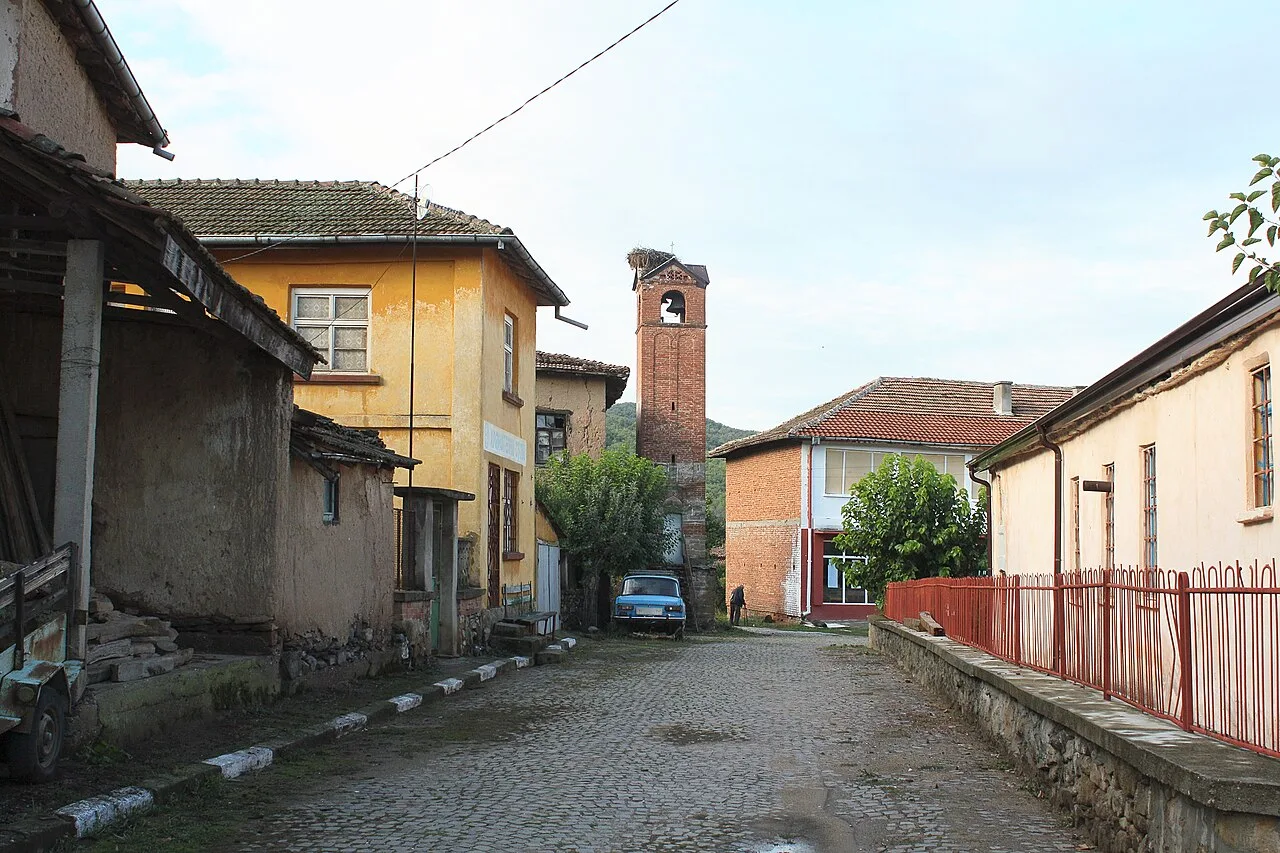
In a village of 34 people on Bulgaria's border with Greece, a woman in her nineties still greets visitors in a kind of Albanian whose first speakers came from the hills around Korçë almost four centuries ago. In Sofia, Albanian masons, shoemakers and exiles once founded a society, a printing press and a newspaper, and printed there the books their homeland was not free to print. Between those two places lies almost everything that is known about Albanians in Bulgaria, and a good deal that is not.
Who are the Albanians of Bulgaria?
There has never been a single Albanian community in Bulgaria. There have been at least three, at different times, and they barely overlap.
The oldest is a scatter of villages founded under Ottoman rule by Orthodox and Catholic Albanians; of these only Mandritsa survives. The second was a colony of migrant workers and writers in Sofia who, from the 1890s until the First World War, printed the Albanian books and newspapers that could not be printed freely in the Ottoman Empire. The third is the present: about 840 citizens of Albania and Kosovo who study, work or have married in Bulgaria.
The village is the heart of the story, the printing press is its most brilliant chapter, and the present is small. Where the evidence stops, that is said.

Mandritsa: the village that kept its language
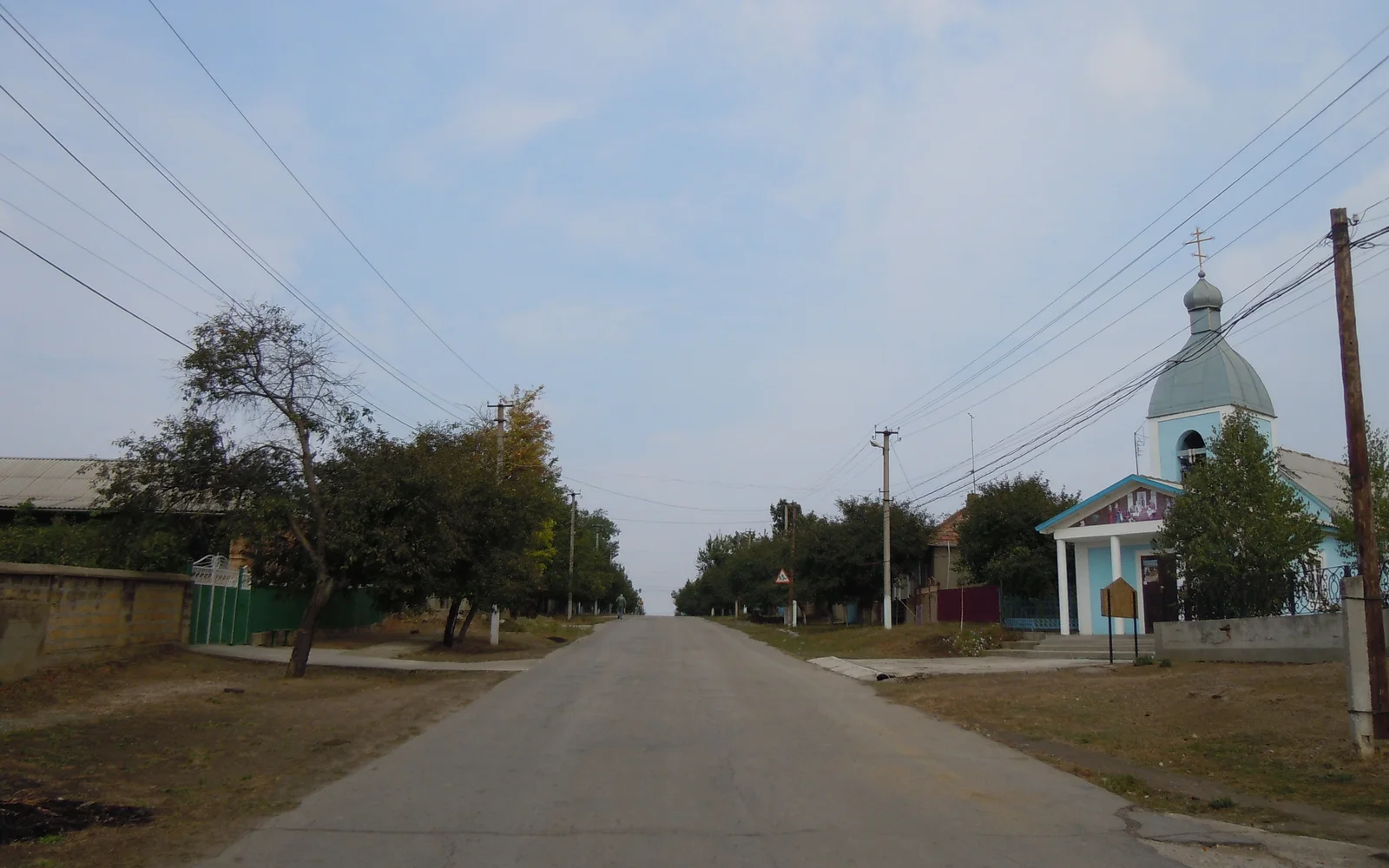
Mandritsa lies in the Eastern Rhodopes, on the right bank of the Byala Reka, 19 kilometres south of the town of Ivaylovgrad and about two kilometres from the river that marks the Greek border. Among its residents an old form of Albanian can still be heard.
"Mandritsa is the only Albanian village in Bulgaria, where even today native people speak this unique archaic Albanian language," says the association for the village's revival. The historian Boyan Gyuzelev, whose study of Albanians in the eastern Balkans is the main scholarly account, puts it more soberly: it is the only village within Bulgaria's present borders inhabited mainly by Albanians, and the only Albanian village in Thrace west of the river Maritsa.
Three brothers, a stone and a tax register
The village tells its own beginning as a legend. Three brothers, Orthodox Albanians from Vithkuq in the Korçë country, supplied the Ottoman army with meat, cheese and butter on its way to Edirne. The bey told them to drive their herds from sunrise to sunset and to settle where night found them, and the village that grew there was freed from taxes. The year usually given is 1636, which the association says rests on an inscription on a stone near the cemetery church.
The documents are older than the legend. Gyuzelev cites Ottoman tax registers that list the village, under the Turkish name Mandracık, with 18 households in 1627 and 25 in 1634. A second local tradition, written down in the 1960s, speaks of 12 families who arrived with their priest. Both fit a small settlement of herders and dairymen in the first half of the 17th century.
Where exactly they came from is settled by the language more than by the legend. The linguist Boyka Sokolova, who devoted a book to the dialect, found it closer to the speech of the Devoll valley than to that of Vithkuq and Voskopojë, and related to the Albanian once spoken at Devnya, near Varna, whose speakers now live in Ukraine. Both valleys belong to the same south-eastern corner of Albania, around Korçë.
Nor did everyone arrive at once. The Albanian scholar Dhimitër Shuteriqi, who studied the church records and the oldest gravestones in 1965, thought the village was founded only in the 18th century. The registers, as Gyuzelev reports them, rule that out, but they do not rule out what Radio Bulgaria reports is thought today: that most of the Albanian families came later, towards the end of the 18th century. Gyuzelev's arithmetic points the same way: settlement must have continued after 1634, because a village cannot grow from 25 households to 350 by births alone.
Silk on the second floor
What the newcomers built is still standing, in part. Mandritsa's tall houses of sun-dried brick on a stone base "can't be seen anywhere else in Bulgaria", Radio Bulgaria reported in 2025, and each of their three floors had a purpose. "The first floor was for livestock, the second for silkworm raising, and people lived on the third floor," the association explains. Silk and tobacco were the main livelihoods.
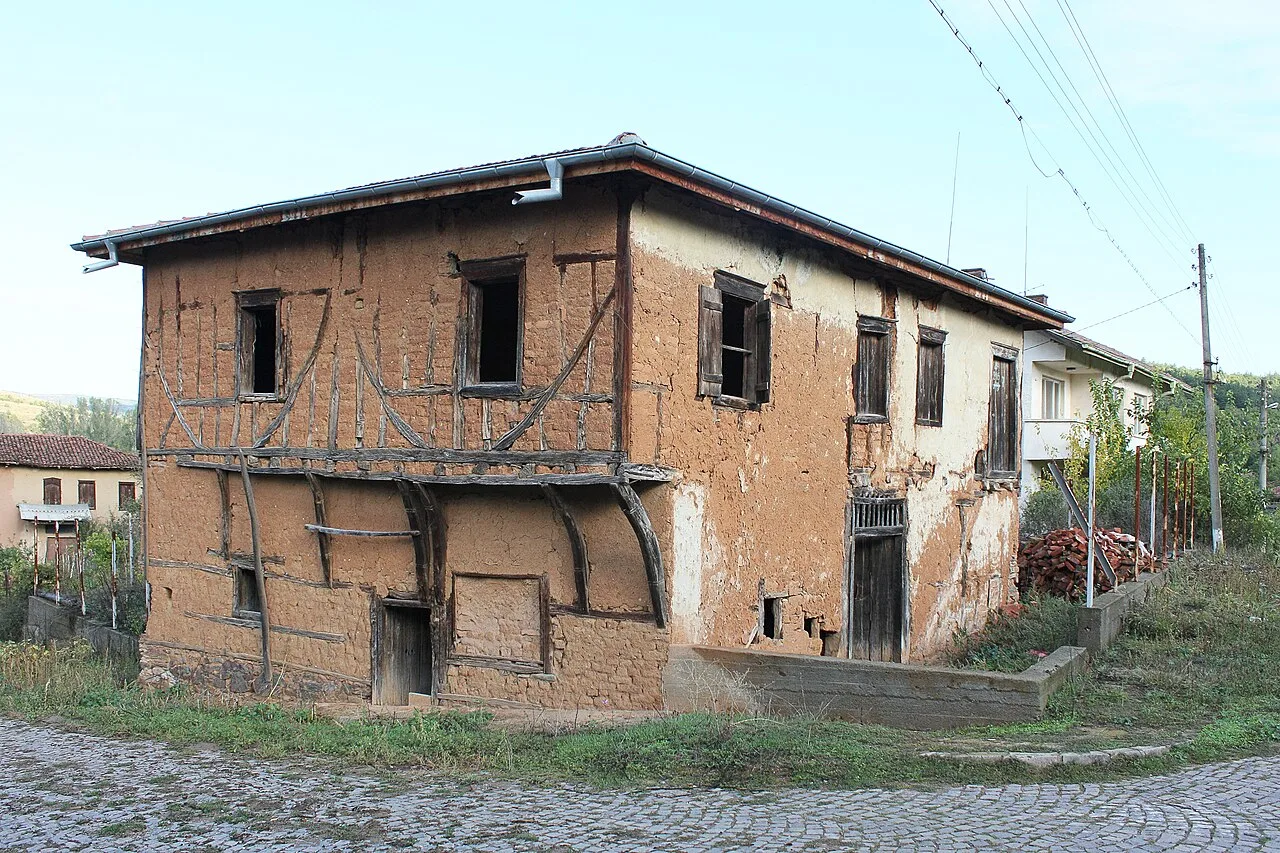
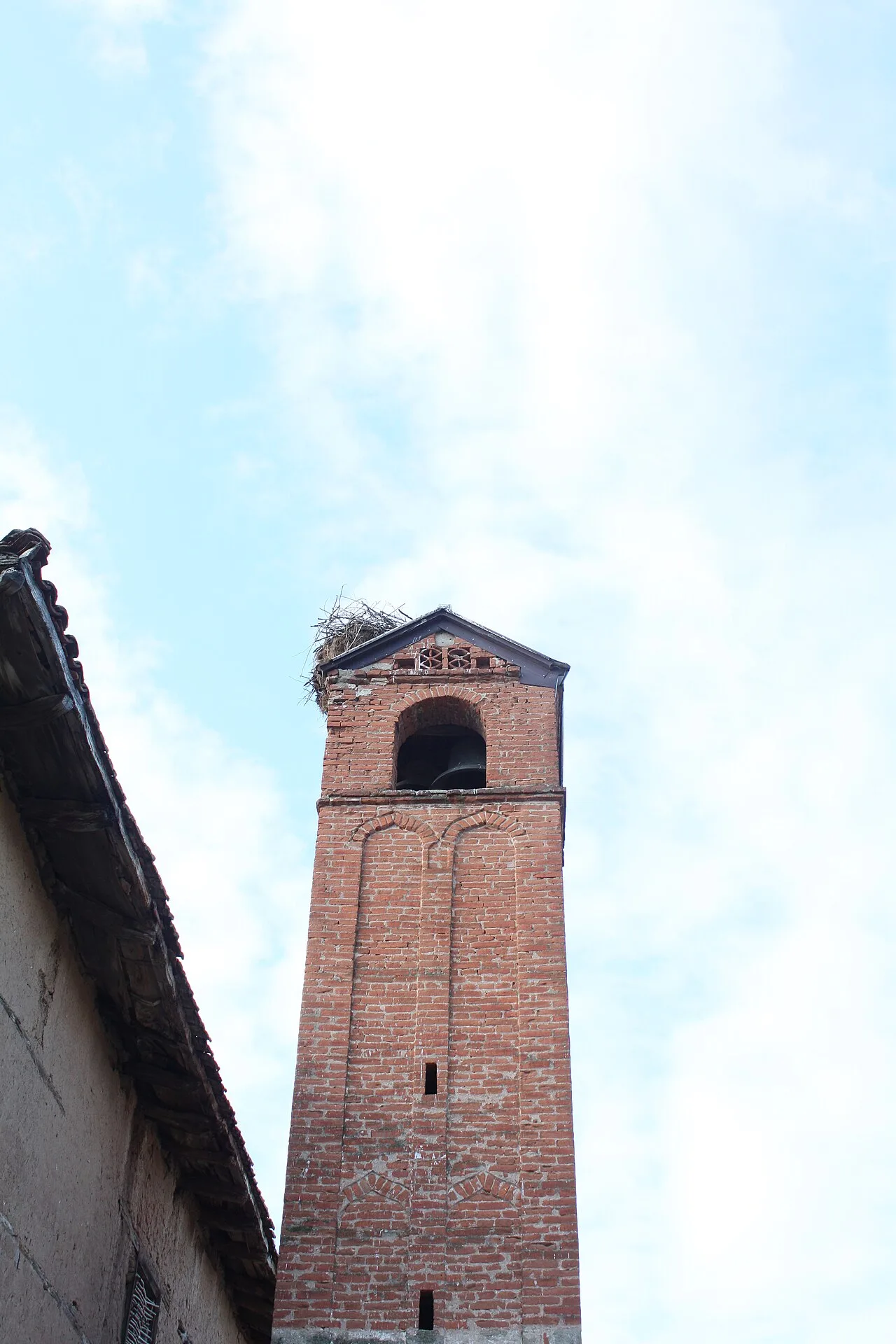
At its height the village had two schools, a hospital with a maternity ward and a soft-drink factory, according to the same report; the Bulgarian news agency BTA adds a bell foundry, sesame and tahini workshops, mills, blacksmiths and a cinema. "Cocoons were raised in their thousands in the parlours of the houses," the radio's reporter wrote. Of the two churches, the small cemetery church of St Nedelya is the older, dated to 1708 by the association and to 1718 by Gyuzelev. The parish church of St Demetrius was built in 1835, and its bell tower, 15 metres high, about 1860.
The houses still tell the story. Showing visitors round her home, Katerina Ilieva points to the spacious upper floor that was built for raising silkworms, BTA reported in 2026; today it is used to dry herbs and hang strings of tobacco. One house stands out: the brick house of Dr Atanas Peykidis, who studied medicine in Istanbul and gynaecology in Paris and came home to practise in the village.
In one respect this Albanian village was Greek. Its church inscriptions were in Greek, the liturgy was sung in Greek until 1912, and so was the school, as Sokolova recorded. Ottoman officials counted Orthodox Christians by church, not by language, so the people of Mandritsa appear in the statistics of the time as Greeks. Albanian was the language of the house.
How large the village became depends on whom one asks. Gyuzelev assembles the counts. A statistic published in 1878 from a tax census of 1873 gives 250 households and 1,080 people. The Bulgarian consul in Edirne counted 350 houses in 1903. For the eve of the Balkan War of 1912 the scholar Lyubomir Miletich gave 1,879 inhabitants, the figure Gyuzelev accepts as the peak. The village association, Radio Bulgaria and BTA speak of 3,000 to 3,500 at the peak. None of them names a census or a register for that figure, and none has been traced.
Sister villages across the Maritsa
Mandritsa was not alone. Its old people told the linguist Boyka Sokolova of ties with Albanian villages beyond the river Maritsa, and named them in their own pronunciation: Alltëntash, Sulltanqoi, Azardere, Zailef, Aballar. Gyuzelev found them in Eastern Thrace, today part of Turkey: Altıntaş, Sultanköy, Pazardere, Zalaf, now Kırcasalih, and Abalar. A statistic of 1878, drawn from a tax census of 1873, gives Zalaf 400 households and 1,740 people, more than Mandritsa had.
War ended that world. When Ottoman troops returned in the summer of 1913, 560 people were killed at Zalaf, the international commission of inquiry sent by the Carnegie Endowment reported in 1914. The report sets the killings beside an earlier episode: in the first war the villagers, "Albanians, Greek in religion", had plundered the neighbouring Pomak village and had a Greek priest baptise its people. Gyuzelev reads that episode as the pretext. After a brief spell of Greek rule, almost all the Albanians of Eastern Thrace left for Greece in 1920–22, Gyuzelev writes, together with the other Orthodox Christians of the Patriarchate. A few families went the other way: ten from Abalar settled near Yambol, in Bulgaria.

1913: the village divides
The Balkan Wars drew a border through the world Mandritsa belonged to. The village went to Bulgaria. Its church had always looked to the Patriarchate in Constantinople, and its Greek neighbours in the town of Ivaylovgrad were leaving.
Accounts of what followed differ by country. The Greek account of Maximos Maravelakis and Apostolos Vakalopoulos, republished in 2019, says that on 13 October 1913 all but 40 of the village's 480 families left, "expelled by the Bulgarians", and spent six months as refugees around Didymoteicho, on Ottoman ground, before moving on to Greece. A master's thesis of 2018 at the Democritus University of Thrace adds that the village was plundered. The Bulgarian Wikipedia article on the village gives another reason, without citing a source: after Bulgarian irregulars entered the village on 13 October, its people fled for fear of reprisals for the deeds of a Greek armed band based there. No documentary source for that version has been traced.
A contemporary Bulgarian witness saw Mandritsa as a partisan village. The scholar Lyubomir Miletich, who toured Thrace to record what its Bulgarians had suffered in 1913, calls it "Greekoman", leaning to the Greek cause, and records the complaints of the neighbouring Bulgarian village of Gökçebunar: its people suspected Mandritsa's notables of denouncing them to the Ottoman army, and gendarmes from Mandritsa took their cattle. When he passed through in June 1914, Mandritsa's houses were standing.
Gyuzelev dates the main departure after 1919, when the peace treaty confirmed the border and the convention on voluntary emigration between Greece and Bulgaria offered a way out: "at least half" of the Albanian inhabitants left, he writes. Many took the place of departed Bulgarians south of Kilkis. The Greek account puts the first 100 families from Mandritsa there in the spring of 1914, at a village then called Ambarköy, and counts 200 by 1926. They named it after their home: Mandres. More about the country they joined is in our guide to Albanians in Greece.

Those who stayed became a minority language community inside a shrinking village. "At one time, our grandfathers were banned from speaking it, but they still spoke it at home," Sultana Aleksandrova, then 93, told Radio Bulgaria in 2025. "Later, during the socialist era, nobody stopped us. Back then, though, our passports said we were 'Albanians'. Later, they changed it to 'Bulgarians'."
"We don't know how to read or write. We can't write in Albanian. We only speak one dialect."
Sultana Aleksandrova of Mandritsa, to Radio Bulgaria, June 2025
What the language sounds like
Linguists classify the speech of Mandritsa as Tosk, the southern branch of Albanian, carried east long before a standard language existed and kept alive by word of mouth alone. Maria Morozova of the Russian Academy of Sciences, who has analysed its grammar, describes a dialect shaped by long contact with Bulgarian and, to a lesser degree, with Greek and Ottoman Turkish.
The association prints a few everyday phrases as the villagers say them: Misen iert for "welcome", Mbetuni me shindet for "goodbye", Kush sohesh? for "what is your name?" and Me shindet for "cheers". In the last one a speaker of today's standard language will, in our reading, recognise me shëndet, "to your health". The village guesthouse is called Bukor Shtepi, which BTA translates from the local dialect as "beautiful house".
Whether a visitor from Albania would be understood is a matter of opinion in the village itself. "Our dialect is different from theirs. We can't understand each other," Sultana Aleksandrova said in 2025. Other residents told BTA in 2026 that on a recent visit to Vithkuq they followed about 80 percent of what was said.
The dialect is unusually well documented for a language with so few speakers: Shuteriqi published texts from the village in 1965, Sokolova her book in German, Die albanische Mundart von Mandrica, in 1983, and the Sofia Albanologist Ludmil Stankov (1949–2020) a monograph in 2017. Maria Georgieva-Peeva's phrasebook, published by the association in 2015, sets each village word beside its standard Albanian form.
Morozova, drawing on Sokolova, explains who kept the language. The men of Mandritsa traded and needed Bulgarian, and many married women from neighbouring Bulgarian villages. Those wives learned Albanian. In the years after 1950 Sokolova still met old women in the village who spoke Bulgarian poorly.
What is left, and who looks after it
The census of 2021 found 34 people in Mandritsa. Radio Bulgaria's reporter counted "around 20 adult inhabitants who still speak Albanian" in 2025. According to Anton Hristov, Sultana Aleksandrova's grandson, the only other speakers are a few emigrants across the border in Greece. Those who left the village live in Ivaylovgrad, Plovdiv and Sofia; one of them is the writer Nikolay Tabakov, founder of the Anubis publishing house, BTA notes.
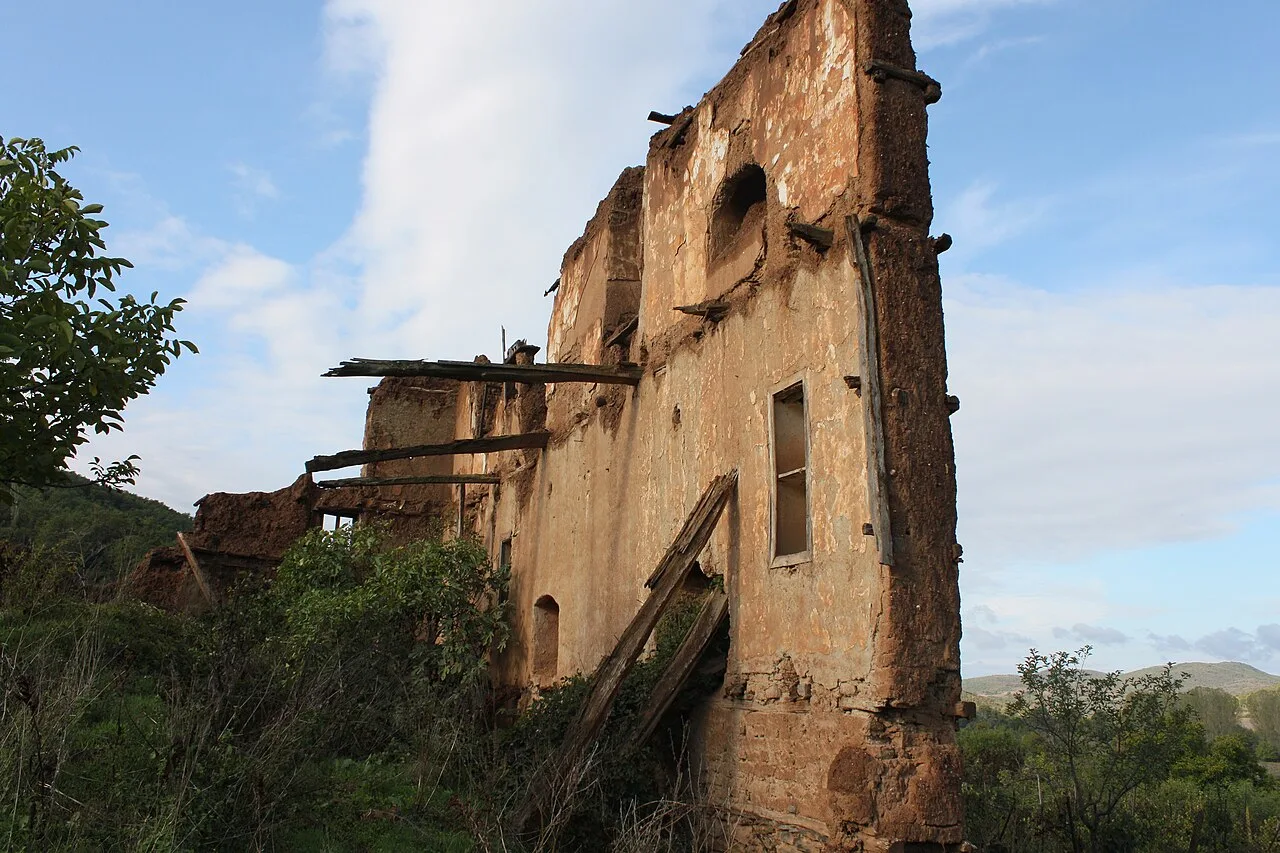
The people who look after the place describe themselves as "a group of enthusiasts". Their Association for the Revival of the Village of Mandritsa, registered in 2010, keeps a website in English and Bulgarian, published the phrasebook, and for years has organised a children's Easter party on the square and a summer gathering called "Together Again" on the last weekend of July. In 2017, by its own account, the gathering drew hundreds of people "from Mexico through Europe to New Zealand".
Albania and Kosovo have taken notice. On 18 and 19 July 2019 the ambassadors of both countries visited the village, and some of the older women put on their costumes and sang. In September 2020 the Albanian government offered two scholarships for "Bulgarian citizens of Albanian origin". Hristov, meanwhile, has restored an old silkworm house as a guesthouse and runs courses in building with clay together with a group of architects.
The church is cared for in the same way. There is no resident priest, BTA reported in 2026; the villagers cense the icons and sell the candles themselves, and the bell now rings at the press of a button, one button for joyful occasions and one for mourning. Sultana Aleksandrova calls St Nedelya a "living saint". After the Easter procession around the village, which is meant to keep hail from the crops, she and other women saw the saint, she told BTA, as a snake coiled in front of the old church, for a moment only: a sign that the saint was pleased. She once sang in a village women's ensemble of 25 that travelled to Albania and won a prize there. She is its last surviving member, and the group's photograph hangs in the narthex of St Demetrius. Every woman in it wears the village costume, a black wool pinafore dress trimmed with red braid, with two openings at the front so that mothers could nurse without taking it off, as Katerina Ilieva explained. BTA's reporters spoke with her, Sultana Aleksandrova and Kostadin Beychev in both Bulgarian and Albanian.
Daily life has adapted: a travelling shop comes on Mondays and Fridays. Several British families have settled in the village and come to church on Sunday; one of them, a builder from London, runs workshops on restoring the adobe houses. After the service villagers meet at the café of the Bukor Shtepi complex, and in summer the children who spend their holidays in the village swim in its pool.
Sofia: the city where Albanians printed their books
The second Albanian Bulgaria had nothing to do with the first. It began after 1878, when the new Bulgarian principality was building a capital and needed hands.
Those who came were few. The historian Nathalie Clayer, as summarised by Said Olgun, describes no more than a few hundred men, most of them unmarried Orthodox Christians from Kolonjë, Devoll and the country around Korçë, working as labourers in Sofia, Plovdiv, Varna and other towns. Bobi Bobev and the Albanologist Thoma Kacori, in the fullest account of the colony, name the trades: masons, sawmill hands, field guards, guards of consulates and schools. Their own estimate, which they offer as an opinion, is higher: more than 500 families of Albanian origin in Sofia at the end of the 19th century.
An inn by the hot spring
Most of them could not read. On free days they met in two places, Bobev and Kacori write: the café "Albania", kept by Adham Shkaba and Spiro Garo, and the inn of Dhimitër Mole by the hot spring in Serdika Street. Mole had come from Bucharest in 1886 with Albanian books and newspapers, and read them aloud. Primers followed, sent from Istanbul and Bucharest. "The inn of Dhimitër Mole turned into a people's school, and the innkeeper into their teacher."
On 1 January 1893, a freezing day by their account, the room at the inn could not hold everyone who came. Christians and Muslims, Tosks and Ghegs, voted to found a society. They called it Dëshira, "longing". That day 53 men joined; others held back for fear of what the Ottoman authorities would do to them when they went home. A master mason was elected chairman and Mole secretary. A Bulgarian court approved the society's statute and seal.
The society's purpose was schooling. Its teacher, Kosta Jani Trebicka, had no classroom, so he went from house to house where there were children, and taught the workmen at the inn by night. A song written for the founding by Spiro Garo put the aim in two lines: founded in Sofia, for a school in Albania.
Mbrothësia: a press called Progress
What Sofia offered that Albania could not was the freedom to print. After the Ottoman authorities suppressed the society that printed Albanian books, such books were produced outside the empire or under Austrian protection in Shkodër, the historian George Gawrych notes. The colony in Sofia set up a press of its own in 1897, named Mbrothësia, "progress", and run by Kristo Luarasi, later its owner. Its first book, Bobev and Kacori write, was an almanac; the National Library of Albania's bibliography of Albanian books records it in 1897 as the Ditërëfenjës Kombiar, known later as Kalendari Kombiar, the National Calendar. Bobev and Kacori write that Midhat Frashëri, under the pen name Lumo Skëndo, edited it from its second year, and that it went on appearing in Bulgaria until the end of the First World War.
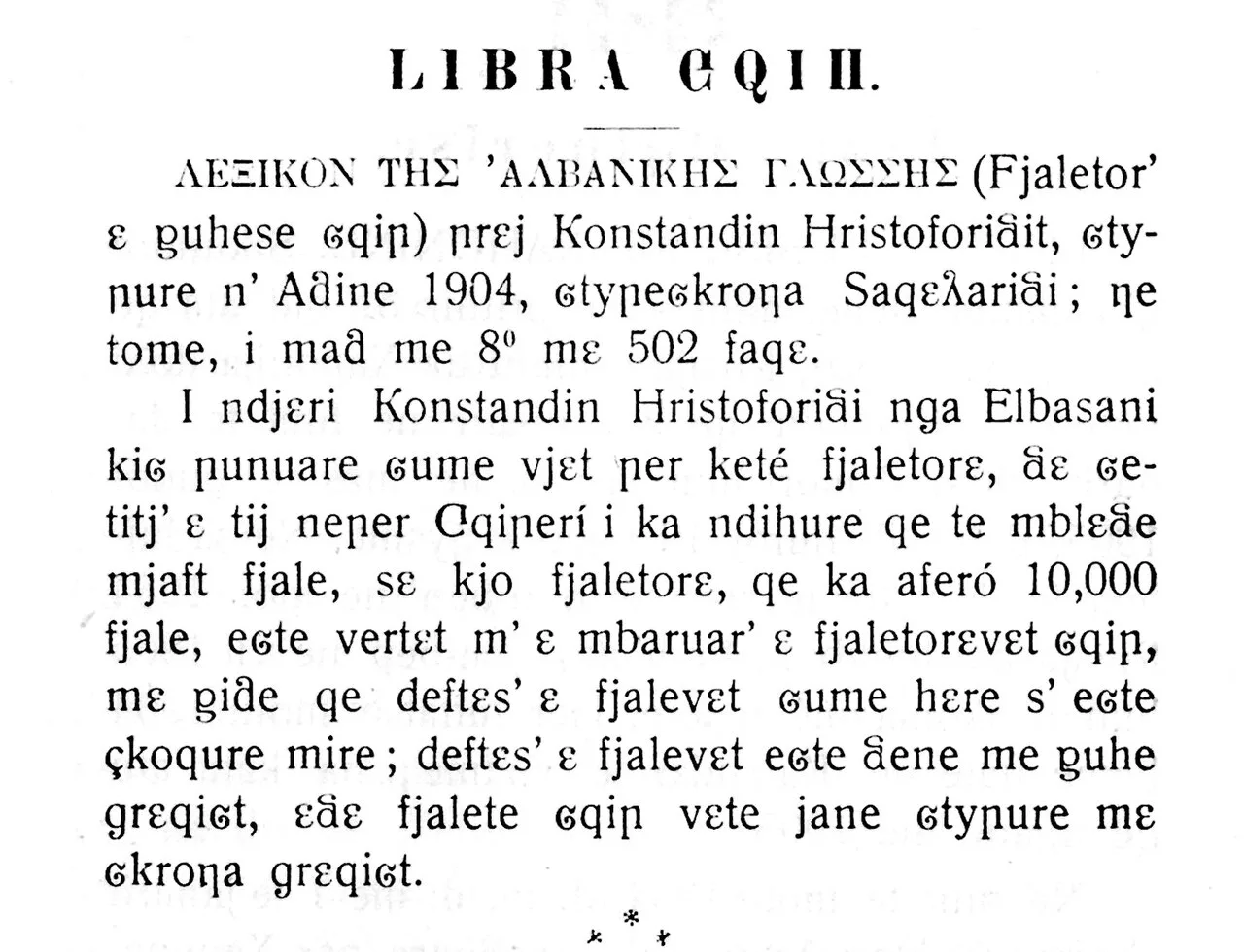
Books followed. Sami Frashëri's play Besa came out in Sofia in a Bulgarian translation and was staged there, Bobev and Kacori write. Spiro Dine's collection of folk songs and tales, Valët e detit, carries a Sofia imprint of 1908. A title page of 1909 shows the press at work for a time in Thessaloniki. After the First World War it moved to Tirana.
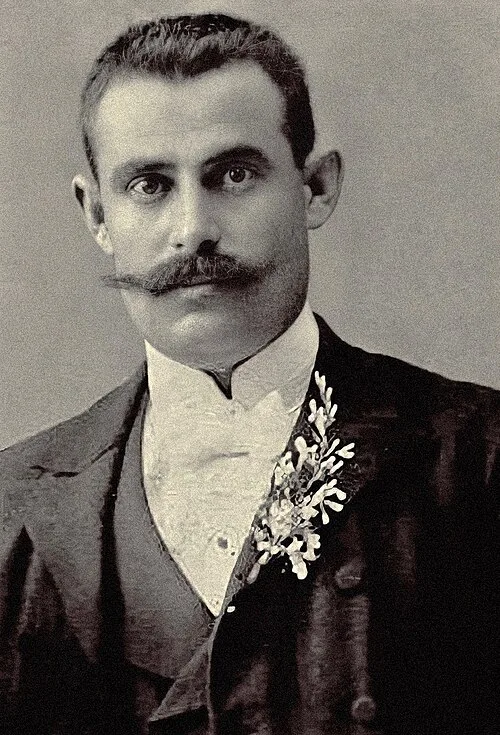
Gawrych gives the measure of what this meant. By 1908, he writes, Albanians abroad had founded clubs and societies that published more than thirty newspapers and journals in their language, "including seven each in Bulgaria and Italy, four each in Egypt and Romania, and three in Belgium". In that count a colony of a few hundred labourers stands level with Italy, home of the Arbëreshë, the Italo-Albanian communities settled there since the 15th century.
Drita: a newspaper from a rented room
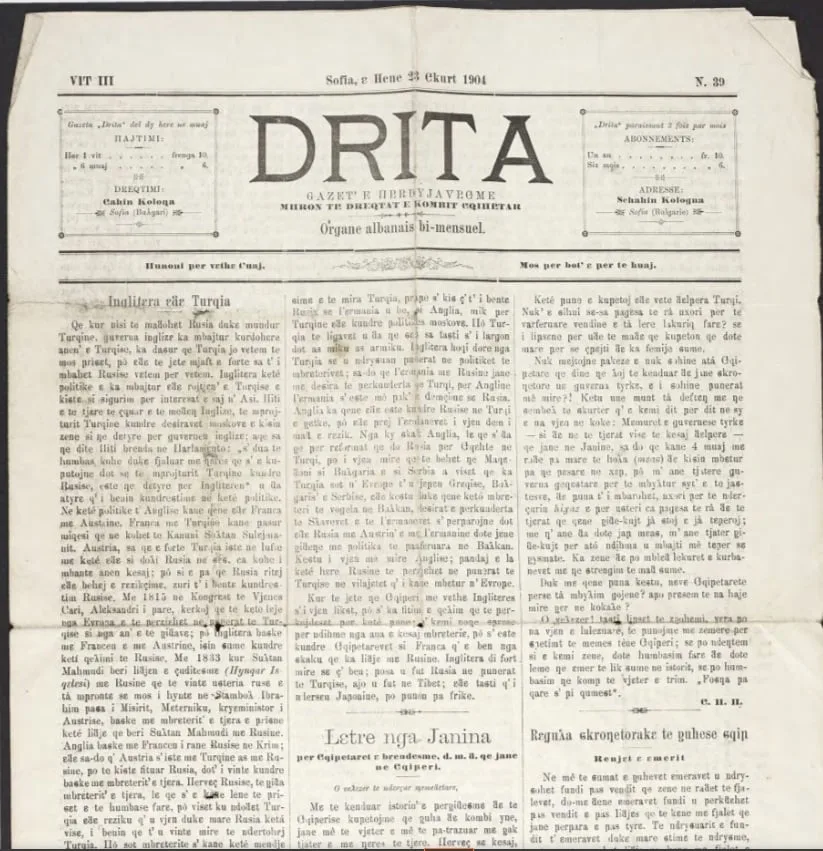
The best known of those papers was Drita, "the light". Its editor, Shahin Kolonja, had been an Ottoman official. In December 1900 he fled the empire by way of Corfu and Brindisi, and settled in Sofia, where, Olgun writes from Ottoman archives, he lived at first "a wretched life" in a small room on the edge of town that he shared with another Albanian activist, Thoma Avrami.
The first number of Drita appeared on 14 November 1901. It came out every two weeks, was printed at Mbrothësia, and ran to 101 numbers before Kolonja returned home in 1908, according to the scholar Sokol Memeti; in 1904 its print run reached 670 copies. From 1903 it was subsidised by Austria-Hungary, according to consular reports published by Genci Luarasi. Being printed in Bulgaria did not make it Bulgarian in its views: Memeti notes that it criticised Bulgarian policy too.
A shoemaker's newspaper
Josif Bageri came to Sofia on foot. Born in Nistrovë in Upper Reka, he arrived at 17, unable to read, after a walk of 18 days, the historian Hamit Boriçi writes, and found work with a shoemaker. He learned to write Albanian in Sofia; Mole was his first teacher. From 1909 to 1911 he edited a paper of his own, Shqypeja e Shqypënis, "the eagle of Albania". In January 1914 he left for Durrës. He died in a hospital in Pristina, Kosovo, on his way back.
From the alphabet to independence
The colony was present when the big decisions were taken. The delegate list of the Congress of Manastir of November 1908, which settled the Albanian alphabet, includes "A. Shkaba, Sofia" and "D. Mole, Philippopolis", the old name of Plovdiv. Kolonja was elected to the committee that chose the letters, alongside Midhat Frashëri.
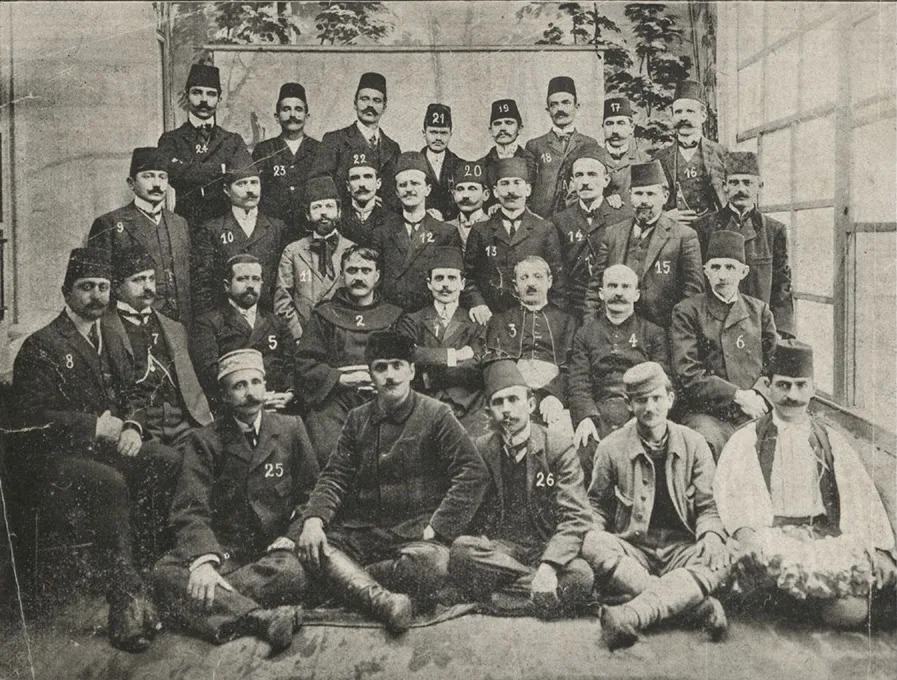
Fighters came through as well as writers: the brothers Bajo and Çerçiz Topulli, who sought weapons for the armed bands, stayed in Sofia for more than six months from 1906, Bobev and Kacori write. Fan Noli came in 1911, on a tour in which he held church services in Albanian for the colonies of Kishinev, Odessa, Bucharest and Sofia, as the scholar Robert Elsie records. Bobev and Kacori place the Sofia liturgy in the church of Sveti Spas, before Bulgarian, Romanian and Greek bishops.
Luarasi had a newspaper of his own by then. Liri e Shqipërisë, "freedom of Albania", came out in Sofia from 1911; a society of Albanian collectors dates its first number to 11 March of that year. On 6 January 1913 its front page carried a picture of the proclamation of Albania's independence at Vlorë.
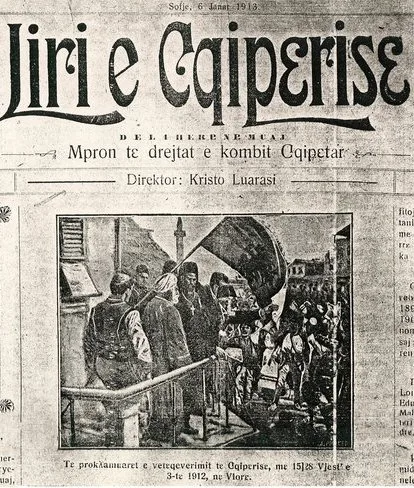
Many websites add that the words of Albania's national anthem, Asdreni's poem "Betimi mbi flamur", were first printed in this paper on 21 April 1912. No primary source for that has been found. The scholar usually cited for it, the musicologist Vasil Tole, dates the poem's first publication to 1908, and the Albanian embassy in Sofia says the words were written in Bucharest in 1912.
After the printers left
Independence emptied the colony of its leaders. After the First World War, Bobev and Kacori write, Mole, Luarasi and others went home to help build the new state, and the press went with them.
The society outlived them by a generation. In 1928, when Ahmet Zogu was proclaimed king, its members split into supporters and opponents, and some left to found a second society named after Gjergj Kastrioti. After 1945, new laws closed foreign societies that were not covered by a cultural agreement between governments, and both came to an end.
One man carried the memory forward. Thoma Kacori was born in 1922 in Shtikë, in Kolonjë, and came to Bulgaria at 17, where his grandfather had worked since about 1890, rising from apprentice paver to builder. Kacori became a writer and translator, and for many years held the lectureship in Albanian that Sofia University opened in 1962. When he died in the last days of 2008, his colleague Rusana Beyleri called him "the last Albanian revivalist" in Bulgaria. By his and Bobev's estimate, about 100 families of Albanian origin remained in Sofia when they wrote in 1998, merged into Bulgarian life but aware of their roots.
Older traces: villages that were Albanian once
Mandritsa was not the only Albanian village in the Bulgarian lands, only the last. Gyuzelev's study follows the others through Ottoman registers, bishops' reports and travellers' diaries, and the four entries below are taken from it.
They were numerous enough to interest a recruiter. In January 1595 a merchant of Dubrovnik, Pavle Djordjić, who was trying to raise the Christians of the Balkans against the sultan, wrote that "in Bulgaria there are many settlements inhabited by Albanians, from which seven thousand brave and well-armed men can be gathered". The number cannot be checked. The settlements can.
- Kopilovtsi, a Catholic mining village near Chiprovtsi in the north-west. In 1640 the bishop Petar Bogdan reported 1,200 communicants and 360 children there, "by nation Albanians, because they came long ago from Albania and even now keep this language". By 1647 they used the Slavic of their neighbours, and in 1658 he found only remnants of Albanian. The village emptied after the uprising of 1688.
- Chervena Voda, near Ruse on the Danube. The register of 1555–56 records a quarter of 100 households and 40 unmarried men whose names are almost all Albanian: Gjorg, Gjon, Gjoka, Dede, Leka. In 1595 its people crossed into Wallachia with the army of Michael the Brave; many returned. The village was burnt in 1811 and resettled by Bulgarians after 1828.
- Poroishte, outside Razgrad, known to the Ottomans simply as Arnautköy, the Albanian village. A traveller who stopped there on 14 November 1674 described "a pleasant village on a hill among many vineyards, populated only by Albanians". It was burnt in 1810. By about 1900, only a few very old villagers still knew the Tosk dialect.
- Devnya and its neighbours near Varna. Their Albanians left for Bessarabia early in the 19th century, together with Bulgarians and Gagauz. Their descendants are the Albanian speakers of southern Ukraine, whose story is told in our guide to Albanians in Ukraine.
No living trace of these communities is known inside Bulgaria today. The language of one of them, Devnya, survives in the villages its emigrants founded on the steppe north of the Black Sea.
Arbanasi: a name and an argument
The best-known "Albanian" place in Bulgaria is the one whose Albanian past is least certain. Arbanasi, the museum village of merchants' houses and painted churches on the hill above Veliko Tarnovo, has a name that means "Albanians" in the old Slavic form. The Ottomans called it Arnavud köy and the Greeks Arvanitochori, which mean the same.
No document says who founded it. Its first record, in the 1540s, calls the place Yaylak, a summer pasture, with 63 households. The explanation Gyuzelev finds most acceptable, following the Dutch Ottomanist Machiel Kiel, is that the first inhabitants, 100 to 200 people, were Albanians brought from the south after the sultan's campaign in Albania in 1492. Direct evidence is lacking, he admits, but he points to Albanian names such as Leka, Gjon and Dede in the register of the mid-16th century, though Greek-Orthodox and Slavic names predominate in it.
The later evidence shows a Greek-speaking village. Gyuzelev explains this by a larger wave of settlers in the mid-16th century, of unrecorded origin but probably mainly Greeks, who outnumbered the first inhabitants; with Greek schooling and the church, the Albanians were assimilated. In 1640 Bishop Petar Bogdan noted that its people, in about 1,000 houses, spoke Greek. An Ottoman register of 1692–93 gives the nationality of 222 men: 197 Greeks, 14 Vlachs, 4 Serbs, 4 Albanians, 3 Bulgarians and one Russian. Some personal names in the same register are Albanian, and the Albanologist Kacori, who studied them, judged part of them "undoubtedly" so.
What can be said is modest. In our reading, outsiders called the first settlers Albanians, strongly enough for the name to stick in three languages. Within a century and a half the village was Greek in speech, church and school.
Four centuries in 15 dates
- 1555–56An Ottoman register records a quarter with Albanian names at Chervena Voda, near Ruse.
- 1627Mandritsa appears in a tax register with 18 households.
- 1640Bishop Petar Bogdan reports that the Catholics of Kopilovtsi still speak Albanian.
- 1811The British traveller John Galt records Zalaf, in Eastern Thrace, as an Albanian village.
- 1886Dhimitër Mole arrives in Sofia from Bucharest with Albanian books and newspapers.
- 1 January 1893Albanian workers in Sofia found the society Dëshira.
- 1897The Mbrothësia press begins printing the almanac Kalendari Kombiar.
- 14 November 1901First number of Shahin Kolonja's newspaper Drita.
- 1911Fan Noli holds services in Albanian in Sofia; Kristo Luarasi's newspaper Liri e Shqipërisë begins.
- 1913–14Mandritsa passes to Bulgaria; by the Greek account most of its families leave, and the first settle near Kilkis in what becomes Mandres. At Zalaf, 560 people are killed, the Carnegie report records.
- 1928The Dëshira society in Sofia splits over King Zog.
- 1920–22Almost all the Albanians of Eastern Thrace leave for Greece.
- 1945The Albanian societies of Sofia are closed.
- 1962Sofia University opens a lectureship in Albanian.
- 2023The National Library in Sofia opens an Albania corner.
Counting a community the census does not show
Nobody knows how many Albanians live in Bulgaria, and the reason is worth understanding.
Bulgaria's census asks about ethnic group, and answering is voluntary. In the tables the National Statistical Institute publishes, however, small groups are folded into "other". In 2021 the "other" group held 79,006 people; after ten groups had been named separately, from Russians to Tatars, 44,585 remained, and Albanians were not among the ten. The institute's comparative tables online, which run back to 1900, show only Bulgarians, Turks, Roma and "other". Published results of the censuses of 1920, 1926, 1946, 1956, 1965 and 1992 did name Albanians among the groups counted, according to a study of the census categories; those volumes could not be consulted.
One number can be found. A paper of the government's council on ethnic issues, summing up the census of 2001, lists among the "small traditional minorities" of fewer than a thousand people: "Albanians: 278". It adds that as late as 1946 there had been two Albanian villages in the Ivaylovgrad district.
Other figures circulate online, among them 220 for the census of 2011. It does not appear in the statistical institute's published tables, and the document usually cited for it gives 278 for 2001 instead, so it is not used here.

Passports are counted better than identities, but even the passport counts disagree. Eurostat's figures for 1 January 2025 show 567 citizens of Albania and 272 citizens of Kosovo living in Bulgaria, and 813 residents born in Albania and 285 born in Kosovo, whatever passport they now hold. Yet on the night before, 31 December 2024, citizens of Albania held 775 valid Bulgarian residence permits and citizens of Kosovo 386. Short stays do not explain the gap: 706 of the Albanian permits were valid for a year or more. The figures come from different places, the permits from the interior ministry's records and the residents from the statistical count of people who usually live in the country. A permit stays valid until it expires, so some holders may well have moved on; that is the likeliest reading, though neither office says so.
Birthplaces move the other way. Residents born in Albania numbered 1,134 in 2011 and 649 in 2023, then 813 in 2025; those born in Kosovo 443, 206 and 285. Over the same years the permits held by citizens of Albania rose from 130 at the end of 2011 to 797 at the end of 2025, and those of citizens of Kosovo from 47 to 412. The two series describe different people: anyone born in Albania counts in the first, including Bulgarians born there and migrants who came long ago, while only today's foreign citizens count in the second. Eurostat publishes no birthplace figures for 2013 to 2022, so when the fall happened cannot be seen. Students are a small group: 61 citizens of Albania and 34 of Kosovo held a permit for education at the end of 2025.

One neighbour is missing from every count. On 1 January 2025, 2,447 citizens of North Macedonia lived in Bulgaria, and at the end of 2025 they held 6,567 valid residence permits. North Macedonia has a large Albanian community, described in our guide to Albanians in North Macedonia, but no Bulgarian or European statistic records how many of these people are Albanians. They cannot be counted here, and they cannot be ruled out.
One more group has to be kept out of the sum. Since 2015 several thousand citizens of Albania have been recognised by the Bulgarian state as being of Bulgarian origin, the first step towards a Bulgarian passport: 8,474 approvals between 2015 and July 2021, according to official data obtained by the daily Sega, and 2,622 passports granted from 2015 to 2020. They declare Bulgarian, not Albanian, descent, and the data do not say where they live.
So the honest answer has three parts. About 20 adults, by Radio Bulgaria's count in 2025, speak the old dialect of Mandritsa. About 100 families of Albanian origin lived in Sofia in 1998, by an estimate published that year. And somewhat over 1,000 people who were born in Albania or Kosovo, or hold one of their passports, live in the country today, beside an unknown number of Albanians from North Macedonia.
The community today
No association of today's Albanians in Bulgaria could be traced. What exists is institutional, and most of it is in Sofia.
Sofia University has taught Albanian since 1962. Its five-year programme in Balkan Studies teaches three languages in equal measure: Romanian, Greek and Albanian. About 60 students a year study Albanian language, literature and history there, the Albanian ambassador said in 2023. Albanian language and culture are taught by the department's Albanologist, Rusana Beyleri.
The two embassies set the calendar. Bulgaria and Albania have had diplomatic relations since 1913 and embassies since 1954. Bulgaria recognised Kosovo on 20 March 2008, and Kosovo's embassy in Sofia opened on 18 January 2010. At the Albanian embassy's national-day reception in November 2024 the guests included, in its words, people "from the Albanian community living in Bulgaria". On 2 April 2026 the Albanian embassy and the university held an evening for the 90th anniversary of Ismail Kadare's birth, in the city where, the embassy noted, he was first translated.
The newest institution is commercial. A Bulgarian–Albanian Business Chamber opened in Sofia on 27 January 2025, a joint initiative of the Albanian embassy, the entrepreneur Ivan Anchev and Ervis Taluri, its executive director; Arjeta Puca chairs its board, the embassy announced. Its ambition, as Radio Bulgaria reported it, is to create "a unique space that will link the diaspora with its roots".
Where to meet in Sofia
- The university. Albanian is taught at the Faculty of Slavic Studies of Sofia University, 15 Tsar Osvoboditel Boulevard.
- The National Library. The library at 88 Vasil Levski Boulevard opened an Albania corner in April 2023, with, in the embassy's words, more than 550 volumes in Albanian and more than 700 about Albania and the Albanians. Readers can register from Monday to Friday, 8:30 to 19:00. Ask at the desk whether the corner is on display.
- The embassies' days. The Albanian embassy holds a reception for the national day in November, and Kosovo's embassy marks its independence day, 17 February.
- Places of worship. No regular service in Albanian, Orthodox, Catholic or Muslim, could be traced anywhere in Bulgaria. Muslims in Sofia pray at Banya Bashi, which the Chief Mufti's Office has called the capital's central mosque. In Mandritsa, the church of St Demetrius holds its liturgy on Sundays.
Passports, visas and consular help
Citizens of Albania deal with their embassy at 20 Aksakov Street, 4th floor (+359 2 943 3857, [email protected]), which points them to Albania's online consular service. Citizens of Kosovo apply to their embassy at 23 Petar Parchevich Street (+359 2 983 3999, [email protected]) for passports, identity cards and the registration of births, marriages and deaths. Its page lists the fees but gives two different figures for an adult passport, 50 and 100 euros, and neither embassy publishes opening hours, so write or call first.
Finding other Albanians in Bulgaria
In a community this small, people find each other through events more than through neighbourhoods: an embassy reception, a literature evening at the university, the July gathering in Mandritsa.
For those looking for a partner who shares the language, the circle in one country can be narrow. dua.com is used by Albanians in many countries, so the search does not have to stop at a border. No dua.com figure for Bulgaria has been published, so none is given here.
Visiting Mandritsa
Mandritsa is a lived-in village, not a museum. Visitors are welcome, but the houses are homes or ruins, and both deserve care.
- Getting there. The village is 19 kilometres south of Ivaylovgrad by road, in Haskovo province. The association says a bus runs from Ivaylovgrad three times a week; ask the municipality for the current timetable, because that information is not dated.
- From Greece. The Ivaylovgrad–Kyprinos crossing opened in 2010, and since 1 January 2025 it can be crossed without document checks. It is limited to vehicles up to 3 metres wide with a payload of up to 3.5 tonnes, and to buses with up to 50 passengers.
- Where to stay. The eco-complex Bukor Shtepi in the village has two buildings, a restaurant and a pool; check dates and prices with the owners.
- What to see. The tall houses of sun-dried brick, the church of St Demetrius with its bell tower and the small cemetery church of St Nedelya. The churches may be locked, so ask in the village.
- When to go. The association's gatherings have been held at Easter and on the last weekend of July. The last programme it published is for 2022, and the newest item on its website is dated 20 May 2025; write to the association before planning around a date.
In Sofia, no plaque or street name for the Mbrothësia press, for Dëshira or for the people who made them could be traced. A visitor will find this chapter in libraries, not in stone.
Directory
Addresses and contacts were checked on 17 November 2026 on each organisation's own page or an official one. Small organisations change quickly; confirm before you travel.
- Association for the Revival of the Village of Mandritsa: mandritsa.com, in English and Bulgarian; [email protected]. The newest item on the site is dated 20 May 2025.
- Bukor Shtepi, Mandritsa: bukorshtepi.com, guesthouse, restaurant and pool; +359 889 359 266; [email protected].
- Municipality of Ivaylovgrad: ivaylovgrad.bg; 49 Bulgaria Street, Ivaylovgrad; +359 3661 4500; weekdays 8:00 to 17:00. Ask here for the bus to Mandritsa.
- Ivaylovgrad Historical Museum: 1 Peyo Yavorov Street; +359 882 296 410; Monday to Friday 8:00 to 17:00, weekends 9:00 to 16:00 (municipal page of 23 July 2026).
- Embassy of Albania in Sofia: ambasadat.gov.al/bulgaria; 20 Aksakov Street, 4th floor; +359 2 943 3857; [email protected]. The newest news item is dated 17 June 2026.
- Embassy of Kosovo in Sofia: ambasadat.net/Bullgari; 23 Petar Parchevich Street; +359 2 983 3999; [email protected].
- National Library St Cyril and St Methodius: nationallibrary.bg; 88 Vasil Levski Boulevard, Sofia; +359 2 9183 212.
- Sofia University, Faculty of Slavic Studies: 15 Tsar Osvoboditel Boulevard; the Balkan Studies programme (in Bulgarian) teaches Albanian as one of its three languages.
How this guide was researched
Every statement here was checked against a source opened in November 2026, listed at the end of the page. For the villages we relied on Boyan Gyuzelev's monograph of 2004, built on Ottoman registers and Catholic reports we did not read ourselves. For Sofia we relied on Bobev and Kacori, on Olgun's summary of Nathalie Clayer, on George Gawrych and on the National Library of Albania's bibliography. Where sources disagree, as on the size of Mandritsa, the events of 1913 and the origin of Arbanasi, the versions are given side by side. Three scholars who were not Albanian did as much as anyone to record this history: Boyka Sokolova and Ludmil Stankov, who described the dialect, and Boyan Gyuzelev, who traced the villages.
Left out or marked as open: census figures for Albanians before 2001, the population of Mandritsa between 1912 and 1985, the number of people of Albanian descent in Sofia today, the Albanian share among citizens of North Macedonia in Bulgaria, and the date often given for the first printing of the anthem's words. We found no association of today's Albanians in Bulgaria. The voices from Mandritsa come from interviews published by Radio Bulgaria and BTA, and no living Albanian in Sofia speaks in these pages yet. Corrections, family documents and accounts are welcome.
Read on in Albanians in Ukraine, where the dialect of Devnya lives on, in Albanians in Greece and Albanians in Turkey, or browse the Albanian community hub. To begin a conversation of your own, meet Albanians on dua.com.
Frequently asked questions about Albanians in Bulgaria
How many Albanians live in Bulgaria?
There is no reliable total. Bulgaria's current census tables do not show Albanians separately; the only figure printed by a state body that could be traced is 278 people who declared Albanian ethnicity in 2001. On 1 January 2025, Eurostat counted 567 citizens of Albania, 272 citizens of Kosovo and 813 residents born in Albania, beside 2,447 citizens of North Macedonia whose Albanian share is not recorded.
Where is the Albanian village in Bulgaria?
It is Mandritsa, in Ivaylovgrad municipality in Haskovo province, 19 kilometres south of Ivaylovgrad and about two kilometres from the Greek border. About 20 adults there still speak an old Albanian dialect, according to a Radio Bulgaria report of 2025, and the village had 34 residents at the census of 2021.
Where did the Albanians of Mandritsa come from?
From the Korçë region of south-eastern Albania. Local tradition names three brothers from Vithkuq and the year 1636, Ottoman tax registers list the village from 1627, and its dialect is closest to that of the Devoll valley. Most families are thought to have arrived towards the end of the 18th century.
What kind of Albanian is spoken in Mandritsa?
A Tosk, or southern, dialect from the Korçë and Devoll area, separated from the rest of the language for centuries and shaped by Bulgarian, Greek and Turkish. Villagers who visited Vithkuq told BTA in 2026 that they understood about 80 percent of what they heard there.
Why was Sofia important for the Albanian national movement?
Because Albanian books and newspapers could be printed there when they could not be printed freely in the Ottoman Empire. Albanian workers founded the society Dëshira there on 1 January 1893, its press Mbrothësia printed the almanac Kalendari Kombiar from 1897, and by 1908 seven Albanian-language periodicals had been published in Bulgaria.
Is Arbanasi near Veliko Tarnovo an Albanian village?
Its name means Albanians, and one scholarly explanation is that its first settlers were Albanians brought there around 1492, but no document proves it. By 1640 the village was Greek-speaking, and a register of 1692 to 1693 lists 197 Greeks and only 4 Albanians among the 222 men whose nationality it records. Its origin remains debated.
Were there other Albanian villages in Bulgaria?
Yes. Ottoman registers, bishops and travellers recorded Albanians at Kopilovtsi, Chervena Voda, Poroishte and Devnya between the 16th and the 19th centuries; all were assimilated or emigrated. Just across today's border, Eastern Thrace had Albanian villages such as Zalaf, Altıntaş and Sultanköy, whose people left for Greece in 1920 to 1922.
Can I visit Mandritsa?
Yes. It is reached by road from Ivaylovgrad, or from Greece through the Ivaylovgrad–Kyprinos crossing, which has been open without document checks since 1 January 2025. The guesthouse Bukor Shtepi has rooms, a restaurant and a pool. The village association has not published event dates since 2022, so write to it before planning around the Easter party or the July gathering.
Where do Albanian and Kosovo citizens get consular help in Bulgaria?
At their embassies in Sofia: Albania's at 20 Aksakov Street, which points citizens to Albania's online consular service, and Kosovo's at 23 Petar Parchevich Street, which issues passports and identity cards and registers births, marriages and deaths. Holders of Kosovo passports need no visa for stays of up to 90 days in any 180, and Bulgaria has applied the full Schengen rules since 1 January 2025.
How can I meet Albanians in Bulgaria?
Through events more than neighbourhoods: the embassies' national-day receptions, literature evenings with Sofia University's Albanian programme, which teaches about 60 students a year according to the Albanian ambassador, and the summer gathering in Mandritsa. If you are looking for a partner, dua.com connects Albanians across borders; no dua.com figure for Bulgaria has been published.