London’s Albanian story is visible in its schools, music, football, neighbourhoods and national-day crowds—not only in a census. The 2021 Census counted 56,460 London residents born in Albania or Kosovo. Once London-born families and the people missed by birthplace records are included, the wider community is likely 75,000–100,000, centred near 80,000.
This visual guide moves from the north-London map to the people and events that make the community public. The deeper history and population methodology are still available in expandable sections for readers who want the full evidence.
Last evidence review: 9 August 2026. The most recent complete local population count remains the Census of 21 March 2021. Later charity, aviation and dua.com figures are dated where they are used. Census cells carry small, deliberate disclosure-control adjustments, so separately published borough totals can differ from London totals by one or two people.
For more on this topic, read Albanians in America: A Community Estimated at 750,000 to 1 Million and Albanians in Copenhagen: A Community Beyond the Numbers.
Albanian London in motion: events, music and public life
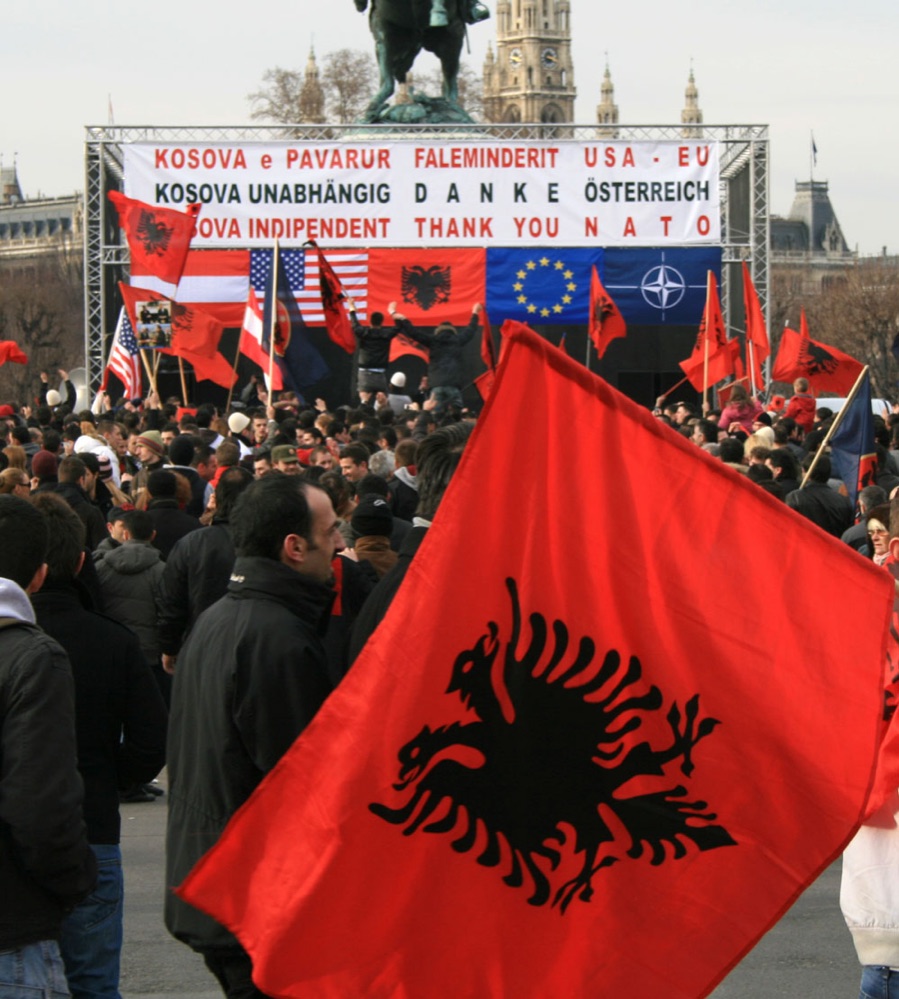
Two dates anchor the public calendar—17 February for Kosovo Independence Day and 28 November for Albanian Flag Day—but Albanian London is active through schools, libraries, concerts and community events all year.
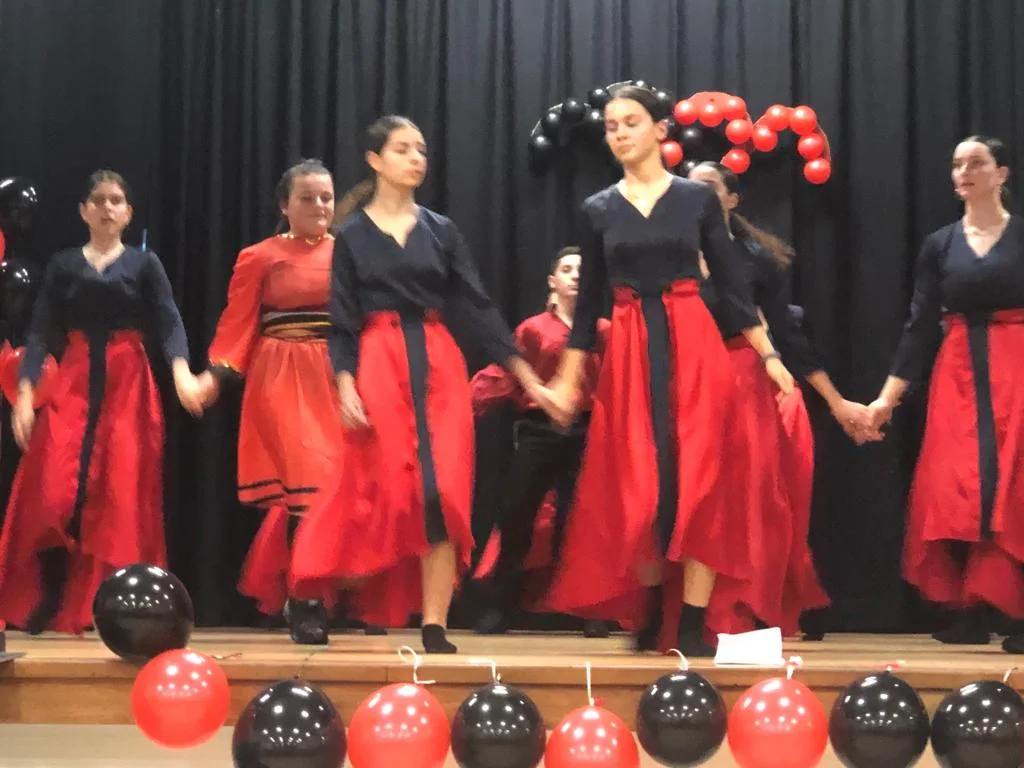
Every 28 November
Albanian Flag Day
Shpresa’s London celebrations put children, dance, music and the red-and-black flag at the centre.
Photo: Shpresa Programme
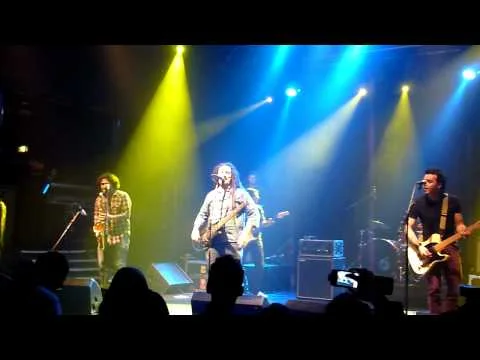
KOKO · 13 February 2011
Kosovo Independence concert
Spasulati Band played KOKO as London’s Kosovan community marked the national day.
Video still: UK Albanians Network
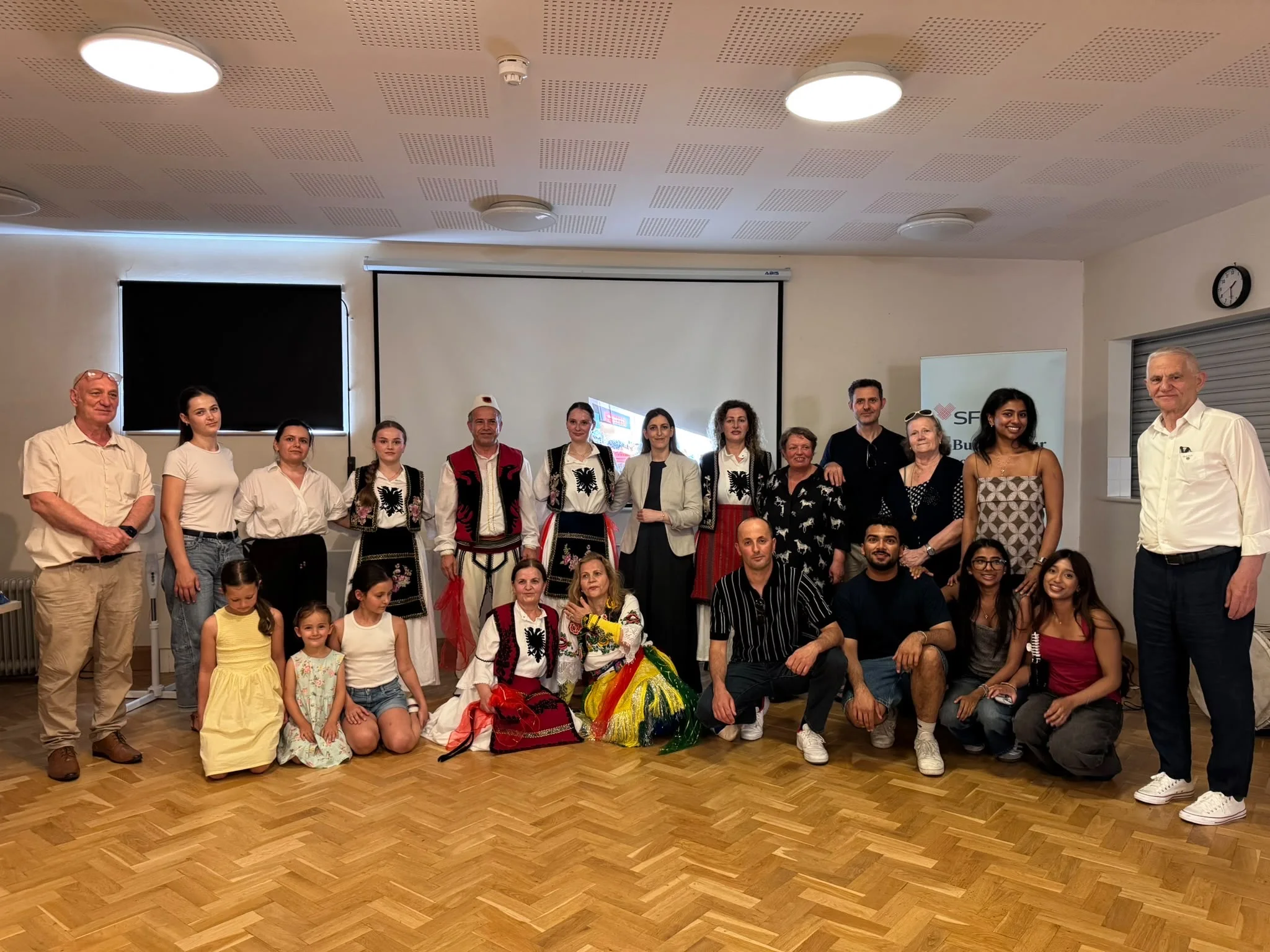
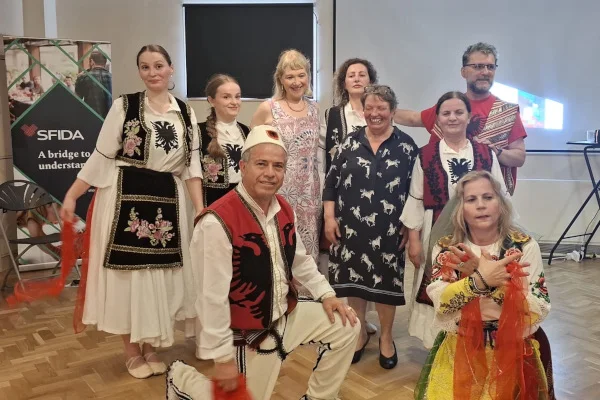
Richmond · June 2026
Courage, Culture and Community
SFIDA brought testimony, çifteli music, dance, children’s art and Albanian food to Richmond Library Annexe.
Photo: SFIDA / Richmond Council
Albanian Embassy · 26 June 2026
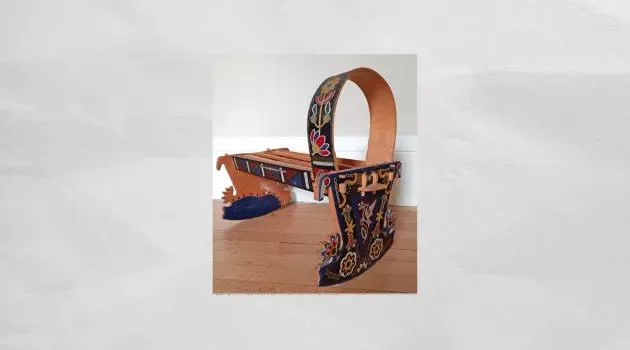
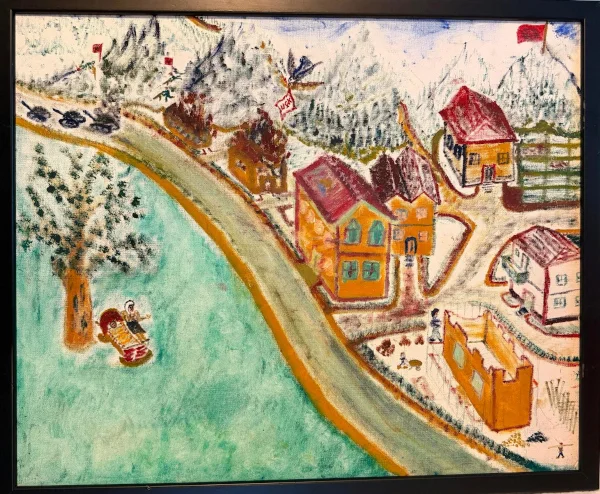
Heritage Speakers and Cultural Memory
UCL students explored Albanian and Kosovan objects in London museums with both embassies.
Image: British Museum Trustees via UCL · CC 4.0
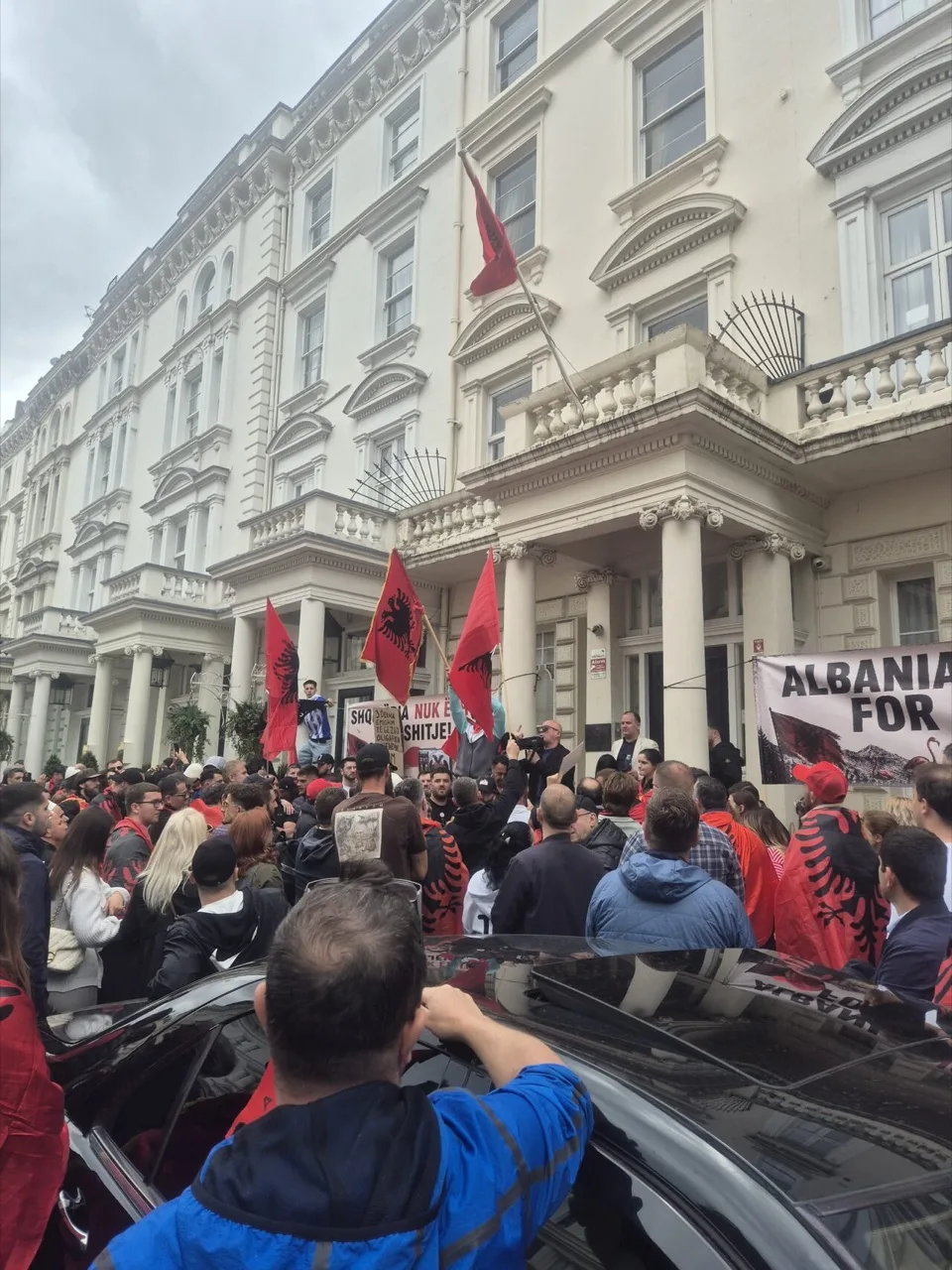
Watch Flag Day take over Waterloo
Football makes the map audible
Albania’s international fixtures fill pubs and cafés; major matches bring flags to streets that otherwise advertise the community more quietly. Wembley has a special place because both Albania and Kosovo have played in London. British-born supporters often follow England, Albania or Kosovo—and a Premier League club—without treating those loyalties as mutually exclusive.
Skanderbeg in Bayswater
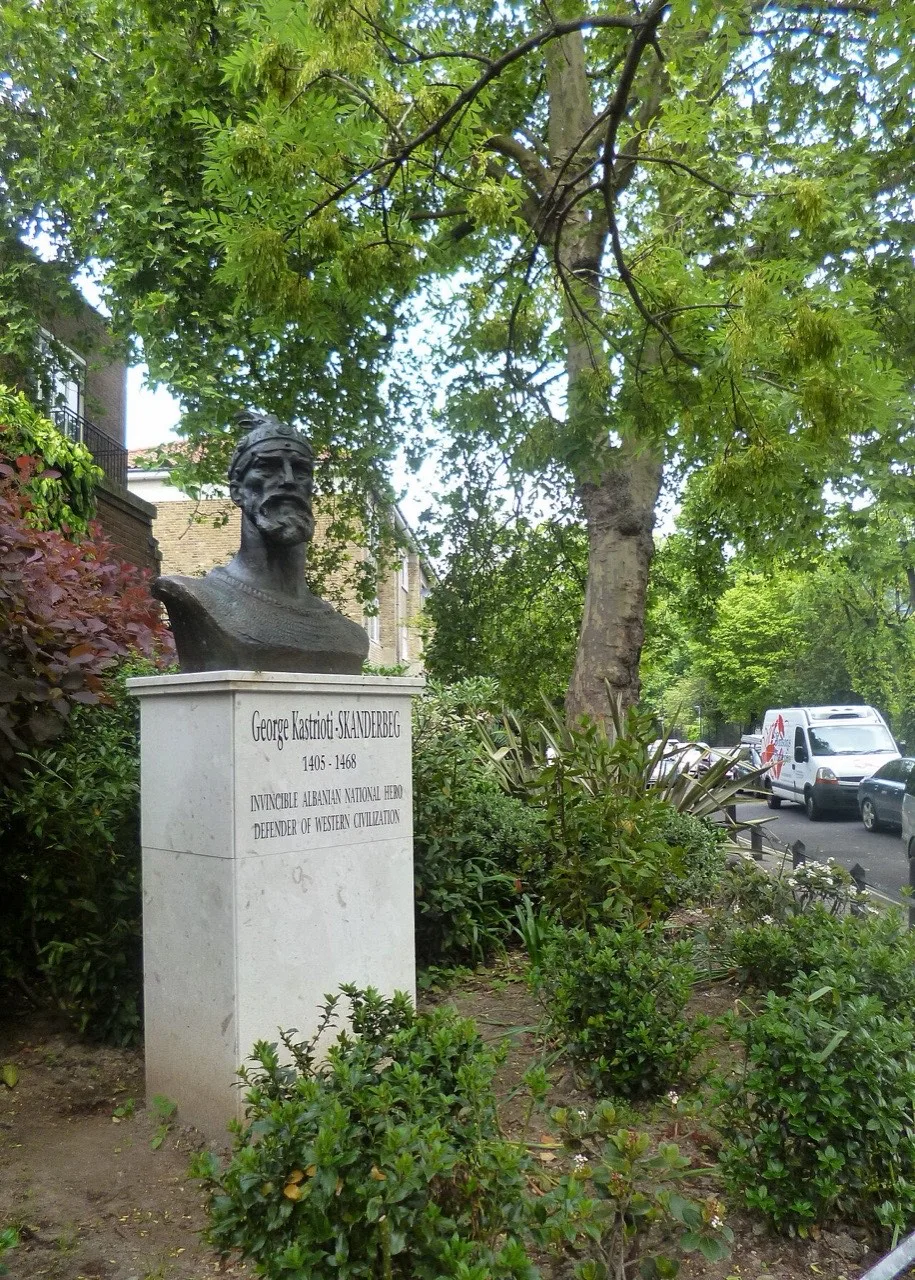
London’s clearest permanent Albanian monument is the bust of Gjergj Kastrioti Skanderbeg in Bayswater, a modest national landmark embedded in an ordinary west-London street.
How many Albanians live in London?
At least 56,460 London residents were born in Albania or Kosovo; the full Albanian community is probably around 75,000 to 100,000. The birthplace figure is the last authoritative count. The range is the page’s conclusion about heritage, including the London-born generation, rather than a number published by the Office for National Statistics.
The exact census split is 34,773 Albania-born and 21,687 Kosovo-born. It matters that the two are named separately. Albania is a state and Kosovo is a state; both populations are overwhelmingly Albanian-speaking, but their routes into London, age structures, citizenship histories and borough maps are different. A Londoner born in North Macedonia, Montenegro or Serbia may also be ethnically Albanian and appears in neither row. A child born in Enfield to two Tirana-born parents appears in neither row. Birthplace supplies a hard floor, not an ethnic ceiling.
Swipe horizontally to explore the full chart.
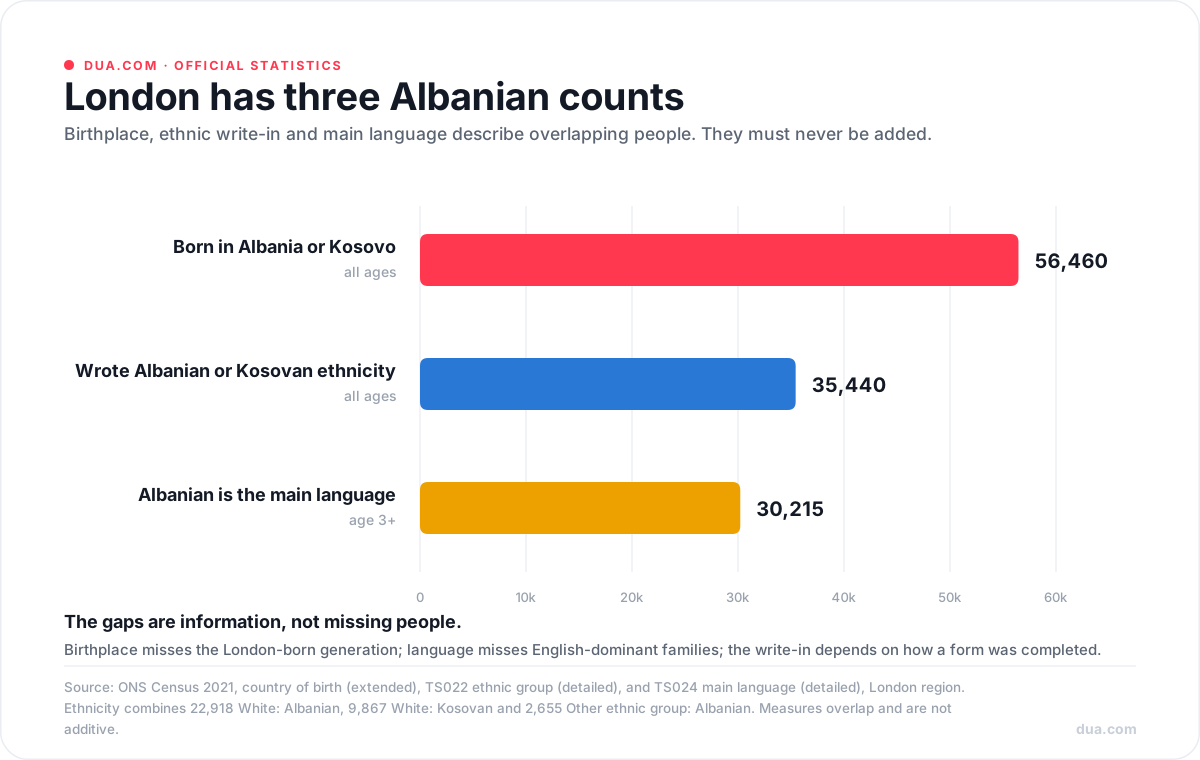
Three official counts, three different universes
London’s 35,440 ethnic write-ins comprise 22,918 people in “White: Albanian”, 9,867 in “White: Kosovan” and 2,655 in “Other ethnic group: Albanian”. That is useful because it can include somebody born in London. It still runs twenty-one thousand below the two-country birthplace count. The ethnic-group question offered broad tick boxes and a free-text field; many residents simply chose “Other White” and did not write a nationality. The number therefore measures the people who named the identity on that form, not everyone who holds it.
The language count answers a narrower question again. 30,215 residents aged three and over said Albanian was their main language. It catches Albanians born in Kosovo, North Macedonia, Montenegro and elsewhere, but it misses every bilingual household that selected English and every child under three. It is best read as a measure of current language use. The fact that it is lower than the birthplace floor is not evidence that thousands of Albania-born Londoners are not Albanian; it is evidence of language shift and of how census questions work.
| Measure | London figure | What it includes | What it misses |
|---|---|---|---|
| Born in Albania | 34,773 | Everyone born in Albania, whatever passport or identity they now hold | All UK-born descendants and Albanians born in other countries |
| Born in Kosovo | 21,687 | Everyone born in Kosovo, including naturalised British citizens | UK-born Kosovar Albanians and people historically coded to Yugoslavia or Serbia |
| Albanian or Kosovan ethnic write-in | 35,440 | People who explicitly wrote one of the identities in the ethnicity field | Anyone who ticked only a broad category such as Other White |
| Albanian main language | 30,215 | Residents aged three and over who use Albanian as their main language | English-dominant and many bilingual families, plus children under three |
The growth the old survey failed to see
Swipe horizontally to explore the full chart.
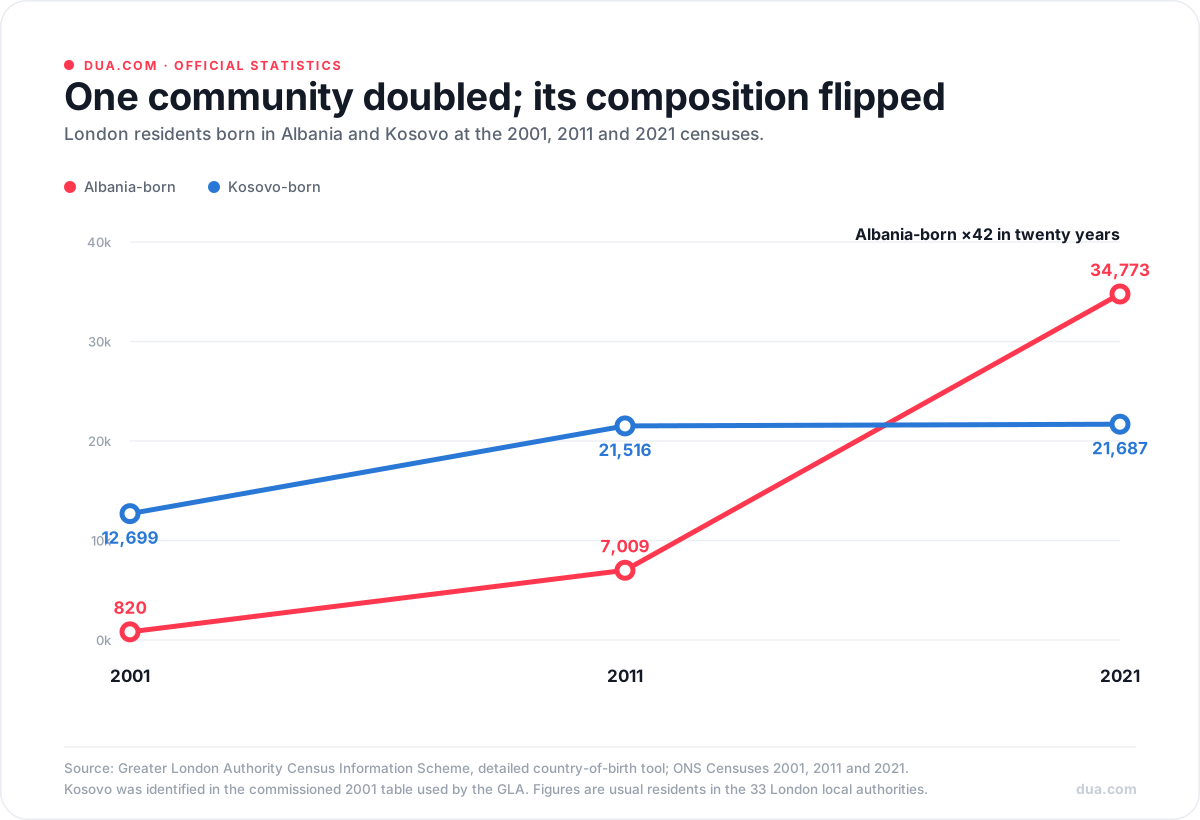
In 2001 London had 820 Albania-born residents and 12,699 Kosovo-born residents. Kosovo supplied 94 percent of the combined two-country total. By 2011 the Albania-born figure had risen to 7,009 and Kosovo-born to 21,516. In 2021 Albania-born reached 34,773 while Kosovo-born was almost unchanged at 21,687. In twenty years the combined population grew from 13,519 to 56,460, but the more important change was its composition: Albania-born London became the majority only in the last decade.
That is why older accounts feel like descriptions of a different community. London’s 1990s institutions were built around refugees from Kosovo: legal advice, emergency housing, language support and family reunification. The 2010s arrival was younger, heavily working-age and frequently connected to Italy and Greece. By 2021 the same word, Albanian, described an established British-Kosovar family in Camden and a twenty-six-year-old Albania-born builder sharing a house in Enfield. The shared language does not erase the thirty years between them.
The census also exposed how badly London’s earlier survey estimate had failed. The discontinued Annual Population Survey put the Albania-born population of London at 8,000 in its final edition covering July 2020 to June 2021. The census, taken in that period, counted 34,773: more than four times as many. Household surveys struggle with recent migrants, houses in multiple occupation and young adults in shared private rentals. Those are not incidental characteristics of the new Albania-born population; they describe its centre.
Why about 80,000, and not 56,460 or 200,000?
The hard floor is clear. The wider range needs restraint. London held 56.9 percent of every Albania- or Kosovo-born resident counted in England and Wales in 2021. It held 50.6 percent of the Albania-born and 71.1 percent of the Kosovo-born. Apply a London share around one half to the companion UK page’s best-supported community range of 150,000–175,000 and the result falls broadly between 75,000 and the mid-90,000s. The 16,301 London members among roughly 37,000 UK dua.com members point in the same direction but at a lower, 44 percent city share. Neither exercise is a census count; the agreement is what makes an 80,000 centre defensible.
The bottom of the range allows for the people the birthplace floor necessarily excludes: the London-born children of the 1990s Kosovar cohort, children of Albania-born parents, people arriving after March 2021, and ethnic Albanians born in neighbouring Balkan states or after their parents moved to Italy and Greece. The top of the range recognises that some national categories are less concentrated in London than the first generation, that families move beyond the Greater London boundary, and that every proxy overlaps. The UK total of 200,000 remains a plausible upper possibility; it does not
No responsible method adds 56,460 birthplace records to 35,440 ethnicity records and 30,215 language records. That would count many adults three times. The correct use of the auxiliary measures is diagnostic: they show a community with a large London-born and bilingual edge, and they tell us whether a model built from the birthplace floor is directionally plausible. They do not supply three piles of different people.
Before there was a community: London and Albania, 1809–1939
There was no Albanian quarter in nineteenth-century London and almost no Albanian migration to Britain. The relationship began the other way round: with British travellers, diplomats and campaigners going to Albanian lands, then bringing back an image of the country. Its most famous object is a portrait painted in London.
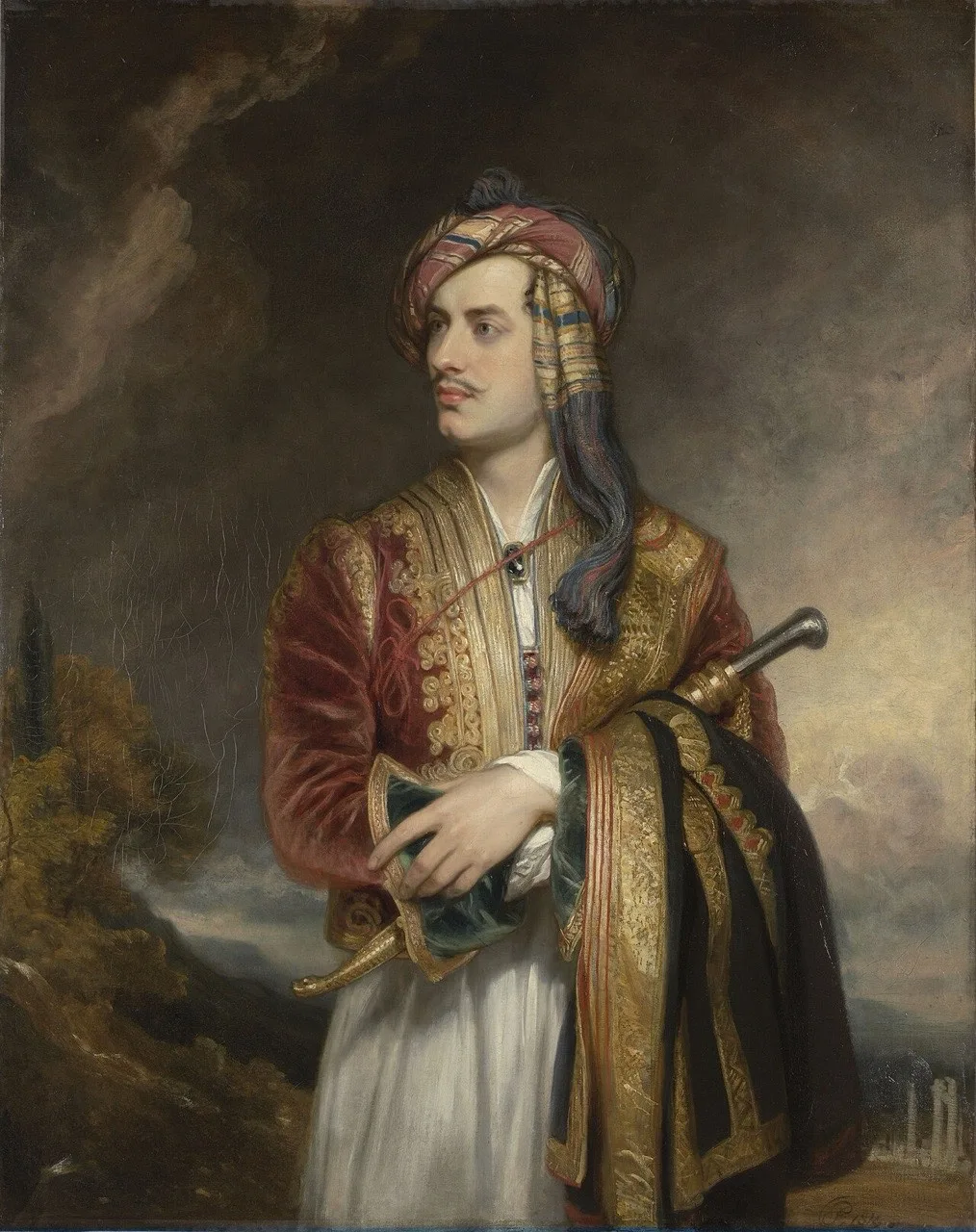
Lord Byron travelled through Albanian-speaking lands in 1809, visited the court of Ali Pasha at Tepelena and bought the ceremonial clothes in which Thomas Phillips painted him four years later. Childe Harold’s Pilgrimage made the journey part of European Romantic culture. The portrait did something quieter: it fixed “Albanian dress” in the British imagination and hung the relationship on a British body. For most Londoners of the period, Albania was a costume, a poem and a place on the edge of an Ottoman map rather than a people next door.
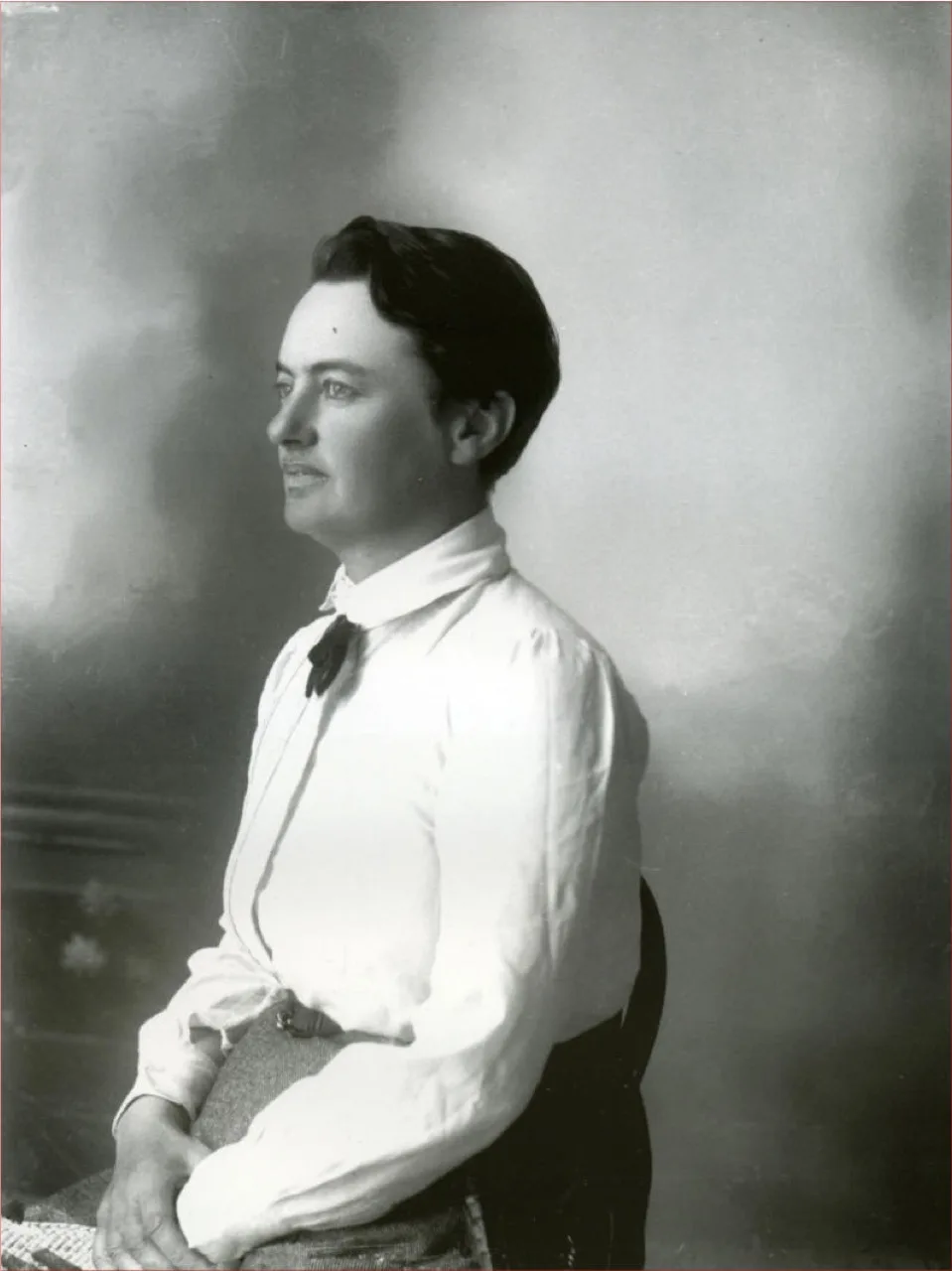
The relationship became less picturesque and more political at the turn of the twentieth century. Mary Edith Durham, an artist and carer from north London, first went to the Balkans after a breakdown in 1900 and spent the next two decades travelling through the northern Albanian mountains. She drew, photographed, collected textiles and wrote books, most famously High Albania in 1909. Her archive is held by the Royal Anthropological Institute in London. Durham was not Albanian and never presented herself as neutral; she became an advocate. That is exactly why her papers matter: they show the point at which British observation became a London campaign for an Albanian political future.
A king at the Ritz and a voice at the BBC
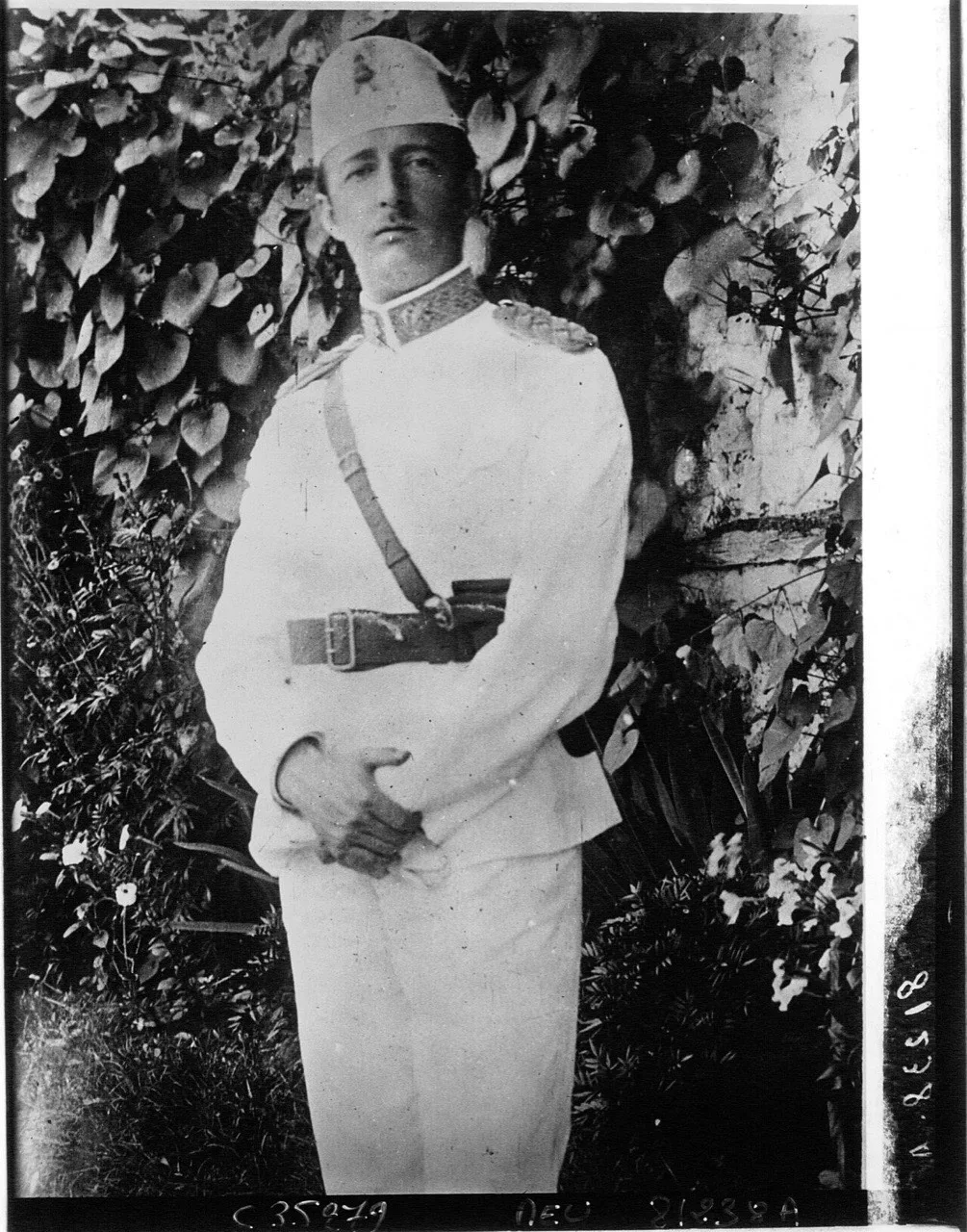
Italy invaded Albania on 7 April 1939. King Zog I, Queen Géraldine and their infant son Leka left the country with a royal household and crossed Europe as war closed behind them. In 1940 they reached Britain. For about nine months the Albanian court in exile lived at the Ritz in Piccadilly, an extraordinary compression of a displaced state into a London hotel. The family later moved to South Ascot and then Parmoor House in Buckinghamshire, where it remained until 1946.
Two migrations, one language, thirty years apart
Albanian London is easiest to understand as two migrations with different clocks. The first was overwhelmingly Kosovar and reached its peak through asylum and refugee routes in the 1990s. The second was overwhelmingly from Albania, accelerated in the 2010s and was bound to work, EU mobility, family networks and—in 2022—a short, highly visible small-boat episode. Their histories overlap, but they should not be collapsed.
The Kosovo decade
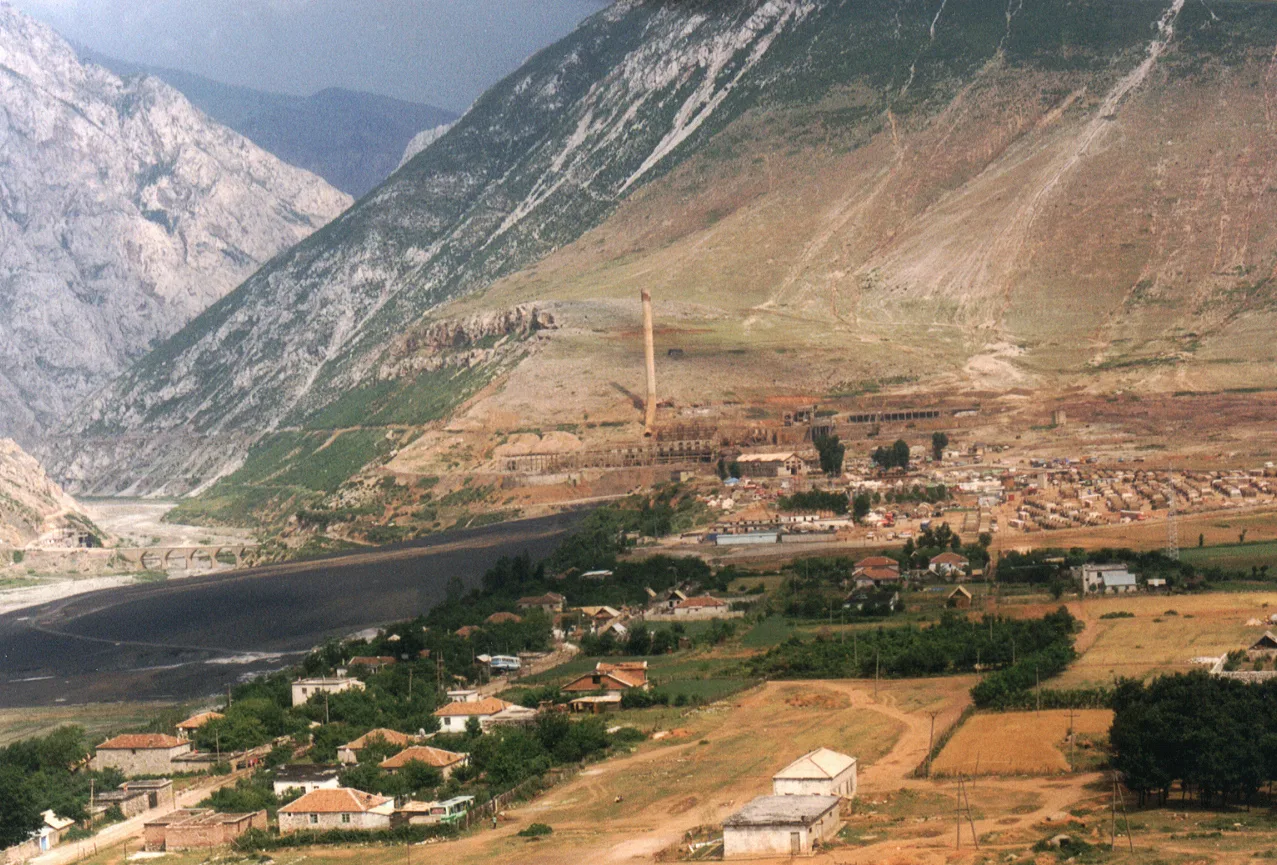
Repression, dismissal from public employment and then war pushed Kosovo Albanians towards Western Europe through the 1990s. Home Office figures record 140 asylum applications from Kosovo in 1996, 600 in 1997, 4,580 in 1998 and 9,850 in 1999, excluding dependants. Grant rates in the early years were extraordinarily high: 1,340 grants of asylum from 1,400 decisions in 1997. The numbers are national, but the institutions, solicitors, relatives and housing pathways concentrated a large part of the settled population in London.
A separate state-organised programme followed during the war. Between 25 April and 25 June 1999, 4,346 refugees were flown from the region to the United Kingdom under the UNHCR Humanitarian Evacuation Programme, followed by 68 medical evacuees. They were not asylum applicants in the ordinary statistics. The government placed them in thirty-three reception areas across Britain—and none of those formal reception areas was London. That detail matters. The Kosovo-born concentration visible in Camden and Westminster cannot simply be attributed to the 1999 airlift; it belongs to the larger asylum and family network of the entire decade, plus later moves.
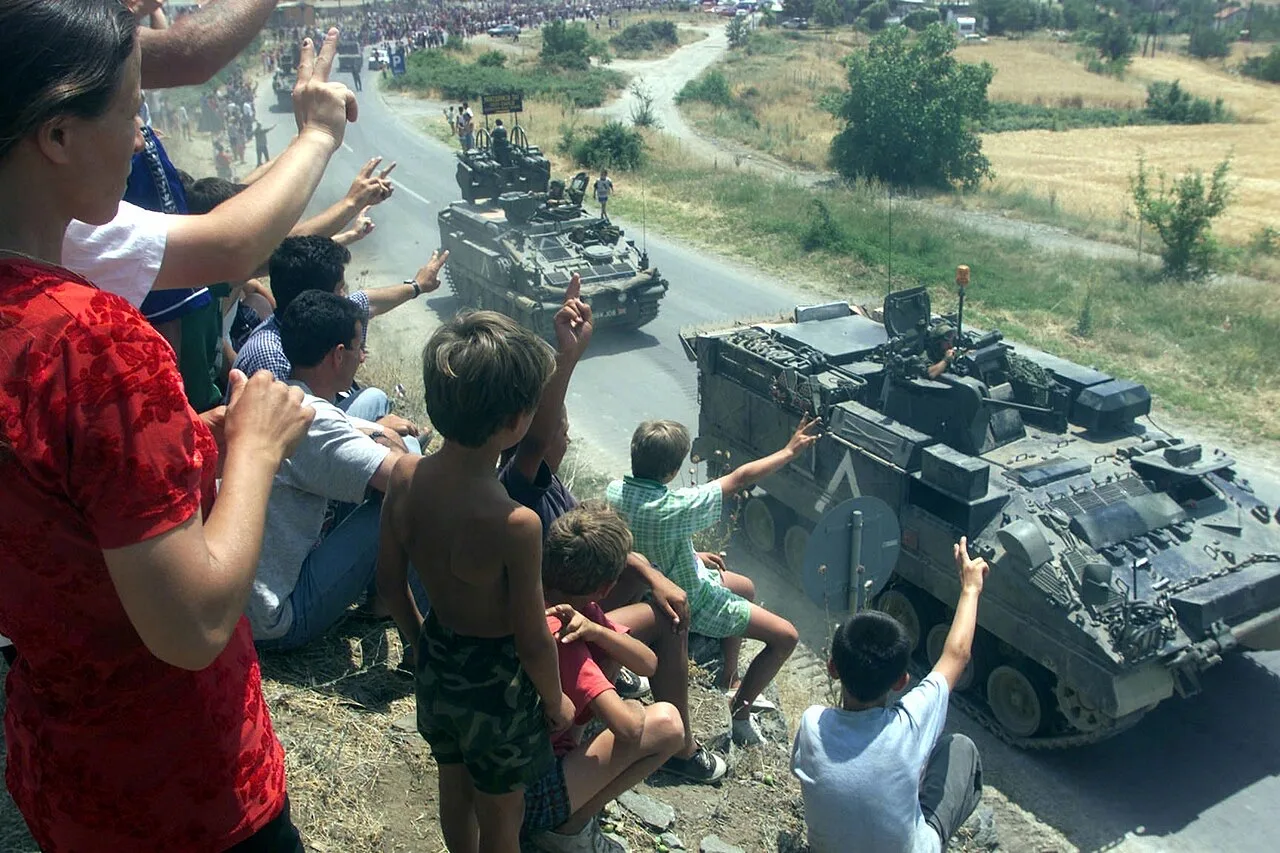
Britain’s military role gave the Kosovar relationship an emotional register the Albania-born migration does not share. British troops led the NATO entry into Kosovo on 12 June 1999. Tony Blair became a popular name for boys in Kosovo, and the United Kingdom acquired a durable image as an ally. That history does not make every British-Kosovar political view identical, but it explains why Kosovo Independence Day in London carries a diplomatic gratitude distinct from the politics of migration from Albania.
By the 2021 Census the Kosovo-born cohort was an established British population. Across England and Wales, 75.6 percent had arrived between 1991 and 2000, 89.9 percent held a British passport and 80.7 percent described their national identity as British only. Only 223 Kosovo-born residents were under sixteen because their children are now overwhelmingly British-born. London’s Kosovo-born total barely changed between 2011 and 2021: 21,516 to 21,687. Stability does not mean disappearance. It means the first generation has naturalised and the demographic growth has moved into a category the birthplace table cannot see.
The Albania decade
The migration from Albania has the opposite age and arrival profile. Across England and Wales, two-thirds of Albania-born residents had arrived during the seven years from 2014 to census day; the modal age band was 25–29. London’s Albania-born population grew from 7,009 in 2011 to 34,773 in 2021. It was a fivefold increase in a decade during which the old official survey barely registered it.
There was no single legal route. Some came on work, study or family visas. Some claimed asylum. Some already held an Italian or Greek passport after years of migration and naturalisation elsewhere in Europe. Freedom of movement made that onward path legally ordinary before Brexit. The 2021 Census counted 20,376 Albania-born residents of England and Wales holding an EU passport, including 3,602 Italian passports, and the figure excludes people born in Italy or Greece to Albanian parents. A portion of “Italian London” and “Greek London” is also Albanian London, but Britain has no ethnic register that can say how large it is.
Research by Russell King and Christina Karamoschou describes this as fragmented, fluid mobility rather than a one-step move. Families left Albania for Greece in the 1990s, built work and language there, then moved to London when economic crisis and citizenship made another move possible. Children could arrive with Greek schooling, an Albanian home language and an EU passport. A census category records only one of those histories at a time.
The 2022 episode and what survived it
In 2022, 12,658 Albanian nationals were recorded arriving in the UK by small boat, 9,044 of them in the third quarter. The number fell sharply after a December 2022 UK–Albania communiqué, accelerated casework, returns and changed routes. The episode became a national political argument in which “Albanian” was routinely used as a proxy for boats, asylum, cannabis farms and crime. London’s established community—British citizens, schoolchildren, businesses, charities and refugees from a different country—was pulled into a debate about one nationality and one year.
Two things can be true. The 2022 route was real, concentrated and politically consequential. It also described a small fraction of Albanian London and cannot explain a population whose census growth began years earlier. Home Office nationality statistics count encounters with an immigration system; the census counts residents; the community includes British citizens and London-born children. Mixing those universes turns enforcement data into ethnic demography and produces bad arithmetic as well as bad politics.
The community’s response was not only protest. Shpresa Programme and legal partners expanded anti-trafficking and immigration advice, particularly for young people. Albanian charities entered coalitions with Citizens UK and local borough institutions. The result was a more public Albanian London: defensive in the face of stereotyping, but also more willing to speak in its own name.
Where do Albanians live in London?
There is no single Albanian London to enter. The community stretches across boroughs, generations and increasingly beyond Greater London's boundary, connected by family, work, schools, institutions and shared events.
The largest concentration is a north-London arc through Enfield, Barnet and Haringey. Those three boroughs held 15,839 residents born in Albania or Kosovo in 2021—28 percent of the London total. Add Waltham Forest and the belt reaches 18,124. It runs through Southgate, Palmers Green, Bowes Park, Wood Green, the Harringay Ladder, New Barnet and Bush Hill Park rather than forming one bounded ethnic quarter.
Swipe horizontally to explore the full chart.
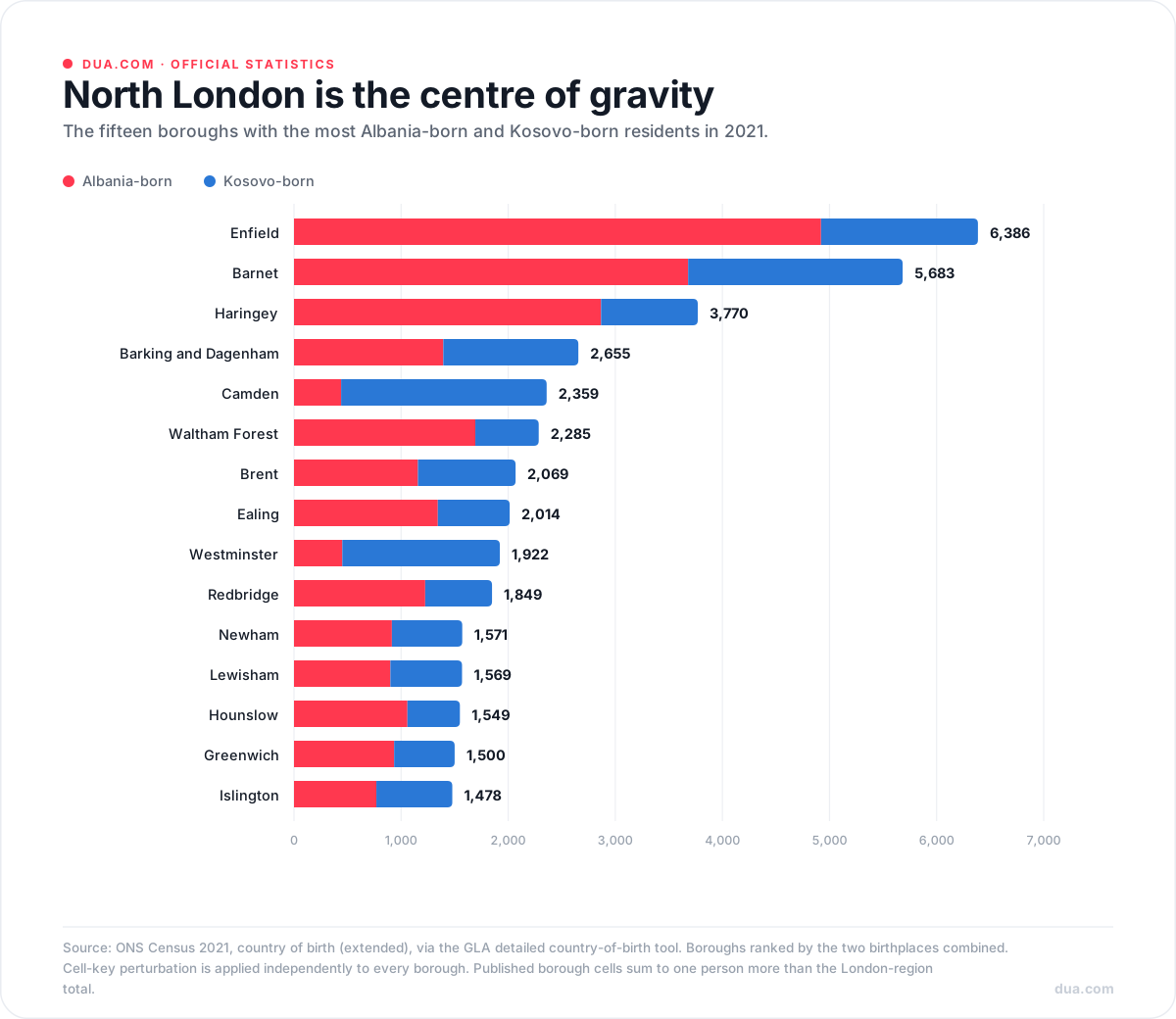
Enfield is the centre: 4,921 Albania-born and 1,465 Kosovo-born residents, 6,386 together. That is about one person in fifty-two of the borough’s entire population. Enfield alone held 7.2 percent of all Albania-born residents of England and Wales and had 3,508 residents who named Albanian as their main language, the highest local-authority count in the country.
Barnet followed with 5,683: 3,680 Albania-born and 2,003 Kosovo-born. Haringey had 3,770. Barking and Dagenham, on the opposite side of the city, had 2,655, almost evenly divided between the two birthplaces. Camden’s 2,359 looked similar in total but completely different inside: 1,919 Kosovo-born and only 440 Albania-born.
The city holds unequal shares of two national populations
London contained half of every Albania-born resident of England and Wales: 34,773 of 68,672. For Kosovo-born residents the concentration was still stronger: 21,687 of 30,515, or 71.1 percent. This is why a UK article and a London article need different maps. Albanian migration from Albania has significant communities in Birmingham, Northampton, Luton and elsewhere. The 1990s Kosovo-born population is much more capital-centred.
The city’s share also changes how national institutions look. A British Albanian school registry is geographically spread, but the largest and oldest institutions are in London. National protests occur at Westminster or an embassy. A UK charity register is, in practice, a London register with a small number of organisations elsewhere. The capital is not the whole diaspora, but it supplies most of its visible infrastructure.
Two maps inside the same map
Swipe horizontally to explore the full chart.
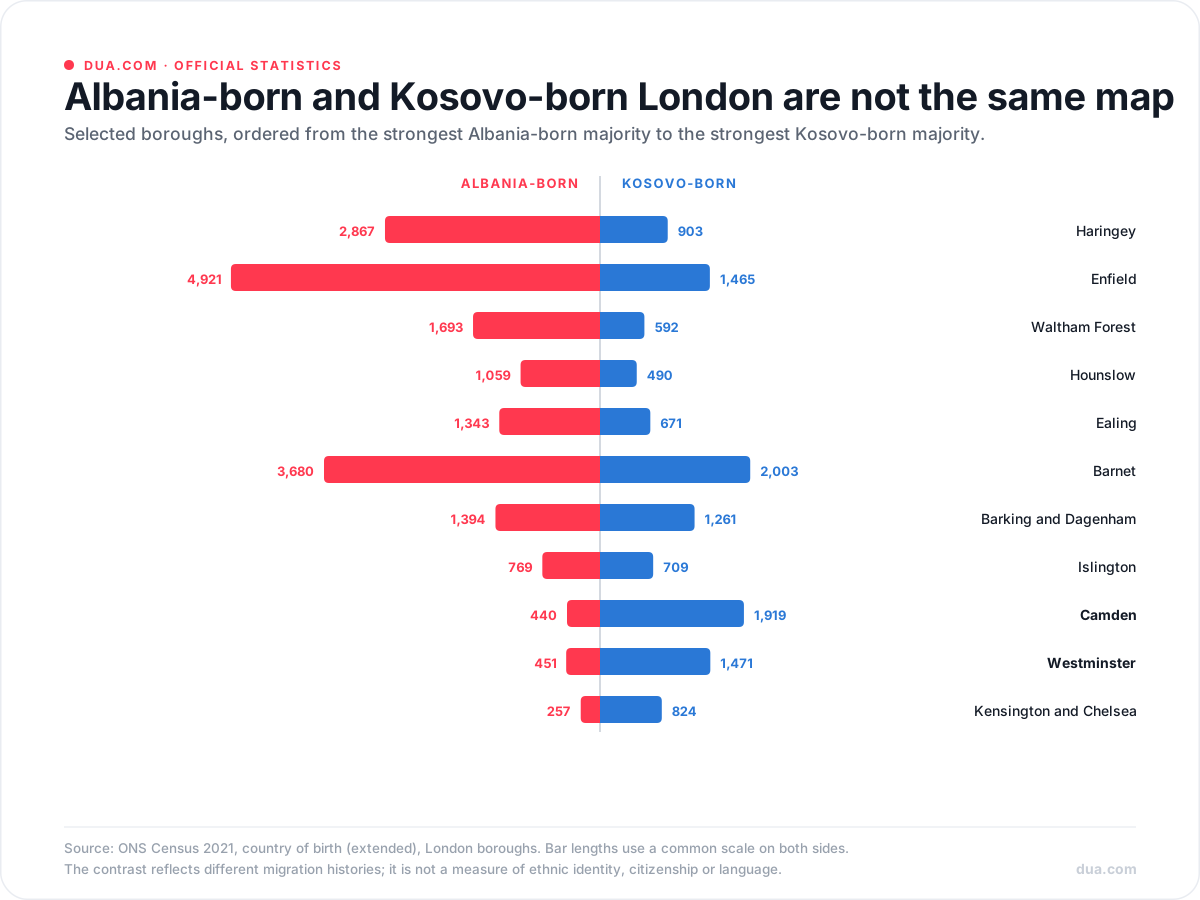
The Albania-born majority is strongest in the outer north: Haringey has more than three Albania-born residents for every Kosovo-born one, Enfield 3.4 and Waltham Forest 2.9. The ratios reverse in inner and west London. Camden has 4.4 Kosovo-born residents for every Albania-born resident; Westminster 3.3; Kensington and Chelsea 3.2.
That is not an ethnic distinction—most people in both rows are Albanian—and it is not a simple income map. It is a migration-history map. An asylum cohort entering London during the 1990s encountered council housing, temporary accommodation and refugee support in inner boroughs. A later labour cohort relied more on family networks, private renting and construction work in outer boroughs. Housing markets and secondary moves have blurred the edges, but the original paths remain visible thirty years later.
The map is also a warning against calling any one place “Little Albania”. Green Lanes is the nearest thing to a continuous commercial spine, but census concentration is stronger around parts of Enfield and Barnet; Kosovo-born density appears in estates elsewhere; schools are distributed across east, north, west and south-east London. Albanian London is a networked city, not a single enclave.
The neighbourhood map: Green Lanes, estates and suburbs
Borough totals conceal the scale at street level. In the Broomfield Park neighbourhood of Enfield, 486 of 11,311 residents were born in Albania. In Southgate, 523 of 10,343 residents had been born in Albania, Kosovo, North Macedonia or Montenegro—roughly one person in twenty. The arc continues through Palmers Green and Bowes Park towards Wood Green and the Harringay Ladder, then north-west through New Barnet and east towards Bush Hill Park.
Those places do not look like an ethnically exclusive district. The shops, schools and pavements belong to many migrations at once. Green Lanes in particular has a deep Greek-Cypriot and Turkish history alongside Kurdish, Bulgarian and newer Albanian businesses. Describing it as an “Albanian takeover” would erase the street that actually exists. A more accurate phrase is an Albanian layer on a long migrant high street: cafés, barbers, grocers, estate agents, builders’ offices, wedding services and flags appearing within an already multilingual economy.
One small documented example carries the pattern. A café-bar at 12 Green Lanes traded as Scutari, the Venetian name for Shkodër, before changing to B7 Café Bar and Lounge in 2024. Its licensing history appears in Enfield council papers because neighbours and police negotiated its hours. The Albanian mark on the street is not a tourist monument; it is an ordinary local business inside the ordinary machinery of a London borough.
The Kosovar estate map
The Kosovo-born neighbourhoods point elsewhere. In Church Street, Westminster, the 2021 cells recorded 243 Kosovo-born residents and 36 Albania-born. In Grahame Park, Barnet, the split was 144 to 37. In Adelaide Road, Camden, it was 96 to eight. These are estate geographies, and the contrast is consistent with a refugee population’s encounter with public and temporary housing in the 1990s.
Consistent is not the same as proven. No public dataset follows individual Kosovar families from an asylum address to a 2021 census address. The formal 1999 evacuation programme did not place its arrivals in London at all. The housing mechanism is therefore an interpretation of the map, supported by migration history, rather than a direct administrative finding. Stating that boundary matters because a persuasive map can otherwise become a story more certain than its evidence.
Beyond the boundary
The community does not stop at the Greater London line. Borehamwood, Potters Bar and towns along northern rail and road corridors sit within the same family and work geography as Barnet and Enfield. Luton has one of Britain’s largest Albanian populations; parts of Hertfordshire and Essex feed the same construction sites, schools, weddings and social networks. A London range tied strictly to the 33 local authorities will miss commuters and families who identify with the city while living outside it. The population ledger keeps the administrative boundary because the census data require one, but everyday Albanian London is metropolitan.
That suburban extension is also generational. A refugee household first placed in Camden may later buy in Barnet or outside London. A new migrant may begin in a shared Enfield house, marry and move further out. Saturday schools, religious institutions and community organisations keep the paths connected. The geography is not static settlement; it is a record of stages in a London life.
Work, business and the city they helped build
The statistic that best explains the Albania-born map is national rather than London-specific: 30.7 percent of Albania-born people in work in England and Wales were in construction at the 2021 Census, compared with 8.7 percent of everyone in work. Among Kosovo-born workers the share was 23.1 percent. Because half of the Albania-born population and seven in ten of the Kosovo-born population lived in the capital, London’s building economy is where a large part of that labour landed.
Swipe horizontally to explore the full chart.
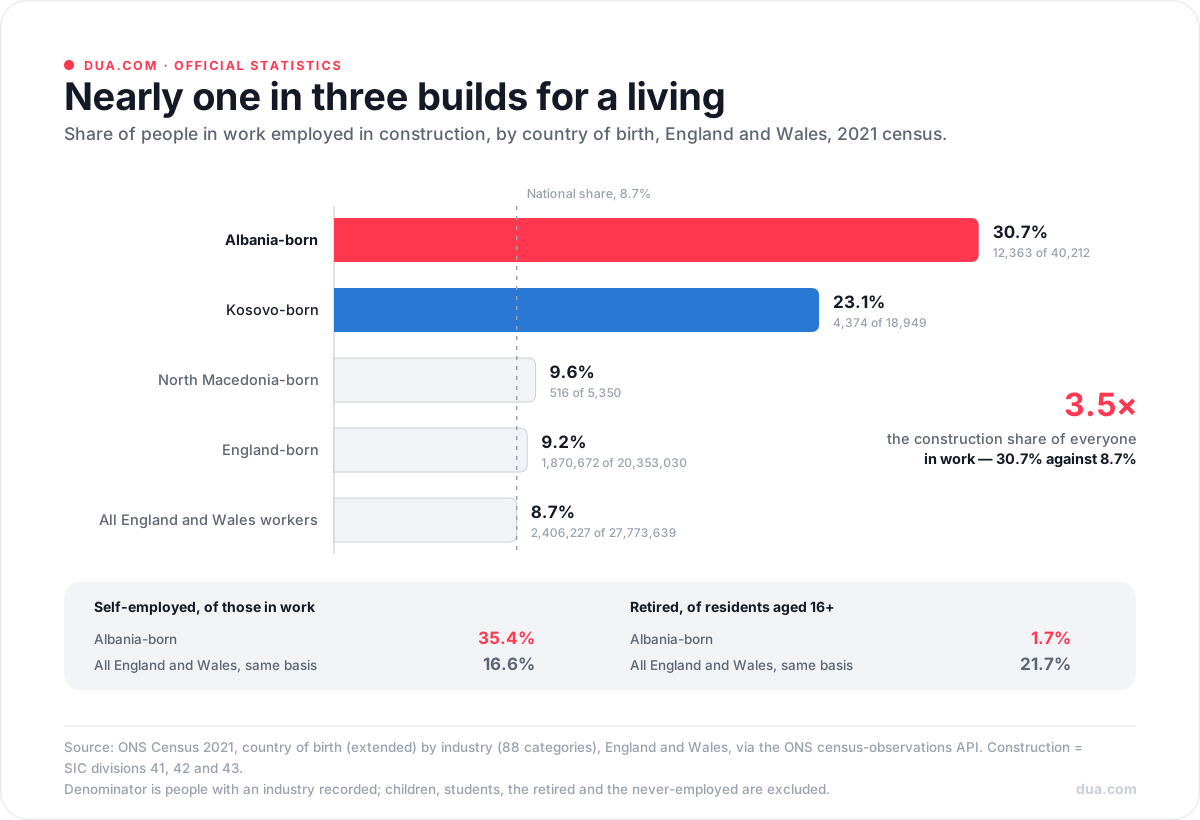
The trade shaped settlement. A construction job does not require an office in the borough where the worker lives; it requires access to sites, vans, suppliers and a trusted crew. North London’s road network, housing stock and family chains made Enfield, Barnet and Haringey practical bases. The same network supports electricians, decorators, roofers, tilers, plasterers and small building companies that move across the city every morning.
Across England and Wales, 35.4 percent of Albania-born people in work were self-employed, against 16.6 percent of all workers. That is the sole-trader and subcontracting structure of construction written into a census. It also creates vulnerability: bogus self-employment, cash work, unpaid wages, unsafe sites and dependence on the person who controls a gang or van. The labour market can be a path to independence and a place where immigration status or weak English is exploited; both belong in an honest account.
The visible high street economy
Construction is only the largest line. Nationally, the next Albania-born industries in 2021 included food and beverage service, retail, health, education, cleaning and services to buildings, the motor trade and personal services such as barbering. Together they describe what becomes visible on a London street: cafés, restaurants, groceries, barbers, car services, cleaning firms, builders and the professional offices that grow around them.
A surname on Companies House is not an ethnic statistic, and a red flag in a shop window does not disclose the owner’s birthplace. For that reason this page does not offer a fabricated count of “Albanian businesses in London”. No authoritative register contains one. The defensible observation is structural: the industries in which Albania-born workers are concentrated are precisely the industries that produce small public-facing firms and mobile subcontractors, and the north-London business layer follows the residential map.
The economy is changing as the population settles. Charity trustees, teachers, solicitors, accountants, doctors, academics, architects, artists and technology workers appear throughout the community’s institutions. UKAP Foundation, registered in 2025, is explicitly a professional network built around mentoring and scholarships. That is not evidence that the trades have disappeared. It is evidence of a second labour market growing on top of the first.
Housing is part of the labour story
Recent workers often begin in private-rented shared housing, the same housing form the old Annual Population Survey was least able to sample. Established Kosovar families are more likely to have moved through asylum accommodation, social housing and later home ownership. The borough contrast between an Albania-born Enfield and a Kosovo-born Camden therefore carries both labour and housing histories.
It also explains why census day in March 2021 should be treated as a floor. The pandemic disrupted central London jobs and international movement; temporary workers may have been elsewhere, and census enumeration is hardest in crowded or subdivided homes. ONS designed the census to count usual residents, not every person present, but even a complete census cannot capture mobile workers who do not regard a London room as their usual residence. The population model allows for undercount without pretending it can measure it.
Money, flights and the practical road home
The practical distance between London, Tirana and Pristina has narrowed dramatically: family and community life increasingly operates across the routes rather than on one side of them.
The strongest measure of connection is no longer a remittance estimate. It is the flight schedule. UK–Tirana passenger traffic rose from 76,325 in 2015 to 1,012,307 in 2025, passing one million annual journeys for the first time. Some of that is British tourism, especially the rapid growth of travel to the Albanian coast. Much of it is a diaspora able to turn a visit once requiring connections and planning into a low-cost weekend.
Swipe horizontally to explore the full chart.
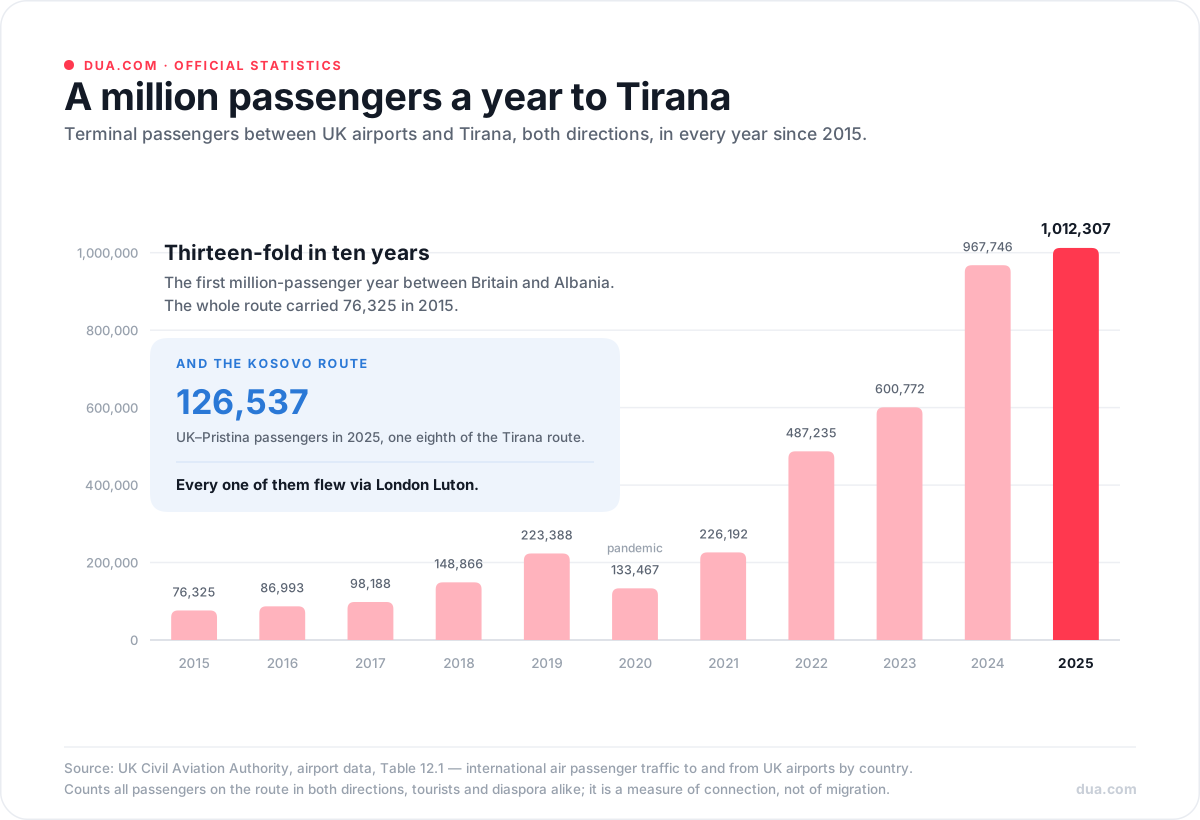
The Kosovo route is smaller and more London-specific: 126,537 passengers travelled between the UK and Pristina in 2025, all through London Luton. Luton is outside Greater London, but socially it is one of Albanian London’s airports. Coaches, family cars and group chats connect it to the same homes and events as Enfield, Camden and Barnet.
Remittances run through the same relationship but should not be romanticised or inflated. The Central Bank of Kosovo tables imply about €37.3 million sent from the UK in 2025, 2.64 percent of Kosovo’s recorded total and far behind Germany and Switzerland. Albania’s older published material put the UK near 8 percent of remittances, but that share is dated and does not support a current London figure. The city’s connection is visible in travel, property, care, politics and digital communication as well as cash.
Language, Saturday school and the London-born generation
Albanian was the main language of 30,215 London residents aged three and over in 2021. It was not confined to one origin: the same standard language connects families from Albania, Kosovo, North Macedonia, Montenegro and the Presheva Valley, while dialect, vocabulary and accent still signal region. For the census, “main language” means the language used most often or most comfortably—not every language a person can speak.
Swipe horizontally to explore the full chart.
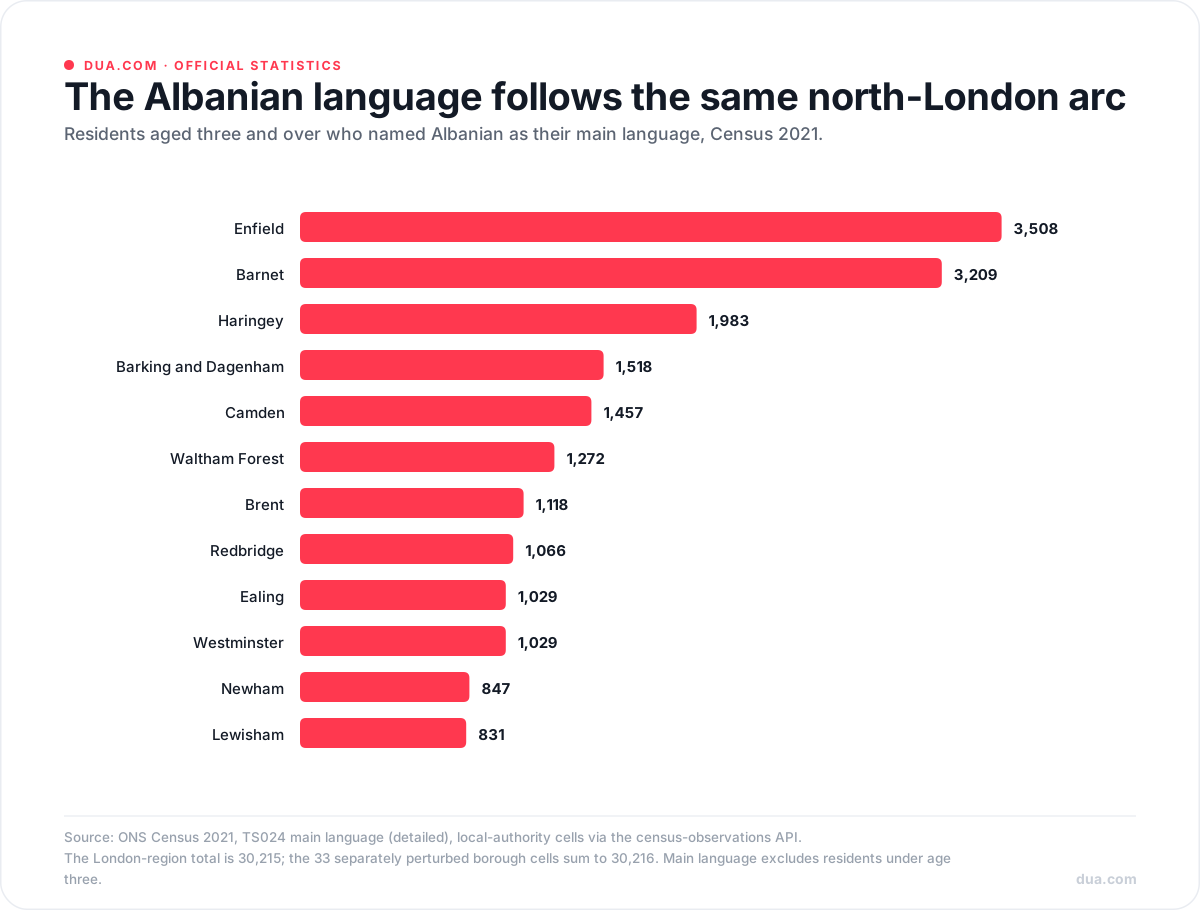
The language geography repeats the birthplace map with remarkable precision. Enfield leads at 3,508, Barnet 3,209 and Haringey 1,983. Barking and Dagenham has 1,518, Camden 1,457 and Waltham Forest 1,272. That independent measure matters: it shows that the north-London arc is not merely a statistical accident produced by birthplace categories.
A young population, seen through a careful proxy
An ONS commissioned table provides the best age profile for Londoners who explicitly wrote Albanian in the ethnic-group field. Among 25,468 household residents in that category, the largest band was 25–34, with 7,330 people. A further 4,345 were aged fifteen or under, 4,188 were 16–24 and 4,768 were 35–44. Only 457 were 65 or over.
Swipe horizontally to explore the full chart.
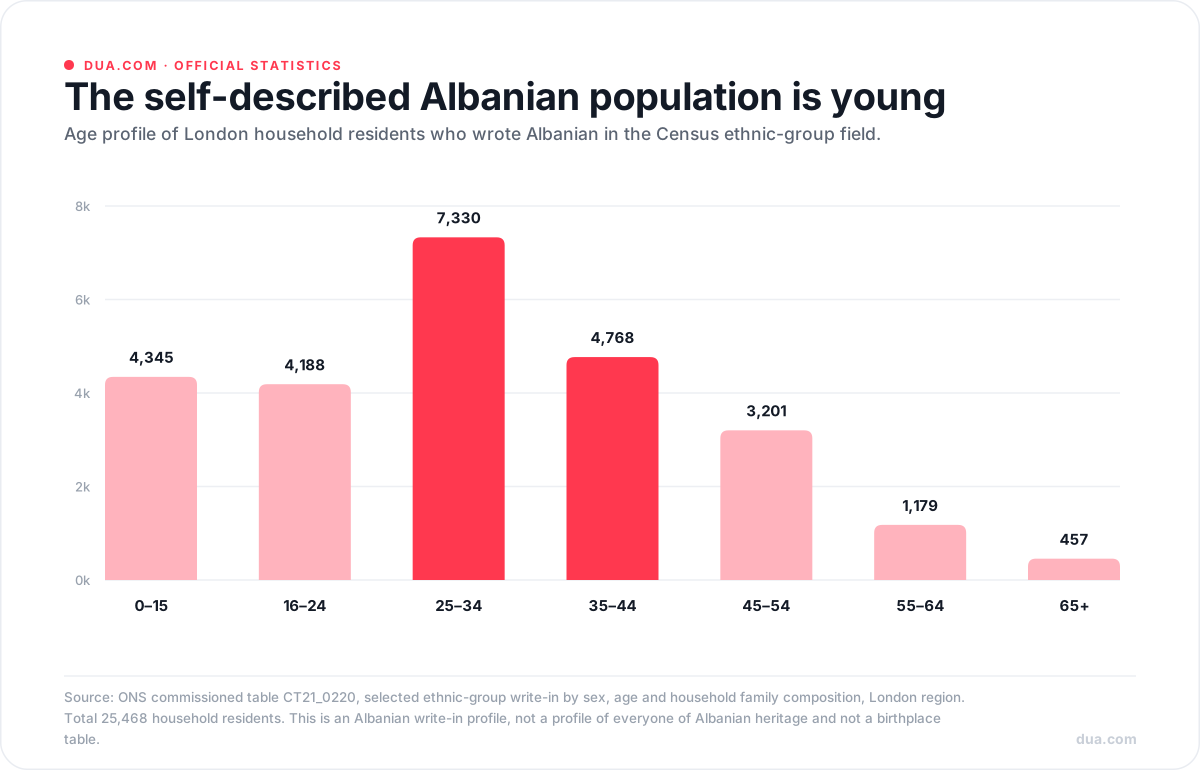
The limitation belongs beside the finding. The commissioned table does not include everyone who wrote Kosovan as a separate identity, everyone who chose only Other White, or people in communal establishments. It is therefore not a denominator for the wider community. Its value is comparative: the explicit Albanian population is heavily concentrated in childhood and working age, with very few older people. The shape matches a recent migration followed quickly by London-born families.
Shkolla Shqipe “Kosova”, since 1993
Albanian is not available as a GCSE or A-level. It was not removed; no British exam board has offered it. That leaves literacy and formal grammar to supplementary schools. London’s oldest is Shkolla Shqipe “Kosova”, founded on 3 October 1993 by Talat Pllana and other parents. It began in Westminster and Camden and now teaches at Haverstock School near Chalk Farm. More than thirty years of Saturday lessons make it older than most of the families in the Albania-born 2010s cohort.
Around it is a distributed school system. Shpresa Programme runs classes across east and north London. Ardhmëria operates five Greater London schools. Nënë Tereza and Arbëria work in Edmonton, Gjurmë Iliriane in Richmond and the Faik Konica association in Chelsea. A school opened in Bexleyheath in October 2024. Albania and Kosovo have shared a diaspora curriculum since 2018 and supply textbooks through public institutions.
The Albanian government’s diaspora publishing centre lists locations, but no audited London enrolment total exists. At the Bexleyheath opening, an Albanian minister said more than 7,000 pupils learn Albanian across Great Britain; the claim was not accompanied by a school-by-school method and should remain attributed. The honest London count is therefore “a network of roughly twenty locations”, not an invented number of children.
The GCSE campaign left a map
Petition 615921, asking for Albanian as a GCSE and A-level, collected 1,916 signatures between May and November 2022. It fell below the 10,000 needed for a government response. Its constituency map was more revealing than its final total: Chipping Barnet led with 68 signatures, Enfield Southgate had 61, Hampstead and Kilburn 55, Edmonton 42 and Hendon 42. A campaign about language independently recreated the census map of the community.
The lack of an exam has practical consequences. A teenager may speak Albanian fluently and attend years of Saturday school but cannot turn that knowledge into a recognised school qualification. Teachers work with borrowed premises, volunteer time and curricula from abroad. The system preserves reading, writing, history, dance and a social network; it also asks community organisations to supply what the mainstream education system does not.
English, Albanian and the second generation
National Department for Education data recorded 16,255 pupils in English state schools whose first language was Albanian in spring 2018. Only 10 percent had joined after reception age, the lowest late-arrival share among the major European languages in the table. Nine in ten had entered the English school system by the start. That is evidence of settlement, not a separate group to add to the census.
There is no current public borough count of Albanian-first-language pupils, and no British longitudinal study measures how well London-born Albanians retain the language. The census tells us that tens of thousands still use Albanian as their main language; the Saturday schools show organised transmission; everyday families supply the rest. Claims that the language is either disappearing or perfectly preserved go beyond the available evidence.
UCL’s School of Slavonic and East European Studies adds an unusual bridge. It has offered Albanian evening courses, including teaching for heritage speakers—people who grew up speaking at home without formal literacy. The institution holds the Mann Collection, named for Stuart Mann, Reader in Czech and Albanian from 1947 to 1972 and author of a 1948 historical Albanian–English dictionary. Konica’s print London and the Saturday-school city meet in a Bloomsbury library.
Faith: one mosque, one chaplaincy, many identities
There is no single Albanian religion in London. Census religion by birthplace across England and Wales makes the point sharply: Albania-born residents were more likely to record a Christian religion than a Muslim one, while Kosovo-born residents were much more likely to record Islam. Large shares in both groups recorded no religion. Birthplace, family region, migration history and personal practice matter more than a national stereotype.
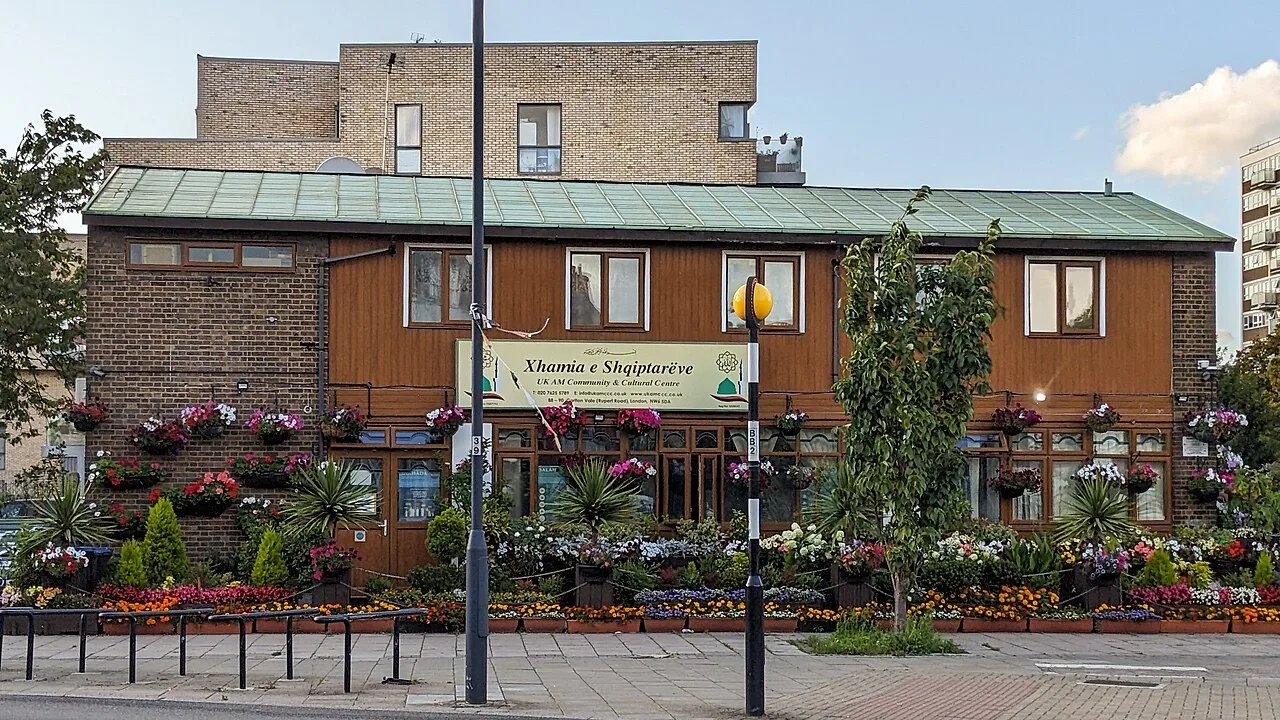
The largest purposefully Albanian religious institution is the UK Albanian Muslim Community and Cultural Centre, known as Xhamia e Shqiptarëve. Founded in 1994 as the Kosova Islamic Centre and registered as a charity in 1996, it stands at Carlton Vale and Canterbury Road near the Brent–Camden–Westminster boundary. Its location follows the Kosovo-born map.
The centre runs daily prayers, classes, marriages, funerals and Albanian-language religious services. Charity accounts recorded income of £246,729 in the year to July 2025. A much larger purpose-built redevelopment has been proposed for the site. The present building was once the Shamrock pub, an Irish institution converted into an Albanian Muslim one: not the replacement of one London by another, but the city’s immigrant history occupying the same corner in sequence.
Other Muslim charities include the British Albanian Muslim Community in West Hampstead and a newer Albanian Muslim Community London in Walthamstow. Their objects combine worship, language, education, relief and community participation. They are not merely prayer rooms; they are civic organisations in a population whose early institutions grew from refugee needs.
Catholic and Orthodox life
Albanian and Kosovan Catholics have a chaplaincy based at St Charles Borromeo, Ogle Street, rather than a dedicated church building. It provides Albanian-language pastoral contact inside an existing Roman Catholic parish structure. Northern Albanian Catholic migration is disproportionately visible in some family and business networks, but London has no official religion-by-ethnicity table capable of counting it.
No Albanian Orthodox parish or Bektashi tekke has been identified in Britain. Orthodox Albanian families may worship in Greek or other Orthodox parishes, but no public register measures them. The absence is noteworthy because Albanian communities in the United States built strong Orthodox and Bektashi institutions. London’s institutional religious map is narrower than its people’s actual beliefs.
Many community events deliberately sit above confession. Flag Day, school performances, embassy receptions, football and charity programmes gather Muslims, Catholics, Orthodox Christians, Bektashis, people of mixed backgrounds and people with no religion. The language of shqiptari—Albanian identity—does not eliminate faith. It supplies a civic space in which no single faith owns the community.
The organisations that hold Albanian London together
The registered Albanian community charity sector in England and Wales is small enough to read in full and London-centred enough that one organisation accounts for nearly half its income. Schools, advice, worship, culture and emergency support are often delivered by the same bodies. That is efficient; it also means a few staff and trustees carry work that a larger diaspora might divide among dozens of institutions.
Politics, visas and the argument over reputation
London is where British policy towards Albania becomes personal. The Home Office, Parliament, national newspapers and both embassies are here; so are the families who experience a visa refusal, an asylum decision or a headline as an everyday event. The city therefore carries two political conversations at once: relations between states and the reputation of a resident community.
The people: music, art, law and public life
No list of “famous Albanians in London” can be complete or perfectly bounded. Some people were born in Kosovo, others in Albania or Britain; some describe themselves publicly as Albanian, Kosovan, British or several at once. The useful question is not whether an editor can police identity. It is how London enabled people of Albanian background to make work that travels beyond the community.
Dua Lipa: London-born, globally Albanian
Dua Lipa was born in London in 1995 to Kosovar Albanian parents who had left Pristina during the 1990s. The family returned to Kosovo when she was eleven; she came back to London as a teenager to pursue music. That movement—London to Pristina to London—is a second-generation story no birthplace table can express. It made her simultaneously a British pop star, a Kosovar public figure and one of the world’s most visible Albanian names.
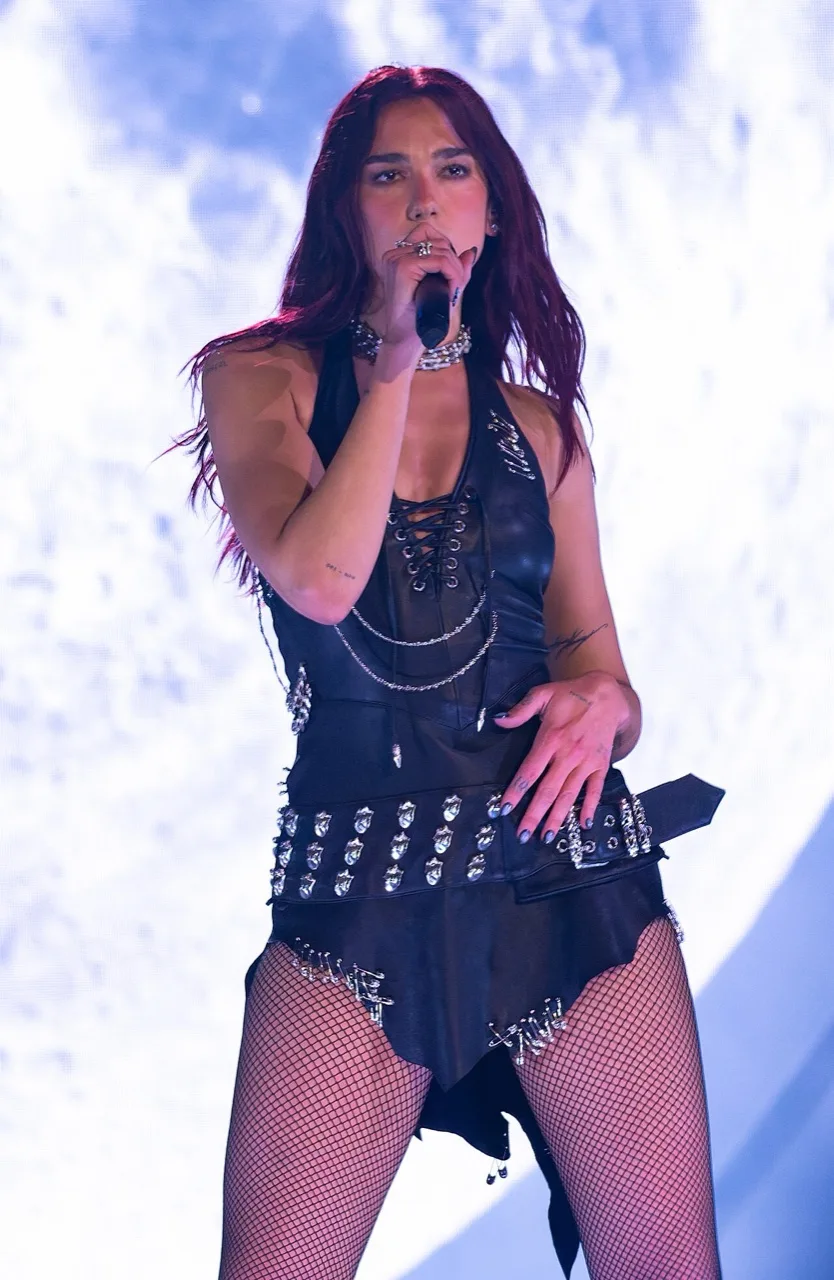
Her public work with Kosovo extends beyond symbolism. The Sunny Hill Foundation and festival connect international music to Pristina, while her interviews make the refugee and return history legible to audiences that might otherwise encounter Kosovo only through geopolitics. She is not representative of an average London life; no celebrity is. She is representative of the community’s ability to hold several places without reducing one to the other.
Rita Ora: from a London school to a global stage
Rita Ora was born in Pristina in 1990 and came to London with her family in 1991 as the political situation in Kosovo deteriorated. She grew up in west London and attended St Cuthbert with St Matthias primary school in Earls Court. Her career began in London’s performing-arts and music worlds before reaching an international audience, but the most revealing marker of that journey remains local: a red plaque at her former school says that she “fled the war in Kosovo and studied here after arriving in the UK in 1991.”
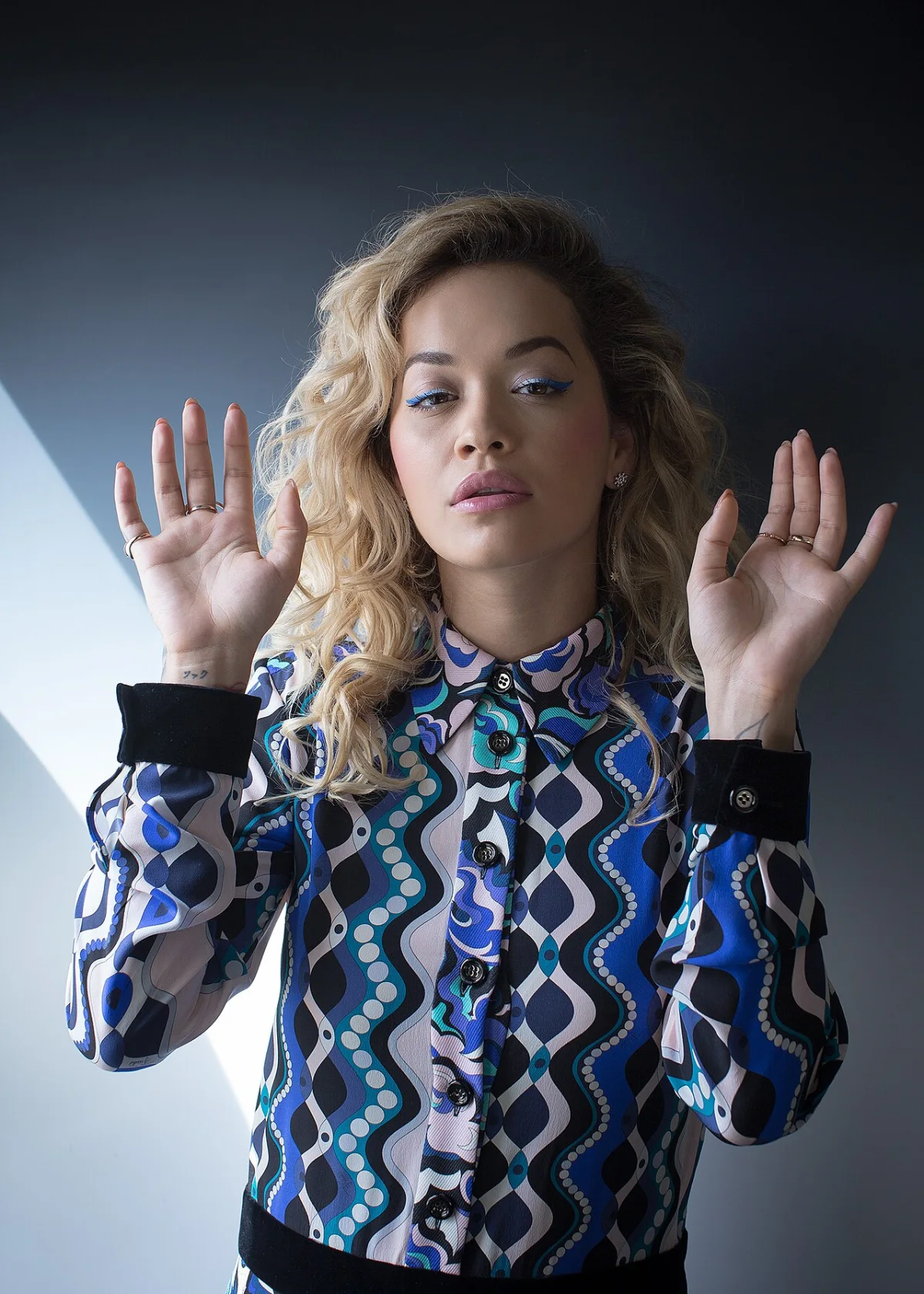
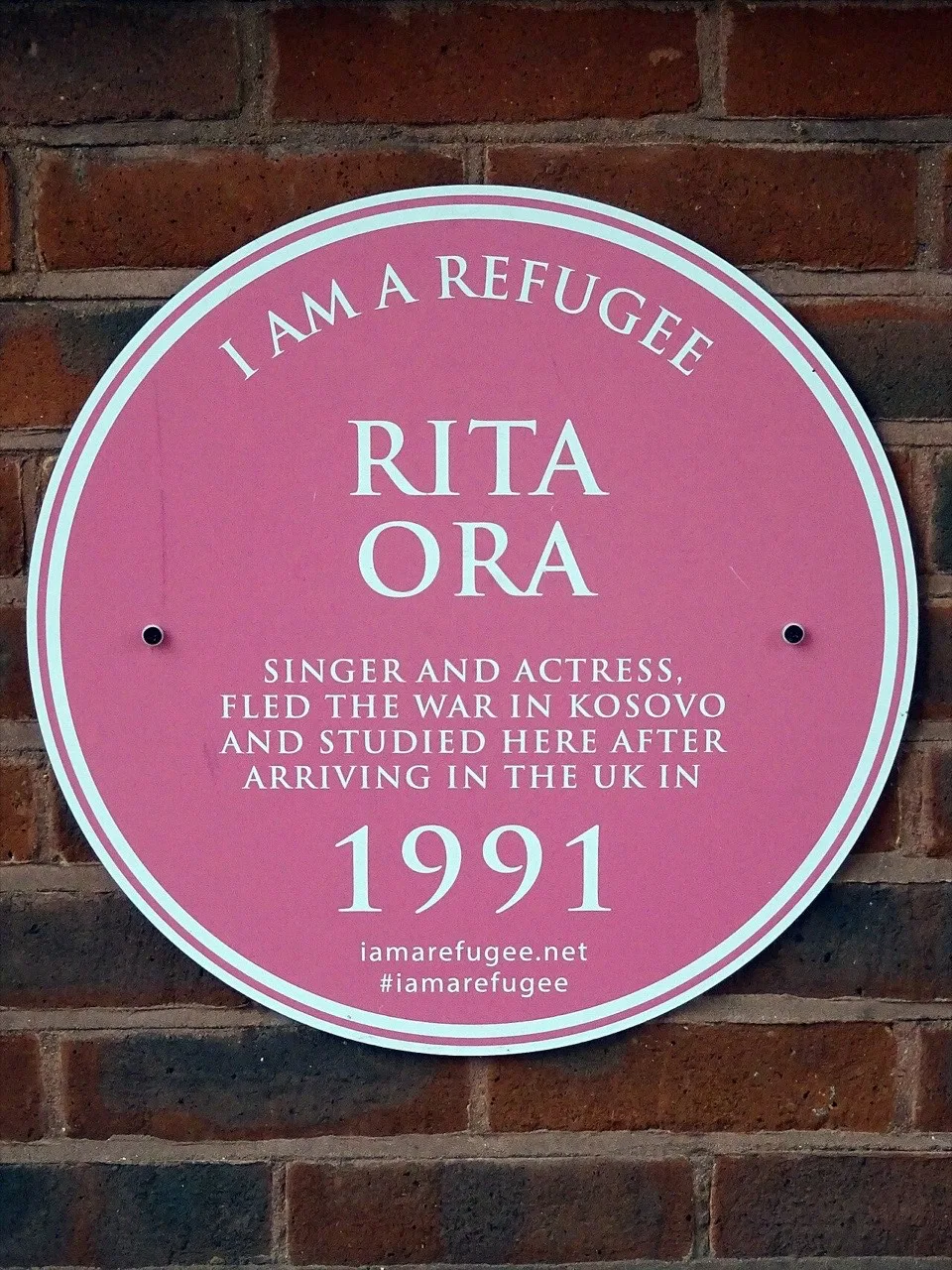
Ora’s family history belongs to the opening of the Kosovar migration rather than its 1999 peak. Placing her portrait beside the school plaque makes the scale of the journey visible: a refugee child educated in Earls Court became one of the most recognisable British artists of Albanian background. The London story is not only that the city produced a celebrity; it is that an ordinary local institution helped a newly arrived family begin again.
Ideas and art
Lea Ypi, born in Tirana and educated in Albania and Italy, is Professor of Political Theory at the London School of Economics. Her memoir Free turned childhood under late communism and Albania’s chaotic transition into an international literary and political argument. She represents a different migration from the refugee and labour stories: academic London as a place where Albanian experience becomes theory.
Artist Alketa Xhafa-Mripa, born in Kosovo and based in London, works across installation, performance and public intervention. Her project Thinking of You filled Pristina’s football stadium with dresses donated in solidarity with survivors of wartime sexual violence. The work moved between a London-based artist’s network and a Kosovo public reckoning; its power came from connecting the two rather than choosing between them.
Actor Orli Shuka, born in Vlorë and based in London, has worked across British television and film. Writers, designers, architects and musicians with Albanian backgrounds now operate in the city without necessarily producing “Albanian work”. That distinction is a sign of normality: heritage can be subject, network or biography without being the only category through which a career is read.
Law, research and public expertise
Dr Andi Hoxhaj, a legal scholar at King’s College London, has become a public expert on corruption, rule of law, migration and UK–Albania relations. His evidence to Parliament is among the sources behind the national estimate of 140,000 Albanians in the UK. The example matters because public debate in 2022 often spoke about Albanians; Albanian-origin lawyers, academics and charity leaders increasingly spoke back with evidence.
The same shift appears locally among solicitors, doctors, teachers and councillors, even where a definitive ethnic list would be inappropriate. The first institutional generation needed interpreters and asylum lawyers. The London-born generation increasingly supplies them. That is the long arc from Konica editing a nation from an Islington room: Albanians are no longer only an object of London knowledge. They are among the people producing it.
The footballers London trained and Albania selected
Albania’s national teams increasingly include players born and trained in England. Armando Broja was born in Slough to parents from Koplik, entered Tottenham’s academy at six and Chelsea’s at eight, and chose Albania despite eligibility for England. Anis Mehmeti, born in London in 2001, developed through English academies before representing Albania. Maldini Kacurri, born in Lewisham in 2005, came through Arsenal and made his senior Albania debut in 2025. Adrion Pajaziti, London-born and developed at Fulham, played for Kosovo’s under-21s before switching to Albania.
The decisions are not simple declarations that one identity has defeated another. International eligibility follows parents and grandparents; academy formation follows the city; a player may feel British, Albanian and Kosovan while regulations require one senior team. London supplies training, Albania or Kosovo supplies a national shirt, and family supplies the reason the choice exists.
Women’s football makes the layers even clearer. Elizabeta Ejupi, born in Kosovo and raised in England, represented England at youth level and Albania as a senior international. Her path across federation categories belongs to a generation whose citizenship, upbringing and family origin point in different directions. The bureaucracy is complicated because the life is complicated.
Libraries, composition and translation
Beyond the best-known names is a durable scholarly network. Composer Thomas Simaku, born in Kavajë, came to Britain for doctoral study in 1991 and became Professor of Composition at the University of York; his British career connects Albanian musical material to contemporary European composition. Sociologist Gëzim Alpion at the University of Birmingham has written extensively on Mother Teresa’s Albanian background. London-based editor Bejtullah Destani has assembled documentary collections on Edith Durham, Tajar Zavalani and Aubrey Herbert that preserve much of the source record used in this article.
British Albanian culture also depends on translators who are not Albanian. John Hodgson has translated Ismail Kadare directly from Albanian, while scholars at London institutions have made Albanian history legible to English readers. Naming that work is not a detour from the diaspora. A small language community becomes intellectually present through collaboration, and London has been one of its main workshops since Konica.
Becoming Londoners: family, identity and the next census
The population story changes when migration becomes family history. A birthplace table works well for a newly arrived adult and badly for that adult’s child. A passport table changes again at naturalisation. A language table narrows as English becomes dominant. None of those changes means Albanian identity has vanished; they mean the official signal has moved.
One community, several ways to connect
Albanian London has never depended on one place or institution. A family may find language through a Saturday school, advice through Shpresa, faith through a mosque or church, professional contacts through a network, and community through football or Flag Day.
Digital connection belongs alongside those networks rather than above them. In a community stretching across boroughs, generations and borders, it gives people another way to find the part of Albanian London they are looking for. dua.com offers one measurable example of that one-to-one connection.
A first-party community signal
What dua.com can measure—and what it cannot
dua.com can see voluntary participation on its own platform, not the size of the Albanian population. The figures below describe self-selecting adults who use a culturally specific service. They are useful evidence of how strongly London is connected within Britain and across borders, but they are not a census and are never added to the population estimate.
| Community signal | Observed value |
|---|---|
| Registered members | 16,301 |
| Matches that continue to chat | 87% |
| Seeking a serious relationship | 65% |
| Want children | 77% |
| Matches with Albania, Kosovo and North Macedonia | 2,994 |
| Peak app-opening hour | 23:00–23:59 |
| Top Fly destinations | Tirana, Pristina, Zurich |
The pattern is both local and transnational: London members are most active late in the evening, while 2,994 matches connect the city with Albania, Kosovo and North Macedonia. Tirana, Pristina and Zurich are the most-used Fly destinations.
The geography may be more revealing than the volume. London members look toward Tirana and Pristina, but also toward Zurich—connecting the British community not only with the Balkans, but with another major centre of the Albanian diaspora. The pattern mirrors Albanian London itself: locally rooted, but socially connected across borders.
Meeting offline
For people looking beyond dating, the most reliable entry points are purpose-specific. Parents find other families through supplementary schools. Faith communities meet through Carlton Vale, West Hampstead, Walthamstow or the Catholic chaplaincy. The Anglo-Albanian Association runs talks and cultural events. Shpresa, Ardhmëria and Nënë Tereza organise programmes across several boroughs. Football fixtures and the two national days create the largest open gatherings.
The best place depends on the connection sought. A new arrival needing advice should begin with a registered charity, not a social-media stranger. A parent looking for language teaching should use the school register. A professional looking for mentors may find UKAP useful. People looking for friendship or a partner can also use dua.com. “The Albanian community” is not one door; London has built several.
A practical directory for Albanians in London
The entries below were checked in August 2026 against official mission pages, charity records and organisation websites. Small organisations move, class locations change and consular appointments require advance booking. Check the linked organisation before travelling.
Embassies and consular services
- Embassy of Albania — 33 St George’s Drive, London SW1V 4DG. Passport, identity-card, civil-status and notarial services are appointment-based; current instructions are on the official consular page.
- Embassy of Kosovo — 8 John Street, London WC1N 2ES. The embassy covers the United Kingdom and is secondarily accredited to Ireland; see its official mission page for consular contact and appointments.
Community, advice and professional networks
- Shpresa Programme — Mansfield House, 30 Avenons Road, Plaistow, London E13 8HT. Advice, advocacy, supplementary schools, women’s and parenting programmes, youth leadership and anti-trafficking legal support. Registered charity 1110688.
- Ardhmëria — Standard House, 107–115 Eastmoor Street, Charlton, London SE7 8LX. Five supplementary schools in Greater London. Registered charity 1118989.
- Nënë Tereza — Community House, 311 Fore Street, Edmonton, London N9 0PZ. Saturday school, advice, advocacy and prison work. Registered charity 1137791.
- British Albanian Kosovar Council — Resource for London, 356 Holloway Road, London N7 6PA. Youth and cultural programmes. Registered charity 1072694.
- Anglo-Albanian Association — talks, screenings, book events and the Gazette; event locations vary. Founded in 1912–13.
- UKAP Foundation — professional mentoring, networking and scholarships; events and applications are announced online. Registered in 2025.
Faith
- UK Albanian Muslim Community and Cultural Centre (Xhamia e Shqiptarëve) — 88–90 Carlton Vale, London NW6 5DA. Daily prayers, classes, marriages, funerals and Albanian-language materials. Registered charity 1057193.
- British Albanian Muslim Community — 41A Mill Lane, West Hampstead, London NW6 1NB. Registered charity 1159724.
- Albanian Muslim Community London — Blackhorse Lane, Walthamstow, London E17 6SH. Friday prayers and teaching in Albanian. Registered charity 1212790.
- Albanian and Kosovan Catholic chaplaincy — St Charles Borromeo, 8 Ogle Street, London W1W 6HS. Confirm current Albanian-language Mass and pastoral arrangements with the parish.
Language, study and culture
- Shkolla Shqipe “Kosova” — Haverstock School, Chalk Farm, London NW3. Founded 3 October 1993; Britain’s oldest continuously operating Albanian supplementary school.
- Qendra e Botimeve për Diasporën school register — the Albanian government’s list of supplementary-school locations across London and Britain. Verify term dates with each school.
- UCL School of Slavonic and East European Studies — Bloomsbury. Albanian evening-language provision has included heritage-speaker teaching; check the current course list. The SSEES Library holds the Mann Collection.
- Centre for Albanian Studies — west London publisher and scholarly resource; events and availability vary.
- Skanderbeg bust — Inverness Terrace / Porchester Gardens area, Bayswater, London W2. The capital’s most visible permanent Albanian monument.
Related dua.com guides
- Albanians in the UK — the national population model, asylum record, work, citizenship and communities beyond London.
- Albanians in America — the Boston beginning, Diversity Visa migration and the evidence behind a 400,000-plus community.
- Albanians in Germany, Italy, Greece and Austria — comparable evidence-led diaspora guides.
The population ledger: from 56,460 counted to about 80,000
A population claim should reveal its arithmetic and its uncertainty. This page carries one count, one range and one centre:
- 56,460 is counted. It is the 2021 Census total for London residents born in Albania (34,773) or Kosovo (21,687).
- 75,000–100,000 is a reasoned range. It describes the wider Albanian community within the 33 London local authorities.
- About 80,000 is the editorial centre. It is deliberately near the lower end because the auxiliary datasets overlap and London’s share of the second generation is uncertain.
Swipe horizontally to explore the full chart.
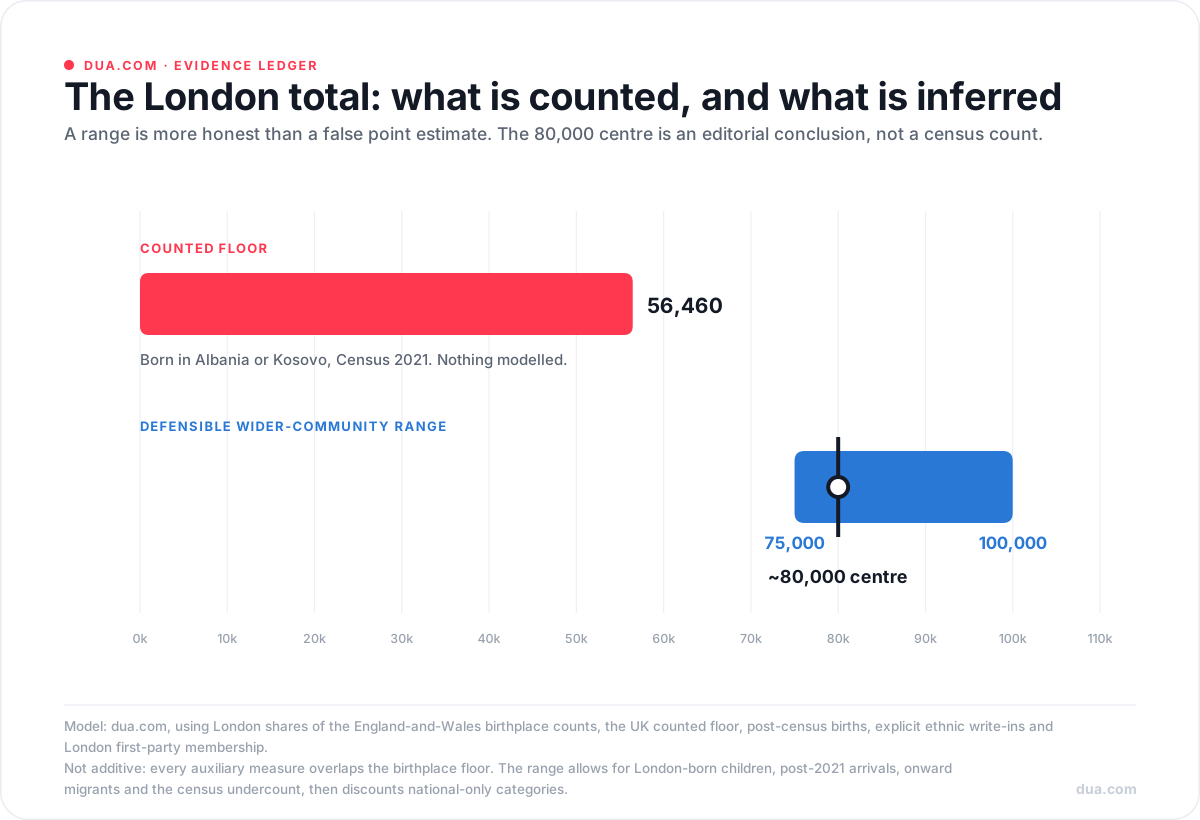
Bottom line: 56,460 is too low for the community because it excludes every London-born descendant. Adding the other published totals would be much too high because they overlap. A range of 75,000–100,000, centred near 80,000, is the answer best supported by the evidence currently available.
Frequently asked questions
How many Albanians live in London?
The 2021 Census counted 34,773 London residents born in Albania and 21,687 born in Kosovo, or 56,460 together. That is a hard floor, not the full ethnic community, because it excludes everyone born in London and Albanians born in North Macedonia, Montenegro, Serbia, Greece, Italy and elsewhere. The best-supported wider range is roughly 75,000–100,000, with about 80,000 the most defensible centre.
Where do most Albanians live in London?
In a north-London arc centred on Enfield, Barnet and Haringey, which together held 15,839 residents born in Albania or Kosovo in 2021. Southgate, Palmers Green, Bowes Park, Wood Green, the Harringay Ladder, New Barnet and Bush Hill Park are important parts of that network. Kosovo-born London is more inner-city, especially in Camden and Westminster.
Which London borough has the largest Albanian population?
Enfield. It had 4,921 Albania-born and 1,465 Kosovo-born residents at the 2021 Census, 6,386 combined, plus 3,508 residents who named Albanian as their main language. That is roughly one person in fifty-two of the borough population born in the two countries.
Is Green Lanes an Albanian neighbourhood?
It is better described as a long-established Turkish and Greek-Cypriot commercial street with Kurdish, Bulgarian, Albanian and other layers. Albanian cafés, barbers, groceries and services are visible from Harringay towards Wood Green and Palmers Green, but London has no single bounded “Little Albania”. The strongest census concentrations are distributed across neighbourhoods in Enfield, Barnet and Haringey.
Why are Albania-born and Kosovo-born Londoners in different boroughs?
They largely arrived in different periods and through different systems. The Kosovo-born cohort came mostly through 1990s asylum and refugee networks and is more visible in inner-city and estate geographies such as Camden and Westminster. The Albania-born cohort grew mainly in the 2010s through work, family and onward EU mobility and is concentrated more strongly in outer north London. The mechanism is an interpretation supported by the map; no dataset follows individual housing journeys.
How many people speak Albanian in London?
30,215 London residents aged three and over said Albanian was their main language in the 2021 Census. The figure is not a total of everyone who can speak Albanian: bilingual residents who selected English, and children under three, are not included. Enfield led with 3,508 main-language speakers.
Are there Albanian schools in London?
Yes, as Saturday supplementary schools rather than mainstream state-school subjects. Shkolla Shqipe “Kosova” has operated since 3 October 1993 and now teaches at Haverstock School near Chalk Farm. Shpresa, Ardhmëria, Nënë Tereza, Arbëria, Gjurmë Iliriane and other organisations run classes across London. Albanian is not currently available as a GCSE or A-level.
What religion are Albanians in London?
There is no single answer. London Albanians include Muslims, Catholics, Orthodox Christians, Bektashis, mixed families and people with no religion. The largest dedicated institution is the Albanian mosque and cultural centre on Carlton Vale. A Catholic chaplaincy operates from St Charles Borromeo on Ogle Street; no dedicated Albanian Orthodox parish or Bektashi tekke has been identified in Britain.
When did Albanians first settle in London?
Individual intellectuals and exiles were present much earlier: Faik Konica edited his journal Albania from Islington in 1903–04, and King Zog’s court lived at the Ritz in 1940. A mass community formed only through Kosovar migration in the 1990s, followed by much larger migration from Albania during the 2010s.
What is the largest Albanian community organisation in London?
Shpresa Programme is the largest Albanian-speaking community charity by income and reach. Based at Mansfield House in Plaistow, it provides advice, advocacy, supplementary schools, women’s and parenting programmes, youth leadership and anti-trafficking legal support across several east and north London boroughs.
Where are the Albanian and Kosovo embassies in London?
The Embassy of Albania is at 33 St George’s Drive, London SW1V 4DG. The Embassy of Kosovo is at 8 John Street, London WC1N 2ES. Both publish appointment and consular instructions online; check the official mission site before visiting.
Which Albanian public events take place in London?
Albanian Flag Day on 28 November produces the largest public gatherings, often around Trafalgar Square as well as schools, libraries and town halls. Kosovo Independence Day on 17 February is marked through embassy, council and community events. Football fixtures, Anglo-Albanian Association talks, school performances and charity programmes run throughout the year.
Which famous Albanians are connected to London?
Dua Lipa was born in London to Kosovar Albanian parents; Rita Ora arrived from Pristina as a child in 1991 and grew up in west London. Political theorist and author Lea Ypi works at the London School of Economics, artist Alketa Xhafa-Mripa is London-based, and footballer Armando Broja developed through Chelsea’s academy before representing Albania.
How can I meet other Albanians in London?
Use the network that fits the purpose: supplementary schools for families, Shpresa and other charities for advice or volunteering, faith centres for worship, the Anglo-Albanian Association for cultural events, professional groups for mentoring, and Flag Day or football for open gatherings. For dating and one-to-one connection, dua.com has 16,301 London members as of August 2026.